P.G. Ruskin Company LLC Furniture
to
3
437
379
57
1
75
31
28
25
25
18
16
14
14
11
11
9
6
5
4
4
2
1
10
102
267
58
36
100
129
7
2
8
13
16
39
19
24
43
32
269
187
137
93
82
180
172
168
65
59
437
437
437
4
3
2
2
2
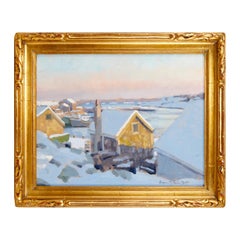
2003 Plein Air Oil on Masonite "Snow at Pigeon Cove" - Eugene J. Quinn Jr.
Located in Morristown, NJ
Eugene J. Quinn Jr. (American, 20th/21st c.). A plein air oil on Masonite titled, "Snow at Pigeon Cove". Signed and dated "Eugene J. Quinn, Jr., '03" at lower right. Painted at Pigeon Cove in Rockport...
Category
21st Century and Contemporary American Classical Paintings
Materials
Masonite, Paint

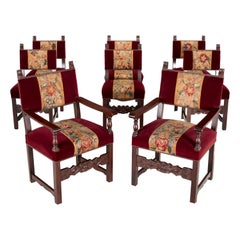
Italian Baroque Style Schmieg-Hungate
Kotzian LLC., Dining Chairs, Set of 8
By Schmieg
Kotzian
Located in Morristown, NJ
Early 20th c., a set of 8 one of a kind dining chairs by expert NYC cabinet makers Schmieg, Hungate and Kotzian in the Italian Baroque style...
Category
Vintage 1920s American Baroque Dining Room Chairs
Materials
Brass
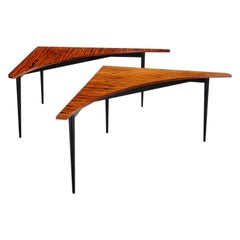
Mid Century Modern Rare Harvey Probber Curved Macassar Corner Tables - A Pair
By Harvey Probber
Located in Morristown, NJ
c. 1960s, USA, a rare pair of Harvey Probber corner tables with Macassar ebony veneer tops and dark stained tapering round wood legs. The triangular tables have a curved longside edge. The tables are unmarked and likely a custom order.
Harvey Probber (1922-2003) was born in Brooklyn, New York, and designed his first sofa at age 16, selling it for $10. By the time he finished high school, he was selling sketches of furniture to companies in Manhattan. Probber was an autodidact, having very little formal training at a time when most designers had formal architectural or art degrees.
He did, however, take a few night classes at Pratt Institute and had on- the-job training in furniture production while working for Trade Upholstery. After serving in the Coast Guard during the 1940s, Probber worked briefly as a cabaret singer, but by 1945 he had opened Harvey Probber, Inc. Realizing that post-war families wanted more flexibility in their homes and their lifestyles, he was the frst to introduce modular seating. His pieces had understated modern...
Category
Vintage 1960s American Mid-Century Modern Coffee and Cocktail Tables
Materials
Steel
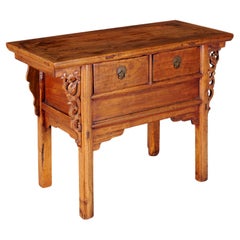
19th C. Chinese Two Drawer Altar Coffer with Floral Brass Door Pulls
Located in Morristown, NJ
Qing Dynasty (19th c), an elm wood, two drawer, altar coffer with brass flower-shaped ring pulls. The rectangular top sits over two frieze drawers above a plank panel and shaped apron, flanked by pierced openwork scrolling cloud molding, the whole raised on square to round...
Category
Antique 19th Century Chinese Qing Furniture
Materials
Brass
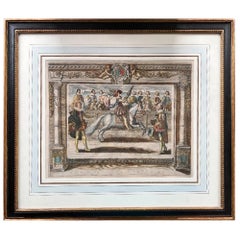
C. 1625 After Antoine de Pluvinel, "Henry IV, Mounted", Hand Colored Engraving
Located in Morristown, NJ
Early 17th century, French hand colored equestrian engraving. After Antoine de Pluvinel (French, 1552-1620), "Henry IV, Mounted", figure 42 from "L'Instruction du Roy en l'Exercice de Monter a Cheval", c. 1625, matted and framed under UF-3 plexiglass (blocks approx. 97% of UV) , gallery label verso. Figures from this publication have sold at Christie's. Those were not hand colored.
A highly detailed engraving with the French King Henry 1V the central figure. Mounted on horseback, Le Roy (the King) is watched by no less than 10 courtiers some of whom are mounted on horseback, all of which are named in the engraving.
Antoine de Pluvinel (1552, Crest, Dauphine - 24 August 1620) was the first of the French riding masters, and has had great influence on modern dressage. He wrote L’Instruction du Roy en L'exercice de Monter à Cheval ("instruction of the King in the art of riding"), was tutor to King Louis XIII, and is credited with the invention of using two pillars, as well as using shoulder-in to increase suppleness.
In 1594, Pluvinel founded the "Academie d'Equitation" near what is now Place des Pyramides. There, the French nobility was trained not only in horsemanship, but also in all the accomplishments (dancing, fashionable dressing, etc.) It can be said that Pluvinel's influence on the aristocracy lasted from the late 16th century to the 17th century. Richelieu, the future Prime Minister of King Louis XIII attended the Academie; so did William, Duke of Cavendish.
Pluvinel's book was published posthumously by the Flemish engraver Crispijn van de Passe II and the royal valet de chambre...
Category
Antique Early 17th Century French Baroque Prints
Materials
Plexiglass, Boxwood, Paint, Paper
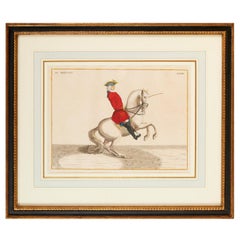
Baron Rais d
Eisenberg, Hand-Colored Equestrian Engraving c. 1747, "Le Brillant"
By Eisenberg
Located in Morristown, NJ
18th century German, a hand-colored engraving of a dressage horse and rider from Description du Manège Moderne by Friedrich Wilhelm, Baron Rais d' Eisenberg (German, ca. 1700-ca. 1770). Engraved by Bernard Picart (French, 1673-1733). Titled "Le Brillant", this dressage engraving is plate XXXIII. There is a gallery label verso. The print is matted and framed under UF-3 plexiglass, which offers the maximum amount of UV protection (approx. 97%).
This print was originally part of an illustrated book Baron d'Eisenberg made describing the art of the cavaliers and depicting the different breeds of horses- The full title of the book is L'Art de Monter a Cheval: ou Description du Manége Moderne, Dans sa Perfection, published in Leipzig: Arkstée et Merkus, 1747). A set of 7 framed engravings from the same book sold at Sotheby's for $9,500 (plus tax and buyers premium).
Reference:
The author, a German horseman and artist, spent some of his youth at the manège of Saxe-Weimar before entering into the service of the Emperor. He then spent six years in Naples as the Master of Horse of the Viceroy before returning to Vienna where he studied under M. de Regenthal, the imperial Master of Horse. He participated in the coronation of the Emperor Charles V at Frankfurt in 1711, then spent some time in England, but was back in Germany before 1753. He probably died in Tuscany where he was Director and Master of the Horse at the Academy in Pisa. Brunet II, 957; Mennessier de la Lance I, p. 438.
The Baron wrote several important and lavishly illustrated books on horses: his Description du manège moderne dans sa perfection, London 1727, and Dictionnaire des termes du manège moderne, 1747, being the best well-known.
He dedicated Description du Manège Moderne to King George II and to his son, His Royal Highness the Prince of Wales. Subscribers to the book included royalty and nobility from all over Europe.
The engraver was Bernard Picart, born in Paris in 1673. He gained honors at the Academy of Paris at the age of sixteen. He was a master designer and engraver and worked in Paris and Amsterdam until his death in 1733.
Dimensions:
9"h x 12"w (sight), 16.5"h x 19.25"w (frame)
Condition:
Good, some rippling to sheet, not examined out of frame.
Provenance:
Lombard Antiquarian Maps & Prints, Cape Elizabeth...
Category
Antique 1740s German Rococo Drawings
Materials
Plexiglass, Wood, Paint, Paper
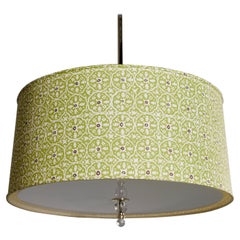
Large Contemporary Designer Drum Shade 3-Light Chandelier In Floral Fabric
Located in Morristown, NJ
21st c., Large contemporary designer 3-light drum shade in a floral print fabric with polished nickel downrod. No visible signature. The fabric is in an abstract green floral patter...
Category
21st Century and Contemporary American Modern Chandeliers and Pendants
Materials
Metal
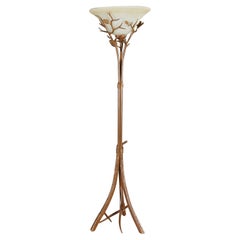
Contemporary Faux Bois Torchiere Floor Lamp with Fir Pine Cones and Needles
Located in Morristown, NJ
Late 20th c., an attractive torchiere style floor lamp with patinated metal branch and leaf design with glass dome shade, unmarked. The glass shade is held up by depictions of fir pi...
Category
Late 20th Century Unknown Adirondack Floor Lamps
Materials
Metal
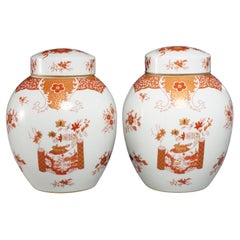
Mid 20th C. Kutani Style French Porcelain Lidded Ginger Jars - A Pair
By Porcelaine de Paris
Located in Morristown, NJ
20th c., a pair of Japanese Kutani style porcelain lidded jars, stamped on Porcelaine de Paris underside of foot. The mark indicates the piece was produced in the 1970's. The jars are decorated in deep orange, tangerine and gold motifs on a white background. On one side, both jars have matching decoration depicting a scroll showing a pastoral scene. On the other side, each jar has a seperate floral depiction; one including bamboo. Both are highly decorative.
Founded 1773 by Jean-Baptiste Locre, Porcelaine de Paris, was one of the first manufactures to use the Chinese secret of porcelain. It immediately aimed for the luxury trade, selling to the Royal Courts of Europe.
After surviving the French Revolution, Porcelaine de Paris steadily produced tableware as well as purely decorative pieces, receiving orders from all over Europe. Productivity was astonishing, creating one new model every day over 30 years!
Around 1830, Jean-Marx Clauss, a German-born potter bought a building at Rue de la Pierre-Levee, where he took over Locre's activity. M. Achille Bloch...
Category
Vintage 1970s French Japonisme Jars
Materials
Gold
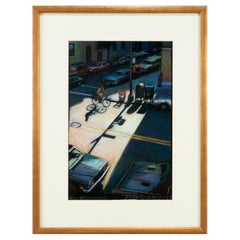
1999 Framed Pastel of New York Street Scene, Tim Folzenlogen
Located in Morristown, NJ
Tim Folzenlogen (American, b. 1952), "New Beginning", pastel drawing of New York streetscape, signed Tim Folzenlogen and dated '99 at lower right.
A g...
Category
1990s Modern Drawings
Materials
Wood, Paper
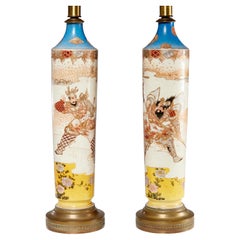
Late 19th C., Pair of Japanese Satsuma Vase Table Lamps with Warrior Figures
Located in Morristown, NJ
Late 19th pair of Japanese Satsuma vase table lamps, decorated with Japanese warriors., with floral and gold accents. Possibly Meiji period. This pair of columnar lamps, with a brass base, socket and harp, has an overall attractive appearance. Decorated on a white background with gold, blue, yellow and...
Category
Antique Late 19th Century Japanese Meiji Table Lamps
Materials
Porcelain, Paint
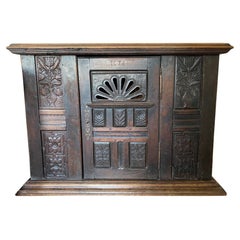
Large and Extensively Carved Late 19th C., French Gothic Revival Cabinet
Located in Morristown, NJ
Late 19th C., French Gothic Revival cabinet, with interior shelf and central door. Heavily adorned with carved panels to front and sides. The front is comprised of panels flanking a central door. To each side of the door are two beautifully carved panels. The door has brass hinges and escutcheon. It locks with the key retained. The carving is mirrored on both sides of the piece, each comprising five carved panels. The red undertones suggest that this is a chestnut rather than an oak piece.
The overall structure owes much to the Gothic Revival movement of 19th century France, with a nod to Renaissance Revival. The door panel is dominated by a lovely example of Gothic tracery in the form of a half moon “window...
Category
Antique 1880s French Gothic Revival Cabinets
Materials
Brass
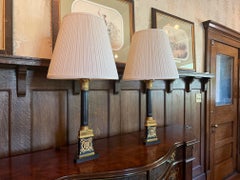
Louis XVI Style Gilt and Patinated Bronze Lamps by Gherardo Degli Albizzi, Pair
Located in Morristown, NJ
Late 20th c., pair of Italian Louis XVI style gold plated, patinated bronze and gilt bronze column table lamps by Gherardo Degli Albizzi. Of beautiful quality, two light, fluted, col...
Category
Late 20th Century Italian Louis XVI Table Lamps
Materials
Metal, Bronze, Ormolu, Gold Plate
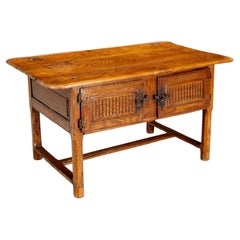
18th C. Continental Baroque Carved Oak Table with Storage and Iron Hardware
Located in Morristown, NJ
18th c., possibly Spanish, solid oak table, wrought iron hardware, the rectangular three board plank top over two hinged panel doors opening to storage, raised on octagonal legs join...
Category
Antique Early 18th Century Spanish Baroque Console Tables
Materials
Wrought Iron
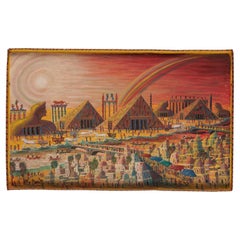
Gabriel Cohen "L
Egypte Ancienne..." Naive Oil Painting on Metal
Located in Morristown, NJ
Gabriel Cohen (1933-2017) French/Israeli, "L'Egypte ancienne..." Naive-style oil painted on sheet metal with a crimped and painted edge forming the frame. The work is a fantastic dep...
Category
Vintage 1980s Folk Art Paintings
Materials
Metal, Sheet Metal
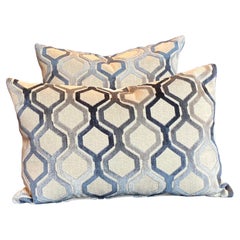
Cut Velvet Geometric Pillow
Located in Morristown, NJ
Geometric cut velvet knife-edge rectangular pillow (zippered case and down insert). Steel gray, navy and cream colorway; navy can read almost black in certa...
Category
21st Century and Contemporary American Modern Pillows and Throws
Materials
Textile, Velvet, Feathers
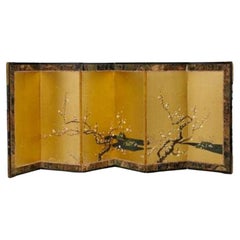
Early 20th Century Japanese 6-Panel Gouache and Gold Leaf Painted Table Screen
Located in Morristown, NJ
20th c., Showa period gouache and gold leaf Japanese screen. Depicting plum tree blossoms on a riverbank across 6 panels. Plum blossoms are often mentioned in Japanese poetry as a symbol of spring...
Category
20th Century Japanese Showa Paintings and Screens
Materials
Gold Leaf