WICK ANTIQUES LTD More Furniture and Collectibles
to
174
172
2
6
6
5
12
125
35
2
22
9
1
6
5
3
4
3
1
1
106
74
36
22
20
162
148
133
8
5
174
174
174
2
2
2
1
1
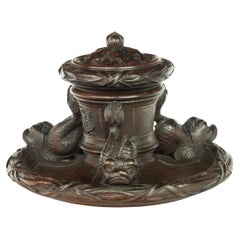
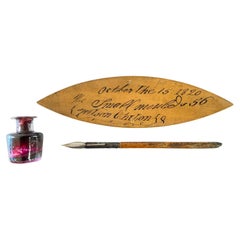
An oak inkwell carved from Lutine timber, dated 1799
Located in Lymington, Hampshire
This large and historically interesting inkwell, or standish, is carved from timber recovered from the wreck of H.M.S. Lutine. It has a central inkwell, with a bud and oakleaf cover...
Category
Antique 1860s English Nautical Objects
Materials
Oak
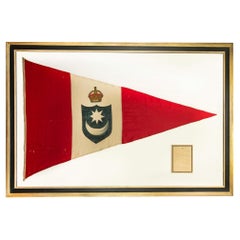
Royal Sailing Yacht Britannia’s 76 inches burgee of the Royal Corinthian Yacht C
Located in Lymington, Hampshire
This large triangular racing burgee is made from pieced wool bunting with machine stitching with three vertical red, white and red stripes. The white stripe showing a blue shield with a white star and crescent moon motif below a royal crown. The leading edge is inscribed in black ink ‘R. Portsmouth Corin n/t’. It is accompanied by a copy of a black edged letter on Buckingham Palace writing paper dated 10th July 1936 saying ‘Dear Sir, I am commanded by the King and Queen Mary to send you these flags which were flown on board “Britannia” at various times during her career, including one of her racing flags. Their Majesties hope you will like to keep these in your club house as souvenirs of the old yacht. Yours Derek Keppell, Master of the Household, The Commodore, Royal Portsmouth Corinthian Yacht Club.” It is offered with a Royal Portsmouth Corinthian Yacht Club printed silk racing programme for the Sixth Regatta in Osborne Bay, 1883, with a gold fringe and a button attached with a red seal to a tag stating ‘Seabed Pattern Button Corinthian Yacht Club, jacket and vest, 1880’, in an envelope ‘On H.M. Service’ addressed to ‘General His Serene Highness, Prince Edward of Saxe-Weimar, Commodore of the Corinthian Yacht Club, Government House...
Category
Vintage 1930s English Nautical Objects
Materials
Textile
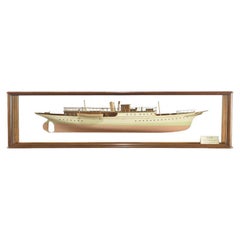
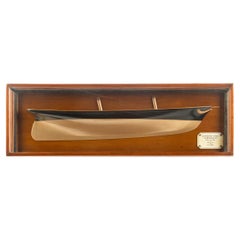
A half hull model of Egyptian Coast Guard Cutter Ab-Bass by G.L.Watson, 1891
Located in Lymington, Hampshire
This fine shipyard half-hull model has a painted pink hull with a pale green waterline and white topsides with a line of portholes. There are two truncated masts, a funnel and a bow...
Category
Antique 1890s Scottish Models and Miniatures
Materials
Metal
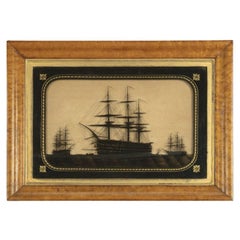
A fine reverse glass silhouette of H.M.S.s Marlborough, Foudroyant and Lee
Located in Lymington, Hampshire
This reverse glass painting shows the silhouettes of three British naval ships of the line within a ropework border, their outlines inside the glass casting shadows on the cream grou...
Category
Antique 1860s English Nautical Objects
Materials
Glass
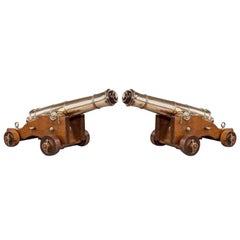
Pair of Antique English Naval Cannon
Located in Lymington, Hampshire
Pair of antique English naval cannon each with a tapering three stage barrel flanked by plain trunnions, with a knob shaped cascabel button before a shaped rectangular raised vent and ending in a 3 1/2” bore muzzle, enclosing a removable conforming wood plug, circa 1800.
Stood upon a naval type bronze-mounted four wheeled wooden carriage, including its wedge shaped quoin with knob handle.
The Earls of Lonsdale, Lowther Castle, Cumbria, presumably by descent to Hugh Cecil Lowther, 5th Earl of Lonsdale (1857-1944), until sold by his heir and brother, Lancelot, 6th Earl, as part of the contents of Lowther Castle, Maple & Co. Ltd./Thomas Wyatt, Tuesday 14 April 1947 and two following days, lot 558: ‘A pair of Old Gun Metal Cannons on teakwood carriages, 3ft. 6in. long’.
Mrs. P.M. Adie-Shepherd, sold Christie’s, London, 29 May 1970, lot 96.
Lowther Castle is a castellated mansion built by Robert Smirke between 1806 and 1814 for William Lowther, 1st Earl of Lonsdale (1757-1844). It was constructed on the foundations of the former 17th century family seat, Lowther Hall, but it was only in the early 19th century that it was afforded the name ‘castle’ in keeping with the Europe-wide fashion for romanticism and which was promoted by influential characters such as William Beckford at Fonthill Abbey, Wiltshire in England and by the writer Sir Walter Scott at Abbotsford, Roxburghshire, Scotland. While it’s not known when these naval cannon were acquired for Lowther they would have been entirely fitting in the castle or its approaches and it’s likely that they were in place soon after the castle was completed, or perhaps acquired later by the 5th Earl. A tantalising possibility is that the cannon were originally aboard the East Indiaman Lowther Castle which was active in the early 19th century.
HUGH CECIL LONSDALE, 5TH EARL OF LONSDALE (1857-1944) AND THE DEMISE OF LOWTHER CASTLE
In 1882 at the age of 25 Hugh Lonsdale (1857-1944) unexpectedly inherited the earldom and with it the extensive Lonsdale estate, including tens of thousands of acres of Cumberland and Westmorland and coalfields at Whitehaven. However, despite his spectacular inherited wealth – he was suddenly one of the wealthiest men in England, over the course of his lifetime he managed to decimate the family fortune. He led a full and colourful life, one of adventure and luxury. An early intrepid escapade took place in July 1888 when, as part of an expedition called the Scotch Naturalist Society, he set embarked on horse sleigh...
Category
Antique Early 1800s English Arms, Armor and Weapons
Materials
Bronze

$181,765 / set
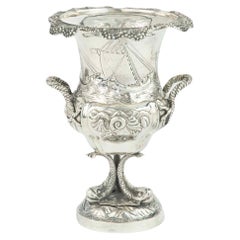
The Luska Bay Regatta Challenge Cup won by Surprise, 1878
Located in Lymington, Hampshire
This ornate repoussé silver trophy is in the form of a handled cup with an everted rim and tripod dolphin base. The high relief decoration comprises three gaff rigged yachts racing,...
Category
Antique 1870s English Sports Equipment and Memorabilia
Materials
Silver
A racing flag from the Royal Sailing Yacht Britannia, circa 1936
Located in Lymington, Hampshire
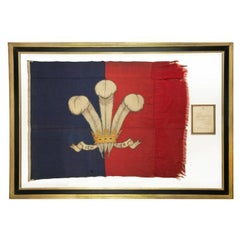
A racing flag from the Royal Sailing Yacht Britannia, circa 1936. This large racing flag was made from pieced wool bunting with machine stitched bunting and a canvas sleeve stamped ‘5’. It is of rectangular form with the Prince of Wales feathers enclosed in a ducal coronet and the motto ‘Ich Dien’ on a halved blue and red ground, later framed and glazed. It is accompanied by a black edged letter on Buckingham Palace writing paper dated 10th July 1936 saying ‘Dear Sir, I am commanded by the King and Queen Mary to send you these flags which were flown on board “Britannia” at various times during her career, including one of her racing flags. Their Majesties hope you will like to keep these in your club house as souvenirs of the old yacht. Yours Derek Keppell, Master of the Household, The Commodore, Royal Portsmouth Corinthian Yacht Club.” King George died on 20 January 1936 which explains the black edge to the letter. English, circa 1936.
Height: 43in (109cm) Width:60in (152.5cm) Framed height: 57½ in (146 cm) Width: 81½ in (207cm)
Provenance: Royal Naval Club & Royal Albert Yacht Club, Portsmouth
R.S.Y. Britannia played an important part in preparing challengers for the America’s Cup. She was used as a trial horse for the Shamrocks and later, after conversion, for most of the ‘J’ Class yachts of the 1930s. Britannia was built in 1893 according to the plans of G. L. Watson for His Royal Highness the Prince of Wales, a keen and able helmsman. From the beginning, Britannia was a successful racing yacht winning races against Kaiser Wilhelm’s Meteors, among many others. Britannia won over two hundred races in her career — a record that has yet to be surpassed. She was beaten once by Navahoe, one of Herreshoff’s boats, but fared better against another America’s Cup yacht, Vigilant, winning twelve races out of seventeen. When Britannia was converted to race in the ‘J’ Class she was stripped of her bulwarks, given a one-piece mast and a Bermudan mainsail. The transition did not interrupt her run of success, although she performed best in hard weather. She was scuttled off the Isle of Wight at the dying request of George V.
A grisaille by Charles Dixon of R S Y Britannia racnig at Cowes. Credit: Wick Antiques
Category
Vintage 1930s English Nautical Objects
Materials
Textile
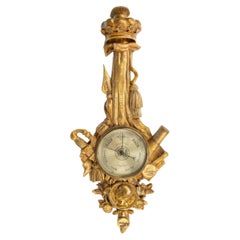
A Wellington commemorative barometer retailed by Wehrle and Steuert
Located in Lymington, Hampshire
This carved giltwood barometer is in the form of a military trophy of arms surmounted by a ducal coronet. It comprises a sword hilt, cannon barrels and standards surrounding a portr...
Category
Antique 1850s English Scientific Instruments
Materials
Giltwood
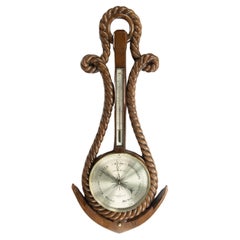
A Victorian anchor and rope barometer by Gray and Keen, Liverpool
Located in Lymington, Hampshire
A Victorian anchor and rope barometer by Gray and Keen, Liverpool. The 10 ¾-inch silvered dial of this walnut barometer is set within the arms of an anchor and a coil of double twisted rope which passes over a ring handle. The dial is inscribed in Spanish and the scale in both Fahrenheit and ‘Beaumur’. It is The trunk inset with a thermometer. Inscribed Gray & Keen, Liverpool on the dial. English and Italian, circa 1860.
Height: 37in (94cm) Width: 17in (43cm)
Gray and Keen from Liverpool exhibited in the Designers and Manufacturers Hall of the Great Exhibition of 1851. The official catalogue entry reads ‘Wheel barometer, designed for use in naval establishments’ and ‘Gothic wheel barometer’s. For a similar rope twist barometer...
Category
Antique 1860s European Victorian Scientific Instruments
Materials
Walnut
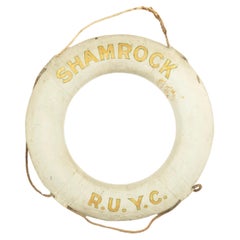
An original life ring from the America’s Cup yacht ‘Shamrock’, Royal Ulster Yach
Located in Lymington, Hampshire
An original life ring from the America’s Cup yacht ‘Shamrock’, Royal Ulster Yacht Club, the circular ring painted in gilt outlined in green ‘Shamrock V, R.U.Y.C.’, on a white ground,...
Category
Antique 19th Century English Nautical Objects
Materials
Canvas
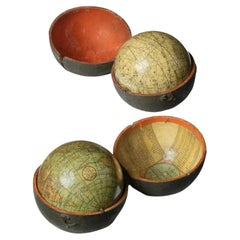
Pair of George III 3 inch pocket globes by J
W Cary, one dated 1791
Located in Lymington, Hampshire
The terrestrial globe is applied with 12 engraved and hand-coloured gores and signed in a circular cartouche ‘Cary’s Pocket Globe, Agreeable to the Latest Discoveries. Pubd. by J. & ...
Category
Antique 1790s English Globes
Materials
Shagreen
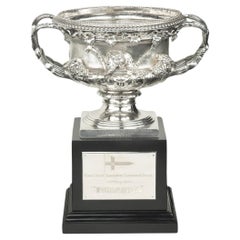
The Royal Squadron Schooner Prize won by Miranda, 1877
Located in Lymington, Hampshire
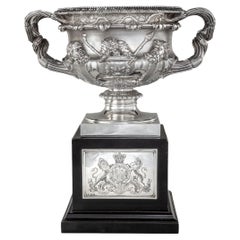
The Royal Squadron Schooner Prize won by Miranda, 1877. This impressive trophy is a small replica of the classical Roman ‘Warwick Vase’. The body is cast and chased with fruiting vi...
Category
Antique 1880s English Sports Equipment and Memorabilia
Materials
Silver
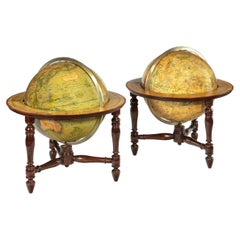
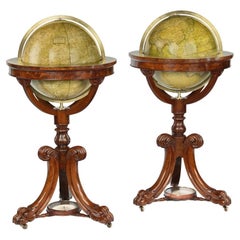
A pair of Newton and Son ‘New
Improved’ 15 inch globes
Located in Lymington, Hampshire
Each of these globes is set into a walnut stand with burr walnut veneers to the frieze and a solid turned and gadrooned walnut bluster support. This is raised on three acanthus carv...
Category
Antique 1860s English Globes
Materials
Walnut
$91,915 / item
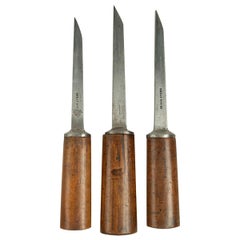
Three mortice chisels, all with sturdy ash handles by Sorby
Co
Located in Lymington, Hampshire
Three mortice chisels, all with sturdy ash handles by Sorby & Co with steel blades, two stamped T. Turton & Sons, another by Sorby & Co, one also stamped Sheaf Works and all bearing the initial W.D for the War Department, dated 1862. English.
Footnote: These three chisels represent three of the most famous firms from the great age of steel manufacturing in Sheffield. Sorby & Co was founded in 1828 and remains a world leading manufacturer and exporter of specialist woodworking tools and equipment. William...
Category
Antique 1860s English Historical Memorabilia
Materials
Ash
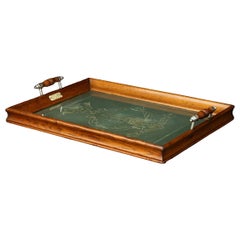
An oak tray from H.M.S. Cambridge
Located in Lymington, Hampshire
An oak tray from H.M.S. Cambridge, of rectangular form, the carrying handles with turned silver plated ends, decorated in cream on a green ground with a ribbon cartouche enclosing a ...
Category
Antique Early 1900s European Nautical Objects
Materials
Oak
An impressive sissoo wood Anglo-Indian four poster bed
Located in Lymington, Hampshire
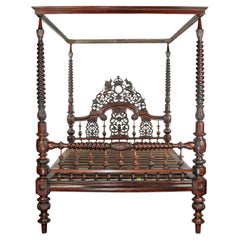
An impressive sissoo wood Anglo-Indian four poster bed, of rectangular form with a central openwork cresting, and splat, showing a naïve carving...
Category
Antique 1840s English Beds and Bed Frames
Materials
Wood
Naïve Coconut Shell “Bugbear” Powder Flask Carved as a Fish
Located in Lymington, Hampshire
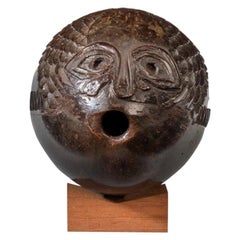
A naïve coconut shell “bugbear” powder flask carved as a fish with an open mouth surrounded by scales above a man hunting with a rifle and dogs, the underside plain, circa 1805.
“Bugbear” coconut...
Category
Antique Early 1800s Decorative Baskets
Materials
Coconut
A William IV mahogany book carrier
Located in Lymington, Hampshire
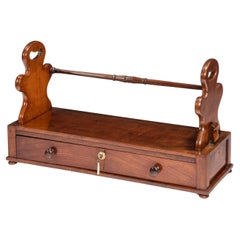
A William IV mahogany book carrier the shaped ends with openwork handles, the frieze with a single drawer.
Category
Antique 1830s English Magazine Racks and Stands
Materials
Mahogany
Presentation silver to the Master Shipwright of Captain Cook’s Endeavour
Located in Lymington, Hampshire
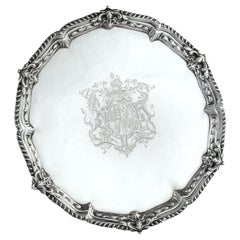
A George III shaped circular silver salver, plain within a shell and scrolling wave border and outer gadrooned edge, engraved with the royal coat of arms, crest and motto (period 1714-1800) of King George III and, on the reverse with a presentation inscription: For the Launching of His Majestys sloop ‘Otter’ 14 Gunns 305 Tonns 26 October 1767 & His Majestys ship ‘Egmont’ 74 Gunns 1643 Tonns 29 August 1768 by Mr Adam Hayes Master Shipwright of his Majestys yard at Deptford; further monogrammed A*H P A*M. Hallmarked for Benjamin Cartwright, London, 1769
Adam Hayes (1710-1785) began his career as ship’s carpenter in Centurion during Commodore Anson’s famous voyage around the world...
Category
Antique 1760s English George III Nautical Objects
Materials
Silver
A black oak snuff box made from timber recovered from H.M.S. Boyne, sunk 1795, r
Located in Lymington, Hampshire
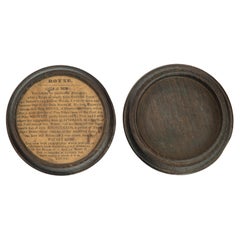
A black oak snuff box made from timber recovered from H.M.S. Boyne, sunk 1795, raised 1833, of circular form with turned lid and base, the lid with printed description of Boyne’s car...
Category
Antique 1830s English Nautical Objects
Materials
Oak
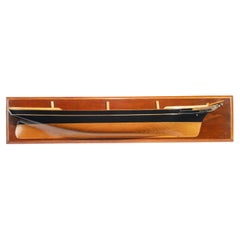
Victorian Half Hull Model of the Three Masted Sailing Ship ‘Elizabeth’
Located in Lymington, Hampshire
A Victorian half hull model of the three masted sailing ship ‘Elizabeth’, shown facing right, the shaped soft wood hull with black painted top sides and applied shear line and gunwal...
Category
Antique Late 19th Century English Nautical Objects
Materials
Wood
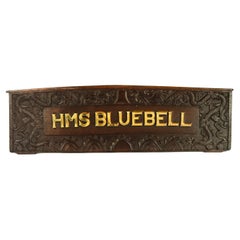
Carved and Shaped Teak Seat Back from the Launch of Minesweeper H M S Bluebell
Located in Lymington, Hampshire
A carved and shaped teak seat back from the launch of minesweeper H M S Bluebell, of shaped rectangular form with a central panel with 3in brass lettering HMS Bluebell, with braced b...
Category
Vintage 1910s English Nautical Objects
Materials
Teak
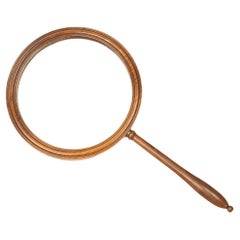
Very Large George III Rosewood Gallery Magnifying Glass
Located in Lymington, Hampshire
A very large George III rosewood gallery magnifying glass, the circular glass within a rosewood frame, the baluster handle screwing into a brass bra...
Category
Antique Early 19th Century English George III Scientific Instruments
Materials
Brass
Presentation Model of America’s Cup Winner America by G. L. Watson
Located in Lymington, Hampshire
This cased presentation half hull model is of the first winner of the America’s Cup, the schooner America. The copper coloured bottom is painted with black topsides and has a finely carved garland around the bow. There are two stump masts, a caprail and bowsprit. It is set on a mahogany backboard with a Bakelite name plaque engraved ‘Schooner Yacht ‘America’ Scale ¼ = 1 foot to W.G.J. from G.L.W’. A label identifies the case maker as ‘Lambert Picture Frame Manufacturer, 34 Albert Gate, Hyde Park, S.W.’ and another describes the model, including the fact that the case was added in 1903. It then explains the initials W.G.J. and G.L.W. ‘This model was presented by G.L.Watson to W.G.Jameson. George L.Watson was one of England’s leading yacht designers. He designed four America’s Cup Challengers which included: Thistle, Valkyrie, Valkyrie II and Shamrock II. He also designed the King’s Britannia, and the Kaiser’s Meteor. William G.Jameson was probably the most successful amateur helmsman in the U K in the 1880’s and the 1890’s. Jameson introduced Lord Dunraven to yacht racing in 1887. Dunraven was to build three challengers for the America’s Cup, all designed by G.L.Watson. Jameson in 1892 acted as an adviser to the Prince of Wales and introduced him to Watson who designed his Britannia. Jameson also advised Thomas Lipton in his Shamrock II challenge. Clearly, Watson and Jameson worked closely throughout their careers. Scottish, 1887.
Provenance: 1887 George L. Watson presented this half hull to William G. Jamieson
1903 Unknown owner(s) thence The Glen Foster Collection
1999 Hyland Granby Antiques, Hyannis Port, Massachusetts
2002 The Kelton Collection of Maritime Art & Artifacts
Probably the most famous racing yacht ever built, and the first winner of the America’s Cup, this schooner, designed by James and George Steers, was built by a syndicate of New York Yacht Club members to sail to England. The purpose of this visit was twofold: to show off U.S. shipbuilding skills and make money through competing in regattas. Only launched on 3rd May 1851, she had crossed the Atlantic and won the 53-mile race around the Isle of Wight by 22nd August that same year. America was captained by Richard Brown, who was a skilled member of the Sandy Hook Pilots group, renowned worldwide for their expertise and speed in manoeuvering schooner-rigged pilot boats...
Category
Antique 1880s Scottish Nautical Objects
Materials
Mahogany
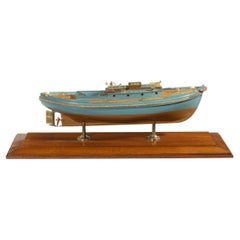
Detailed Owner’s Model or Shipyard Model of a Double Ended Harbour Launch
Located in Lymington, Hampshire
A detailed owner’s model or shipyard model of a double ended harbour launch, painted pale blue, the coach house with eight portholes, fitted with port and starboard lights...
Category
Vintage 1940s English Models and Miniatures
Materials
Wood
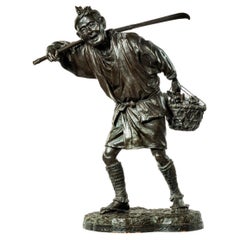
A fine Meiji period bronze of a fruit picker by UDAGAWA
Located in Lymington, Hampshire
His bronze work is a collection in the Japanese Art Department of Ashmolean Museum, Oxford. This work, a farmer’s wife feeding a baby at lunch on a bench (bronze), is also reproduced in Professor HARADA Jiro’s article Studio: Japanese Art and Artists of Today V Metal work (page 102)
His original name was UDAGAWA Sutejiro 宇田川捨次郎, which he used on his work until Meiji 39. He exhibited at the Third (Meiji 23, 1890) and Fifth (Meiji 36, 1903) at the Inland Industrial Exhibition (Naikoku kangyo hakurankai) --- in both cases using his earlier name Udagawa Sutejiro. In Meiji 39 he adopted his new art name Udagawa Kazuo. He exhibited at major exhibitions abroad: P-142 (Paris Great Expo in 1900, section 1), Q-43, 88 (Paris Great Expo in 1900, section 2), R-531 (Paris Great Expo in 1900, award winning section), S-123 (St Louise...
Category
Antique Late 19th Century Japanese More Furniture and Collectibles
Materials
Bronze
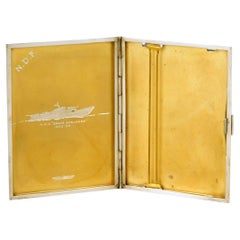
Silver Cheroot Case from Mtb ‘Brave Borderer, ’
Located in Lymington, Hampshire
A silver cheroot case from MTB ‘Brave Borderer,’ of rectangular form, the exterior textured, the interior gilt and incised with an image of the boat above the legend ‘H.M.S. “Brave Borderer” 1858-59’ and the initials ‘N.D.F’. Fully assayed.
The Brave-class fast patrol torpedo boats...
Category
Antique 1850s English Nautical Objects
Materials
Silver
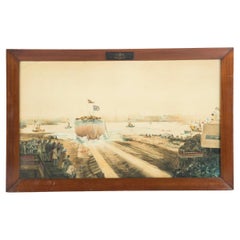
George Edward Horton: the Launch of H.M.S. ‘Victoria’ from the Elswick Shipyard
Located in Lymington, Hampshire
George Edward Horton: The Launch of H.M.S. ‘Victoria’ from the Elswick shipyard of Sir W. G. Armstrong Whitworth and Co. Ltd, Newcastle-upon-Tyne in 1887, watercolour and pencil heig...
Category
Antique 1880s European Paintings
Materials
Paint
Duke of Edinburgh’s World tour 1959 on HM Yacht Britannia
Located in Lymington, Hampshire
Duke of Edinburgh’s World tour 1959 on HM Yacht Britannia, a fascinating photographic record of the Duke’s visit to numerous destinations between Rango...
Category
Vintage 1950s British Historical Memorabilia
Materials
Paper
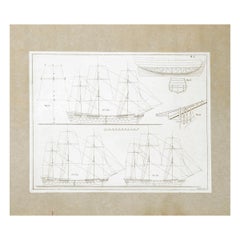
Frederick Chapman: ‘Naval Architecture War Vessels’, circa 1770
Located in Lymington, Hampshire
FREDERICK CHAPMAN: ‘Naval Architecture War Vessels’, circa 1770, , 50 engraved plates of various sizes depicting naval diagrams (numbered I-XXVI), four signed ‘F. Ringheim’and one ea...
Category
Antique 18th Century Swedish Books
Materials
Paper
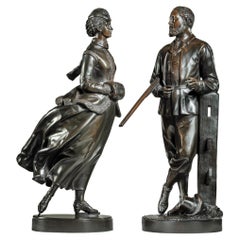
Prince Edward and Princess Alexandra of Wales by Count Gleichen
By Elkington
Co.
Located in Lymington, Hampshire
These bronze figures show Edward, Prince of Wales, standing in a nonchalant pose with one leg crossed over the other, a cigar in his left hand, his hat at his feet and a shotgun slung over his right arm. The elegant Princess of Wales is depicted skating, with feathers in her hat, and wearing a fur-trimmed coat and muff as the wind catches her three-quarter length skirt. Each stamped Elkington & Co Founders and G 1870. English, dated 1870.
Provenance: Prince Victor of Hohenlohe-Langenburg, Count Gleichen.
Prince Victor of Hohenlohe-Langenburg, Count Gleichen, was the son of Prince Ernst of Hohenlohe-Langenburg and Princess Feodore of Leiningen, half-sister to Queen Victoria. He ran away from school to England in 1848 and was sponsored to enter the Royal Navy by Queen Victoria. In 1854 he attained the rank of Lieutenant after serving as mate on the flagship Cumberland, where his future brother-in-law was captain and his future father-in-law was admiral. In 1866 he retired from the navy and trained with the British sculptor William Theed. As a sculptor, he carried out several portrait commissions for Queen Victoria including a statuette of Prince Alfred, her second son, and another of Prince Albert Victor...
Category
Antique 1870s English Figurative Sculptures
Materials
Bronze
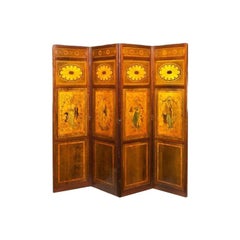
A late victorian inlaid four fold drafts screen, attributed to Hicks of Dublin
By Hicks of Dublin
Located in Lymington, Hampshire
A very fine late Victorian four fold mahogany draught screen, attributed to Hicks of Dublin, each tall rectangular leaf divided into three panels below a flowerhead border, all inlaid with stained and exotic woods on a satinwood ground, the central panels showing four classical muses, the plain lower panels with satinwood stringing on a harewood ground. English, circa 1895.
Footnote: James Hicks was born into a family of Dublin chair-makers and the moved to London to train in workshops on the Tottenham Court Road, London. On returning to Dublin in 1894, he opened a business in Lower Pembroke Street, which rapidly became one of the city’s leading cabinet-making firms and won the royal warrants of King Edward VII and Princess Victoria, the Crown Princess of Sweden. He was inspired by the styles of Sheraton...
Category
Antique Late 19th Century English Late Victorian Screens and Room Dividers
Materials
Mahogany, Satinwood
Wilson Chilton’s mahogany Naval Architects/draughtsman box of curves/templates
By Gillows of Lancaster
London
Located in Lymington, Hampshire
Wilson Chilton’s mahogany Naval Architects/Naval draughtsman box of curves and templates, probably by Gillows still retaining around 100 superb quality...
Category
Antique 19th Century English Historical Memorabilia
Materials
Mahogany
Royal Naval Ship’s Elm Companionway Board
Located in Lymington, Hampshire
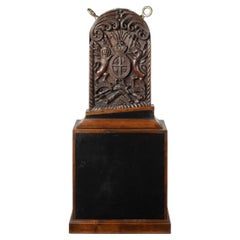
A Royal Naval ship’s elm companionway board, of rectangular form with an arched top and two sturdy brass rings, naively carved with a crowned coat of arms flanked by a lion and unicorn...
Category
Antique 1860s English Nautical Objects
Materials
Elm
Lord Mountbatten by Greta Berlin, 1989
Located in Lymington, Hampshire
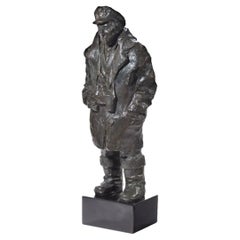
This bronze is the maquette for a sculpture of Lord Louis Mountbatten wearing a naval duffel coat, peaked cap and sea boots and holding a pair of binoculars. It is set on a highly polished black stone base and inscribed on the back ‘Mountbatten Study, G. Berlin no. 3 of 3’. English, 1989.
We are indebted to Ms Berlin for her kind help in supplying the following information. “I made this piece as a working model, maquette, to show, along with another image, to the clients who were offering the commission for the nine-foot bronze of Lord Mountbatten...
Category
Vintage 1980s English Figurative Sculptures
Materials
Bronze
Her Majesty’s Vase: A horse racing trophy by John Samuel Hunt
By John Samuel Hunt
Located in Lymington, Hampshire
This silver presentation vase is a small replica of the classical Roman ‘Warwick Vase’. The body is cast and chased with fruiting vines below the rim. The central field has a continuous band with bearded Bacchic heads floating above a lion’s mask and pelt. The applied handles comprise gnarled twisted vine stems. The spreading stem is set on a square foot which in turn sits on an ebonised wooden plinth base. The plinth is applied with two vacant laurel wreath cartouches and two rectangular plaques, one finely engraved with the Royal Coat of Arms and the other inscribed “Plymouth, Devonport and Cornwall Races 1845, the gift of her Most Gracious Majesty Queen Victoria, Augustus Coryton Esqr, W. R. Fortescue Esqr, Stewards” and “Her Majesty’s Vase, value 100gs., for three-year-old and upwards – Heats, about two miles, starting at the T.Y.C. Starting-post, once round, to the Grand Stand Winning-post.” Fully marked and stamped on the side of the foot ‘Hunt & Roskell Late Storr & Mortimer 2225’. English, assayed for London 1845.
Provenance: Her Majesty Queen Victoria. Sir John Barker-Mill, Baronet of Mottisfont.Thence by descent.
John Barker (1803-1860) was created 1st Baronet ‘of Mottisfont in the County of Southampton’ on 16 March 1836. A noted racehorse owner, Barker won numerous prestigious trophies with Giantess, Cymba, Miss Ellis and Pugilist. His most prestigious horse, Leviathan, sire of Giantess, won 16 of 21 starts and was sold to George IV for 2,000 guineas.
Plymouth, Devonport and Cornwall Races were held from 1828 until 1930. The racecourse was a flat, oval course of 12 furlongs with a straight run-in of 2 ½ furlongs. ‘Royal Plates...
Category
Antique 1840s English Historical Memorabilia
Materials
Silver
A pair of Glastonbury chairs made for the Pembertons of Durham
Located in Lymington, Hampshire
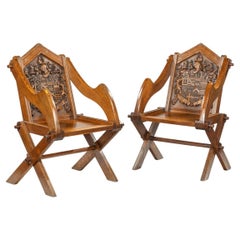
Each of these oak Glastonbury chairs has a pointed back and a fixed rectangular seat. The shaped arms and X-frame legs are attached with protruding pegs, giving the impression of a c...
Category
Antique 1870s English Chairs
Materials
Oak
Queen Adelaide’s Coach Panels
Located in Lymington, Hampshire
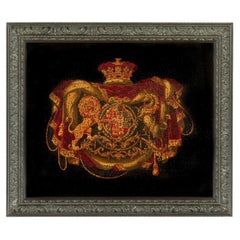
These two wood panels are of rectangular form, one with rounded corners. Each is painted with a large Royal coat of arms flanked by a lion and a unicorn surmounted by a queen’s crown and red velvet mantling trimmed...
Category
Antique 1840s English Historical Memorabilia
Materials
Wood
$25,819 / set
Regency Lane’s Pocket Globe, Dated 1818
By Lane
s
Located in Lymington, Hampshire
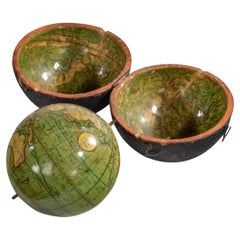
A 3 ½ inch Regency Lane’s pocket globe, dated 1818, the terrestrial globe with the seas in light green and the land masses outlined in darker green, contained within a hinged black shagreen case, the concave interior of the case applied with the engraved celestial charts...
Category
Antique 1810s English Regency Globes
Materials
Wood
Count Gleichen’s shrapnel paperweight. Russian and English, 1854
Located in Lymington, Hampshire
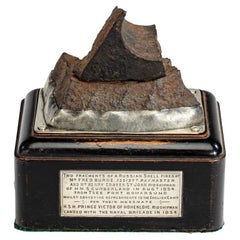
Count Gleichen’s Russian shell paperweight, the tooth shaped fragment of a Russian armament shell set above another of rectangular form both raised on a silver mount on an ebonized rectangular plinth, applied with a plaque reading ‘Two fragments of a Russian shell fired at Mr Fred Burne assist.t paymaster and Mr Henry Crave St John midshipman of H.M.S. Cumberland in Aug.t 1854 from Tsee Fort Bonarsund whilst conveying refreshments to the English camp – for their messmate – H.S.H. Prince Victor of Hohenlohe Midshipman landed with the Naval Brigade in 1854’. With a framed caricature of Count Gleichen inscribed Vanity Fair, London, July 5, 1884. Vice Admiral H.S.H Count Gleichen – the Queen’s Nephew.Russian and English, 1854.
The print has the following biography on the reverse and on the mount ‘His Serene Highness Prince Victor …. of Hohenlohe-Langenburg, is better known in England as Count Gleichen and as the Queen’s nephew. Born fifty years ago, he was sent to school at Dresden; but at the age of fourteen he conceived ideas not to be bounded within the confines of the small life of a German principality. So he ran away from school to go to sea, and his aunt the Queen of England, being informed of the fact, proposed to her sister to let her adventurous nephew become naturalised as an Englishman and enter the English Navy. This was accordingly done, and Prince Victor, as he was then called, was appointed to the Powerful on the Mediterranean Station, in 1848. He served in the Crimean War and in the operations in China he proved a popular officer and a good sailor-man, and was three times wounded in battle. In 1861 he married the daughter of Admiral Sir George Seymour, sister of the fifth Marquis of Hertford on which occasion it was that he put down his title of Prince and took up for future use that of Count. He became, in due course a Vice-Admiral, and in the meantime he also became a sculptor. It is in the latter art that he now mainly busies himself, and he has created many pleasing busts of his royal relatives and some works of greater pretensions than family portraits. An Alfred the Great, a Beaconsfield, and a Prince Imperial...
Category
Antique 1880s English Paperweights
Materials
Metal, Silver
Portrait Mezzotint of Admiral Viscount Duncan
By John Raphael Smith
Located in Lymington, Hampshire
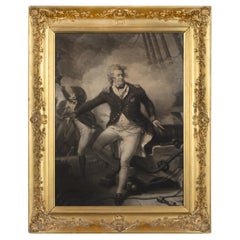
This fine impression of the celebrated print engraved by mezzotint engraver John Raphael Smith after a painting by Henry Danloux shows the subject on the deck of a ship in the heat of the Battle Camperdown. It is framed in an ornate giltwood frame with a paper label on the reverse showing a coat of arms flanked by the inscription ‘Admiral Lord Viscount Duncan when Victorious off Camperdown, is by permission most humbly dedicated to the Hon. Miss Jane Duncan by her most obedient Servant H.P.Danloux London. Published by H. P. Danloux No 11 Charles Street, Middlesex Hospital...
Category
Antique Early 1800s English Prints
Materials
Giltwood, Paper
Fine Pair of Bronze Cannon by McAndrew and Woore English, circa 1850
Located in Lymington, Hampshire
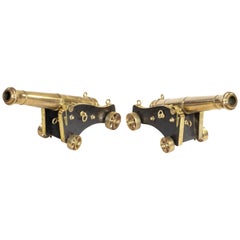
A fine pair of bronze cannon by McAndrew and Woore, set on their original brass bound black painted oak carriages with brass spider wheels, also with a p...
Category
Antique 1850s English Arms, Armor and Weapons
Materials
Bronze
Gold and Agate Snuff Box Belonging to Anne, First Duchess of Buccleuch
Located in Lymington, Hampshire
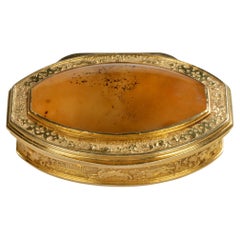
This oval gold snuff box is inscribed with a crest of ‘a stag trippant’ within mantling of upright ostrich plumes tied with a bow, all below a ducal coronet and above a cypher of the entwined initials ‘B.A.B.’ for Anne of Buccleuch. English, circa 1670.
Provenance: Anne, 1st Duchess of Buccleuch
Anne Scott, 1st Duchess of Buccleuch (1651-1732) was a wealthy Scottish peeress. After her father died when she was a few months old, and her sisters by the time she was 10, she inherited the family’s titles. She was married, at 12 years old, to James, 1st Duke of Monmouth, the eldest illegitimate son of Charles II, then 14. Following the king’s death in February 1685, James spearheaded an anti-Catholic revolt to depose the new king, James II, and claim the throne from his uncle. The brief Monmouth Rebellion ended in defeat and James, by then Duke of Monmouth and Buccleuch, was executed for treason. The Duchess had six children by Monmouth, and a further three by her second husband, Charles, 3rd Baron Cornwallis, whom she married in 1688. She died in 1732 and was succeeded by her grandson, Francis, Earl of Dalkeith.
The style of chasing used on this box is very reminiscent of a signed piece in the Gilbert...
Category
Antique 1670s English Snuff Boxes and Tobacco Boxes
Materials
Agate, Gold
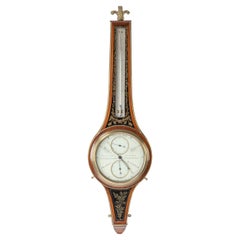
‘Royal’ Barometer by John Russell, Watchmaker to the Prince Regent
By John Russell
Located in Lymington, Hampshire
This superbly crafted wheel barometer and thermometer has a mahogany case surrounded by twisted brass stringing and central panels of foliate tendrils above Russell’s signature thistle motif in black and gilt verre églomisé. It is surmounted by a brass Prince of Wales feather finial. The long, rectangular thermometer plate is inscribed ‘Thermometers: Beaumar, Fahrenheit, Royal Society of London’, the latter being an early attempt to standardise temperature measurement. The circular dial is inscribed ‘Changeable, Fair, Settled Fair, Much Rain’ and ‘Rain’ and signed across the centre ‘J Russell, Falkirk, Invt et Fecit, Watch Maker to his R.H the Prince Regent’. The reverse has a paper label ‘Russell, Iden Collection Inventory 1896’. Scottish, circa 1815.
Provenance: Mr Walter Iden.
Published: Percy G. Dawson, The Iden Clock Collection, Woodbridge, 1987. No.125, p.280.
These ‘royal barometers’ were so named because John Russell of Falkirk...
Category
Antique 1810s Scottish Scientific Instruments
Materials
Metal
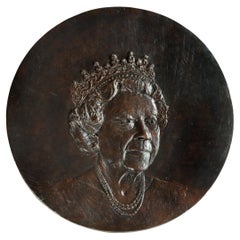
Vivien Mallock: Queen Elizabeth II’s Diamond Jubilee Portrait Roundel, 2012
Located in Lymington, Hampshire
This is the bronze maquette for a bas-relief portrait commissioned by the City of Winchester in honour of Queen Elizabeth II’s Diamond Jubilee. The final roundel is six feet in diameter and is shaped as a Winchester Rose with Queen Elizabeth II in the centre. She is wearing a three-strand diamond necklace and the Girls of Great Britain and Ireland tiara. Signed ‘VM 1’. English, 2012.
The Girls of Great Britain and Ireland tiara was made by the House of Garrard...
Category
2010s English Figurative Sculptures
Materials
Bronze
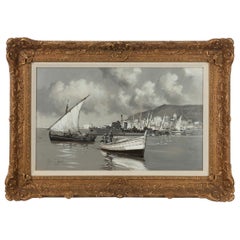
Montague J Dawson, ‘Valetta Harbour’
By Montague Dawson
Located in Lymington, Hampshire
Montague J Dawson (1895-1973), ‘Valetta Harbour’, oil on board, painted in a grisaille palette with a British Hunt Class Type II destroyer in Valetta Harbour, Malta, signed ‘Montague Dawson’, English, 1940.
Footnote: Montague Dawson RMSA, FRSA (1890–1973) was born in West London, in Chiswick in 1895, Montague Dawson was the grandson of Victorian landscape painter Henry Dawson. He studied under the seascape artist Charles Napier Hemy...
Category
Vintage 1940s English Paintings
Materials
Paint
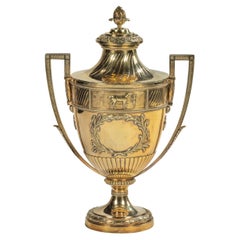
1802, Richmond “Gold Cup”, by Robert Adam, Paul Storr and Robert Makepeace
By Paul Storr, Robert Makepeace I, Robert Adam
Located in Lymington, Hampshire
This exceptional silver-gilt trophy was made by Paul Storr in 1802, by arrangement with the London retailer Robert Makepeace. It is in the form of a classi...
Category
Antique Early 1800s English Historical Memorabilia
Materials
Silver
Fine Presentation Sword Given to Lieutenant Charles Peake
Located in Lymington, Hampshire
A fine presentation sword given to Lieutenant Charles Peake as a token of gratitude by the Men of His Ship when recommissioned for Foreign Service i...
Category
Antique 1820s English Arms, Armor and Weapons
Materials
Metal
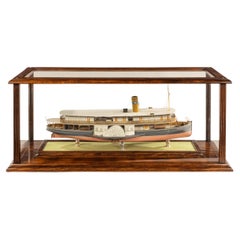
Builder’s Model of the Brazilian Passenger Paddle Steamer Caxias
Located in Lymington, Hampshire
A builder’s model of the Brazilian passenger paddle steamer Caxias built by Hepple, South Shields, 1912, with a 24in. laminated and carved hull finished...
Category
Vintage 1910s English Models and Miniatures
Materials
Laminate, Wood, Mahogany
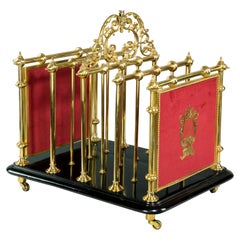
Unusual Brass Victorian Music Canterbury with Lyre Engraving
Located in Lymington, Hampshire
An unusual Victorian brass music Canterbury, of rectangular form with four compartments divided by knopped brass frames, the central one surmounted by...
Category
Antique 1870s French Victorian Music Stands
Materials
Brass
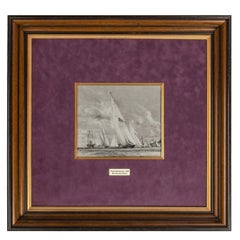
Charles Dixon R.A. for King George V, Royal Yacht Britannia
Located in Lymington, Hampshire
This ‘en grisaille’ watercolour on paper is Charles Dixon’s preparatory sketch for a proposed but apparently uncompleted painting of the royal racing yacht Britannia...
Category
Vintage 1930s English Nautical Objects
Materials
Paper
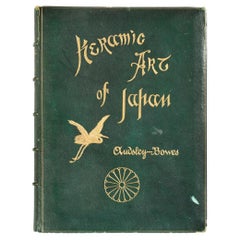
Audsley, George Ashdown and James, Lord Bowes ‘The Keramic Art of Japan’
By George Ashdown Audsley
James Lord Bowes
Located in Lymington, Hampshire
Audsley, George Ashdown and James, Lord Bowes ‘The Keramic Art of Japan’, Liverpool and London, Henry Sotheran, 1875. 2 volumes, first edition hardback folio including 41 coloured an...
Category
Antique 1870s English Books
Materials
Paper
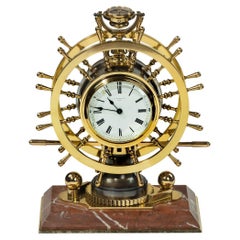
Victorian Brass Novelty Clock by Elkington
Co
By Elkington
Co.
Located in Lymington, Hampshire
A Victorian brass novelty clock by Elkington & Co., in the form of a double steering-wheel, one wheel enclosing a clock and the other a barometer, with ...
Category
Antique 1880s English Victorian Mantel Clocks
Materials
Brass
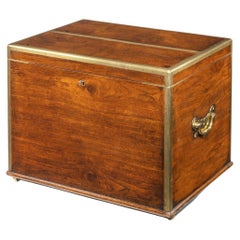
Very Robust Brassbound William IV Anglo-Chinese Padouk Silver Chest
Located in Lymington, Hampshire
A very robust brassbound William IV Anglo-Chinese padouk silver chest, of rectangular form with a hinged lid and the original substantial brass carrying handles, the lock stamped ‘Barron WR Patent’. Circa 1830.
Footnote: In 1778 Robert Barron...
Category
Antique 1830s Chinese William IV Trunks and Luggage
Materials
Padouk
Pair of 18 Inch Floor Standing Globes by C Smith
Son
Located in Lymington, Hampshire
A pair of 18 inch floor standing globes by C Smith & Son, each set into a mahogany stand with a turned baluster support and three legs centred on a compass, on...
Category
Antique 1840s English Globes
Materials
Mahogany
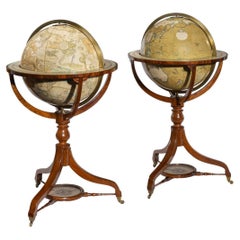
Fine Pair of Floor Globes by J
G Cary, Dated 1820 and 1833
By George
John Cary
Located in Lymington, Hampshire
A fine pair of 15 inch floor globes by J & G Cary, dated 1820 and 1833, each set into a mahogany stand with a vase shaped support and three legs centred on a compass, one with a labe...
Category
Antique Early 19th Century English Regency Globes
Materials
Mahogany
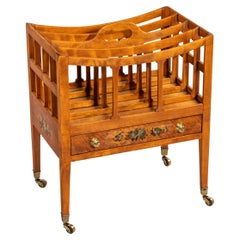
George III Satinwood Four Division Canterbury
Located in Lymington, Hampshire
A George III satinwood four division Canterbury, of rectangular form with concave dividers and a handle, the frieze with a single drawer and painted with flowers, on the original bra...
Category
Antique Early 1800s English Magazine Racks and Stands
Materials
Satinwood
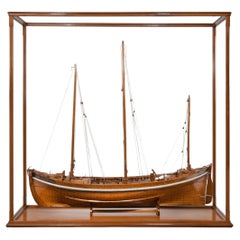
Lugger Lifeboat Model by Twyman for the International Exhibition, London, 1862
Located in Lymington, Hampshire
A Lugger lifeboat model by Twyman for the International Exhibition, London 1862. The planked and pinned hull of this lifeboat has a lead keel, bilge keels, a wooden rudder with a yoke, gesso-coated canvas wales and a grab line. It is fitted internally with a forward compartment enclosing a stove and glazed deck lights, seats, covered hatches with copper strapping, a bilge pump with a handle, mast securing points, a metal anchor with a buoy and other details, together with a quantity of furled masts and rigging, a silk flag, and other accessories. The bow has ‘Sunbeam/Friend of all Nations’ and the stern has ‘Ramsgate’, painted in gold on a black ground. English, 1862.
Provenance: H. Twyman (designer/modeller) thence by descent
Exhibited: International Exhibition, London 1862, Vol. 2, object no. 2760
The 1862 International Exhibition in London hosted a fine array of exhibits from 28,000 exhibitors, and enjoyed a footfall of 6.1 million (about the same as that of the 1851 Great Exhibition...
Category
Antique 1860s English Nautical Objects
Materials
Glass, Wood
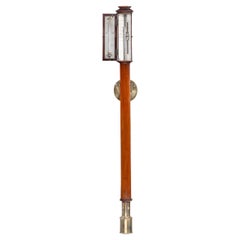
Bow-Front Marine Barometer by John Dollond
By Dollond, London
Located in Lymington, Hampshire
A bow-front marine barometer by John Dollond It is of slender cylindrical form with a silvered register plate enclosed by a hinged thermometer flap an...
Category
Antique 1820s English Scientific Instruments
Materials
Brass
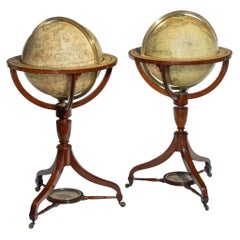
Pair of Table Globes by J
W Newton, Dated 1820
By John
William Newton
Located in Lymington, Hampshire
A pair of 12 inch table globes by J & W Newton, dated 1820, each with 12 hand coloured gores, graduated meridian rings, set within ebonised stands with t...
Category
Antique 1820s English Regency Globes
Materials
Wood