Japonisme Ceramics

JAPONISME STYLE

In the late 19th and early 20th century, France developed an enduring passion for Japanese aesthetics and craftsmanship. Not only did this interpretation of Japanese culture — which became known as Japonisme — infuse fresh energy into French art and design, but it also radically transformed how Europeans, and subsequently the world, would come to understand visual culture. 

Until 1853, Japan had been closely guarded against foreign visitors for over two centuries. However, American Commodore Matthew C. Perry sailed into Japan that year and initiated the first of its treaties with the United States and Europe, thereby opening its borders and giving the West its first-ever look at Japanese design. 

For the next few decades, taken with Japonisme, sophisticated collectors in Paris, New York and elsewhere gorged themselves on lacquered screens, celadon ceramics and netsuke ornaments, along with artworks depicting various aspects of Japanese life. The East Asian country’s influence on Europe, particularly France, contributed to one of the most creatively prosperous periods in history, leaving an imprint on the Impressionist, Art Nouveau and Art Deco movements, and inspiring artists like Edgar Degas, Mary Cassatt, Vincent van Gogh as well as luxury houses such as Louis Vuitton and Hermès. Japonisme emerged at the time when the ornate Renaissance Revival style was the most prominent mode of decorating in Europe, and Japanese aesthetics seemed strikingly modern and elegant in comparison. 

In addition to everyday practical objects from Japan, such as vases, tableware and decorative boxes, Japanese art, especially Japanese woodblock prints by masters of the ukiyo-e school, caught the eye of many artists — particularly those in the Art Nouveau poster community in 1880s Paris. The luscious organic colors associated with traditional Japanese design, motifs like cherry blossoms and carp and the vivid patterns found in woodblock prints, silks and more were adopted and appropriated by painters as well as ceramicists and those working in other fields of the decorative arts. Today, demand for Japanese lacquerware — furniture, trays, writing boxes, screens, incense burners — from the Edo period (1615–1868) and the late 19th century continues to be very strong among collectors.

Find a collection of antique Japonisme furniture and decorative objects on 1stDibs.

to
8
60
20
89
5
4
87
54
17
16
14
7
6
5
4
4
3
3
2
2
2
1
4
47
38
9
21
7
3
11
2
1
1
1
95
40
11
5
3
94
94
93
2
1
98
98
98
16
3
2
2
2
Style: Japonisme
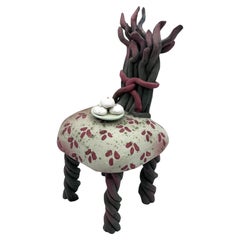
American Contemporary Painted Ceramic Fantasy Chair by Vicky Choke, Ca. 1990
Located in New York, NY
Vicky Choke, Chinese Contemporary Painted Ceramic Fantasy Chair, Ca. 1990 This unique little ceramic sculpture by renowned American Ceramist, Vicky Choke depicts a fantasy chair wit...
Category

1990s Japanese Japonisme Ceramics

Materials

Ceramic

Large Red Antique Japanese Low Bowl Hand-Painted Children-at-Play circa 1885
Located in Katonah, NY
We are pleased to offer this large antique Japanese low bowl painted with children-at-play and bird-and-flower motifs on a striking red background. The bowl dates to the late 19th ce...
Category

Late 19th Century Japanese Antique Japonisme Ceramics

Materials

Porcelain

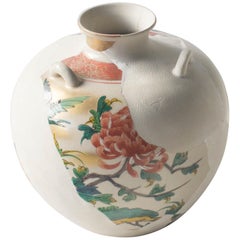
Reconstructed Ceramics #6 Contemporary Zen Japonism Style
Located in Shibuya-ku, Tokyo
This series of ceramics are unique work by Norihiko Terayama. He broke ceramic at first, and make it into a lot of fragment. He rasp some of fragmen...
Category

2010s Japanese Japonisme Ceramics

Materials

Ceramic

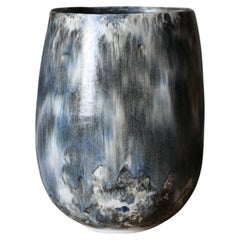
Blue Abstract Painted Vase by Scarlet Pottery
Located in Sammu-shi, Chiba
This is a vase made by the Japanese ceramic artist unit "Scarlet Pottery." It is a piece of pottery made using Amakusa pottery stone. Amakusa pottery stone is famous as the raw mater...
Category

2010s Japanese Japonisme Ceramics

Materials

Porcelain

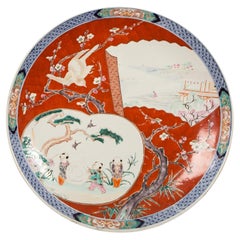
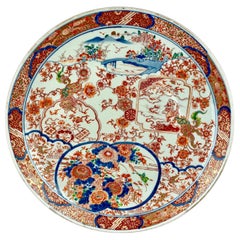
Imari Porcelain Charger-Japan, Meiji Period-18.25" Diameter
Located in West Palm Beach, FL
Large finely decorated Japanese Meiji period Imari porcelain charger. The decoration consists of shaped panels overlayed...
Category

1880s Japanese Antique Japonisme Ceramics

Materials

Enamel

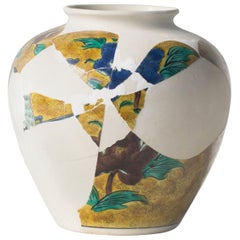
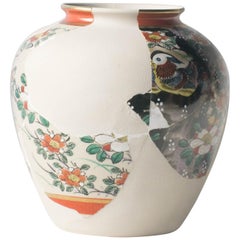
Reconstructed Ceramics #4 Contemporary Zen Japonism Style
Located in Shibuya-ku, Tokyo
This series of ceramics are unique work by Norihiko Terayama. He broke ceramic at first, and make it into a lot of fragment. He rasp some of fragmen...
Category

2010s Japanese Japonisme Ceramics

Materials

Ceramic

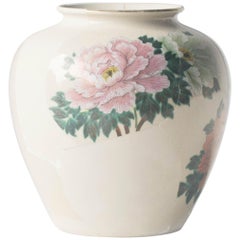
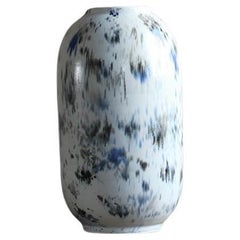
Small White Vase with abstract painting by Scarlet Pottery
Located in Sammu-shi, Chiba
This is a vase made by the Japanese ceramic artist unit "Scarlet Pottery." It is a piece of pottery made using Amakusa pottery stone. Amakusa pottery stone is famous as the raw mater...
Category

2010s Japanese Japonisme Ceramics

Materials

Porcelain

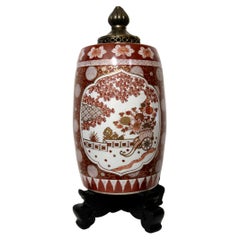
Imari Ovoid Japanese Design Vessel with Ebonized Base and Brass Finial
Located in Lomita, CA
A Japanese parcel gilt and brass mounted porcelain vessel with an ebonized wood base with a distinctive Imari motif of flowers, medallions and touches of gold. The stylized Imari pa...
Category

Mid-20th Century Japanese Japonisme Ceramics

Materials

Ceramic

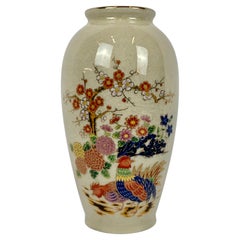
Vase with Delicate Hand Painted Floral Spray on Neutral Ground-Japan, early 20th
Located in West Palm Beach, FL
Japanese porcelain vase delicately hand painted on an craquelure oatmeal colored ground. The brightly colored design is of prunus blossoms, chrysanthemums and several roosters all ou...
Category

Early 1900s Japanese Antique Japonisme Ceramics

Materials

Enamel

Reconstructed Ceramics #7 Contemporary Zen Japonism Style
Located in Shibuya-ku, Tokyo
This series of ceramics are unique work by Norihiko Terayama. He broke ceramic at first, and make it into a lot of fragment. He rasp some of fragmen...
Category

2010s Japanese Japonisme Ceramics

Materials

Ceramic

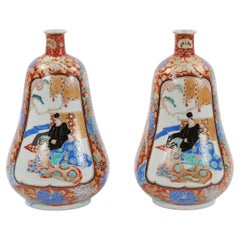
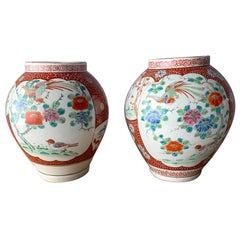
Pair Japanese Imari Gourd Shaped Porcelain Vases
Located in Tarry Town, NY
Experience the captivating charm of Japan with this pair of Imari gourd-shaped porcelain vases. These vases beautifully showcase the renowned Imari style, which has captured hearts a...
Category

19th Century Japanese Antique Japonisme Ceramics

Materials

Gold

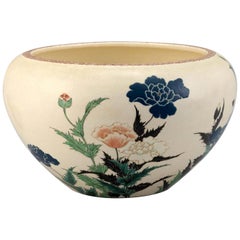
Japanese Studio Ceramic Centerpiece Okumura Shozan Meiji Period
Located in Atlanta, GA
A beautifully crafted large ceramic bowl as a centerpiece by Okumura Shozan (1842-1905) in the Kyo-yaki (kyoto ware) style. A Classic ovoid form with flatly...
Category

Late 19th Century Japanese Antique Japonisme Ceramics

Materials

Ceramic

Reconstructed Ceramics #3 Contemporary Zen Japonism Style
Located in Shibuya-ku, Tokyo
This series of ceramics are unique work by Norihiko Terayama. He broke ceramic at first, and make it into a lot of fragment. He rasp some of fragmen...
Category

2010s Japanese Japonisme Ceramics

Materials

Ceramic

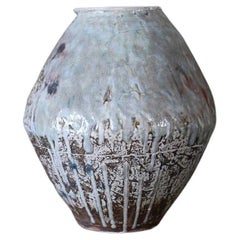
Bicone Vase by U-Turn Ushiro
Located in Sammu-shi, Chiba
Bicone vase by U-Turn Ushiro. It is baked for several days in an anagama (a kiln that burns firewood). It is shaped vertically symmetrically. The copper contained in the clay blows out on the surface, and reddish-black spots can be seen partially. It is a work where you can see various reactions of various ingredients. U-Turn Ushiro While working at the fire station...
Category

2010s Japanese Japonisme Ceramics

Materials

Pottery

Imari Porcelain Flower Pot 19th Century
Located in Beuzevillette, FR
Beautiful porcelain planter decorated with imari. On this flowerpot, the background is blue, there are reserves in which appear a dragon and a bird surrounded by red flowers. The upp...
Category

Late 19th Century Japanese Antique Japonisme Ceramics

Materials

Porcelain

Near Pair of Antique Japanese Arita Export Ceramic Jars
Located in Atlanta, GA
A near pair Hizen pottery jars from Artia Japan, circa mid-19th century of the Meiji Era. Heavy stoneware construction with overglaze enamels that was inspired by Chinese WuCai from ...
Category

Mid-19th Century Japanese Antique Japonisme Ceramics

Materials

Ceramic

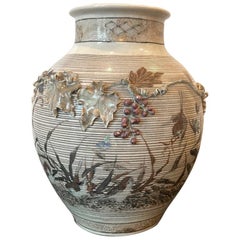
Japanese Porcelain Vase with Relief Surface Makuzu Kozan
Located in Atlanta, GA
A rare porcelain vase by Makuzu Kozan (1842-1916) circa 1870-81 (late Meiji period). The vase is dated to the earlier work from Kozan's studio during his early period (Takauki-ware p...
Category

Late 19th Century Japanese Antique Japonisme Ceramics

Materials

Ceramic

Vintage Japanese Imari Porcelain Bowl Hand-Painted for Geary s Beverly Hill
Located in Moreno Valley, CA
Vintage Japanese Imari Porcelain 7.5" Bowl - Hand Decorated for Geary's Beverly Hills. Set of two Japanese Imari porcelain Bowls from the prestigious brand GEARYS BEVERLY HILLS, Vintage collectible large blue and white porcelain bowl. These beautiful Japanese bowls are hand painted. Perfect for display or using as catchall or vide poche. Vintage Japanese Porcelain...
Category

20th Century Hong Kong Japonisme Ceramics

Materials

Ceramic, Porcelain

Japanese Porcelain Vase Makuzu Kozan Meiji Period
Located in Atlanta, GA
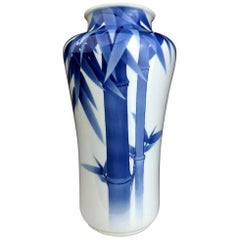
A striking blue and white vase from the studio of Japanese Potter Makuzu Kozan, also known as Miyagawa Kozan (1842–1916), one of the most established and collected ceramist from Meiji Period. Born as Miyagawa Toranosuke, Kozan established his pottery studio in Yokohama circa 1870s and later became one of the appointed artists to the Japanese Imperial household. His work was exhibited in many international fairs that the Meiji government participated at the turn of the century and won many grand prizes. Of a relatively large size, this vase is decorated with underglaze cobalt blue using the novel technique developed by Kozan called Fuki-e (the blow painting). As a result, the bamboos appear took on a three-dimensional quality as if appearing in a mist. Known as one of the most creative ceramists, circa 1887, Kozan started experimenting with new chemical colors from the West in the format of his porcelain glaze. New colors allowed him to create underglaze design that appeared bright, smooth and glossy. He even invented his own receipt of cobalt blue to achieve a much brighter yet softer shade, as evident on this vase. To create landscape that is realistic and dimensional, more common in the western paintings, he was inspired by the native Japanese ink painting technique developed around 1900 by Yokoyama Taikan...
Category

Early 1900s Japanese Antique Japonisme Ceramics

Materials

Ceramic

Antique Japanese Ceramic Ko-Kutani Revival Footed Dish
Located in Atlanta, GA
A Japanese glazed ceramic footed dish made in the Ko-Kutani type of Edo period but likely during Kutani revival in the 19th century Meiji Period. The dish with delicate foliaged rim ...
Category

19th Century Japanese Antique Japonisme Ceramics

Materials

Ceramic

One of The Two Japanese Ceramic Vases Makuzu Kozan Meiji Period
Located in Atlanta, GA
Two small nearly identical ceramic vases by Japanese Meiji imperial potter Makuzu Kozan (1842-1916), circa 1890-1900s. The vases were made in the form of jarlet with swelled shoulder...
Category

Late 19th Century Japanese Antique Japonisme Ceramics

Materials

Ceramic

Set of Five Ceramic Tea Cups by Otagaki Rengetsu
Located in Atlanta, GA
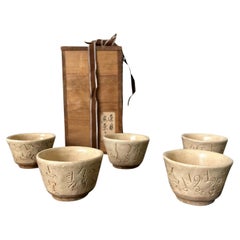
A set of five stoneware sencha tea cups by Otagaki Rengetsu (1791-1875). These miniature cups were simply molded in the classic form, glazed in off white and incised with cursive waka poems, a signature decorative style by the artist. Accompanies the cups is a wood storage box and paper slip label inscribed "Rengetsu sencha, tea cups" Purportedly purchased from Tessai-do Co. Ltd., Japan in 1991. Otagaki Rengetsu was a famous Buddhist nun in Edo period who is widely regarded to have been one of the greatest Japanese poets...
Category

Late 19th Century Japanese Antique Japonisme Ceramics

Materials

Ceramic, Wood

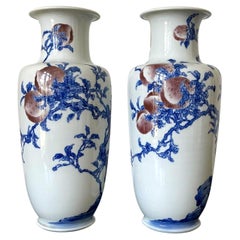
Pair of Rare Porcelain Commemorative Vases by Makuzu Kozan Meiji Period
Located in Atlanta, GA
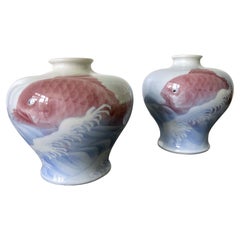
A pair of porcelain vases in classic form, decorated with underglaze blue and copper red painting by Imperial potter Makuzu Kozan. Also known as Miyagawa Kozan (1842–1916), Makuzu was one of the most established and collected ceramist known to the west from Meiji Period. The vases are in a classic Chinese form called "Bang Chu Ping" (grain-mallet vase...
Category

1910s Japanese Vintage Japonisme Ceramics

Materials

Ceramic

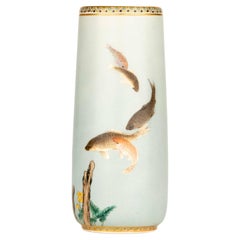
A Satsuma Vase Depicting A Group Of Carp Swimming In A Stream
Located in Milano, IT
A Satsuma vase depicting a group of carp swimming in a stream. The scene is depicted from a shore perspective, where partially submerged tree trunks emerge and delicate flowers bloom...
Category

Late 19th Century Japanese Antique Japonisme Ceramics

Materials

Ceramic

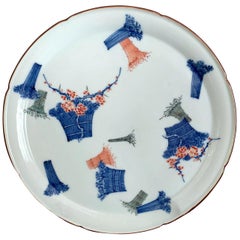
Japanese Antique Kakiemon Plate from Arita
Located in Atlanta, GA
A milky white dish with slight scalloped rim and decorated with cobalt blue iron red and green enamel over glaze, this delicate piece in Kakiemon Style was dated at least to the earl...
Category

Early 18th Century Japanese Antique Japonisme Ceramics

Materials

Porcelain

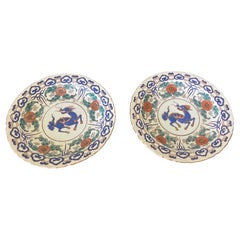
Pair Antique Japanese Artia Ceramic Cabinet Plates
Located in Atlanta, GA
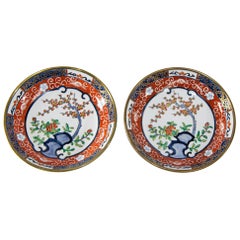
A pair of Japanese decorative ceramic plates, made in Arita for export market circa 17-18th century. The cabinet-display dishes feature lotus-petal gilt rim and a lavish tricolor ene...
Category

18th Century Japanese Antique Japonisme Ceramics

Materials

Ceramic

Japanese Ceramic Sake Bottle Chosen Karatsu Ware
Located in Atlanta, GA
The long neck bottle of classic form was heavily potted with coarse clay with high iron content. The flask, circa 18th century Edo period, was purposed for sake storage but also substituted as a flower vase during tea ceremony. The surface is covered in glossy black glaze and contrasts strikingly with white ash glaze around the shoulder. The white, fired with straw, displays a splashing feather effect and fine crackles, blending in with the black artistically. This type of Karatsu ware...
Category

18th Century Japanese Antique Japonisme Ceramics

Materials

Ceramic

Japanese Ceramic Ikebana Vase Bizen Ware Nanba Koyo
Located in Atlanta, GA
A tall vintage ceramic vase with handle from Japan (20th century) by Nanba Koyo. Made in the tradition of Bizen ware, the vase has a modern aesthetic with a...
Category

20th Century Japanese Japonisme Ceramics

Materials

Ceramic

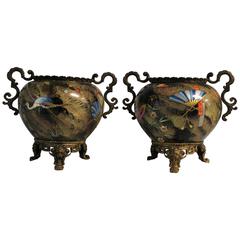
Pair of Japonisme Porcelain and Ormolu Mounted Aesthethic Movement Vase s
Located in Hamilton, Ontario
Pair of Japonism porcelain and ormolu-mounted Aesthethic Movement vase's.
Category

19th Century English Antique Japonisme Ceramics

Materials

Brass, Ormolu

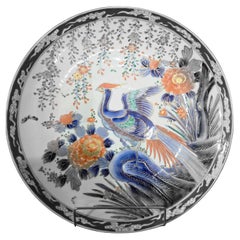
Lovely Imari Charger
Located in Swadlincote, GB
Super Imari charger in excellent overall condition, signed to the back. Imari ware, a type of Japanese porcelain, originated in the Arita region of Kyushu, Japan. The name "Imari" co...
Category

19th Century Japanese Antique Japonisme Ceramics

Materials

Porcelain

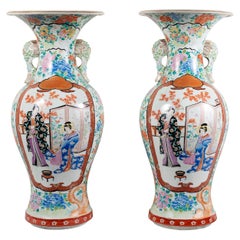
Pair of Japanese Kutani Porcelain Vase, circa 1880
Located in Brighton, Sussex
An impressive and very decorative pair of Meiji period (1868-1912) Japanese Kutani porcelain vases, each with wonderful exotic floral d...
Category

Late 19th Century Japanese Antique Japonisme Ceramics

Materials

Porcelain

Rare Large Vase with White Slip Inlay Makuzu Kozan Meiji Period
Located in Atlanta, GA
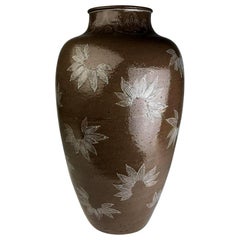
A impressively large and unusual stoneware vase in an urn shape from the studio of Japanese Potter Makuzu Kozan, also known as Miyagawa Kozan (1842–1916), one of the most established and collected ceramist from Meiji Period. Born as Miyagawa Toranosuke, Kozan established his pottery studio in Yokohama circa 1870s and later became one of the appointed artist to the Japanese Imperial household. His work was exhibited in many international fairs that the Meiji government participated at the turn of the century and won many grand prizes. This vase is dated to the end of Makuzu's life circa 1910-1916 based on similar work created around that time. After achieving domestic and international fame, Makuzu retired and handed the business to his son Hanzan in 1912. He dedicated his time to other selected projects that were more in tune with Japanese sensibility than export aesthetic. He made a group of stoneware pottery pieces inspired by Edo master like Ninsei and Kenzan as well as his own poetic creation. This piece is attributed to that period. Standing of an impressive size, this vase is more like an urn, made with stoneware instead of porcelain. It was coated with a brown iron glaze with a slight translucent quality. Underglaze whit slips were used to draw low relief decoration of bamboo leaves that sparsely scatter on the surface. Slightly more elaborate scrolling vines and autumn flowers circles under the mouth rim. Same white slip inlay was used to sign the vase under the base. The whole effect of the piece is unusual. With its dark glaze in contrast with the sparse white decoration that is more abstract and geometric than realistic, it appears almost modern with an Art Deco flavor. For stoneware urn and vase in the similar genre by Makuzu Kozan: see figure 113 on page 182 of "Sekai ni Aisa Reta ya Kimono" MIYAGAWA KOZAN MAKUZU...
Category

1910s Japanese Vintage Japonisme Ceramics

Materials

Ceramic

Excellent Satsuma Charger
Located in Swadlincote, GB
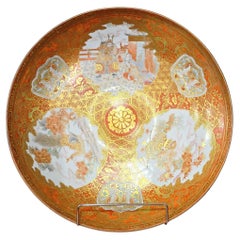
A super quality Satsuma bowl, in overall excellent condtion. Satsuma china, or Satsuma ware, originates from the Satsuma Province in southern Kyūshū, Jap...
Category

19th Century Japanese Antique Japonisme Ceramics

Materials

Ceramic

Japanese Glazed Ceramic and Silver Koro Incense Burner Makuzu Kozan
Located in Atlanta, GA
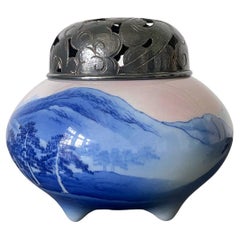
A tri-pod ceramic incense burner (koro) by Japanese Imperial potter Makuzu Kozan (1842-1916) circa late Meiji to the start of Taisho period (1890-1910s). A fine example of the artist's work belonging to the late part of his underglaze paint phase (started around 1887 until his death), the surface of the koro was painted in beautiful shades of blue to depict a continuous landscape not unlike a traditional ink and watercolor hand scroll. The rise and fall mountains recede and fade into the horizon and are dotted with groves of pines. The sky is painted with a beautiful subtle shade of pink, suggesting a time of sunrise or sunset. The koro is fitted with an ensuite reticulated sterling silver hoya (incense cover), pierced with swirling cloud and marked with "pure silver' in Kanji. The base is signed in underglaze blue "Makuzu Kozan Sei" within a double ring. The piece is beautifully potted in form and the decoration was done with expertise using the novel technique developed by Kozan called Fuki-e (the blow painting), in order to achieve the striking landscape known as "Mountain and Water" with sense of dimensions and gradient, the poetic effects normally conveyed only by sumi ink staining on paper. The piece comes with an unsigned tomobako (wood storage box) of a recent age. Also known as Miyagawa Kozan (1842–1916), Makuzu Kozan was one of the most established and collected ceramist from Meiji Period. Born as Miyagawa Toranosuke, Kozan established his pottery studio in Yokohama around 1870s and later became one of the appointed artists to the Japanese Imperial household. His work was exhibited in many international fairs that the Meiji government participated at the turn of the century and won many grand prizes. Being one of the most creative ceramists, Kozan started experimenting with new chemical colors from the West in the format of his porcelain glaze around 1880s. New colors allowed him to create underglaze designs that appeared bright, smooth and glossy. He even invented his own receipt of cobalt blue to achieve a much brighter yet softer shade, as evident on this vase. To create landscape that is realistic and dimensional, more common in the western paintings, he was inspired by the native Japanese ink painting technique developed around 1900 by Yokoyama...
Category

Early 1900s Japanese Antique Japonisme Ceramics

Materials

Silver

Asian Flambe Studio Pottery Vase
By Kyoto Pottery
Located in Atlanta, GA
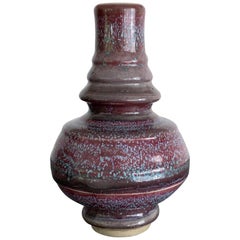
A garlic bottle vase in an archaic Chinese form, but likely Japanese in origin. Several circumventing grooves however, suggest a more modern age. It was done in a brilliant purple glaze over a robin egg blue background glaze. The bubbling and bursting effects during the firing renders the surface an artistic spotting effect. The color pallet recalls the Classic Jun Yao...
Category

Late 19th Century Japanese Antique Japonisme Ceramics

Materials

Ceramic

Hagi Ikebana Vase by Kyusetsu Miwa X Japanese Studio Pottery
By Kyusetsu Miwa X
Located in Atlanta, GA
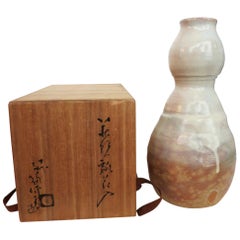
A stoneware vase with white dripping glaze from Hagi by Kyusetsu Miwa X (1895-1981), Showa Period. The vase is in the shape of "Double Gourd" with a bulbous ...
Category

20th Century Japanese Japonisme Ceramics

Materials

Ceramic

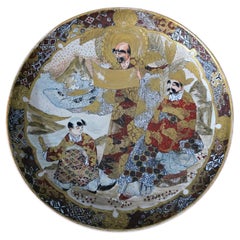
A Large Satsuma Vase Depicting A Scene Of Daily Life
Located in Milano, IT
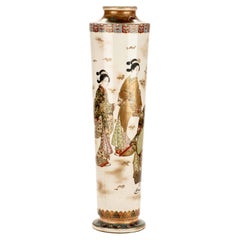
Large cylindrical Satsuma vase, decorated with polychrome enamels and pure gold, depicting a scene of daily life with three geishas and a samurai on a festive day. Signed ‘Seizan zō...
Category

Late 19th Century Japanese Antique Japonisme Ceramics

Materials

Ceramic

Super Kutani Charger
Located in Swadlincote, GB
A superb Kutani charger, signed to the back, in overall excellent condition. Kutani porcelain, or Kutaniyaki, originates from the Kutani village in the...
Category

19th Century Japanese Antique Japonisme Ceramics

Materials

Porcelain

Japonisme ceramics for sale on 1stDibs.

Find a broad range of unique Japonisme ceramics for sale on 1stDibs. Many of these items were first offered in the 21st Century and Contemporary, but contemporary artisans have continued to produce works inspired by this style. If you’re looking to add vintage ceramics created in this style to your space, the works available on 1stDibs include asian art and furniture, decorative objects, serveware, ceramics, silver and glass and other home furnishings, frequently crafted with ceramic, porcelain and other materials. If you’re shopping for used Japonisme ceramics made in a specific country, there are Asia, East Asia, and Japan pieces for sale on 1stDibs. While there are many designers and brands associated with original ceramics, popular names associated with this style include Makuzu Kozan, Norihiko Terayama, Awaji Pottery, and Ito Tozan I. It’s true that these talented designers have at times inspired knockoffs, but our experienced specialists have partnered with only top vetted sellers to offer authentic pieces that come with a buyer protection guarantee. Prices for ceramics differ depending upon multiple factors, including designer, materials, construction methods, condition and provenance. On 1stDibs, the price for these items starts at $115 and tops out at $54,000 while the average work can sell for $3,271.

Still Thinking About These?

All Recently Viewed