Wood Asian Art and Furniture

to
909
4,026
1,284
5,940
383
68
155
105
76
54
39
31
22
21
14
12
11
10
8
5
5
4
4
3
532
2,525
2,883
451
1,364
712
201
137
12
86
44
38
68
97
57
32
14
6,391
5,396
5,332
2,999
2,689
5,431
3,914
2,385
1,349
1,051
6,391
6,130
6,254
64
59
37
19
17
Material: Wood
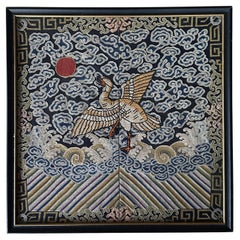
Antique Chinese Kesi Fourth Rank Badges Qing Dynasty
Located in Atlanta, GA
A fine silk kesi civil rank badge panel (known in Chinese as Buzi) framed and glazed. The fourth rank panel feature borders of fret archaic key and are cente...
Category

19th Century Chinese Qing Antique Wood Asian Art and Furniture

Materials

Silk, Giltwood

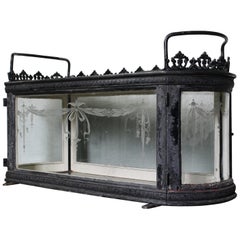
19th Century Infants Coffin Casket, Carved Wood, Etched Glass, Memento Mori
Located in Lowestoft, GB
For sale a very rare early 19th century infants coffin carrier, this would of been housed on a horse and cart hearse. The casket has a decorative wrought...
Category

Early 19th Century English Gothic Revival Antique Wood Asian Art and Furniture

Materials

Wrought Iron

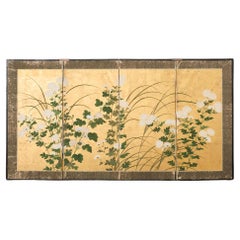
Japanese Edo Four Panel Screen Flowering White Chrysanthemums
Located in Rio Vista, CA
19th century extraordinary Japanese late Edo/early Meiji period four-panel byobu screen featuring flowering white chrysanthemums painted in a moriage (raised pigment) style. The pain...
Category

19th Century Japanese Edo Antique Wood Asian Art and Furniture

Materials

Brass, Gold Leaf

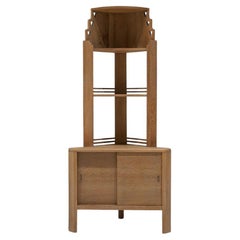
Japanese Antique Oak Corner Rack, 1950s–1960s, Japandi Wabi-Sabi
Located in Chiba, Chiba
A Japanese antique corner rack crafted from oak, dating from the 1950s–1960s. Designed to make purposeful use of a room’s corner, the piece settles neatly into limited space, quietly...
Category

Mid-20th Century Japanese Wood Asian Art and Furniture

Materials

Wood

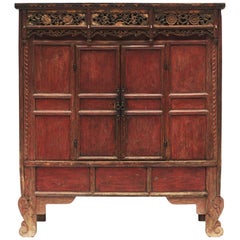
15th-16th Century Ming Dynasty Cabinet. Red Lacquer
Located in Kastrup, DK
Rare and well-preserved 16th century cupboard / cabinet. Detailed carved top section depicting a floral leaf design and people in polychrome lacquer. Front with red lacquer, pair of ...
Category

16th Century Chinese Ming Antique Wood Asian Art and Furniture

Materials

Elm

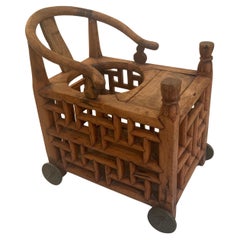
Ming Dynasty Child’s Safety Chair
Located in Los Angeles, CA
Fabulous Ming Dynasty Child’s Safety Chair with Bronze casters and all hand carved wood details. the Horseshoe Shaped back and fretwork on all sides is Ming. Amazing original safety ...
Category

1690s Chinese Ming Antique Wood Asian Art and Furniture

Materials

Wood

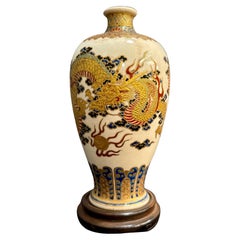
Japanese Satsuma Dragon Vase, Meiji Period, c 1900, Japan
Located in Austin, TX
A fantastic small Japanese Satsuma vase with image of writhing dragons, Meiji Period, circa 1900, Japan. The vase of elegant baluster form, with a slightly flared foot, slender body...
Category

Early 1900s Japanese Meiji Antique Wood Asian Art and Furniture

Materials

Ceramic, Porcelain, Pottery, Stoneware, Hardwood
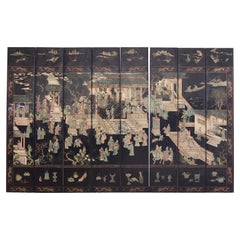
Gracie Studio Ming Style Lacquered Eight Panel Coromandel Screen
Located in Rio Vista, CA
Rare, bespoke lacquered eight-panel coromandel screen made in the Ming Dynasty style by Gracie Studio artisans in New York. Modern custom-made coromandel...
Category

20th Century American Ming Wood Asian Art and Furniture

Materials

Wood

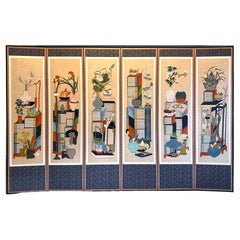
Korean Folding Chaekgeori Painted Scholar Floor Screen
Located in Atlanta, GA
A six-panel painted folding floor screen from Korea circa early 20th century. This type of screen is called Chaekgeori (books and things) which is quite unique to Korea. It became popular at the end of 18th century favored and encouraged by King Jeongjo (1752-1800) as a political tool to promote social conservatism such as the traditional Confucianism value, especially considered important in a time when waves of new ideology influx came to Korea. Initially commissioned for the royal court, they became increasingly popular with the scholars of noble and affluent households and were used widely in their halls and studies. Early screens were painted with trompe-l’oeil bookcases displaying books and arrays of collectibles. Later, the bookcases were eliminated to focus on the assemblage of neatly stacked books and objects of scholarly pursue. On this screen, the six panels were neatly presented and framed in woven brocade borders. Among the stacked volumes, one can find many fine porcelain vases with flowers, potted orchids, pen holders with brush pens and scroll paintings, incense burner, ink stone, teapot, fan with ink painting, vessels of fruits, exotic plants such as lotus, plumeria and even a pair of glasses. It feels like a pleasant visual measure hunting for the viewers. Several words in Chinese found their way into the picture as well, including filial (xiao), longevity (shou) and luck (fu). The painting was done in a meticulous way with no details overlooked and also with a rather western still-life dimensional perspective. In a rather unusual maximal but also minimalistic way, the screen exudes a historical charm with a folky flair but appears modern at the same time. Each panel is 17.5"w by 70.2"h. For general information on the subject see reference: Chaekgeori the Power and Pleasure of Possessions in Korean Painted Screens...
Category

20th Century Korean Folk Art Wood Asian Art and Furniture

Materials

Brocade, Silk, Wood, Paper

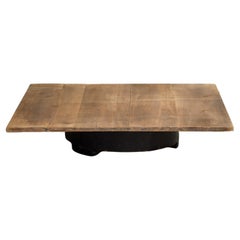
Japanese Antique Wood Low Table , Primitive Low Table , Wabi Sabi
Located in Katori-Shi, 12
This is an antique low table from the Taisho period. The table top is made of five pieces of Shurizakura wood with beautiful grain, and its rich expression captivates the viewer. In...
Category

Early 20th Century Japanese Taisho Wood Asian Art and Furniture

Materials

Wood

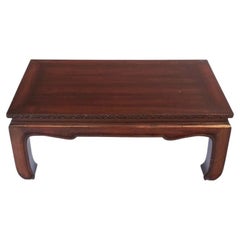
Chinese Rosewood Mandarin Style Coffee Table
Located in Locust Valley, NY
Vintage Chinese rosewood coffee table, Mandarin style with carved frieze detail, curved apron and legs, and a glass top.
Category

Mid-20th Century Wood Asian Art and Furniture

Materials

Rosewood

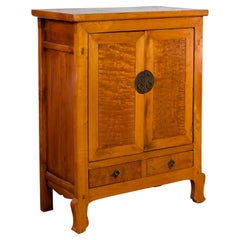
Chinese 19th Century Qing Dynasty Cabinet with Two Doors over Two Drawers
Located in Yonkers, NY
A Chinese Qing Dynasty period lacquered cabinet from the 19th century, with natural color and two doors over two drawers. Created in China during the 19th century, this Qing Dynasty cabinet...
Category

19th Century Qing Antique Wood Asian Art and Furniture

Materials

Wood

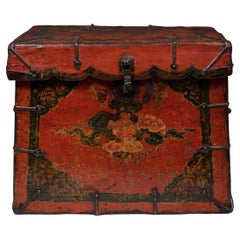
Ca. 17th Century Wood, Mineral Pigment and Iron Metalwork Trunk, Tibet
Located in Point Richmond, CA
Trunk Tibet ...
Category

17th Century Tibetan Tribal Antique Wood Asian Art and Furniture

Materials

Iron

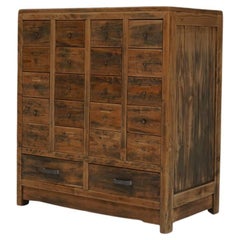
Japanese Antique Cedar Drawer Chest, 1940s–1960s, Japandi Wabi-Sabi
Located in Chiba, Chiba
A Japanese antique drawer chest crafted from cedar and dating from the 1940s–1960s. The cabinet features an impressive arrangement of twenty-two drawers, twenty of which are small an...
Category

Mid-20th Century Japanese Wood Asian Art and Furniture

Materials

Wood

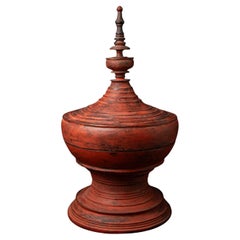
19th century Antique wooden Burmese offering vessel from Burma
Located in DEVENTER, NL
This Antique Wooden Burmese Offering Vessel is a remarkable piece that beautifully showcases the craftsmanship of the Shan (Tai Yai) people. Crafted from high-quality wood, this vess...
Category

19th Century Burmese Antique Wood Asian Art and Furniture

Materials

Wood

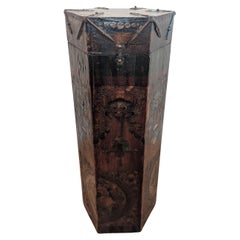
Tibetan Scroll Box
Located in New York, NY
Tibetan hexagon Tonka scroll box. Hand made hexagon box covered in leather hand painted. Traditional Tibetan art work hand painted with raised outlining of Jambhala faces, Tibetan Je...
Category

Mid-20th Century Tibetan Tibetan Wood Asian Art and Furniture

Materials

Pine, Wood, Animal Skin

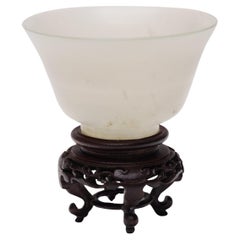
Chinese White Jade Cup with Stand
Located in Chicago, IL
Minimal and refined, this elegant Chinese cup has a simple silhouette sculpted from a single piece of luminous white jade, carefully selected for its clarity and pale color. The delicate form is shaped with a flared lip, short footed base, and thin walls that appear nearly translucent in the light. The jade cup...
Category

20th Century Chinese Minimalist Wood Asian Art and Furniture

Materials

Jade

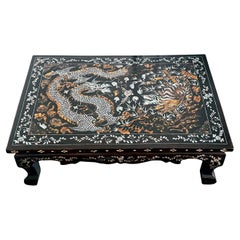
Musuem Quality Antique Korean Table with superb Inlay Joseon Dynasty
Located in Atlanta, GA
A Korean black lacquered wood low table with fine inlay works circa Joseon dynasty (19th century), Musuem quality. The low table was traditionally placed on the floor or bed and mean...
Category

19th Century Korean Other Antique Wood Asian Art and Furniture

Materials

Tortoise Shell, Mother-of-Pearl, Wood, Lacquer
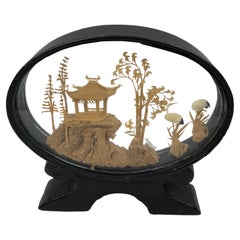
20th Century Chinese Cork Diorama, circa 1950s
Located in Miami, FL
Beautiful 20th century oval Chinese cork diorama. Finely carved decoration in a glass case and black lacquered base. Chinese landscape view, a pagoda in a traditional garden featur...
Category

Mid-20th Century Chinese Wood Asian Art and Furniture

Materials

Cork

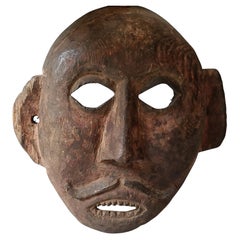
Nepal Ritual Mask Himalayan Asian art Antiques Tribal masks Interior design
Located in London, GB
Nepal Ritual Mask Himalayan Asian art antiques  A fine old Nepalese ritual mask of Shiva with moustache Hard dense wood with aged patina and traces of pigments Height 23 cm Perio...
Category

Early 20th Century Nepalese Wood Asian Art and Furniture

Materials

Wood

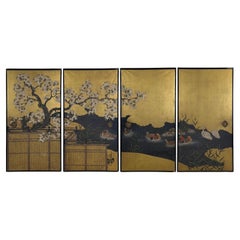
Stunning Set of Four 19th Century Edo Period Fusuma Door Decorative Panels
Located in Los Angeles, CA
A set of four fusuma (sliding door) panels from the 19th century, painted in ink and colors on gold leaf. The panels depict a blossoming cherry tree extending beyond a woven fence an...
Category

Late 19th Century Japanese Edo Antique Wood Asian Art and Furniture

Materials

Gold Leaf, Brass

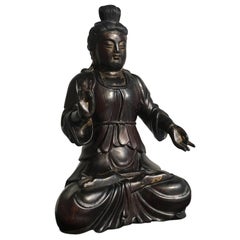
Chinese Carved Zitan Figure of a Bodhisattva, Qing Dynasty
Located in Austin, TX
A finely carved Chinese zitan wood figure of an unidentified bodhisattva, possibly Guanyin, late Qing Dynasty, circa 1900, China. The androgynous figure has a plump, almost matronly face, with downcast eyes and a gentle smile. The hair in long tresses, gathered and tied in a high chignon. The enlightened being is portrayed seated in dhyanasana, bare feet resting on crossed legs, both soles pointing up. Thick robes billow and drape around the full figured body. The hands display...
Category

Early 20th Century Chinese Qing Wood Asian Art and Furniture

Materials

Lapis Lazuli

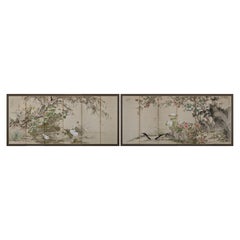
19th Century Japanese Screen Pair - Birds Flowers of the Four Seasons
Located in Kyoto, JP
Birds & Flowers of the Four Seasons Yamamoto Baiitsu (1783-1856) Late Edo period, Dated 1850 A magnificent pair of six-panel Japanese folding screens by Yamamoto Baitsu, representin...
Category

Mid-19th Century Japanese Edo Antique Wood Asian Art and Furniture

Materials

Wood, Paper

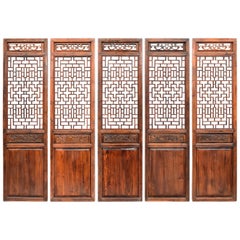
Set of Five Chinese Antique Screens Ming Style
Located in Somis, CA
A set of beautiful Chinese antique screens in natural finish. Each of the five screens has a middle section featuring a different flower, symbo...
Category

19th Century Chinese Ming Antique Wood Asian Art and Furniture

Materials

Wood

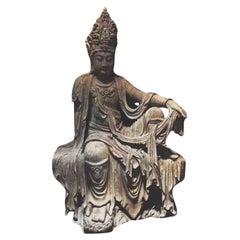
A Large Chinese Carved Wood Figure of Guanyin, Late Qing Dynasty
Located in ARMADALE, VIC
Description: A fine depiction of Guanyin, possessing the regal tranquillity that the Chinese Bodhisattva of compassion has come to be visually associated with. Marked by an urna signifying her spiritual enlightenment and crowned with a diadem depicting the Buddha Amitabha, the figure is immediately recognisable as Guanyin. Her androgynous figure is gracefully poised in the Lalit asana or “royal ease”, the pose classical in representations of the deity. The figure is asymmetric, with the weight of her supple form falling upon her left hand placed against the base, her right knee raised and left pendant. Her right hand rests upon her raised knee, delicately pinching at her draped attire. At first unassuming, this gesture may be suggestive of the Apana Mudra, the seal of purification. This Mudra is associated with physical wellbeing, fecundity and the cleansing of the body. Though she is adorned in the princely garb of dhoti, she bears features of idealised feminine beauty as prescribed in Asian art. With plump cheeks and near pouted lips, her full face gazes down upon the viewer with an empathetic and half-lidded gaze, upholding her title as ‘One who hears the cries of the world.’ Notes on the item: Guanyin is the Chinese interpretation of Avalokiteshvara, the Indian Bodhisattva of compassion. The term “Bodhisattva” is derived from the Sanskrit “Bodhi”, meaning ‘awakening’ or ‘enlightenment’, combined with “Sattva”, meaning ‘spirit’ or ‘being’, referring to one on the path to achieving enlightenment. Bodhisattvas in Mayahana Buddhism are recognised as figures who have effectively achieved enlightenment yet relinquish their accension to nirvana in order to remain amongst mankind in the ultimate act of compassion to aid as spiritual guides. As such, the Bodhisattva inhabit a liminal space between samsara and nirvana; enlightened beings that maintain a relationship with humanity that buddhas cannot, as attaining Buddhahood necessitates the abandonment of all worldly attachments, including mankind. Guanyin’s very name, ‘One who hears the cries of the world’ highlights this role as a compassionate figure who acknowledges the suffering and strife of man. Along with Mahāsthāmaprāpta, a fellow bodhisattva, Guanyin serves as an attendant to Buddha Amitabha, with these three deities recognised as the Three Sages of Western Pure Land Buddhism, a sect of Mayahana Buddhism popular in East Asia. Avalokiteshvara is commonly posited to have been adopted from Indian Buddhism into China as Guanyin around 200-400 CE, however it was the Tang dynasty (618-907) which saw the popularisation of the deity. By the Ming (1358–1644) and Qing (1644–1911) dynasties, Guanyin held the position as the most popular female deity in China. The unique state of religion in China held no monolithic canon regarding Buddhism and saw the assimilation of several belief systems, primarily Daoism, Buddhism and Confucianism. Consequently, Guanyin became a deity to be revered beyond Buddhism alone, appointed as both an official imperial deity and Daoist deity in the 12th century. Guanyin may also be seen to fulfil the role of idealised femininity as prescribed by Confucianism, with the scarcity of female Chinese deities perhaps accounting for the gradual gender shift Guanyin underwent. The Indian Avalokiteshvara is unequivocally recognised as male, whilst the supposed gender of Guanyin remains contentious. Although there is a clear shift from the masculine Avalokiteshvara towards a more feminine representation, it is unclear if Guanyin is understood to be entirely feminine, to inhabit qualities of both genders or to be elevated beyond gender entirely, embodying neither. Depictions of Guanyin are highly androgynous, which some believe lends credence towards Guanyin symbolising the unity of dualistic forces as recognised in Daoism, displaying the anthropomorphism of yin and yang. Comparative Analysis: Market comparisons of similar Qing Dynasty polychrome figures of Guanyin include lot 767 (no.2) From Christies ‘Important Chinese Ceramics and Works of Art,’ New York, 25 March 2022, with the price realised USD 52,920 (Estimate USD 20,000 – USD 30,000). Christies also auctioned a comparable polychrome Guanyin...
Category

Late 19th Century Chinese Qing Antique Wood Asian Art and Furniture

Materials

Hardwood

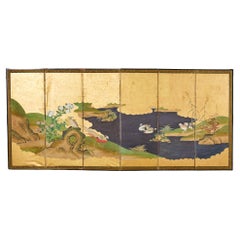
Japanese Meiji Six Panel Screen Kano School Bird Waterscape
Located in Rio Vista, CA
Stunning late 19th century Japanese Meiji period six panel byobu screen featuring a deep blue waterscape with pheasants and ducks. Made in the Kano sch...
Category

19th Century Japanese Meiji Antique Wood Asian Art and Furniture

Materials

Brass, Gold Leaf

Late 19th Century Elmwood Console China Export
Located in Brescia, IT
This elegant elmwood console is handcrafted and so the beautiful details under the top and to the corners, both the sides. This is a piece of glamorous timeless The top is in solid...
Category

Late 19th Century Chinese Chinese Export Antique Wood Asian Art and Furniture

Materials

Elm

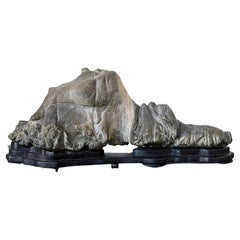
Chinese Scholar Stone Mountain Form with Display Stand
Located in Atlanta, GA
A small desk top Chinese scholar stones (also known as Gong Shi, meditation stone and spirit rock) on a fitted display wood stand circa 19th century. This is likely a grey Lingbi type stone with subtle arch mimics a horizontal mountain range. The wrinkles and folds on the greyish black surface were perfectly weathered by elements for millenniums. Smooth and rugged at the same time, the mountain range shows a poetic formation that was often depicted in the ink scroll...
Category

19th Century Chinese Chinese Export Antique Wood Asian Art and Furniture

Materials

Stone

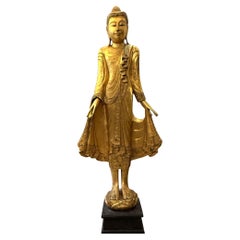
Antique wooden gilt Burmese Buddha statue in Mandalay style, circa 1940/1950
Located in NICE, FR
This 20th century Burmese standing Buddha embodies both spiritual presence and refined craftsmanship. Carved from wood and richly gilded, the figure captures the elegance of Burmes...
Category

1940s Burmese Chinese Export Vintage Wood Asian Art and Furniture

Materials

Wood, Giltwood

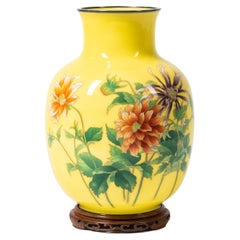
Japanese Cloisonné Vase Ando Jubei with Storage Box
Located in Atlanta, GA
A beautifully decorated cloisonné vase with silver rims by Ando Jubei (1876-1956), the celebrated Japanese Shippo studio. The piece is dated to late Meiji to early Showa period circa...
Category

Early 20th Century Japanese Japonisme Wood Asian Art and Furniture

Materials

Metal, Silver, Enamel

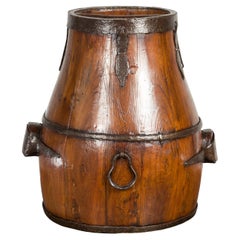
Qing Dynasty Period 19th Century Pear-Shaped Wooden Grain Basket
Located in Yonkers, NY
An antique Chinese Qing Dynasty period handmade pear shaped wooden grain basket from the 19th century, with varnished finish and iron hardware. Created in China during the Qing Dynas...
Category

19th Century Chinese Rustic Antique Wood Asian Art and Furniture

Materials

Iron

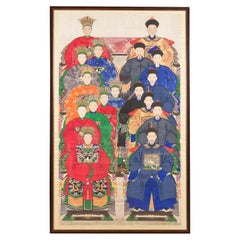
Qing Dynasty Period 19th Century Ancestor Group Portrait in Custom Frame
Located in Yonkers, NY
A Chinese Qing Dynasty period painting from the 19th century of an ancestor group portrait in custom frame. Created in China during the Qing Dynasty, this vertical painting features ...
Category

19th Century Chinese Antique Wood Asian Art and Furniture

Materials

Canvas, Plexiglass, Wood

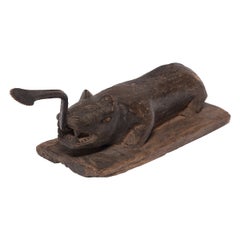
Mythical Beast Coconut Grater, c. 1900
Located in Chicago, IL
This wooden coconut grater (khood maprow) from the early 20th century is carved in the form of a crouching beast ready to pounce. Once used by a food vendor in a southeast Asian mark...
Category

Early 20th Century Southeast Asian Primitive Wood Asian Art and Furniture

Materials

Iron

Pair of Japanese Edo Six Panel Screens the Seven Sages
Located in Rio Vista, CA
Fantastic pair of 19th century Japanese late Edo/early Meiji period six-panel screens titled The seven sages of the bamboo grove. The Kano school screens...
Category

19th Century Japanese Edo Antique Wood Asian Art and Furniture

Materials

Brass, Gold Leaf

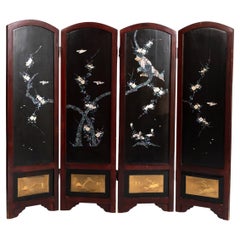
19th Century Shibayama Four Panel Screen Meiji Period Japan, C.1880
Located in London, GB
19th century Shibayama four Panel screen Meiji Period Japan C.1880 Mother of pearl inlay in black lacquer depicting a bird in relief with cherry blossom. The lower section with gilt panels, and the reverse red lacquer with tree silhouettes.
Category

19th Century Japanese Meiji Antique Wood Asian Art and Furniture

Materials

Mother-of-Pearl, Wood, Lacquer

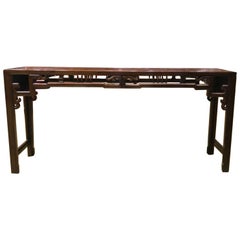
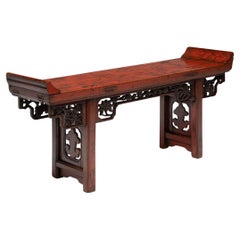
Petite Chinese Red Lacquer Altar Table, c. 1850
Located in Chicago, IL
In a traditional Chinese home, a long narrow table with everted flanges is placed in the main hall and set with beautiful objects such as instruments, flowers, or porcelains. Often r...
Category

Mid-19th Century Chinese Qing Antique Wood Asian Art and Furniture

Materials

Elm

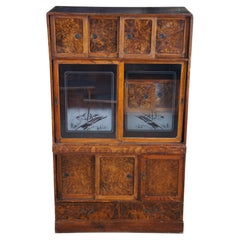
Late Meiji Japanese Cha Tansu Tea Chest Display Cabinet Cupboard 45"
Located in Dayton, OH
An antique Meiji era Cha Tansu Tea Cabinet. Features a burled frame. Features a central display portion with etched glass covering shelves and upper and lower cupboard with sliding...
Category

Late 19th Century Meiji Antique Wood Asian Art and Furniture

Materials

Hardwood, Burl

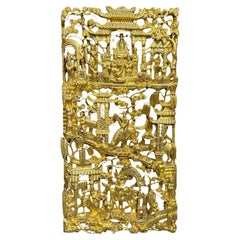
Large Chinese Carved Gilt Wood Story Panel, "Romance of the Three Kingdoms"
Located in Austin, TX
An unusually large vintage Chinese carved and pierced gilt wood story panel, early to mid 20th century, Southern China. The intricately carved panel depicts images from "The Romance...
Category

Mid-20th Century Chinese Qing Wood Asian Art and Furniture

Materials

Metal

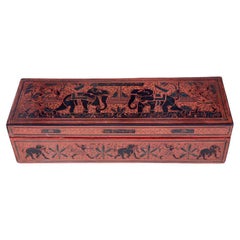
Burmese Lacquer Rectangular Box with Incised Decoration of Elephants and Figures
Located in Point Richmond, CA
Antique Burmese Lacquer Rectangular Box with Incised Decoration of Elephants and Figures. The box crafted of wood and covered in several layers...
Category

Early 20th Century Burmese Other Wood Asian Art and Furniture

Materials

Wood, Lacquer

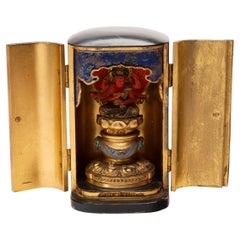
Japanese Zushi Traveling Shrine of Aizen Myō-ō, c. 1850
Located in Chicago, IL
A simple exterior of black lacquer belies the splendor within this late 19th-century Japanese traveling shrine (zushi). The hinged doors open to reveal a lustrous gold interior and a...
Category

Mid-19th Century Japanese Edo Antique Wood Asian Art and Furniture

Materials

Wood

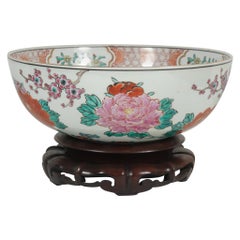
Chinese Late Republic Period Bowl On Stand Decorated in Enamel Colors
Located in Hudson, NY
This nice medium-sized bowl has underglaze and overglaze painted details and was made circa 1945 to 1950. It is decorated in an asymmetrical pattern of prunus and chrysanthemums with...
Category

Mid-20th Century Chinese Wood Asian Art and Furniture

Materials

Porcelain, Rosewood

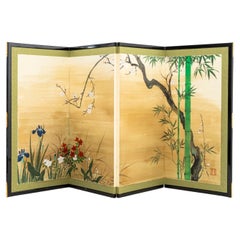
Japanese Bamboo Orchids 4-Panel Byobu Screen
Located in Astoria, NY
Japanese Bamboo and Orchids Scene Four-Panel Byobu Screen, gouache on silk, with iron red six character mark on the lower right panel, in ebonized wood frame. 24" H x 39" W. Provenan...
Category

20th Century Japanese Ming Wood Asian Art and Furniture

Materials

Silk, Hardwood

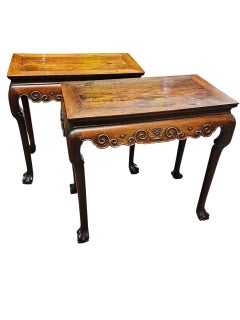
Rare Pair of C19th Chinese Altar tables
Located in London, GB
Pair of Early C19th Chinese Alter Tables Panelled Tops with Shaped Frieze raised on lovely shaped Cabriolet Legs Lovely Colour wood Dated C1820s
Category

19th Century Chinese Chinese Chippendale Antique Wood Asian Art and Furniture

Materials

Hardwood

Rare Pair of C19th Chinese Altar tables
$11,489 Sale Price / set
30% Off
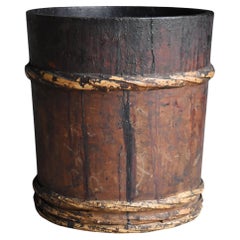
Japanese Antique Lacquer Bucket 1860s-1920s / Plant Pot Cover Wabisabi
Located in Chōsei District Nagara, JP
This is an old Japanese lacquer tub, a rare piece that preserves the craftsmanship of artisans from the Meiji to Taishō period (1860s–1920s). The body is made of Japanese cedar, whil...
Category

Early 20th Century Japanese Taisho Wood Asian Art and Furniture

Materials

Bamboo, Cedar, Lacquer

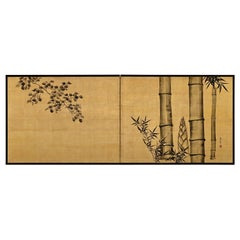
19th Century Japanese Screen for Tea-Ceremony, Ink Bamboo and Plum on Gold Leaf
Located in Kyoto, JP
Three Friends of Winter Nakajima Raisho (1796-1871) Late Edo period, circa 1850 Ink and gold leaf on paper. This is a double-sided Japanese Furosaki or tea-ceremony screen from the mid 19th century; bamboo and plum on the front, young pines the back. It by Nakajima Raisho, a master painter of the Maruyama school in the late Edo and early Meiji periods. In this work Raisho combines exquisite ink brushwork with large open spaces of brilliant gold-leaf to inspire the viewers imagination. Rather than naturalism, he is searching for the phycological impression of the motifs, resulting in abstraction and stylization. His simplification of the motifs the result of looking to capture the inner nature of the objects. This art motif is known as Sho Chiku Bai, or the Three Friends of Winter. Evergreen pine connotes steadfastness, bamboo suggests both strength and flexibility, while plum blossoms unfurling on snow-laden branches imply hardiness. Combined, this trio is emblematic of Japanese new year. Chinese literati were the first to group the three plants together due to their noble characteristics. Like these resilient plants flowering so beautifully in winter, it was expected of the scholar-gentleman to cultivate a strong character with which he would be able to show the same degree of perseverance and steadfastness even during times of adverse conditions. The screen would have been placed near the hearth of a room used for the Japanese tea ceremony, shielding the fire from draughts and also forming a stimulating and decorative backdrop behind the tea utensils. It would have been used in the Hatsugama, or first tea-ceremony of the new year. Nakajima Raisho (1796-1871) originally studied under Watanabe Nangaku before entering the school of Maruyama Ozui. He was the highest ranking Maruyama school painter at the end of the Edo period and was known as one of the ‘Four Heian Families’ along with Kishi...
Category

Mid-19th Century Japanese Edo Antique Wood Asian Art and Furniture

Materials

Gold Leaf

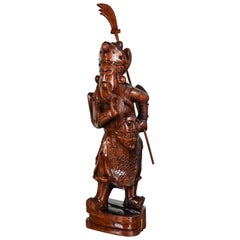
20th Century Asian Sculpture Guan Yu Chinese Warrior Hand Carved Rosewood
Located in Topeka, KS
Handsome vintage Asian Chinoiserie rosewood Guan Yu or Chinese warrior hand carved larger scale sculpture. Beautiful condition, keeping in mind that this is vintage and not new so will have signs of use and wear. Please see photos and zoom in for details. We attempt to portray any imperfections. Circa, 20th Century. A warrior is one who sacrifices himself for the good of others. His task is to take care of the elderly, the defenseless, those who cannot provide for themselves, and above all, children- the future of humanity. This is a magnificent vintage Chinese warrior or Guan Yu sculpture comprised of stunning rosewood with intricately hand carved details and a removeable guandao (Chinese pole weapon). In Chinese culture, General Guan Yu represents loyalty and valor. People believe that by having his image in art or sculpture in their home will protect their family from harm. And while we don’t believe he is going to break out with any actual martial arts moves; his fearless presence commands the room and demands attention! You may notice that in some of the photos our warrior friend is holding his guandao upside-down, don’t judge! Even the best of warriors tend to get exhausted from a long day of defending humanity and protecting mankind. A guy can get a little turned around! Just look at his expression… he is OVER it!! His hand is even up gesturing as if to say, “Talk to the hand!” LOL!! He is handsomely dressed from head to toe in full body armor and his long beard or Fu Manchu is flowing in the breeze. He stands proud upon a rounded square base at about 24 inches tall, so he is definitely larger scale, he will be fabulous in ANY room of your home, and he is the EPITOME of Chinoiserie excellence! Don’t let this incredible hand carved rosewood Chinese warrior sculpture...
Category

20th Century Chinese Chinese Export Wood Asian Art and Furniture

Materials

Rosewood

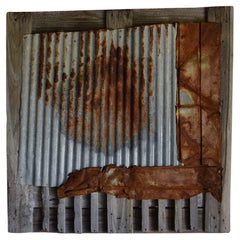
Japanese Wall Art / Japanese objet / wabi-sabi art / primitive wall art
Located in Sammu-shi, Chiba
This is a wall art made using some of the material from an old Japanese door. This is a wooden door reinforced with galvanized iron sheets. It's a convenient size that doesn't take...
Category

2010s Japanese Primitive Wood Asian Art and Furniture

Materials

Tin

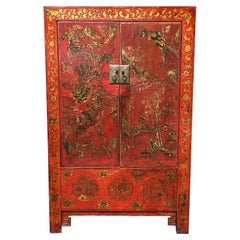
19th Century Red Lacqured Chinese Cabinet with Gilt Decoration
Located in Dallas, TX
A very decorative red and black lacqured 19th century cabinet from Shanxi China. This cabinet has gilded decoration depicting mountain, foliage and temples with people as well as but...
Category

Late 19th Century Chinese Chinoiserie Antique Wood Asian Art and Furniture

Materials

Wood

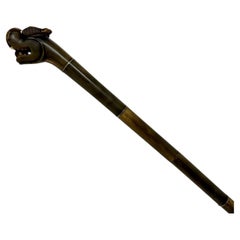
Antique Asian Chinese Horn Dragons Head Victorian Vintage Walking Stick Cane
Located in Dublin, Ireland
Very Unusual Horn Sectional Hand Carved Chinese Walking Stick or Dress Cane of outstanding quality, last half of the Nineteenth Century. The ...
Category

Late 19th Century Chinese Victorian Antique Wood Asian Art and Furniture

Materials

Sterling Silver

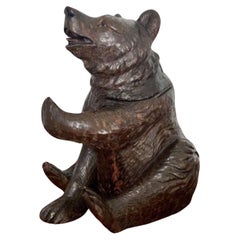
Large antique 19th century Victorian quality carved Black Forest bear
Located in Ipswich, GB
Large antique 19th century Victorian quality carved Black Forest bear in a seated position, with the original glass eyes, fantastic carved detail throughout, his head lifts to the si...
Category

Early 19th Century Victorian Antique Wood Asian Art and Furniture

Materials

Wood

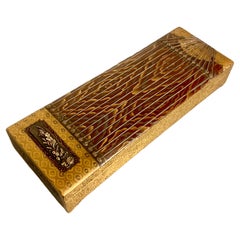
Japanese Lacquer Writing Box, Suzuribako, Edo Period, 18th Century, Japan
Located in Austin, TX
An exceptionally fine and unusual Japanese lacquer writing implements box, suzuribako, in the form of a zither, koto, Edo Period, 18th century, Japan. With a modern wood storage box,...
Category

18th Century Japanese Edo Antique Wood Asian Art and Furniture

Materials

Gold, Silver, Copper

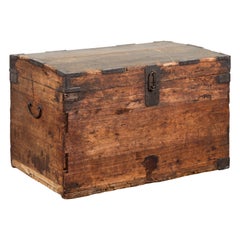
Japanese Meiji Period 19th Century Blanket Chest with Iron Hardware and Patina
Located in Yonkers, NY
A Japanese Meiji period blanket chest from the 19th century with iron hardware and distressed patina. Created in Japan during the Meiji period, this wooden blanket chest features a s...
Category

19th Century Japanese Meiji Antique Wood Asian Art and Furniture

Materials

Iron

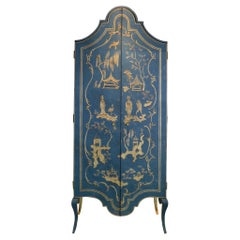
18th Century Hand-Painted Venetian Style Deep Blue Chinoiserie Tevere Armoire
Located in Ronchi dei Legionari, IT
From our Hand-Painted Furniture Collection, we are pleased to introduce you to our Tevere Armoire in a special deep sea blue with a full on-relief gilded Chinoiserie Decor. The entire facade of this spectacular Armoire becomes an amazing canvas opportunity to hand-decorate a full gilded Chinoiserie Decor on relief. Each Piece from our Collections is entirely hand-painted on each side of the Furniture by using the very best 18th century craftsmanship Venetian techniques, passed down through the generations of artists from our land. Likewise, the sides of this beautiful creation is also enriched with on-relief Chinoiserie Scrollings...
Category

2010s Italian Other Wood Asian Art and Furniture

Materials

Wood

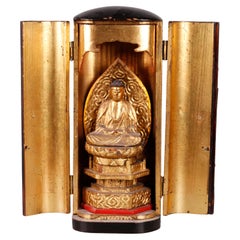
Japanese Lacquer Buddha w/ Shrine, 19th c.
Located in New York, NY
3in(D) x 4in(W) x 9in(H) are the overall dimensions of the shrine
Category

Late 19th Century Japanese Antique Wood Asian Art and Furniture

Materials

Wood, Lacquer

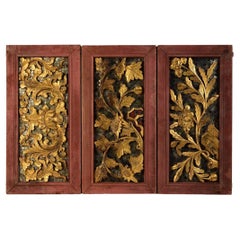
19th C., Rattanakosin, A Set of Antique Thai Wood Carving Panels with Flower
Located in Sampantawong, TH
A set of antique Thai wood carving panels with flower. Age: Thailand, Rattanakosin Period, 19th Century Size per panel: Height 61.5 C.M. / Width 30.7 C.M. / Thickness 3.6 C.M. Size ...
Category

19th Century Thai Antique Wood Asian Art and Furniture

Materials

Wood

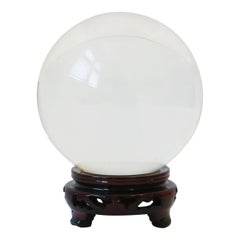
Crystal Ball Sphere with Chinoiserie Base
Located in New York, NY
A crystal ball decorative sphere decorative object with Chinoiserie wood base, circa late-20th century. A great piece for a shelf, cocktail table, credenza, etc. Very good condition ...
Category

Late 20th Century Chinoiserie Wood Asian Art and Furniture

Materials

Crystal

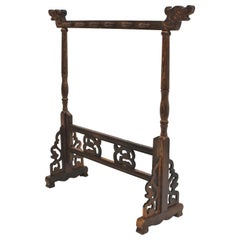
New Brush Stand Solid Wenge Wood Large Holds 16
Located in Somis, CA
Our calligraphy brush stands are made of solid wenge wood, a prized, sustainable, exotic wood with beautiful grains. Top of the stands are deco...
Category

2010s Chinese Wood Asian Art and Furniture

Materials

Wood, Wenge

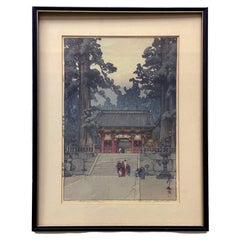
Framed Japanese Woodblock Print Yoshida Hiroshi Toshogu Shrine
Located in Atlanta, GA
A Japanese woodblock print by Yoshida Hiroshi (1876-1950), entitled "Toshogu Shrine", The vertical oban format print was made in Showa 12th year (1937). On the left margin in grey in...
Category

1930s Japanese Showa Vintage Wood Asian Art and Furniture

Materials

Wood, Paper

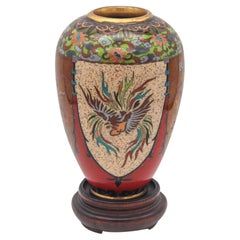
Japan 1890 Meiji Period Decorative Vase In Cloisonné Enamel With Wood Base
Located in Miami, FL
Japanese vase from the Meiji Period (1868-1912). Beautiful antique decorative vase, created in Japan during the Meiji period (1868-1912), circa 1890s. It was carefully crafted in so...
Category

1890s Japanese Meiji Antique Wood Asian Art and Furniture

Materials

Bronze, Enamel

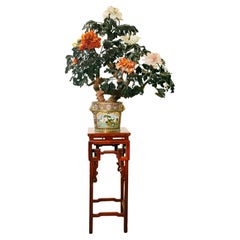
massive Chinese jade/stone flower tree in cloisonné base
Located in New York, NY
tall wooden stand/pedestal shown in pictures is not included with this item; flower tree only (not including wooden stand): 43in(H)
Category

Late 20th Century Chinese Wood Asian Art and Furniture

Materials

Stone, Agate, Jade, Metal, Enamel

Still Thinking About These?

All Recently Viewed