Asian Paintings and Screens
to
330
929
283
1,493
104
9
38
25
16
4
4
4
2
1
143
604
746
113
257
157
70
38
3
26
14
6
17
24
17
8
2
724
679
618
517
417
1,606
1,465
962
455
113
1,606
1,566
1,580
25
23
4
3
2
Place of Origin: Asian
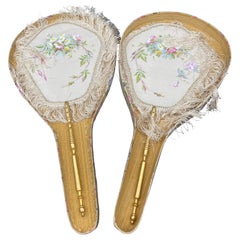
19th Century a Pair of Chinese Silk Fans with Giltwood Handles
Located in Brea, CA
Antique 19th century hand painted floral motifs on silk Chinese fans Qing dynasty, the fan in silk with silk fringe and giltwood handles, housed within a conforming paper covered box...
Category
Late 19th Century Qing Antique Asian Paintings and Screens
Materials
Silk
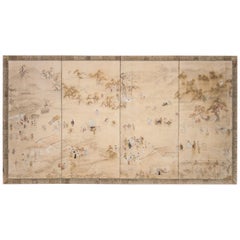
Japanese Four Panel Screen Country Genre Scene
Located in Hudson, NY
Depicting farmers, pheasant hunting, picnicking, festival and general village scenes. Ink and mineral pigments on handmade mulberry paper.
Category
18th Century Antique Asian Paintings and Screens
Materials
Paper
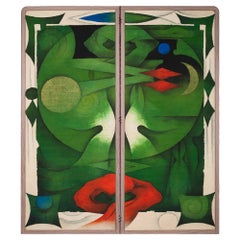
Japanese Two Panel Screen Psychedelic Forms
Located in Hudson, NY
Celestial images on hand-dyed tsumugi cloth. Makers mark: unreadable.
Category
Mid-20th Century Asian Paintings and Screens
Materials
Fabric
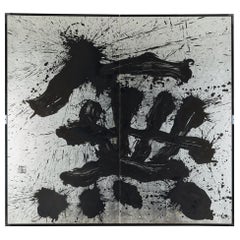
Japanese Two Panel Screen: Mu (Nothing)
Located in Hudson, NY
Calligraphy reads: Mu (Nothing). Ink on silver in a black lacquered wooden trim. Seal is illegible.
Category
Early 20th Century Asian Paintings and Screens
Materials
Silver
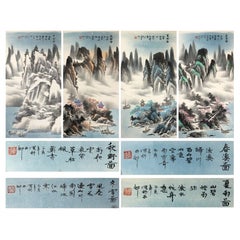
Lovely Four Seasons SerieS Scroll Painting China Artist Painted, 20th Century
Located in Amsterdam, Noord Holland
It is a work of landscape maps and four width pairs in the four seasons of Shenzhen, China. It is a tasteful work that makes each one feel the taste of the season.
Additional inform...
Category
20th Century Asian Paintings and Screens
Materials
Paper

$2,774 Sale Price / set
20% Off
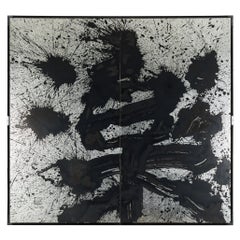
Japanese Two Panel Screen: Raku (Pleasure)
Located in Hudson, NY
Calligraphy reads: Raku (Pleasure). Ink on silver in a black lacquered wooden trim. Seal is illegible.
Category
Early 20th Century Asian Paintings and Screens
Materials
Silver
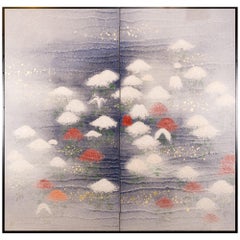
Japanese Two Panel Screen Chrysanthemums Through the Mist Obara Art Screen
Located in Hudson, NY
Japanese two panel screen: Chrysanthemums Through the Mist Obara Paper Art Screen. Surreal and masterful rendering of chrysanthemums cloaked in mist that varies in opacity made entirely of carefully arranged mulberry paper fibers in a Japanese art practice called Obara. Accented with gold leaf. Unique in terms of both execution and dreamlike mood. Made by Yamauchi Issei (b. 1929), stamped in the corner. Issei is well known throughout Japan as the leading artist in Obara Paper Art. Starting in 1948, he apprenticed with Fuji Tatsukichi, a leading proponent of the arts and crafts movement in Japan who worked to revive many cultural traditions on the brink of extinction. Issei started exhibiting in the Nitten in 1953, won the gold medal in 1963, and eventually became a juror. His artwork was given as a gift to the Showa Emperor of Japan, as well as dignitaries such as General Douglas MacArthur...
Category
Mid-20th Century Showa Asian Paintings and Screens
Materials
Wood, Paper
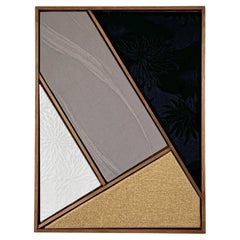
Vintage kimono textile art " Monochrome Geometry " by ikasu Gold Grey Japan
By Kimono ikasu
Located in Setagaya City, JP
This work is inspired by traditional Japanese nature colors symbolism, and is framed in paulownia wood originally used for a kimono chest-of-drawers.
It is filled with storytelling ...
Category
1960s Japonisme Vintage Asian Paintings and Screens
Materials
Silk, Wood
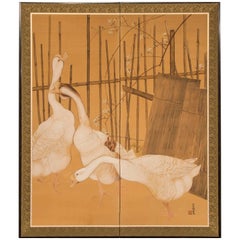
Japanese Two-Panel Screen: Geese in a Country Setting
Located in Hudson, NY
Country farm geese with early spring blossoms and a bamboo fence. Beautiful details on the feathers. Signature and seal read Keibo Joshi (Ms. Keibo) min...
Category
Early 20th Century Meiji Asian Paintings and Screens
Materials
Silk, Wood, Paper
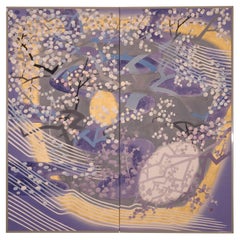
Japanese Two Panel Screen: Yozakura (Cherry Blossom Viewing at Night)
Located in Hudson, NY
Unusual subject matter of cherry blossoms in the moonlight on dyed silk and applied gold in a grey lacquer trim. Signature and seal read: Adachi Masakazu. ...
Category
20th Century Asian Paintings and Screens
Materials
Gold
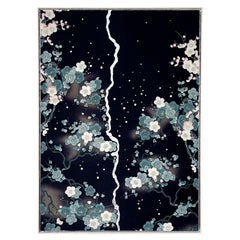
Japanese Two-Panel Screen Pink and White Magnolias in Early Bloom
Located in Hudson, NY
Japanese two-panel screen: Pink and white magnolias in early bloom, Taisho period (1912-1926) painting of Japanese magnolia tree branches as the flowers...
Category
1920s Taisho Vintage Asian Paintings and Screens
Materials
Silk, Wood, Paper

Antique kimono textile art " Plum Blossom Night ~ Resilience ~ " by ikasu Japan
By Kimono ikasu
Located in Setagaya City, JP
This artwork uses antique fabric from Taisho era (early 1920ies) kimono and paulownia wood taken from antique kiritansu - chest-of-drawers used initially to keep kimonos.
It is el...
Category
1920s Japonisme Vintage Asian Paintings and Screens
Materials
Silver Leaf
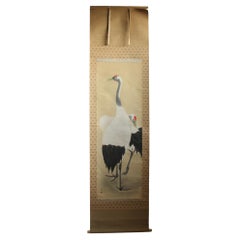
K7 Japanese Antiques Hanging scroll, silk, crane
Located in Niiza, JP
Hanging scroll, silk, crane
Image size: 420 (W) x 1270 (H) [mm] Scroll size: 560 (W) x 2120 (H) [mm]
Box size: 80 x 75 x 630 mm, 830 g
Colored cloth and silk, wooden tip
The crane...
Category
19th Century Antique Asian Paintings and Screens
Materials
Silk
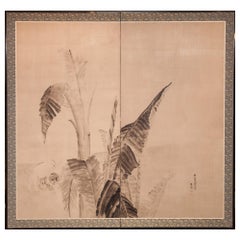
Japanese Two Panel Screen Ink Painting of Banana Leaves on Mulberry Paper
Located in Hudson, NY
Edo period (dated 1787) beautiful painting of unfurling palm leaves with romping puppies in the background. Ink painting (sumi-e) on mulberry paper. Signature reads: Okyo. Calligraph...
Category
Late 18th Century Edo Antique Asian Paintings and Screens
Materials
Paper
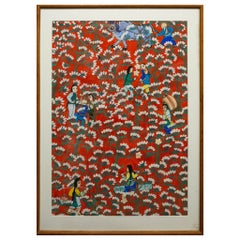
Pruning the Orchard with Blue Ox
Located in Hudson, NY
Chinese gouache painting on paper of farmers tending to the land. Signed on the reverse. Comes framed.
Category
1970s Vintage Asian Paintings and Screens
Materials
Paper
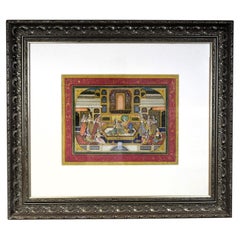
Miniature Mughal of Emperor Akbar And His Wife In His Courtyard, 19th Century
Located in Islamabad, PK
The Mughal miniature painting, executed with an exceptionally fine single-hair brush, is a testament to the meticulous craftsmanship and exquisite detail characteristic of Mughal art...
Category
Late 19th Century Anglo-Indian Antique Asian Paintings and Screens
Materials
Paint, Paper
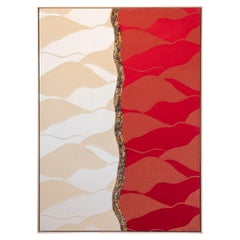
Vintage obi textile art "Under the Sun ~ Serendipity ~" by ikasu Red Beige Japan
By Kimono ikasu
Located in Setagaya City, JP
<
This artwork creatively uses tree bark to evoke the imagery of woods and mountains during both the morning and nighttime on left and right. It is elegantly framed with paulownia wood, a tree closely connected to kimono culture, and is filled with storytelling and sense of luxury.
By incorporating both the front and back sides of the same obi fabric woven in different colors, the play of light and shadow on the mountains is depicted through the contrasting appearances of these surfaces.
The intention behind this piece is to convey the exquisite beauty of Japanese mountains and the lush forests that inhabit them. To achieve this, traditional elements of Japanese culture, such as obi textiles and craftsmanship involving wood, were used.
The outer side and inner linings of the same obi, no longer suitable for clothing, along with bark material that would normally be discarded, have been repurposed to create this exceptional upcycle artwork.
The fusion of Japanese natural materials – silk, paulownia wood, and pine bark for the central decoration – along with the so-called "Tozan" pattern, a unique Japanese natural design showing mountains from far-away point, captures the magnificent beauty of Japanese nature from various perspectives.
The central bark decoration stands out as a distinctive feature of this work. Pine, oak, and other tree barks are interwoven among the mountains woven into the obi, creating a tangible and authentic natural atmosphere.
<< Period / Story
The obi used in this piece was originally crafted during the late Showa period (1960-80ies).
<< Explanation and meaning of pattern and colors
This upcycle artwork uses an obi with a tozan pattern woven in two colors. The design is inspired by a distant mountain range, a motif that has been used in paintings and crafts since ancient times. However, in this particular design, the mountains are depicted not as distant peaks but as graceful semicircles giving it a mild atmosphere.
<< Characteristics of the fabric
This upcycled Fukuro-obi (two-side obi) showcases a festive color pattern of mountains intricately woven with gold threads against a beige front and red on the back.
The way this obi interacts with light allows it to shift in expression, much like a mountain revealing different facets over time. It can transform from deep shades of color to the appearance of gold shimmering against bright hues, depending on the lighting and viewing angle.
<< About the frame
Kiritansu - chest-of-drawers for kimono, is traditionally made from paulownia wood, a uniquely Japanese material closely tied to the world of kimonos.
Paulownia wood is known as the lightest wood in Japan, prased for its natural luster, resistance to moisture, and resilience against cracking. Since ancient times, it has been used in crafting furniture, chests, and musical instruments.
During the Edo period, it became customary to store cherished kimonos in paulownia chests...
Category
Late 20th Century Japonisme Asian Paintings and Screens
Materials
Silk, Wood
A Burmese painting showing a colourful scene of a a ceremonial celebration
Located in Central England, GB
This most eye catching piece of fine artwork dates to circa 1930 and is a Burmese painting on fine canvas laid onto a card and shows a kaleidoscope typ...
Category
Mid-20th Century Primitive Asian Paintings and Screens
Materials
Canvas, Wood

VIntage kimono textile art " Geometry ~ Chrysanthemums ~" by ikasu White Japan
By Kimono ikasu
Located in Setagaya City, JP
<
This work is inspired by traditional Japanese natural symbolism, and is framed in paulownia wood originally used for a kimono chest-of-drawers.
It is elegantly framed with...
Category
1960s Japonisme Vintage Asian Paintings and Screens
Materials
Silk, Wood

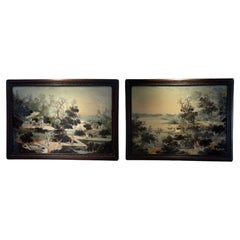
Chinese Pair
Diptych
Reverse Glass Paintings of Port Life, Early 18th Century
Located in North Miami, FL
This pair of reverse glass paintings are truly one-of-a-Kind pieces. The scene has been beautifully rendered, with great attention paid to detail. These piece were created in China d...
Category
18th Century Antique Asian Paintings and Screens
Materials
Wood, Glass, Paint
$23,600 Sale Price / set
20% Off
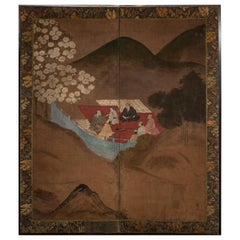
Japanese Two Panel Screen, Cherry Blossoms Viewing Party
Located in Hudson, NY
A private viewing in picnic surrounding of nobles (probably samurai), including one woman. Mineral pigments on mulberry paper with silk brocade border.
Category
18th Century Edo Antique Asian Paintings and Screens
Materials
Silk, Paper
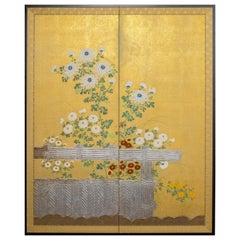
Japanese Two-Panel Screen, Rimpa Style Chrysanthemums on a Twig Fence
Located in Hudson, NY
Detailed painting of varieties of chrysanthemums behind a bound-twig garden fence rendered in silvered, raised gofun. Stylized low-hanging gold mist clouds. Rimpa-style painting in m...
Category
Late 19th Century Antique Asian Paintings and Screens
Materials
Gold
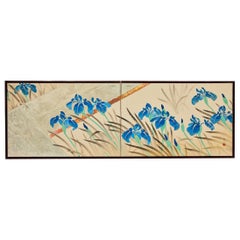
Japanese Two Panel Screen: Irises Along a Raised Garden Walkway
Located in Hudson, NY
Furosaki (tea ceremony screen) Mineral pigments on mulberry paper with oxblood lacquer trim. Signature and seal read: Katsutoshi. On back it is titled: Irises (Kakitsubata) with a ...
Category
Early 20th Century Asian Paintings and Screens
Materials
Lacquer, Paper
Japanese Two-Panel Screen, Shogun
s Journey to Edo
Located in Hudson, NY
Kano school painting of nobles at rest (some yawning) under moonlit sky. Mostly likely a representation of the last story in the Ise Monogatari: chapter 16, Sekiya (The Gatehouse). A...
Category
Mid-19th Century Antique Asian Paintings and Screens
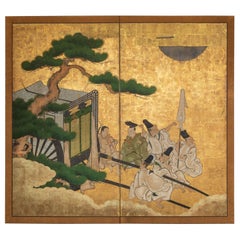
Vintage obi textile art " Broken Vase ~ kintsugi ~" by ikasu Black Gold Japan
By Kimono ikasu
Located in Setagaya City, JP
<
This textile artwork uses a vintage obi dated around 1980ies, with a feather motif, and arranges it so that it looks like a vase.
Antique obi, just as it is a broken vase, is united back again with black obijime - a string used to tie up obi when it’s worn. Framed in kiritansu (antique chest) paulownia wood.
It is elegantly framed with paulownia wood originally used for kimono chest-of-drawers, and is filled with storytelling and sense of luxury.
I used pieces of kimono that could no longer be used as clothing and kiritansu chest-of-drawers that would normally be discarded to create the ultimate upcycled piece.
<< Explanation and meaning of pattern and colors
Feathers hold various meanings and symbolism in Japanese traditional culture, often reflecting themes of spirituality, symbolism, and folklore. Here are some of the meanings associated with feathers in Japanese tradition:
・Divine Protection: Feathers are often seen as symbols of divine protection and spiritual guidance. Feathers, especially those from birds, are considered to be imbued with the protective energy, offering spiritual guardianship and safeguarding against negative forces.
・Connection to the Spirit World: Feathers are sometimes associated with the spirit world and the realm of the divine. In folklore and mythology, feathers are depicted as messengers between the earthly realm and the celestial realms.
・Symbol of Beauty and Elegance: Feathers are admired for their natural beauty, grace, and elegance. In traditional Japanese arts such as Noh theater, Kabuki, and dance performances like Kagura, actors and performers often use feathered costumes or accessories to enhance their appearance and convey a sense of refinement and sophistication.
・Sign of Good Luck and Prosperity: In Japanese folklore, certain birds like cranes and pheasants are considered symbols of good fortune, longevity, and prosperity. Feathers from these birds are often depicted in art and craftwork as auspicious symbols believed to bring blessings and positive energy to the bearer.
<
Kiritansu - chest-of-drawers for kimono, is traditionally made from paulownia wood, a uniquely Japanese material closely tied to the world of kimonos.
Paulownia wood is known as the lightest wood in Japan, prased for its natural luster, resistance to moisture, and resilience against cracking. Since ancient times, it has been used in crafting furniture, chests, and musical instruments.
During the Edo period, it became customary to store cherished kimonos in paulownia chests...
Category
1980s Japonisme Vintage Asian Paintings and Screens
Materials
Silk, Wood
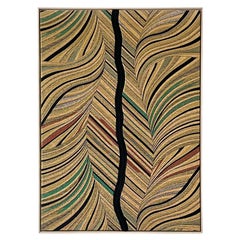
B4 JapaneseAntiques 6panels, Gold back, Flower&bird Chicken Crane, FoldingScreen
Located in Niiza, JP
Material: paper, wooden frame
One sheet: W580×H1750mm,
unfolded size: W3520mm, 10kg
Folded size: W600×H1750×D105mm
Estimated packaging (sandwiched with 5-10mm plywood):
21cm x 70cm x...
Category
19th Century Antique Asian Paintings and Screens
Materials
Paper
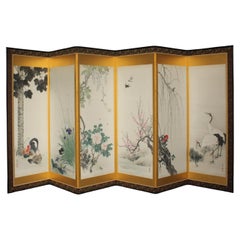
Nightingale on Branch Meiji Period Scroll Japan 19/20c
Located in Amsterdam, Noord Holland
Very Lovely painting.
Category
Mid-19th Century Meiji Antique Asian Paintings and Screens
Materials
Silk
$1,196 Sale Price
20% Off
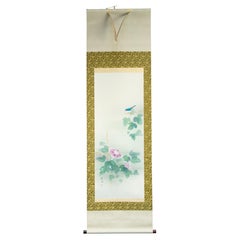
Japanese Single Wood Panel: Lacquered Wild Grasses
Located in Hudson, NY
Beautiful fine detail of a variety of wild grasses. Lacquer on wood panel with carved surface and metal rim. Exhibited at National Nitten Exhibition 1969.
Category
20th Century Asian Paintings and Screens
Materials
Metal
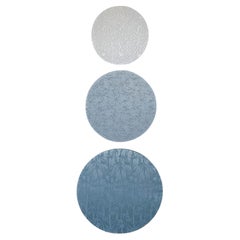
Vintage kimono textile art " Turquoise Forest ~ Strength ~ " by ikasu Blue Japan
By Kimono ikasu
Located in Setagaya City, JP
Fabrics featuring iconic Japanese plants like chrysanthemum, maple, and bamboo were gathered from various long underwear and kimono pieces to create a set of canvases (diameter 30, 25 and 20cm) showcasing exquisite gradations.
The top canvas, in pristine white, originates from long under-kimono, while the middle and bottom canvases are skillfully upcycled from kimono fabrics.
<< Period / Story
The long under-kimono and kimono fabrics used in these canvases were originally crafted and worn during the late Showa period (1960-80ies).
<< Explanation and meaning of pattern and colors
The pattern on the top canvas features a chrysanthemum, an auspicious emblem symbolizing longevity. It is affectionately referred to as the "raccoon dog chrysanthemum" due to the large, overlapping petals resembling the fur of a muzina, a creature similar to a raccoon dog or badger. This motif is highly popular in various plant-inspired designs and frequently seen in Edo komon, katazome, and jimon textiles.
The top canvas naga-juban under-kimono, being entirely white and devoid of any additional dyes, suggests its use as formal wear. Its pristine white hue accentuates the silk's luster when exposed to light and highlights the beauty of the woven patterns.
The fabric used here is rinzu, a type of fabric thinner than crepe de chine, characterized by its soft, smooth texture and subtle sheen. This particular lintel distinguishes itself with the way its ground pattern emerges and also incorporates a woven chrysanthemum pattern.
The central canvas showcases a maple tree, symbolizing longevity, which changes its colors with the seasons, bringing joy and happiness to people's lives.
The bamboo featured on the lower canvas has been regarded as a symbol of good fortune since ancient times, given its straight and vigorous growth, along with the Chinese legend that a phoenix consumes its fruit. It embodies concepts such as "immortality," "longevity," and "strength" because it remains green even in winter. The hollow stem also signifies "innocence," suggesting that there are no hidden agendas.
All three canvases are adorned with ground patterns that, when viewed from a distance, appear as modern works of art, yet upon closer inspection, they reveal a distinct Japanese ambiance.
<< Characteristics of the fabric
All three canvases are made of fabrics with jimon. The unique and high level of Japanese weaving...
Category
1970s Japonisme Vintage Asian Paintings and Screens
Materials
Canvas, Silk
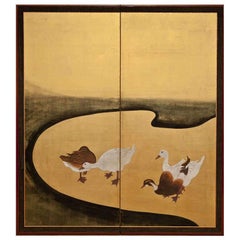
Japanese Two Panel Screen: Water Fowl by River
s Edge
Located in Hudson, NY
Japanese Two Panel Screen: Water Fowl by River's Edge, Showa period (1926 - 1989) painting of fowl on a river bank. Very art deco in style. Painted in min...
Category
Early 20th Century Showa Asian Paintings and Screens
Materials
Silk, Wood, Paper
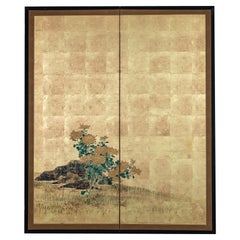
Japanese Two Panel Screen: Simple Chrysanthemums on Gold
Located in Hudson, NY
Mineral pigments on gold leaf. Not signed, by: Baikei Hitsu.
Category
1880s Antique Asian Paintings and Screens
Materials
Gold Leaf
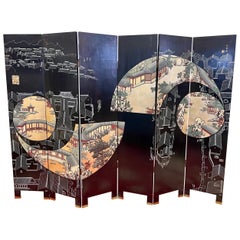
Chinese Chinoiserie Black Lacquered and Gold Coromandel 6 Panel Screen
Located in West Hartford, CT
Spectacular Chinese black lacquered 6 panel folding screen incised with gold gilt and white paint featuring Chinese village scenery. Feet...
Category
Mid-20th Century Chinese Export Asian Paintings and Screens
Materials
Wood, Lacquer
$2,316 Sale Price
44% Off
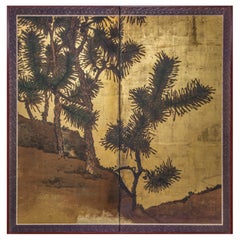
Japanese Two Panel Screen Young Pine and Pine Cones on Gold
Located in Hudson, NY
Mineral pigments on gold leaf on mulberry paper with a silk brocade border.
Category
Early 1800s Antique Asian Paintings and Screens
Materials
Brocade, Silk, Paper
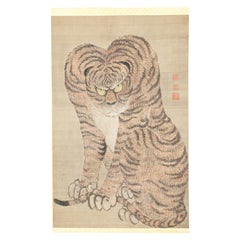
Large Japanese Scroll of a Tiger
Located in Hudson, NY
Wonderfully large and bold tiger painted in ink and mineral pigments on silk mounted with silk brocade border. Seal reads: Miyaguchi (alternative reading: ...
Category
Early 1800s Edo Antique Asian Paintings and Screens
Materials
Silk
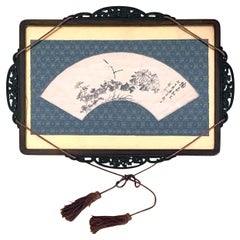
Framed Japanese Ink Painting Hidaka Tetsuo
By Hidaka Tetsuo
Located in Atlanta, GA
An ink painting on the fan surface by Japanese Zen artist Hidaka Tetsuo (1791-1871), now framed in a traditional Japanese carved wood frame with silk fabric mat and decorative hangin...
Category
1850s Japonisme Antique Asian Paintings and Screens
Materials
Wood, Paper
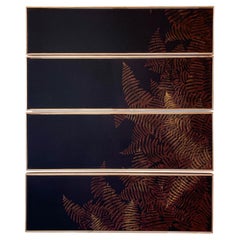
Vintage kimono textile art " Fern ~ Connection to Nature ~" by ikasu Black Japan
By Kimono ikasu
Located in Setagaya City, JP
This work uses an antique tomesode (festive kind of kimono) with fern design to evoke feelings of tranquility, harmony, and appreciation for the beauty of the environment. Can be used both vertically and horizontally.
It is elegantly framed with paulownia wood originally used for kimono chest-of-drawers, and is filled with storytelling and sense of luxury.
I used pieces of kimono that could no longer be used as clothing and kiritansu chest-of-drawers that would normally be discarded to create the ultimate upcycled piece.
<< Explanation of colors and patterns
In Japanese traditional culture, ferns, particularly the Japanese painted fern (Athyrium niponicum), hold several meanings and symbolisms:
・Elegance and Beauty: Ferns are admired for their graceful, delicate appearance and intricate leaf patterns. In Japanese aesthetics, they are appreciated for their natural beauty and are often used in gardens, landscapes, and floral arrangements to add a sense of refinement and elegance.
・Resilience and Perseverance: Ferns are known for their ability to thrive in diverse environments, including shady forests, rocky cliffs, and damp soil. Their resilience in the face of challenging conditions is seen as a symbol of endurance and perseverance. In Japanese culture, ferns may represent the ability to overcome adversity and flourish despite obstacles.
・Connection to Nature and Tranquility: Ferns are native to forested areas and are often associated with the natural world. In Japanese traditional culture, they symbolize a deep connection to nature and the importance of maintaining harmony with the environment. The lush green foliage of ferns evokes feelings of tranquility and peacefulness, making them popular motifs in Zen gardens and traditional landscape paintings.
・Purity and Simplicity: Ferns are emblematic of simplicity and purity in Japanese aesthetics. Their unassuming beauty and understated elegance reflect the principles of wabi-sabi, an aesthetic worldview that values imperfection, impermanence, and simplicity. Ferns may be used in tea ceremonies, Ikebana (flower arranging), and other traditional arts to evoke a sense of tranquility and appreciation for life's fleeting moments.
Overall, ferns in Japanese traditional culture symbolize elegance, resilience, connection to nature, purity, and simplicity. Their presence in art, literature, and landscape design underscores their enduring significance as symbols of natural beauty and spiritual resonance.
<< Characteristics of the fabric
This vintage textile is hand-painted with a traditional Japanese technique called "yuzen".
<< About the frame
Kiritansu - chest-of-drawers for kimono, is traditionally made from paulownia wood, a uniquely Japanese material closely tied to the world of kimonos.
Paulownia wood is known as the lightest wood in Japan, prased for its natural luster, resistance to moisture, and resilience against cracking. Since ancient times, it has been used in crafting furniture, chests, and musical instruments.
During the Edo period, it became customary to store cherished kimonos in paulownia chests...
Category
1960s Japonisme Vintage Asian Paintings and Screens
Materials
Silk, Wood
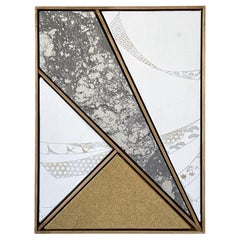
VIntage kimono textile art " Geometry ~ Marble ~" by ikasu Gold White Grey Japan
By Kimono ikasu
Located in Setagaya City, JP
This work is inspired by traditional Japanese nature motifs symbolism, and is framed in paulownia wood originally used for a kimono chest-of-drawers.
It is elegantly framed with pau...
Category
1960s Japonisme Vintage Asian Paintings and Screens
Materials
Silk, Wood
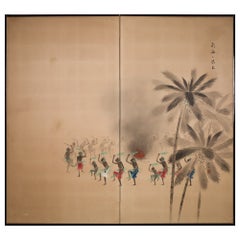
Japanese Two Panel Screen South Seas Fire Dancers
Located in Hudson, NY
Ink and color on buff ground, on paper. reads: Nankaino omoide (memory of south sea) signature and seal read: Katsuyuki. Very unusual subject matter.
Category
Early 20th Century Asian Paintings and Screens
Materials
Paper
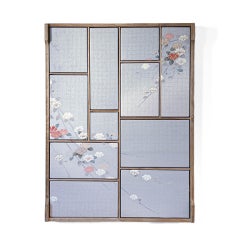
Vintage obi textile art " Camellia ~ Serendipity ~" by ikasu Blue Japan
By Kimono ikasu
Located in Setagaya City, JP
[Story behind the work]
This work is inspired by traditional Japanese nature motifs symbolism, and is framed in paulownia wood originally used for a kimono chest-of-drawers.
It is elegantly framed with paulownia wood originally used for kimono chest-of-drawers, and is filled with storytelling and sense of luxury.
In this artwork, the aim was to capture the the auspicious symbol of camellia used in antique kimono. Traditional Japanese culture, represented by the kimono, and wood, an integral element of Japanese craftsmanship, were used to bring this vision to life.
I used pieces of kimono that could no longer be used as clothing and kiritansu chest-of-drawers that would normally be discarded to create the ultimate upcycled piece.
[Explanation and meaning of pattern and colors]
This delicate piece features hand-drawn camellia motifs flowing gracefully on a softly brightened grayish background.
Camellias, native to Japan, bloom from winter to early spring. As an evergreen tree with green leaves throughout the year, it symbolizes the anticipation of spring and is considered an auspicious plant. Due to its seasonal significance and auspicious meanings, camellias have been used as motifs symbolizing good fortune. Additionally, they were highly valued for their use in oil, cosmetics, and medicine, representing nobility. Believed to possess the power to ward off misfortune, camellias also carry the meaning of "protection from calamity" and have strong ties to traditional ceremonies. In this artwork, camellias are delicately depicted alongside flowing branches, subtly representing good fortune with their pale pink and white hues.
"Sora-iro nezumi 空色鼠" refers to a light grayish color with a hint of blue, reminiscent of the slightly brightened sky on a lightly cloudy day. Popular during the late Edo period (19th cent.), it elegantly captures the slightly brighter sky pattern seen on lightly overcast days. Notably, the term "nezumi-iro" (mouse gray), popular during the late Edo period, was paired with brown tones, collectively known as "Forty-eight Teas and a Hundred Mice 四十八茶百鼠." Colors within the "nezumi" (gray) spectrum, particularly "sora-iro nezumi," were favored by young people for their cool and sophisticated appeal.
[Characteristics of the fabric]
The fabric features intricately woven patterns that reveal subtle gradations through dyeing, creating a grid pattern that transforms depending on the light conditions.
Originally, this fabric was part of a formal kimono known as a "hōmongi 訪問着," featuring motifs along the hem, shoulders, and sleeves. These motifs have been carefully selected and combined to create a unified piece of artwork.
[About the frame]
Kiritansu - chest-of-drawers for kimono, is traditionally made from paulownia wood, a uniquely Japanese material closely tied to the world of kimonos.
Paulownia wood is known as the lightest wood in Japan, prased for its natural luster, resistance to moisture, and resilience against cracking. Since ancient times, it has been used in crafting furniture, chests, and musical instruments.
During the Edo period, it became customary to store cherished kimonos in paulownia chests...
Category
1960s Japonisme Vintage Asian Paintings and Screens
Materials
Silk, Wood
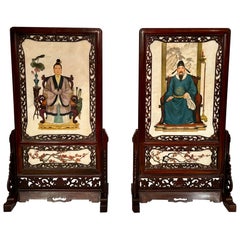
Pair Antique 19th Century Chinese Teakwood and Porcelain Table Screen Plaques.
Located in New Orleans, LA
Pair Antique 19th Century Chinese Teakwood and Porcelain Table Screen Plaques.
Per the last 4 photos, these screens can be removed from their bases and hung as a wall decoration.
Category
Late 19th Century Antique Asian Paintings and Screens
Materials
Porcelain, Teak
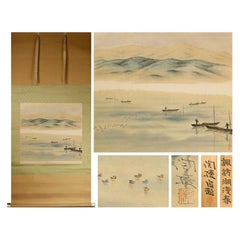
Lake Awasaru Scene Meiji Period Scroll Japan 19c Artist Marked Nihonga Style
Located in Amsterdam, Noord Holland
As you can see, it is a Japanese painting "Lake Suwa Asaharu" figure / co-box.
It is a "Lake Suwa Asaharu" figure with gentle sunlight, and it is
a very tasty work combined with a ...
Category
Mid-19th Century Meiji Antique Asian Paintings and Screens
Materials
Silk
$1,196 Sale Price
20% Off
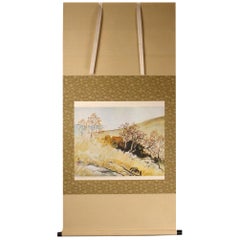
Autumn landscape 20th Century Scroll Painting Japan Artist Kawagoe Tamado
Located in Amsterdam, Noord Holland
It is a high-class craft of the work drawn by Kawagoe Tamado as you can see.
It is the "late autumn in the highlands" where you can feel the taste of autumn, and it is
a work in which the trees and flowers that sway in the wind shine well.
«Kawagoedado»
[1873-1957] Japanese painter. Born in Aichi.
His real name is Hosaburo. Another issue, Ikuan.
At the beginning, he studied under the Shijo school and then Masakuni Hashimoto to...
Category
Early 20th Century Taisho Asian Paintings and Screens
Materials
Silk
$1,055 Sale Price
58% Off
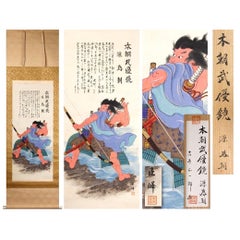
Lovely 19th-20th Century Scroll Painting Japan Artist Shoichiro Yoshii, Painted
Located in Amsterdam, Noord Holland
¦ Silk and handpaitning
¦ State
There are some discoloration and stains in the age.
¦ Axial dimension/approx. 193.0 cm x 57.0 cm.
¦ Actual paper size/about 103.0 cm x about 44...
Category
20th Century Showa Asian Paintings and Screens
Materials
Silk
$2,058 Sale Price
20% Off
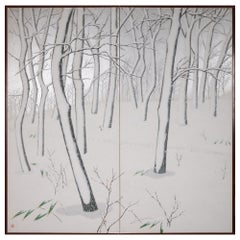
Japanese Two Panel Screen Snow Flakes Falling in the Forest
Located in Hudson, NY
With young bamboo and winter berry in the foreground and footprints in the snow. Mineral pigments and mica on paper. Seal reads: Seikan.
Category
Early 20th Century Asian Paintings and Screens
Materials
Paper
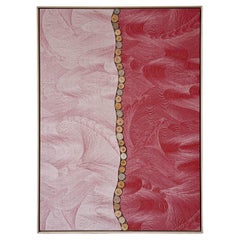
Vintage kimono textile art " Sunset Timelapse ~ Ephemerality ~" ikasu Red Japan
By Kimono ikasu
Located in Setagaya City, JP
<
The art piece uses two sides - front and reverse - of the same kimono, to show beautiful sea surrounding Japan, in hues and in late sunset, as a timelapse.
The frame for this work is made of paulownia wood taken from antique Kiritansu - chest-of-drawers for kimono.
I use antique kiritansu that can’t be used as furniture anymore to create basis and frames for my works. It adds them even more authentic atmosphere of traditional wabisabi spirit. Can you feel it?
<< Period / Story
The kimono used in this piece was originally crafted during Showa period (around 1960ies).
<< Explanation and meaning of pattern and colors
Sea waves, depicted in two color variations here, are a symbol of transience and Impermanence in Japanese culture. The ebb and flow of the tides, the ever-changing currents, and the relentless motion of the waves serve as reminders of the fleeting nature of life. This artwork featuring the sea convey themes of impermanence, reminding viewers to cherish the present moment and appreciate the beauty of life's fleeting moments.
The theme of impermanence is strengthen by two colors of the sea - the lighter in early hues and the darker when the sun is just about to set in the sea.
<< About the frame
This artwork frame is crafted from paulownia wood, a uniquely Japanese material closely tied to the world of kimonos, and it serves to convey the refined beauty of Japanese nature.
Paulownia wood is known as the lightest wood in Japan, prased for its natural luster, resistance to moisture, and resilience against cracking. Since ancient times, it has been used in crafting furniture, chests, and musical instruments.
Paulownia wood is closely linked to kimono culture. During the Edo period (17th cent.~), it became customary to store cherished kimonos in paulownia chests...
Category
1960s Japonisme Vintage Asian Paintings and Screens
Materials
Silk, Wood
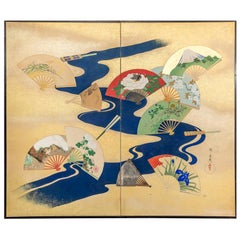
Japanese Two-Panel Screen, Deco Landscape with River Fans
Located in Hudson, NY
Japanese two-panel screen, deco landscape with river fans. Modern scene of a 12th century festival in Kyoto in which fans are sent down the Kamo River and caught downstream. Taisho (...
Category
Early 20th Century Taisho Asian Paintings and Screens
Materials
Gold Leaf
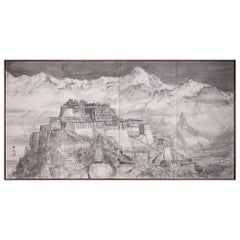
Japanese Four Panel Screen Tibetan Mountain Monastery
Located in Hudson, NY
This is an exceptionally powerful and evocative four-panel screen depicting a sprawling Tibetan monastery set against a backdrop of massive, towering mountains. Executed in ink on pa...
Category
Early 19th Century Antique Asian Paintings and Screens
Materials
Paper
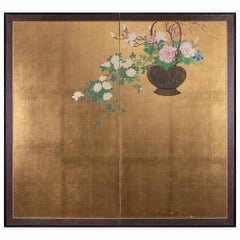
Japanese Two-Panel Screen Ikebana on Gold
Located in Hudson, NY
Japanese two-panel screen: Ikebana on gold. Meiji period (1868-1912) painting of a basket with beautifully arranged spring flowers in the style of ikebana (Japanese traditional flowe...
Category
Late 19th Century Meiji Antique Asian Paintings and Screens
Materials
Gold Leaf
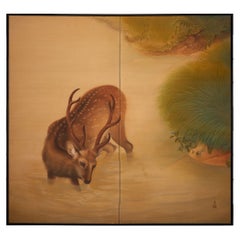
Japanese Two-Panel Screen, Wading Deer
Located in Hudson, NY
In Japan, it is a Shinto belief that the deer is a treasured and sacred animal. This admirable scene captures this gentle creature in its natural habitat with beautiful detail in bot...
Category
Early 20th Century Asian Paintings and Screens
Materials
Silk, Lacquer
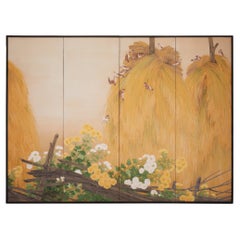
Japanese Four Panel Screen: Japanese Tree Sparrows on Stacks of Bailed Rice
Located in Hudson, NY
Sparrows ravish freshly harvested rice, drying on stakes, beyond wild chrysanthemum. Mineral pigments on silk. Signed in the lower left corner, signature reads: Soetsu. With a simple...
Category
Early 20th Century Asian Paintings and Screens
Materials
Silk, Wood, Lacquer
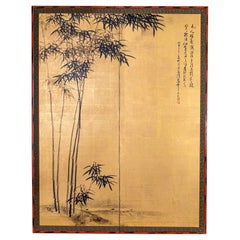
Japanese Two Panel Screen: Bamboo with Calligraphy Poem
Located in Hudson, NY
Moon and bamboo in ink on gold paper with red and black lacquered negoro frame. (Meiji period) Calligraphy reads: Beauty in ink painting with standing woods and branches, like in par...
Category
Early 1900s Antique Asian Paintings and Screens
Materials
Paper
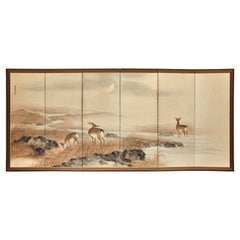
Japanese Six Panel Screen: Deer in Moonlit Water Landscape
Located in Hudson, NY
Meiji period (1868 - 1912) painting of a family of deer exploring the grassy and rocky shoreline of a meandering creek under the moonlight. Shijo School ink painting with minimal pi...
Category
19th Century Antique Asian Paintings and Screens
Materials
Brocade, Silk, Paper
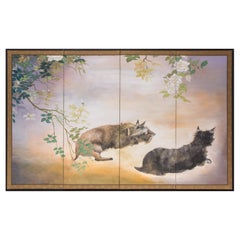
Japanese Four Panel Screen: Scotties Under Roses
Located in Hudson, NY
Modern painting in mineral pigments on mulberry paper with a silk brocade border.
Category
20th Century Asian Paintings and Screens
Materials
Brocade, Silk, Paper
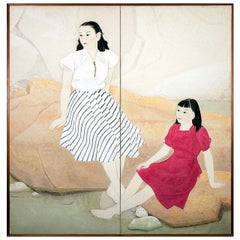
Japanese Two-Panel Screen "Women in Western Dress"
Located in Hudson, NY
Japanese Two Panel Screen: Women in Western Dress, Nihonga style painting of two young women in Western style summer clothing, sitting at water's edge and cooling off by putting their feet in the water. Showa period painting...
Category
1930s Showa Vintage Asian Paintings and Screens
Materials
Wood, Paper
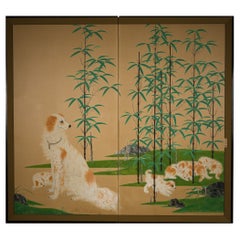
Japanese Two Panel Screen Mother and Puppies Under Bamboo
Located in Hudson, NY
Mineral pigments on paper. Signature and seal read: Shigehiro.
Category
Early 20th Century Asian Paintings and Screens
Materials
Paper
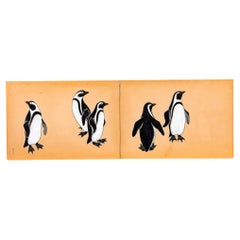
Japanese Two Panel Screen: Lacquer Penguins
Located in Hudson, NY
Beige ground lacquer with black and grey lacquer penguins with small pieces of shell making up white areas. Lacquer on wood. Writing reads: Lacquer Screen By Izumi Atsuhiko. It was ...
Category
Early 20th Century Asian Paintings and Screens
Materials
Shell, Wood, Lacquer
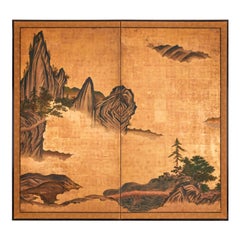
Japanese Two Panel Screen: Mountain Landscape With Cedar and Pine on Gold Leaf
Located in Hudson, NY
Kano School painting, reminiscent of early Kano School paintings, in sumi (ink) and minimal pigments on gold leaf with a silk brocade border.
Category
Early 19th Century Antique Asian Paintings and Screens
Materials
Gold Leaf
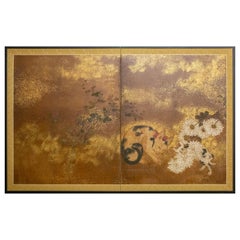
Japanese Two-Panel Screen, Mother and Kitten with Chrysanthemums
Located in Hudson, NY
Delicate painting of garden chrysanthemums with a fine gold mist. A cat grooms herself while a kitten plays with a chrysanthemum. Mineral pigments...
Category
Mid-19th Century Antique Asian Paintings and Screens
Materials
Gold
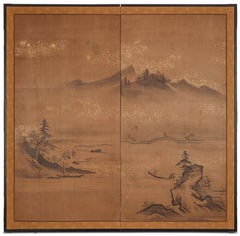
Japanese Two Panel Screen, Ink Landscape on Paper with Gold Dust
Located in Hudson, NY
Sesshu-style painting in ink on mulberry paper with gold dust accents and a silk brocade border.
Category
19th Century Antique Asian Paintings and Screens
Materials
Gold
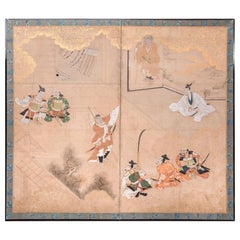
Japanese Two Panel Screen: Genpei Warriors
Located in Hudson, NY
The Genpei War took place from 1180–1185, during which the Minamoto clan rebelled against the Taira clan for control of Japan. The two clans had a bitter rivalry for years, and the M...
Category
Early 19th Century Edo Antique Asian Paintings and Screens
Materials
Gold Leaf
Still Thinking About These?
All Recently ViewedMore Ways To Browse
Chinese Woodblock Print
Fusuma Doors
Japanese Tiger Screen
Ogata Korin
Painted Panel Screen Birds
Antique Chinese Black Lacquer Screen
Antique Falconry
Carved Stone Panel
Chinese Carved Hardwood Screen
Chinese Folding Silk Screen Art
Chinese Paint Brushes
Chinese Pearl And Lacquer Screen
Gold Screen Crane
Japanese 4 Panel Screen
Japanese Autumn Screen
Japanese Calligraphy Screen
Japanese Cherry Blossom Screen
Japanese Snow Painting