18th Century and Earlier Decorative Boxes
to
47
411
411
2,316
4,641
984
1,117
1,545
1,039
186
89
183
226
102
218
358
522
187
65
66
47
18
11
9
8
5
3
3
3
1
270
165
39
38
34
210
185
326
97
82
64
52
Height
to
Width
to
411
411
411
3
3
1
1
1
Period: 18th Century and Earlier
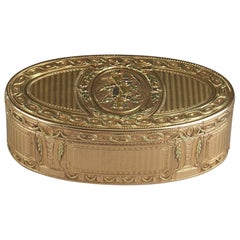
Gold box of Louis XVI period
Located in Paris, FR
Three-tones gold oval snuff box. The hinged lid is decorated with a country trophy medallion. The medallion is framed by a garland of green gold foliage and roses. The medallion is d...
Category
French Louis XVI Antique 18th Century and Earlier Decorative Boxes
Materials
Gold

$42,220
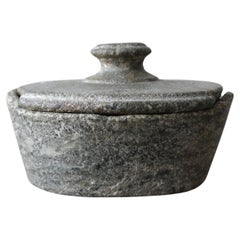
Swedish Empire Butter Box, ca 1820
Located in Farsta, SE
Swedish Empire Butter Box, ca 1820
This is the smallest marble butter box we have ever had.
Its heavily worn-down edges truly show the centuries of use and time.
Made of Swedish Ko...
Category
Swedish Scandinavian Modern Antique 18th Century and Earlier Decorative Boxes
Materials
Marble
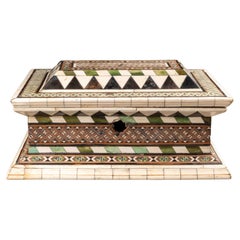
Embriachi workshop marquetry casket - Northern Italy, 15th century
Located in Bruxelles, BE
Embriachi workshop marquetry casket
Northern Italy, 15th century
Alla certosina inlays (bone, stained bone, pewter and wood)
H 28.2 x W 18 x D 14 cm
This beautiful casket of rectangular form is richly decorated with the characteristic geometric patterns of the Embriachi style.
The intricate geometric patterns are fashioned by juxtaposing lighter and darker pieces of wood, (colored) bone, horn and pewter. The lid and base are framed by a broad band of horn. When ivory became scarce in Europe due to disrupted trade routes, bone was substituted.
The attention to Symmetry and balance created an harmonious visual effect
Enhancing the overall aesthetic appeal of the casket.
The application of geometrical motifs is in Italy known as marquetry ‘alla Certosina’, named after the Certosina Church in Pavia with its famous altarpiece decorated in this way. This is ‘intarsia technique’, a term derived from the Arabic 'tarsi', which means ‘incrustation' recalling ancient mosaics made from various materials.
These geometric elements not only enhance the aesthetic appeal of the caskets but also demonstrate the versatility and skill of the artisans in creating multifaceted works of art.
‘Alla Certosina’ became famous through the Northern Italian Embriachi family who achieved a particularly high standard in working in this technique. Venice in particular was known for the production of these luxurious boxes. The caskets, hexagonal or rectangular, surmounted by a lid decorated in several registers constitute the secular, albeit equally renowned component of the workshop’s production, in addition to mirror frames and various everyday objects.
The method of fabrication of those objects was based on two concepts that underlay pre-industrial production: standardization and modularity, thanks to a distribution of skills according to the different phases of fabrication.
even the realization of the marquetry motifs (in the form of ingots from which portions of the desired size were cut) were therefore entrusted to various specialized craftsmen, as were the assembly phase.
Today better known thanks to the extensive research work recently carried out by Michele Tomasi, this workshop owes its name to its founder and owner, the Florentine Baldassare Ubriachi (or degli Embriachi), a merchant and banker established in the Tuscan capital before he settled in Venice in 1395. Together with sculptor Giovanni di Jacopo, who directed the workshop, from the last years of the fourteenth century, Baldassare oversaw a production that was truly original, and still easily recognizable today, comprising monumental altarpieces and various objects, primarily triptychs and caskets.
The precise location of the workshop is unknown, except that it originated in Florence and in ca. 1431 there was apparently a workshop in Venice, in the area of S Luca. They employed local workers specializing in 'certosina' (inlay of stained woods, bone and horn), and the workshop produced items carved in bone (usually horse or ox) with wood and bone marquetry.
The geometric decoration of Embriachi caskets reflects the artistic complexity and attention to detail that characterized their work.
this inlaid casket is a testament to the skill and artistry of the Embriachi family and serves as a stunning example of the decorative arts of the late Middle Ages.
Related Literature :
E. Berger, Prunk-Kassetten: Europäischen Meisterwerke aus acht Jahrhunderten / Ornamental Caskets...
Category
Italian Renaissance Antique 18th Century and Earlier Decorative Boxes
Materials
Pewter
$20,507 Sale Price
22% Off
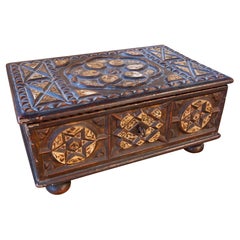
17th Antique Aragonese Carved Wooden Box with Geometric Inlays
Located in Marbella, ES
Magnificent antique hand-carved wooden chest, decorated with intricate geometric motifs and inlays in light tones that contrast with the dark background. The design features stars, d...
Category
Spanish Antique 18th Century and Earlier Decorative Boxes
Materials
Wood
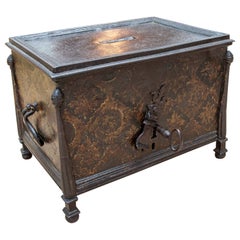
16th Wrought Iron Safe, Renaissance Style, for Donations or Cash Chest
Located in Marbella, ES
Impressive wrought iron tabletop safe with engraved decoration and original patina. This type of safe was commonly used in the 16th and 17th centuries to hold valuables, alms, or doc...
Category
Spanish Antique 18th Century and Earlier Decorative Boxes
Materials
Iron
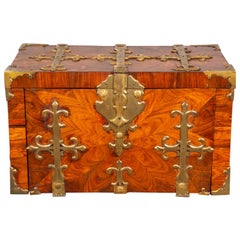
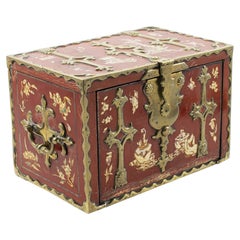
William And Mary Kingwood Coffre-Fort
Located in Essex, MA
With rectangular hinged top with brass strap mounting. When open the front folds down to expose hidden compartments and wells. Case mounted the same as the lid. Side carry handles. I...
Category
European William and Mary Antique 18th Century and Earlier Decorative Boxes
Materials
Brass
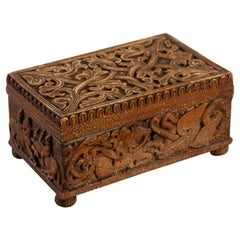
Norwegian Baroque Box, Carved Mythical Creatures + Figurative Scenes, Circa 1740
Located in New York, NY
Very special Baroque box with carved decorations of mythical creatures and figurative scenes
Carved monogrammed initials "HPP" + Family Crest, origin: Gudbrandsdal, Norway, circa 174...
Category
Norwegian Baroque Antique 18th Century and Earlier Decorative Boxes
Materials
Softwood
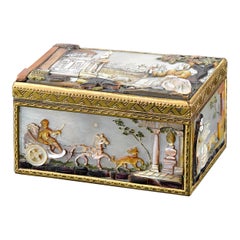
German Mother of Pearl Snuff Box
Located in New Orleans, LA
Magnificent layers and inlays of multi-colored mother-of-pearl cover each side of this breathtaking German snuff box. Each incredibly detailed scene is framed by finely engraved yell...
Category
German Other Antique 18th Century and Earlier Decorative Boxes
Materials
Gold
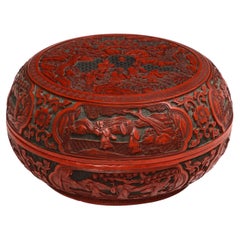
18th/19th Century Chinese Cinnabar Circular Box with Multiple Cartouches
Located in New York, NY
An 18th/19th Century Chinese cinnabar circular box with multiple cartouches of Families. This is a marvelous piece with very fine details on the main top panel of the box. The top pa...
Category
Chinese Qing Antique 18th Century and Earlier Decorative Boxes
Materials
Lacquer
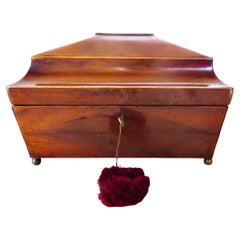
18thC. Georgian Yew Wood Large Sarcophagus Shaped Table Box England. Circa 1760
Located in Incline Village, NV
Fabulous looking fine quality and unusual large size 18th century George III table top yew wood sarcophagus shaped box. While it could have been a tea caddy; at 14" wide it seems ove...
Category
English George III Antique 18th Century and Earlier Decorative Boxes
Materials
Yew
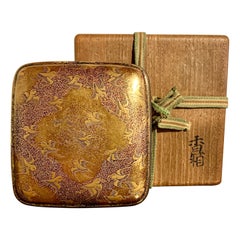
Japanese Lacquer Incense Box, Kogo, Momoyama or Edo Period, 16th/17th Century
Located in Austin, TX
A wonderful Japanese lacquer incense box, kogo, with a design of plovers in flight, late Momoyama or early Edo Period, circa 1600, Japan.
The small box, called a kogo, was used to s...
Category
Japanese Edo Antique 18th Century and Earlier Decorative Boxes
Materials
Gold, Pewter
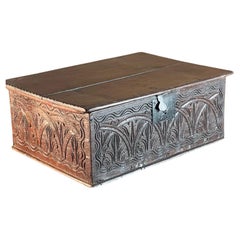
C1680 Oak Bible Box Well Carved
Located in Bakewell, GB
C1680 oak bible box well carved on 3 sides
good colour and patination
58cms Wide x 45cms Deep x 24cms High
Category
Antique 18th Century and Earlier Decorative Boxes
Materials
Oak
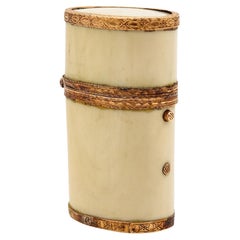
FRENCH 18th Century Perfumed Scents Necessaire Box In 18Kt Yellow Gold
Carving
Located in Miami, FL
French perfumed scents necessaire from the 18th century.
This is a fantastic and very rare 18th century necessaire box for perfumed scents, created in the kingdom of France during t...
Category
French Baroque Antique 18th Century and Earlier Decorative Boxes
Materials
Rock Crystal, Gold
$2,998 Sale Price / set
25% Off
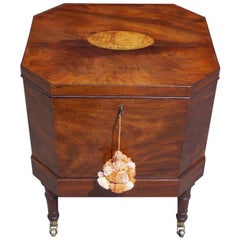
English Mahogany Satinwood Conch Shell Inlaid Wine Cellarette. Circa 1780
Located in Charleston, SC
English mahogany wine cellarette with inlaid Satinwood conch shell, hinged top revealing a compartmentalized fitted interior, and terminating on the original turned legs with brass c...
Category
English George III Antique 18th Century and Earlier Decorative Boxes
Materials
Brass
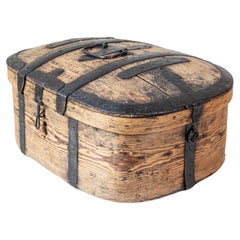
Swedish 1790s Rustic Oval Top Wooden Box with Iron Accents and Distressed Patina
Located in Atlanta, GA
A rustic Swedish wooden box from the late 18th century, with iron accents and natural patina. Created in Sweden during the last decade of the 18th century, this wooden box charms us ...
Category
Swedish Rustic Antique 18th Century and Earlier Decorative Boxes
Materials
Metal
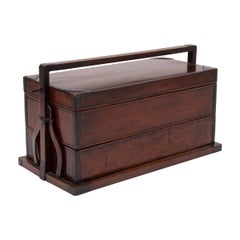
Chinese Picnic Box, c. 1750
Located in Chicago, IL
The basic form of this two-tiered box with handle has remained unchanged for 1,000 years. Stacked boxes were commonly used as portable containers for food or ...
Category
Chinese Qing Antique 18th Century and Earlier Decorative Boxes
Materials
Hardwood
$57,280
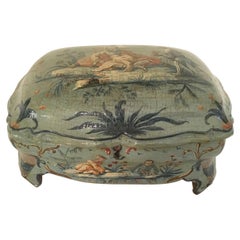
1750 Venezia Italy Green Light Blue Lacquered and Shaped Wooden Box with Flowers
Located in Brescia, IT
This is a refined lacquered and shaped wooden box, with polychrome Chinese figures and fine floral decoration on green and light blue background.
The curved shape of the box, on the front, on the sides and of the feet, the rich carving, are the result of the high level craftemanships of the Venetian master cabinetery.
This magnificent piece hails from the Mid-18th Century in Venezia and masterfully shows the lacquered Venetian style.
Its carefully considered proportions, refined carvings, magnificent color of the lacquer, and premium materials culminate in this wooden box that shows sophistication and grace.
This is a little jewel, a case to contain jewels.
One of the distinctive characteristics of Venetian Baroque and Rococo furniture is the skilful use of lacquers. Lacquer is a natural resin that was very rare in the past, imported from the East and used to create smooth and colored surfaces on furniture, ready to be finely decorated with refined floral designs or exotic animals.
Venetian artisans became masters in lacquer processing which required time and patience because it was made with many steps.
The Venetian style deeply influenced furniture design throughout Europe, but none reached the Venetian level in terms of beauty. The skillful use of lacquer and carvings defined Venice's unique style during the Rococo period, its Golden Age.
The iron little key is not working. Inside are visible some scribbles.
The piece is in very good state of maintenance and guaranteed original in every parts. The surface was only cleaned not restored and it is original.
The wooden light blue lacquered...
Category
Italian Rococo Antique 18th Century and Earlier Decorative Boxes
Materials
Wood, Lacquer
Early 18th Century Dutch Baroque Box
Located in Kastrup, DK
Rare Dutch baroque box composed of padauk wood with original red lacquer finish, decorated with ivory lacquer with gold outline. Richly adorned with heavy brass (or bronze) decorativ...
Category
Dutch Baroque Antique 18th Century and Earlier Decorative Boxes
Materials
Brass
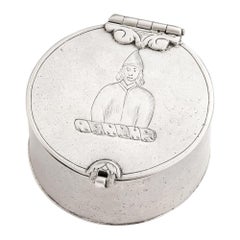
Charles II Confit Box Made in London, circa 1670
Located in London, GB
An Extremely Rare Charles II Confit Box Made, Most Probably, in London circa 1670, Maker's Mark of M With a Crown Above
This very rare piece is circular in form and plain in design ...
Category
English Charles II Antique 18th Century and Earlier Decorative Boxes
Materials
Silver, Sterling Silver
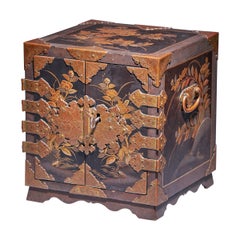
Important Early Edo Period 17th Century Miniature Japanese Lacquer Cabinet
Located in Oxfordshire, United Kingdom
A Rare and Important 17th Century Miniature Japanese Lacquer Cabinet, 19 cm H, 17cm W, 16.5cm D.
The exquisitely decorated cabinet depicts fine floral raised scenes to each side. l...
Category
Antique 18th Century and Earlier Decorative Boxes
Materials
Lacquer
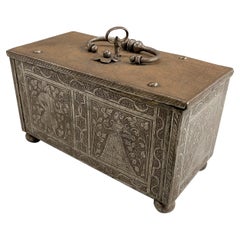
Steel Engraved Nuremberg Money Chest or Cash Box circa 1600
Located in Milford, NH
A fine example of a money chest or cash box with steel engraved figures on each side and an intricate locking mechanism under the lid, typical of metalwork coming out of a host of ci...
Category
German Antique 18th Century and Earlier Decorative Boxes
Materials
Steel
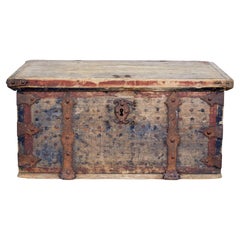
Mid 18th century Swedish pine chest decorated with labyrinth
Located in Debenham, Suffolk
Mid 18th century Swedish pine chest decorated with labyrinth circa 1730.
Rare and beautiful Swedish pine chest. Traces of original paint to the outside with decorative metal strap...
Category
Swedish Folk Art Antique 18th Century and Earlier Decorative Boxes
Materials
Metal
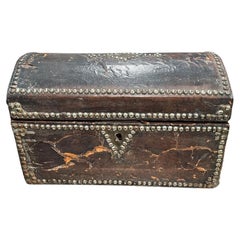
18th Century Antique Leather Box with Nailheads
Located in New Orleans, LA
This antique leather box with nailheads is not only a beautiful decorative item but also a functional piece of history. It could have been used for a variety of purposes, such as sto...
Category
French Antique 18th Century and Earlier Decorative Boxes
Materials
Brass
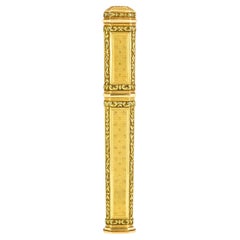
18th-Century French Gold Etui
Located in New Orleans, LA
A marvelous objet d'art is this exquisite Louis XVI-era étui. Crafted entirely of green and yellow gold, this stunning octagonal vessel bears an exceptional, engraved Neoclassical de...
Category
French Louis XVI Antique 18th Century and Earlier Decorative Boxes
Materials
Gold
18th century Chinese hard wood coffer chest
Located in Debenham, Suffolk
Rare 18th century perhaps earlier hard wood coffer, circa 1790.
Presented in original un-restored condition. Original handles and metal work to outer edges.
Lid opens on ringed ha...
Category
Chinese Qing Antique 18th Century and Earlier Decorative Boxes
Materials
Hardwood
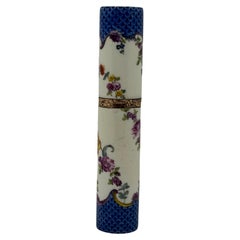
Meissen Gilt-Metal Mounted Etui / Bodkin Case, circa 1755
Located in Basildon, GB
Meissen Gilt-Metal Mounted Etui / Bodkin Case, circa 1755, cylindrical case painted with floral trails between blue-scale borders, the ends painted with pe...
Category
German Rococo Antique 18th Century and Earlier Decorative Boxes
Materials
Porcelain
$1,705 Sale Price
30% Off
1750 Venezia Italy Green Lacquered Wooden Box Jewelry Case and Floral Decoration
Located in Brescia, IT
This little, refined and exquisite lacquered wooden box or jewelry case, with polychrome floral decoration on green background is a piece that shows its elegance. It could be a little jewel to contain jewels and its beauty perfectly matches with every timeless home.
The curved shape of the box, on the front, on the sides and of the feet, the rich carving, are the result of the high level craftemanships of the Venetian master cabinetery.
This magnificent piece hails from the Mid-18th Century in Venezia and masterfully shows the lacquered Venetian style.
One of the distinctive characteristics of Venetian Baroque and Rococo furniture and decorative objects is the skilful use of lacquers. Lacquer is a natural resin that was very rare in the past, imported from the East and used to create smooth and colored surfaces on furniture, ready to be finely decorated with refined floral designs or exotic animals.
Venetian artisans became masters in lacquer processing which required time and patience because it was made with many steps.
The Venetian style deeply influenced furniture design throughout Europe, but none reached the Venetian level in terms of beauty. The skillful use of lacquer and carvings defined Venice's unique style during the Rococo period, its Golden Age.
The piece is in very good state of maintenance and it is guaranteed original in every parts. The surface was only cleaned not restored and it is original.
The wooden green lacquered box...
Category
Italian Rococo Antique 18th Century and Earlier Decorative Boxes
Materials
Wood
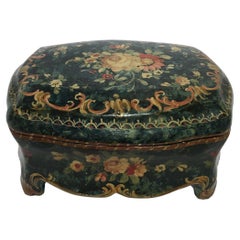
Cherry wood and native wood box from the 18th century
Located in Beuzevillette, FR
Very large slurry box with parts in native wood veneer, marquetry nets and geometric decorations in marquetry on the top. The box rests on four arched feet in the Louis XV style.
Thi...
Category
French Louis XV Antique 18th Century and Earlier Decorative Boxes
Materials
Wood

$1,544 Sale Price
20% Off
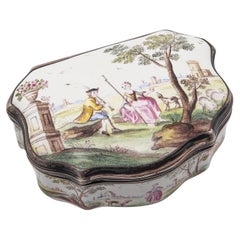
England 1770 Georgian Battersea Enamel Decorated Box in Sterling Silver
By Battersea
Located in Miami, FL
Georgian Battersea enamel box from the 18th century.
A beautiful fine antique English Battersea Bilston table snuff box created in the district...
Category
English Georgian Antique 18th Century and Earlier Decorative Boxes
Materials
Silver, Sterling Silver, Enamel
$2,988 Sale Price
25% Off
German Porcelain Box
Located in New Orleans, LA
This important German porcelain box exhibits delightful artistry and craftsmanship. Its hand-painted wild game scene celebrates the natural world,...
Category
German Antique 18th Century and Earlier Decorative Boxes
Materials
Gold, Bronze
$3,950
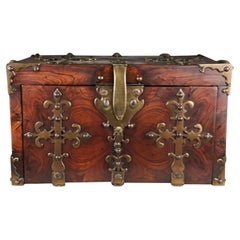
Early 18th Century Louis XVI Kingwood Small Chest
Located in Dallas, TX
A Louis XVI kingwood small chest with brass mounts. Opens to a metal lined interior and two velvet working lower drawers. Circa 1700, France.
Category
French Louis XVI Antique 18th Century and Earlier Decorative Boxes
Materials
Metal, Brass
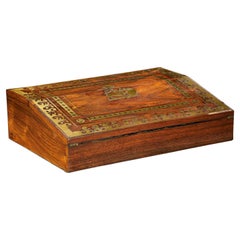
19th Century Manner of George Bullock, Regency Brass Inlaid Rosewood Lap Desk
Located in Morristown, NJ
c.1800, England, Regency brass inlaid rosewood lap desk in the manner of George Bullock. Rectangular box with double-hinged lid, opening to tooled na...
Category
English Regency Antique 18th Century and Earlier Decorative Boxes
Materials
Brass, Gold Leaf
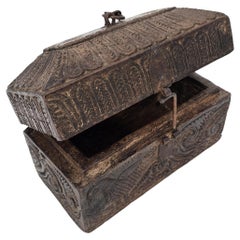
Indian carved wood spice box, late 17th century, circa 1790
Located in Central England, GB
This superb Indian spice box is of a larger scale than normally seen. It is highly decorative and original. It is made from a solid block of dense woo...
Category
Indian Medieval Antique 18th Century and Earlier Decorative Boxes
Materials
Wrought Iron
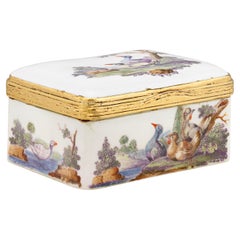
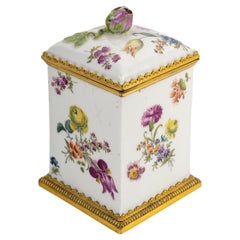
An 18th Century Meissen Porcelain Box, Louis XV Period.
Located in Saint-Ouen, FR
An 18th century Meissen porcelain box, Louis XV period.
An 18th century Meissen porcelain box, Louis XV period, gilt brass mounting.
H: 14cm, W: 9cm, D: 9cm
Category
French Louis XV Antique 18th Century and Earlier Decorative Boxes
Materials
Brass
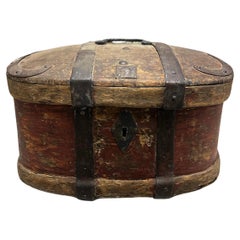
18th Century Swedish Wedding Box
Located in Houston, TX
This late 18th-century Swedish wooden box exudes rustic charm and historical character. Crafted in Sweden during the waning years of the 18th century, this antique treasure showcases...
Category
Swedish Rustic Antique 18th Century and Earlier Decorative Boxes
Materials
Metal
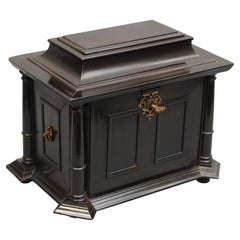
Flemish Ebony and kingwood Table Cabinet
Located in Lincolnshire, GB
A charming 17th century ebony and kingwood cabinet with turned columns to the corners, the fall front opens to reveal a set of drawers and arched mirrored centre. The lid also housin...
Category
European Antique 18th Century and Earlier Decorative Boxes
Materials
Ebony, Kingwood
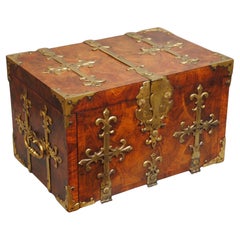
Fine Large Example Of A Kingwood Oyster Veneer Coffre Fort
Located in Lincolnshire, GB
A superb early 18th century kingwood oyster veneered coffre fort with fine gilt brass metal work, the fall front opens to reveal three drawers and three hidden compartments.
Lovely c...
Category
European Antique 18th Century and Earlier Decorative Boxes
Materials
Brass
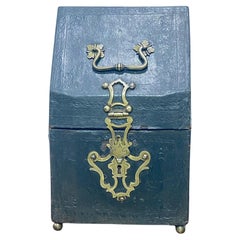
17th Century English Leather Covered Knife Box Converted To a Letter Box
Located in San Francisco, CA
17th century leather knife box converted to a letter box with original brass hardware, sitting on brass ball feet.
Fitted interior lined with 18th century silk fabric.
In very good...
Category
European Antique 18th Century and Earlier Decorative Boxes
Materials
Brass
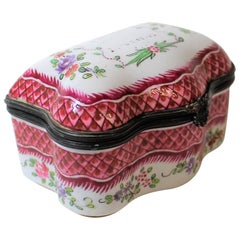
18th Century, Lowestoft English Porcelain Trinket Box
Located in Hamilton, Ontario
18th century, English porcelain trinket box hand decorated in polychrome glazes and inscribed: "A Trifle from Lowestoft 1795".
Category
English George III Antique 18th Century and Earlier Decorative Boxes
Materials
Porcelain
$3,195 Sale Price
54% Off
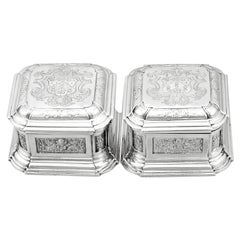
1733 George II Sterling Silver Toilet Boxes
Located in Jesmond, Newcastle Upon Tyne
A magnificent, fine and impressive pair of antique George II English sterling silver toilet boxes; an addition to our Georgian silverware collection.
These...
Category
English George III Antique 18th Century and Earlier Decorative Boxes
Materials
Sterling Silver
$15,234 / set
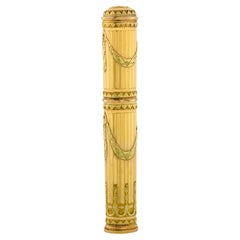
Gold Étui in Original Case
Located in New Orleans, LA
Gold Étui in Original Case
Jacques Martin Petitjean
Circa 1777
Expertly engraved entirely of yellow gold, this remarkably rare Louis XVI-era étui is a work of art. Resplendent colum...
Category
French Louis XVI Antique 18th Century and Earlier Decorative Boxes
Materials
Gold
$16,850
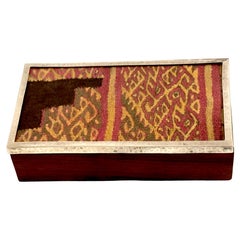
Pre-Columbian Andean Textile Fragment in Sterling Silver
Hardwood Presentation
Located in West Palm Beach, FL
Pre-Columbian Andean Textile Fragment in Sterling Silver & Hardwood Presentation Box
Textile: Wari or Inca Culture, Andes, Circa 600–1400 CE Box: Mid-20th Century
A refined and hist...
Category
Peruvian Pre-Columbian Antique 18th Century and Earlier Decorative Boxes
Materials
Sterling Silver
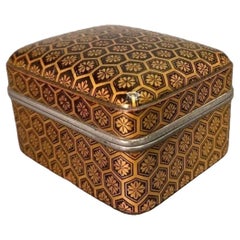
A Japanese Edo Period Lacquer Kogo (Incense) Box, late 17/early 18th Century
Located in Spencertown, NY
Early Japanese Lacquer Incense Box (Kogo) Late 17thc. Of rectangular form with soft corners, decorated with a diaper pattern in gold lacquer on a brownish black ground, with pewter r...
Category
Japanese Edo Antique 18th Century and Earlier Decorative Boxes
Materials
Pewter
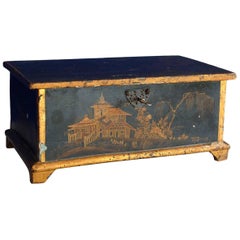
Rococo Chinoiserie Box, circa 1750
Located in New York, NY
Swedish Rococo chinoiserie box with red interior, circa 1750, Origin: Sweden.
Original blue paint under the later chinoiserie paint. Many pieces were redecorated with chinoiserie ...
Category
Swedish Rococo Antique 18th Century and Earlier Decorative Boxes
Materials
Paint
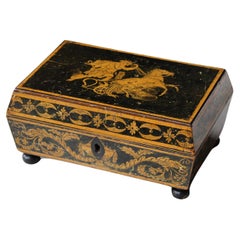
Late 18th Century Neoclassical George III Penwork Sarcophagus Jewellery Box
Located in Lowestoft, GB
A George III penwork sarcophagus work box with hinged lid decorated with a chariot, the side with Neo-Classical devices.
Age related abrasions and knocks later replacement ebonised ...
Category
European Neoclassical Antique 18th Century and Earlier Decorative Boxes
Materials
Sycamore
Chest. Carved wood, metal. Spanish school, 16th century.
Located in Madrid, ES
Chest. Carved wood, metal. Spanish school, 16th century.
Rectangular casket with a flat lid decorated on the outside with a series of figurative reliefs in a symmetrical arrangemen...
Category
Spanish Renaissance Antique 18th Century and Earlier Decorative Boxes
Materials
Metal, Other
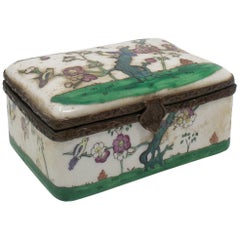
19th Century French Porcelain and Brass Trinket Box with Flower Decorations
Located in Marbella, ES
19th century French porcelain and brass trinket box with flower decorations.
Category
French Antique 18th Century and Earlier Decorative Boxes
Materials
Porcelain
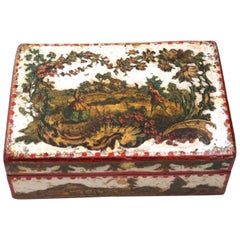
Italian Arte Povera Box, Mid-18th Century
Located in Spencertown, NY
The papier mâché box depicting a landscape scene on a white ground with red trim on all sides.
Category
Italian Rococo Antique 18th Century and Earlier Decorative Boxes
Materials
Paper
$1,440 Sale Price
20% Off
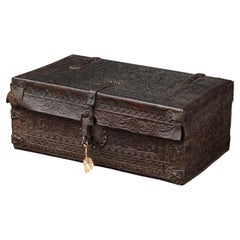
Boiled Leather Trunk, Spanish, 17th Century
Located in Bruxelles, BE
Leather trunk
Spanish, 17th century
Boiled Leather, wood and iron
Measures: 22 x 53 x 32 cm.
Provenance :
- collection Metz-Noblat, Château de Clevant, France
Rectangular trunk of the form and size of a small suitcase with wrought iron hinges and lock-plate.
Wood, covered with leather, cut and embossed with every surface of the thick cow hide covered in interlace, zoomorphic features.
The construction method is boiled leather, often referred to by its French translation cuir-bouilli: a process used to change flexible, vegetable-tanned leather into rigid, moulded objects. For shaping of the vegetable-tanned leather, heat and moisture were used, as indicated by the term boiled leather. No written medieval sources describing the production of decorated cuir bouilli objects survive, so knowledge of the process relies on the important studies of the Scottish leather historian John William Waterer. A large range of methods, materials and techniques could be used in various combinations. The vegetable-tanned leather, made supple with moisture and heat, was stuffed, shaped and nailed to the rigid wooden coffer support. The stuffing material was probably modeled beeswax or stearin wax. To shape the leather, to create its topography, « Cushions » were made by lacing a thread through an awl hole and attaching the flexible leather and stuffing to the rigid wooden support on the bottom. Then the decoration was done: lines were incised through the upper layer of the leather (epidermis) with different thicknesses of knives or needles. Contours were created with deep v-shaped cuts, decoration with thin incision and final details with a needle point. For the incision and pouncing stage, the leather was probably kept heated and moistened for suppleness.
Once dry, the leather would be hard and rigid.
the saturated leather is worked over a form, possibly even damp sand, with the pattern shaped using bone or wooden tools. Compare to metal, leather was lighter and it offered protection from cuts and punctures. Cuir bouilli objects were produced by specialist leather workers and needed skillful craftsmanship.
The surface is filled with roundels shaped foliages enclosing animals, lions and peacocks. The foliate arabesques creating a vegetal connection tweet the animals create the impression of a lush verdant space . The vegetal pattern here employed in combination with geometrical pattern came from the pre-islamic artistic traditions of the Byzantine and Sasanian empires. An aspect of Islamic geometry Is the basic symmetrical repetition and mirroring of the shapes that create a sense of harmony.
The decoration of this truck is inspired by the islamic « arabesque » a form of vegetal ornament composed of spirals, intertwining plants and abstract curvilinear motifs. An arabesque character is given to the birds of the decorations through extreme stylisation. This arabesque maintained the classical tradition of median symmetry, freedom in Detail and heterogeneity of ornament.
The presence of the peacocks is a paradisiacal allusion: in popular Islamic literature they were among the original inhabitants of the garden of Paradise expelled with Adam and Eve. Peacock as a decorative motif may have originated in the West, despite their eastern provenance. There was an ancient belief that the flesh and feathers of peacock do not decay. This led to the peacock becoming a christian symbol for Christ’s resurrection.
Renowned for their decorative wall hangings, seventeenth-century Spanish leatherworkers also produced utilitarian objects, such as this trunk. A similar trunk is on display at the Metropolitan museum of art ( 09.158.1).
Related literature :
Davies L. 2006. Cuir bouilli. Conservation of leather and related materials, 94-102, Oxford: elsevier Butterworth-Heinemann
Grabar, Oleg. The Mediation of Ornament. Princeton: Princeton University Press, 1992
Gabriela Germana Roquez, "El mueble en el Peru en el siglo XVIII...
Category
Antique 18th Century and Earlier Decorative Boxes
Materials
Iron
$13,028 Sale Price
40% Off
Roger Briggs 1790s Georgian Sterling Silver Vinaigrette
By Roger Briggs
Located in Jesmond, Newcastle Upon Tyne
A fine and impressive antique George III English sterling silver vinaigrette; an addition to our collection of silver boxes and cases.
This fine antique Georgian...
Category
English George III Antique 18th Century and Earlier Decorative Boxes
Materials
Silver, Sterling Silver
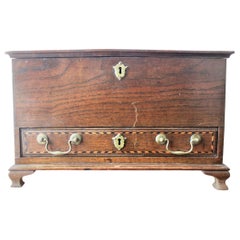
Antique English Handcrafted Wedding or Apprentice Chest or Box with Drawer
Located in Hamilton, Ontario
This early George the 3rd era and styled handcrafted wooden miniature blanket box is unsigned by presumed to have been made in England in circa 1790. T...
Category
English George III Antique 18th Century and Earlier Decorative Boxes
Materials
Brass, Steel
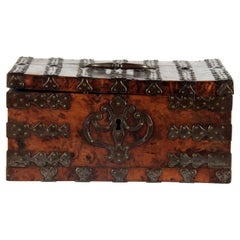
Sea Captain
s Box, circa 1680/1720
Colonial
Located in Esbeek, NL
Sea captain's box with iron fittings
1680/1720
colonial.
Category
European Antique 18th Century and Earlier Decorative Boxes
Materials
Wood, Walnut
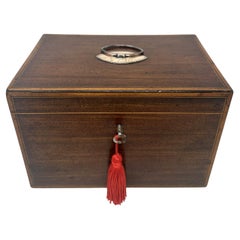
Antique English Mahogany Georgian Double Tea Caddy attrib Gillows 18th Century
Located in Dublin, Ireland
A Superb Example of an English Georgian Period Well figured Mahogany Double Interior Section Tea Caddy of flat rectangular outline, generous proportions and outstanding quality, all ...
Category
English Georgian Antique 18th Century and Earlier Decorative Boxes
Materials
Mahogany
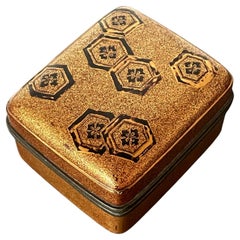
Antique Japanese Lacquered Incense Box Kobako Ex-Christie
s
Located in Atlanta, GA
An old Japanese lacquered small box likely used to contain incense powder called Kobako, circa Momoyama to early Edo period (16-17th century). The rectangular form box with a fitted ...
Category
Japanese Japonisme Antique 18th Century and Earlier Decorative Boxes
Materials
Lead
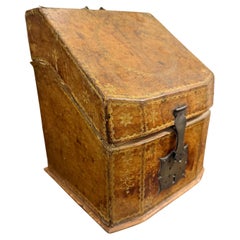
An Italian Gold Embossed Leather Knife Box, 18th Century
Located in ARMADALE, VIC
An Italian Gold Embossed Leather Knife Box, 18th Century
Description:
The wooden surface with leather overlay and painted gilt surface decoration consisting of florets and a central...
Category
Italian Antique 18th Century and Earlier Decorative Boxes
Materials
Leather, Wood
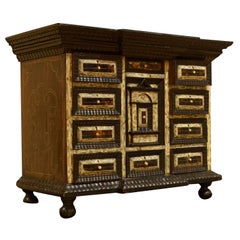
Mexican Tortoiseshell and Pen-Engraved Cabinet
Located in Mexico, DF
Mexican cabinet. Made of tortoiseshell, pen-engraved and wood. Possible Oaxaca or Puebla, 17th century.
Category
North American Spanish Colonial Antique 18th Century and Earlier Decorative Boxes
Materials
Tortoise Shell
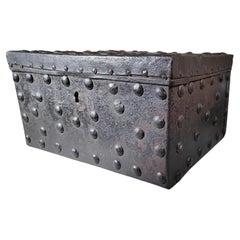
Wrought iron box with secret 18th century
Located in Madrid, ES
Wrought iron box with secret 18th century
Riveted wrought iron box. One of the rivets moves upwards and makes an internal mechanism move in order to open. The mechanism is incomplete...
Category
Antique 18th Century and Earlier Decorative Boxes
Materials
Wrought Iron
Important and Rare Italian Box Safe from the 17th Century
1647
Located in Madrid, ES
Important and Rare Italian box safe from the 17th century
In chiseled bronze, decorated with jasper plates and hard stones, with a cameo with a male figure at the centre.
Inscriptio...
Category
Italian Baroque Antique 18th Century and Earlier Decorative Boxes
Materials
Bronze
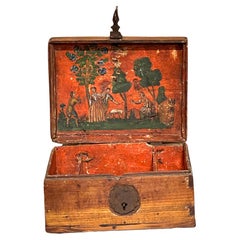
18th Century Dutch Walnut
Iron Polychromed Domed Table Box
Located in West Palm Beach, FL
18th-century Dutch Walnut and Iron Polychrome Domed Table Box
Netherlands, 18th century or older
A 18th-century Dutch walnut and iron polychrome domed table box, likely retaining i...
Category
Dutch Baroque Antique 18th Century and Earlier Decorative Boxes
Materials
Iron
$956 Sale Price
20% Off
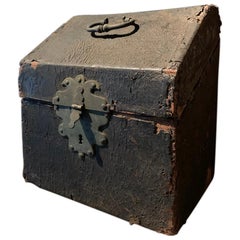
17th Century Cutlery Box
Located in Vosselaar, BE
A 17th century cutlery box with the original leather, metal hardware and interior.
Category
French Antique 18th Century and Earlier Decorative Boxes
Materials
Leather, Softwood
$1,447