Anglo-Indian Decorative Boxes
to
5
96
40
56
26
20
2
1
1
1
922
619
609
429
193
189
155
109
108
95
85
85
85
81
62
41
27
19
64
30
24
23
13
74
15
85
84
76
8
5
Height
to
Width
to
96
96
96
6
2
1
1
1
Style: Anglo-Indian
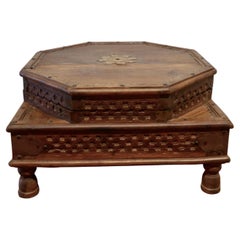
Double Height Carved Indian Box
Located in Godshill, Isle of Wight
Double height carved Indian box
An unusual piece with 2 levels, the top of the box in the octagonal shape has an opening lid. The lower is recta...
Category
Early 20th Century Anglo-Indian Decorative Boxes
Materials
Teak
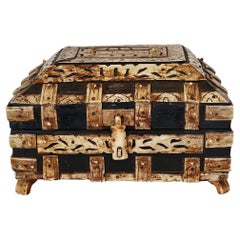
Antique Vizagapatam India Table Box Ebonized Wood
Bone Carvings
Located in Forney, TX
Vizagapatam box, India, 19th century.
This highly decorative and unusual Anglo-Indian table box features rustic workmanship that adds to the character and charm of this unique Sout...
Category
19th Century Indian Antique Anglo-Indian Decorative Boxes
Materials
Bone, Wood
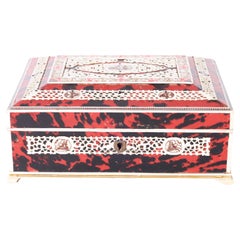
Antique Anglo Indian Tortoise and Bone Box
Located in Palm Beach, FL
Standout exotic Anglo Indian lidded box handcrafted in mahogany and clad in tortoise shell with applied lacy bone designs inscribed and painted with flowers. The interior has a mirro...
Category
Early 20th Century Indian Anglo-Indian Decorative Boxes
Materials
Bone, Tortoise Shell, Mirror, Mahogany
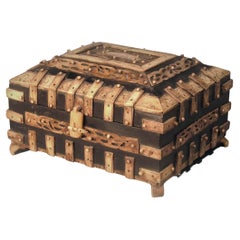
Very Decorative Vizagapatam Box INDIA 19th Century
Located in Ottawa, Ontario
VERY DECORATIVE VIZAGAPATAM BOX
Vizagapatam, India, 19th Century.
Rustic workmanship will only add to the decorative appeal of this Anglo-Indian footed domed casket in ebonized woo...
Category
19th Century Indian Antique Anglo-Indian Decorative Boxes
Materials
Bone
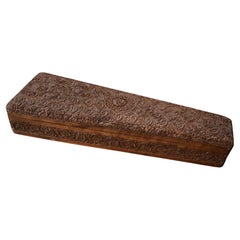
Antique Indian Carved Wooden Storage Box For Fans, 19th century
Located in Bilzen, BE
Richly carved hardwood Indian box for storage of fans in a fine quality
Late 19th century
length 38 cm, width 6.5 and 12.5 cm, height 7 cm
Aged patina
Category
Late 19th Century Indian Antique Anglo-Indian Decorative Boxes
Materials
Wood
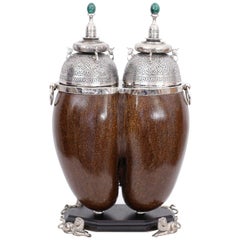
Coco De Mer Tea Caddy
Located in Palm Beach, FL
Unusual coco de mer tea caddy crafted with a double lobe nut found on the Seychelles Islands, it is said to have mystical properties. Featuring malachite f...
Category
Early 20th Century Indian Anglo-Indian Decorative Boxes
Materials
Coconut

$9,900
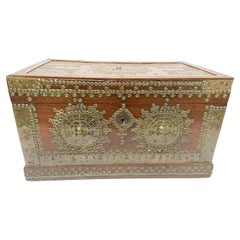
19th C. Indian Fitted Teak Workbox with Brass Tack and Applique Work
Located in Chapel Hill, NC
Indian teak work or stationary box with brass tack and applique decoration on the top and sides and fitted with brass lift-handles. the interior fitted with lift out trays and open c...
Category
Mid-19th Century Indian Antique Anglo-Indian Decorative Boxes
Materials
Brass
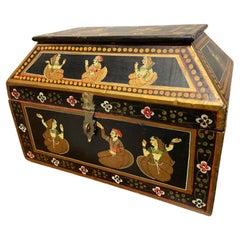
Anglo Indian Decorative Box with Painted Figures of Dancers
Located in Stamford, CT
Very decorative hand painted in the Anglo-Indian style. Painted back and gold with each framed panel filled with female dancers and male flower bearing suiters. A colorful and fun, a...
Category
Mid-20th Century Indian Anglo-Indian Decorative Boxes
Materials
Wood
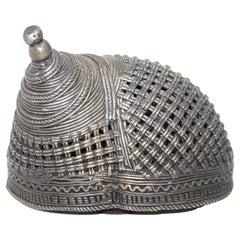
Indian Cast Brass Metal Incense Burner in a Snail Form
Located in Moreno Valley, CA
Hand tooled cast metal incense stick holder in a Snail Shaped form.
Vintage cast brass incense burner holder.
A censer, incense burner, perfume ...
Category
Mid-20th Century Indian Anglo-Indian Decorative Boxes
Materials
Metal
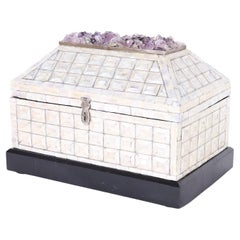
Amethyst and Mother of Pearl Lidded Box by Antony Redmile
Located in Palm Beach, FL
Anglo Indian style hinged box ambitiously covered in a mother of pearl geometric mosaic and featuring a fixed cluster of amethyst stones on top. Stamped "redmile London".
Category
20th Century English Anglo-Indian Decorative Boxes
Materials
Amethyst
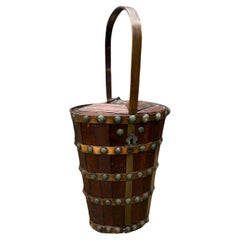
Unusual 19th Century, Anglo-Indian Style Dutch Paneled Basket
Located in Atlanta, GA
This unique 19th-century basket combines Dutch craftsmanship with Anglo-Indian stylistic influences, resulting in a truly distinctive piece. The box features paneling across the main...
Category
19th Century Danish Antique Anglo-Indian Decorative Boxes
Materials
Brass
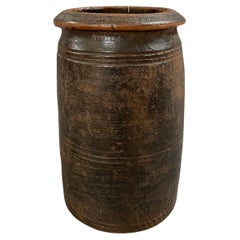
1920s Wood Himachal Pot
Located in Roma, IT
This seemingly simple wooden vase is a design object of infinite beauty and elegance that can be placed in either an antique or a modern or contemporary setting.
They are Indian arte...
Category
Early 20th Century Indian Anglo-Indian Decorative Boxes
Materials
Wood
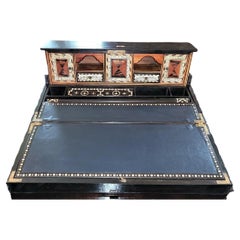
19C Anglo Ceylonese Lap Desk of Museum Quality
Located in Dallas, TX
Presenting an absolutely fantastic 19C Anglo Ceylonese lap desk of museum quality.
We can safely say that this is one of the finest lap desks we hav...
Category
Early 19th Century Sri Lankan Antique Anglo-Indian Decorative Boxes
Materials
Bone, Ebony, Sandalwood
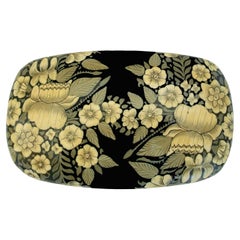
Kashmir Black Lacquer
Hand Painted Papier Mâché Box, India, Mid-20th Century
Located in Chatham, ON
Vintage South Asian / Kashmir hand painted papier mâché box with removeable lid - featuring a profuse floral pattern over the top and sides set against a black lacquer background - h...
Category
Mid-20th Century Indian Anglo-Indian Decorative Boxes
Materials
Composition
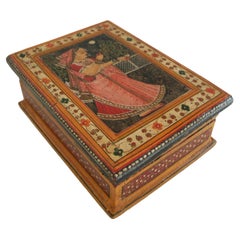
Vintage South Asian Folk Art Hand Painted Wooden Box - India - Mid 20th Century
Located in Chatham, ON
Vintage South Asian hand painted wooden box with removeable lid - featuring a full length portrait of an Indian woman in a pink sari to the lid...
Category
Mid-20th Century Indian Anglo-Indian Decorative Boxes
Materials
Softwood, Paint
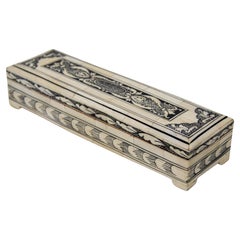
Moorish Islamic Mughal Raj Decorative Vizagapatam Carved Bone Jewelry Box India
Located in Moreno Valley, CA
Decorative Mughal Raj Vizagapatam Carved Veneered Bone Jewelry Rectangular shape Box.
Vintage Asian lidded box crafted with bone finely engraved and hand painted in black with geometric Moorish designs.
Delightful Anglo Indian footed box crafted with an intricate patterned polished bone inlay mosaic over a wood frame.
Handmade in Vizagapatam, India, mid 20th century.
Elegant intricate pattern. A true work of Islamic artwork...
Category
Late 20th Century Indian Anglo-Indian Decorative Boxes
Materials
Bone, Wood
19C Anglo Indian Highly Carved Teak Sadeli Mosaic Inlaid Sewing Box
Located in Dallas, TX
PRESENTING A LOVELY 19C Anglo Indian Highly Carved Sadeli Mosaic Inlaid Sewing Box.
Made in Bombay, India, circa 1880.
The box is made of sandalwood with highly carved raised teak wood panels on all sides, depicting temple scenes, animals and foliage.
The box is in a sarcophagus form.
It is edged in bone (and we can tell it is bone and not ivory, from the color and evidence of capillaries, which are not found in ivory), and banded with Bombay Sadeli mosaic and ebony veneer.
The lid opens to reveal a removable tray with various open compartments and lidded compartments. 5 lidded compartments, 1 unlidded compartment and 8 holders for thimbles, etc
The tray lifts to reveal a blue velvet (original) lined section, for storing jewelry etc, with sections for collars etc.
The inside of the lid has a removable mirror (the mirror is missing on this one but can easily be replaced). Behind the mirror is the original green velvet lining.
It has its original brass carry handles on the sides and sits on 4 silvered button feet (of recent origin).
Some repairs to the exterior and condition issues (priced accordingly), but still a LOVELY COLLECTIBLE box!
These boxes were made by superb Indian craftsmen, specifically for sale to the ruling British elite. These types of boxes, carved padouk and sandalwood, (whilst beautiful and superbly crafted) were of a lesser quality, than the more profusely and intricately mosaic inlay, tortoiseshell and ivory boxes, made for the British ‘Upper Classes’ in the areas of Bombay and Vizagapatam. These type of boxes were much more affordable back in 1880 (and indeed today) and would probably have been bought by mid-level diplomats, civil servants or visitors.
Sewing boxes (in general), were in EVERY Victorian home in Britain in the 19th century and like other boxes etc were ‘status symbols’ of your place in society! The more ornate the box, the more ‘Upper Class’ you were!
SADELI MOSAIC: “Anglo Indian boxes were made in India for the English residents from the early part of the 18th century. They were brought back or sent back to England usually by the people who had commissioned them. From the beginning of the nineteenth century they were imported more commercially, although not in any significant numbers until the middle decades. They were very highly valued, especially the early ones, to the extent that the designs were copied on late 19th and early 20th century tins.
The ancient art of Sadeli Mosaic is said to have been introduced from Shiraz in Persia via Sind to Bombay, a long time before the Anglo Indian boxes were made. It was a technique, which required a high degree of skill and patience. It was executed very lavishly, in that the frequent cuts wasted a great amount of the precious materials used. The workmanship was however more than commensurable to the value of the materials.
Ivory, silver, pewter (or other metals), wood and Horn were cut into faceted rods which were bound together to form geometric patterns. When the glue has set, the rods were sliced in transverse sections. This gave the maker a number of angled circular pieces in the original pattern. Several variations of patterns could be achieved by combining the materials in different ways. The ivory was sometimes dyed green to give an extra color.
The mosaic pieces in a combination of patterns, often separated by ivory, ebony, Horn or silver stringing were used to veneer sandalwood boxes. In the early boxes, which date from the turn of the 18th to the 19th century, there are large panels of mosaic covering tops and sides of boxes. It took incredible skill to cover such large areas without any shakes or wavering of the pattern. The corners and joins on these boxes are impeccably matched.
The makers (reputed to be Persian) of Sadeli mosaic made in the first two decades of the 19th century displayed a total understanding of the qualities of the different materials they used. They combined substances, which can expand and contract according to atmospheric conditions with others, which are hard and unyielding. The result was a sharp definition of the lines and patterns, which made up the whole design.
On the early boxes the designs look deceptively simple. The fact is, they emerged from a culture, which had mastered geometry and understood how to generate a pattern from a set number of points. The patterns are so harmoniously combined that their incredible complexity is not immediately apparent.
The earliest Sadeli boxes...
Category
Late 19th Century Indian Antique Anglo-Indian Decorative Boxes
Materials
Bone, Sandalwood, Teak
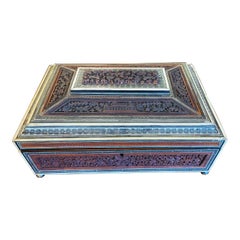
19c Anglo Indian Highly Carved Teak and Sandalwood Sarcophagus Sewing Box
Located in Dallas, TX
PRESENTING A VERY NICE 19C Anglo Indian Highly Carved Teak and Sandalwood Sarcophagus Sewing Box.
Made in Bombay, India circa 1890-1900.
The box case/body is made of sandalwood wit...
Category
Late 19th Century Indian Antique Anglo-Indian Decorative Boxes
Materials
Bone, Sandalwood, Teak
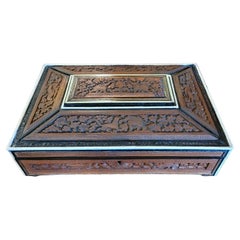
Exquisite 19th c. Luxury Compartmented Ceylonese Sailor
s Box
Located in Greenwich, CT
An exquisite 19th century luxury sailor's box in sandalwood with dramatically contrasting bone and ebony geometric decoration and string inlay having raised center tier with sliding ...
Category
Late 19th Century Sri Lankan Antique Anglo-Indian Decorative Boxes
Materials
Sandalwood
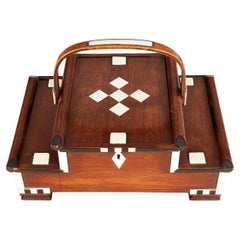
19C Anglo Indian Highly Carved Sadeli Mosaic Sarcophagus Sewing Box
Located in Dallas, TX
PRESENTING A GORGEOUS 19C Anglo Indian Highly Carved Sadeli Mosaic Sarcophagus Sewing Box.
Made in Bombay, India circa 1860-80.
Box made of sandalwood with highly carved teak wood reliefs and panels on all sides.
Edged with bone and ebony veneers and glorious sadeli mosaic, made from tiny pieces of faux ivory, pewter, green semi-precious stone.
The box is in a sarcophagus form with domed lid.
The original brass carry handles are on the sides.
The interior is in great condition and consists of a removeable mirror under the lid portion, with the original red velvet lining behind it.
The base is removeable and contains a number of lidded compartments.
6 of the interior lids on the base, are each inlaid with sadeli mosaic banding. The rest are also carved and chased.
The interior is fully complete with 7 lidded faux ivory/bone, thread canisters with sadeli domes and the original bone thimble.
The box sits on 4 brass ball or bun feet with the original velvet lining on the base.
Some minor repairs and losses, but this box is fully complete. This is ‘rare’ as many of these boxes have not survived in such condition!
Included in the sale are 2 photos that were in the box (under the base tray). Interestingly, one of them is a view of downtown Nassau, New Providence (Bermuda) from the early 20C and stamped on the rear. What a ‘journey’ this piece has made! Made in India … travelled to Bermuda, probably via Britain … back to Ireland (where we bought it) …. then to Texas!
These boxes were made by superb Indian craftsmen, specifically for sale to the ruling British elite. These types of boxes, carved padouk and sandalwood, (whilst beautiful and superbly crafted) were of a lesser quality, than the more profusely and intricately mosaic inlay, tortoiseshell and ivory boxes, made for the British ‘Upper Classes’ in the areas of Bombay and Vizagapatam. These type of boxes were much more affordable back in 1880 (and indeed today) and would probably have been bought by mid-level diplomats, civil servants or visitors.
Sewing boxes (in general), were in EVERY Victorian home in Britain in the 19th Century and like other boxes etc were ‘status symbols’ of your place in society! The more ornate the box, the more ‘Upper Class’ you were!
Of it’s type, this one, is one of the very higher quality one’s, than the norm!
SADELI MOSAIC: “Anglo Indian boxes were made in India for the English residents from the early part of the 18th century. They were brought back or sent back to England usually by the people who had commissioned them. From the beginning of the nineteenth century they were imported more commercially, although not in any significant numbers until the middle decades. They were very highly valued, especially the early ones, to the extent that the designs were copied on late 19th and early 20th century tins.
The ancient art of Sadeli Mosaic is said to have been introduced from Shiraz in Persia via Sind to Bombay, a long time before the Anglo Indian boxes were made. It was a technique, which required a high degree of skill and patience. It was executed very lavishly, in that the frequent cuts wasted a great amount of the precious materials used. The workmanship was however more than commensurable to the value of the materials.
Ivory, silver, pewter (or other metals), wood and horn were cut into faceted rods which were bound together to form geometric patterns. When the glue has set, the rods were sliced in transverse sections. This gave the maker a number of angled circular pieces in the original pattern. Several variations of patterns could be achieved by combining the materials in different ways. The ivory was sometimes dyed green to give an extra color.
The mosaic pieces in a combination of patterns, often separated by ivory, ebony, horn or silver stringing were used to veneer sandalwood boxes. In the early boxes, which date from the turn of the 18th to the 19th century, there are large panels of mosaic covering tops and sides of boxes. It took incredible skill to cover such large areas without any shakes or wavering of the pattern. The corners and joins on these boxes are impeccably matched.
The makers (reputed to be Persian) of Sadeli mosaic made in the first two decades of the 19th century displayed a total understanding of the qualities of the different materials they used. They combined substances, which can expand and contract according to atmospheric conditions with others, which are hard and unyielding. The result was a sharp definition of the lines and patterns, which made up the whole design.
On the early boxes the designs look deceptively simple. The fact is, they emerged from a culture, which had mastered geometry and understood how to generate a pattern from a set number of points. The patterns are so harmoniously combined that their incredible complexity is not immediately apparent.
The earliest Sadeli boxes...
Category
19th Century Indian Antique Anglo-Indian Decorative Boxes
Materials
Bone, Sandalwood, Teak
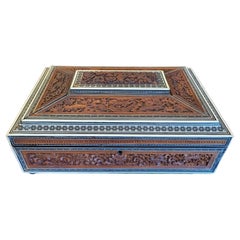
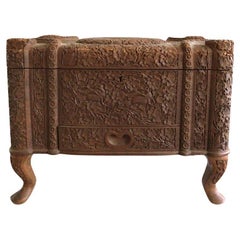
1950s Fine And Densely Carved Anglo-Indian Style Box
Located in Tarrytown, NY
1950s Fine And Densely Carved Anglo-Indian Style Box
Drawer at outside base of box
South-Indian or Anglo-Indian style
Lacking keys
Decoration adorned on all sides depicting birds amo...
Category
1950s Vintage Anglo-Indian Decorative Boxes
Materials
Wood
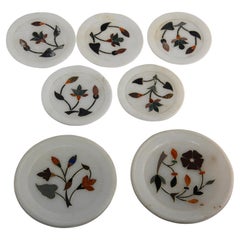
Vintage Rajasthani Pietra Dura White Stone Inlay Taj Mahal India Style
By Rajhastani
Located in Moreno Valley, CA
Vintage Rajasthani Pietra Dura White Stone Inlay Taj Mahal India Style coaster plates.
Rajasthani inlaid stone marble decorative set of 7 small roun...
Category
Mid-20th Century Indian Anglo-Indian Decorative Boxes
Materials
Stone, Marble
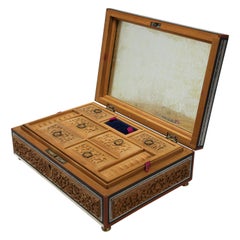
Anglo-Indian Footed Box with Lidded Compartments, 19th Century
Located in Moreno Valley, CA
19th century Anglo-Indian wooden box fitted with various compartments finely hand carved.
The top is finely hand carved with the Taj Mahal.
The interior with removable hand carved nine-lidded compartments, the front cover has a mirror, the whole exhibiting very fine workmanship.
This fine late Victorian Anglo-Indian box from India is in great condition for it age.
A beautiful example of an Anglo-Indian fine art...
Category
Late 19th Century Indian Antique Anglo-Indian Decorative Boxes
Materials
Sandalwood
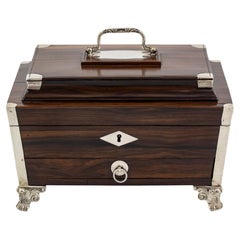
Anglo Indian Coromandel and Silver Sewing Box
Located in Northampton, GB
Mounted with Silver
From our Sewing Box collection, we are pleased to offer this Solid Coromandel Anglo Indian and Silver Sewing Box. The Sewing Box of...
Category
Early 19th Century Indian Antique Anglo-Indian Decorative Boxes
Materials
Silver
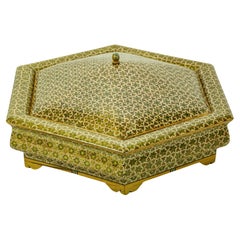
Large Anglo Indian Mosaic Inlaid Jewelry Hexagonal Box 1950s
Located in Moreno Valley, CA
Large Anglo Indian Moorish Islamic style micro mosaic inlaid jewelry box with lid.
Intricate inlaid Anglo Persian box with floral and geometric Moorish Sadeli design in an hexagonal shape form with micro mosaic marquetry, very fine artwork.
Museum collector piece like the one in Doris Duke Islamic Art Museum.
The repeating geometric patterns of Sadeli Mosaic are what give it beauty and richness.
This decorative technique is a type of micro mosaic featuring repeating geometric patterns.
Dimensions: H: 5 in : 12 in W x 12 in. D.
Circa 1950s.
Sadeli mosaic art is a highly skilled craft, it has had a long history in India and the Middle East with early examples dating back to the 16th century. In the 1800s, it became popular as a decoration on a variety of boxes, card cases, and chess boards imported from India. Since Bombay became a center of making them, they became known as Bombay boxes.
The ancient art of Sadeli Mosaic is said to have been introduced from Shiraz in Persia via Sind to Bombay, a long time before Indian boxes appeared. The designs on early boxes look deceptively simple. The fact is they emerged from a culture which had mastered geometry and understood how to generate a pattern from a set number of points. The patterns are so harmoniously combined that their incredible complexity isn’t immediately apparent to the viewer.
Will look great in a Moroccan decor...
Category
Mid-20th Century Indian Anglo-Indian Decorative Boxes
Materials
Wood
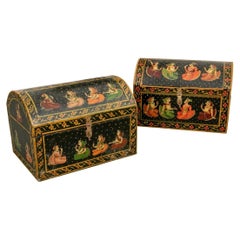
Pair of Fine Painted Indian Dome Top Trunks
Located in Bridgeport, CT
Wood with domed tops. Painted in black with multi-colored figural court scenes with colorfully dressed seated men and women. Floral borders. Painted red inside, brass hardware.
Meas...
Category
Mid-20th Century Indian Anglo-Indian Decorative Boxes
Materials
Wood
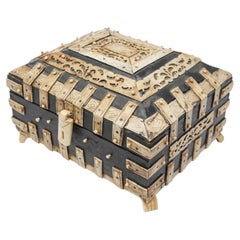
Antique 19th c. Decorative Anglo-Indian Overlay Footed Box with Engraved Bone
By Rajhastani
Located in Moreno Valley, CA
Nice and unusual Jewelry decorative box with filigree bone overlaid decoration.
Large Anglo-Indian footed domed box with exceptional engraved bone de...
Category
Late 19th Century Indian Antique Anglo-Indian Decorative Boxes
Materials
Wood
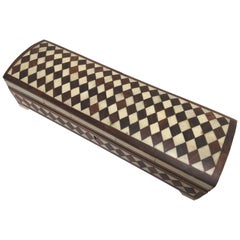
Vizagapatam Anglo-Indian Rectangular Box with Bone Inlaid
Located in Moreno Valley, CA
Fabulous Anglo-Indian decorative box inlaid.
Made in Vizagapatam, situated on the south east coast of India, near Madras.
Great decorative inlaid pen box or jewelry box.
Inside dimen...
Category
20th Century Indian Anglo-Indian Decorative Boxes
Materials
Sandalwood
19th Century Old Portable Chest in Wood and Iron Frames Resting on Four Feet
Located in Sofia, BG
Rare Indian coffee made of hand carved wood with metal frame. The door opens from the top and reveals the interior. Beautiful piece that could be used as a letter box or as a small jewellery cabinet...
Category
Early 19th Century Indian Antique Anglo-Indian Decorative Boxes
Materials
Wood
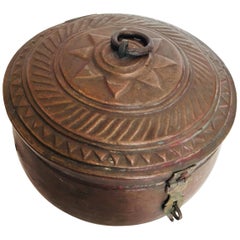
Large Decorative Round Copper Box with Lid Northern India
Located in Moreno Valley, CA
Very large beautiful vintage handcrafted decorative round copper box with lid, latch and handle
Delicately and intricately hand-hammered with geometric designs.
Hand crafted by skill...
Category
Early 20th Century Indian Anglo-Indian Decorative Boxes
Materials
Brass, Copper, Tin
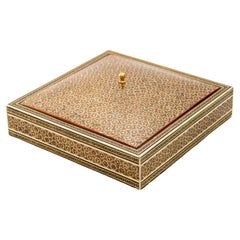
1950s Anglo Indian Style Micro Mosaic Inlaid Jewelry Box
Located in Moreno Valley, CA
1950's Anglo Indian, Indo Persian style micro mosaic inlaid jewelry box with lid.
Large vintage intricate inlaid middle Eastern Persian style box with floral and geometric Islamic Mo...
Category
Mid-20th Century Indian Anglo-Indian Decorative Boxes
Materials
Fruitwood
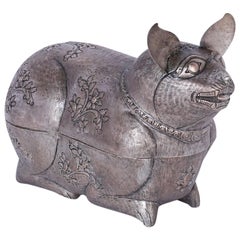
Anglo Indian Metal Cat Box
Located in Palm Beach, FL
Whimsical silvered metal feline handcrafted with a folky charm that is hammered and etched in a decorated floral design that unexpectedly opens as a trinket box.
Category
Early 20th Century Indian Anglo-Indian Decorative Boxes
Materials
Metal
19th Century Anglo-Indian Sadeli Mosaic Jewelry Box with Lidded Compartments
Located in Moreno Valley, CA
19th century Anglo-Indian sandal wood box, Sadeli mosaic box fitted with various compartments finely hand-carved with the Taj Mahal.
Of sarcophagus form ...
Category
Late 19th Century Indian Antique Anglo-Indian Decorative Boxes
Materials
Sandalwood
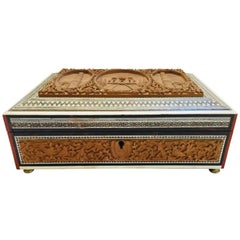
Antique American Gilt
Inset Glass Decorative Dresser Box or Vide Poche
Located in Hamilton, Ontario
This antique decorative box was made by the Apollo Manufacturing Company of the United States in approximately 1920 in an Anglo-Indian style. ...
Category
Early 20th Century American Anglo-Indian Decorative Boxes
Materials
Spelter
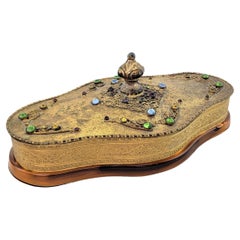
19th Century Anglo Indian Vizagapatam Carved Sandalwood Box Micro Mosaic Inlays
Located in West Sussex, Pulborough
We are delighted to offer for sale this lovely 19th century Anglo-Indian Vizagapatam carved sandalwood and inlaid box
Mid-19th century Anglo-Indian Vizagapatam carved sandalwood box...
Category
19th Century Indian Antique Anglo-Indian Decorative Boxes
Materials
Wood
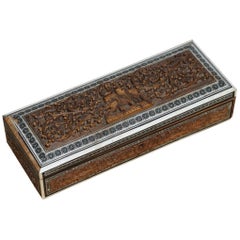
Rajasthani Carved Box Made from 19th Century Blue Parts
Located in Dallas, TX
This sturdy box is slightly waxy to the touch. Giving light to the olden way of preserving carved wood. There are blue pieces to this box that give off a cultural and exotic feel. Th...
Category
19th Century Indian Antique Anglo-Indian Decorative Boxes
Materials
Wood
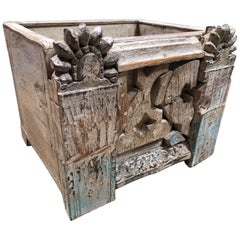
Anglo-indian decorative boxes for sale on 1stDibs.
Find a broad range of unique Anglo-Indian decorative boxes for sale on 1stDibs. Many of these items were first offered in the Late 20th Century, but contemporary artisans have continued to produce works inspired by this style. If you’re looking to add vintage decorative boxes created in this style to your space, the works available on 1stDibs include decorative objects, asian art and furniture, serveware, ceramics, silver and glass and other home furnishings, frequently crafted with wood, metal and other materials. If you’re shopping for used Anglo-Indian decorative boxes made in a specific country, there are Asia, South Asia, and India pieces for sale on 1stDibs. While there are many designers and brands associated with original decorative boxes, popular names associated with this style include Rajhastani, Agra, Anthony Redmile London, and Apollo Woodwoking and Metal Corp. It’s true that these talented designers have at times inspired knockoffs, but our experienced specialists have partnered with only top vetted sellers to offer authentic pieces that come with a buyer protection guarantee. Prices for decorative boxes differ depending upon multiple factors, including designer, materials, construction methods, condition and provenance. On 1stDibs, the price for these items starts at $95 and tops out at $11,900 while the average work can sell for $1,200.