Early 19th Century Mantel Clocks
to
24
305
132
1,664
408
39
241
94
41
59
18
47
29
8
6
10
10
10
7
133
18
12
11
7
4
1
1
1
280
202
115
87
63
201
59
274
244
21
17
5
Height
to
Width
to
305
305
305
3
2
2
2
2
Period: Early 19th Century
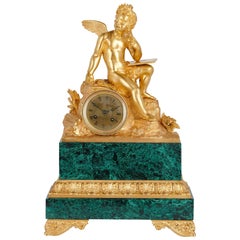
French Neoclassical Malachite and Gilt Bronze Mantel Clock
Located in London, GB
French neoclassical malachite and gilt bronze mantel clock
French, circa 1830
Measures: Height 51cm, width 33cm, depth 14cm
This mantel ...
Category
French Charles X Antique Early 19th Century Mantel Clocks
Materials
Malachite, Ormolu, Bronze

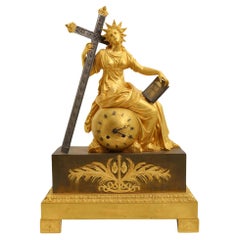
19th Century French Ormolu Bronze Mantel Clock Depicting Madonna with Cross
Located in New York, US
Our large French gilt and patinated bronze mantel clock dating from the second quarter of the nineteenth century features the finest casting and gilded details. It depicts Mary sea...
Category
French Neoclassical Antique Early 19th Century Mantel Clocks
Materials
Bronze
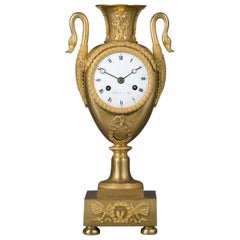
Empire Clock in the Form of a Classical Urn, by Maison Lepautre, circa 1825
By Pierre-Basile Lepaute
Located in Brighton, West Sussex
A gilt bronze Empire clock in the form of a classical urn, by Maison Lepautre.
French, circa 1825.
The dial signed 'Lepaute a Paris'.
The clock has an ornate cast bezel with a 3-inch porcelain dial with Roman numerals and Breguet style hands. The twin train eight-day movement with outside count wheel striking on a bell and silk thread suspension.
This elegant Empire style clock has a gilt bronze case in the form of a classical urn with swan neck handles and a winged cherub to the neck. The circular pedestal base is raised on a footed stepped square plinth.
The Lepaute family were the premier French clockmakers of their day. Their significance lies in their contribution to the clock making industry which had hitherto come under the trade of locksmiths. The family held the brevet Horlogers du Roi.
Jean-André Lepaute (1720–1789) arrived in Paris at an early age and in 1740 founded the family business. A skilled artist and mechanic, he quickly gained an excellent reputation. He was received as maître by the clockmakers guild in 1759, was granted royal lodgings from the king in The Luxembourg Palace, and was entrusted with the construction of the majority of the great public clocks of Paris. He executed, amongst others, those in The Luxembourg Palace, the Jardin des Plantes, the Château de Bellevue and the Château des Ternes. His clock at Paris’s École Militaire still works today. Three editions of his Traité d’Horlogerie were published in Paris in 1755, 1760 and 1767. A small volume, Description de Plusieurs Ouvrages d’Horlogerie appeared in 1764. Jean-André’s wife, Nicole-Reine Etable de la Brière (1723-1788), was a highly esteemed mathematician and astronomer. Her passion for science lent itself to Lepaute’s work and she played an active role in the scientific and mathematical aspects of the clock making.
Jean-André’s younger brother Jean-Baptiste Lepaute (1727-1802) joined him in Paris in 1747 and immediately started working for the family business. He was received as maître in 1776 and was known for the clocks he constructed for the Paris Hôtel de Ville (1780), destroyed in a fire of 1871, and for the Hôtel des Invalides (1784). Jean-Baptiste took over the workshop when Jean-André retired in 1775.
After Jean-Baptiste’s death in 1802, the firm was taken over by his nephew Pierre-Basil Lepaute (1750-1843) where he was duly joined by his own nephew Jean-Joseph (1768-1846) and son Pierre-Michel (1785-1849). By 1816, Pierre-Michel Lepaute was in charge of the business. His masterpieces include the astronomical clock in Paris’s Bureau...
Category
French Empire Antique Early 19th Century Mantel Clocks
Materials
Bronze
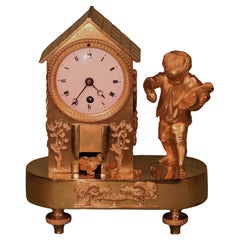
19th Century French Ormolu Mantel Hen House Clock
Located in London, GB
An early 19th century French ormolu mantel clock, having 8-day movement with enamel dial, mounted in “hen house” with urn and flower mounts to side, the oval...
Category
French Antique Early 19th Century Mantel Clocks
Materials
Ormolu
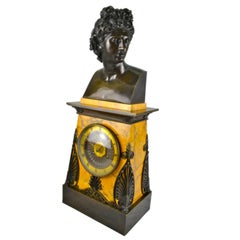
Empire Bronze and Sienna Marble Clock with a bust of Apollo Belvedere
Located in Vancouver, British Columbia
A fine example of a French Empire period mantle clock, circa 1830. The rectangular stepped case is made of yellow Sienna marble and is decorated on the top and bottom with patinated ...
Category
French Empire Antique Early 19th Century Mantel Clocks
Materials
Siena Marble, Bronze
More Ways To Browse
Black Onyx Clock
Black Victorian Mantle
English Fusee Clock
French Clocks Greek
French Regulator Clock
Garniture Cheminee
Marble And Slate Mantel Clocks
Samuel Marti Bronze Clock
Sienna Marble Clock
Tiffany Marble Clock
Vintage Bird Clock
Westminster Antique Clocks
1855 Clocks
Ansonia Brass
Antique Ansonia Mantel Clock
Antique Clock Gongs
Antique Clock Sound
Antique Figurine Clock