15th Century and Earlier Figurative Sculptures
to
18
204
1,163
3,788
9,411
2,653
2,265
3,283
2,164
306
163
561
571
260
545
556
716
397
284
1
70
59
59
35
18
111
86
72
70
46
39
33
Height
to
Width
to
204
204
204
1
1
Period: 15th Century and Earlier
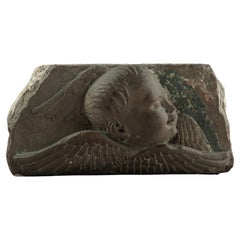
Renaissance Winged Cherub Relief
- Florence, 15th century
Located in Bruxelles, BE
Renaissance Winged Cherub Relief
Florence, Second Half of the 15th Century
Stone with traces of polychromy
Provenance: Important private collection, Northern Italy
This exceptional...
Category
Italian Renaissance Antique 15th Century and Earlier Figurative Sculptures
Materials
Stone
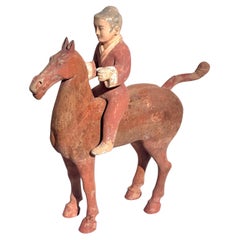
Han Dynasty Painted Pottery Horse And Detachable Rider.
Located in Dallas, TX
Large Han Dynasty Pottery Horse And Rider.
Painted Pottery
Western Han Dynasty (206BCE- 220CE)
Rider and tail is removable and are original in excellent condition. This is a rare exa...
Category
Chinese Han Antique 15th Century and Earlier Figurative Sculptures
Materials
Pottery
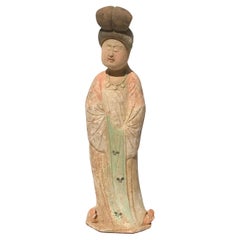
Tang Dynasty Painted Pottery Fat lady Sculpture
Located in Dallas, TX
A wonderful period Tang Dynasty Pottery Figure of a Fat Lady.
Tomb Pottery
China
Height: 15 Inches
No TL Test
A COA by Avantiques will accompany the sale of this item.
Condition: Ve...
Category
Chinese Tang Antique 15th Century and Earlier Figurative Sculptures
Materials
Pottery
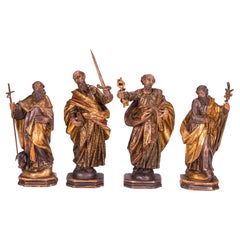
15th Cen Four Pillars of the Christian Faith Saint Peter, Saint Paul, Saint Luke
Located in North Miami, FL
15th century Italian carved wood, polychromed and gold gilded sculptures of four Pillars of the Christian Faith (Saint Peter, Saint Paul, Saint Luke, Saint Matthew).
Category
Italian Renaissance Antique 15th Century and Earlier Figurative Sculptures
Materials
Gold Leaf

$30,000 Sale Price / set
20% Off
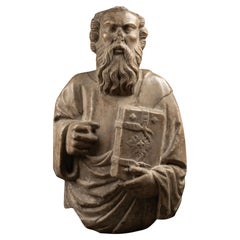
Circle of Pierpaolo and Jacobello Dalle Masegne (Venice, late 14th century)
Located in Bruxelles, BE
Circle of Pierpaolo and Jacobello Dalle Masegne (Venice, late 14th century)
San Bartolomeo
high relief 'en applique'
white marble
52 x 30 x 14 cm
Provenance :
Collection South of...
Category
Italian Gothic Antique 15th Century and Earlier Figurative Sculptures
Materials
Marble
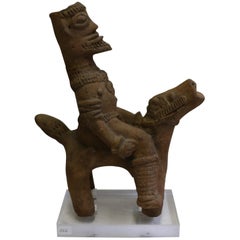
Equestrian figure Koma-Bulsa, Ghana, 14th-15th century
Located in Paris, FR
Terracotta, 14th-15th century (thermoluminescence test: Interexpert 388317 from March 18, 1988).
Koma-Bulsa motifs (Ghana), including a concave hairstyle with braided frontal ornamen...
Category
Ghanaian Tribal Antique 15th Century and Earlier Figurative Sculptures
Materials
Terracotta
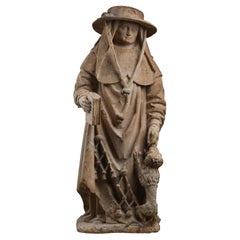
Followers of Jean de la Huerta, Jean de Blany ? - Saint Jerome
Located in Bruxelles, BE
Followers of Jean de la Huerta, Jean de Blany ?
Saint Jerome
Limestone
Burgundy, second half of the15th century
60,5 cm
ALR Ref : S00248050
This exquisite sculpture of Saint Jerome, carved from soft, nearly white limestone typical of eastern France, exemplifies the exceptional craftsmanship of 15th-century Burgundian art. The figure of Saint Jerome, a key figure in Christian history renowned for translating the Bible into Latin, is depicted wearing a cardinal’s hat and holding the Vulgate Bible...
Category
French Renaissance Antique 15th Century and Earlier Figurative Sculptures
Materials
Limestone
Primitive Head Figure From the Pre-Columbian Period Made of Stone
Located in North Miami, FL
Introducing a remarkable artifact from the Pre-Columbian period—a primitive head figure intricately carved from stone. This ancient relic stands proudly...
Category
Pre-Columbian Antique 15th Century and Earlier Figurative Sculptures
Materials
Stone
$2,963 Sale Price
24% Off
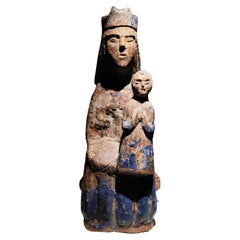
Seated Virgin with Child (Sedes Sapientiae) from the 12th Century in Spain
Located in Madrid, ES
Technique: Tempera and oil on wood
Dimensions: 25 x 11 x 8 cm
Description:
This exceptional work from the 12th century represents the Seated Virgin with Child (Sedes Sapientiae), standing out as an artistic treasure from medieval Spain. The portrayal of the Virgin enthroned with the Child on her lap is emblematic of Romanesque art, and this particular piece is a valuable and authentic example of that era.
The current polychromy belongs to the Gothic period and overlays the original Romanesque layer. It is crucial to highlight that the current state of the artwork is the original, without any cleaning interventions, imparting a unique authenticity.
The work exhibits architectural characteristics typical of Romanesque art, evident in the sides of the throne. The rigidity and symmetry characteristic of this style are reflected in the firm presentation of the Baby Jesus, noticeable in his gesture while holding his son. The Virgin wears a crown, symbolizing her royal character as the Queen of Heaven and Creation. Both figures retain traces of polychromy on the face and attire, adding layers of history and authenticity.
While similar Romanesque Virgin...
Category
Antique 15th Century and Earlier Figurative Sculptures
Materials
Fruitwood
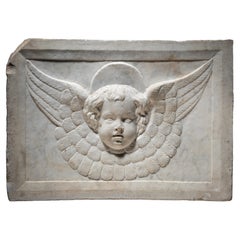
Cercle of Jacopo della Pila - Marble relief depicting a winged Cherub
Located in Bruxelles, BE
Cercle of Jacopo della Pila (Lombard, in Naples 1471-1502)
Marble relief depicting a winged Cherub
Naples, second half of15th century
40 x 57 x 12 cm
Exquisitely carved, this relief portrays a winged cherub with cascading hair and delicate features. The cherub's plump, smooth countenance, rounded cheeks, outlined lips, and finely drawn nose emanate a sense of tenderness. The quadrangular module, is adorned with a carved frame. The relief ascends gradually, transitioning from the low relief of the wings to the high relief of the head.
The rectangular frame and the subtly curved form of the artwork suggest that the relief likely adorned the upper part of an arch or a vaulted chapel. The type is that of the perspective room with a coffered ceiling decorated with figures of winged cherubs, which is found in various Neapolitan chapels of the 15th century. Coffered ceilings attest to the recovery of antiquity and the search for luxury in Renaissance architecture, first in Florence, then in Rome and Naples. The majority of the numerous family chapels and tombs built during the late fifteenth century in south of Italy employ the new formal vocabulary of the Florentine Renaissance in a self-confident manner that permitted a broad spectrum of variations.
The escalating admiration for the classical world, coupled with the development of perspective, significantly contributed to the Renaissance endorsement of coffered ceilings. This artistic and constructive device drew inspiration from the intricate marble patterns observed in historical landmarks such as the Arch of Titus, the Temple of Vesta in Tivoli, the Pantheon, and the Basilica of Maxentius. A distilled product of both mathematical and artistic cultures, deeply scrutinizing the ancient world, the coffered ceiling plays a vital role in the perspective construction of space with its regular and directional geometry. The motif of the coffered ceiling decorated with cherubs in relief was introduced in Naples by Francesco Laurana in the plastic decoration of the Arch of Castelnuovo. Laurana's impact on the art scene in the south of Italy was profound. The introduction of the winged cherub into the region's artistic vocabulary bridged the gap between the classical and the contemporary, creating a synthesis that resonated with both aesthetic and spiritual sensibilities. His influence extended beyond the immediate visual appeal, shaping the cultural identity of the Renaissance in southern Italy. Although the plastic decoration of the Arch of Castelnuovo cannot certainly be ascribed to a mature Renaissance style, it was precisely on this occasion that the sculptors who worked there could get to know and export throughout the Italian peninsula that type of "Florentine classicism" which, even in the 15th century Naples, was conditioned by the Burgundian culture imported into the Kingdom by Alfonso of Aragon himself, with artists called from Spain and Northern Europe. The coffered ceiling, with its geometric patterns and Laurana's winged cherubs nestled within, became a symbol of refinement and cultural sophistication. The relief sculptures, carefully integrated into the overall design, transformed the ceiling into a celestial realm, inviting viewers to contemplate the divine while immersed in the grandeur of the Renaissance space.
Similar winged cherubs appears also in the Naples cathedral. Within the renowned Succorpo Chapel, a mesmerizing marble coffered ceiling adorned with cherubs epitomizes the splendor of the Neapolitan Renaissance. The interplay of light and shadow on the textured surface of the marble coffered ceiling introduces an ethereal dimension, providing an immersive visual experience for observers. The geometric precision and the repeated patterns, reminiscent of classical motifs, establish a sense of harmony and balance that has become the hallmark of the Neapolitan interpretation of Florentine Renaissance aesthetics.
Although probably intended to be admired from a distance, this cherub is intricately detailed and exquisitely rendered: the face and hair are elegantly outlined and the feathers are textured through juxtaposed lines. The marble, both figurative and decorative, adheres to the principles of balance and restrained ornamentation typical of the « Florentine Classicism ». Harmonious shapes and gracefully orchestrated curves , rooted in the classical repertoire, converge to evoke a sense of ethereal beauty. The surface displays the masterful use of a chisel to intricately carve the feathers and facial features, creating an almost abstract quality.
This work is a testament to a sculptor of great skill and rich figurative knowledge, seamlessly blending classical firmness in contours with a refined treatment of the marble's surface. The combination of tradition and innovation point to a stylistic idiom from Lombardy, in particular we can find some comparaisons with the works of Jacopo della Pila, sculptor of Lombard origin working in Naples in the second half of the 15th century. He is documented there between 1471 and 1502, and is a protagonist of the Aragon Renaissance in the second half of the Quattrocento, together with the other great Northern sculptor active in the kingdom, Domenico Gagini.
the first commission he received dates back to August 9, 1471, when Jacopo publicly committed to sculpting the funerary monument of Archbishop Nicola Piscicelli to be placed in the Cathedral of Salerno. The last known work is an altar ordered on July 29, 1502, by the noble Jacopo Rocco for the church of San Lorenzo Maggiore in Naples. Between these two chronological extremes (1471-1502), we must place the fervent activity of the artist, who had trained in Rome, perhaps under the guidance of Paolo Romano but also engaged in dialogue with other major artists of the city, especially Isaia da Pisa. He enriched his experience in Naples, initially drawing inspiration from the works of Domenico Gagini and later from the Tuscan masterpieces of Antonio Rossellino and Benedetto da Maiano destined for the church of Santa Maria di Monteoliveto. Jacopo della Pila's artistic personality is thus based on a complex interplay of influences, contributing to the definition of a highly personal style.
Close comparaison can be made between our cherub and the winged angels reliefs...
Category
Italian Renaissance Antique 15th Century and Earlier Figurative Sculptures
Materials
Marble
$22,738 Sale Price
20% Off
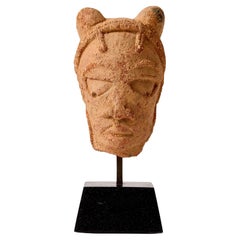
Ancient Nok Clay Sculpture from Nigeria
Located in Sagaponack, NY
Terracotta head remnant on tapered wood base
Category
Nigerian Antique 15th Century and Earlier Figurative Sculptures
Materials
Ceramic
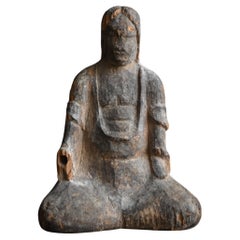
Rare Japanese antique wooden god statue /12th century/small wabi-sabi figurines
Located in Sammu-shi, Chiba
I was able to obtain a very rare item.
This is a sculpture of the god ``Shinzo''.
"Shin" = God
"zo" = statue
Since ancient times in Japan, it has been believed that gods reside in all things in the universe, and there have been many shrines.
In the 6th century, Buddhism was introduced and gradually spread throughout Japan.
Around the 8th century, the idea that gods follow the teachings of Buddha spread.
Until the Edo period, God and Buddha became one and the idea of ``Shinto and Buddhism syncretism'' was established.
This statue was created during such a history.
Originally, the image of God was invisible and could not be understood as something tangible.
However, with the introduction of Buddhism to Japan, idol worship was also introduced, and the idea that the gods follow the teachings of Buddha was also propagated at the same time in order to spread the teachings of Buddhism.
Around that time, around the 9th century, the first statues of gods...
Category
Japanese Other Antique 15th Century and Earlier Figurative Sculptures
Materials
Cypress
Flemish Field Altar Virgin, Burgundy, 15th Century
Located in Madrid, ES
Flemish Field Altar Virgin, Burgundy, 15th Century
An extraordinary 15th-century Flemish carving from Burgundy, made of polychrome and gilded wood, depicting the Virgin and Child. Ap...
Category
Spanish Baroque Antique 15th Century and Earlier Figurative Sculptures
Materials
Silver
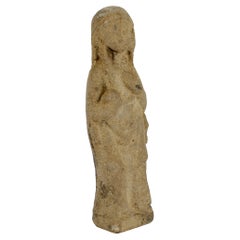
Antique Gothic Carved Limestone Model of a Madonna or Venus
Located in Philadelphia, PA
A fine antique limestone carving.
Modeled as a Madonna.
With her head slightly tilted, holding an orb in one hand, and with her other hand resting on her breast.
By repute ...
Category
Unknown Gothic Antique 15th Century and Earlier Figurative Sculptures
Materials
Limestone
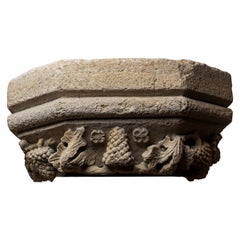
Large Hexagonale Base of Pilaster in Burgundy Stone, Burgundy, 15th Century
Located in Bruxelles, BE
Large base of molded hexagonal pilaster in burgundy stone carved with vines, grapes and rosettes in high relief.
Burgundy, 15th century
28 x 63 x 30 cm
Provenance : collection De...
Category
French Gothic Antique 15th Century and Earlier Figurative Sculptures
Materials
Stone
$6,158 Sale Price
20% Off
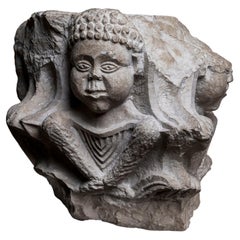
Rare Romanesque Capital Depicting Four Africans, Apulia, 13th Century
Located in Bruxelles, BE
Large stone capital carved on each side in strong relief. The basket is covered with two crowns of vertical acanthus leaves which sprout from the astragal and fill the space between ...
Category
Italian Medieval Antique 15th Century and Earlier Figurative Sculptures
Materials
Stone
$21,791 Sale Price
20% Off
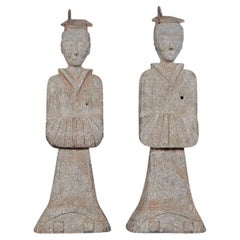
Han Dynasty Rare And Large Court Attendees TL Tested
Located in Dallas, TX
Han Dynasty Rare And Large Court Attendees TL Tested
A Rare and Beautiful Pair of Painted Pottery Court Attendants. Holes under arms held wood spears long deteriorated ago. Museum gr...
Category
Chinese Han Antique 15th Century and Earlier Figurative Sculptures
Materials
Pottery
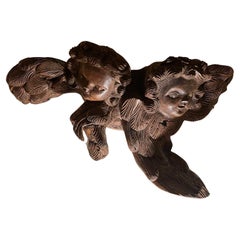
Rare Large 15th Century Renaissance English Oak Roof Angels Corbel.
Located in Vero Beach, FL
Rare Large 15th Century Renaissance English Oak Roof Angels Corbel.
Truly astonishing rare roof angels, circa 1450. The large Medieval carvi...
Category
English Medieval Antique 15th Century and Earlier Figurative Sculptures
Materials
Oak
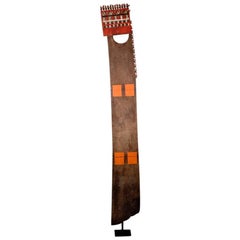
South Coast Wood Ceremonial Leeboard with Open Lattice Designs, Ex-Sotheby
s
Located in San Pedro Garza Garcia, Nuevo Leon
A South Coast wood ceremonial leeboard, Ica Valley region, Late Intermediate Horizon, ca. A.D. 1100-1400.
This large 'remo' made from the hard algarrobo wood, features twelve figure...
Category
Pre-Columbian Antique 15th Century and Earlier Figurative Sculptures
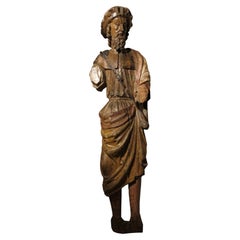
15th Century Carved Wood Depicting Saint James
Located in Saint-Ouen, FR
The Saint depicted here is Saint James the Great.
James is the brother of St. John the Evangelist. Nothing is known of his activities after the Ascension...
Category
French Gothic Antique 15th Century and Earlier Figurative Sculptures
Materials
Oak
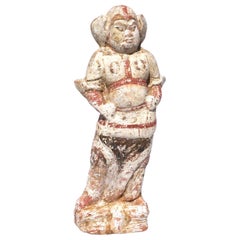
Tang Dynasty Pottery Lokapala Tomb Figure
Located in Dallas, TX
A wonderful Chinese red clay pottery tomb figure from the Tang Dynasty (618 to 907). Guarding a dignitary or decorated soldier; these figures stood guard for over a thousand years surviving to decorate your home collection of ancient artistic and cultural artifacts. Original Polychromed red and gray paint pigments still present.
Chinese Buddhist guardian statues made of earthenware and pigments, from the Tang Dynasty (618–907 AD), dated to the late 7th to first half of the 9th century.
The foreign facial features of this brilliantly sculpted guardian figure is evidence of the strong Western presence in Tang-dynasty China. Originating in the Lokapala deity of the Buddhist religion, which came to China from the West, this type of armored tomb guardian...
Category
Chinese Tang Antique 15th Century and Earlier Figurative Sculptures
Materials
Terracotta
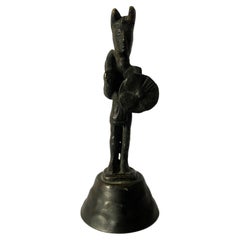
Statuette of a Nuragic Warrior 18th Century before J-C
Located in Beuzevillette, FR
Very beautiful statuette of a Nuraghic warrior dating from 18 century before J-C. The warrior rests on a hollow base. He carries in his right hand a weapon, surely a knife, and in his left hand a shield decorated with a four-petal flower. He is wearing a headdress decorated with two horns. This statuette was realized in bronze by a technique of casting of "lost wax" (a process of precision), and carries a label in the hollow base: "bronzetto nuragico guerriero" (bronze nuragic "warrior").
The Nuraghic culture makes its appearance in Sardinia, in the age of bronze...
Category
Antique 15th Century and Earlier Figurative Sculptures
Materials
Bronze
$378 Sale Price
20% Off
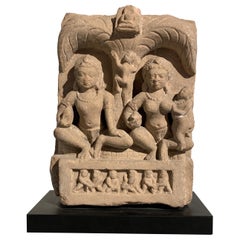
Carved Sandstone Jain Family Group, 6th-7th Century, Uttar Pradesh, India
Located in Austin, TX
A fine and rare Indian carved sandstone stele of a Jain family group, Sarnath style, early Indian Medieval period, 6th-7th century, Uttar Pradesh, India.
Carved from a single block of buff sandstone, the stele features a Jain family group comprised of a father, mother, and two children. The family group is portrayed upon a lotus pedestal under a tall palm tree. The mother and father both seated in a relaxed pose known as lalitasana, or royal ease pose, a jovial expression on their faces. The mother holds the daughter in her lap. The younger son scampers mischievously up the trunk of the palm tree, his head turned to look back at his parents.
Above the family, nestled in a niche amongst the palm fronds, an image of a Jain Tirthankara...
Category
Indian Medieval Antique 15th Century and Earlier Figurative Sculptures
Materials
Sandstone
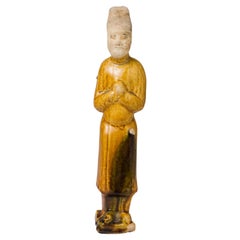
Amber-Glazed Pottery Figure Of An Official
Located in seoul, KR
The figure stands with arms crossed in front, a pose that is often seen in tomb figurines which were intended to serve the deceased in the afterlife. The long robe and facial feature...
Category
Hong Kong Tang Antique 15th Century and Earlier Figurative Sculptures
Materials
Earthenware
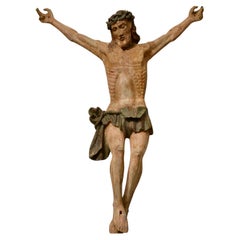
15th Century Corpus Christi Wood Sculpture
Located in Stockholm, SE
Rare late 15th century or early 16th century Gothic Corpus Christi wood sculpture. Probably North German or South Sweden. This large Christ sculpture...
Category
German Gothic Antique 15th Century and Earlier Figurative Sculptures
Materials
Wood
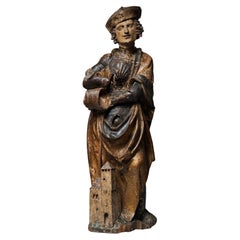
Saint Florian
Located in Saint-Ouen, FR
SAINT FLORIAN
ORIGIN: SOUTH GERMANY, SWABIA
PERIOD: END OF THE 15th CENTURY
Height : 100,5 cm
Width : 34 cm
Depth : 17 cm
Polychromed lime wood
Good state of conservation
Sin...
Category
German Gothic Antique 15th Century and Earlier Figurative Sculptures
Materials
Wood
$49,741
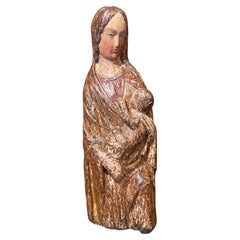
Rare Nursing Virgin from the 14th century
Located in Saint-Ouen, FR
RARE NURSING VIRGIN FROM THE 14TH CENTURY
ORIGIN : ITALY
PERIOD : 14TH CENTURY
Height : 60 cm
Width : 20,5 cm
Depth : 11 cm
Wood
Seated and in a very maternal position, Mary is wearing a red dress with a long, flowing cloak covering her narrow shoulders and falling down her body, with one side hugging her bust.
Her hair, half hidden under a veil, frames an oval face featuring a high forehead, a long and thin nose, a small mouth with thin lips and half-closed eyes.
Mary is carrying her son, the infant Jesus, who is wrapped in a cloak, in her lap. Jesus is being nursed by his mother, held by her left hand.
This remarkable depiction, imbued with such gentleness, is directly inspired by the iconographic theme of the Virgin and Child in Majesty. It breaks with the hieratic, impassive style of the models from the 12th and 13th centuries, adding a touch of realism. From Virgin Queen, Mary became Virgin Mother.
Linked to the development of the Marian cult, this type of representation, sometimes known as Virgo lactans, Virgin of Milk or Nurturing Virgin, remains extremely rare. This image of the Virgin Mary and the Infant Jesus is an extremely delicate representation of the intimate bond formed...
Category
Italian Gothic Antique 15th Century and Earlier Figurative Sculptures
Materials
Wood
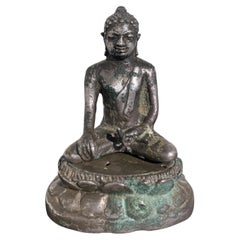
Central Javanese Cast Silver Transcendent Buddha, 9th-12th Century, Indonesia
Located in Austin, TX
An exceedingly rare Javanese cast silver figure a Transcendent Buddha, probably the Dhayani Buddha Akshobhya, early classical Javanese period, 9th - 12th century, Java, Indonesia.
...
Category
Javanese Antique 15th Century and Earlier Figurative Sculptures
Materials
Silver
15th-16th Century Burmese Sandstone Pagoda Guardian Sculpture
Located in Kastrup, DK
Sculpture of a pagoda guardian carved from sandstone,
Originating from a Buddhist pagoda or temple in Burma, dating back to the 15th-16th century. This piece was unearthed following ...
Category
Burmese Other Antique 15th Century and Earlier Figurative Sculptures
Materials
Sandstone
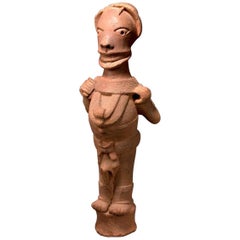
Nok Terracotta Standing Dignitary Figure, TL Tested, Nigeria Africa 500-100 BC
Located in San Pedro Garza Garcia, Nuevo Leon
Nok Terracotta Standing Dignitary Figure in Royal Pose. I-II Century AD. Certificate of Authenticity with TL Test and Passport from Europe. Museum Piece...
Category
Nigerian Primitive Antique 15th Century and Earlier Figurative Sculptures
Materials
Terracotta
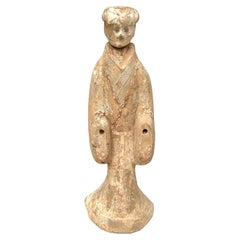
Han Dynasty Pottery Large Standing Tomb Attendant Figure
Located in Dallas, TX
A PAINTED GREY POTTERY STANDING FIGURE. Han Dynasty
The attenuated figure stands with body inclined slightly forward and wearing long, layered robes with a flared hem and red border...
Category
Chinese Han Antique 15th Century and Earlier Figurative Sculptures
Materials
Pottery
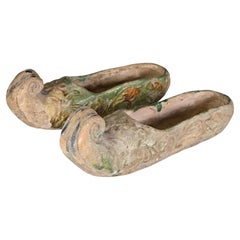
Pair of Sancai Glazed Tang Dynasty Ceramic Slippers
Located in Kilmarnock, VA
A remarkably rare and unusual pair of sancai-glazed slippers dating from the Tang Dynasty (618–907 CE). These were likely created as funerary mingqi—tomb objects made to accompany th...
Category
Chinese Tang Antique 15th Century and Earlier Figurative Sculptures
Materials
Clay
Carved Wood Depicting Saint Martin
Located in Saint-Ouen, FR
Carved wood depicting saint martin
Origin : Germany
Period : 15th century
Measure: Height : 85 cm
Wood
Polychrome remains
Good state of conservation
Collection number on the back 26757
Our partially polychromed Saint...
Category
Antique 15th Century and Earlier Figurative Sculptures
Materials
Wood
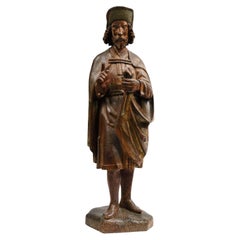
Virgin and Child in Majesty with a Bird
Located in Saint-Ouen, FR
Virgin and child in majesty with a bird
Origin: Southern Germany Or Austria
Period: Late 13tth - Early 14th Century
Height : 87.5 cm
Length : 32 cm
Depth : 19 cm
Lime ...
Category
Antique 15th Century and Earlier Figurative Sculptures
Materials
Wood
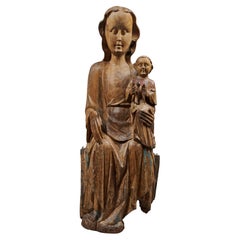
Majapahit in terracotta, Indonesia - 1295-1500
Located in Fidenza, IT
La terracotta Majapahit è l'arte tra il XIII e il XV secolo.
Alcuni manufatti di terracotta di questo periodo sono stati scoperti a Trowulan, East Java. Alcune sculture, ritrovate n...
Category
Indonesian Antique 15th Century and Earlier Figurative Sculptures
Materials
Pottery
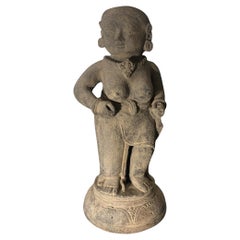
Majapahit in terracotta, Indonesia- 1295-1500
Located in Fidenza, IT
Majapahit periodo 1295 - 1500, Indonesia.
La terracotta Majapahit è l’arte tra XIII e il XV secolo.
Significativi manufatti di terracotta di questo periodo sono stati scoperti a Tro...
Category
Indonesian Antique 15th Century and Earlier Figurative Sculptures
Materials
Pottery
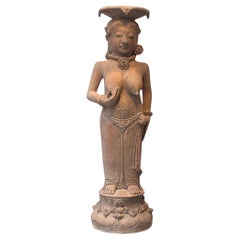
Fine Tang Dynasty Pottery Statue of Guardian, TL Tested
Located in Greenwich, CT
A very refined, unusual and important lively modeled pottery statue of guardian, dramatic and powerful pose, early Tang dynasty, 618-907AD, comes with Oxford authentication TL test...
Category
Chinese Tang Antique 15th Century and Earlier Figurative Sculptures
Materials
Terracotta
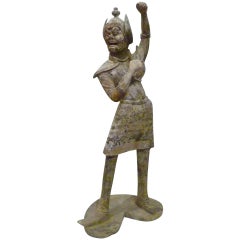
$26,000 Sale Price
27% Off
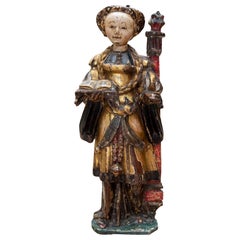
15th Polychrome Wooden Sculpture of Saint Barbara. Mechelen.
Located in Marbella, ES
This sculpture represents the maiden of Nicomedia kept in a tower with three windows where her father locked her away. In her right hand she holds an open book that records her medit...
Category
Belgian Antique 15th Century and Earlier Figurative Sculptures
Materials
Gold
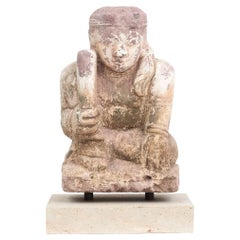
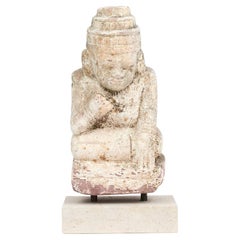
15th Century Burmese Sandstone Seated Monk Sculpture
Located in Kastrup, DK
Seated monk carved in sandstone, originating from a Buddhist pagoda or temple in Burma, dating back to the 15th century.
Discovered as part of an archaeological find after an earthqu...
Category
Burmese Other Antique 15th Century and Earlier Figurative Sculptures
Materials
Sandstone
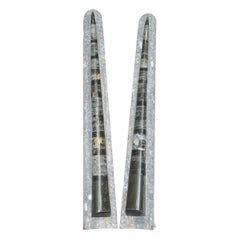
Pair of Large Decorative 395 Million Year Old Ammonite Atlas Mountains Fossils
Located in West Sussex, Pulborough
We are delighted to offer for sale this stunning pair of fully polished circa 395-million-year-old Ammonite Atlas Mountains fossil statues
These are some of the most decorative pi...
Category
Swedish Other Antique 15th Century and Earlier Figurative Sculptures
Materials
Other
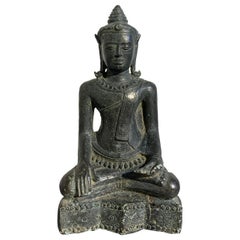
Thai Lopburi Cast Bronze Seated Buddha, 13th Century
Located in Austin, TX
A fine early Thai Lopburi figure of a crowned and adorned Buddha, cast bronze, mid-13th century.
The unusual figure of the Buddha sits in virasana upon a stylized lotus pedestal. He is dressed in the traditional monastic robes, but also adorned with a crown and jewelry, including earrings, a necklace, and jeweled belt.
His hands in an atypical combination of mudras. His right hand in bhumisparsha mudra, reaching down to touch the earth, while his left hand held somewhat outwards, seemingly in varada mudra, the gesture of granting favours or wishes. The palm of his outstretched hand marked with the dharmachakra, the Wheel of the Law, representing Buddhist teaching.
The bronze with a beautiful silvery patina.
Lopburi was an independent Mon kingdom with strong ties to the Khmer Angkor...
Category
Thai Antique 15th Century and Earlier Figurative Sculptures
Materials
Bronze
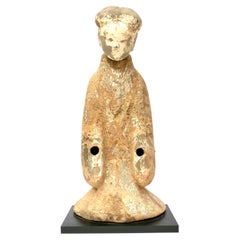
Han Dynasty Pottery Kneeling Court Attendant Figure
Located in Dallas, TX
Chinese painted pottery kneeling court attendant. A solemn downward looking tomb minqui attendant cold painted kneeling on wooden stand. Hands were originally wood and never last due...
Category
Chinese Han Antique 15th Century and Earlier Figurative Sculptures
Materials
Pottery
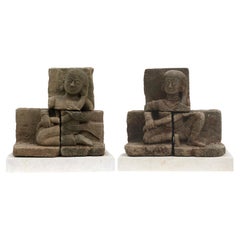
Pair of Sandstone Paragode Guards
Located in Kastrup, DK
Pair of carved sandstone temple guards.
Originates from paragoda in Burma circa 15th century.
Hand carved with fine details. Each guard is in two parts...
Category
Burmese Other Antique 15th Century and Earlier Figurative Sculptures
Materials
Sandstone
$5,639 / set
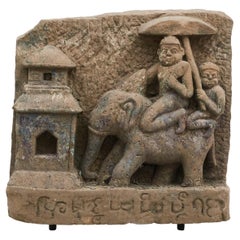
Sandstone Carving of Two Demons Riding an Elephant, Burma 15-16
th Ctr
Located in Kastrup, DK
500-600 Year old sandstone carving.
The sculpture is depicting 'Two demons riding an elephant at the pagoda'.
From Buddha pagoda / temple in Arakan, Burma.
Naive and charming in its design. With a beautiful patina. Mounted on light sandstone plinth...
Category
Burmese Other Antique 15th Century and Earlier Figurative Sculptures
Materials
Sandstone
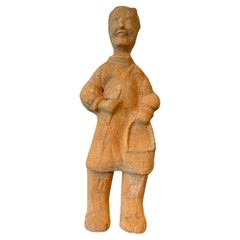
Chinese Terracotta Statue Tomb Figure East Han Dynasty
Located in Atlanta, GA
A Chinese terracotta tomb figure (Ni Yong) from East Han Dynasty (25-220 AD), likely from the area of nowadays Sichuan. It depicts a horse groomer with tool and harness in hand. Dres...
Category
Chinese Archaistic Antique 15th Century and Earlier Figurative Sculptures
Materials
Clay
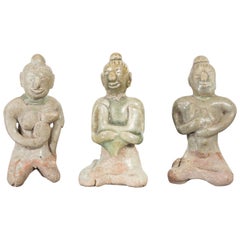
Set of Three 14th or 15th Century Ceramic Fertility Figures from Thailand
Located in Yonkers, NY
A set of three Thai ceramic fertility figures from the 14th or 15th century. Created in Thailand during the 14th or 15th century, this set of petite ...
Category
Thai Antique 15th Century and Earlier Figurative Sculptures
Materials
Ceramic
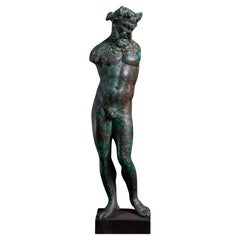
Hellenistic Bronze Statuette of Bearded Satyr
Located in London, GB
This finely cast bronze statuette of a bearded satyr - once exhibited at New York’s Metropolitan Museum - dates to the 2nd-3rd century BC. It is a superb example of the expressive na...
Category
Classical Greek Antique 15th Century and Earlier Figurative Sculptures
Materials
Bronze
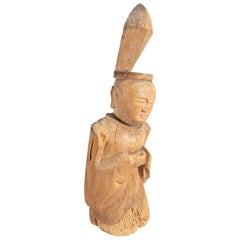
Early Shinto Carving of Figure Referred to as Father Japan
Located in Hudson, NY
Shinto carving of figure referred to as Father Japan. Heian period (794 to 1185) sculpture made of hinoki wood in single piece construction called ichiboku...
Category
Japanese Antique 15th Century and Earlier Figurative Sculptures
Materials
Wood
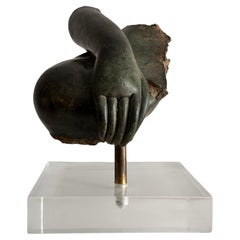
A Thai Bronze, Buddha Fragment, 15th Century
Located in PARIS, FR
A Thai bronze, Buddha fragment, 15th century.
Arm, hand and leg fragment, mounted on a plexiglas stand from 70s.
Overall: 17,2 cm.
Category
Antique 15th Century and Earlier Figurative Sculptures
Materials
Bronze
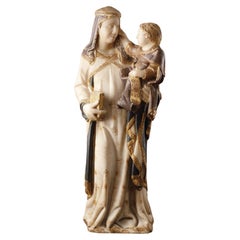
A Polychrome and Parcel-Gilt Marble Group of the Virgin and Child
Located in London, GB
A Polychrome and Parcel-Gilt Marble Group of the Virgin
and Child
Attributed to Giovanni Di Balduccio (1317 - 1349)
Marble
Italy
Circa 1330 - 1340
SIZE: 65cm high, 28cm wide - 25½ ins high, 11 ins wide
PROVENANCE:
Possibly Trivolzio Collection, Milan
With Piero Tozzi Inc., New York
Acquired by the William Randolph Hearst Foundation for The Los Angeles County Museum (A.5832.47-42), 1947
An auction of property de-accessioned by the Los Angeles County Museum of Art to benefit new acquisitions...
Category
Italian Antique 15th Century and Earlier Figurative Sculptures
Materials
Marble
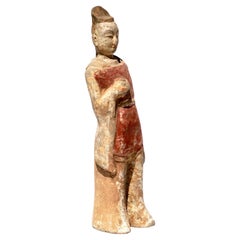
Chinese Northern Wei Terrecotta Attendant - TL Tested
Located in Dallas, TX
Circa 386-534 ADA well defined Chinese Northern Wei Terracotta Attendant Statue.
The Figure is depicted standing with his hands along the body, wearin...
Category
Chinese Tang Antique 15th Century and Earlier Figurative Sculptures
Materials
Terracotta
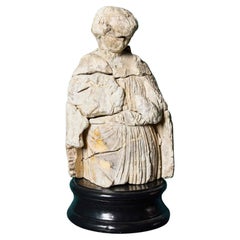
Medieval English Alabaster Statue
Located in Wormelow, Herefordshire
A medieval English alabaster statue, possibly dating as far back as the late 14th / early 15th century, mounted on one of our exclusive large display plinths. Well weathered over the centuries, this 600-year-old statue depicts a medieval cloaked figure, possibly a monk, offering a glimpse into English architecture and sculpture of the Middle Ages.
This sculpture is possibly made from Nottingham alabaster. During the 14th and 15th centuries, Nottingham was the centre of alabaster carving and painting. Alabaster works were mostly made as small alabaster models with religious themes. During the 16th century Reformation, many alabaster carvings were destroyed under King Henry VIII's rule, making any surviving examples even more significant.
Provenance
From the collection of Peter Hone (b. 1941). A master plaster caster, he is an expert and experienced collector, building up an extraordinary, museum-worthy collection of items in his one-bedroom flat in London W11...
Category
English Medieval Antique 15th Century and Earlier Figurative Sculptures
Materials
Alabaster
Indian Carved Wood of Shakti Goddess, Ca. 8th to 12th Century
Located in New York, NY
Indian Medieval Carved Wood Sculpture of Shakti Goddess
Ca. 8th to 12th Century
...
Category
Indian Anglo-Indian Antique 15th Century and Earlier Figurative Sculptures
Materials
Wood
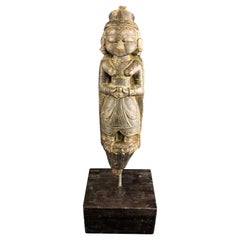
Grand Scale 15th Century Solid Hand Carved Stone Male Statue
Located in Larkspur, CA
Grand scale 15th century solid hand-carved stone male statue. Source of origin Bhutan.
Category
Antique 15th Century and Earlier Figurative Sculptures
Materials
Stone
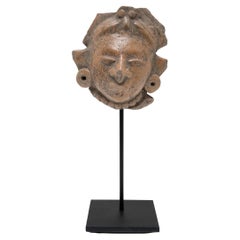
Teotihuacan Ceramic Head Fragment
Located in Chicago, IL
This intriguing head fragment was once attached to a bust or full effigy figurine crafted in 400 A.D. Mesoamerica. Earthenware figurines were made in great abundance throughout Teotihuacan's history. After 250 A.D. objects made from clay increased dramatically in Teotihuacan, serving a wide variety of purposes and functions from religious rituals to burial offerings.
Figurines like this commemorated important people and events within the city of Teotihuacan and other parts of Mesoamerica, portraying individuals of different rank and status such as soldiers, merchants, bureaucrats, and occasionally divinities. This figure is adorned with an elaborate headdress, a thick beaded necklace...
Category
Mexican Pre-Columbian Antique 15th Century and Earlier Figurative Sculptures
Materials
Ceramic
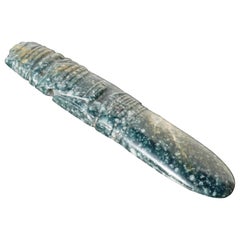
COSTA Rica Jade Avian Axe God Celt Pendant Pre Columbian, 500 Ad-1500 Ad
Located in Dallas, TX
Fine Costa Rican Jade Axe God, Guanacaste-Nicoya region, circa. A.D. 1-1500. Of a celt form depicting the mythical part human- part avian bird figure, with cir...
Category
Costa Rican Pre-Columbian Antique 15th Century and Earlier Figurative Sculptures
Materials
Jade
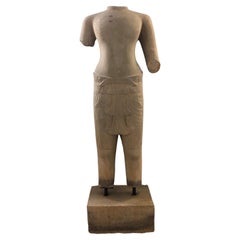
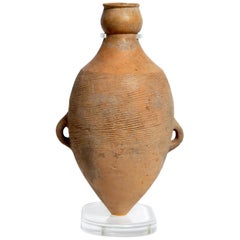
Neolithic Jar on Stand
Located in Chicago, IL
This Neolithic jar originates from China 3500 BC and these funerary jars were placed in tombs and intended for use in the afterlife.
Category
Chinese Antique 15th Century and Earlier Figurative Sculptures
Materials
Terracotta
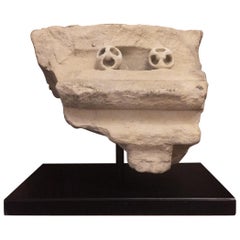
$3,200
Medieval Architectural Fragment Cornice, Corbel
Located in Vosselaar, BE
A fragment of a sandstone corbel with flat upper face, moulded transverse ledge and two protruding lobes with reserved trefoil detailing. The lower edge has fine dentiled carving and...
Category
British Gothic Antique 15th Century and Earlier Figurative Sculptures
Materials
Sandstone
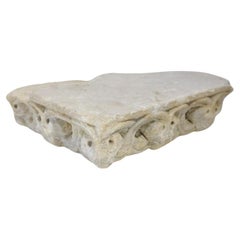
Frammento di cornicione in marmo di epoca romanica - XIII secolo
Located in Fidenza, IT
Frammento di cornicione in marmo di epoca romanica - XIII secolo.
Il frammento presenta una decorazione scolpita con motivi vegetali stilizzati che potrebbero ricordare le foglie d'a...
Category
Italian Antique 15th Century and Earlier Figurative Sculptures
Materials
Marble
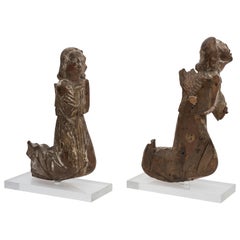
Pair of Wooden Praying Angels, End of 15th Century
Located in Roma, IT
Pair of praying angels is an original decorative object realized in the second half of the 15th century by North Italian or French manufacturing.
Thes...
Category
Italian Antique 15th Century and Earlier Figurative Sculptures
Materials
Wood
More Ways To Browse
Thai Musician
The Dying Gaul
Torso Brass
Vintage Pin Holder
War Statue
Water Maiden
Winged Cherubs Sculpture
Winged Mercury
Woman Ceramic Figurine
15th Century Angel
1880s Bronze Sculptures
1960s Mannequin
African Bronze Figure
Alabaster Head Sculpture
Alabaster Plinth
Alexandra Feodorovna
Andrea Del Verrocchio
Antique German Gnomes