Beaux Arts Sculptures

BEAUX ARTS STYLE

Beaux Arts furniture included chairs replicating models from the Renaissance and sofas inspired by Louis XIV. These pieces filled high-ceilinged rooms that featured tapestries fit for a medieval castle and were illuminated by crystal chandeliers reminiscent of those in European palaces. Leon Marcotte Company created furnishings for the White House mimicking the style of Louis XVI, while in France, cabinetmaker Louis Majorelle reproduced 18th-century pieces that would influence his later Art Nouveau style.

Students at the École des Beaux-Arts in 19th-century Paris meticulously sketched Roman and Greek art and architecture as part of a curriculum that elevated the classical world. This reverence for history informed the architecture and design being constructed in the French capital and beyond, where columns and pediments were joined with elements referencing the Renaissance and Baroque eras, culminating in grand civic buildings such as the Palais Garnier opera house constructed under Napoleon III.

Beaux Arts style, also known as Classical Eclecticism for its flamboyant mixing of influences, made its way to the United States in the late 19th century through American architects who studied in Paris, like Richard Morris Hunt and Charles Follen McKim. They designed monumental turn-of-the-century buildings like train stations, libraries, museums and mansions that featured soaring entry halls and grand stairways with nearly every surface embellished, from mosaic floors to stained-glass ceilings. The luxurious interiors of these Beaux Arts buildings, which weren’t crowded with objects as in the Victorian era, matched this spirit of opulence and embraced the past.

Find a collection of Beaux Arts decorative objects, lighting, wall decorations and other furniture on 1stDibs.

to
23
137
61
2
1
32
104
63
26
4
11
5
6
3
2
4
1
5
6,853
4,653
2,873
881
854
697
626
507
466
450
367
246
196
195
91
83
79
76
133
55
47
18
13
137
61
186
166
10
6
6
Height
to
Width
to
200
200
200
21
21
20
10
9
Style: Beaux Arts
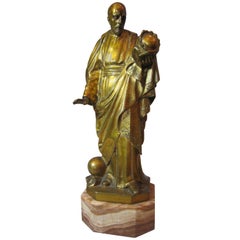
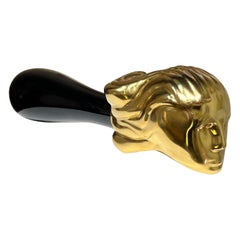
Bronze Depicting the Slain Head of King Richard III Shakespeare Interest
Located in Petaluma, CA
For those who are wanting sculpture of any Shakespeare characters, we have that here for you. We know it is the head of King Richard III being held by an...
Category

1910s French Vintage Beaux Arts Sculptures

Materials

Onyx, Bronze

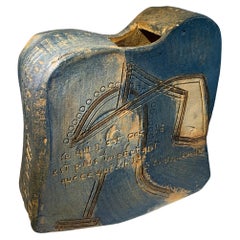
Jacques LAROUSSINIE, Wood-fired Stoneware Sculpture, la BORNE, France.
Located in L’ISLE-SUR-LA-SORGUE, FR
Stoneware Vase-Sculpture by the artist Jacques Laroussinie. Remarkable one-of-a-kind piece, signed. This double-sided vase-sculpture was wood-fired at the renowned ceramics center of...
Category

1980s French Vintage Beaux Arts Sculptures

Materials

Sandstone

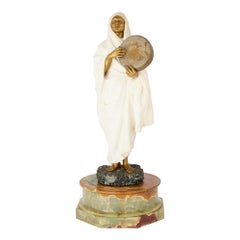
Marble and Gilt Bronze Orientalist Sculpture by Hautot
By Rachel Hautot
Located in London, GB
Marble and gilt bronze Orientalist sculpture by Hautot French, Early 20th Century Figure: Height 60cm, width 20cm, depth 18cm Base: Height 12.5cm, width 30cm, depth 30cm Overall: Hei...
Category

Early 20th Century French Beaux Arts Sculptures

Materials

Stone, Marble, Onyx, Ormolu

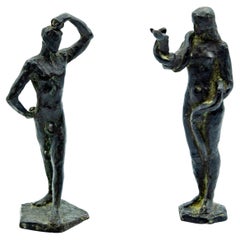
Pair of Bronze Figures of Adam and Eve by William Hunt Diederich
Located in Essex, MA
Adam and Eve standing, Eve with a snake wrapped around her arm and Adam posed with his fist on his head. Signed on base. Artist is represented in The Metropolitan Museum in New York, Whitney and Newark Museum. He enrolled at the Pennsylvania Academy and met Paul Manship who became a lifelong friend. His mother was the daughter of noted Boston artist William Morris Hunt...
Category

Early 20th Century American Beaux Arts Sculptures

Materials

Bronze

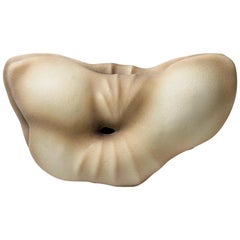
Porcelain Sculpture by Wayne Fischer, 2006
Located in Saint-Ouen, FR
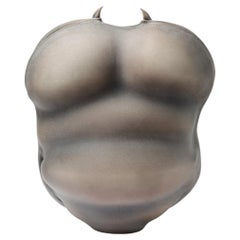
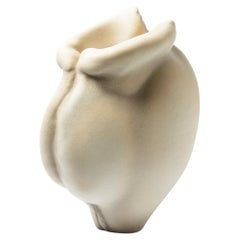
A porcelain sculpture by Wayne Fischer. Perfect original conditions. Signed. Unique piece. 2006. How can an inert object produce deeply unsuspecting, indecipherable, uncontrollable emotions? Wayne Fischer is an artist who can create works that force one to ask such moving questions as this. If he doesn’t know why, if he can’t explain the deepest reasons of his artistic research, he definitely knows the workings and limitations of the artistic process he invented. He has never deviated from the course he set for himself since university; translate life. The works presented here show the evolution of his creations over the past thirty years. If Wayne Fischer has received several international prizes and quickly obtained the recognition of his peers in ceramics, nevertheless he retains a singular position at once unavoidable and disturbing. His sculptures are paradoxical, powerful and sensual, and cause a certain unease. They are beautiful, carnal, touchable, all the while being outside the standard idea of beauty. The ambiguity of attraction and rejection is at the heart of this evolution. The pieces from the 1980s and 90s are imposing by their size, stature and symmetry, which give them balance. They generate surprise, curiosity and play between contrasts that are both soft and aggressive. They reference the body, muscles, and torso, without presenting an exact reality. They are double-faced, seductive, and enigmatic. Wayne’s shapes are inspired by shells, bivalves, sometimes presented as though they are floating in space. But the reference of the marine world to the mysterious female body has only one interpretation and only history and emotion condition the reaction of the spectator: he accepts or refuses to see, to be seduced. He is touched or he flees. The more recent sculptures are appreciated in the fullness of their round volume and the search for a pure universal beauty. “Metamorphosis,” the work recently awarded by the Bettencourt Foundation, is from this series of pieces wheel- thrown and deformed which pushes the porcelain from the inside so the bulges evoke the movement of waves or the musculature of several bodies. The exactness, the clean breaks, the assurance of lines and valleys are testimony to the interior power that governs the creation. The life energy expressed is also felt by the artist as the origin of ceramics. All the pieces are curved and tense. They show no marking, no sign of the hand, no imprints, and yet give an impression of spontaneity, as if a dropped piece of clay found its form by chance. Depending on the angles, the content becomes “the origins of the world”. Femininity and sensuality are exalted. Inspired by the body, before and after birth, or simply the sea, the parts of the sculpture conjugate around a mysterious interior cavity, secret and troubling. The interior wall doesn’t correspond to the exterior, and has its own volumes, deformities, and intimacy. The pieces present two kinds of interior: one open, and partially uncovered, the other totally hidden inside. The differences of their respective deformation reinforce the impression of life : the subjective representation of muscles and bones, of bulges pushed by an interior force, like a visceral movement of respiration. The surface of the ceramic is crackled but soft and fine, even reflecting light like the skin. The nuances of color reinforce the expression of sensuality. The alignment of technique and what it causes one to see and feel has rarely been so intimately successful. Wayne Fischer perfected his technique in the 1970s and has remained faithful to it. He adds fibers to porcelain clay that has been chosen for its whiteness to create and accentuate volume around empty space, by assembling slabs or thrown pieces. Then, he makes another piece that takes its place inside; both parts are formed with no hand...
Category

21st Century and Contemporary French Beaux Arts Sculptures

Materials

Ceramic

Porcelain Sculpture by Wayne Fischer, 2022
Located in Saint-Ouen, FR
A porcelain sculpture by Wayne Fischer. Perfect original conditions. Signed. Unique piece. 2022. How can an inert object produce deeply unsuspecting, indecipherable, uncontrol...
Category

21st Century and Contemporary French Beaux Arts Sculptures

Materials

Ceramic

A porcelain sculpture by Wayne Fischer, 2015
Located in Saint-Ouen, FR
A porcelain sculpture by Wayne Fischer. Perfect original conditions. Signed. Unique piece. 2015. How can an inert object produce deeply unsuspecting, indecipherable, uncontrollable emotions? Wayne Fischer is an artist who can create works that force one to ask such moving questions as this. If he doesn’t know why, if he can’t explain the deepest reasons of his artistic research, he definitely knows the workings and limitations of the artistic process he invented. He has never deviated from the course he set for himself since university; translate life. The works presented here show the evolution of his creations over the past thirty years. If Wayne Fischer has received several international prizes and quickly obtained the recognition of his peers in ceramics, nevertheless he retains a singular position at once unavoidable and disturbing. His sculptures are paradoxical, powerful and sensual, and cause a certain unease. They are beautiful, carnal, touchable, all the while being outside the standard idea of beauty. The ambiguity of attraction and rejection is at the heart of this evolution. The pieces from the 1980s and 90s are imposing by their size, stature and symmetry, which give them balance. They generate surprise, curiosity and play between contrasts that are both soft and aggressive. They reference the body, muscles, and torso, without presenting an exact reality. They are double-faced, seductive, and enigmatic. Wayne’s shapes are inspired by shells, bivalves, sometimes presented as though they are floating in space. But the reference of the marine world to the mysterious female body has only one interpretation and only history and emotion condition the reaction of the spectator: he accepts or refuses to see, to be seduced. He is touched or he flees. The more recent sculptures are appreciated in the fullness of their round volume and the search for a pure universal beauty. “Metamorphosis,” the work recently awarded by the Bettencourt Foundation, is from this series of pieces wheel- thrown and deformed which pushes the porcelain from the inside so the bulges evoke the movement of waves or the musculature of several bodies. The exactness, the clean breaks, the assurance of lines and valleys are testimony to the interior power that governs the creation. The life energy expressed is also felt by the artist as the origin of ceramics. All the pieces are curved and tense. They show no marking, no sign of the hand, no imprints, and yet give an impression of spontaneity, as if a dropped piece of clay found its form by chance. Depending on the angles, the content becomes “the origins of the world...
Category

21st Century and Contemporary French Beaux Arts Sculptures

Materials

Ceramic

A porcelain sculpture by Wayne Fischer, 2022
Located in Saint-Ouen, FR
A porcelain sculpture by Wayne Fischer. Perfect original conditions. Signed. Unique piece. 2022. How can an inert object produce deeply unsuspecting, indecipherable, uncontrollable emotions? Wayne Fischer is an artist who can create works that force one to ask such moving questions as this. If he doesn’t know why, if he can’t explain the deepest reasons of his artistic research, he definitely knows the workings and limitations of the artistic process he invented. He has never deviated from the course he set for himself since university; translate life. The works presented here show the evolution of his creations over the past thirty years. If Wayne Fischer has received several international prizes and quickly obtained the recognition of his peers in ceramics, nevertheless he retains a singular position at once unavoidable and disturbing. His sculptures are paradoxical, powerful and sensual, and cause a certain unease. They are beautiful, carnal, touchable, all the while being outside the standard idea of beauty. The ambiguity of attraction and rejection is at the heart of this evolution. The pieces from the 1980s and 90s are imposing by their size, stature and symmetry, which give them balance. They generate surprise, curiosity and play between contrasts that are both soft and aggressive. They reference the body, muscles, and torso, without presenting an exact reality. They are double-faced, seductive, and enigmatic. Wayne’s shapes are inspired by shells, bivalves, sometimes presented as though they are floating in space. But the reference of the marine world to the mysterious female body has only one interpretation and only history and emotion condition the reaction of the spectator: he accepts or refuses to see, to be seduced. He is touched or he flees. The more recent sculptures are appreciated in the fullness of their round volume and the search for a pure universal beauty. “Metamorphosis,” the work recently awarded by the Bettencourt Foundation, is from this series of pieces wheel- thrown and deformed which pushes the porcelain from the inside so the bulges evoke the movement of waves or the musculature of several bodies. The exactness, the clean breaks, the assurance of lines and valleys are testimony to the interior power that governs the creation. The life energy expressed is also felt by the artist as the origin of ceramics. All the pieces are curved and tense. They show no marking, no sign of the hand, no imprints, and yet give an impression of spontaneity, as if a dropped piece of clay found its form by chance. Depending on the angles, the content becomes “the origins of the world”. Femininity and sensuality are exalted. Inspired by the body, before and after birth, or simply the sea, the parts of the sculpture conjugate around a mysterious interior cavity, secret and troubling. The interior wall doesn’t correspond to the exterior, and has its own volumes, deformities, and intimacy. The pieces present two kinds of interior: one open, and partially uncovered, the other totally hidden inside. The differences of their respective deformation reinforce the impression of life : the subjective representation of muscles and bones, of bulges pushed by an interior force, like a visceral movement of respiration. The surface of the ceramic is crackled but soft and fine, even reflecting light like the skin. The nuances of color reinforce the expression of sensuality. The alignment of technique and what it causes one to see and feel has rarely been so intimately successful. Wayne Fischer perfected his technique in the 1970s and has remained faithful to it. He adds fibers to porcelain clay that has been chosen for its whiteness to create and accentuate volume around empty space, by assembling slabs or thrown pieces. Then, he makes another piece that takes its place inside; both parts are formed with no hand...
Category

21st Century and Contemporary French Beaux Arts Sculptures

Materials

Ceramic

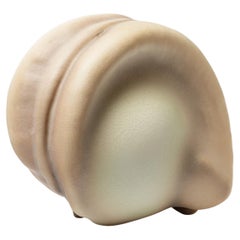
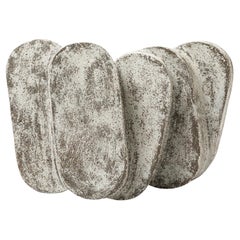
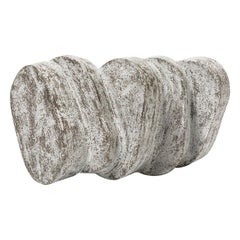
Stoneware Sculpture by Maarten Stuer, Entitled "Bloc in Motion", 2020
Located in Saint-Ouen, FR
A ceramic sculpture "Bloc in motion" by Maarten Stuer. This piece can be put indoor or outdoor. Artist monogram under the base. 2020. Unique piece.
Category

21st Century and Contemporary French Beaux Arts Sculptures

Materials

Ceramic

Stoneware Sculpture by Maarten Stuer, Entitled "Bloc in Motion", 2020
Located in Saint-Ouen, FR
A ceramic sculpture "Bloc in motion" by Maarten Stuer. This piece can be put indoor or outdoor. Artist monogram under the base. 2020. Unique piece.
Category

21st Century and Contemporary French Beaux Arts Sculptures

Materials

Ceramic

Stoneware Sculpture by Maarten Stuer, Entitled "Bloc in Motion", 2020
Located in Saint-Ouen, FR
A ceramic sculpture "Bloc in motion" by Maarten Stuer. This piece can be put indoor or outdoor. Artist monogram under the base. 2020. Unique piece.
Category

21st Century and Contemporary French Beaux Arts Sculptures

Materials

Ceramic

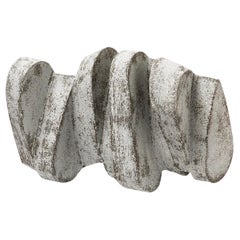
Ceramic Sculpture by Alistair Danhieux, circa 2010
Located in Saint-Ouen, FR
A ceramic sculpture white glazes decoration by Alistair Danhieux. Perfect original conditions. Signed under the base, circa 2010.  
Category

21st Century and Contemporary French Beaux Arts Sculptures

Materials

Ceramic

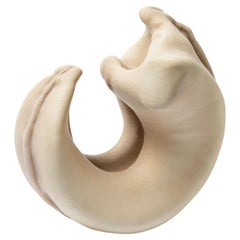
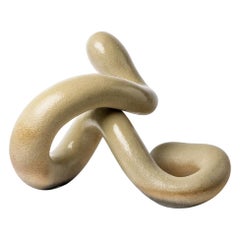
Unique Porcelain Sculpture by Wayne Fischer, 2017
Located in Saint-Ouen, FR
An unique porcelain sculpture by Wayne Ficher. Perfect original conditions. Signed under the base, Wayne Fischer. 2017.  
Category

2010s French Beaux Arts Sculptures

Materials

Porcelain

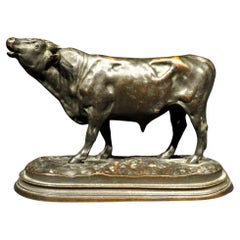
A Fine Animalier School Bronze Figure of a Bull, After Rosa Bonheur (1822-1899)
Located in Ottawa, Ontario
Although there is seemingly no apparent foundry mark, this finely cast & patinated animalier bronze known as ‘Bull’ or ‘Taureau Beuglant’ is exemplary in demonstrating exceptional at...
Category

Early 20th Century French Beaux Arts Sculptures

Materials

Bronze

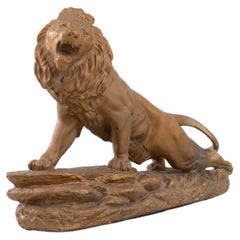
1900s French Plaster Sculpture
Located in High Point, NC
A painted plaster sculpture from 1900s France. This sculpture depicts a lion climbing up to a cliff's edge, with legs stretched back releasing a ferocious roar. The gold paint that coats the plaster cast sculpture has chipped here and there, adding maturity to the image of the jungle king...
Category

Early 1900s French Antique Beaux Arts Sculptures

Materials

Plaster

1900s French Plaster Sculpture
$516 Sale Price
35% Off
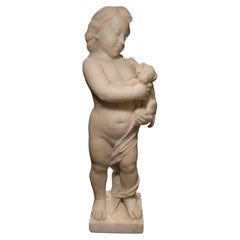
Marble Sculpture Of Cherub Holding A Puppy
Located in Guaynabo, PR
This is a marble sculpture of a cherub who is standing up in front of a trunk. His head has an abundant hair with curly ends. He is gently holding a puppy. The sculpture has attached...
Category

Early 20th Century Unknown Beaux Arts Sculptures

Materials

Alabaster

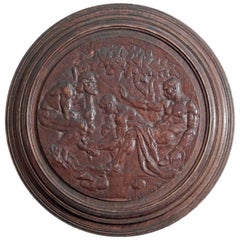
"Placing the Sandal, " Bas Relief Masterpiece with Nudes by Levillain
Located in Philadelphia, PA
This very fine carved relief panel was sculpted by Ferdinand Levillain, France's master of bas relief at the turn of the last century. Levillain was famous for his low reliefs in med...
Category

1890s French Antique Beaux Arts Sculptures

Materials

Wood

Paolo Di Ferdinando Triscornia
Located in New York, NY
La Chasseresse Indienne, The Indian Huntress by Paolo Di Ferdinando Triscornia (Italian, 1856-1936) , after Charles Cumberworth white marble, signed Paolo Triscornia / F H 34 in. (8...
Category

Late 19th Century Italian Antique Beaux Arts Sculptures

Materials

Marble

White Marble Statue : Smiling Little Girl Sculpture
Located in Alessandria, Piemonte
Wonderful white marble statue of a smiling sweet little girl, with flowers in the hair. a very unusual marble statue . nr. O/7552.
Category

Early 19th Century French Antique Beaux Arts Sculptures

Materials

Marble

Louise Bourgeois, « Fallen woman »
By Louise Bourgeois
Located in SAINT-OUEN-SUR-SEINE, FR
Sculpture in Sèvres porcelain, titled « Fallen woman », by Louise Bourgeois for the manufacture nationale de Sèvres, France circa 1996. Edition numbered 21/25. Stamped « Manufacture ...
Category

1990s French Beaux Arts Sculptures

Materials

Porcelain

Beaux Arts sculptures for sale on 1stDibs.

Find a broad range of unique Beaux Arts sculptures for sale on 1stDibs. Many of these items were first offered in the 21st Century and Contemporary, but contemporary artisans have continued to produce works inspired by this style. If you’re looking to add vintage sculptures created in this style to your space, the works available on 1stDibs include decorative objects, folk art, serveware, ceramics, silver and glass and other home furnishings, frequently crafted with ceramic, metal and other materials. If you’re shopping for used Beaux Arts sculptures made in a specific country, there are Europe, France, and Italy pieces for sale on 1stDibs. While there are many designers and brands associated with original sculptures, popular names associated with this style include Tim Orr, Wayne Fischer, Antoine-Louis Barye, and Michel Lanos. It’s true that these talented designers have at times inspired knockoffs, but our experienced specialists have partnered with only top vetted sellers to offer authentic pieces that come with a buyer protection guarantee. Prices for sculptures differ depending upon multiple factors, including designer, materials, construction methods, condition and provenance. On 1stDibs, the price for these items starts at $195 and tops out at $650,000 while the average work can sell for $3,212.

Still Thinking About These?

All Recently Viewed