Qing Sculptures

QING STYLE

The last imperial dynasty from 1644 to 1912 was a time of change in China, beginning with the invasion by Manchurian forces that ended the Ming dynasty and established the Shunzhi Emperor. The expansion of exportation and trade that had bolstered the arts during the Ming era continued, as Qing dynasty furniture involved the same attention to craftsmanship with expert construction techniques in hardwood pieces that were assembled with mortise and tenon joints rather than nails or glue. Together, these eras comprise a golden age of Chinese furniture design.

Ming-style furniture is simple and elegant with clean lines. Chairs of the period and other Ming furniture made an impression on Scandinavian modernist Hans Wegner and his streamlined seating, for example. Whereas Qing-style furniture is elaborate, with an increasing influence from the West leading to lavish carving inspired by the European Baroque and Rococo styles. And while many of the forms that define examples of the latter are common within classical Chinese furniture, such as curving and folding chairs as well as large screens, Qing designs are laden with ornamentation. Frequently, the carved motifs and inlaid designs in mother-of-pearl were auspicious, such as peonies for wealth or dragons for luck. Bats were symbols of happiness in the design of Qing furniture, with one of the characters in the word for bat, bianfu, being a homophone for fu, or “fortune.”

While several types of wood were used in the construction of Qing beds, tables, storage pieces and seating, today’s collectors know that the most prized were the rare rosewoods zitan and huanghuali. They were both sourced from Hainan, China’s largest island, and are marked by a rich luster that occurs naturally, without the application of lacquer or other decorative materials. Many of the most popular woods were imported from southeast Asia, adding to their value. Red sandalwood was also sought after for its durability and connection with Chinese medicine, with some chairs being made for health benefits.

Find a collection of antique Qing tea tables, stools, benches, decorative objects and more furniture on 1stDibs.

to
13
131
4
24
65
42
4
29
5
2
1
6,926
4,717
2,929
901
859
714
637
534
472
469
366
245
206
203
97
85
82
78
56
27
27
27
17
101
28
134
130
129
2
1
Height
to
Width
to
135
135
135
Style: Qing
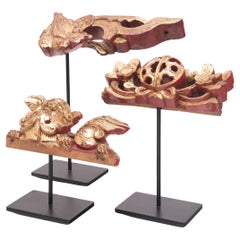
Set of Three Chinese Gilt Fragments, c. 1850
Located in Chicago, IL
Hand-carved and lavishly pigmented, these gilt fragments originated as decorative elements of ornate Qing-dynasty furniture or architecture. Elevated by ...
Category

Mid-19th Century Chinese Antique Qing Sculptures

Materials

Wood

Chinese Gilt Brocade Ball Fragment, c. 1870
Located in Chicago, IL
This hand-carved wooden fragment was originally a decorative element of ornate Qing-dynasty furniture or architecture. Colored by gilt pigments over an underlayer of red lacquer, the fragment depicts a silk brocade ball, commonly depicted alongside fu dog lions to symbolize high rank or power. The embroidered ball is flanked by chrysanthemum blossoms and tied with a long flowing ribbon, a sign of longevity. Elevated by a custom steel display mount, the storied fragment adds bright color and iridescence to a bookcase or table arrangement...
Category

Late 19th Century Chinese Antique Qing Sculptures

Materials

Wood

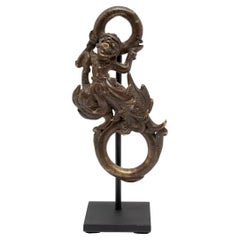
Bronze Wrathful Deity Ring, c. 1900
Located in Chicago, IL
This sculptural bronze object is a charming example of 19th-century metalwork. The bronze figure is formed as a Buddhist wrathful deity, weari...
Category

Early 20th Century Chinese Qing Sculptures

Materials

Bronze

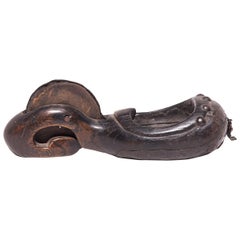
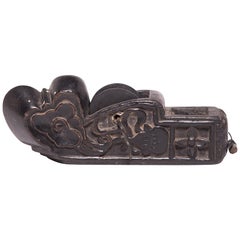
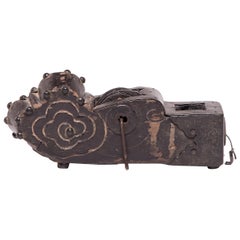
Chinese Carpenter s Inkline Reel, c. 1850
Located in Chicago, IL
Given the beauty and thoughtful design of traditional Chinese furniture, it’s no wonder that Qing-dynasty carpenter’s tools were accorded the same att...
Category

Mid-19th Century Chinese Antique Qing Sculptures

Materials

Iron

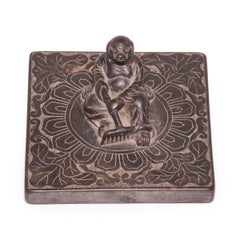
Chinese Stone Shoemaker s Weight with Zhu Bajie, c. 1850
Located in Chicago, IL
Hand carved of stone, this object would have been used in a shoemaker’s shop to press down large pieces of leather. Doubling as a handle, the central figure depicts the curious figure of a man with pig-like facial features holding a rake. The figure is Zhu Bajie, a character from the Ming-dynasty novel “Journey to the West...
Category

Mid-19th Century Chinese Antique Qing Sculptures

Materials

Stone

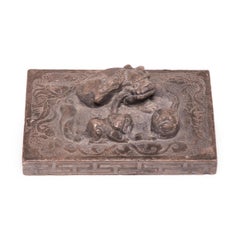
Chinese Stone Shoemaker s Weight with Mother, Cub, and Embroidered Ball
Located in Chicago, IL
Carved from a solid piece of stone, this weight was originally used by a Shoemaker to press down large pieces of leather. Surrounded by intricate scrollwork and peony blossoms, a gua...
Category

Early 20th Century Chinese Qing Sculptures

Materials

Stone

Chinese Auspicious Gourd Carpenter Line, c. 1850
Located in Chicago, IL
Given the beauty and thoughtful design of traditional Chinese furniture, it’s no wonder that Qing-dynasty carpenter’s tools were accorded the same att...
Category

Mid-19th Century Chinese Antique Qing Sculptures

Materials

Iron

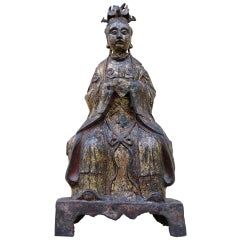
Gilt Bronze Figure of Xi-Wang-Mu, Qing Dynasty, Qianlong Kingdom
Located in Torino, IT
The queen mother of the west is cast in a seated position with her hands held before her chest holding a "gui". She is dressed in long-sleeved robes. Her face is framed by an elabora...
Category

1790s Chinese Antique Qing Sculptures

Materials

Bronze

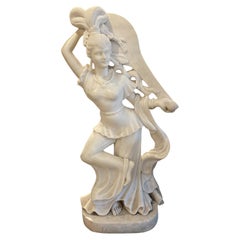
Large White Marble Statue of Chinese Flying Apsara
Located in New York, NY
Statue of flying Apsara playing the pipa, finely sculpted from white marble, measuring 51 by 23 by 25 inches. Apparenlty unsigned. In good condition with surface dirt, scratches and...
Category

20th Century Chinese Qing Sculptures

Materials

Marble

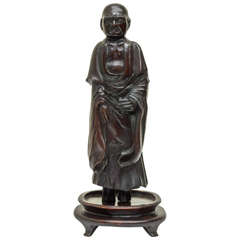
Early 18th Century Chinese Qing Period Carved Lohan Figure
Located in San Francisco, CA
Early 18th century Chinese Qing period carved Lohan figure in draped robes. Very finely carved heavy dark rosewood. The aged surface patina with tight gra...
Category

Early 18th Century Chinese Antique Qing Sculptures

Materials

Rosewood

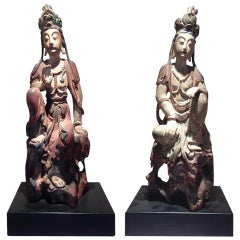
Pair of Chinese Wood Statues of Bodhisattva Buddhism Art
Located in Atlanta, GA
A pair of finely carved wood statues depicting near mirror images of two Bodhisattvas, likely dated to 19th century of late Qing dynasty, but executed in Song style. Dressed in flowing robes, crowned and bejeweled, these Bodhisattvas are known as Avalokitesvara in Sanskrit. In China, his identify took a cultural transformation and became Guanyin (the one who detects the sounds of the world), who is worshipped for her compassion and mercy for those in the sufferings. Both posed in the seated "Royal Ease...
Category

19th Century Chinese Antique Qing Sculptures

Materials

Wood

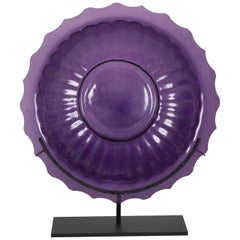
Purple Peking Glass Charger on Stand
Located in Stamford, CT
A Chinese Peking glass charger on new stand, late 19th century.
Category

1890s Chinese Antique Qing Sculptures

Materials

Glass

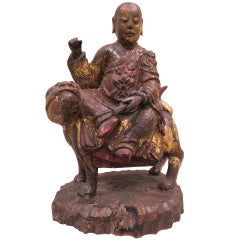
Ancient Chinese Hand-Carved Lohan Monk Buddha On Lion, Kangxi, 1661-1722
Located in Torino, IT
A Fine hand-carved and Lacquered wood figure of a Luohan Arhat, Buddha' disciple. Seated in royal ease on a standing lion, wearing long flowing robes. China, Kangxi Kingdom 1661-17...
Category

18th Century Chinese Antique Qing Sculptures

Materials

Giltwood, Lacquer

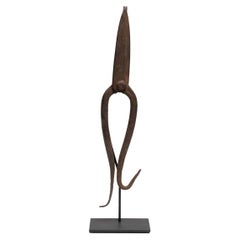
Chinese Blacksmith Iron Scissors on Mount, c. 1850
Located in Chicago, IL
This hand-forged metal sculpture, with its delicate appearance and whimsical shape, was once an integral tool to a 19th century Chinese cobbler’s trade. Made of iron, these scissors ...
Category

Mid-19th Century Chinese Antique Qing Sculptures

Materials

Iron

Chinese Abstract Cloud Carpenter Line, c. 1850
Located in Chicago, IL
Given the beauty and thoughtful design of traditional Chinese furniture, it’s no wonder that Qing-dynasty carpenter’s tools were accorded the same att...
Category

Mid-19th Century Chinese Antique Qing Sculptures

Materials

Iron

Qing sculptures for sale on 1stDibs.

Find a broad range of unique Qing sculptures for sale on 1stDibs. Many of these items were first offered in the 21st Century and Contemporary, but contemporary artisans have continued to produce works inspired by this style. If you’re looking to add vintage sculptures created in this style to your space, the works available on 1stDibs include decorative objects, asian art and furniture, more furniture and collectibles and other home furnishings, frequently crafted with wood, ceramic and other materials. If you’re shopping for used Qing sculptures made in a specific country, there are Asia, China, and East Asia pieces for sale on 1stDibs. While there are many designers and brands associated with original sculptures, popular names associated with this style include and He Chaozong. It’s true that these talented designers have at times inspired knockoffs, but our experienced specialists have partnered with only top vetted sellers to offer authentic pieces that come with a buyer protection guarantee. Prices for sculptures differ depending upon multiple factors, including designer, materials, construction methods, condition and provenance. On 1stDibs, the price for these items starts at $48 and tops out at $38,800 while the average work can sell for $1,880.