Earthenware Ceramics
to
95
747
124
2
119
317
311
126
85
149
37
32
5
18
23
10
38
20
20
10
101
77
42
35
28
26
18
17
11
10
10
9
2
2
9,623
1,244
912
873
543
463
392
773
265
160
145
132
873
838
865
30
28
26
25
23
Material: Earthenware
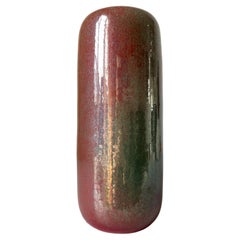
Zaalberg 1950s Dark Red Green Lustre Glazed Vase
By Zaalberg
Located in Copenhagen, DK
Dark red and green glaze with mother of pearl sheen covers this soft cylinder shaped tall Dutch vase from the 1950s. Signed under base. Beautiful vintage condition.
Zaalberg, The N...
Category
Mid-20th Century Dutch Mid-Century Modern Earthenware Ceramics
Materials
Ceramic, Luster, Pottery, Stoneware

$534 Sale Price
35% Off
Contemporary Organic Modern Moroccan Handmade Terracotta Brown Ceramic Wall Lamp
Located in Marseille, FR
- Handbuilt brown ceramic wall light
- slip applied with natural pigments
- made of clay collected from the potter's surroundings.
- made in ...
Category
2010s African Organic Modern Earthenware Ceramics
Materials
Clay, Earthenware

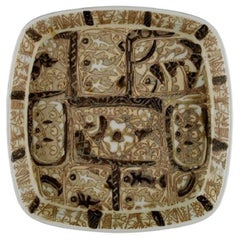
Nils Thorsson and Johanne Gerber, Aluminia, Royal Copenhagen, Square Baca Dish
Located in København, Copenhagen
Nils Thorsson and Johanne Gerber for Aluminia, Royal Copenhagen.
Square Baca dish decorated with fish, patterned glaze in the sand and light brown shades. 1960/70s.
Measures: 22.5...
Category
1960s Danish Scandinavian Modern Vintage Earthenware Ceramics
Materials
Faience
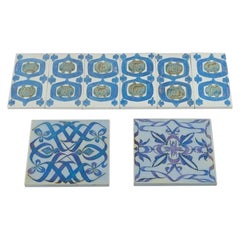
Aluminia and Royal Copenhagen, Tenera Faience, Eight Tiles, Approx 1960s/70s
Located in København, Copenhagen
Aluminia and Royal Copenhagen, Tenera faience. Eight tiles.
Approx. 1960s/70s
First factory quality.
Marked.
Dimensions:
The smaller ones: L 15.0 x D 7.7 cm.
Square tile: 15.4 cm.
Category
1960s Danish Vintage Earthenware Ceramics
Materials
Faience
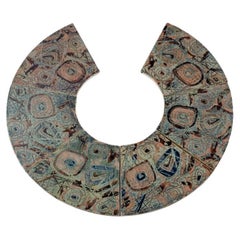
Royal Copenhagen, Six Baca Faience Tiles with Patterned Glaze, Model 869/3811
Located in København, Copenhagen
Royal Copenhagen, six Baca faience tiles with patterned glaze in brown, blue, green and sand colours.
Model 869/3811.
1970s.
In perfect condition.
Marked.
First factory quality....
Category
1970s Danish Vintage Earthenware Ceramics
Materials
Faience
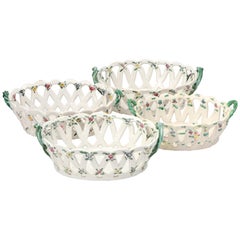
Two Pairs of Italian Maiolica Baskets, circa 1780
Located in Milano, IT
Two pairs of maiolica baskets
Antonio Ferretti Manufacture
Lodi, circa 1770-1790
Maiolica polychrome decorated “a piccolo fuoco” (third fire).
Measures: A) Height 3.54 x 6.69 x 9.84 in (9 x 17 x 25 cm);
B) Height 3.93 x 7.48 x 11.02 in (10 x 19 x 28 cm).
Total weight 4.85 lb (2.200 kg)
State of conservation:
A) One of the smaller baskets has some areas of restoration, the other slight chipping from use;
B) One of the larger baskets is intact and the other shows a clearly glued break.
The mold with which the baskets were forged simulates a wicker weave.
The two larger works have high, vertical walls, with branch-shaped handles penetrating the weave. The painted decorations, small polychrome flowers applied only externally, highlight the points where the weaves intersect.
The decision to leave the center of the basket devoid of decoration is highly unusual, but given the size and complexity of the shape, as well as the quality of the enamel, it is possible to hypothesize that it represents a precise choice in manufacturing or for a particular client.
The two smaller baskets have small, twisted handles and, on the outside, reproduce more decisively the characteristic wicker weave, obtained through thin molded lines. The interior exhibits a rich, typical decoration of naturalistic flowers: a bunch centered around a main flower and secondary stems accompanied by small “semis”. The exterior of these works is also adorned with small little flowers where the weaves intersect.
The size and morphological characteristics of the baskets confirm their attribution to the Lodi factory of Antonio Ferretti between 1770 and 1790, during its most successful period; by this point his original reworking of the "Strasbourg" decoration, known as "old Lodi", had achieved great fame even outside Italy.
This decorative choice represented a strong point of the Lodi factory, which established itself thanks to the vivid nature of the colors made possible by the introduction of a new technique perfected by Paul Hannong in Strasbourg and which Antonio Ferretti introduced in Italy. This production process, called “piccolo fuoco” (third fire), allowed the use of a greater number of colors than in the past; in particular, the purple of Cassius, a red made from gold chloride, was introduced. Its use allowed for many more tones and shades, from pink to purple.
The Ferretti family had started their maiolica manufacturing business in Lodi in 1725.
The forefather Simpliciano had started the business by purchasing an ancient furnace in 1725 and, indeed, we have evidence of the full activity of the furnaces from April of the same year (Novasconi-Ferrari-Corvi, 1964, p. 26 n. 4). Simpliciano had started a production of excellence also thanks to the ownership of clay quarries in Stradella, not far from Pavia. The production was so successful that in 1726 a decree of the Turin Chamber came to prohibit the importation of foreign ceramics, especially from Lodi, to protect internal production (G. Lise, La ceramica a Lodi, Lodi 1981, p. 59).
In its initial stages, the manufacture produced maolicas painted with the “a gran fuoco” (double fire) technique, often in turquoise monochrome, with ornamentation derived from compositional modules in vogue in Rouen in France. This was also thanks to the collaboration of painters like Giorgio Giacinto Rossetti, who placed his name on the best specimens next to the initials of the factory.
In 1748 Simpliciano made his will (Gelmini, 1995, p. 30) appointing his son Giuseppe Antonio (known as Antonio) as universal heir. After 1750, when Simpliciano passed away, Antonio was directly involved in the maiolica factory, increasing its fortunes and achieving a reputation on a European level. Particularly important was the aforementioned introduction in 1760 of the innovative “a piccolo fuoco” (third fire) processing, which, expanding the ornamental repertoire with Saxon-inspired floral themes, could commercially compete with the German porcelains that had one of its most renowned offerings in the naturalistic Deutsche Blumen. Antonio Ferretti understood and promoted this technique and this decoration, proposing it in a fresher and more corrective version, less linked to botanical tables...
Category
1770s Italian Neoclassical Antique Earthenware Ceramics
Materials
Maiolica
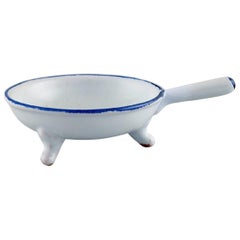
Emile Gallé for St. Clement, Nancy, Antique Bowl with Handle
Located in København, Copenhagen
Emile Gallé for St. Clement, Nancy. Antique bowl with a handle on three feet in hand painted faience with a coat of arms. 1870s-1880s.
Measures: 15.5 x 5 cm.
In excellent condition.
Category
1870s French Arts and Crafts Antique Earthenware Ceramics
Materials
Faience
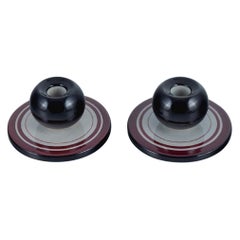
Ilse Claesson for Rörstrand, Two Hand Painted Faience Candlesticks, 1930s
Located in København, Copenhagen
Ilse Claesson for Rörstrand, two hand painted faience candlesticks.
1930s.
In great condition.
Marked.
Dimensions: D 12.0 x H 5.0 cm.
Category
1930s Swedish Art Deco Vintage Earthenware Ceramics
Materials
Faience
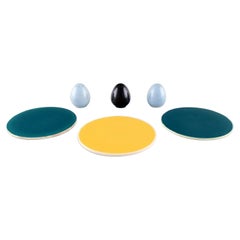
Royal Copenhagen/Aluminia Confetti, Three Salt/Pepper Shakers and Butter Boards
Located in København, Copenhagen
Royal Copenhagen / aluminia confetti. Three salt/pepper shakers and three butter boards in glazed faience. Mid-20th century.
Butter board diameter: 15 cm...
Category
Mid-20th Century Danish Scandinavian Modern Earthenware Ceramics
Materials
Faience
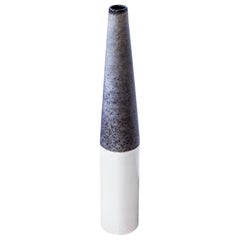
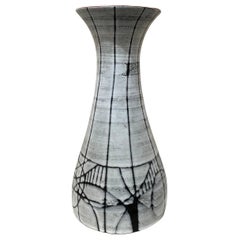
"Pylon" Vase by Ingrid Atterberg for Upsala Ekeby, Sweden, 1955-1956
Located in Hägersten, SE
Rare "Pylon" vase, no 2207 designed by Ingrid Atterberg. Produced by hand at Upsala Ekeby in Sweden between 1955-1956. Made from earthenware with shifting white and grey glaze. Excel...
Category
1950s Swedish Scandinavian Modern Vintage Earthenware Ceramics
Materials
Earthenware
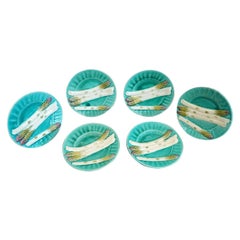
Set of Six
6
French Faience Asparagus Plates by Luneville
By Luneville
Located in Pembroke, MA
Set of very decorative, late 19th century blue-green French Majolica asparagus plates, hand-painted in white, green and purple, showing four asparagus spears in relief, and with fluted rims. The underside is stamped "Depose K G Luneville...
Category
Late 19th Century French French Provincial Antique Earthenware Ceramics
Materials
Ceramic, Majolica
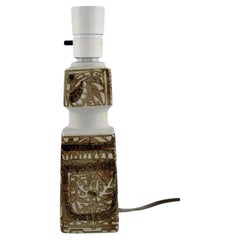
Nils Thorsson and Johanne Gerber for Aluminia, Royal Copenhagen, Two Baca Dishes
Located in København, Copenhagen
Nils Thorsson and Johanne Gerber for Aluminia, Royal Copenhagen.
Baca table lamp with patterned glaze in sand and light brown shades. 1960s / 70s.
Measur...
Category
1960s Danish Scandinavian Modern Vintage Earthenware Ceramics
Materials
Faience
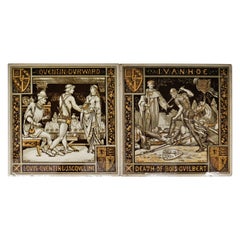
Pair of Antique 19th Century John Moyr Smith Ceramic Tiles, Circa 1877
By Minton
Located in Hamilton, Ontario
A pair of large Victorian hand painted Minton China Works in Stoke-upon-Trent, England, English tiles based on Scott's popular Waverly Novels, designed ...
Category
Late 19th Century English Victorian Antique Earthenware Ceramics
Materials
Ceramic, Earthenware
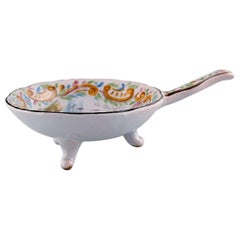
Emile Gallé for St. Clement, Nancy, Antique Bowl with Handle on Three Feet
Located in København, Copenhagen
Emile Gallé for St. Clement, Nancy. Antique bowl with a handle on three feet in hand painted faience with frogs, 1870s-1980s.
Measures: 15.5 x 5 cm.
In excellent condition.
Signed.
Category
1870s French Arts and Crafts Antique Earthenware Ceramics
Materials
Faience
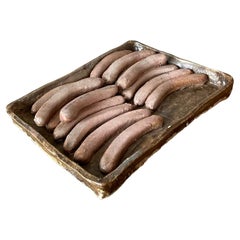
Vintage Boho Majolica Ceramic Tray of Sausages
Located in West Palm Beach, FL
A wonderfully surreal and conversation-starting piece of trompe l'oeil ceramic art, this vintage tray of sausages is a testament to playful, artisanal craftsmanship. Meticulously han...
Category
Mid-20th Century Italian Folk Art Earthenware Ceramics
Materials
Earthenware
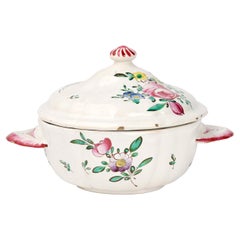
Italian Maiolica Cup Ferretti Lodi, circa 1770 - 1780
Located in Milano, IT
Maiolica puerperal cup
Antonio Ferretti Manufacture
Lodi, Circa 1770 - 1780
Maiolica polychrome decorated “a piccolo fuoco” (third fire).
It measures: 4.3 x 6.8 x 5.3 in (11 x 17,5 x 13,5 cm)
Weight: 0.78 lb (358 g)
State of conservation: some closed pass-through fêlures on the cup, barely visible on the outside. Some use chips on the edge of the lid, two of which are more marked.
From about the mid-sixteenth century, the puerperal soup tureen or puerperal cup became one of the most popular wedding gifts in central Italy. As an auspicious symbol, it replaced the birth table (“desco da parto”) which, on the occasion of high-ranking marriages, from the thirteenth century, had been painted by famous artists, especially in Tuscany.
In France this same tureen is called "écuelle de mariée", as it is given to spouses as a sign of fertility.
During the eighteenth century this custom spread even outside Italy to all social levels. Depending on availability and rank, it was made of different materials: precious metals, maiolica, porcelain, glass, pewter, etc.
Beginning in the mid-twentieth century, the custom of this symbolic homage gradually disappeared, although famous designers such as Gio Ponti and Giuseppe Gariboldi, even as recently as the 1940s, revisited a model of a small puerperal soup bowl for the Ginori and, also in Italy in 1940, in a national competition for young potters, one of the themes of the test was indeed a modern model of a puerperal cup as an auspicious gift.
This particular cup was also called a "service cup" or "puerperal vase" or "stuffed cup" - the windows were sealed with straw to prevent drafts of air for women in labor.
In the eighteenth century the line of the puerpera cup was simplified, so much so that it took the form of a small tureen with two handles - the typical broth cup...
Category
1770s Italian Rococo Antique Earthenware Ceramics
Materials
Maiolica
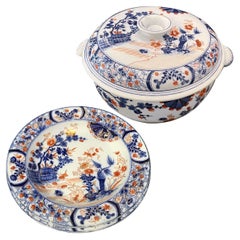
Luxury 60 Pcs Service "Japon" Imari Know as "Monet" Creil
Montereau 19th
Located in Paris, FR
"Japon" Imari service, produced in 1876 by the Creil & Montereau pottery, shows the great success of Japonism in tableware production, like the Bracquemo...
Category
Late 19th Century French Japonisme Antique Earthenware Ceramics
Materials
Gold
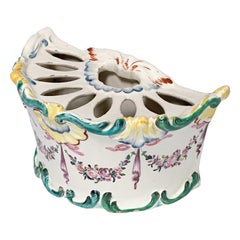
Italian Maiolica Flower Pot Garlands of Flowers, P. Rubati, Milano, 1770 circa
Located in Milano, IT
Maiolica flower pot “a mezzaluna”
decorated with garlands of flowers
Pasquale Rubati Factory
Milan, circa 1770
Measures: 4.7 in x 5 in x 8.8 in
...
Category
1770s Italian Rococo Antique Earthenware Ceramics
Materials
Maiolica
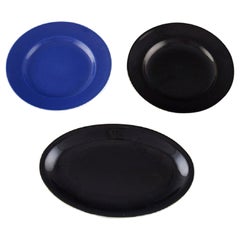
Royal Copenhagen / Aluminia Confetti Dish and Two Plates, Mid-20th C.
Located in København, Copenhagen
Royal Copenhagen / Aluminia Confetti dish and two plates in black and blue glazed faience. Mid-20th century.
The dish measures: 23 x 14.5 cm.
Plate diameter: 17.5 cm.
In excellent...
Category
Mid-20th Century Danish Scandinavian Modern Earthenware Ceramics
Materials
Faience
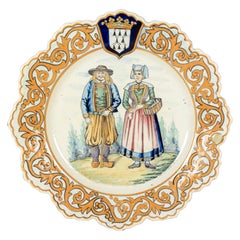
French Henriot Quimper Faience Plate
Located in Winter Park, FL
A Henriot Quimper French faience hand painted decorative plate, depicting a Breton couple in traditional clothing. Orange foliate border and with Quimper crown crest at the top. A go...
Category
Early 20th Century French Earthenware Ceramics
Materials
Faience
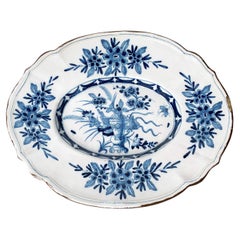
Maiolica Oval Tray, Felice Clerici Manufactory, Milan, Circa 1770-1780
Located in Milano, IT
Small oval tray
Felice Clerici Manufactory 1745-1780
Milan, Circa 1770-1780
Maiolica polychrome.
Dimensions: 10.82 x 8.66 in (27.5 x 22 cm); weight 0.4...
Category
1770s Italian Rococo Antique Earthenware Ceramics
Materials
Maiolica
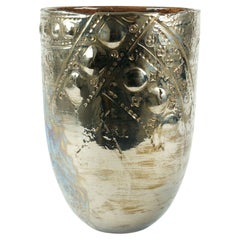
Decorative Ceramic Vase Vessel Metallic Platinum Luster Antiqued Handmade Italy
Located in Recanati, IT
Decorative ceramic vase handmade in Italy and decorated with platinum luster, the luster process requires three firings of the vase. Dimensions: D 22 cm, H 31 cm.
The vase draws in...
Category
21st Century and Contemporary Italian Modern Earthenware Ceramics
Materials
Platinum
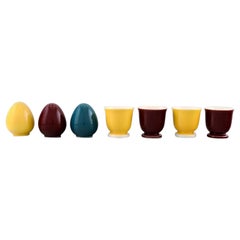
Confetti Royal Copenhagen / Aluminum Faience, Three Salt Shakers, Four Egg Cups
Located in København, Copenhagen
Confetti Royal Copenhagen / aluminum faience. Three salt shakers and four egg cups in glazed faience. Burgundy, yellow and turquoise glaze.
...
Category
1950s Danish Scandinavian Modern Vintage Earthenware Ceramics
Materials
Faience
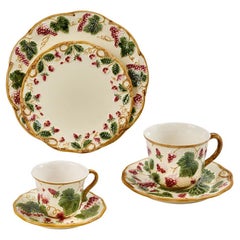
Flowery "George Sand" Set of 4 Pieces
By Aude Clément
Located in Paris, FR
Very original set of 4 pieces from the "George Sand" set. It's named this way because inspired by the famous set created by the French manufactory Creil & ...
Category
2010s French Earthenware Ceramics
Materials
Earthenware
$783 / set
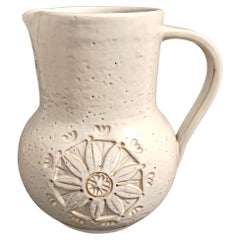
Postmodern Beige Earthenware Pitcher / Vase by Aldo Londi for Bitossi, Italy
By Aldo Londi, Bitossi
Located in Bresso, Lombardy
Made in Italy, 1970s.
It was designed by Aldo Londi and produced by Bitossi.
Bitossi was founded in 1921 in Montelupo, a city near Florence, and it is one of the most known Italian ...
Category
1970s Italian Post-Modern Vintage Earthenware Ceramics
Materials
Earthenware
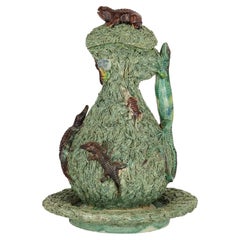
Palissy Style Majolica Ewer with Cover and Stand by Mafra
Located in London, GB
Portuguese Majolica ewer in the manner of Palissy
Portuguese, c. 1865-87
Measures: Height 37cm, diameter 26cm
This beautiful green ewer and bowl set...
Category
Late 19th Century Portuguese Antique Earthenware Ceramics
Materials
Majolica
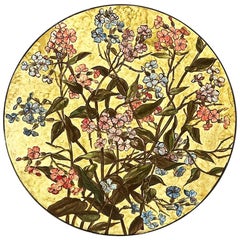
Earthenware John Bennett Plaque with Pink and Blue Phlox
By John Bennett
Located in New York, NY
FAPG 20247D
John Bennett (1840-1907), New York
Plaque with pink and blue phlox, circa 1881-1882
Earthenware, painted and glazed
Measures: 14 7/8 in. diameter, 1 13/16 in. high
Signed and inscribed (on the back): J B[monogram] ENNETT /
E 24 NY. / MC [or] CM
If the Herter Brothers was the most distinguished and successful cabinet making and decorating firm in New York in the 1870s-1880s, the transplanted Englishman John Bennett was probably the most gifted ceramicist working in New York in the Aesthetic period. (Bennett was included in The Metropolitan Museum of Art’s landmark exhibition, In pursuit of beauty: Americans and the Aesthetic Movement, in 1986–87, and Alice Cooney Frelinghuysen’s chapter, “Aesthetic Forms in Ceramics and Glass,” pp. 216–19, significantly informs this essay). Born in England, the son of a potter who worked in the Staffordshire district, Bennett came under the influence of John Sparkes, head of London’s Lambeth School of Art. Soon thereafter, he was hired by Henry Doulton of the eponymous firm to teach artisans there the new art of underglaze faience decoration, which was part of a revival of the sixteenth-century interest in hand-painted ceramics.
A number of Bennett’s works for Doulton were shown in the Doulton display at the Centennial Exposition in Philadelphia in 1876, and the considerable success enjoyed by Bennett and Doulton from an American audience undoubtedly played an important role in Bennett’s decision to leave Doulton and England and set up shop in New York in 1877. By the next year, he had already established a studio in New York, where he produced his own pottery in the tradition of the Arts & Crafts innovators, William Morris and William De Morgan, and also taught classes at the new Society of Decorative Art to the growing band of women who had taken up china painting, both professionally and avocationally.
Bennett’s pottery developed a very serious following among students and collectors, and was offered for sale at such leading retail establishments as Tiffany & Company in New York. Typically, his work was brilliantly colored, with carefully drawn naturalistic flowers against a monochromatic background.
Bennett’s fully developed American work, particularly pieces of larger scale, is exceedingly rare, as he worked in New York only from 1877 to 1883, in which year he withdrew to a farm in rural West Orange, New Jersey, where his production continued on a limited basis. He remained listed as a ceramicist there until 1889. While in New York City, Bennett maintained a studio at 412 East 24th Street. The present charger, boldly featuring pink and blue phlox, is signed by Bennett, and is inscribed “E 24 NY,” indicating its manufacture during Bennett’s time in New York. Although it is not dated, this piece is closely related stylistically to various dated pieces from 1881–82, which would place its production toward the end of Bennett’s New York years.
Although we do not know whether Bennett worked out of this 24th Street studio from the outset, he was indeed working there by 1879 when he made (and signed, inscribed, and dated) a charger with white and red flowers now in the collection of the Art Institute of Chicago, which specifically points to “412 East 24 / NY” (acc. no. 1998.317). Additionally, the U.S. Census of 1880 lists Bennett as a ceramicist located at that same address, married to Mary Bennett with whom he had had six children. There are several other examples from Bennett’s time in New York City, which also give his studio address on East 24th Street, including a covered jar in cadmium yellow with indigo and green flowers made in 1881; an undated footed vase with lilac...
Category
1880s American Aesthetic Movement Antique Earthenware Ceramics
Materials
Earthenware
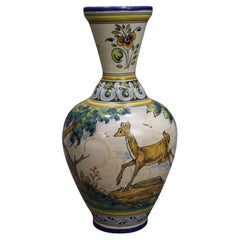
Hand Painted 20th c. Glazed Earthenware Talavera Vase
Located in Worcester, GB
Hand-Painted Talavera Pottery Vase by Mave, Spain, Mid-20th Century
Description:
A vibrant hand-painted Spanish Talavera pottery vase, attributed to the Mave workshop and signed “Ta...
Category
Mid-20th Century Spanish Earthenware Ceramics
Materials
Earthenware
$449 Sale Price
30% Off
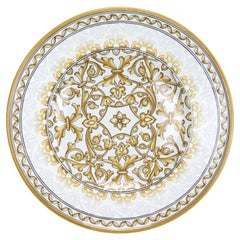
Plate Centerpiece Tray Ornament Bowl Wall Dish Majolica White Decorated In Stock
By deBlona
Located in Recanati, IT
This exclusive ceramic plate is handmade and hand-painted in Italy following the original Renaissance painting technique, unchanged over time, which we observe to the letter: it is d...
Category
21st Century and Contemporary Italian Modern Earthenware Ceramics
Materials
Ceramic, Majolica
18th Century Italian Maiolica Centerpiece Bassano Venice, circa 1750
Located in Milano, IT
Maiolica centerpiece
Pasquale Antonibon factory
Nove di Bassano, Venice, 1740-1770.
Measures: 1.85 in x 19.21 in x 15.27 in
4.7 cm X 48.8 cm X 38.8 cm.
lb 5.29 (kg 2.4)
State of conservation: thin passing fêlure with covered chipping and a glued foot
The Antonibon were an important family of Venetian...
Category
1750s Italian Baroque Antique Earthenware Ceramics
Materials
Maiolica
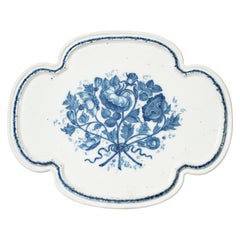
Postmodern White Lacquered Earthenware Horse Head Decorative Object, Italy 1980s
Located in Bresso, Lombardy
This large-scale figure of a horse head was produced in Italy and dates to the 80s.
The white glaze gives this piece a modern look and captures the elegance and beauty of the horse....
Category
1980s Italian Post-Modern Vintage Earthenware Ceramics
Materials
Earthenware
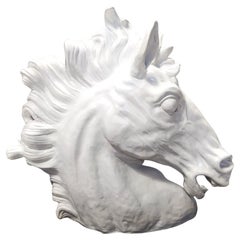
Rococo Italian Maiolica Flower Pot Pasquale Rubati, Milano, 1770 circa
Located in Milano, IT
Maiolica flower pot “a mezzaluna” with support feet
decorated with little bunches of flowers
Pasquale Rubati Factory
Milan, circa 1770
5.5 in X ...
Category
1770s Italian Rococo Antique Earthenware Ceramics
Materials
Maiolica
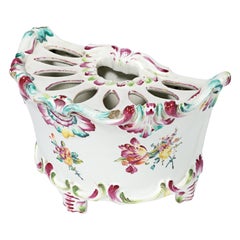
Pair of Ancient Italian Maiolica Flower Pots Milan, Rubati Factory, 1770 circa
Located in Milano, IT
Maiolica flower pot “a mezzaluna”
decorated with trompe l’oeil
Pasquale Rubati Factory
Milan, circa 1770
Measures: each 4.7 in (cm 12) x 5 in (c...
Category
1770s Italian Rococo Antique Earthenware Ceramics
Materials
Maiolica
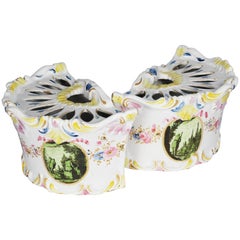
Quimper French Ceramic Earthenware Vessel with Lid
Located in Los Angeles, CA
Quimper ceramic earthenware vessel with lid
Substantial piece in weight and feel with beautiful floral motif
Wonderfully vibrant colors
Marked identi...
Category
Mid-20th Century French Earthenware Ceramics
Materials
Earthenware
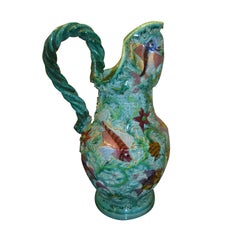
Italian Majolica Incised and Painted Ewer Fish Motif
Located in Palm Springs, CA
A truly whimsical and wonderful piece of Italian Majolica that is incredibly well crafted. It is incised and appears almost enameled. It is signed or inscribed by the artist on the b...
Category
1950s Italian Vintage Earthenware Ceramics
Materials
Majolica
$960 Sale Price
20% Off
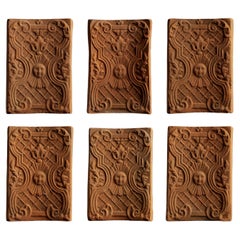
Antique Tiles with Sun and Asbtract Decoration
Located in Leuven , BE
A 6 antique earthenware tiles set evoking a delicate sun-shaped figure surrounded by abstract shapes. A beautiful decorative set that can be used on a chimney or a wall - one of many...
Category
15th Century and Earlier Antique Earthenware Ceramics
Materials
Earthenware
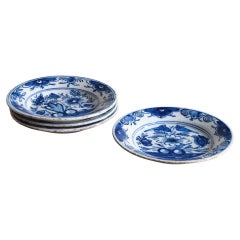
Two Sets of Late 18th Century Dutch Delft Plates, circa 1790
Located in Madison, MS
These sets of Delft Dutch plates would be a lovely addition to a dining room or would make beautiful decorations displayed on a wall or resting on a buffe...
Category
Late 18th Century Danish Antique Earthenware Ceramics
Materials
Delft
$1,380 Sale Price
20% Off
Vase, Ceramic, Enamel Hand Painted, Attributable to Late Bauhaus, 1930, Germany
Located in Wien, AT
Very special vase, made of ceramic with extraordinarily decorative painting, made by hand in enamel.
This style in Art Deco, the workmanship and the objects of comparison, for exam...
Category
1920s German Bauhaus Vintage Earthenware Ceramics
Materials
Ceramic, Majolica
$496 Sale Price
20% Off
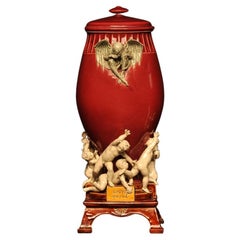
CARRIER-BELLEUSE and CHOISY LE ROI Manufacture, "Sauve qui peut" Vase
Located in SAINT-OUEN-SUR-SEINE, FR
Glazed red and white faience.
Another example, presented at the Salon de la Société Nationale des Beaux-Arts, in 1898, and numbered 4060, was shown with three other vases: Hercules ...
Category
Late 19th Century French Napoleon III Antique Earthenware Ceramics
Materials
Ceramic, Faience
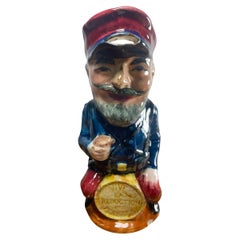
Frie Onnaing Majolica French Army Reservit Jug Pitcher
Located in Ciudad Autónoma Buenos Aires, AR
Majolica water jug or pitcher made by Onnaing in northern France.
A colorful soldier dressed in a pre-1914 army uniform sits on a barrel.
Category
1910s French French Provincial Vintage Earthenware Ceramics
Materials
Ceramic, Majolica
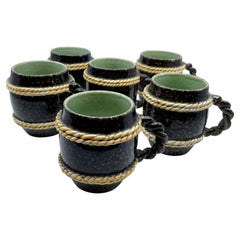
Set of Six Faux Porphyry Mugs
Located in New York, NY
Set of six faux porphyry mugs. Six unique hand cast majolica nautical cups/mugs in faux porphyry glaze with celadon blue interior wash and contrasting “rope” trim. Markings for Calta...
Category
Late 19th Century Italian Antique Earthenware Ceramics
Materials
Majolica
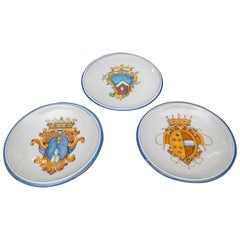
Set of Three Late 19th Century Italian Majolica Plates
By M. Cupi
Located in San Francisco, CA
A set of three, late 19th century. Italian Majolica plates / chargers. Decorated with armorial crests of three different designs. Very good dra...
Category
Late 19th Century Italian Renaissance Revival Antique Earthenware Ceramics
Materials
Ceramic, Majolica
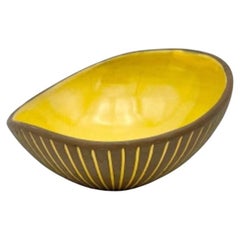
$650 Sale Price / set
25% Off
Yellow Ceramic Bowl by Hjördis Oldfors
Located in Atlanta, GA
One of ten earthenware bowl and vase designs, the ‘Kokos’, or Coconut, series was only produced in 1954. This piece is one of a sought after design by the innovative and renowned Swe...
Category
1950s Swedish Vintage Earthenware Ceramics
Materials
Ceramic, Earthenware
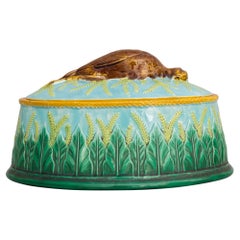
Partridge Majolica Game Pie Dish Made by George Jones, Ca. 1867
By George Jones
Located in Fort Lauderdale, FL
A majolica game pie dish designed by George Jones circa 1867-1869 in the ‘Partridge’ shape. The game pie dish is decorated with a lovely turquoi...
Category
1860s English Victorian Antique Earthenware Ceramics
Materials
Earthenware, Majolica, Pottery
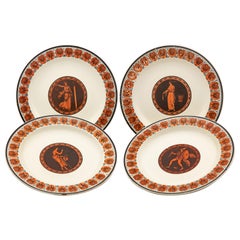
Early Wedgwood Neoclassical Creamware Dessert Dishes Made circa 1780
By Wedgwood
Located in Fort Lauderdale, FL
A set of four early Wedgwood creamware Neoclassical dessert dishes made circa 1780.
Sir William Hamilton’s Collection of Etruscan, Greek and Roman an...
Category
Late 18th Century English Neoclassical Antique Earthenware Ceramics
Materials
Creamware
Colourful Ceramic Faience Bowl by Stig Lindberg – Gustavsberg Studio, 1950s
Located in Stockholm, SE
Bowl designed by Stig Lindberg, Gustavsberg
Sweden, 1940/50s
Faience.
H: 20 cm / 7 7/8"
L: 26.5 cm / 10 7/16"
W: 18 cm / 7 1/16"
Category
1950s Vintage Earthenware Ceramics
Materials
Faience
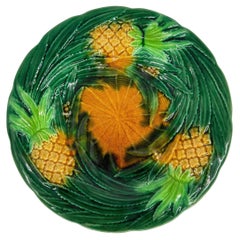
A George Jones Majolica Pineapples on Basketweave Plate, English, ca. 1863
By George Jones
Located in Banner Elk, NC
A George Jones Majolica Dessert Plate, with relief-molded pineapples and swirling green-glazed leaves, the center with yellow ocher-glazed simulated basketweave, the reverse impresse...
Category
19th Century English Victorian Antique Earthenware Ceramics
Materials
Majolica
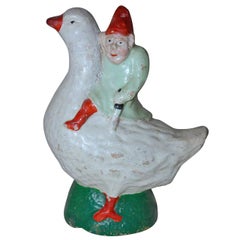
Antique Christmas Elf On Goose Money Bank
Located in Copenhagen, K
The Elf or "Nisse" as they are called in Denmark, used to live in every farmhouse, and you had to treat them nice to make them stay. Later on they became associated with Christmas an...
Category
1890s Danish Folk Art Antique Earthenware Ceramics
Materials
Earthenware
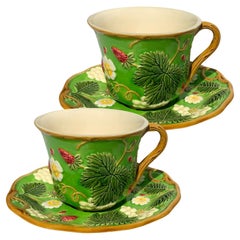
$549 Sale Price
20% Off
Flowery Tea Cups for 2 "George Sand", green color
By Aude Clément
Located in Paris, FR
Beautiful set of 2 earthenware tea cups in the "George Sand" collection.
These tea cups feature an elegant and detailed design, adorned with a raised pattern of strawberry leaves, ...
Category
2010s French Earthenware Ceramics
Materials
Earthenware
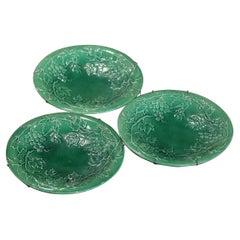
19th Century English Majolica Wall Plates with Vine and Grape Motifs, Set of 3
Located in Dallas, TX
Decorate a wall or a shelf with this elegant set of antique plates. Crafted in England circa 1880, each painted platter features vine, leaf and grape motifs in high relief throughout...
Category
Late 19th Century English Antique Earthenware Ceramics
Materials
Majolica
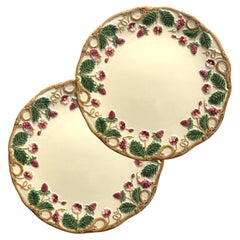
Set of 2 White flowery "George Sand" dessert plates, earthenware
By Aude Clément
Located in Paris, FR
Set of Two white dessert plates from the George Sand Collection.
This dessert plate is adorned with a raised pattern of strawberries, strawberry leaves, and small white flowers, car...
Category
2010s French Earthenware Ceramics
Materials
Earthenware
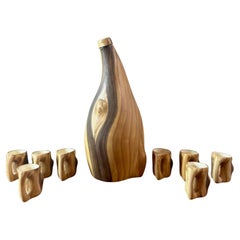
20th century French Earthenware Vallauris Liquor set, 1970s
Located in LEGNY, FR
Very nice Earthenware tableware with 'Faux Bois' decoration, made by atelier Grandjean Jourdan Vallauris in the 1970s.
Set with a jug and 8 liquor mu...
Category
1970s French Vintage Earthenware Ceramics
Materials
Earthenware
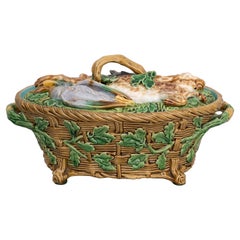
English Victorian Majolica Game Pie Dish Made by Minton
Co.
By Minton
Located in Fort Lauderdale, FL
A majolica game pie dish made by Minton & Co. in 1874. The dish takes the form of a wicker basket and is covered with oak leaves, acorns, vines,...
Category
1870s English Victorian Antique Earthenware Ceramics
Materials
Earthenware, Majolica, Pottery
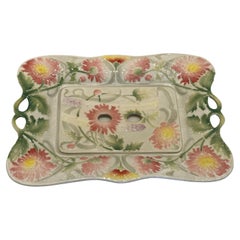
French asparagus dish St Clément, Aesthetic Movement, 19th century
Located in Paris, FR
Discover an exquisite piece of Aesthetic Movement French faïence: an asparagus dish by Keller & Guérin, St. Clément, circa 1890–1900, in the Art Nouveau style. This dish features a r...
Category
Late 19th Century Antique Earthenware Ceramics
Materials
Ceramic, Earthenware, Majolica
Flowery "George Sand" Breakfast Cups for 2, blue color
By Aude Clément
Located in Paris, FR
Beautiful set of 2 earthenware breakfast cups in the "George Sand" collection.
This breakfast cup features an elegant and detailed design, adorned with a raised pattern of strawber...
Category
2010s French Earthenware Ceramics
Materials
Earthenware

Talavera Jar Decorative Vase Folk Art Vessel Mexican Ceramic Black White Modern
By Cesar
Located in Queretaro, Queretaro
Elegant black and white jar made with the authentic Talavera technique. Master artisan, Cesar Torres portraits the colonial art of Mexico while cre...
Category
21st Century and Contemporary Mexican Spanish Colonial Earthenware Ceramics
Materials
Ceramic, Clay, Majolica
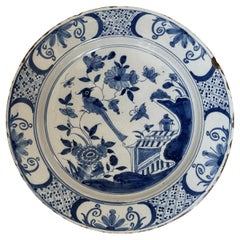
Fine English delft charger featuring a chinoiserie garden scene
Located in Charlottesville, VA
A fine English delft charger featuring a chinoiserie garden scene with long-tailed bird, butterflies, and bees amid peonies and a fence, painted in deep cobalt blue on a tin-glazed g...
Category
18th Century English Chinoiserie Antique Earthenware Ceramics
Materials
Delft
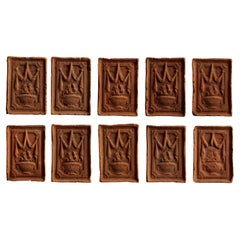
Set of 10 Small Antique Earthenware Tiles
Located in Leuven , BE
Set of 2 small antique earthenware tiles.
Category
19th Century Antique Earthenware Ceramics
Materials
Earthenware
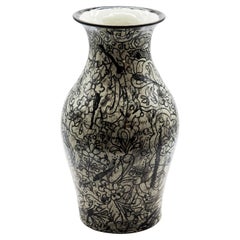
Vase by Robert Dupanier
Located in SAINT-OUEN-SUR-SEINE, FR
Vase in enamelled ceramic by Robert Dupanier, Vallauris, France circa 1950
Category
1950s French Mid-Century Modern Vintage Earthenware Ceramics
Materials
Ceramic, Faience
$1,128
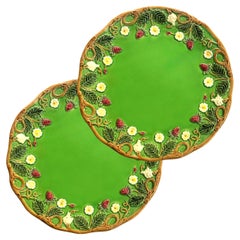
Set of 2 green flowery "George Sand" dessert plates, earthenware
By Aude Clément
Located in Paris, FR
Set of Two green dessert plates from the George Sand Collection.
This dessert plate is adorned with a raised pattern of strawberries, strawberry leaves, and small white flowers, car...
Category
2010s French Earthenware Ceramics
Materials
Earthenware
More Ways To Browse
William Wyman
Zachariah Boyle
Zsolnay Jug
16th Century English Silver
18 Century Tea Table
18th Century Dutch Delft Shoes
Aj Wilkinson
Aldo Rossi Rosenthal
Antique 1 Gallon Crock
Antique Ceramic Jelly Moulds
Antique Chinese Green Ginger Jar
Antique Majolica Sardine Box
Arabia Tile Finland
Aspic Mold
Atelier Claude Tabet
Barnyard King
Benedicte Vallet
Bjorn Wiinblad Pitcher