Neoclassical Ceramics
to
13
70
1
12
25
33
1
7
9
4
1
1
1
2,712
952
948
658
304
250
119
114
71
65
54
32
31
16
8
6
3
2
65
10
9
7
4
42
26
57
25
22
10
9
71
71
71
11
2
2
2
2
Style: Neoclassical
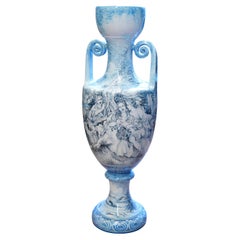
Light Blue and Gray Ceramic Majolica Amphora Hand Painted Francois Boucher Italy
Located in Recanati, IT
Large ceramic amphora with handles, made and painted entirely by hand, central Italy production, year 2009. The decoration on the vase is a reproduction of a painting by Francois Bou...
Category
Early 2000s Italian Neoclassical Ceramics
Materials
Ceramic, Majolica
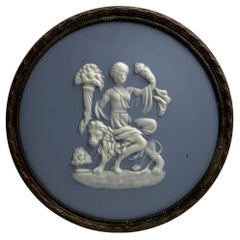
Limoges Tharaud “Cameo” Blue Plaque Stand
Located in Guaynabo, PR
This a Limoges Camille Tharaud pate sur pate blue ceramic plaque depicting a mythological figure-Sphinx who is sitting over a lion. She is holding with one hand a large cornucopia...
Category
Early 20th Century French Neoclassical Ceramics
Materials
Ceramic

$200 Sale Price
20% Off
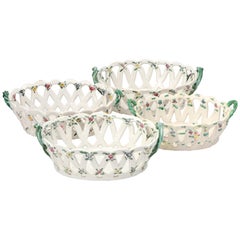
Two Pairs of Italian Maiolica Baskets, circa 1780
Located in Milano, IT
Two pairs of maiolica baskets
Antonio Ferretti Manufacture
Lodi, circa 1770-1790
Maiolica polychrome decorated “a piccolo fuoco” (third fire).
Measures: A) Height 3.54 x 6.69 x 9.84 in (9 x 17 x 25 cm);
B) Height 3.93 x 7.48 x 11.02 in (10 x 19 x 28 cm).
Total weight 4.85 lb (2.200 kg)
State of conservation:
A) One of the smaller baskets has some areas of restoration, the other slight chipping from use;
B) One of the larger baskets is intact and the other shows a clearly glued break.
The mold with which the baskets were forged simulates a wicker weave.
The two larger works have high, vertical walls, with branch-shaped handles penetrating the weave. The painted decorations, small polychrome flowers applied only externally, highlight the points where the weaves intersect.
The decision to leave the center of the basket devoid of decoration is highly unusual, but given the size and complexity of the shape, as well as the quality of the enamel, it is possible to hypothesize that it represents a precise choice in manufacturing or for a particular client.
The two smaller baskets have small, twisted handles and, on the outside, reproduce more decisively the characteristic wicker weave, obtained through thin molded lines. The interior exhibits a rich, typical decoration of naturalistic flowers: a bunch centered around a main flower and secondary stems accompanied by small “semis”. The exterior of these works is also adorned with small little flowers where the weaves intersect.
The size and morphological characteristics of the baskets confirm their attribution to the Lodi factory of Antonio Ferretti between 1770 and 1790, during its most successful period; by this point his original reworking of the "Strasbourg" decoration, known as "old Lodi", had achieved great fame even outside Italy.
This decorative choice represented a strong point of the Lodi factory, which established itself thanks to the vivid nature of the colors made possible by the introduction of a new technique perfected by Paul Hannong in Strasbourg and which Antonio Ferretti introduced in Italy. This production process, called “piccolo fuoco” (third fire), allowed the use of a greater number of colors than in the past; in particular, the purple of Cassius, a red made from gold chloride, was introduced. Its use allowed for many more tones and shades, from pink to purple.
The Ferretti family had started their maiolica manufacturing business in Lodi in 1725.
The forefather Simpliciano had started the business by purchasing an ancient furnace in 1725 and, indeed, we have evidence of the full activity of the furnaces from April of the same year (Novasconi-Ferrari-Corvi, 1964, p. 26 n. 4). Simpliciano had started a production of excellence also thanks to the ownership of clay quarries in Stradella, not far from Pavia. The production was so successful that in 1726 a decree of the Turin Chamber came to prohibit the importation of foreign ceramics, especially from Lodi, to protect internal production (G. Lise, La ceramica a Lodi, Lodi 1981, p. 59).
In its initial stages, the manufacture produced maolicas painted with the “a gran fuoco” (double fire) technique, often in turquoise monochrome, with ornamentation derived from compositional modules in vogue in Rouen in France. This was also thanks to the collaboration of painters like Giorgio Giacinto Rossetti, who placed his name on the best specimens next to the initials of the factory.
In 1748 Simpliciano made his will (Gelmini, 1995, p. 30) appointing his son Giuseppe Antonio (known as Antonio) as universal heir. After 1750, when Simpliciano passed away, Antonio was directly involved in the maiolica factory, increasing its fortunes and achieving a reputation on a European level. Particularly important was the aforementioned introduction in 1760 of the innovative “a piccolo fuoco” (third fire) processing, which, expanding the ornamental repertoire with Saxon-inspired floral themes, could commercially compete with the German porcelains that had one of its most renowned offerings in the naturalistic Deutsche Blumen. Antonio Ferretti understood and promoted this technique and this decoration, proposing it in a fresher and more corrective version, less linked to botanical tables...
Category
1770s Italian Antique Neoclassical Ceramics
Materials
Maiolica
Antique B&G
Bing
Grondahl
Rare Biscuit Figure, Late 19th Century
Located in København, Copenhagen
Antique B&G (Bing & Grondahl) Rare biscuit figure.
Measures: 20 cm. x 11 cm.
1st. factory quality, in perfect condition.
Marked, late 19th century.
Category
Late 19th Century Danish Antique Neoclassical Ceramics
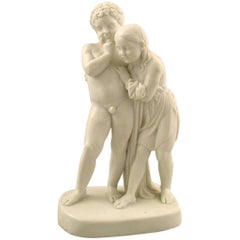
B&G / Bing
Grondahl Bisque Figure after Thorvaldsen, circa 1870
Located in København, Copenhagen
B&G / Bing
Grondahl Bisque figure after Thorvaldsen, circa 1870.
In good condition.
Stamped: B
G Eneret (indistinct)
Measures: 19 x 15.5 cm.
Category
1870s Danish Antique Neoclassical Ceramics

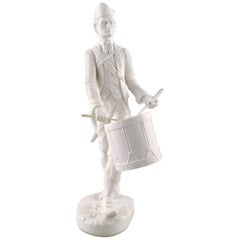
J. Bromley for B&G "American Drummer Boy, 1st Maryland, circa 1776"
Located in København, Copenhagen
J. Bromley for B&G "American Drummer Boy, 1st Maryland, circa 1776".
A B&G bisquit figurine.
No. 698/750.
Measures: Height 38 c...
Category
20th Century Danish Neoclassical Ceramics
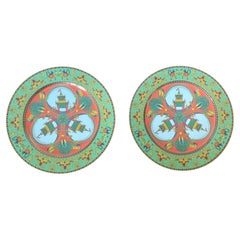
Pair of Serving Platters by Versace for Rosenthal
Located in Atlanta, GA
Designed by Gianni Versace for Rosenthal Studio Line, these "Le Voyage De Marco Polo" service platters or charger plates features beautiful and detaile...
Category
20th Century German Neoclassical Ceramics
Materials
Ceramic
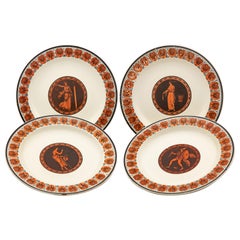
Early Wedgwood Neoclassical Creamware Dessert Dishes Made circa 1780
By Wedgwood
Located in Fort Lauderdale, FL
A set of four early Wedgwood creamware Neoclassical dessert dishes made circa 1780.
Sir William Hamilton’s Collection of Etruscan, Greek and Roman an...
Category
Late 18th Century English Antique Neoclassical Ceramics
Materials
Creamware
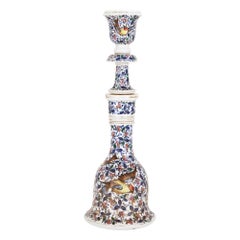
19th Century Porcelain Huqqa with Bird Paintings
Located in London, GB
This huqqa (or hookah) is a wonderful item which is crafted from porcelain and finely hand painted and parcel gilt. The huqqa was created in the late 19th century, most likely in Rus...
Category
Late 19th Century Russian Antique Neoclassical Ceramics
Materials
Porcelain
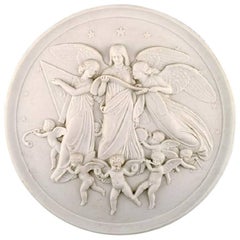
Antique B&G "Bing
Grondahl" Bisque Plate after Thorvaldsen
Located in København, Copenhagen
Antique B&G (Bing & Grondahl) bisque plate after Thorvaldsen.
In perfect condition, 1st. factory quality.
Measures: 32 cm.
Late 19 century.
Category
19th Century Danish Antique Neoclassical Ceramics
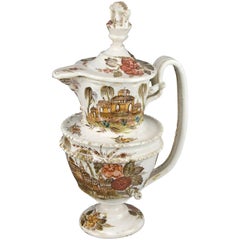
Villafeliche Jug, Aragon, Spain, 18th Century
Located in Madrid, ES
Late Baroque pottery jug made and decorated with high temperature glazes over a white slip of tin. These motifs are combined with enameled decorations in relief obtained mold. The typology of the piece combines Italian jug with handle ovoid belly and vertical bow, with the peak jug typically Spanish, characterized by the outgoing peak of the mouth. Decorations reveal the oriental influence, with large floral bouquets arranged asymmetrically and complex landscapes with architecture and palm trees, which remove some figures, such as totally Western. The reasons appear pincelados in manganese black, and colored with ocher, blue, green and red, mainly enamels. Aragon ceramic least a century old will be characterized by a strong own, combined with the influences of personality Talavera and Catalonia. You will have three main centers: Teruel, Muel and Villafeliche, the first two with tradition since the 16th century, and the third created in the late 17th century. The Villafeliche will generally be very popular ceramics...
Category
18th Century Spanish Antique Neoclassical Ceramics
Materials
Ceramic
Neoclassical ceramics for sale on 1stDibs.
Find a broad range of unique Neoclassical ceramics for sale on 1stDibs. Many of these items were first offered in the 18th Century and Earlier, but contemporary artisans have continued to produce works inspired by this style. If you’re looking to add vintage ceramics created in this style to your space, the works available on 1stDibs include serveware, ceramics, silver and glass and other home furnishings, frequently crafted with ceramic and other materials. If you’re shopping for used Neoclassical ceramics made in a specific country, there are Europe, Italy, and Spain pieces for sale on 1stDibs. It’s true that these talented designers have at times inspired knockoffs, but our experienced specialists have partnered with only top vetted sellers to offer authentic pieces that come with a buyer protection guarantee. Prices for ceramics differ depending upon multiple factors, including designer, materials, construction methods, condition and provenance. On 1stDibs, the price for these items starts at $1,945 and tops out at $2,973 while the average work can sell for $2,459.
Still Thinking About These?
All Recently ViewedMore Ways To Browse
Bruno Geyer
Burmese Silver Cup
Ceramic Wine Goblets
Ceramics Gustavo Perez
Chinese Export Blue And White Plate 18 Century
Clews Transferware
Cup With Lithophane
Dansk Dinnerware
Dansk Espresso
Dansk Mug
Dip A Mano
Don Schaumburg Flared Studio Bowl
Ernest Miller Ceramics
Famille Verte Cabbage Leaf And Butterfly
Fitz And Floyd Mug
Fornasetti Espresso Cups
Fornasetti Espresso
Francois Roger France Ceramics