Creamware Serveware, Ceramics, Silver and Glass

to
7
124
1
42
69
13
1
8
3
4
1
41
31
6
4
3
2
1
1
163
29,216
27,758
18,609
14,100
118
7
116
73
72
32
9
125
125
125
16
9
7
4
4
Material: Creamware
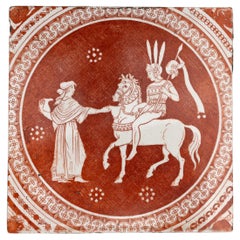
Early Spode Red Greek Pattern Tile
Located in Fort Lauderdale, FL
A Neoclassical red transferware tile made by Spode 1806-1810, with the ‘Refreshments for Phliasian Horseman’ pattern. Sir William Hamilton’s Collection of Etruscan, Greek and Roman antiquities, first published in 1766 by Pierre d’Hancarville, was a landmark publication in English design. It intended to disseminate the Antique style through its engravings of Attic pottery. The catalog’s faithful reproductions of Classical vases led British potteries, including Spode, to adapt or even copy the ancient art for modern life. These Spode Greek pattern tiles reflect the major influence of Hamilton’s catalog on English Neoclassicism. The central scene was taken directly from the catalog. This tile can be dated to a narrow window of production in the Spode factory, 1806-1810. During that time, Spode used a technique known as the “Pluck and Dust” method to print in red transfer designs onto creamware. Using this method, source prints were transferred overglaze using tissue imprinted with a very faint rendition of the design outlined in sticky oil. The decorator applied the tissue to the object then carefully “plucked” or pulled it away, leaving the sticky oil design behind. Then, a finely-ground enamel color was “dusted” onto the surface, sticking to any areas that had the oil. A final firing at a low temperature in the enamel kiln made the pattern permanent. The Pluck and Dust technique improved upon bat-printing and enabled larger designers to be transferred. It was short-lived, however, as under-glaze transfer printing soon took over as the preferred method for producing transferwares. Dimensions: 5 in. x 5 in. x 1/4 in. Condition: Excellent. Slight chip to the upper left corner measuring approximately 0.9 cm. in length. Provenance: The Collection of Nancy and Andrew Ramage Jonathan Horne...
Category

Early 19th Century English Neoclassical Antique Creamware Serveware, Ceramics, Silver and Glass

Materials

Earthenware, Creamware

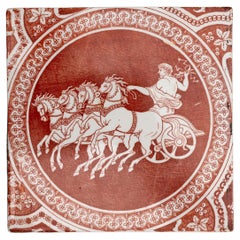
Early 19th Century Spode Red Greek Pattern Tile
Located in Fort Lauderdale, FL
A Neoclassical red transferware tile made by Spode 1806-1810, with the ‘Zeus in His Chariot’ pattern. Sir William Hamilton’s Collection of Etruscan, Greek and Roman antiquities, first published in 1766 by Pierre d’Hancarville, was a landmark publication in English design. It intended to disseminate the Antique style through its engravings of Attic pottery. The catalog’s faithful reproductions of Classical vases led British potteries, including Spode, to adapt or even copy the ancient art for modern life. These Spode Greek pattern tiles reflect the major influence of Hamilton’s catalog on English Neoclassicism. The central scene was taken directly from the catalog. This tile can be dated to a narrow window of production in the Spode factory, 1806-1810. During that time, Spode used a technique known as the “Pluck and Dust” method to print in red transfer designs onto creamware. Using this method, source prints were transferred overglaze using tissue imprinted with a very faint rendition of the design outlined in sticky oil. The decorator applied the tissue to the object then carefully “plucked” or pulled it away, leaving the sticky oil design behind. Then, a finely-ground enamel color was “dusted” onto the surface, sticking to any areas that had the oil. A final firing at a low temperature in the enamel kiln made the pattern permanent. The Pluck and Dust technique improved upon bat-printing and enabled larger designers to be transferred. It was short-lived, however, as under-glaze transfer printing soon took over as the preferred method for producing transferwares. Dimensions: 5 in. x 5 in. x 1/4 in. Condition: Excellent. Provenance: The Collection of Nancy and Andrew Ramage Jonathan Horne...
Category

Early 19th Century English Neoclassical Antique Creamware Serveware, Ceramics, Silver and Glass

Materials

Earthenware, Creamware

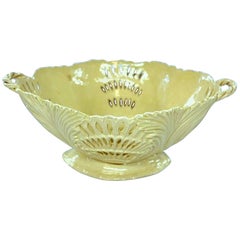
Antique English Late 18th Century Yorkshire or Staffordshire Basket
Located in CHARLESTON, SC
Rare antique English Yorkshire or Staffordshire creamware pierced basket with intricate reticulated body. Lovely color no damage or repairs.
Category

Late 18th Century English Antique Creamware Serveware, Ceramics, Silver and Glass

Materials

Creamware

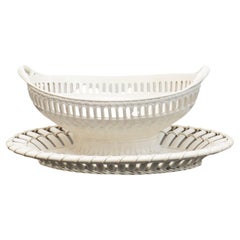
19th Century English Creamware Oval Basket and Stand
Located in Hudson, NY
The exquisite creamware oval basket with stand, shown here, reveals the artistry and sophistication of 19th century English table ware. Feat...
Category

19th Century English Georgian Antique Creamware Serveware, Ceramics, Silver and Glass

Materials

Creamware, Ceramic, Pottery

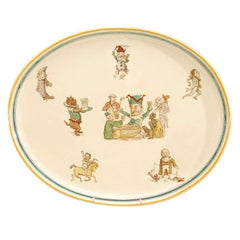
19th Century Wedgwood Creamware "Punch" Decorated Platter or Tray
Located in Great Barrington, MA
This large creamware tray or platter is made by Wedgwood depicting everything "Punch". Transfer outlines of whimsical 19th century characters are hand-painted in polychrome enamels w...
Category

19th Century English Antique Creamware Serveware, Ceramics, Silver and Glass

Materials

Creamware

Still Thinking About These?

All Recently Viewed