Tribal Art
to
178
735
563
1,404
21
13
72
12
12
9
1
1
1
51
228
1,125
34
447
430
72
9
4
20
29
18
31
33
23
17
4
704
286
205
167
91
794
650
339
178
141
1,438
1,432
1,437
53
25
14
9
7
Tribal Art For Sale
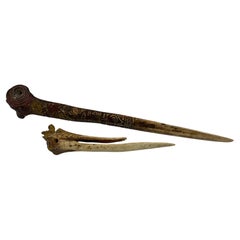
Antique Ethnic Artifact Sepik River Cassowary Bone from Papua New Guinea
Located in Moreno Valley, CA
Antique Ethnic Artifact Sepik River Cassowary Bone from Papua New Guinea
For many groups in Papua New Guinea, bone was an important medium for making tools of all types. This artifact is made from leg bone of a cassowary, a large, flightless, and extremely dangerous, bird.
Cassowaries also play an important role in the mythology of groups in the Sepik River area.
Though no longer used these bone artifacts are still used ceremonially. They often play important roles in male initiation and other rituals. They are also worn as personal adornment by tucking them into a band of braided fibers worn around the upper arm.
Antique Ethnic Bone Cassowary Artifact with minimal carving and incised design confined to the joint end.
A small hole has been drilled through from both sides of the top and presumably for the threading of a cord.
The bone has been partially divided near the top and to form two prongs that project down the back of the dagger possibly allowing the user to wear is tuck into a waist band or belt.
Origin Papua New Guinea Maprik Dist Area
From the Art Collection of Marian and John Scott, acquired in 1962.
Similar items are in display in the Timothy S. Y. Lam Museum of Anthropology.
Purchased from the amazing private collection of Mark Lissauer who spent his life collecting niche ethnographic pieces.
About Mark Lissauer:
Mark Lissauer spent forty years travelling abroad for months at a time collecting ethnographic artefacts primarily from New Guinea and the islands of the West Pacific, and from Asia and Himalayan countries. Fluent in five languages and having in the course of business travelled to more than forty countries, Mark is well-known to museums and art-collectors around the world for his long career and his interesting and diverse collection of rare ethnographic material.
Mark knows the origin and symbolism of each piece. Through extensive research and more than ninety trips around the globe, Mark familiarised himself with the traditions of the various cultures he visited in order to understand the meaning of each object to its region and tribe. His home has a specialist library and several rooms are filled with tribal carvings, textiles and ethnographica.
He acquired his first tribal piece in 1948 during a business trip to Milne Bay, New Guinea, and has since documented the acquisition of some 35,000 items. Several thousands of these have been sold to important private collections and museums worldwide, including the Rockefeller Museum, the British Museum and the Musée National des Arts d’Afrique et d’Océanie, now incorporated into the Louvre Museum.
Estimator certificate of authenticity by Wayne Heathcote Tribal Art Dealer and Expert.
Heathcote has a flash gallery in Brussels, where much of the tribal art business is centred, and is an expert at Sotheby's tribal art sale...
Category
Early 20th Century Folk Art Tribal Art
Materials
Bone
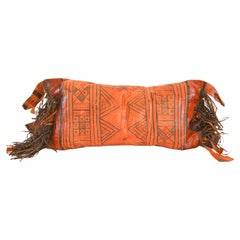
African Tuareg Hand-Tooled Leather Pillow with Fringes
Located in Moreno Valley, CA
Large African Tuareg hand tooled leather pillow.
Great colors, hand painted with tribal geometric design with long leather fringes on each side.
Handcrafted in Africa with pieces of ...
Category
Mid-20th Century Kenyan Tribal Tribal Art
Materials
Leather
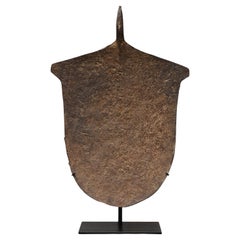
Extra Large Curved Hoe Currency, Angas, Nigeria
Located in Point Richmond, CA
Extra Large Curved Hoe currency
Angas, Nigeria
Early 20th century
Iron
Measures: 29.5 x 20.5 in. / 75 x 52 cm
Height on custom display stand: 33.25 in. / 84 cm
Weight: 20.6 pounds / 9.34 kg
Combined weight with base: 43.8 pounds / 19.9 kg
The large currency forms are comprised of a heavy sheet of iron forged into the shape of a curved hoe. They were customary gifts for a bride’s father as well as having a function during wedding celebrations (Ballarini, The Perfect Form...
Category
Early 20th Century Nigerian Other Tribal Art
Materials
Iron
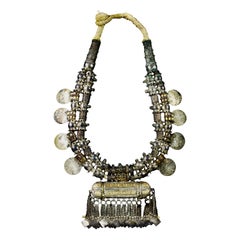
Oman, Silver
Gold Necklace with Amulet Box, 19th Century
Located in PARIS, FR
Stunning and rare Omani tribal necklace in gold and silver featuring eight Burgau thalers dated 1780 and a large amulet box (Hirz) also in gold and silver. 19th century.
Very good condition. Preserved and professionally framed.
Dimensions of the necklace: 52 x 30 x 3
Dimensions of the frame: 70 x 47 x 5
Secure shipping.
This fine Omani necklace of silver and gold comprises two strands of spiky, seed pod-like silver beads; gold-wrapped beads; eight silver Maria Theresa thaler coins; and a large silver and gold amulet box, with multiple chain tassels each of which finishes with a square-shaped pendant cut from sheet silver.
The cigar-shaped amulet box called hirz would have contained some Koranic verse or religious text.
Such a spectacular display of wealth would only have been worn at times of important festivities such as marriage celebrations.
Maria Theresa thalers were made in Austria since the reign of Empress Maria Theresa of the Austro-Hungarian Empire. The Empress died in 1780 and since that time, all thalers that were subsequently struck were minted with that date regardless of the actual year that they were produced. The coins achieved such a level of trust for their silver content (which is 83.3% silver) in the Middle East that neither the design not the date was varied, and so for more than 200 years the coins were used as an international currency among the tribes and the states of the Middle East, in much the same way as the Spanish dollar was used as an international currency at the time elsewhere. The thalers were used to complete most important transactions locally and were also given as dowries. They were also an important source of silver and were melted locally for jewellery.
The coins made their way to the ports of the Red Sea, Egypt and northern Africa from the ports of Genoa, Trieste, Livorno and Marseille. European traders used the coins to buy precious materials from the Gulf and northern Africa which it desired – commodities such as spices, coffee, gum Arabic, indigo, pearls, and tortoise shell.
The importance and the beauty of the coins saw them incorporated into local jewellery most particularly in Oman and Yemen.
References
Al-Jadir, S., Arab & Islamic Silver, Stacey International, 1981.
Harrigan, P., ‘Tales of a Thaler’, Saudi Aramco World, January/February 2003.
Hawley, R., Omani Silver, Longman, 1978.
Hawley, R., Silver: The Traditional Art of Oman, Stacey International, 2000.
Rajab, J.S., Silver Jewellery of Oman, Tareq Rajab Museum, 1998.
Ransom, M., Silver Treasures from the Land of Sheba: Regional Yemeni Jewelry...
Category
19th Century Omani Antique Tribal Art
Materials
Gold, Silver
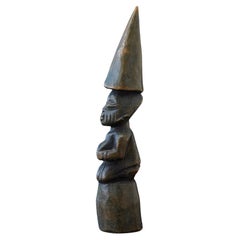
Tall Carved Wooden Oracle or Divination Tapper "Iroke Ifa", Yoruba People, 1930s
Located in Aramits, Nouvelle-Aquitaine
Tall hand-carved wooden oracle or divination tapper "Iroke Ifa" statue, showing a kneeling woman holding her breasts. Yoruba, Nigeria, circa 1930s.
Yoruba belief specifies that each ...
Category
1930s Nigerian Tribal Vintage Tribal Art
Materials
Wood
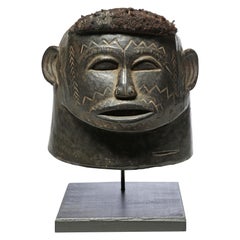
Powerful Scarified Makonde Portrait Helmet Mask Tanzania, Early 20th C Africa
Located in Point Richmond, CA
Powerful Scarified Makonde portrait helmet mask from Tanzania. Early 20th century with heavy dark patina from traditional tribal use, wear inside from being used. Finely carved featu...
Category
Early 20th Century Tanzanian Tribal Tribal Art
Materials
Wood

$1,365 Sale Price
30% Off
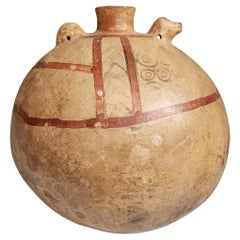
Pre-Columbian Chancay Canteen Vessel South American Antiques
Located in London, GB
Rare Pre-Columbian Chancay Vessel – Peru, C 1000-1450 AD
A Rare Pre-Columbian Chancay canteen type vessel, ovoid with a slim flat bottom, pottery with cream slip painted with re...
Category
15th Century and Earlier Peruvian Antique Tribal Art
Materials
Wool
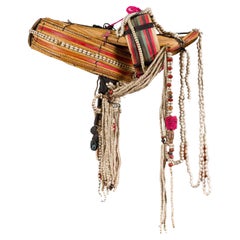
Ulo Tribal Akha Woman
s Headdress with Framework of Bamboo and Beads
Located in Yonkers, NY
A Ulo Akha woman's Tribal headdress adorned with framework of bamboo, beads, pompons, seeds and other unique items. Immerse yourself in the rich cul...
Category
Early 20th Century Thai Folk Art Tribal Art
Materials
Fabric, Bamboo, Beads
Powerful Early Classic Cubist Wood Standing Bobo Fing Figure Africa Ex J. Willis
Located in Point Richmond, CA
Powerful early cubist carved wood standing female figure from the Bobo-Fing of Burkina Faso, Africa. Created early 20th century. Ex private collection Texas, originally acquired from James Willis...
Category
Early 20th Century Liberian Tribal Tribal Art
Materials
Wood
$3,150 Sale Price
30% Off
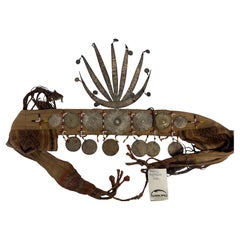
An exquisite warrior
s headdress or
Kaibauk
Located in Amsterdam, NL
Amarasi district, Kupang regency, West Timor island, early 20th century
Category
Early 20th Century Timorese Tribal Art
Materials
Metal
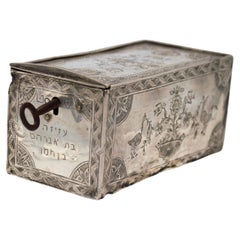
extremely rare Algerian Judaica silver, jewish Dowry box early 19th century
Located in Tel Aviv - Jaffa, IL
Amazing and scarce JUDAICA object, we have here one of the most touching jewish objects we had for a long time, this small silver dowry box was made in Algeria in the early 19th century, it is all covered with symbols of jewish faith and of couples, the sliding lid has 2 flanking birds with hamsa (protective hand) on each side and a flower vase in the middle.
one side shows two flanking lions with a tree in the middle and the other side shows again two big and two small birds with a flower bowl in the middle, front side has a key hole and next to it there is the Hebrew inscription ס״ט״" which says Siman tov or in English "a good sign" it is taken from the wedding blessing, underneath the lock there is another inscription with the name ״עזיזה בת אברהם בן חמו״ which is the name of the bride, her father and her grandfathers name.
the box is full marked a lot of times with the silversmith mark, every side of the box is marked.
this box was probably ordered by the grooms family to hold the jewelry they are giving to the bride as dowry, this type of objects are rare and there are just a few of them on museum collections.
DOWRY (Heb. נְדֻנְיָה), the property a wife brings to her husband at marriage; the Yiddish equivalent, nadn, is from the same root. The custom of nedunyah became clearly defined and institutionalized only in the talmudic period. In biblical times, mohar (מֹהַר), whereby the groom bought his wife from her father (Gen. 24:53; Ex. 22:15–16; Hos. 3:2), was the accepted practice. It was then customary that the groom give the bride gifts, and that she bring certain property to her husband's home upon marriage: slaves, cattle, real estate, etc. (cf. Gen. 24:59–61; 29; Judg. 1:14ff.; I Kings 9:16). Evidence of the custom of nedunyah is to be found in Tobit (7:14; 8:21) and in the Assuan papyri (Cowley, Aramaic, nos. 15, 18). Gradually, mohar was superseded by the ketubbah custom according to which the husband merely assumed the responsibility of compensation to his wife in case he divorced her: he had to pay her 200 zuzim if she had been a virgin at the time of marriage, and 100 zuzim if a widow or divorcée (see *Ketubbah).
By talmudic times, the institution of nedunyah was prevalent; the father gave a dowry to the bride since the daughter was excluded from paternal inheritance. Fifty zuzim (equivalent to the worth of 180 grams of silver) was the minimum amount a father was obliged to give to his daughter (Ket. 6:5). Parents usually gave much more, according to their social standing. Community funds provided the dowry for an orphan or a very poor girl (ibid.; cf. Sh. Ar., YD 251:8). In case of her father's death, the brothers of a minor girl were obliged to give her the minimum dowry, and the court estimated how much her father would have given her above the minimum dowry. The sum was then taken out of the father's estate and given to the daughter upon majority (Ket. 6:6; 68a–69b). In the absence of such an estimate, each daughter was entitled to receive one-tenth of the value of her father's estate in money, or in valuables (Yad, Ishut, 20:4–7; Sh. Ar., EH 113:4). If the father was unable or unwilling to pay the promised dowry at the betrothal ceremony, the groom could refuse to marry his bride (Ket. 13:5; Ket. 108b–109a). Insistence on exact payment of the promised dowry, however, was frowned upon by later rabbinic authorities (Rema to Sh. Ar., EH 2:1). In certain communities it was customary for the groom's father to make a dowry contribution equal to that of the bride's father (Ket. 102b). The dowry, whether given in real estate, slaves, money, or chattel was recorded in the marriage contract (the ketubbah) and in some instances one-third or one-fifth of the actual value of the dowry was added to the sum mentioned in the ketubbah. Based upon a decree enacted by *Simeon b. Shetah (first century C.E.), the Talmud ruled that the husband and his entire property were liable for compensation as stipulated in the ketubbah, either in case he died (when she collected the sum specified in the ketubbah from the heirs) or in case he divorced his wife (Ket. 82b). For the status of the dowry and the husband's rights and obligations, see below. The rabbinic enactments (Takkanot Shum) by R. Jacob *Tam and by the rabbinic synod of the communities of Speyer, Worms, and Mainz (Germany) stipulated that if a woman died...
Category
Mid-19th Century Algerian Antique Tribal Art
Materials
Silver
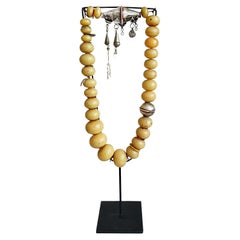
Berber Copal Amber and Silver Necklace, Early 20th Century
Located in New York, NY
A long Berber necklace, hand-crafted with Copal amber large beads and silver accents. Morocco, early 20th Century.
Copal amber is a tree resin similar to amber but not fully fossil...
Category
1920s Moroccan Tribal Vintage Tribal Art
Materials
Silver
$455 Sale Price
30% Off
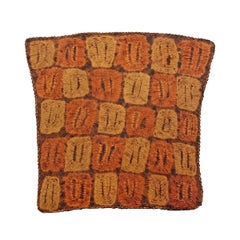
Mounted Dida Tie-Dyed Ceremonial Kerchief
Located in Chicago, IL
An incredible and rare mid-20th century Dida hand-plated Shibori tie-dyed raffia ceremonial kerchief mounted on a linen stretched board that floats off the wall in the shape of the k...
Category
Mid-20th Century Ivorian Tribal Tribal Art
Materials
Raffia
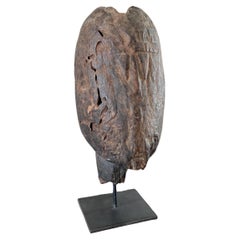
Abstract primitive head Fragment of a Dogon Sculpture."
Located in Vosselaar, BE
A beautifully patined Dogon fragment of a head sculpture. Because of its natural wear perhaps even being more abstract and natural. As African art inspired the European modernist mov...
Category
Early 20th Century Malian Primitive Tribal Art
Materials
Wood
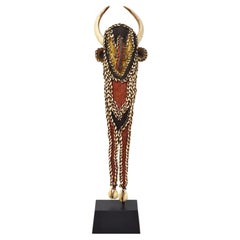
Karaut
Pectoral
Ornament, Abelam Culture, Papua New Guinea
Located in Point Richmond, CA
This piece is an excellent example of an adornment used by Abelam warriors to frighten their enemies. They are held in a warrior’s mouth for courage and to intimidate their adversary...
Category
Early 20th Century Papua New Guinean Other Tribal Art
Materials
Shell, Natural Fiber
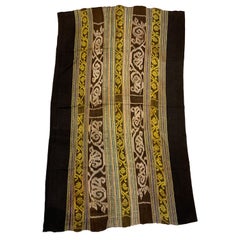
Ikat Textile from Timor Island with Stunning Naturally Coloured Dye, Indonesia
Located in Jimbaran, Bali
This Ikat textile originates from the Island of Timor, Indonesia. It is hand-woven using naturally dyed yarns via a method passed on through generations. A wonderful textile with dis...
Category
1950s Indonesian Other Vintage Tribal Art
Materials
Yarn
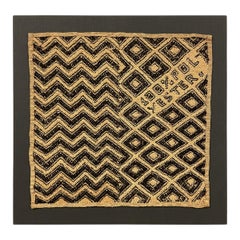
Tongue-in-Cheek Mounted Kuba Cloth Panel
Located in Chicago, IL
A provocative late 20th century Kuba cloth panel with a bold zigzag and diamond pattern woven in black and natural cut pile raffia surrounding a tongu...
Category
Late 20th Century Congolese Tribal Tribal Art
Materials
Raffia
ARKO Wall Art15 Contemporary Art Japanese Craft Rice Straw Art Wall Sculpture
By ARKO
Located in Shibuya-ku, Tokyo
Hand-sewed rice straw art by ARKO.
Title: Composition Rinforzando
This is one of the series named "Composition XX"
Her works have the feelings of...
Category
2010s Japanese Organic Modern Tribal Art
Materials
Canvas, Thread, Straw

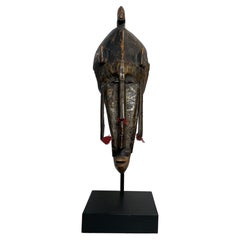
Ceremonial dance MARKA mask, Mali circa 1930’s. Collection Agogue, Paris, France
Located in Encino, CA
Tribal Art - African Art
Ceremonial dance MARKA mask, Mali, Africa, circa 1930’s ,ex Jean Paul Agogue, Paris -France.
H.14" x W.5" x D.4" without the stand
...
Category
1930s Vintage Tribal Art
Materials
Wood
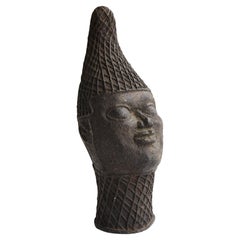
Bronze Head of an Oba, Yoruba People, 1950s
Located in Aramits, Nouvelle-Aquitaine
A Benin bronze of an Oba. Oba means ruler in the Yoruba language.
Wearing a lattice-pattern cap with strands of beads suspended around the head.
The neck is bound with a lattice-patt...
Category
1950s Beninese Tribal Vintage Tribal Art
Materials
Bronze
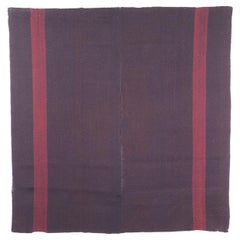
circa 1900 Bolivian Alpaca Wool Poncho
Located in Point Richmond, CA
Circa 1900 Bolivian Alpaca wool poncho
Woven of alpaca wool and dyed with natural dyes, this small poncho from the highlands of Bolivia is patterned with two simple wide stripes i...
Category
Early 20th Century Bolivian Tribal Tribal Art
Materials
Wool
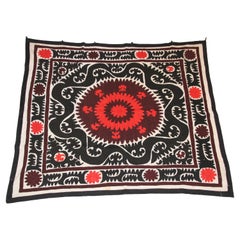
Vintage Samarkand Suzani, Uzbekistan Embroidered Textile Red and Black
Located in Moreno Valley, CA
Vintage Samarkand Suzani, Uzbekistan embroidered textile red and black
Tashkent Suzani from Samarkand Uzbekistan, 1950.
Overall good condition for its age and use some stains.
"Suzani" means needlework and these embroideries are some of the most characteristic forms of textile art from Central Asia. The mastery of color and the dynamic sense of movement they convey continue to add depth and joy to contemporary interiors. A high level of creative variation and the individuation of each flower are what make each piece unique.
Measures: 67.5" x 57".
The Silk Road Bukhara: Like scattered pearls along the vast expanse of the Great Silk Road, the cities of Uzbekistan glisten radiantly under the unforgiving sun. This nation, nestled in a picturesque oasis, holds a treasure trove of historical artifacts, owing to its advantageous position at the heart of the ancient Silk Road network. In the year 138 BC, a transformative era commenced as China graciously opened its borders to trade, giving rise to caravans that embarked upon this illustrious route. These trading pathways served as conduits not only for the exchange of goods and craftsmanship but also for the intermingling of cultures, beliefs, and wisdom. Even today, within the ancient walls of cities like Samarkand, one can still discern the echoes of bustling voices, the melodious jingle of camel harnesses...
Category
Early 20th Century Turkish Folk Art Tribal Art
Materials
Fabric
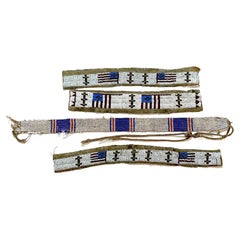
Set of 4 Plains Tribe American Flag Motif Ceremonial Beadwork Strips
Located in West Palm Beach, FL
Set of 4 Plains Tribe American Flag Motif Ceremonial Beadwork Strips
USA, circa 1900s
A rare collection of four Plains Tribe American Flag motif ceremonial beadwork strips dating ba...
Category
20th Century North American Tribal Art
Materials
Leather, Fabric, Beads
$608 Sale Price / set
20% Off
African Nigeria Epa Helmit Mask with Provenance
Located in Atlanta, GA
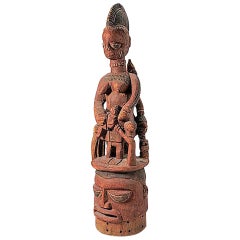
An Epa helmet mask, Nigeria, Africa.
Fully carved mother and child; painted red and black with touches of white;
Provenance: The Children's Museum of Indianapolis; The Eiteljorg Mu...
Category
1950s Nigerian Tribal Vintage Tribal Art
Materials
Wood
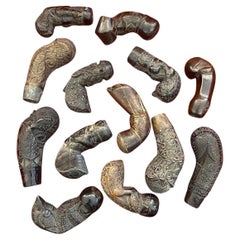
Collection of Kriss Handles, Java, Indonesia, Late 18th / Early 19th Century
Located in NICE, FR
A set of thirteen kriss handles originating from Java, Indonesia, dating from the late 18th to early 19th century.
Beautiful aged patina in dark or amber tones. Exquisite carving wo...
Category
1790s Indonesian Tribal Antique Tribal Art
Materials
Wood
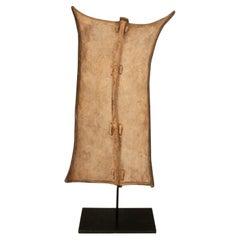
Early 20th Century Leather Shield, Taposa/Turkana, South Sudan
Located in Point Richmond, CA
Leather Shield, South Sudan
A small leather shield typical of the region known as an upwal, concave hide is attached to a reed spine with plaiting to form a strong grip. Mounted on ...
Category
Early 20th Century Sudanese Tribal Tribal Art
Materials
Wood, Leather
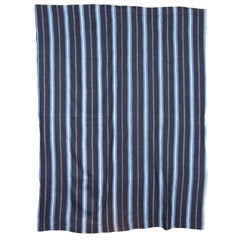
Yoruba (Nigeria) Early 20th Century Cloth
Located in Greenwich, CT
Fine early 20th Century hand spun indigo cotton and Trans-Sahara silk cloth.
Category
Early 20th Century Nigerian Tribal Tribal Art
Materials
Cotton, Silk
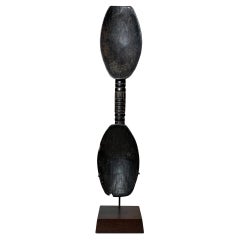
DAN Spoon, Ivory Coast, Early 20th.C. Ex Collection Paolo Morigi of Lugano.
Located in Encino, CA
Tribal Art - African Art
Dan Spoon, Côte d’Ivoire (Ivory Coast)
Wood, early 20th century
H.17" x W.4" x D.2" without the stand
H.20" x 3"1/4 x D.4"1/8 with ...
Category
Early 20th Century Tribal Art
Materials
Wood
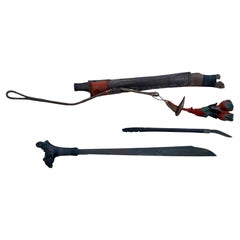
Spectacular Complete Dayak People Mens Mandau Sword
Located in Bridgeport, CT
A rare Museum quality Traditional Men’s Sword known as a Mandau. Used by the Dayak while on the Hunt and in former times in disputes regarding hunting rights and land boundaries. Thi...
Category
Mid-20th Century Indonesian Tribal Tribal Art
Materials
Iron, Tin
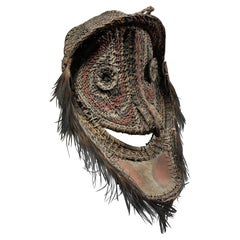
Large Woven Painted Basketry Wall Mask Blackwater Rivers, Papua New Guinea
Located in Point Richmond, CA
Large woven painted basketry wall mask created in Blackwater Rivers area, Papua New Guinea. With open expressive mouth and mask fringed with feathers, striking mask that easily hang...
Category
Mid-20th Century Papua New Guinean Tribal Tribal Art
Materials
Organic Material
$1,715 Sale Price
30% Off
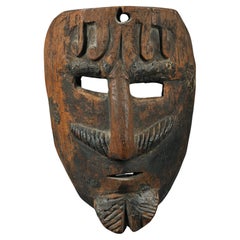
Early Hardwood Mexican Mask, Man With Moustache and Beard early 20th century
Located in Point Richmond, CA
Early hardwood Mexican mask, representing a man with moustache and beard with curly hair on forehead. Strong, sharp carving with high relief detaisl. Heavy staining and wear inside...
Category
Mid-20th Century Mexican Tribal Tribal Art
Materials
Organic Material
$1,160 Sale Price
20% Off
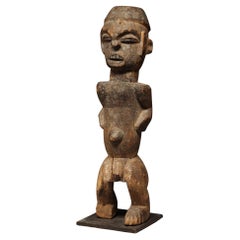
Early Ibibio Standing Wood Male Shrine Figure, powerful, Nigeria, Africa
Located in Point Richmond, CA
Early Ibibio standing carved wood male figure, powerful expression with hands on sides of stomach, exposed teeth and vertical raised scarification marks on sides of face. From a shr...
Category
Mid-20th Century Nigerian Tribal Tribal Art
Materials
Wood
$2,360 Sale Price
20% Off
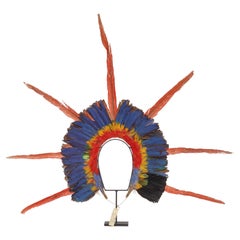
A Kayapo Amazon Indigenous feather headdress
Located in Amsterdam, NL
Brazil, Pará, circa 1950s-1960s
H. 97 x W. 106 cm
Provenance:
Collection Rinck Hollnberger, Munich
(purchased in the 1980s)
Category
20th Century Brazilian Tribal Art
Materials
String, Feathers
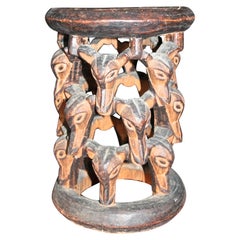
Cameroon "Bat" Stool African Sculpture
Located in Sharon, CT
Possibly Babanki. Circular ceremonial wood stool constructed of repeated animal heads. Original applied patina.
Category
Early 20th Century Cameroonian Tribal Tribal Art
Materials
Wood
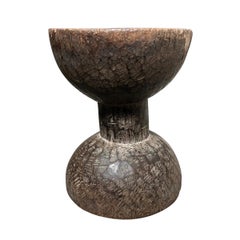
Modernist Dan Peoples Stool
Located in Chicago, IL
A chic modernist early 20th century Dan Peoples stool from Ivory Coast, carved from one piece of wood with a simple hourglass form, and the most wonderful p...
Category
Early 20th Century Ivorian Modern Tribal Art
Materials
Wood
$1,800 / item
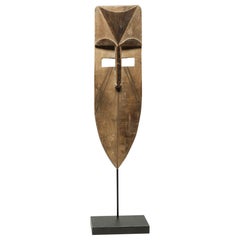
Early Afikpo Stylized Geometric Mask, with Long Face Nigeria, West Africa
Located in Point Richmond, CA
Early finely carved African Afikpo mask with stylized geometric abstract long face.
From Nigeria close to the Cross River.
From an old collection in the Southwest.
Overall dimensi...
Category
Mid-20th Century Nigerian Tribal Tribal Art
Materials
Wood
$3,960 Sale Price
20% Off
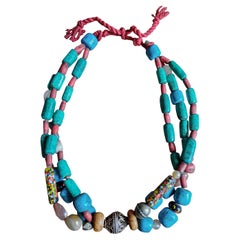
Berber Stone Necklace, Early 20th Century
Located in New York, NY
A long Berber necklace, hand-crafted with stone beads and wool, with a round filigree silver accent. Morocco, early 20th Century.
Green and blue amazonite, red coral, glass and sto...
Category
1920s Moroccan Tribal Vintage Tribal Art
Materials
Stone, Silver
$270 Sale Price
40% Off
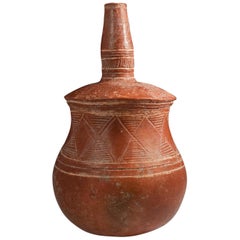
Late 19th-Early 20th Century Tribal Terracotta Bottle, Djenne Area, Mali
Located in Point Richmond, CA
Late 19th-Early 20th century tribal terracotta bottle, Djenne Area, Mali
A handsome terracotta bottle from the Djenne area of Mali with incised geometric patterns on the globular ...
Category
Early 20th Century Malian Tribal Tribal Art
Materials
Terracotta
$600 Sale Price
20% Off
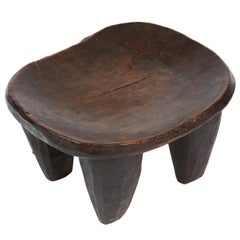
Ancient African Wooden Stool
Located in Soho, London, GB
Ancient wooden stool with four feet dating to the 19th century. From Congo, Africa.
Provenance: Galerie Démons et Merveilles, Paris; Private Collection, United Kingdom.
Category
19th Century Congolese Antique Tribal Art
Materials
Wood
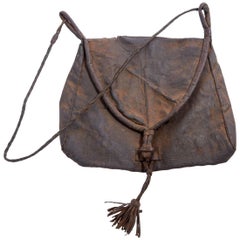
Early 20th Century Afghani Leather Bag
Located in Wainscott, NY
Early 20th century leather Afghani bag.
Category
Early 20th Century Afghan Tribal Art
Materials
Leather
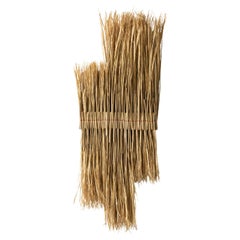
ARKO Wall Art11 Contemporary Art Japanese Craft Rice Straw Art Wall Sculpture
By ARKO
Located in Shibuya-ku, Tokyo
Hand-sewed rice straw art by ARKO.
Title: Composition Rubato
This is one of the series named "Composition XX"
Her works have the feelings of cont...
Category
2010s Japanese Organic Modern Tribal Art
Materials
Canvas, Thread, Straw
Impressive and Seldom Nigerian Large Basket Garment and Cover
Located in Antwerp, BE
An impressive and seldom Nigerian large basket garment and cover, with dyed patterned band.
Those baskets where used to preserve grains.
Tall colorful handwoven lidded basket from ...
Category
Mid-20th Century Nigerian Mid-Century Modern Tribal Art
Materials
Straw
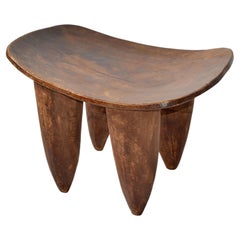
Organic Handmade African Tribal Art Folk Art Hand Carved Wood Stool Ivory Coast
By Senufo
Located in Miami, FL
Vintage Andrianna Shamaris Senufo Style African tribal art very unique wood stool, bench, side table or headrest from a single block of wood with stunning wood grain and patina.
Stur...
Category
1950s Ivorian Tribal Vintage Tribal Art
Materials
Wood, Reclaimed Wood
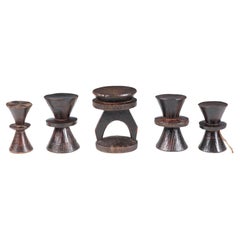
Antique Tribal Ethiopian Ceremonial Coffee Stands
Located in Point Richmond, CA
Grouping of Ceremonial coffee stands
Ethiopia
Early 20th century
Wood
Largest: 8" high x 6" diameter (20 x 15 cm)
Smallest: 6.75" x 3.50" ( 17 x 9 cm)
These little known Branc...
Category
Early 20th Century Ethiopian Tribal Tribal Art
Materials
Wood
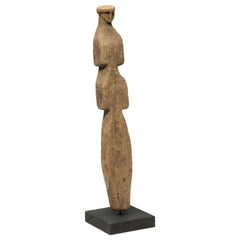
Old Weathered Hardwood Kuna Indian Abstract Figure, Panama, Ina Sua Wood
Located in Point Richmond, CA
Old well weathered hardwood Kuna Indian abstract figure, Panama, Provenance, old CA state collection. Body abstracted down to two forms for shoulders and hips, with small fine head....
Category
Early 20th Century Panamanian Tribal Tribal Art
Materials
Wood
$750 Sale Price / item
70% Off
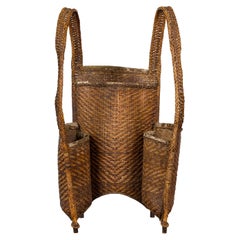
19th Century Tribal Handwoven Rattan Backpack with Inner Pockets
Located in Yonkers, NY
An antique hand-woven rattan backpack with three inner pockets and rustic character. Experience a slice of Thailand's rich cultural history with this u...
Category
19th Century Thai Tribal Antique Tribal Art
Materials
Rattan
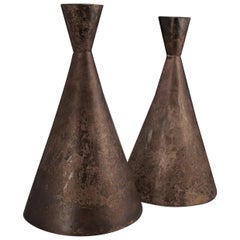
9th Century Silver Processional Priest
s Hats, Chimu Culture, Peru
Located in Point Richmond, CA
9th century silver processional priest's hats, Chimu culture, Peru.
These silver hats were originally covered with fabric, as can be seen in the remaining surface pattern. The hol...
Category
15th Century and Earlier Peruvian Tribal Antique Tribal Art
Materials
Silver
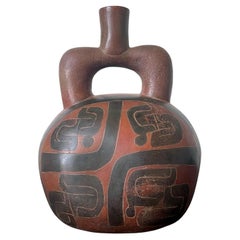
Pre-Columbian Cupisnique Stirrup Vessel from Peru
Located in Atlanta, GA
A pre-Columbian ceramic stirrup vessel in Cupisnique style circa 700-500BCE. This ancient vessel features a robust squatted body and a short thick stirr...
Category
15th Century and Earlier Peruvian Pre-Columbian Antique Tribal Art
Materials
Ceramic
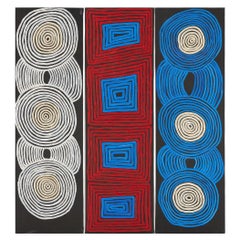
Triptych Australian Aboriginal Paintings Tingari Ronnie Tjampitjinpa
Located in Atlanta, GA
A triptych panel painting by Australian Aboriginal artist Ronnie Tjampitjinpa (1943-2023). Entitled "Tingari Cycle", the artwork was painted in 2002 for Art Mob, Tasmania in oil on c...
Category
Early 2000s Australian Modern Tribal Art
Materials
Canvas
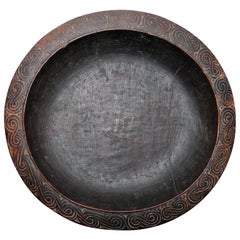
Massim Food Bowl Trobriand Islands Papua New Guinea
Located in Sharon, CT
Ornately decorated rim, with abstract carvings on bottom. Beautiful rich patina.
Category
Early 20th Century Oceanic Tribal Tribal Art
Materials
Wood
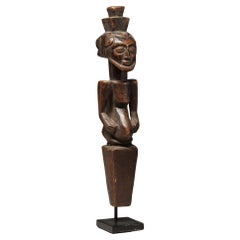
Bembe Bearded Male Figure Bust with Beard Hands on Stomach Staff Top DRC Africa
Located in Point Richmond, CA
Striking Bembe bearded male bust figure with hands on sides of projecting stomach and finely carved beard. Stacking square hair style on top of head and projecting element hair on b...
Category
Mid-20th Century Nigerian Tribal Tribal Art
Materials
Wood
$1,560 Sale Price
20% Off
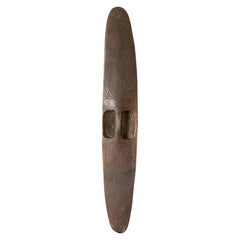
Carved Wood Aboriginal Shield, Western Australia
Located in Atlanta, GA
A tall and narrow parrying shield from the Aboriginal people living in the Western Australia. The piece was carved out of a single block of hard wood t...
Category
Early 20th Century Australian Tribal Tribal Art
Materials
Wood
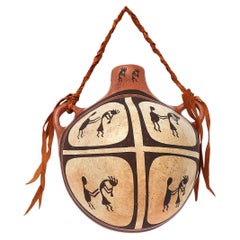
1989 Hopi-Tewa Painted Pottery Canteen by Jean Sahme Nampeyo with Kokopelli
Located in Denver, CO
This exquisite painted pottery canteen, crafted by renowned Hopi-Tewa artist Jean Sahme Nampeyo (b. 1949), is a stunning blend of traditional Hopi pott...
Category
1980s American Native American Vintage Tribal Art
Materials
Ceramic, Clay
Australian Aboriginal Painting Rain Dreaming Ronnie Tjampitjinpa
Located in Atlanta, GA
A contemporary painting by Australian Aboriginal artist Ronnie Tjampitjinpa (1943-2023). Entitled "Rain Dreaming", the artwork was acrylic on canvas and painted in 1999
Fully documented: originally purchased in 1999 from Kimberley Australian Aboriginal Art, Melbourne, cat. no. KA 708/99; The in the collection of The Kelton Foundation, Santa Monica; It was exhibited in: "G'Day LA" Australia Week, in partnership with the Australian Consulate Los Angeles, Pacific Design Center, West Hollywood, CA, 15-25 January 2004. It is housed in a black thin wood frame.
Ronnie Tjampitjinpa was born in Pintupi land at Muyinnga, about 100 kilometres west of the Kintore Range, just across the Western Australian border. He is the son of Uta Uta Tjangala’s older brother, Minpuru Tjangala (c.1899–1976).
Artist's Biography (Courtesy of Art Gallery NSW)
After his initiation into Pintupi law at the site of Yumari, Tjampitjinpa and his younger brother Smithy Zimran Tjampitjinpa walked into the Aboriginal community of Yuendumu. They later joined their parents and other siblings – who had come in to Ikuntji (Haasts Bluff) in 1956 from the Dover Hills/Yumari area – at the new settlement of Papunya. Tjampitjinpa worked as a labourer, assisting with the fencing of the aerodromes at Papunya and Ikuntji. He was one of the youngest of the group of men who began painting at the start of the Western Desert art movement in 1971, and was a founder of Paunya Tula Artists.
During the 1970s, Tjampitjinpa was preoccupied with returning to his traditional lands and became a strong advocate for the outstation movement, travelling between meetings in Papunya, Yuendumu, Wirrimanu (Balgo) and Mount Doreen Station. His goal was finally achieved with the establishment of the Walungurru (Kintore) settlement in 1981. Tjampitjinpa moved there with his young family in 1983, establishing an outstation at Ininti (Redbank) and serving as chairman of the Kintore Outstation Council. During this period, he emerged as one of Papunya Tula Artists’ major painters, pioneering the bold, scaled-up, linear style that came to dominate many of the Walungurru painters’ work during the 1990s. His distinctive aesthetic preoccupa-tion is exemplified in the untitled works of 1994 and 2001. Now one of the last founding members of Papunya Tula Artists, Tjampitjinpa’s career spans more than 40 years. He has had six solo exhibitions since 1989 in Australia, most recently at Utopia Art, Sydney.
Throughout the 1980s Tjampitjinpa worked devotedly on a land claim for Ininti, holding meetings in Darwin, Warmun (Turkey Creek...
Category
1990s Australian Modern Tribal Art
Materials
Canvas, Acrylic
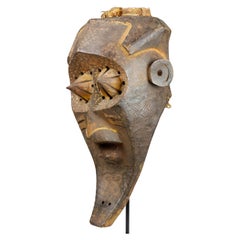
Pre-1940
s Kete Mask With Powerful Expression, D.R.C. (Ex Penn Kent Collection)
Located in London, GB
This striking early twentieth-century mask, from the Kete culture in the Democratic Republic of the Congo, previously belonged to the private collection of Penn Kent, the former Dire...
Category
Early 20th Century Congolese Tribal Tribal Art
Materials
Metal
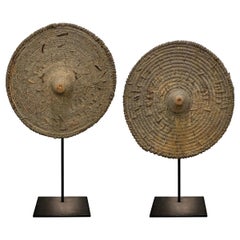
Pair of Tamberma Shields on Stands
Located in Chicago, IL
A pair of wonderfully sculptural early 20th century handwoven wicker shields from the Tamberma people of Togo, mounted on custom steel stands.
Category
Early 20th Century Togolese Tribal Tribal Art
Materials
Wicker
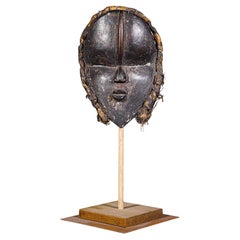
A Dancing Mask by Dan Tribe Africa 1930
s
Located in HYÈRES, FR
A Dancing Mask by Dan Tribe Africa 1930's
Beautiful patina.
This mask was probably worn for ritual dances.
Old traces of paint on the raffia
Report : Base is not included
Category
1930s Ivorian Vintage Tribal Art
Materials
Raffia, Wood
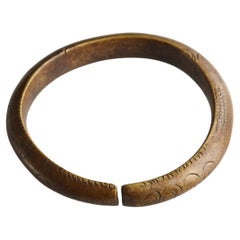
Bronze Currency Bangle/Manilla, Oromo People, Burkina Faso, Ethiopia, 19th C.
Located in Aramits, Nouvelle-Aquitaine
19th-century bronze currency bangle / Manilla with a fixed opening. Minimalist, simple design work with engraved geometrical circles and lines.
This type of bracelet was used and wor...
Category
Mid-19th Century Ethiopian Tribal Antique Tribal Art
Materials
Bronze
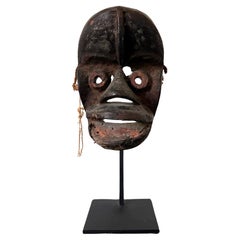
Guere Mask from Cote d
Ivoire Africa with Sotheby
s Sticker
Located in Atlanta, GA
A Guere wood mask with paint and fiber remnant from We people displayed on a metal stand. The We people (also known as the Krahn or Guere) are an indigenous African people that inhabit areas in nowadays eastern Liberia and western Côte d'Ivoire. Their material culture shares many aspects with the neighboring Dan tribe. Like the Dans, the We use a wide variety of masquerades, which hold important regulatory position within their small, egalitarian communities. Masks are owned by families and used by individual lineage members in contexts of social control, ritual ceremony and entertainment. This type of Guere mask, however, has a distinct fearsome character. The ferocious design with jagged facial expression, bulging tubular eyes are intended for use in mediations between community members, as visual aids during moral lessons, as well as forms of entertainment. By portraying the more frightening nature of the animal, the mask is viewed as powerful and may have been used as part of social control methods prior to the introduction of Western law systems during the colonial period.
The mask on offer, based on our examination, appears to be an original one that was used natively instead of reproduction made for the tourist market. The surface presents apparently genuine patina consistent with use. The red paint that highlights the eyes and gapping mouth also appear original. There are small losses flanking the nose ridge by the eyes, extensive surface accretion, remain of some fiber tassels. The back of the mask reveals chisel marks from hand tools and importantly, stain marks that were likely from repetitive contacts from the nose of the wearer.
The mask is 9" in height, and it retains an old Sotheby’s catalog...
Category
20th Century Ivorian Tribal Tribal Art
Materials
Wood
Rare Sino-Tibetan Silver Ritual Lamp Stands Tibet Himalayan - Candle holders
Located in London, GB
Pair of Sino-Tibetan Silver Ritual Lamp Stands
Tibet / Himalayan Region, Late 19th–Early 20th Century
Pair of Sino-Tibetan Silver Lamp Stands, Late 19th–Early 20th Century
A finely ...
Category
Early 20th Century Tibetan Tribal Art
Materials
Silver
