Japanese Floor Lamps
to
9
41
22
50
17
10
Height
to
Width
to
72
24
9
8
8
7
7
7
6
6
5
5
38
4
4
1
1
7
42
27
2
22
15
1
9
3
3
6
4
55
49
37
22
10
14,199
12,854
5,247
2,135
2,114
77
72
73
43
15
13
5
2
Place of Origin: Japanese
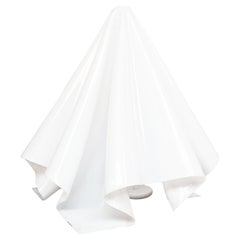
Japan Mid-Century Floor Lamp Ghost
Fantasma
by Kuramata for Yamagiwa, 1972
By Shiro Kuramata, Yamagiwa
Located in MIlano, IT
Japan mid-century Floor lamp ghost (Fantasma) by Kuramata for Yamagiwa, 1972.
Floor lamp ghost (Fantasma) in plexiglass. The white acrylic glass shade has the shape of a floating clo...
Category
1970s Mid-Century Modern Vintage Japanese Floor Lamps
Materials
Metal
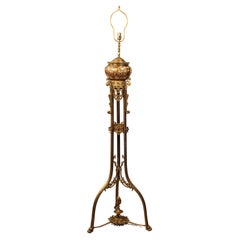
Late 19th Century Gilt Bronze and Japanese Satsuma Porcelain Floor Lamp
By Satsuma
Located in Long Island City, NY
Late 19th Century Gilt Bronze and Japanese Satsuma Porcelain Floor Lamp
The round lamp with painted scenes of men, women and children in landscape scenes and at leisure...
Category
Late 19th Century Belle Époque Antique Japanese Floor Lamps
Materials
Bronze, Ormolu
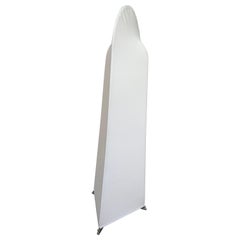
Kazuhide Takahama, Floor Lamp, 1975
By Kazuhide Takahama
Located in Saint Ouen, FR
Floor lamp from Kazuhide Takahama for Sirrat Edition
Stainless steel and nylon
Piece of collection
circa 1975.
Category
20th Century Japanese Floor Lamps
Materials
Stainless Steel
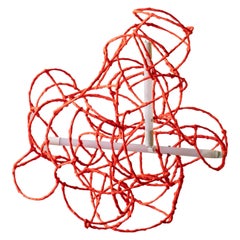
Bulge Lines table lamp red Norihiko Terayama Sculptural lamp
By Norihiko Terayama
Located in Shibuya-ku, Tokyo
Bulge Lines: fluorescent lamp red
This sculptural lighting is made of mainly a lot of wires bonded each.
Three light bulbs are attached. It is a lighting work of an artist with a ...
Category
2010s Modern Japanese Floor Lamps
Materials
Wire
Ryosuke Harashima Contemporary Zen floor lamp Japanese paper
By Ryosuke Harashima
Located in Shibuya-ku, Tokyo
Name: Leading to Solaris
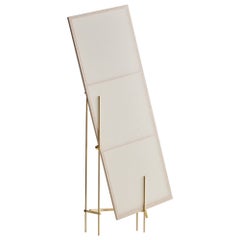
Floor lamp created with Japanese Shoji door. Shoji door is Japanese traditional door made of wood frame and Japanese paper. This floor lamp is contemporary ...
Category
2010s Japonisme Japanese Floor Lamps
Materials
Brass
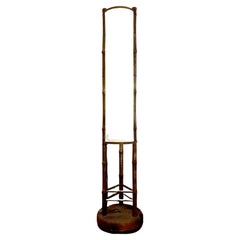
Japanese or Chinoiserie Paper Vintage Hand Crafted Bamboo Floor Lamp
Located in Lomita, CA
This lamp was with several other unique one-offs from a collector offered at auction. It creates a nice silhouette and the round wood base makes it very solid. It only uses a little ...
Category
Mid-20th Century Japonisme Japanese Floor Lamps
Materials
Bamboo, Elm, Paper

$1,080 Sale Price
29% Off
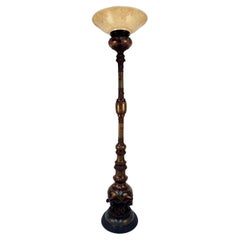
Japanese Champlevé Bronze Elephant Floor Oil Lamp
Located in Montreal, QC
A Japanese floor oil lamp, crafted in bronze with a dark lush patina and decorated with enamel in a champlevé technique in floral designs with peasants....
Category
Late 19th Century Meiji Antique Japanese Floor Lamps
Materials
Bronze, Enamel
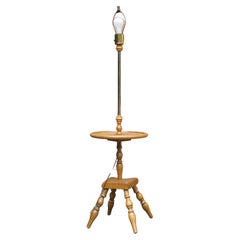
Authentic Furniture Products Maple Floor Lamp Table
Located in Germantown, MD
Japanese Authentic Furniture Products' Quadpod Maple Floor Lamp Table. Table is 23" high.
Category
Mid-20th Century Mid-Century Modern Japanese Floor Lamps
Materials
Maple
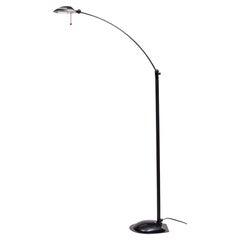
rabbit Tanaka corp Mempis Style Halogen floor lamp 1980s Japan
By Tanaka Kosai
Located in Den Haag, NL
Vintage Rabbit Tanaka Corp Halogen Floor Lamp Japan Memphis design home Japan space age design mid century atomic design Table lamp Rabbit Tanaka desk...
Category
1980s Post-Modern Vintage Japanese Floor Lamps
Materials
Plastic
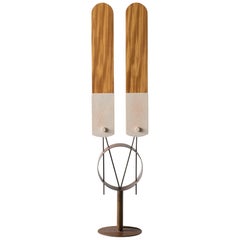
Twin Lights Takuya Hamajima Contemporary Zen Japanese Ceramic
Located in Shibuya-ku, Tokyo
Contemporary Japanese style floor light. Rather sculpture than lighting. Made of rusted steel, ceramic, and wood. Base is metal. Ivory part is ceramic in Japanese traditional style. Top twin panels...
Category
21st Century and Contemporary Japonisme Japanese Floor Lamps
Materials
Ceramic, Wood
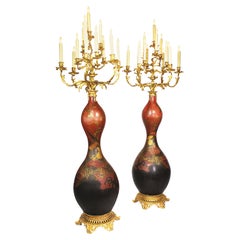
Pair 19th Century Japanese Imari Porcelain
Gilt-Bronze Torchere Candelabra
By Imari Porcelain
Located in Los Angeles, CA
A fine Pair of 19th century Japanese Imari Porcelain and French Gilt-Bronze Mounted Thirteen-Light Celadon Torchere Candelabra. The bottle-shaped Japonisme vases with a Royal red background, decorated with parcel-gilt and black soaring eagles in the hunt within a forestall scene. Each Vase fitted and surmounted with a French 19th century Louis XV Style 13-Light scrolled candelabrum and all raised on a circular pierced gilt-bronze plinth. circa: 1880.
Imari Porcelain (????) is the name for Japanese porcelain wares made in the town of Arita, in the former Hizen Province, northwestern Kyushu. They were exported to Europe extensively from the port of Imari, Saga, between the second half of the 17th century and the first half of the 18th century. The Japanese as well as Europeans called them Imari. In Japanese, these porcelains are also known as Arita-yaki (???). Imari or Arita porcelain has been continously produced up through the present day.
Characteristics
Though there are many types of Imari, Westerners' conception of Imari in the popular sense is associated only with a type of Imari produced and exported in large quantity in mid-17th century. This type is called Kinrande. Kinrande Imari is colored porcelain with cobalt blue underglaze and red and gold overglaze. The color combination was not seen in China at that time. Traditional Ming dynasty color porcelain used dominantly red and green, probably due to scarcity of gold in China, whereas gold was abundant in Japan in those days. The subject matter of Imari is diverse, ranging from foliage and flowers to people, scenery and abstractions. Some Imari design structures such as kraak style were adopted from China, but most designs were uniquely Japanese owing to the rich Japanese tradition of paintings and costume design. The porcelain has a gritty texture on the bases, where it is not covered by glaze. There is also blue and white Imari. Kakiemon style Imari is another type of Imari, but it tends to be categorized separately in Europe.
History
"Imari" was simply the trans-shipment port for Arita wares. It was the kilns at Arita which formed the heart of the Japanese porcelain industry.
Arita's kilns were set up in the 17th century, when kaolin was discovered in 1616 by the immigrant Korean potter, Yi Sam-pyeong (1579–1655). (He may also be known by the name, "Kanage Sambei".) Yi Sam-Pyeong, along with his extended family of 180 persons, left Korea on the offer of a privileged position in Japan. This decision was made after the occurrence of certain Japanese invasions of Korea. After Yi Sam-Pyeong's discovery, his kilns began to produce revised Korean-style blue and white porcelains, known as "Shoki-Imari".
In the mid-17th century there were also a lot of Chinese refugees in Northern Kyushu due to the turmoil on Chinese continent, and it is said one of them brought coloring technique to Arita. Thus Shoki-Imari developed into Ko-KutaniImari. Ko-Kutani was produced around 1650 for both export and domestic market. Blue and white porcelain continued to be produced and they are called Ai-Kutani. Ko-Kutani Imari for the export market usually adopted Chinese design structure such as kraak style, whereas Ai-Kutani for the domestic market were highly unique in design and are accordingly valued very much among collectors.
Ko-Kutani style evolved into Kakiemon style Imari, which was produced for about 50 years around 1700. Imari achieved its technical and aesthetic peak in Kakiemon style, and it dominated European market. Blue and white Kakiemon is called Ai-Kakiemon. Kakiemon style transformed into Kinrande in the 18th century. Kinrande used blue underglaze and red and gold overglaze, and later some other colors.
Imari began to be exported to Europe because the Chinese kilns at Ching-te-Chen were damaged in the political chaos and the new Qing dynasty government stopped trade in 1656–1684. Exports to Europe were made through the Dutch East India Company, but the designation "Imari Porcelain" in Europe connotes Arita wares of mostly Kinrande Imari.
Export of Imari to Europe stopped in mid-18th century when China began export to Europe again, since Imari was not able to compete against China due to high labor cost. By that time, however, both Imari and Kakiemon style were already so popular among Europeans, Chinese export porcelain copied both Imari and Kakiemon style, which is called Chinese Imari. At the same time, European kilns, such as Meisen also tried to copy Imari and Kakiemon.
Export of Imari surged again in late 19th century (Meiji era) when Japonism flourished in Europe. Thus in western world today, two kinds of Imari can...
Category
19th Century Japonisme Antique Japanese Floor Lamps
Materials
Bronze, Ormolu
$18,950 Sale Price / set
61% Off
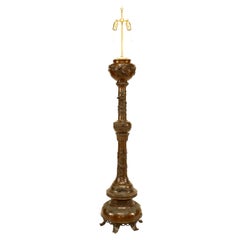
Japanese Bronze Column Floor Lamp with Foliate and Bird Reliefs
Located in Queens, NY
Asian Japanese style (19th/20th Century) bronze column form floor lamp with foliate and bird relief detail culminating in urn top.
Category
19th Century Anglo-Japanese Antique Japanese Floor Lamps
Materials
Bronze
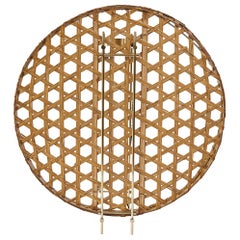
Bamboo Lattice Light Ryosuke Harashima Contemporary Zen Japanese Craft Mingei
By Ryosuke Harashima
Located in Shibuya-ku, Tokyo
Lamp designed by Ryosuke Harashima.
This work is made of antique Japanese bamboo basket and brass.
Artist creates new style lamp by comb...
Category
2010s Edo Japanese Floor Lamps
Materials
Brass
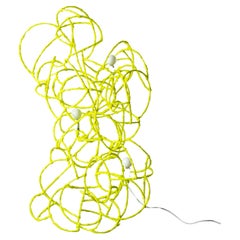
Bulge Lines floor lamp yellow Norihiko Terayama Sculptural lamp
By Norihiko Terayama
Located in Shibuya-ku, Tokyo
Bulge Lines: floor lamp yellow
This sculptural lighting is made of mainly a lot of wires bonded each.
Three light bulbs are attached. It is a ligh...
Category
2010s Modern Japanese Floor Lamps
Materials
Wire
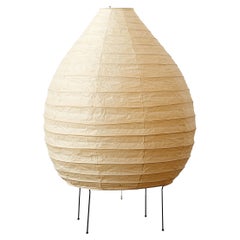
Early Isamu Noguchi Akari Light Sculpture, Model 23N
By Isamu Noguchi
Located in Brooklyn, NY
Isamu Noguchi Akari light sculpture. Model 23N.
Noguchi’s Akari series started in 1951, model 23N was designed in 1968. This is an early model, marked with iconic red sun and moon i...
Category
Mid-20th Century Mid-Century Modern Japanese Floor Lamps
Materials
Bamboo, Paper
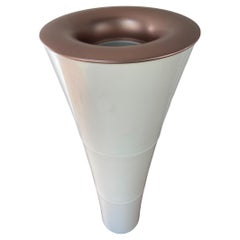
Torch Floor Lamp, Kaoyi Flacha, Circa 1980
Located in Saint ouen, FR
Torch floor lamp - Kaoyi Flacha - Circa 1980
Made in Japan
In white and rose gold PVC in perfect condition.
Electricity in perfect working order.
...
Category
1980s Vintage Japanese Floor Lamps
Materials
PVC
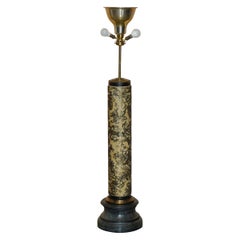
LARGE ANTIQUE JAPANESE FLOOR STANDING PRINTING SCROLL LAMP SOLID MARBLE BASe
Located in West Sussex, Pulborough
We are delighted to offer for sale this super rare and highly decorative, Japanese floor standing lamp which is an antique printing scroll fixed to a solid two piece marble base
This is a very impressive lamp, I personally purchased this from Nice France of my antiques tour...
Category
Early 1900s Japonisme Antique Japanese Floor Lamps
Materials
Marble
Read More
More Ways To Browse
Pink Giraffe Lamp
Plastic Tiffany Lamp
Pola Amstelveen
Pola Design Amstelveen
Poulsen Water Pump
Rawhide Lamp Shade
Relco Light
Rembrandt Floor Lamp Brass
Rice Paper Floor Lamp
Rice Paper Lamp Shade
Robot Martinelli
Roger Nathan
Roland Smith
Rolf Tiemroth
Roman Column Floor Lamp
Rooms To Go Tiffany Lamps
Rose Tarlow Lamp
Rosmarie And Rico Baltensweiler