Japonisme Lighting

JAPONISME STYLE

In the late 19th and early 20th century, France developed an enduring passion for Japanese aesthetics and craftsmanship. Not only did this interpretation of Japanese culture — which became known as Japonisme — infuse fresh energy into French art and design, but it also radically transformed how Europeans, and subsequently the world, would come to understand visual culture. 

Until 1853, Japan had been closely guarded against foreign visitors for over two centuries. However, American Commodore Matthew C. Perry sailed into Japan that year and initiated the first of its treaties with the United States and Europe, thereby opening its borders and giving the West its first-ever look at Japanese design. 

For the next few decades, taken with Japonisme, sophisticated collectors in Paris, New York and elsewhere gorged themselves on lacquered screens, celadon ceramics and netsuke ornaments, along with artworks depicting various aspects of Japanese life. The East Asian country’s influence on Europe, particularly France, contributed to one of the most creatively prosperous periods in history, leaving an imprint on the Impressionist, Art Nouveau and Art Deco movements, and inspiring artists like Edgar Degas, Mary Cassatt, Vincent van Gogh as well as luxury houses such as Louis Vuitton and Hermès. Japonisme emerged at the time when the ornate Renaissance Revival style was the most prominent mode of decorating in Europe, and Japanese aesthetics seemed strikingly modern and elegant in comparison. 

In addition to everyday practical objects from Japan, such as vases, tableware and decorative boxes, Japanese art, especially Japanese woodblock prints by masters of the ukiyo-e school, caught the eye of many artists — particularly those in the Art Nouveau poster community in 1880s Paris. The luscious organic colors associated with traditional Japanese design, motifs like cherry blossoms and carp and the vivid patterns found in woodblock prints, silks and more were adopted and appropriated by painters as well as ceramicists and those working in other fields of the decorative arts. Today, demand for Japanese lacquerware — furniture, trays, writing boxes, screens, incense burners — from the Edo period (1615–1868) and the late 19th century continues to be very strong among collectors.

Find a collection of antique Japonisme furniture and decorative objects on 1stDibs.

to
20
53
28
79
6
Height
to
Width
to
60
33
4
2
2
2
2
2
2
2
2
2
58,733
18,738
9,090
8,354
3,970
2,519
2,130
1,672
1,608
960
848
831
708
566
551
405
189
127
1
32
46
6
11
14
17
3
1
1
1
2
1
11
4
53
42
23
21
16
44
27
26
26
20
85
82
84
10
6
2
2
2
Style: Japonisme
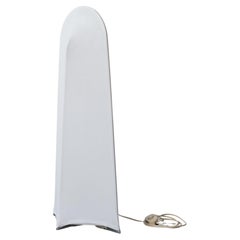
Kazuki floor lamp by Kazuhide Takahama by Sirrah, 1975
Located in Athens, Attiki
The Kazuki floor lamp, produced in 1975 by the Italian lighting manufacturer Sirrah to a design by the Japanese architect and designer Kazuhide Takahama, present a fresh interpretati...
Category

1970s Italian Vintage Japonisme Lighting

Materials

Metal

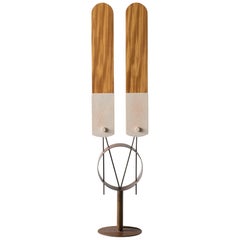
Twin Lights Takuya Hamajima Contemporary Zen Japanese Ceramic
Located in Shibuya-ku, Tokyo
Contemporary Japanese style floor light. Rather sculpture than lighting. Made of rusted steel, ceramic, and wood. Base is metal. Ivory part is ceramic in Japanese traditional style. Top twin panels...
Category

21st Century and Contemporary Japanese Japonisme Lighting

Materials

Ceramic, Wood

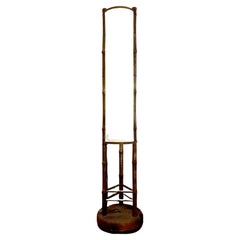
Japanese or Chinoiserie Paper Vintage Hand Crafted Bamboo Floor Lamp
Located in Lomita, CA
This lamp was with several other unique one-offs from a collector offered at auction. It creates a nice silhouette and the round wood base makes it very solid. It only uses a little ...
Category

Mid-20th Century Japanese Japonisme Lighting

Materials

Bamboo, Elm, Paper

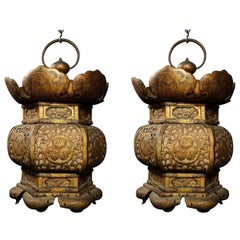
Pair of Large Antique Japanese Gilt Copper Lanterns
Located in New York, NY
A exquisite pair of large and unique antique Japanese octagonal form reticulated gilt copper lanterns. These large antique Japanese gilt copper lanter...
Category

20th Century Japonisme Lighting

Materials

Copper

Japanese Mixed Metal Vase Mounted as a Lamp Meiji Period
Located in Ottawa, Ontario
Japanese mixed metal vase Mounted as a lamp Meiji period The bulbous-form body with long conical neck decorated in high-relief copper w...
Category

Late 19th Century Japanese Antique Japonisme Lighting

Materials

Brass, Copper

Pair of Antique Japanese Arita Imari Porcelain Vase Lamps
Located in London, GB
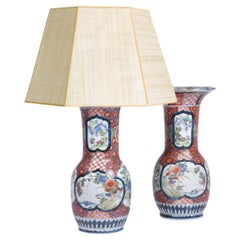
A pair of antique Japanese Arita Imari porcelain vases, available as lamps. Meiji period (1868-1913) Japanese porcelain vases decorate...
Category

Late 19th Century Japanese Antique Japonisme Lighting

Materials

Porcelain

Pair of Vintage Japonesque Faux Lacquer Painted Glass
Located in Lomita, CA
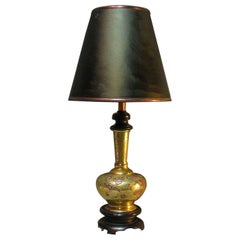
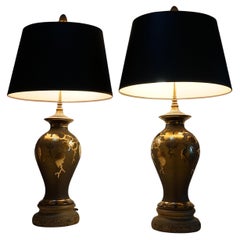
A pair of vintage Japonesque faux lacquer painted glass table lamps mid to third-quarter of the 20th Century and stunning. Of circular section and baluster form, with flared tops, st...
Category

Mid-20th Century American Japonisme Lighting

Materials

Gold Leaf

17th Century Orange Blue White Japanese Arita Ware Charger Plate
Located in Lomita, CA
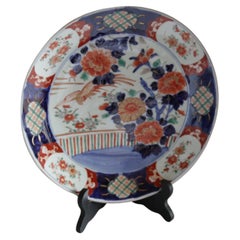
This Japanese Export porcelain charger is singular and speaks for itself in a beautiful palette of soft orange, blue and white. It is remimiscent of Imari, but the appraisers say it is from a 17th or 18th century kiln in Arita Japan. The colors are vibrant and clear, and there are no chips or other damage to this beautiful piece. Arita ware...
Category

Late 17th Century Japanese Antique Japonisme Lighting

Materials

Porcelain

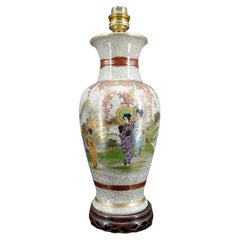
Satsuma porcelain lamp, Geishas and Cherry trees, Japan, Circa 1950
Located in VÉZELAY, FR
Satsuma porcelain lamp decorated with Geishas and Cherry trees. Japan, Circa 1950 Very good condition, new electricity. Beautiful cracked email Dimensions: Height:32cm Diameter:12cm
Category

1950s Japanese Vintage Japonisme Lighting

Materials

Metal

Pair 19th Century Japanese Imari Porcelain Gilt-Bronze Torchere Candelabra
Located in Los Angeles, CA
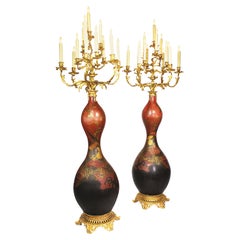
A fine Pair of 19th century Japanese Imari Porcelain and French Gilt-Bronze Mounted Thirteen-Light Celadon Torchere Candelabra. The bottle-shaped Japonisme vases with a Royal red background, decorated with parcel-gilt and black soaring eagles in the hunt within a forestall scene. Each Vase fitted and surmounted with a French 19th century Louis XV Style 13-Light scrolled candelabrum and all raised on a circular pierced gilt-bronze plinth. circa: 1880. Imari Porcelain (????) is the name for Japanese porcelain wares made in the town of Arita, in the former Hizen Province, northwestern Kyushu. They were exported to Europe extensively from the port of Imari, Saga, between the second half of the 17th century and the first half of the 18th century. The Japanese as well as Europeans called them Imari. In Japanese, these porcelains are also known as Arita-yaki (???). Imari or Arita porcelain has been continously produced up through the present day. Characteristics Though there are many types of Imari, Westerners' conception of Imari in the popular sense is associated only with a type of Imari produced and exported in large quantity in mid-17th century. This type is called Kinrande. Kinrande Imari is colored porcelain with cobalt blue underglaze and red and gold overglaze. The color combination was not seen in China at that time. Traditional Ming dynasty color porcelain used dominantly red and green, probably due to scarcity of gold in China, whereas gold was abundant in Japan in those days. The subject matter of Imari is diverse, ranging from foliage and flowers to people, scenery and abstractions. Some Imari design structures such as kraak style were adopted from China, but most designs were uniquely Japanese owing to the rich Japanese tradition of paintings and costume design. The porcelain has a gritty texture on the bases, where it is not covered by glaze. There is also blue and white Imari. Kakiemon style Imari is another type of Imari, but it tends to be categorized separately in Europe. History "Imari" was simply the trans-shipment port for Arita wares. It was the kilns at Arita which formed the heart of the Japanese porcelain industry. Arita's kilns were set up in the 17th century, when kaolin was discovered in 1616 by the immigrant Korean potter, Yi Sam-pyeong (1579–1655). (He may also be known by the name, "Kanage Sambei".) Yi Sam-Pyeong, along with his extended family of 180 persons, left Korea on the offer of a privileged position in Japan. This decision was made after the occurrence of certain Japanese invasions of Korea. After Yi Sam-Pyeong's discovery, his kilns began to produce revised Korean-style blue and white porcelains, known as "Shoki-Imari". In the mid-17th century there were also a lot of Chinese refugees in Northern Kyushu due to the turmoil on Chinese continent, and it is said one of them brought coloring technique to Arita. Thus Shoki-Imari developed into Ko-KutaniImari. Ko-Kutani was produced around 1650 for both export and domestic market. Blue and white porcelain continued to be produced and they are called Ai-Kutani. Ko-Kutani Imari for the export market usually adopted Chinese design structure such as kraak style, whereas Ai-Kutani for the domestic market were highly unique in design and are accordingly valued very much among collectors. Ko-Kutani style evolved into Kakiemon style Imari, which was produced for about 50 years around 1700. Imari achieved its technical and aesthetic peak in Kakiemon style, and it dominated European market. Blue and white Kakiemon is called Ai-Kakiemon. Kakiemon style transformed into Kinrande in the 18th century. Kinrande used blue underglaze and red and gold overglaze, and later some other colors. Imari began to be exported to Europe because the Chinese kilns at Ching-te-Chen were damaged in the political chaos and the new Qing dynasty government stopped trade in 1656–1684. Exports to Europe were made through the Dutch East India Company, but the designation "Imari Porcelain" in Europe connotes Arita wares of mostly Kinrande Imari. Export of Imari to Europe stopped in mid-18th century when China began export to Europe again, since Imari was not able to compete against China due to high labor cost. By that time, however, both Imari and Kakiemon style were already so popular among Europeans, Chinese export porcelain copied both Imari and Kakiemon style, which is called Chinese Imari. At the same time, European kilns, such as Meisen also tried to copy Imari and Kakiemon. Export of Imari surged again in late 19th century (Meiji era) when Japonism flourished in Europe. Thus in western world today, two kinds of Imari can...
Category

19th Century Japanese Antique Japonisme Lighting

Materials

Bronze, Ormolu

Japonisme Lamp Att. to E. Lièvre , Japan-France, Circa 1880
Located in PARIS, FR
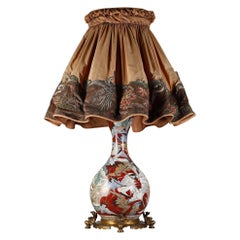
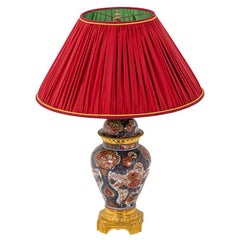
Height with lampshade : 133 cm (52,3 in.) / without lampshade : 125 cm (49,2 in.) ; Lampshade - Height 74 cm (29,1 in.) ; Diameter : 86 cm (33,8 in.) Important Japanese style gourd-shaped lamp, made with a polychrome Kutani porcelain vase decorated with lake scene and flowers in cartouches, in the middle of flying waders on a red background. It is covered with its original beige pleated silk lampshade, embroided with flowers and waders. It rests on an « old gold » patinated bronze base with stylized openwork decoration, topped with a Fô dog on each foot. Related work : Japanese enamel porcelain...
Category

1880s French Antique Japonisme Lighting

Materials

Bronze

19th-Century Japanese Satsuma Vases Mounted as Lamps, Gilt Bronze Mounts, Pair
Located in Miami, FL
19th-Century Japanese Satsuma Vases Mounted as Lamps, Gilt Bronze Mounts, Pair Offered for sale is a rare and fine pair of 19th century Japanese Satsuma vases mounted as lamps. The...
Category

19th Century Japanese Antique Japonisme Lighting

Materials

Bronze

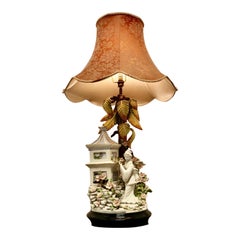
Large Figural Ceramic Table Lamp by D. Polo Uiato, Capodimonte Style
Located in Godshill, Isle of Wight
Large figural ceramic table lamp by D. Polo Uiato, Capodimonte style This is a large and rare piece lamp, the lamp is a colourful outdoor scene wi...
Category

Mid-20th Century Japonisme Lighting

Materials

Ceramic

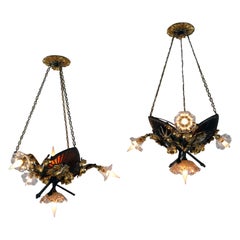
Pair of "Japonisme" Chandeliers by E. Soleau, France, Circa 1900
Located in PARIS, FR
Signed SOLEAU and E. SOLEAU PARIS Beautiful pair of Japanese chandeliers in patinated bronze, gilded and silvered with five lights. They are composed of three stylized fans, lined w...
Category

Early 1900s French Antique Japonisme Lighting

Materials

Bronze

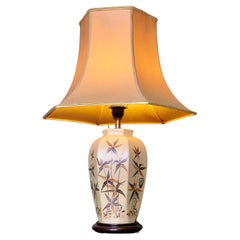
Signed Hand Painted Vase Lamp, in the Japanese Style A Lovely piece
Located in Godshill, Isle of Wight
Signed Hand Painted Vase Lamp, in the Japanese Style A Lovely piece a 6 sided ginger jar vase, hand painted with the artist’s monogram The lamp is in good condition, working and ...
Category

1980s Vintage Japonisme Lighting

Materials

Ceramic

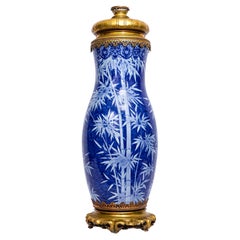
A Large French Ormolu Mounted Japanese Blue White Porcelain Vase/Lamp
Located in New York, NY
An Incredible and Quite Large 19th Century French Ormolu Mounted Japanese Blue and White Porcelain Vase Turned to Lamp, The moun...
Category

19th Century French Antique Japonisme Lighting

Materials

Bronze

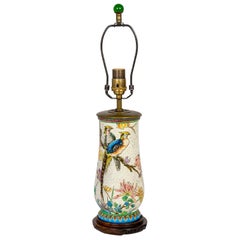
Crackle Glaze Ceramic Lamp w/ Painted Peacock Flower Scene
Located in San Francisco, CA
A French Japonisme piece from the early 20th century - this white, crackle glazed ceramic table lamp is incised and intricately hand painted with a colorful scene of peacocks, butter...
Category

Early 20th Century French Japonisme Lighting

Materials

Brass

Lamp in Imari Porcelain and Gilt Bronze, circa 1880
Located in Saint-Ouen, FR
Baluster shaped lamp with Imari decor in porcelain and gilt bronze. Body adorned with red flower motifs on a white and blue background. Chiseled and gilt bronze mount. Quadripod hexagonal base. Work realized circa 1880. New and functional electric system. !The price doesn’t include the lampshade price. However, our workshop can advise you with pleasure and realize it with your size and color choices! Imari is a place of production of Japanese ceramics, otherwise known as “Arita porcelain”. It is the port of an island. Imari porcelain was first exhibited by the Dutch, with their Compagnie Orientale des Provinces-Unies (the V.O.C). These are Europeanized decorations but remaining very inspired by the great traditions of Asian spirituality. The Imari style is characterized by three dominant colors: cobalt blue, red tending to saffron and the white background of porcelain. Imari porcelain had a notable influence on the East India Company (Chinese Imari is referred to as East India Company porcelain...
Category

19th Century Antique Japonisme Lighting

Materials

Bronze

A Highly Unusual Pair of English Japanism Motif Porcelain Vases Turned to Lamps
Located in New York, NY
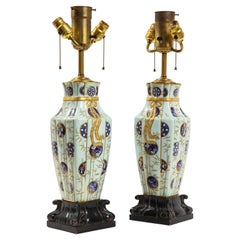
A Highly Unusual Pair of 19th Century English Japanism Motif Porcelain Vases Turned to Lamps. Each with a waisted neck and wide-angled body, these lamps are very unusual in form. T...
Category

1880s English Antique Japonisme Lighting

Materials

Porcelain, Wood

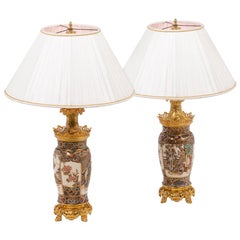
Satsuma earthenware vase with geishas, circa 1880
Located in Saint-Ouen, FR
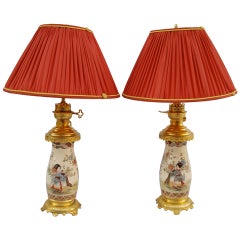
Pair of slightly bulged Satsuma earthenware lamps with a gilt bronze mount. Beige background decoration with geishas surrounded with dahlias in outside scenes and flanked by a palm l...
Category

19th Century Japanese Antique Japonisme Lighting

Materials

Faience

Pair of Lamps in Satsuma Earthenware, circa 1880
Located in Saint-Ouen, FR
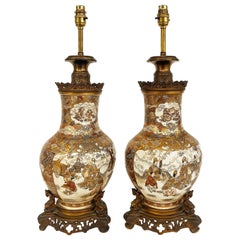
Pair of egg-shaped lamps in a fine Satsuma earthenware. Body presenting Japanese dignitaries speaking together inside cartouches on a white background as well as red, golden, brown and green decorative and geometric motifs. Mount in gilt bronze adorned with openwork and chiselled Japanese style motifs. Work realized circa 1880. New and functional electric system. !The price doesn’t include the lampshade price. However, our workshop can advise you with pleasure and realize it with your size and color choices! Satsuma earthenware appeared at the 16th century in Japan on Satsuma lands. This kind of ceramics is characterized by a wide range of shapes evolving through time and ovens used...
Category

19th Century Antique Japonisme Lighting

Materials

Earthenware

Pair of Satsuma Lamps
Located in Los Angeles, CA
A pair of Japanese Satsuma glazed earthenware vases with French dore bronze mounts originally as gas lamps, now electrified.
Category

19th Century Japanese Antique Japonisme Lighting

Materials

Bronze

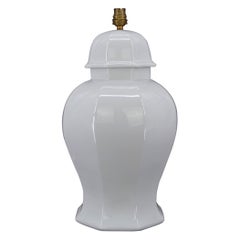
White Porcelain Lamp by Pillivuyt, Japonisme, France, circa 1970
Located in VÉZELAY, FR
Beautiful white porcelain living room lamp. Far Eastern inspiration / Japonism, France, circa 1970-1980. Stamped "Pillivuyt France Porcelain since 1...
Category

1970s French Vintage Japonisme Lighting

Materials

Porcelain

Pair of French Antique Japonisme Glazed Ceramic and Ormolu Mounted Lamps
By L. Malpass
Located in London, GB
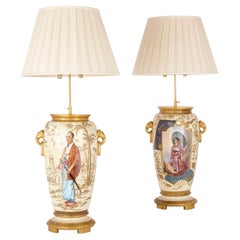
Pair of French antique Japonisme glazed ceramic and ormolu mounted lamps French, Late 19th Century Lamps: height 104cm, width 36cm, depth 26cm Shades: height 33cm, diameter 50cm In the Japonisme style, these superb, exceptionally large lamps (converted from vases) are made from glazed ceramics and fitted with ormolu mounts. The beautiful vases are parcel gilt and decorated with exquisite images of, to the front, a Japanese male figure on one and a female figure on the other; complemented by images of Japanese landscapes including trees, birds (ducks), shrubbery, flowers, and insects, including stick insects and butterflies. Each piece is fitted with superb ormolu elephant...
Category

Late 19th Century French Antique Japonisme Lighting

Materials

Ormolu

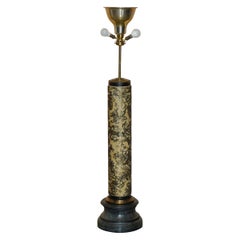
LARGE ANTIQUE JAPANESE FLOOR STANDING PRINTING SCROLL LAMP SOLID MARBLE BASe
Located in West Sussex, Pulborough
We are delighted to offer for sale this super rare and highly decorative, Japanese floor standing lamp which is an antique printing scroll fixed to a solid two piece marble base This is a very impressive lamp, I personally purchased this from Nice France of my antiques tour...
Category

Early 1900s Japanese Antique Japonisme Lighting

Materials

Marble

Japonisme lighting for sale on 1stDibs.

Find a broad range of unique Japonisme lighting for sale on 1stDibs. While there are many designers and brands associated with original lighting, popular names associated with this style include Ingo Maurer, Cordélia Faure, Dorian Étienne, and Lars Vejen. It’s true that these talented designers have at times inspired knockoffs, but our experienced specialists have partnered with only top vetted sellers to offer authentic pieces that come with a buyer protection guarantee.

Still Thinking About These?

All Recently Viewed