Lapis Lazuli Furniture
to
38
164
120
232
62
8
28
25
17
13
12
8
5
3
2
1
1
9
64
159
70
25
37
48
6
2
4
1
1
11
7
8
9
2
302
361,491
298,539
227,914
151,436
164
68
67
52
34
302
273
281
12
7
3
3
2
Material: Lapis Lazuli
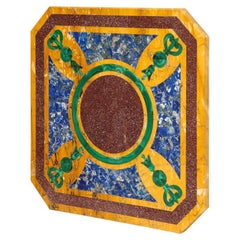
Italian Neoclassical Style Marble, Malachite, Lapis Lazuli, and Porphyry Panel
Located in Long Island City, NY
A magnificent Italian neoclassical style marble, malachite, lapis lazuli, and porphyry panel, early 20th century.
This panel is made with all different precious hardstones. All th...
Category
Early 20th Century Neoclassical Lapis Lazuli Furniture
Materials
Marble, Porphyry, Malachite, Lapis Lazuli

$7,150 Sale Price
35% Off
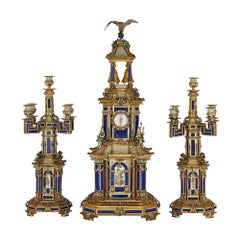
Impressive Antique Austrian Champlevé Enamel, Silver-Gilt and Lapis Lazuli Clock
Located in London, GB
Impressive antique Austrian champlevé enamel, silver-gilt and lapis lazuli clock set
Austrian, Late 19th century
Clock: Height 91cm, width 37cm, depth 37cm
Candelabra: Height 64cm, width 24cm, depth 24cm
Clock case: Height 97cm, width 44cm, depth 41cm
Candelabra case: 67cm, width 27cm, depth 27cm
Crafted in Austria in the late 19th century, this magnificent three-piece clock set was most likely gifted to the Imperial Russian family by the Austro-Hungarian Royal family. Its design is inspired by various cultures and styles, whilst its high quality celebrates some of the best craftsmen of the late 19th century.
Of a tiered pagoda shape, the clock is surmounted by an eagle, its wings spread wide landing atop a vibrant lapis lazuli ball. The eagle is most likely a reference to Turul, a mythological animal which is a symbol of Hungary. This bird of prey is also a popular feature within Turkish traditions.
Within a canopy, supported on four sturdy lapis lazuli pillars two prominent silver-gilt bells are hanging. These are carved with various motifs such as acanthus leaf design and connect to the clock mechanism below. The bells ring informing its users of the time.
All four sides of the piece are inset with a clock, an unusual feature on an object of this type and a testament to its highest quality. The inclusion of clocks on all sides signifies that the antique is aimed to be a centrepiece, admired from all sides. The dial is decorated using the champlevé enamelling technique, whereby ‘parcels’ are carved into the silver gilt and into which enamel is poured. The 12 numbers are coloured in black with a gold outline and are surrounded by a white circular background making them stand out and easy to read. The hour clock dial is cast in the form of a sun, while the minute hand is represented as the moon. The two motifs symbolise one’s bright and gloomy sides of existence.
The four corners around the clocks are mounted with three-dimensional female figures dressed in traditional garments from around the world. For example, one figure is dressed in typical Turkish clothing...
Category
Late 19th Century Austrian Antique Lapis Lazuli Furniture
Materials
Lapis Lazuli, Silver, Enamel, Bronze
More Ways To Browse
Tavolo In Marmo
Antique General Store
Antique Glass Door Display Case
Antique Hara
Antique Hindu Sculpture
Antique Horse Sleigh
Antique Indian Blanket Chest
Antique Iron Window Grates
Antique Japanese Doll
Antique Lingerie Chest
Antique Marble Lion
Antique Meissen Clocks
Antique Mill Stone
Antique Ming Horses
Antique Nautical Table
Antique Norwegian Cabinet
Antique Pairpoint Silver
Antique Pine Blanket Box