Maiolica Furniture
to
14
138
13
145
7
1
29
25
6
6
6
4
4
2
1
1
84
32
29
8
9
15
5
4
2
2
3
3
1
4
156
360,258
298,001
227,270
151,160
148
118
14
8
3
153
152
152
12
10
9
6
4
Material: Maiolica
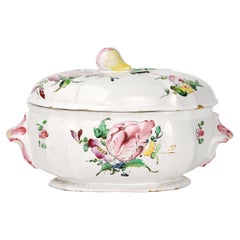
Italian Maiolica Tureen, Rubati Manufacture, Milan, circa 1770-1780
Located in Milano, IT
Maiolica tureen
Pasquale Rubati Manufacture
Milan, circa 1770 - 1780
Maiolica polychrome decorated “a piccolo fuoco” (third fire).
It measures 6.69 in x 11,02 x 8.26 (17 x 28 x ...
Category
1770s Italian Rococo Antique Maiolica Furniture
Materials
Maiolica
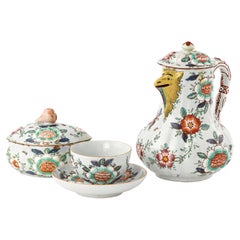
Ancient Maiolica Coffee Set “Barbotine” Decoration Milan, 1770- 1780
Located in Milano, IT
Coffee assortment with “barbotine” decoration
Manufacture of Pasquale Rubati or Felice Clerici
Milan, 1770- 1780
Maiolica polychrome decorated “a piccolo fuoco” (third fire).
...
Category
1770s Italian Rococo Antique Maiolica Furniture
Materials
Maiolica
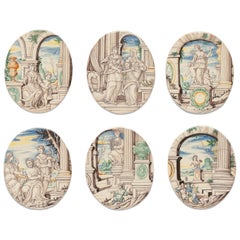
Ancient Maiolica Tiles, Ambrogette, Rampini Manufactory, Pavia, 1693-1704
Located in Milano, IT
Six maiolica “ambrogette” (tiles)
Rampini manufactory, painter probably Siro Antonio Africa
Pavia, 1693-1704
a) 6.88 x 5.51 in (17.5 x 14 cm); 0.55 lb (252 g)
b) 7.08 x 5.70 in (18 x 14.5 cm); 0.51 lb (233 g)
c) 6.88 x 5.70 in (17.5 x 14.5 cm); 0.54 lb (245 g)
d) 6.81 x 5.51 in (17.3 x 14 cm); 0.50 lb (230 g)
e) 6.88 x 5.51 in (17.5 x 14 cm); 0.50 lb (229 g)
f) 7.08 x 5.70 in (18 x 14.5 cm); 0.51 lb (233 g)
State of conservation: intact.
These six ”maiolica fina” small “ambrogette” belong to a family of ceramic works considered among the finest produced between the 17th and 18th centuries. For a long time, this type of maiolica was attributed to the Venetian village of Angarano, but later it was definitively attributed to the pottery factories in Pavia. A fundamental study ascribed this production specifically to Pavia through an analysis of Lombard collections and a comparison with archaeological remains found near the two main manufacturing sites in the city. (E. Pelizzoni - M. Forni - S. Nepoti, La maiolica di Pavia tra Seicento e Settecento, Milano 1997).
The six small oval tiles have rounded edges and are decorated with a historiated motif. They were created using high-fired polychrome technique, with a predominance of cool tones and a dominance of gray and blue, interspersed with manganese, citrine yellow, orange-yellow, and green. The six small “ambrogette” are characterized by the same stylistic features, with a similar decorative design.
The first tile (a) depicts a female figure, holding a stiletto and sitting near a pedestal supporting a relief-decorated baluster vase. Behind her, a child is holding a chalice, while through the arches of a portico, a glimpse of a mountainous landscape can be seen in the background. The female figure could possibly be Lucretia, an example of virtue in ancient Roman culture.
In the second “ambrogetta” b), the Biblical episode of Judith and Holofernes is depicted through canonical iconography: the decapitated body of Holofernes lies on the bed in the background, while the protagonist, Judith, is seen placing his head into a sack held by a maidservant. Through an archway a shining slice of the moon gives the perception of nighttime. Surprisingly, within the narrative, there is the presence of a basin in the shape of a large shell, closely resembling the products of Pavia's factories.
The third small plaque (c) depicts a female figure standing on a plinth and framed by an architectural arch with a vast mountainous landscape in the background. The woman, with her breasts exposed, is accompanied by two children: one approaching her as if wanting to be picked up, and the other seated with an apple in his hand. The protagonist lends herself to different interpretations: perhaps she represents Rea Silvia with the two twin founders of Rome, or perhaps she is an allegory for the Pietà, a common theme depicted on maiolica.
In the fourth tile (d), three characters are depicted near a column. The main figure is an old man with a sad expression, holding a cup, while a woman, wearing a turban on her head, also holds a cup in her right hand and a pitcher in her left. A second woman with her hair bound holds another pitcher behind the old man: at his feet a traveller's bag can be seen, along with some apples and a slice of cheese on a rectangular base. It is likely the sad Biblical episode of Lot and his daughters...
Category
Early 1700s Italian Baroque Antique Maiolica Furniture
Materials
Maiolica
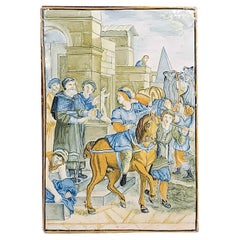
FIRST HALF OF THE 18th CENTURY VERTICAL CASTLES MAJOLICA PLAQUE
By Castelli
Located in Firenze, FI
Beautiful vertically painted majolica plaque, attributable to the famous Castelli factory, located in Abruzzo (Central Italy), dating back to the first half of the 18th century. The ...
Category
Early 18th Century Italian Antique Maiolica Furniture
Materials
Maiolica
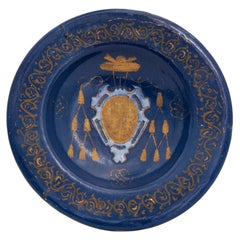
16th Century Castelli Italian Maiolica Farnese alla turchina Dish
By Castelli
Located in Fort Lauderdale, FL
An extraordinary azure maiolica dish in the Farnese service, made by Castelli d'Abuzzo between 1580 and 1589.
In the peak of the High Renaissance, Cardinal Alessandro Farnese commissioned a dinner service from the Castelli maiolica...
Category
16th Century Italian Renaissance Antique Maiolica Furniture
Materials
Maiolica
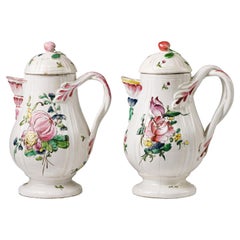
Ancient Pair Coffee Pots, Pasquale Rubati Manufacture Milan, 1770 circa
Located in Milano, IT
Pair of small coffee pots.
Manufacture of Pasquale Rubati
Milan, 1770 Circa
Maiolica polychrome decorated “a piccolo fuoco” (third fire).
a) height 7.87 x 5.51 x 3.93 in (20 x 14 x ...
Category
1760s Italian Neoclassical Antique Maiolica Furniture
Materials
Maiolica
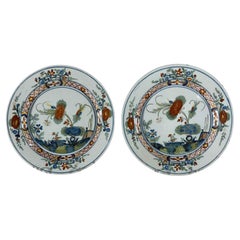
Piatti di Maiolica Italiana 1770 Decoro Al Garofano Manifattura Ferniani Faenza
Located in Milano, MI
Coppia Di Piatti In Maiolica italiana XVIII secolo Con Decoro Al Garofano Manifattura Ferniani Faenza dipinti in policromia, nei toni del blu, bruno, giallo, rosso, arancio e verde.
...
Category
1770s Italian Baroque Antique Maiolica Furniture
Materials
Maiolica
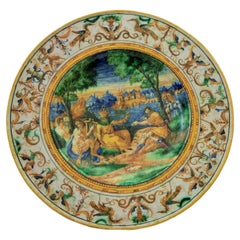
Important 19th Century Italian Parade Plate
Located in Madrid, ES
Important 19th Century Italian Parade Plate
Polychrome ceramic, with a wide brim, short frill, and a wide base. Reverse with ring support. Decoration on the rim with harpies and fan...
Category
Early 19th Century Italian Baroque Antique Maiolica Furniture
Materials
Maiolica, Porcelain
Two Ancient Maiolica Pot Mustard Set, Milan, 1745-1788 Circa
Located in Milano, IT
Two pot mustard set
Felice Clerici or Pasquale Rubati Factory
Milan, 1745-1788 Circa
Majolica polychrome decorated "a piccolo fuoco" (third fire)
It measures: 3.94 in in height x...
Category
18th Century and Earlier Italian Rococo Antique Maiolica Furniture
Materials
Maiolica
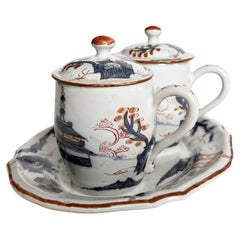
Ancient Italian Maiolica Faenza, Ferniani Factory, Circa 1700
Located in Milano, IT
Centerpiece white maiolica shell
Ferniani factory, early period: 1693-1776
Faenza, circa 1700
Measures: 5.6 in x 14.72 in x 13.46 in (14.3 cm x 37.4...
Category
Early 1700s Italian Baroque Antique Maiolica Furniture
Materials
Maiolica
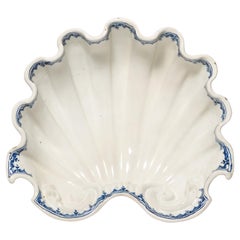
Bas Rilief, 1950 Germano Belletti
Located in Milano, IT
Exceptional and exclusive Bas Rilief, 1950 Germano Belletti " Centauri" in Faenza, 1914 works with Pietro Melandri, Riccardo Gatti, Mario Morelli. Apprezzated to Giò Ponti.
Category
1950s Italian Other Vintage Maiolica Furniture
Materials
Maiolica, Wood
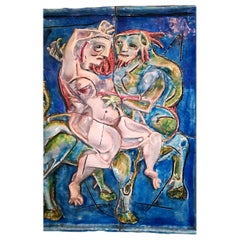
Vase
Pot
1930, Multi-Color Round Shape, Majolica, Giò Ponti
Located in Milano, IT
GIO PONTI -VASE of Majolica 1930, signed Ginori model 3130, accompanied by the authentic certiate from Gio' Ponti Archives.
Category
1930s Italian Art Deco Vintage Maiolica Furniture
Materials
Maiolica
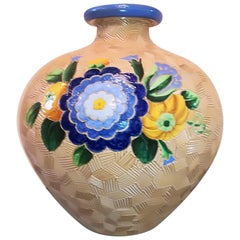

$8,448 Sale Price
40% Off
Important Plate Fratelli Minardi Faenza 1920 Art Deco
Located in Madrid, ES
Important Plate Fratelli Minardi Faenza 1920
Lady's profile, a polychrome ceramic plate with a wide rim and a deep recess, with a ring-shaped support on the back, on a recessed back...
Category
Early 20th Century Italian Baroque Maiolica Furniture
Materials
Maiolica, Porcelain
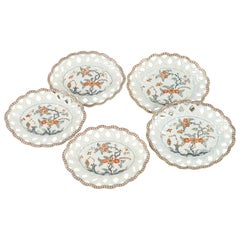
Ancient Maiolica Plates Pasquale Rubati, Milan Circa 1770-1780
Located in Milano, IT
Five oval maiolica dishes with pierced edge
Manufacture of Pasquale Rubati
Milan, 1770-1780
Three small oval dishes 10.23 in x 7.67 in (26 cm x 19.5 cm)
Two large oval dishes 10.82 in x 8.85 in (27.5 x 22.5 cm)
lb 3.5 (kg 1.8)
State of conservation: intact
The five dishes of different sizes have an oval shape, a mixtilinear edge and a molded polylobed shape with a surface enriched with a relief weave motif extending to the brim and forming a perforated basket...
Category
1770s Italian Rococo Antique Maiolica Furniture
Materials
Maiolica
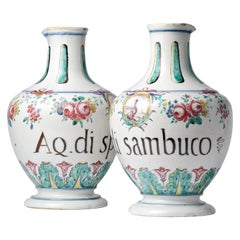
Italian Maiolica Pharmacy Flasks Felice Clerici, Milan Circa 1770-1780
Located in Milano, IT
Two maiolica pharmacy flasks
Milan, Felice Clerici Manufacture, 1770-1780
They each measure 9.44 in (24 cm) in height x 6.10 in (15.5 cm) in diameter
l...
Category
1770s Italian Neoclassical Antique Maiolica Furniture
Materials
Maiolica
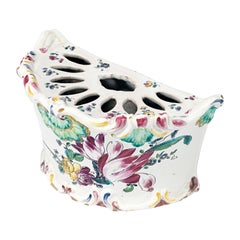
Ancient Maiolica Flower Pot Pasquale Rubati Factory, Milan Circa 1770
Located in Milano, IT
Maiolica flower pot “a mezzaluna” decorated with tulip
Pasquale Rubati Factory
Milan, circa 1770.
Measures: 4.7 in x 4.7 in x 8.6 in
12 cm x 12...
Category
1770s Italian Rococo Antique Maiolica Furniture
Materials
Maiolica
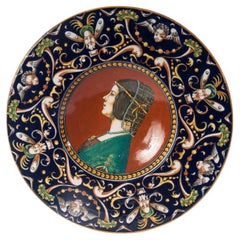
Italian Cantagalli Maiolica Large Plate with family noble emblem, Late 19th C.
By Cantagalli
Located in CH
Cantagalli Maiolica Plate with Heraldic Emblem
Cantagalli Factory, Florence, Late 19th Century
Tin-glazed earthenware (maiolica); polychrome decoration
This large maiolica plate was...
Category
Late 19th Century Italian Renaissance Revival Antique Maiolica Furniture
Materials
Ceramic, Maiolica
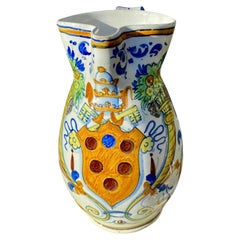
An Antique Italian Glazed Pottery Jug from the Montelupo Fiorentino factory
Located in New Orleans, LA
This is an antique Italian ceramic jug, likely from the Montelupo Fiorentino factory, dating to around the late 19th century with the coat-of-arms of the Medici Grand Dukes flanked b...
Category
1880s Italian Renaissance Revival Antique Maiolica Furniture
Materials
Ceramic, Earthenware, Maiolica, Majolica, Pottery
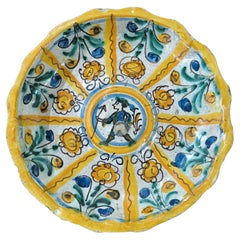
AMAZING PLATE MONTELUPO 17th Century
By FF Montelupo
Located in Madrid, ES
AMAZING PLATE MONTELUPO 17th Century
Round earthenware bowl with contours on a pedestal, polychrome decoration of a soldier in a frame of floral reserves.
Minor restorations.
Diame...
Category
17th Century Italian Baroque Antique Maiolica Furniture
Materials
Porcelain, Maiolica
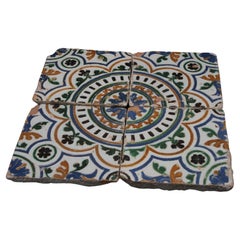
Spanish Azulejo set of 4 tiles Arista y Cuenca - Toledo 16th century
Located in DELFT, NL
A set of four early Arista y Cuenca tiles from Toledo, Spain, dating to circa 1550–1575. These tiles were produced during the Spanish Renaissance, a period when Toledo was a major ce...
Category
16th Century Spanish Renaissance Antique Maiolica Furniture
Materials
Earthenware, Maiolica
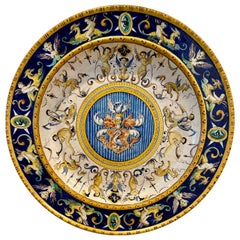
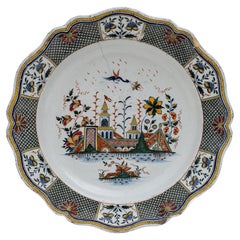
Large Majolica Dish France Rouen Manufactory of Jean-Baptiste Guillibaud, 1730
Located in Puglia, Puglia
Big dish.
France, Rouen, Manufactory of Jean-Baptiste Guillibaud, around 1730.
Majolica. Brand: "Gb" linked in italics, in blue.
Diameter 44 cm. Conservation: flaking recomposed in o...
Category
1730s French Rococo Antique Maiolica Furniture
Materials
Maiolica
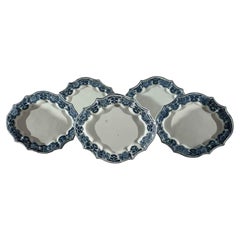
Cinque Piatti di Maiolica Italiana Faenza Secolo XVIII Decoro Floreale Blu
Located in Milano, MI
Cinque Piatti Sagomati Del 1700 con una decorazione floreale sul bordo. Gruppo di cinque piatti in maiolica, manifattura faentina del secolo XVIII, corpo ovale dal bordo orlato, con ...
Category
18th Century and Earlier Italian Baroque Antique Maiolica Furniture
Materials
Maiolica
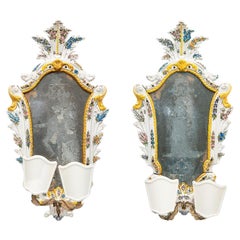
Coppia di specchierine veneziane in maiolica del Settecento
Located in Vicenza, IT
Questa bellissima coppia di specchierine in maiolica furono realizzate in Veneto nel XVIII secolo.
They have shaped white majolica frames with flowers embellished with gilding.
Alla...
Category
Mid-18th Century Italian Louis XV Antique Maiolica Furniture
Materials
Ceramic, Maiolica, Porcelain
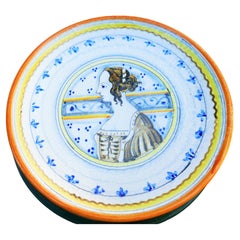
Eugenio Taccini Montelupo majolica plate
Located in Lugo, IT
Eugenio Taccini Montelupo majolica plate.
Good condition.
Thank you.
Category
1970s Italian Renaissance Vintage Maiolica Furniture
Materials
Maiolica
Italian Renaissance Plate, Patanazzi Workshop Urbino, End of 16th Century
Located in Milano, IT
Acquareccia plate
Patanazzi workshop
Urbino, last quarter of the 16th century
It measures diameter 17.12 in; foot diameter 11.53 in; height 1.88 in (43.5 cm; 29.3 cm; 4.8 cm).
Weight
State of conservation: wear and a few small minimal detachments of enamel, chipping on the raised areas, peeling of enamel at the brim on the back.
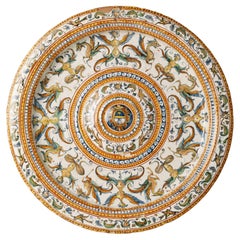
This large, shallow basin is equipped with a wide and convex well. It is umbonate with a contoured center. The brim, short and flat, is enclosed in a double rounded and barely raised edge. The basin has a flat base without rims; it has a slightly concave center in correspondence to the well.
The shape takes inspiration from the basins associated with the metal forged amphora pourers that traditionally adorned the credenza. These were used from the Middle Ages to wash hands during banquets. Two or three people washed their hands in the same basin and it was considered an honor to wash one’s hands with an illustrious person.
The decoration is arranged in concentric bands with, in the center of the umbo, an unidentified shield on a blue background: an oval banded in gold with a blue head, a gold star and a field with a burning pitcher.
Rings of faux pods separate the center from a series of grotesque motifs of small birds and masks. These go around the basin and are, in fact, faithfully repeated on the brim. The main decoration develops inside the flounce of the basin, which sees alternating symmetrical figures of winged harpies and chimeras. The ornamentation, outlined in orange, green and blue, stands out against the white enamel background.
This decorative style, defined since the Renaissance as “grottesche” or “raffaellesche”, refers to the decorations introduced after the discovery of the paintings of the Domus Aurea towards the end of the fifteenth century. The discovery of Nero's palace, buried inside Colle Oppio by damnatio memoriae, occurred by chance when a young Roman, in 1480, fell into a large crack which had opened in the ground on the hill, thus finding himself in a cave with walls covered with painted figures.
The great artists present in the papal city, including Pinturicchio, Ghirlandaio, Raffaello, immediately visited these caves. The decorations found there soon became a decorative subject of immense success: the term grotesque , with the meaning of “unusual,” “caricatured,” or “monstrous,” was later commented by Vasari in 1550 as “una spezie di pittura licenziose e ridicole molto”( “a very licentious and ridiculous kind of painting”).
The decorations “a grottesche” also widely circulated in ceramic factories, through the use of engravings, variously interpreted according to the creativity of the artists or the requests of the client.
Our basin is reflected in similar artifacts produced at the end of the sixteenth century by the factories of the Urbino district. See the series of basins preserved in the main French museums, among which the closest in morphology is that of the Campana collection of the Louvre (Inv. OA1496); this however has a more complex figure decoration, while the decoration of our specimen is sober and with a watercolor style.
The style, sure in its execution, approaches decorative results still close to the works produced around the middle of the sixteenth century by the Fontana workshop. The decoration is closely linked to their taste, which later finds its natural outlet, through the work of Antonio, also in the Patanazzi workshop. Studies show the contiguity between the two workshops due to the kinship and collaboration between the masters Orazio Fontana and Antonio Patanazzi, both trained in the workshop of Guido Fontana il Durantino. It is therefore almost natural that their works, often created according to similar typologies and under the aegis of the same commissions, are not always easily distinguishable, so much so that the presence of historiated or “grottesche” works by Orazio is documented and preserved in Antonio Patanazzi's workshop. Given that the studies have always emphasized the collaboration between several hands in the context of the shops, it is known that the most ancient “grottesche” works thus far known, can be dated from 1560, when the Fontana shop created the so-called Servizio Spagnolo (Spanish Service) and how, from that moment on, this ornamentation became one of the most requested by high-ranking clients. We remember the works created for the Granduchi di Toscana, when Flaminio Fontana along with his uncle Orazio supplied ceramics to Florence, and, later, other commissions of considerable importance: those for the service of the Duchi d’Este or for the Messina Farmacia of Roccavaldina, associated with the Patanazzi workshop when, now after 1580, Antonio Patanazzi began to sign his own work.
Thus, in our basin, the presence of masks hanging from garlands, a theme of more ancient memory, is associated in the work with more advanced stylistic motifs, such as the hatching of the chimeras and harpies. These are found here on the front with the wings painted in two ornate ways. In addition, the theme of the birds on the edge completes the decoration along the thin brim and can be seen as representing an early style typical of the Urbino district during a period of activity and collaboration between the two workshops. Later, a more “doll-like” decorative choice, typical of the end of the century and the beginning of the seventeenth century, characterized the period of the Patanazzi workshop under the direction of Francesco.
Bibliography:
Philippe Morel, Il funzionamento simbolico e la critica delle grottesche nella seconda metà del Cinquecento, in: Marcello Fagiolo, (a cura di), Roma e...
Category
16th Century Italian Renaissance Antique Maiolica Furniture
Materials
Maiolica
Spanish Azulejo Tile Arista y Cuenca - Toledo 16th century
Located in DELFT, NL
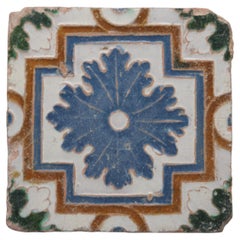
Early Arista y cuenca tiles made in Toledo. Tile decorated in renaissance with stylized flowers, probably made between 1550 and 1575.
I have four of them available, please reach o...
Category
16th Century Spanish Renaissance Antique Maiolica Furniture
Materials
Earthenware, Maiolica
Spanish Azulejo Tile Arista y Cuenca - Toledo 16th century
Located in DELFT, NL
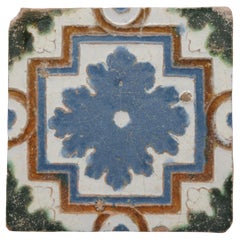
Early Arista y cuenca tiles made in Toledo. Tile decorated in renaissance with stylized flowers, probably made between 1550 and 1575.
I have four of them available, please reach o...
Category
16th Century Spanish Renaissance Antique Maiolica Furniture
Materials
Earthenware, Maiolica
Santucci Deruta Oil and Vinegar Majolica with Raphaelesque
By Deruta
Located in Lugo, IT
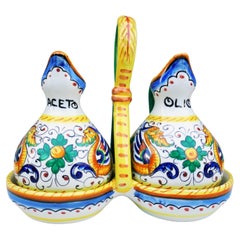
Santucci Deruta Oil and Vinegar Majolica with Raphaelesque decoration.
Good condition.
Thanks
Category
1980s Italian Vintage Maiolica Furniture
Materials
Maiolica
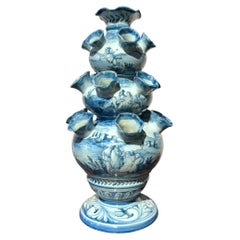
Italian Faience Tulip Vase in the Maiolica Style, 18th Century
Located in NICE, FR
This large Italian faience tulip vase is conceived in a three-tiered architectural form with a total of nineteen openings for the display of flowers, arranged as six openings on each...
Category
Late 18th Century Italian Renaissance Antique Maiolica Furniture
Materials
Faience, Maiolica
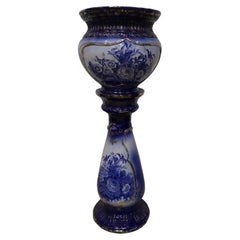
Vaso su piedistallo di Jardiniere U&C Sarreguemines, XIX secolo
Located in Catania, IT
Vaso piedistallo della Jardiniere U&C Sarreguemines, in ottime condizioni. Fine del XIX secolo.
Category
Late 19th Century French Antique Maiolica Furniture
Materials
Ceramic, Maiolica
$711 Sale Price
39% Off
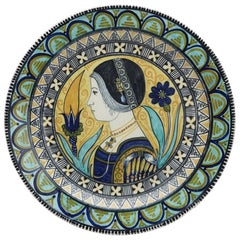
Torquato Castellani Majolica Renaissance Revival Tin-Glazed Charger
Located in Bishop
s Stortford, Hertfordshire
An exceptional Renaissance Revival Maiolica tin-glazed plate painted with a side profile portrait of a lady within a decorative border with a line painted design to the base. The lig...
Category
1880s Italian Renaissance Revival Antique Maiolica Furniture
Materials
Earthenware, Maiolica
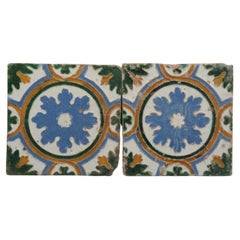
Spanish Azulejo pair of Tiles Arista y Cuenca - Toledo 16th century
Located in DELFT, NL
Early Arista y cuenca tiles made in Toledo. Tile decorated in renaissance with stylized flowers, probably made between 1550 and 1575.
Also separately available, please reach out t...
Category
16th Century Spanish Renaissance Antique Maiolica Furniture
Materials
Earthenware, Maiolica
Mid 20th Century Italy Faenza Production Ceramic Vase, Signed
Located in Casale Monferrato, IT
We present this stunning large vase, made in Faenza, Italy, dating back to the 1950s. The vase is crafted from polychrome glazed ceramic. The eye-catching, classically painted decora...
Category
Mid-20th Century Italian Maiolica Furniture
Materials
Maiolica
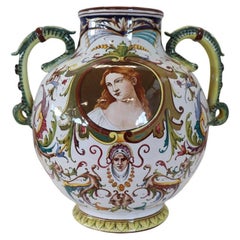
20th Century Italy Florentine Production Ceramic Vase, Signed
Located in Casale Monferrato, IT
We present this fantastic large vase, made in Florence, Italy, dating back to the 1980s. The vase is crafted from polychrome glazed ceramic. The eye-catching, classically styled deco...
Category
1980s Italian Vintage Maiolica Furniture
Materials
Maiolica
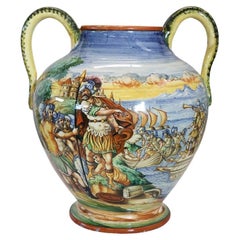
Small Maiolica Plate, Urbino District, 1533-1555
Located in Milano, IT
Maiolica plate (tondino)
Urbino district, Casteldurante or Pesaro, 1533-1555
It measures: diam. 7.48 in (19 cm), foot diam. 2.75 in (7 cm), height 1.0...
Category
16th Century Italian Renaissance Antique Maiolica Furniture
Materials
Maiolica
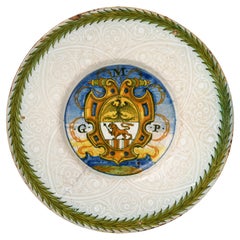
Blue and White Cherubs and Landscape Vase by Ernan, Albisola, Italy, 1940s
Located in Brescia, Brescia
A stunning hand-painted ceramic vase by Ernan of Albisola, Italy, dating to the 1940s. Featuring an elegant baroque silhouette with a wide flared rim and bulbous body, the piece is r...
Category
1940s Italian Art Deco Vintage Maiolica Furniture
Materials
Ceramic, Maiolica
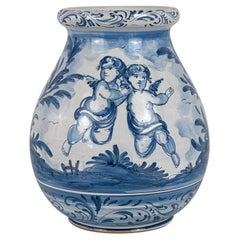
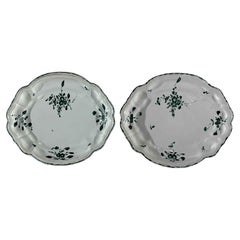
Vassoi di Maiolica 1770 Decoro Mazzolino Verde Manifattura Ferniani Faenza
Located in Milano, MI
Coppia Di Vassoi in maiolica italiana Con Decoro Al Mazzolino Verde Manifattura Ferniani Fine 1700 entrambi mostrano un ampio cavetto liscio, apodo, larga tesa, lievi costolature e o...
Category
1770s Italian Baroque Antique Maiolica Furniture
Materials
Maiolica
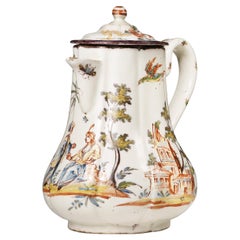
Ancient Italian Coffee Pot, Coppellotti Manufacture, Lodi, Circa 1740
By Antonio Maria Coppellotti
Located in Milano, IT
Coffee pot
Antonio Maria Coppellotti Manufacture
Lodi, Circa 1740
High fire polychrome maiolica
It measures: 7.87 in x 6,49 x 5.11 (20 cm x 16,5 x 13); weight 1.23 lb (561 g)
...
Category
1730s Italian Rococo Antique Maiolica Furniture
Materials
Maiolica
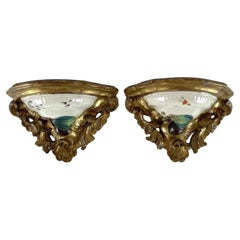
Coppia di Mensole Italiane XIX Secolo in Legno Dorato e Maiolica Barocca 1700s
Located in Milano, MI
Due Mensole Antiche Dorate italiane del XIX secolo centrate da Maiolica del 1700, piccole mensole sagomate in legno intagliato e dorato, realizzate con un coperchio in maiolica polic...
Category
Mid-19th Century Italian Baroque Antique Maiolica Furniture
Materials
Maiolica, Giltwood
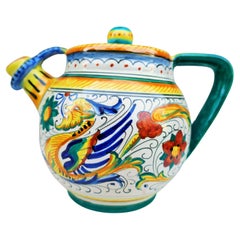
Labor Deruta teapot with Raphaelesque decoration
By Deruta
Located in Lugo, IT
Labor Deruta teapot with Raphaelesque decoration.
Two defects in the lid.
Thanks
Category
1980s Italian Vintage Maiolica Furniture
Materials
Maiolica
Antique Ceramics from the Giustiniani Family Collection by Angelo
Located in CABA, AR
The Giustiniani family was one of the most important in ceramic production in Naples, particularly from the 17th to the 19th century. The Giustiniani manufactory is famous for its "r...
Category
Late 19th Century Italian Antique Maiolica Furniture
Materials
Ceramic, Maiolica
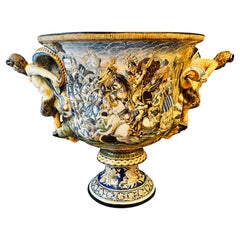
A Pair of Minton Majolica Baskets or Jardinieres by Albert Carrier-Belleuse.
Located in Skanninge, SE
A pair of Minton Majolica Reticulated Baskets, designed by Albert-Ernest Carrier-Belleuse (1824-1887).
Excellent condition on both pieces, no issues!
Made in lead-glazed earthenware (Mintons "Majolica").
With full marks "MINTON 1210".
Albert-Ernest Carrier-Belleuse worked at Minton as chief designer between 1850 and 1855. During his time at Minton, he created models for porcelain items, including vases and sculpture...
Category
1860s English Victorian Antique Maiolica Furniture
Materials
Maiolica
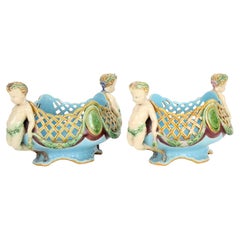
Morelli Faenza Ceramic Tulip Vase, Italy 1960s
Located in Milan, IT
Morelli Faenza Ceramic Tulip Vase, Italy 1960s
Category
1960s Italian Mid-Century Modern Vintage Maiolica Furniture
Materials
Maiolica
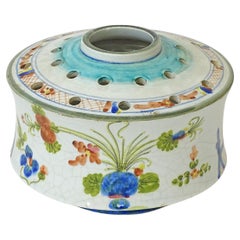
Majolica lume cuollomozzo produced in Vietri sul mare or Caltagirone
Located in Lugo, IT
Oil lume with a cuollomozzo on a circular base with a raised edge.
Cylindrical stem with a thickening and a constriction that supports the oil container.
Two handles, one of which is...
Category
1890s Antique Maiolica Furniture
Materials
Maiolica
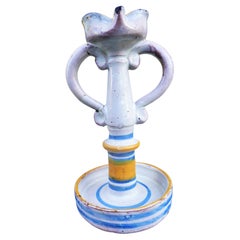
Large Dish In Italian Majolica Manufacture Antonibon Fruit Decoration 1750
Located in Milano, MI
Large Maiolica Dish Of The Antonibon Manufacture With Fruit Decoration Circa 1750 in excellent condition of oval shape with mixtilinear edges, bears in the center a fruit decoration ...
Category
Mid-18th Century Italian Baroque Antique Maiolica Furniture
Materials
Maiolica
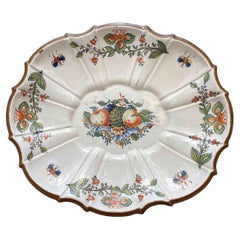
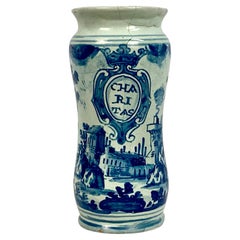
18th Century Italian Maiolica Blue and White Alborello Pharmacy Jar #2
Located in Bradenton, FL
18th Century Italian Majolica Albarello Pharmacy Jar. Jar is in a cylindrical shape with flared rim and foot. Jar features blue and white pattern with the word "Charitas" in an oval ...
Category
18th Century Italian Renaissance Antique Maiolica Furniture
Materials
Maiolica
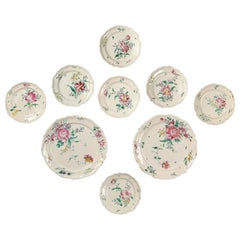
Ancient Maiolica Dishes with flowers, Lombard Manufacture, 1770-1780 Circa
Located in Milano, IT
Assortment of dishes
Lombard manufacture
1770 – 1780 Circa
Maiolica polychrome decorated “a piccolo fuoco” (third fire).
Two large dishes: diameter 14.76 in (37.5 cm); weight 4.5...
Category
1770s Italian Rococo Antique Maiolica Furniture
Materials
Maiolica
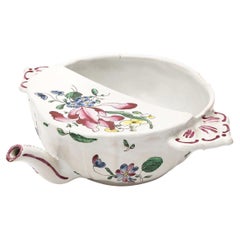
Ancient Maiolica Cup, Rubati Manufacture, Milan, Circa 1770 - 1780
Located in Milano, IT
Sick cup
Pasquale Rubati Manufacture
Milan, Circa 1770 - 1780
Maiolica decorated in polychrome “a piccolo fuoco” (third fire)
It measures: h 2.36 x 7.4 x 7.87 (h 6 x 19 x 20 cm)
...
Category
1770s Italian Rococo Antique Maiolica Furniture
Materials
Maiolica
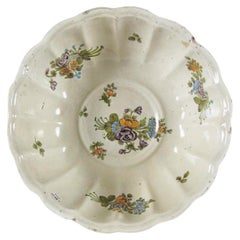
18th Century Italian Majolica Faience Centerpiece Large Lodi Circular Bowl
Located in Milano, MI
18th century Italian collectible antique painted majolica bowl, a large basin-shaped centerpiece, with vertical ribs, decorated with polychrome flowers. Small chips, felure and minor...
Category
Mid-18th Century Italian Rococo Antique Maiolica Furniture
Materials
Maiolica
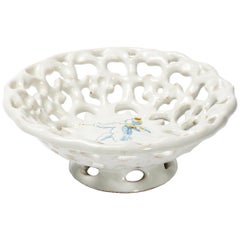
Ancient Italian Renaissance Maiolica Crespina, Faenza, 1580 Circa
Located in Milano, IT
Crespina
Faenza, last quarter of the 16th century
Maiolica painted in two colors, light blue and yellow, on a thick, rich layer of white enamel.
It measures 2.24 in (5.7 cm) in height, 6.10 in (15.5 cm) in diameter.
lb 0.55 (kg 0.25)
State of conservation: mimetic restoration.
The small cup has a raised central “umbone”, a perforated brim and a shaped rim. It rests on a high jutting foot. The "crespina" shape, in some inventories is cited as "tacce de frute" (fruit cups). It was particularly appreciated in the Renaissance and has variants based on the formal types and the different sizes. The decoration, made according to the dictates of the “compendiario” style, used few standardized colors: blue and yellow on a thick white and shiny enamel, deliberately chosen as the colour which was most reminiscent of silver. This choice derived from a trend in creative design of the era: the shapes used in the molds were often taken from metal objects. An idea which would last throughout the Renaissance.
The work shows, in the middle of the “umbone”, a winged putto stepping forward while playing a long thin trumpet.
The depiction of the putto is fully representative of the repertoire of the Faenza workshops of the sixteenth century.
Some specimens with this type of decoration have been published in a volume by Carmen Ravanelli Guidotti: there appears the whole productive repertoire of this fundamental moment of transition between the taste for the “istoriato” style and the great simplification of decoration in the “compendiario” period. This style, in its simplicity, however, saw its expression in a rather varied collection of decorative subjects, including old-fashioned busts...
Category
16th Century Italian Renaissance Antique Maiolica Furniture
Materials
Maiolica
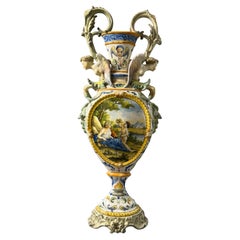
Majolica ceramic amphora - second half of the 19th century
Located in Fidenza, IT
Neapolitan-made bi-layered majolica ceramic amphora from the second half of the 1800s. It presents a classical style with mythological decorations on one side and, grotesques on the ...
Category
19th Century Italian Antique Maiolica Furniture
Materials
Maiolica
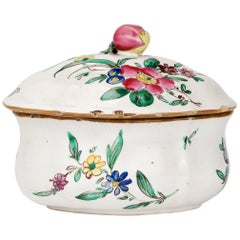
Italian Maiolica Ancient Sugar Bowl, Lodi, 1770-1780
Located in Milano, IT
Maiolica sugar bowl
Antonio Ferretti Manufacture
Lodi, Circa 1770-1780
Maiolica polychrome decorated “a piccolo fuoco” (third fire).
It measures 3.54 x 4.52 x 3.54 in (9 x 11,5 x 9 cm)
Weight: 0.394 lb (0.179 kg)
State of conservation: small and slight chips on the edges.
The small sugar bowl has a swollen and ribbed body resting on a flat base. The cap-shaped lid follows the rib of the container and is topped with a small knob in the shape of a two-colored fruit.
The sugar bowl is painted “a piccolo fuoco” (third fire) with the characteristic floral motif of bunches and isolated semis.
An example which closely corresponds to this one is kept at the Civic Museum in Lodi (G. Gregorietti, Maioliche di Lodi, Milano e Pavia, Catalogo della Mostra, Milano, 1964 n. 137).
This decorative style represented a strong point of the Lodi factory, which established itself thanks to the vivid nature of the colors made possible by the introduction of a new technique perfected by Paul Hannong in Strasbourg and later introduced by Antonio Ferretti to Italy. The production process, called “piccolo fuoco” (third fire), allowed the use of a greater number of colors than in the past; in particular, the purple of Cassius, a red made from gold chloride, was introduced. Its use allowed for many more tones and shades, from pink to purple.
The Ferretti family started their maiolica manufacturing business in Lodi in 1725.
The forefather Simpliciano started the business by purchasing an ancient furnace in 1725 and, indeed, we have evidence of the full activity of the furnaces starting from April of the same year (Novasconi-Ferrari-Corvi, 1964, p. 26 n. 4). Simpliciano started a production of excellence also thanks to the ownership of clay quarries in Stradella, not far from Pavia. The production was so successful that in 1726 a decree of the Turin Chamber came to prohibit the importation of foreign ceramics, especially from Lodi, to protect internal production (G. Lise, La ceramica a Lodi, Lodi 1981, p. 59).
In its initial stages, the manufacture produced maolicas painted with the “a gran fuoco” (double fire) technique, often in turquoise monochrome, with ornamentation derived from compositional modules in vogue in Rouen in France. This was also thanks to the collaboration of painters like Giorgio Giacinto Rossetti, who placed his name on the best specimens next to the initials of the factory.
In 1748 Simpliciano made his will (Gelmini, 1995, p. 30) appointing his son Giuseppe Antonio (known as Antonio) as universal heir. After 1750, when Simpliciano passed away, Antonio was directly involved in the maiolica factory, increasing its fortunes and achieving a reputation on a European level. Particularly important was the aforementioned introduction in 1760 of the innovative “a piccolo fuoco” (third fire) processing, which, expanding the ornamental repertoire with Saxon-inspired floral themes, was able to commercially compete with the German porcelains that had one of its most renowned offerings in the naturalistic Deutsche Blumen. Antonio Ferretti understood and promoted this technique and this decoration, proposing it in a fresher and more corrective version, less linked to botanical tables, both with or without contour lines, as well as in purple or green monochrome. After efforts to introduce more industrial production techniques to the sector succeeded, even the Ferretti manufacture, in the last decade of the eighteenth century, started heading towards decline despite its attempts to adapt production to neoclassical tastes.
In 1796 the Napoleonic battle for the conquest of the Lodi bridge over the Adda definitively compromised the furnaces. Production resumed, albeit in a rather stunted manner, until Antonio's death on 29 December 1810. (M. L. Gelmini, pp. 28-30, 38, 43 sgg., 130-136 (for Simpliciano); pp. 31 sgg., 45-47, 142-192 (for Antonio).
Bibliography
G. Gregorietti, Maioliche di Lodi Milano e Pavia Catalogo della Mostra, Milano, 1964 n. 137;
C. Baroni, Storia delle ceramiche nel Lodigiano, in Archivio storico per la città e i comuni del circondario e della diocesi di Lodi, XXXIV (1915), pp. 118, 124, 142; XXXV (1916), pp. 5-8;
C. Baroni, La maiolica antica di Lodi, in Archivio storico lombardo, LVIII (1931), pp. 453-455;
L. Ciboldi, La maiolica lodigiana, in Archivio storico lodigiano, LXXX (1953), pp. 25 sgg.;
S. Levy, Maioliche settecentesche lombarde e venete, Milano 1962, pp. 17 sgg.;
A. Novasconi - S. Ferrari - S. Corvi, La ceramica lodigiana, Lodi 1964, ad Indicem; Maioliche di Lodi, Milano e Pavia (catal.), Milano 1964, p. 17;
O. Ferrari - G. Scavizzi, Maioliche italiane del Seicento e del Settecento, Milano 1965, pp. 26 sgg.;
G. C. Sciolla, Lodi. Museo civico, Bologna 1977, pp. 69-85 passim; G. Lise, La ceramica a Lodi, Lodi 1981;
M. Vitali, in Storia dell'arte ceramica...
Category
1770s Italian Rococo Antique Maiolica Furniture
Materials
Maiolica
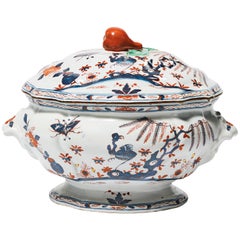
Ancient Italian Maiolica Tureen Milano, 1770 circa
Located in Milano, IT
Maiolica tureen “allo struzzo” (ostrich decoration)
Milan, Felice Clerici or Pasquale Rubati factory, circa 1750-1780
Measures: 9.25 in x 12.79 in x 10.23 in (cm 23.5 x cm 32.5 x cm 26)
lb 4.78 (kg 2.17)
State of conservation, a felûre consolidated inside with slight edge chipping restored.
In Milan in the 18th century two Majolica warehouses were opened, the first, by Felice Clerici, in 1745, the second in 1756 by Pasquale Rubati.
Traditionally this type of decoration has been attributed to the Pasquale Rubati factory. In reality the motif “allo struzzo”, one of the clearest examples of how the taste for chinoiserie met with considerable success during the 18th century, had been produced, in specimens of greater or lesser quality, by both Milanese manufactories.
This Maiolica tureen has a swollen and ribbed oval bowl, rests on an extroflexed foot and shows stirrup handles.
The tri-color ornament, in the typical tones of Japanese "Imari" decorations, shows an idealized oriental landscape that develops around a perforated rock and has a willow tree with long lance-shaped leaves framing the long-legged bird figure. The ornamentation is enhanced by decorative elements such as butterflies, small florets and a vase with a thin flowery stem.
The lid is ribbed with a pear-shaped knob on top.
The decoration was called in the Milanese manufactories "allo struzzo" (ostrich decoration) and this refers to the oriental figure Xian He or the crane, symbol of longevity, here losing its symbolic value. It is hypothesized that among some 16th century engravings...
Category
1770s Italian Chinoiserie Antique Maiolica Furniture
Materials
Maiolica
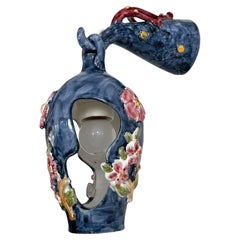
1950
s Flower and Coral Maiolica Illuminated Lantern by Vietri Italy
By Vietri
Located in Morazzone, Varese
This is a truly magical Italian maiolica wall mounted lantern depicts flowers and vivid red corals.
One single bulb provides ample illumination - this can be used as shown, wall mou...
Category
1950s Italian Mid-Century Modern Vintage Maiolica Furniture
Materials
Ceramic, Maiolica
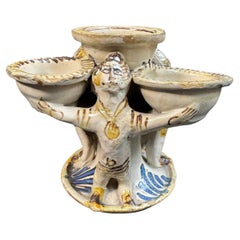
Saliera Laertina in maiolica - seconda metà del XVIII secolo
Located in Fidenza, IT
Saliera Laertina in maiolica della seconda metà del XVIII secolo. Questo oggetto, descritto nei cataloghi del patrimonio culturale, è composto da tre piccole vaschette circolari e un...
Category
18th Century Italian Antique Maiolica Furniture
Materials
Maiolica
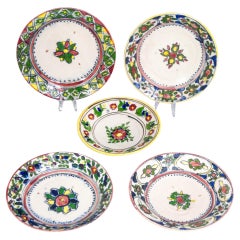
Five hand-painted and glazed majolica dishes. Central Italy. Nineteenth Century
Located in Torino, IT
Five dishes
hand-painted majolica
and glazed. Manifattura
central Italy.
ORIGIN
Central Italy
PERIOD
Nineteenth Century
MATERIALS
Hand-painted majolica
and glazed
DIMENSIONS
The ...
Category
19th Century Italian Antique Maiolica Furniture
Materials
Maiolica
CIMA Perugia hand-painted majolica bowl. Italy, 1980s
By Cima
Located in Torino, IT
Majolica Bowl
hand-painted
CIMA Perugia.
ORIGIN
Italy
PERIOD
Anni 80
MARK
CIMA Perugia
MATERIALS
Maiolica smaltata
and hand-painted
DIMENSIONS
Height: 9 cm
Ø 20 cm
CONDITIONS
P...
Category
1980s Italian Vintage Maiolica Furniture
Materials
Maiolica
$227 Sale Price
20% Off
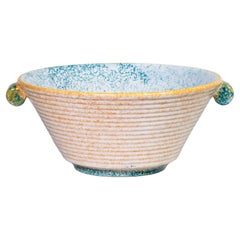
Two Small Italian Dishes Antonio Maria Coppellotti Manufacture, Lodi, Circa 1740
By Antonio Maria Coppellotti
Located in Milano, IT
Two small dishes
Antonio Maria Coppellotti Manufacture
Lodi, Circa 1740
High fire polychrome majolica
They measure: diameter 7.08 in(18 cm)
Weight: 0.37 lb (170 g)
State of conservat...
Category
1740s Italian Baroque Antique Maiolica Furniture
Materials
Maiolica
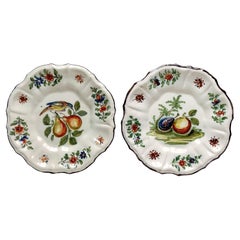
Pair of Abruzzo Maiolica Albarelli, 17th Century
Located in London, GB
17th Century pair of Abruzzo Maiolica Albarelli
Waisted cylindrical form decorated with classical figures. White tin glaze with blue decoration.
Dimensions: 29 x 12 cm.
Category
17th Century Italian Antique Maiolica Furniture
Materials
Maiolica
$4,923 / set
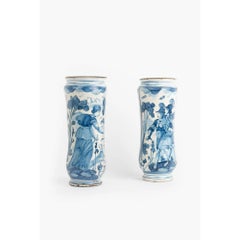
Abruzzi Maiolica Albarelli, circa 1700
Located in Basildon, GB
An Abruzzo maiolica 'albarelli' in good condition.
White tin glaze, waisted cylindrical form decorated in blue, with a classical figure of a putto surrounded by trees and flowers.
...
Category
Early 18th Century Italian Baroque Antique Maiolica Furniture
Materials
Maiolica
$1,244 Sale Price
30% Off
Still Thinking About These?
All Recently ViewedMore Ways To Browse
Tavolo In Marmo
Antique General Store
Antique Glass Door Display Case
Antique Hara
Antique Hindu Sculpture
Antique Horse Sleigh
Antique Indian Blanket Chest
Antique Iron Window Grates
Antique Japanese Doll
Antique Lingerie Chest
Antique Marble Lion
Antique Meissen Clocks
Antique Mill Stone
Antique Ming Horses
Antique Nautical Table
Antique Norwegian Cabinet
Antique Pairpoint Silver
Antique Pine Blanket Box