Painted Historical Memorabilia
to
25
73
29
121
1
19
13
6
5
5
3
2
2
2
2
1
1
1
1
11
58
52
1
16
26
3
2
2
4
1
4
1
1
1
44
36
24
22
13
59
42
38
19
19
122
121
122
7
2
1
1
1
Technique: Painted
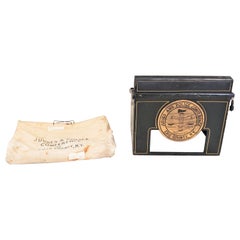
Erie County New York Judges
Police Conference Portable Lecturn or Podium
Bag
Located in Hamilton, Ontario
The maker of this lecturn is unknown, but presumed to have originated from the United States and date to approximately 1965. The podium is composed of pine boards and playwood with h...
Category
Mid-20th Century American Mid-Century Modern Painted Historical Memorabilia
Materials
Pine
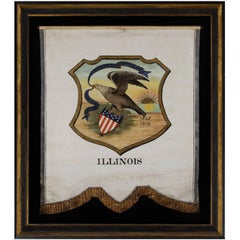
Hand-Painted 19th Century Banner with the 1867 Proposed Seal of Illinois
Located in York County, PA
HAND-PAINTED 19TH CENTURY BANNER WITH AN 1867 VERSION OF THE SEAL OF THE STATE OF ILLINOIS, PROPOSED IN THAT YEAR BY THE SECRETARY OF STATE, BUT IN A VARIATION NEVER FORMALLY ADOPTED
Banner with the Illinois State Seal, in a rare variation of the design, never adopted. In 1867 Illinois Secretary of State Sharon Tyndale proposed that the phrases in the state motto be reversed. In the wake of the Civil War, (which ended in 1865,) Tyndale suggested that the verbiage be changed from "State Sovereignty--National Union" to "National Union--State Sovereignty,” which made sense given the recent secession of the Southern States, which placed their own interests first. Illinois' own Abraham Lincoln had worked hard to preserve national interests, echoed here in the altering of the language. Though Tyndale’s suggestion was rejected, he was nonetheless charged with creating a new design, which he did and was soon adopted. This displayed the dates of "1818," when Illinois became a state, and "1868," when the seal was officially changed. Interestingly enough, Tyndale did manage to send a message in the new version by turning the word “sovereignty” upside-down , with the surmised explanation that this fit accordingly with the orientation / position of the streamer.
The banner is beautifully hand-painted on muslin and retains its original staff. The shape is beautifully scalloped at the bottom edge, which is painted to look as if there is an applied fringe. Most of the elements are congruent with the 1868 version, but there are various differences. Set within a shield-shaped medallion—usually circular—is the expected eagle in a side view, spread wing pose with beak uplifted. The eagle is supposed to be perched upon a rock with one talon, while gripping a Federal shield in the other. Here there is no rock and both talons grip the shield, which displays 13 stars. Note the date of "1867" and Tyndale's preferred order of the wording on the billowing ribbon in the eagle's beak. The foreground of the official design is all grass. Here there are olive branches—a peacetime reference appropriate for a country recovering from war—on a grassy area, set upon a sandy shore before Lake Michigan, with a rising sun on the horizon.
Mounting: The banner was mounted and framed within our own conservation department, which is led by masters degree trained staff. We take great care in the mounting and presentation of flags and have preserved thousands of examples; more than anyone worldwide.
The background is 100% cotton twill, black in color. The mount was placed in a black-painted, hand-gilded and distressed Italian molding. A shadowbox was created to accommodate the staff. The glazing is U.V. protective plexiglass. Feel free to contact us for more details.
Banner - 49" x 56.5"
Frame - 67.75" x 59.25"
About Jeff R. Bridgman Antiques, Inc.:
As an advisor to top museums and collectors alike, Jeff Bridgman is the world's leading expert and source for antique American flags and political textiles...
Category
1860s American Antique Painted Historical Memorabilia
Materials
Cotton

Price Upon Request
More Ways To Browse
Vintage Gas Can
Vintage Glass Bird Ornaments
Vintage Harley Memorabilia
Vintage Leather Ski Boots
Vintage Petrol Cans
Vintage Tree Topper
William K Vanderbilt
World War 2 Memorabilia
Wrigley Gum
Ww1 Memorabilia
1920s Bike
1930s Phone
1950 Vintage Christmas Ornaments
American Flags And Americana
Antique English Spring Balance Scale
Antique Iron Shoe Forms
Antique Military Saddles
Antique Watchmaker Tool