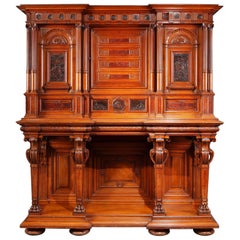
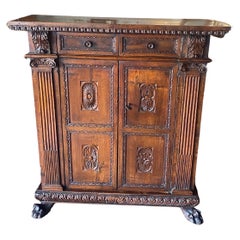
Renaissance Cabinets

RENAISSANCE STYLE

Spanning an era of cultural rebirth in Europe that harkened back to antiquity, the Renaissance was a time of change in design. From the late 1400s to the early 1600s, Rome, Venice and Florence emerged as artistic centers through the expansion of global trade and a humanist belief in the arts being central to society. Antique Renaissance furniture was ornately carved from sturdy woods like walnut, its details standing out against the tapestries and stained glass adorning the walls.

Renaissance chests, which were frequently commissioned for marriages, were often decorated with gilding or painted elements. Those that were known as cassoni were crafted in shapes based on classical sarcophagi. As opposed to the medieval era, when furniture was pared down to the necessities, a wide range of Renaissance chairs, tables and cabinets were created for the home, and the designs regularly referenced ancient Rome.

Large torchères of the Renaissance era that were used as floor lamps were inspired by classical candelabras, while marble surfaces evoked frescoes. The inlaid boxes being imported from the Middle East informed the intarsia technique, which involved varying hues of wood in mosaic-like patterns, such as those by architect Giuliano da Maiano in the Florence Cathedral.

Tapestry-woven cushion covers accented the variety of Renaissance seating — from conversation to study chairs — while bookcases for secular use reflected the migration of culture and knowledge from the church into the home. The aesthetics of the Italian Renaissance later spread to France through the publishing of work by renowned designers, including Hugues Sambin and Jacques Androuet du Cerceau. Centuries later, the 19th-century Renaissance Revival would see a return to this influential style.

Find a collection of antique Renaissance case pieces, decorative objects and other furniture on 1stDibs.

to
26
Height
to
Width
to
Depth
to
85
77
159
8
1,978
1,564
628
496
277
244
234
231
192
167
160
158
129
103
97
87
64
46
96
49
14
8
5
2
7
1
2
4
161
82
40
27
18
132
53
37
19
5
167
164
164
1
1
1
Style: Renaissance
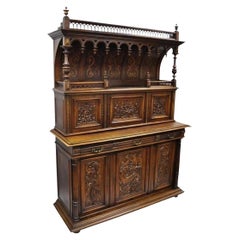
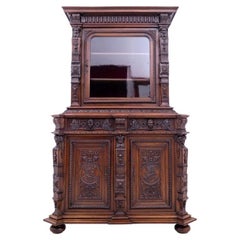
French Buffet / Cabinet / Credenza / Dresser - Gothic Renaissance - France 19th
Located in Beuzevillette, FR
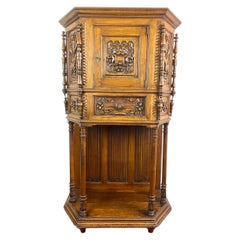
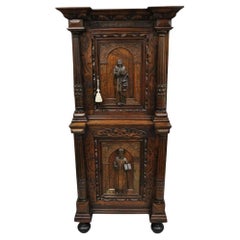
Credenza, Drinks cabinet, Cabinet, Sideboard in beech carved on its 3 facades. The splashback is decorated with fine sculpted figures of fruit, fruit baskets, plants and birds, proba...
Category

19th Century French Antique Renaissance Cabinets

Materials

Wood

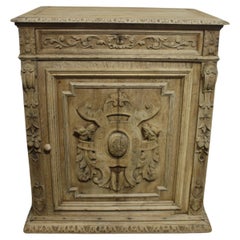
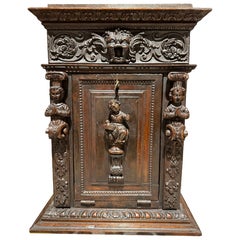
Late 19th Century Renaissance Style Carved Cabinet
Located in Bridgeport, CT
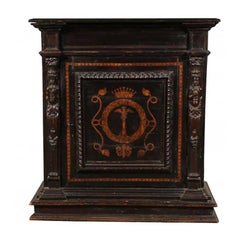
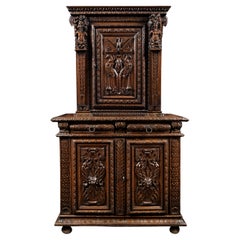
Antique carved cabinet having a central marquetry inlaid door panel with high relief carved rope design flanked by carved figural columns, panel...
Category

Late 19th Century Antique Renaissance Cabinets

Materials

Wood

Rare Renaissance Cabinet Richly Carved
Located in Saint-Ouen, FR
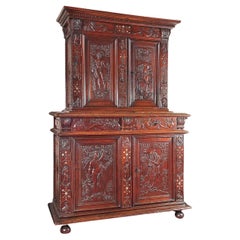
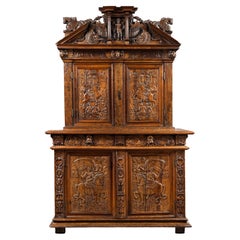
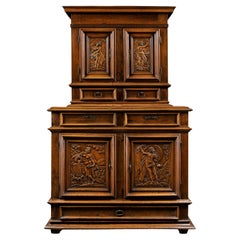
This rare Renaissance cabinet is richly decorated on the doors and drawers with carvings depicting the four seasons, and on the uprights and the entablature, alternating flower bouquets inlaid with mother of pearl. This is a beautifully conceived piece of furniture, representing a crowned portico with its entablature and cornice. The upper body Articulated separately in a ternary rhythm, as with the lower body, the upper part opens with two carved doors. The doors are framed by both the lateral uprights and the casing. There are cartouches carved into the casing in which mythological figures are depicted with flower bouquets. On the doors: On the right: Spring, a female figure crowned with a wreath of leaves, holding a basket full of flowers. She is wearing necklaces and bracelets on each arm, with drapery discretely wrapped around her body and is standing on a winged putti’s head. On each side are depicted a tree and a village with a steepled church. Above her head floats the three signs of the zodiac corresponding to the season: Aries, Taurus and Gemini. On the left: Summer, a bearded man crowned with ears of corn and bearing armfuls of corn. He is standing on a similar winged putti, flanked by a tree and an ear of corn. The following three signs of the zodiac appear: Cancer, Leo and Virgo. On the uprights and the central casing a number of smaller figures seem to represent virtues and vices that newly wedded couples should aspire to and avoid. On each side, at the bottom of the uprights, there is a dog representing fidelity. Above, a lion embodies power, wisdom, and justice. In between, on the left upright, there is a figure of noncombatant Athena wearing a helmet and holding a spear, an arrow pointing down and in her left hand, a shield, symbol of protective power. On the right upright, the goddess Venus controls the arrow of Cupid. The iconography here acts as a clear reminder of the required virtues that both parts of a young couple need to fulfill: fidelity, power, wisdom and justice. For him, the goddess Athena focuses on the power. Whereas for her, it is Venus who shows how to control Cupid’s arrow. On the central casing at the bottom, by way of contrast, there is a peacock, a symbol of pride and at the top, a monkey representing lust and mischief. In between, a woman holding a chain and a cup full of precious stones while on the floor sits a half empty opened casket. This can be interpreted as a symbol of extravagance. Above, the entablature, decorated with male figures resting on leaking urns, may symbolize the passing of time. They are flanked by two consoles decorated with acanthus leaves and separated by flower bouquets (inlaid with mother of pearl). Finally on top, a cornice acts as a crown for the piece of furniture. The lower body The moulded base stands on four round, flattened feet. Represented on the doors: On the left: Autumn, a stocky, naked man crowned with vine leaves, holding fruits in his right hand and with his left, picking a bunch of grapes from a climbing vine. Standing on a mound, he is surrounded by a vine and a hill, at the foot of which a man presses the grapes in a big vat after the harvest. Above the climbing vine appear the signs of Libra, Scorpio and Sagittarius. On the right: Winter, an elderly man wearing a fur cloak...
Category

16th Century French Antique Renaissance Cabinets

Materials

Walnut

Spanish Renaissance 1680s Walnut Spice Cabinet with Foliage Carved Décor
Located in Atlanta, GA
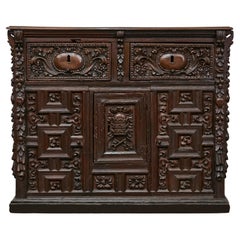
A Spanish Renaissance walnut spice cabinet from circa 1680 with abundant foliage carved décor. This captivating Spanish Renaissance walnut spice cabinet, dating to circa 1680, enchan...
Category

Late 17th Century Spanish Antique Renaissance Cabinets

Materials

Walnut

Gothic Renaissance Revival Carved Walnut Dragon Griffin Sideboard Buffet Cabinet
Located in Philadelphia, PA
Gothic Renaissance Revival Carved Walnut Dragon Griffin Sideboard Buffet Cabinet. Item features two-part construction with ornate carvings throughout including dragons/griffins and f...
Category

Late 19th Century Unknown Antique Renaissance Cabinets

Materials

Walnut

A 17th century Augsburg miniature marquetry collector cabinet
Located in PARIS, FR
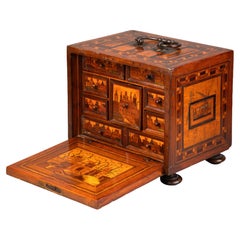
An early 17th century Augsburg miniature marquetry collector cabinet Dimensions: h. 18 cm, w. 19 cm, d. 14.5 cm. This charming little cabinet is inlaid on all sides with various nat...
Category

Early 17th Century German Antique Renaissance Cabinets

Materials

Fruitwood, Maple, Pine

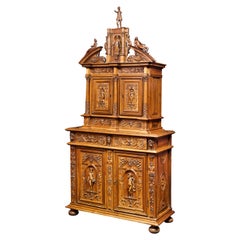
Monumental Hunt Cabinet 19th century carved oak Black Forest French Renaissance
By Alexander Roux
Located in Ijzendijke, NL
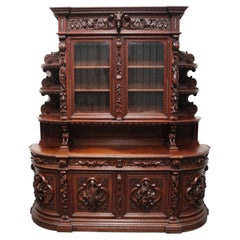
Rare monumental Hunt style Renaissance Revival cabinet by Alexander Roux 1870 museum quality piece. Carved out of solid oak with numerous rich details...
Category

1860s American Antique Renaissance Cabinets

Materials

Glass, Oak

16th Century French Carved Renaissance Cabinet
Located in Saint-Ouen, FR
Rare carved Renaissance cabinet Period : 2nd half 16th century, ca. 1570 Origin : France, Burgundy or Languedoc This cabinet embody the produ...
Category

16th Century French Antique Renaissance Cabinets

Materials

Walnut

French 19th Century Cabinet Confiturier
Located in Stockbridge, GA
This buffet confiturier is in the style of Henri II, rich in carvings. Buffet confiturier means a cabinet with 1 door that was in the 19th century generally used in the kitchen.
Category

Late 19th Century French Antique Renaissance Cabinets

Materials

Oak

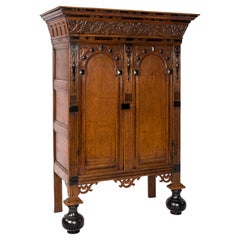
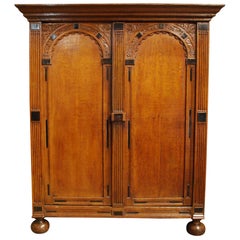
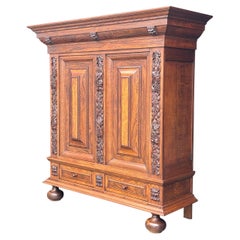
Antique 17th Century Dutch Oak and Ebony Two-Door Renaissance Cabinet
Located in Casteren, NL
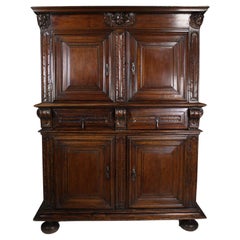
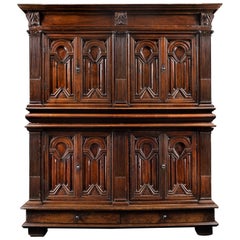
Antique 17th Century Dutch oak and ebony two-door Renaissance cabinet. This extraordinary cupboard is made of the finest quarter-sawn oak...
Category

17th Century Dutch Antique Renaissance Cabinets

Materials

Ebony, Oak

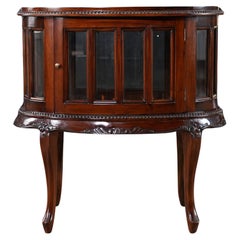
Oval Tray Top Mahogany Display Table
Located in Annville, PA
The Oval Tray Top Mahogany Display Table from Niagara Furniture is an exercise in elegance. The sweeping mahogany legs are created by hand and support the table’s finely carved skirt...
Category

2010s Renaissance Cabinets

Materials

Glass, Mahogany

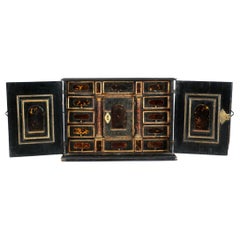
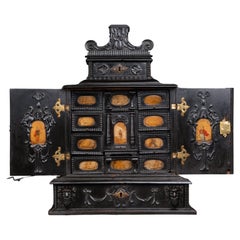
17th Century Italian Tortoiseshell Table Cabinet
Located in Bradenton, FL
17th century Ebonized case with parcel gilt decoration, iron handles and hinges. Fitted interior with inset tortoiseshell panels surrounded by brass filigree inlaid ebonized wood drawer and door fronts. Faux painted architectural columns on either side of center door which opens to reveal an additional set of small drawers. A rare early cabinet...
Category

17th Century Italian Antique Renaissance Cabinets

Materials

Tortoise Shell

17th C. Italian Tuscan Walnut Cabinet, original lock key, original back
Located in Brooklyn, NY
17th C. Italian Tuscan Walnut Cabinet, original lock & key, original back (very good antique condition, never touched) H: 73.5 D: 22.5 W: 80.75 ...
Category

17th Century Italian Antique Renaissance Cabinets

Materials

Walnut

Antique Ebonized Wood, Gilt Bronze and Hardstone Cabinet
Located in London, GB
This cabinet is an exquisite piece of antique furniture, which is crafted from beautifully-contrasting ebonised wood, golden gilt bronze (ormolu) and colourful hardstones. The ca...
Category

19th Century French Antique Renaissance Cabinets

Materials

Multi-gemstone, Ormolu, Brass, Bronze
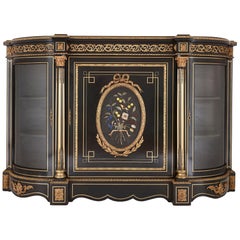
Antique Italian Pietra Dura Hardstone Wood Ormolu Cabinet on Stand
Located in London, GB
Antique Italian Pietra Dura Hardstone Wood Ormolu Cabinet on Stand Italian, Late 19th Century Height 227cm, width 141cm, depth 46cm Rich in detail and craftsmanship, this magnific...
Category

Late 19th Century Italian Antique Renaissance Cabinets

Materials

Stone, Ormolu

Antique Late 17th Century Dutch Renaissance Single-Door Cabinet in Solid Oak
Located in Casteren, NL
This elegant single-door cabinet was made in the Southern part of the Netherlands in the late 17th century. It was made in the best quality quarter-sawn oak in the tradition of the Dutch Renaissance during the “Dutch golden age”. The piece is of exceptional quality and was made completely in watered oak...
Category

Late 17th Century Dutch Antique Renaissance Cabinets

Materials

Steel

+17th century Dutch renaissance two door portal cabinet with exotic carvings
Located in Casteren, NL
On offer here is a very rare Dutch cabinet made of the finest European summer oak in the tradition of the Dutch Renaissance during the “Dutch Golden...
Category

Late 17th Century Dutch Antique Renaissance Cabinets

Materials

Ebony, Oak

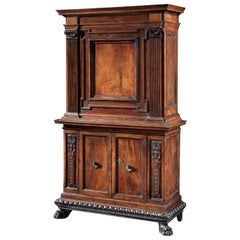
An Italian Renaissance Style Walnut Studiolo Cabinet, 17th Century
Located in ARMADALE, VIC
An Italian Renaissance Style Walnut Studiolo Cabinet, 17th Century Description: A renaissance style studiolo of architectural form in walnut, the exterior entablature with risen gal...
Category

17th Century Italian Antique Renaissance Cabinets

Materials

Walnut

16th Century Italian Renaissance Cabinet in walnut with rich carvings
Located in Meulebeke, BE
Italy / 16th Century / Cabinet / walnut / Renaissance / Antique Rare 16th Century Italian Renaissance cabinet in walnut with hand carved decorations of 3 heads and floral patterns f...
Category

16th Century Italian Antique Renaissance Cabinets

Materials

Walnut

16th Century Cabinet with Knights Carving from Avignon Workshops France
Located in Saint-Ouen, FR
Collection Jean Thuile Around the mid-sixteenth century French furnishing evolves in its conception and ornamentation. The start of major archi...
Category

16th Century French Antique Renaissance Cabinets

Materials

Walnut

18th Century Rustic Renaissance Two-Tiered Cabinet
Located in Dallas, TX
18th Century Rustic Renaissance Two-Tiered Cabinet is the perfect solution for more storage in style! Hand-crafted from solid oak, it features a subtly recessed upper tier flanked b...
Category

Late 18th Century Dutch Antique Renaissance Cabinets

Materials

Oak

French 17th Century and Later Cabinet on Stand
Located in Vancouver, British Columbia
An ornately-carved walnut 17th century and later French cabinet on stand, the top with a pair of carved doors and paneled carved sides with co...
Category

17th Century French Antique Renaissance Cabinets

Materials

Walnut

Exceptional Cabinet known as the Sumene Cabinet
Located in Saint-Ouen, FR
EXCEPTIONAL CABINET KNOWN AS THE SUMÈNE CABINET   ORIGIN : FRANCE, NÎMES PERIOD : 16th CENTURY   Height: 199 cm Width: 180.5 cm Depth: 69 cm   Walnut wood Good state of preservation ...
Category

16th Century French Antique Renaissance Cabinets

Materials

Wood, Walnut

Cassone Venetian 16thc Renaissance Cedar Original Stand Neptune Armorial Unicorn
Located in BUNGAY, SUFFOLK
A large, museum-quality, late-16th century, cedar, Venetian, cassone on its original stand ; the sea creature ornament probably drawn from De la Cosmographie Universelle, livre III, engraving 1550-1568 • This is the only, known, cassone of this type retaining its original stand. • The collection in Italy that it originally came from was a palazzo that it had reputedly been in for generations of the same family and this most likely why the stand has survived. • The decoration is very unusual, and delightful in the array of sea creatures depicted. The connection of the region with the sea is very strong. • The inner lid is very practical and can be used for display or serving. The interior offers masses of storage space which is particularly suitable for textiles being cedar which repels moths. • The cassone is a beautiful, rich colour and has developed a lustrous patina. • The cassone is Illustrated & discussed in discussed in ‘Woods in British Furniture Making’, (Bowett) c13 Provenance: Private collection, Mayorca. Private collection, Italy Related to: Cassone in V&A collection, no 4886-1858 Width 177 cm., 70 in., Height 87 cm., 34 ½ in. Depth 68 cm. 26 ½ in. With lid open 155 cm., 61 in “Late 16th and 17th century, London inventories confirm that cypress wood chests were relatively common in prosperous households. In 1598 there was a cypress chest in the hall of John Mason, a vintner, valued at 50 shillings. It was the most expensive piece of furniture in the house. Similarly there was a ‘fair cypress chest’ in the great chamber of Adrian Moore, haberdasher, in 1618, and a cypress chest worth £ 9 in the hall of Thomas Willis, a clotherworker in 1630. The chests were sometimes described as ‘great’ or ‘small’ but not otherwise described – presumably they were familiar to the compilers of the inventories. They were placed in halls, chambers and parlours, places where they would have been on prominent view. It is noteworthy that only the chests were imported and not, apparently, the wood. “ (p282, Cypress, Woods in British Furniture making) The decoration is very unusual, and delightful in the array of sea creatures depicted. The connection of the region with the sea is very strong. I have never seen one of these chests on its original stand. The collection in Italy that it came from was a palazzo that it had reputedly been in for generations of the same family and this most likely why the stand has survived. In practical terms, the stand makes the chest a comfortable height to use. The exterior of the chest is a beautiful, mellow colour and has developed a lustrous patina. The top comprises three planks faced with a shallow, cleated, moulded edge nailed on. The front retains its original hasp and lockplate and, as is commonly found, the lock has been removed but, unusually the original ring hinges have survived. The top opens to reveal an inner lid with ring hinges and a brass ring, revealing a large open storage compartment below, the bottom lined with an old fabric. The underside of the lid retains its original penwork and pierced decoration. The central panel depicts sea creatures, sharks, flatfish, monster fish, sea horses, Neptune and mermaids, probably drawn from De la Cosmographie Universelle, livre III, engraving 1550-1568. The panels either side depicting a crown, the sun and unicorns amongst stylised floral sprays. The surrounding naive penwork border features repeats of three naked ladies in the sea, a man wearing an animal mask with two dogs in a forest and a huntsman with two dogs. The floor of the inside of the cassone is upholstered in an 18th century red and yellow striped woven textile the colours of the Catalan flag. The front is decorated with pierced, silhouettes of beasts, trees and figures. The sides are plain with iron carrying handles. On its original stand, with similar decoration, and bearing a cartouche which would have been decorated with the arms of its original owner. Italian, last quarter of the 16th century. Condition Report : Old repair to bottom left moulding of top. Some hairline cracks to top. The hasp, lockplate and ring hinges are original, the lock has been removed. Handles probably 18th century. The inner lid was probably added in the 18th century and supporting mechanism in the 19th century. Exceptional original, lustrous colour and patina. Measures: Width 177 cm. 70 in., height 87 cm. 34 ½ in., depth 68 cm. 26 ½ in. The cassone was the principal piece of furniture in 16th century, Italy. These chests were made as bridal gifts for nobles and aristocrats from cedar specifically for storing their much prized and valued hangings, clothing and linens, as the wood repels moths and the sweet fragrance delicately scents fabrics. Consquently the cassone, as in this example might be decorated with the family coat of arms or with depictions of virtue and edifying episodes from the Bible. A young woman could not be allowed to enter marriage without some instruction. Later, many cassoni were taken apart so that the decorated front panel could be hung as a painting. The stand of this cassone has a cartouche that would have contained a painted coat of arms in the centre which shows that it was conceived for a noble family. Such cypress or cedar chests, incised in bas relief and pyrographically engraved, have long been associated with Venice and typically have a naïve decoration on the exterior. Literature: The 'cypress chests' containing 'arras, counterpoints, costely apparel, tents, and canopies, fine linen, Turkey cushions...
Category

16th Century Italian Antique Renaissance Cabinets

Materials

Cedar

French Late 16th Century Renaissance Walnut Deux-Corps Cabinet
Located in Troy, NY
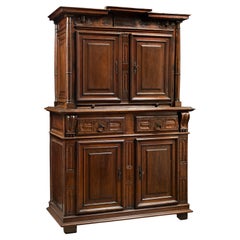
French Late 16th Century Renaissance Walnut Deux-Corps Cabinet in two parts. The top part with two carved doors featuring classical figures, opening to an interior fitted with three ...
Category

16th Century French Antique Renaissance Cabinets

Materials

Walnut

Painted Antique Renaissance Style French Bibliotheque Deux Corps
Located in Dallas, TX
This fabulous parcel paint bibliotheque or buffet a deux corps from Southwest France was created in the 19th Century, largely with 17th Century elements. The large variety motifs whi...
Category

Early 19th Century French Antique Renaissance Cabinets

Materials

Glass, Oak

18th Century Dutch Renaissance Cabinet
Located in Casteren, NL
This late 18th century cabinet is a so called 'kussenkast' or pillow cabinet. The pillow refers to the shape of the raised panels in the doors. It is a typical Dutch Renaissance cabinet...
Category

Mid-18th Century Dutch Antique Renaissance Cabinets

Materials

Oak

ITALIAN COUNTER/CABINET WITH TREMPE 19th Century
Located in Madrid, ES
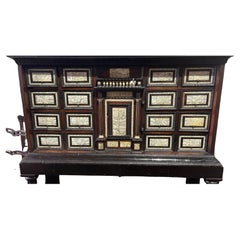
ITALIAN COUNTER/CABINET WITH TREMPE 19th Century Italian, 19th century. with ebony marquetry, ebonized wood with engraved ivory applications, decorated with "Compositions with mythol...
Category

19th Century Italian Antique Renaissance Cabinets

Materials

Wood

A 17th-18th Century French/Italian Renaissance Walnut Carved Credenza Cabinet
Located in Los Angeles, CA
A 17th-18th Century French/Italian Renaissance Walnut Figural Carved Credenza Cabinet or Cupboard. The two-part cabinet with a pair of upper coffered doors with metal key-hole hardwa...
Category

Late 17th Century Antique Renaissance Cabinets

Materials

Metal

Country Estate Four Drawer File
Located in Annville, PA
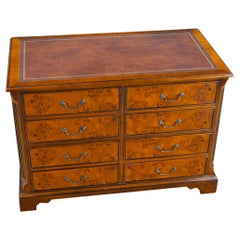
A highly functional and decorative piece this Country Estate Four Drawer File cabinet from Niagara Furniture is made with fine quality burled wood. The top of the cabinet is covered ...
Category

2010s Renaissance Cabinets

Materials

Leather, Wood

Antique French Renaissance Carved Walnut Floral Inlay Blind Door China Cabinet
Located in Philadelphia, PA
Antique French Renaissance Carved Walnut Floral Inlay Blind Door China Cabinet. Item features a satinwood floral design inlay, 2 wooden interior shelves, nicely carved details, 1 dov...
Category

Early 20th Century Renaissance Cabinets

Materials

Walnut

Antique Italian Renaissance 109" Tall Carved Wood Gothic Cupboard Hutch Cabinet
Located in Philadelphia, PA
Please message us with your zip code to request a more reasonable domestic U.S. shipping quote. Antique Italian Renaissance 109" Tall Carved Wood Gothic Cupboard Hutch Cabinet. Item...
Category

Late 19th Century Antique Renaissance Cabinets

Materials

Glass, Pine

First French Renaissance Dresser
Located in Saint-Ouen, FR
Provenance : Chabrières Arlès collection then through descent Under the reign of Henry II, during the French Renaissance, the rigour of composi...
Category

16th Century French Antique Renaissance Cabinets

Materials

Oak

Renaissance Style Wooden Cabinet Attributed to H.A. Fourdinois, France, 1893
Located in PARIS, FR
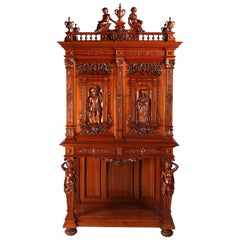
A wooden cupboard, elaborately carved throughout, dated "1893" on the crest and attributed to H.A. Fourdinois. The upper section with a pair of cherubs at the center of a balustrade ornamented with two-handled urns, two architectonic doors below, carved with lady and gentleman in niches surrounded by extensive carving with classical motifs. The lower section with two drawers above a standing female caryatid support at each front corner. The all reposing on four gadronned round feet. The Fourdinois company was founded in 1835 by Alexandre-Georges Fourdinois (1799-1871). The Universal Exhibition held in London in 1851 was undoubtedly their first great artistic and public success. Winning the Great medal for a neo-Renaissance buffet...
Category

1890s French Antique Renaissance Cabinets

Materials

Wood

Antique 17th Century Oak and Ebony Two-Door Renaissance Cabinet
Located in Casteren, NL
This extraordinary cupboard is made of the finest quarter sawn oak in the tradition of the Dutch Renaissance during the “Dutch golden age” It is a small two-door cabinet with arche...
Category

Mid-17th Century Dutch Antique Renaissance Cabinets

Materials

Ebony, Oak

A 17th century Augsburg ebonized cabinet with painted pietra paesina panels
Located in PARIS, FR
An ebonized wood cabinet with painted pietra paesina panels Augsburg, southern Germany, mid-17th century Dimensions: h. 43 cm, w. 32 cm, d. 20 cm Ebonized wood, inlay of painted piet...
Category

Mid-17th Century German Antique Renaissance Cabinets

Materials

Marble

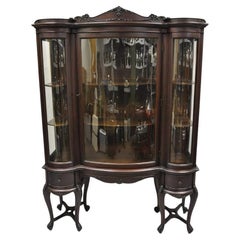
Antique French Renaissance Dark Walnut Triple Bowed Glass China Cabinet
Located in Philadelphia, PA
Antique French Renaissance Dark Walnut Triple Bowed Glass China Cabinet. Item features 2 lower drawers, raised on cabriole stretcher base leg...
Category

Early 20th Century Unknown Renaissance Cabinets

Materials

Glass, Walnut

Renaissance Cupboard from Loire Valley, France
Located in Saint-Ouen, FR
This cabinet is composed of two bodies, the upper one being recessed. The extraordinary proportions are enriched by a mythological and floral carved decor. The Lower body stands o...
Category

16th Century French Antique Renaissance Cabinets

Materials

Walnut

Antique Spanish Renaissance Figural Carved Oak Wood Religious Cupboard Cabinet
Located in Philadelphia, PA
Antique Spanish Renaissance Figural Carved Oak Wood 2 Pc Religious Cupboard Cabinet. Item features solid wood two part construction, carving that reads "Anno 1654" to crest, carved f...
Category

Late 18th Century Unknown Antique Renaissance Cabinets

Materials

Oak

Spanish Renaissance Style Walnut Wrought Iron Vargueno
Located in Queens, NY
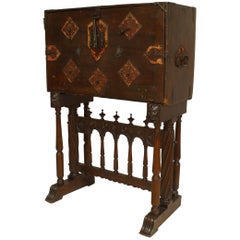
Spanish Renaissance style (17th Century and Later) wrought iron mounted walnut vargueno on later stand with a fall front enclosing 3 long drawers.
Category

17th Century Spanish Antique Renaissance Cabinets

Materials

Wrought Iron

19th Century Belgian Buffet À Deux Corps or China Cabinet
Located in Winter Park, FL
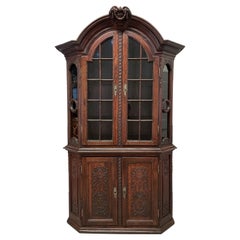
A 19th century buffet à deux corps from Belgian. Made of solid oak in two parts, the top has arched glass paned doors and opens to four removable shelves and the bottom opens to two ...
Category

19th Century Belgian Antique Renaissance Cabinets

Materials

Brass

Renaissance Palace Wardrobe with Perspectival Views
Located in Saint-Ouen, FR
A rare carved walnut wardrobe opening with four door-leaves and two drawers in the lower part. The doors bear architectural views in low reliefs, fluted pilasters and Ionic capitals. Upper Body Two door-leaves with carved architectural perspectives open the wardrobe framed by three fluted pilasters with Ionic capitals. Each door-leaf depict two semi-circular arcades whose cornice and base shows a central vanishing point. Likewise the pavement’s lines act for the artisan as a way to create depth. The vaulting instead leads us to think the vanishing point has to be situated where the handle is, between the two complementaries reliefs. The elegant moulded belt hides an internal secret space, accessible through a moveable plank in the upper body. Lower Body Two door-leaves identical to those of the upper body framed by three fluted pilasters with Doric capitals. The base of the wardrobe opens with two large drawers. The sides also bear panels depicting architectural perspectives. The external pilasters share their Ionic capital with the facade’s pilasters. Thus we can observe on the wardrobe’s sides the capital’s lateral parts with the elegant volute specific to the Ionic order. This palace wardrobe is topped by an overlapping cornice standing on three consoles for the facade and two consoles on each sides. Placed right above the pilasters each console are adorned by fully expanded leaves. During the 15th century a major interest for architecture and perspective studies arises and influences patrons tastes. The work of great theorists such as Leon Battista Alberti...
Category

16th Century Italian Antique Renaissance Cabinets

Materials

Walnut

Rare Cabinet depicting the Four Elements
Located in Saint-Ouen, FR
RARE CABINET DEPICTING THE FOUR ELEMENTS ORIGIN : FRANCE PERIOD : CIRCA 1600 Height: 178 cm Width: 112 cm Depth: 50 cm Former Perpitch Collection Forme...
Category

16th Century European Antique Renaissance Cabinets

Materials

Wood, Walnut

Rare 19th Century Italian Renaissance Murillo Design Collectors Writing Cabinet
Located in Reading, Berkshire
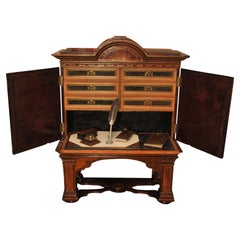
A Stunning and Rare 19th Century Handcrafted Tooled Brown Leather Italian Renaissance Design Fitted Writing Cabinet On Original Plinth Featuring fourteen hand-painted portraits (aft...
Category

Late 19th Century Italian Antique Renaissance Cabinets

Materials

Leather

Renaissance Cabinet form Lyon France
Located in Saint-Ouen, FR
Condition : Partly dating from the Renaissance. The backs and the drawer’s insides have been re-done. Historical background The 16th century is a prosperous period for Lyon...
Category

16th Century French Antique Renaissance Cabinets

Materials

Walnut

Important 16th Century Renaissance Florentine Drop Front Desk Cabinet
Located in Dallas, TX
An Italian Florentine Renaissance Carved Burl Walnut Fall-Front Writing Cabinet, Circa 1560, 16th century From the Davanzatti Palace Museum in Florence Height: 59 inches x 36 inches ...
Category

16th Century Italian Antique Renaissance Cabinets

Materials

Iron

Fontainbleau Renaissance Cabinet Bearing the Dodieu’s Family Coat-of-arms
Located in Saint-Ouen, FR
Fontainebleau renaissance cabinet bearing the Dodieu’s family coat-of-arms Origin : ILe De France, School of Fontainebleau Period : Second ...
Category

16th Century Antique Renaissance Cabinets

Materials

Walnut, Ebony

19th Century French Walnut Renaissance Grand Cabinet with Crystal Vitrines
Located in Sofia, BG
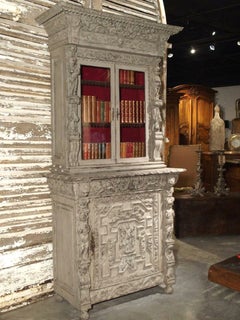
This magnificent and rare 19th century Renaissance grand cabinet with vitrines features intricate decorations heavily carved into the solid walnut wood. There are massive carved wood...
Category

Mid-19th Century French Antique Renaissance Cabinets

Materials

Walnut

French Renaissance Cabinet with Perspectives
Located in Saint-Ouen, FR
This Renaissance Cabinet reveals the great mastery of the Lyon workshops which are at the origin of its realization. Sculptors and wood-carvers worked here in symbiosis to express an...
Category

16th Century French Antique Renaissance Cabinets

Materials

Walnut

Vintage Councill 2 Part Breakfront
Located in Annville, PA
From Niagara Furniture a Vintage Councill 2 Part Breakfront in excellent, ready to use in your home, condition. Simple yet sophisticated this beautiful Councill Mahogany Vintage Bre...
Category

1980s North American Vintage Renaissance Cabinets

Materials

Mahogany

Carved sideboard, France, ca. 1880.
Located in Chorzów, PL
Carved sideboard, France, ca. 1880. Very good condition. Wood: walnut Dimensions: height: 220 cm width: 140 cm depth: 62 cm
Category

Late 19th Century French Antique Renaissance Cabinets

Materials

Walnut, Glass

19th Century Dutch Renaissance Rosewood Cabinet
Located in Petworth,West Sussex, GB
An exquisite antique mid 19th century Dutch cabinet or cupboard in the renaissance style, crafted from the finest rosewood veneers on solid oak. Moulded top cornice, above a frieze o...
Category

19th Century Dutch Antique Renaissance Cabinets

Materials

Oak

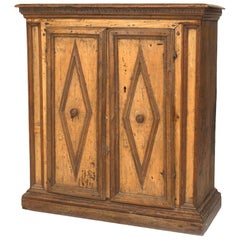
Italian Renaissance Tuscan Walnut Cabinet
Located in Queens, NY
Italian Renaissance Tuscan (late 17th Century) walnut cabinet having 2 doors with a diamond design.
Category

Late 17th Century Italian Antique Renaissance Cabinets

Materials

Walnut

Writing Cabinet Scrittoio Escritoire Desk Walnut Italy Florence Renaissance
Located in BUNGAY, SUFFOLK
An exceptionally rare, late-Renaissance, Florentine, walnut, writing cabinet, scrittoio, escritoire or desk in two parts This striking, writing cabinet has a classical form, ornam...
Category

Early 1600s Italian Antique Renaissance Cabinets

Materials

Walnut

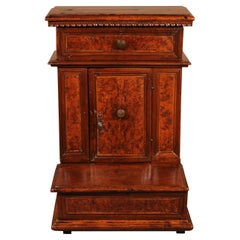
Prie-Dieu or Oratory in Walnut and Burl Walnut, circa 1600
Located in Brussels, Brussels
Elegant oratory or prieu dieu (prayer Kneeler) in walnut and burr walnut from northern Italy circa 1600 Very beautiful Italian Renaissance furniture...
Category

16th Century Italian Antique Renaissance Cabinets

Materials

Walnut

16th Century Renaissance Two-Bodied Cabinet
Located in Saint-Ouen, FR
Former collection Altounian At the beginning of the reign of Henri II (1547-1559) the furniture’s ornamentation evolves. The few medieval motifs that were still used are eventually relinquished. Furniture becomes more sober showcasing moulded panels and perfect architecture. Cabinet-makers use ornaments such as curved fluted or plain columns, feather quills, roses or winged putti heads. High-relief carving becomes more scarce and compositions lighter. To that end cabinet-makers draw inspiration from Fontainebleau motifs filtering them and adapting them to French taste. During this period cabinet-makers turn into a kind of architects. Indeed the architectural balance of furniture is the centre of their concerns. The study of Antic formulas is then a necessity. From this care given to proportions appear refined cabinets with pure lines. This style is characteristic of the reign of Henri II and disappears soon after under the regency of Catherine de Medici (1560-1574) when an abundance of high and low-relief ornaments comes back on furnitures. This two-bodies cabinet...
Category

16th Century French Antique Renaissance Cabinets

Materials

Walnut

Exceptional Large Antique Italian Renaissance Cabinet With Heraldic Crest
Located in Bridgeport, CT
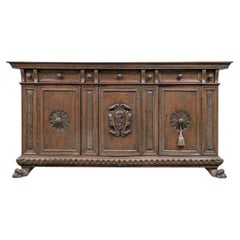
An exceptional Renaissance style antique cabinet with imposing style and presence. Solid cabinet with a central door having a carved heraldic element flanked by two doors with carved...
Category

19th Century Antique Renaissance Cabinets

Materials

Hardwood

Chest of Drawers Chest Commode Architectural Facade Enclosed Renaissance Cedar
Located in BUNGAY, SUFFOLK
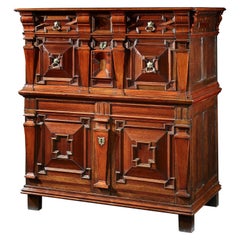
A museum quality, English, Late-Renaissance, cedar enclosed chest of drawers with exceptional snakewood, walnut & oak with an architectural or façade front This is the most sophisticated English model of chest of drawers conceived as a cabinet piece with an architectural front intended to disguise the drawers. This chest exhibits the mastery of English Late-Renaissance, cabinet making combining woods prized for their exoticism, color and beautiful figuring with carving and moulding in different ornamental patterns to simulate materials found within an architectural façade...
Category

Early 17th Century European Antique Renaissance Cabinets

Materials

Cedar

Neo-Renaissance Cabinet by G.F. Quignon, Universal Exhibition of Paris 1889
By Frederic Gustave Quignon
Located in PARIS, FR
Presented at the Universal Exhibition of Paris in 1889 Important sculpted and engraved natural wood, patinated bronze and Griotte de Campan red marble inlaid Neo-Renaissance style cabinet. The upper part is composed of a frieze of bronze medallions separated by triglyphs and supported by ribbed columns with Corinthian capitals. There are eight of these columns paired at the front and two simple columns at the rear. The facade presents an alternation of bronzes in niches and cartouches, of marble slates in cartouches sometimes flanked by palmettes, and of engraved motives of laurel and foliage scrolls. The upper part opens with three leaves and three mobile compartments. The belt carved with acanthus leaves opens with two drawers. This cabinet is supported by four richly sculpted tapered feet ending with claws. Four fluted pilasters are inscribed in the moulded back as counterparts. The whole ensemble stands on a moulded plinth and eight rounded feet. Neo Renaissance Cabinet...
Category

1880s French Antique Renaissance Cabinets

Materials

Marble, Bronze

A tall 17th C. walnut cabinet buffet, having a plank top with dentil moulding.
Located in Buchanan, MI
A tall walnut cabinet buffet, having a plank top with dentil moulding above a two drawers. The carved paneled doors, flanked by Doric columns sitting on multi-moiled base, supported ...
Category

17th Century Italian Antique Renaissance Cabinets

Materials

Walnut

Renaissance cabinets for sale on 1stDibs.

Find a broad range of unique Renaissance cabinets for sale on 1stDibs. Many of these items were first offered in the 21st Century and Contemporary, but contemporary artisans have continued to produce works inspired by this style. If you’re looking to add vintage cabinets created in this style to your space, the works available on 1stDibs include case pieces and storage cabinets, more furniture and collectibles, building and garden elements and other home furnishings, frequently crafted with wood, walnut and other materials. If you’re shopping for used Renaissance cabinets made in a specific country, there are Europe, France, and Italy pieces for sale on 1stDibs. While there are many designers and brands associated with original cabinets, popular names associated with this style include Europa Antiques, Edouard Lievre, Paul Sormani, and Alexander Roux. It’s true that these talented designers have at times inspired knockoffs, but our experienced specialists have partnered with only top vetted sellers to offer authentic pieces that come with a buyer protection guarantee. Prices for cabinets differ depending upon multiple factors, including designer, materials, construction methods, condition and provenance. On 1stDibs, the price for these items starts at $950 and tops out at $167,108 while the average work can sell for $9,800.

Still Thinking About These?

All Recently Viewed