Mid-19th Century Decorative Art
to
791
1,693
123
1,830
Height
to
Width
to
89
50
24
16
11
4
3
3
2
2
2
2
1
1
1,799
6,052
6,778
2,324
1,611
2,086
1,411
380
96
255
195
162
467
435
489
262
140
1,622
120
49
43
39
603
328
286
162
47
1,830
1,830
1,830
9
7
4
3
3
Period: Mid-19th Century
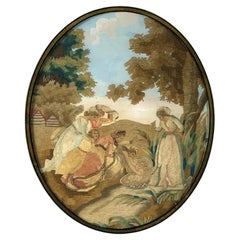
Needlework Biblical Scene Moses Drawn From The River Nile England Circa 1840
Located in Katonah, NY
The Bible story of baby Moses drawn from the River Nile made with silkwork and chenille.
Moses is gently taken from a basket made of reeds while his sister Miriam watches over him.
...
Category
English Romantic Antique Mid-19th Century Decorative Art
Materials
Silk
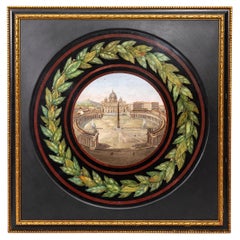
Large Antique Italian Micro Mosaic plaque of St. Peters Square, Rome mid 1800
s
By Vatican Mosaic Studio
Located in New York, NY
A Very Large and Exceptionally Fine Quality Antique Italian Micro-Mosaic Plaque Depicting "The Saint Peter Square" in Rome. The center medallion surrounded by a beautiful Laurel Wreath in multiple shades of Green Mosaic amidst a black Belgium Marble border. The interior rounded subject depicts Saint Peter Square which is found in Rome, Italy. The entire center panel is made up of a captivating array of tesserae in a variety of shapes and colors, which create this stunning mosaic construct. When inspected from up-close, small rectangular tesserae are found in an assortment of colors, which include: white, green, blue, red, black, brown, orange etc. When the subject is seen from afar, a fantastic image of the entire Saint Peter Square can be viewed as if a painting has been created. The oil on canvas of this scene, by was sold in Christie's Auction for over $2,000,000 USD. The plaque rests in a custom ebonized and gilt square frame. This can be used as a decorative object on the wall to serve as a painting, or, be converted to a table-top by mounting it on a table stand.
Rome, Circa: 1850
Giovanni Paolo Panini (Piacenza 1691-1765 Rome), View of Saint Peter's Square, Rome.
From Christie's Auction:
Giovanni Paolo Panini arrived in Rome in 1711, painting capricci and architectural pieces in a vigorous if slightly eccentric style, and by 1719, when he was admitted to the Academy of St. Luke and the virtuosi al Pantheon, he was a rising star in the Roman art world. From around 1719-1726 he was much in demand for decorative frescoes, including quadratura, ornament and landscape and other genres, often in collaboration with figure or flower painters. During this period he worked for Cardinal Patrizi at Villa Patrizi, Cardinal Annibale Albani at Palazzo Albani (now del Drago) alle Quattro Fontane, Livio de Carolis at Palazzo de Carolis, Cardinal Alberoni at Palazzo Alberoni, Innocent XIII Conti in the Quirinal and in the library of S. Croce in Gerusalemme. In 1724 he married Caterina Gosset, the sister-in-law of Nicolas Vleughels, the director of the French Academy in Rome, to which he was admitted in 1732, and as a result he was much patronized by the French. During the 1720s he developed his figure style away from the awkwardness of his early works into one that concentrated on groups of stylishly-dressed aristocrats and skillfully modelled bystanders, sibyls and pseudo-antique figures. These he noted down in drawings (such as a sketchbook in the British Museum) that he drew upon to populate his paintings. He also began to receive commissions to design and record temporary festivals, often for French ambassadors to Rome.
By the beginning of the 1730s Panini was developing a distinctive subgenre of the capriccio in which recognizable monuments are placed in imaginary topographical relationships, which were well-received in the classicizing era of Clement XII Corsini. In 1732 he was one of the panel of judges for the competition instituted by Clement for the Lateran façade, and in the following year painted an impressive View of Piazza del Quirinale for the pope. At about this time he was developing his best-known topographical subjects, interior views of St Peter's and the Pantheon, which were much in demand, to judge by the number of extant versions extending into the 1750s. By about 1734 he was beginning to attract the attention of English patrons, who ordered sets of Roman views, such as those at Marble Hill House (1738) and Castle Howard. In 1736, through Filippo Juvarra, he received important commissions from Philip V of Spain for scenes of the life of Christ in the Chinoiserie room at La Granja in Spain (1736). From as early as the 1720s he had been producing some vedute (view-paintings), initially based on prototypes by Gaspar van Wittel, and he developed the genre in subsequent decades in works that would include impressive panoramic views of the Forum or Palatine, although his staple genre was the capriccio rather than the veduta. He also expanded his repertory of church interiors, adding such churches as S. Paolo fuori le Mura and S. Agnese in Piazza Navona, as well as church interiors recording special events. His son by his first marriage, Giuseppe (1718-1805), began to support him in architectural and festival design projects.
By the 1740s Panini was at the peak of his powers, and evidently had a considerable workshop helping him meet demand, especially of capricci to be used as overdoors and other decorative installations. Giovanni Paolo was successful in elevating himself socially above the usual artisanal status of genre painters, and would sometimes include a self-portrait in paintings commissioned by the great and powerful. He also appears to have been successful financially, and owned a substantial palazzo in via Monserrato. He increasingly concentrated on important commissions, such as a view of the Lottery in Piazza Montecitorio (London, National Gallery, 1743-1744), the designs for the festival decorations for the birth of the Dauphin in Palazzo Farnese (Waddesdon Manor, 1751), or the view of an imaginary picture gallery housing the collection of Cardinal Valenti Gonzaga (Wadsworth Atheneum, 1749). In the mid-1750s he received an important series of commissions from the Duc de Choiseul, French ambassador to Rome and soon to become one of the most powerful men in France, that included his best-known compositions, Ancient Rome (Roma Antica) and Modern Rome (Roma Moderna). These large paintings, of which there are three sets (in Boston and Stuttgart, the Metropolitan Museum, and the Louvre) represent imaginary picture galleries based on the Valenti Gonzaga composition but hung with what purport to be Panini's own vedute of ancient and modern sites respectively (with corresponding pieces of sculpture). These paintings sum up the eighteenth-century canon of the greatest works of architecture and sculpture, and the equivalence between modern and ancient Rome. By this time Panini was being assisted by his son by his second marriage, Francesco (1748-1800), who was a skilled draughtsman and painter who continued his father's work after his death in 1765.
The Farnborough Hall paintings
The Piazza S. Pietro and the Campidoglio are important vedute by Panini painted in 1750 and originally installed, with other works by Panini and Canaletto, in the seat of the Holbech family, Farnborough Hall, Warwickshire (National Trust). Farnborough Hall had been inherited in 1717 by William Holbech (circa 1699-1771), who is documented on the Grand Tour in Florence, Rome and Venice from late 1732 until his return home at the end of April 1734 with his brother Hugh. Holbech is said to have gone on the Grand Tour to recover from a broken heart and to have spent a considerable time there prior to these documented appearances. During his time in Rome he acquired two Paninis, which were seen by an anonymous antiquary around 1746, who referred to various sculptures "all brought from Rome with two pictures, one of the Rotunda, and the other of diverse buildings by Panino" (British Library, Add. MS 6230, pp. 31-32). The Rotunda (the Pantheon) is a painting now in a private collection in New York, and is signed and dated 1734. The Diverse Buildings, which was probably one of Panini's capricci, has not been identified. On his Grand Tour Holbech seems also to have acquired two Canalettos, although they are not mentioned by the antiquary, who may only have had eyes for things Roman.
In about 1746-1747, Holbech remodelled the house by creating a Saloon, now the dining room, at the back of the house. This room, the entrance hall, the staircase, library and closet were stuccoed by William Perritt of York, and a bill for this work dated 14 November 1750 survives (or survived until recently; G. Beard, Decorative Plasterwork in Great Britain, London, 1975, p. 233). The two Canalettos acquired on the Grand Tour were installed in the Saloon, together with two new works commissioned from Canaletto, who was then in England and working nearby at Warwick Castle in 1748. The two Paninis acquired on the Grand Tour may have been installed in the Library, as Alastair Laing assumes (op. cit.), while three new works commissioned from Panini in Rome were placed in the Hall and Saloon: the Piazza S. Pietro for the overmantel in the Hall (fig. 1), the Campidoglio as the overmantel in the Saloon (fig. 2), and an Interior of St Peter's (now in Detroit) (fig. 3) on the adjacent wall facing the windows. Two of the Canalettos flanked the Campidoglio, while the others were on the opposite wall. The Interior of St Peter's was therefore effectively the fifth member of the Canaletto set, distinct from the two overmantels.
Holbech's installation of his Canalettos and Paninis in fixed stucco frames was unusual for England in 1750, and had probably been inspired by what he had seen on his Grand Tour in Northern Italy, where fixed stucco installations of canvases were common in the 1720s and 1730s (Cornforth, II, p. 51). The Campidoglio and the Interior of St Peter's are both signed and dated 1750, a date that corresponds to the payments for the stucco.
The commission for the new Paninis would have been made through an agent, possibly the Roman dealer in antiquities Belisario Amidei from whom some of the antique busts in the Hall were acquired in 1745, who was also a picture dealer; or perhaps the painter Pietro Berton, who on 7 December 1750 shipped a Panini to England.
The paintings were sold to Savile Gallery in 1929 and replaced by copies by one Mohammed Ayoub. The four Canalettos were exhibited at Savile Gallery in 1930 and entered the London art trade, finding their way at various times to Augsburg, Melbourne, Ottawa and a private collection. The Paninis seem to have been resold immediately to Knoedler & Co. in New York. When the stucco was removed from the library by Holbech's great-grandson, another William Holbech, shortly after his succession in 1812, the Interior of the Pantheon and the Diverse Buildings may have been taken down. Although there is no record of either painting being at Farnborough subsequently, the Interior of the Pantheon at least must have remained there, since it appeared at Knoedler's in 1930 at about the same time as the other Paninis, and was presumably acquired at the same time from the same source.
The Campidoglio was a rare subject for Panini: this is the only known extant version, apart from fictive versions in the Metropolitan Museum (1757) (figs. 4) and Louvre (1759) versions of his Roma Moderna composition (but not in the first Boston version of 1757). Probably Holbech insisted on the choice of subject in order to represent the centre of Rome's civic administration to complement the religious one of St Peter's. The Campidoglio may have been of interest to English patrons because it represented the seat of a form of government they were more comfortable with than the papacy. For example, Canaletto painted the subject, together with English subjects, for Thomas Hollis, 'the most bigoted of all Republicans' in 1755, who may have wanted to 'represent London as the heir to the legacy of Ancient Rome and Renaissance Italy' (see Michael Liversidge and Jane Farrington, eds., Canaletto and England, exhibition catalogue, Birmingham Museums and Art Gallery, London, 1993, p. 25). Canaletto also painted the subject for Sir Richard Neave, Ist Baronet (1731-1814) of Dagnam Park, Essex, at the end of his English stay or shortly afterwards (i.e. 1755-1766) (sold, Sotheby's, London, 10 July 2002, lot 8). Like Holbech, Neave mixed Venetian and Roman subjects, but his Roman subjects steer clear of St Peter's: the others were the Piazza del Quirinale and Piazza Navona. While Holbech had gone to both Venice and Rome and commissioned views of both cities, Rome sets the keynote for his decoration: antique busts line the Hall, and its religious and civic centres are the overmantels in the Hall and Saloon respectively.
The Piazza S. Pietro
The Piazza S. Pietro shows the piazza much as it appears today, apart from the absence of Valadier's late eighteenth-century clocks on the towers. Bernini's colonnade (1656-1667), both ends of which are visible, reaches out its arms to embrace the viewer. In the center of the piazza is the obelisk moved by Sixtus V in 1586 from the left side of the church where it had formed part of the Circus of Nero. On either side are two fountains, the one on the right by Carlo Maderno (1613) and the one on the left created to match it by Carlo Fontana in 1677. Beyond is the rectangular forecourt to the church, the piazza retta, leading to the façade by Maderno, completed in 1610, and the dome by Michelangelo, Giacomo della Porta and Domenico Fontana. To the right of the façade the roof of the Sistine Chapel is just visible, followed by the Cortile di S. Damaso, the palace of the Swiss Guards and the palace of Paul V. A Cardinal is being driven in a carriage across the piazza at the right in the direction of the Borgo Nuovo and Ponte S. Angelo with his blue-liveried retinue and subsidiary carriages. Unlike the later versions of the subject that depict the Duke de Choiseul, there seems to be no intent to portray any particular cardinal: the procession of a cardinal here is presented simply as characteristic activity within the piazza. Various groups of figures, including well-dressed women in brightly colored dresses, Swiss Guards, priests, gentlemen, idlers and a pilgrim are distributed around the piazza. In the foreground an imaginary heap of fallen masonry provides visual interest in an otherwise dead space.
Panini painted the Piazza S. Pietro on a number of occasions, and his works falls into two types, one with the viewpoint shifted slightly to left of the axis, as in the Farnborough Hall version, and one with it shifted slightly to the right. The first type is based on a composition by Gaspar van Wittel, of which there are numerous versions from 1684 until 1721 (Fig. 9 van Wittel). The work by Panini that seems closest to Van Wittel and therefore probably the earliest is the version in the Circolo della Caccia, Rome, which has been dated to the second half of the 1730s, but is probably a decade or so earlier. Another, on the London art market in 2002-2009, and a version with workshop participation at Sotheby's, Milan (20 November 2007, lot 137) and currently on the art market in Rome, are closer to an important painting in Toledo (Arisi no. 308) that is signed and dated 1741 (fig. 6).
Van Wittel employed a wide format (about 2:1), showed both of the end faces of the colonnade almost to their full extent, and introduced the theme of a heap of masonry to enliven the foreground. His choice of perspective implies a viewpoint located in the small piazza between the Borgo Nuovo and Borgo Vecchio, now the Piazza Pio XII at the top of the Via della Conciliazione. From this viewpoint a building at the left tended to interfere with the view of the end of the left arm, as can be seen from the Nolli map...
Category
Italian Louis XVI Antique Mid-19th Century Decorative Art
Materials
Glass
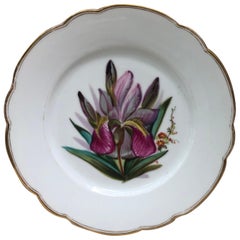
French Porcelain Purple Iris Plate, circa 1850
Located in Austin, TX
French porcelain purple iris plate, circa 1850.
Category
French Louis Philippe Antique Mid-19th Century Decorative Art
Materials
Ceramic, Porcelain
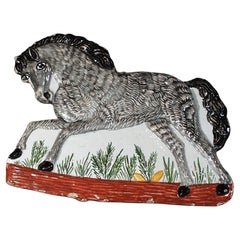
Faience Plaque in the Form of a Horse, circa 1840
By Rörstrand
Located in Downingtown, PA
Continental faience plaque in the form of a horse,
circa 1840,
Probably Rorstrand.
The plaque is amusingly decorated with a galloping gray horse wi...
Category
Swedish Early Victorian Antique Mid-19th Century Decorative Art
Materials
Ceramic, Faience
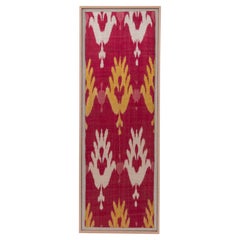
Framed Antique Silk and Cotton Ikat Fragment, 19th C.
Located in Istanbul, TR
First the fragment has been hand backed on a linen fabric, then stretched over a wooden stretcher and finished with a wooden frame.
Late 19th C. Uzbekistan
Ready to go on a wall.
Fr...
Category
Uzbek Folk Art Antique Mid-19th Century Decorative Art
Materials
Silk
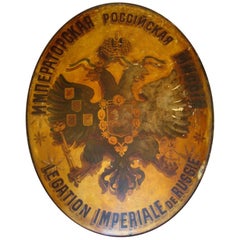
Romanoff Arms of the Russian Empire Embassy or Consulate Painted Sign
Located in Buenos Aires, Olivos
Early Embassy or Consulate painted sign. Sign says Legation Imperiale de Russie, this sign was used from 1850 to 1917, it is very rare to find these things with the Russian Empire Ca...
Category
Russian Art Nouveau Antique Mid-19th Century Decorative Art
Materials
Tin
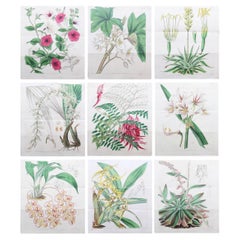
Set of 9 Large Scale Original Antique Botanical Prints. Curtis. Dated 1837
Located in St Annes, Lancashire
Wonderful set of 9 botanical prints
Lithographs after drawings by William Fitch
Original hand color
Published by S.Curtis. Dated 1837
Unframed.
Free shipping
Category
English Georgian Antique Mid-19th Century Decorative Art
Materials
Paper
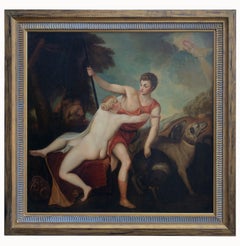
Continental Mythological Antique Oil on Canvas of Venus and Adonis
Located in Tarzana, CA
A 19th century continental mythological oil painting on canvas of Aphrodite and Adonis, after the 16th century painting by Titian (now in the Metropolitan Museum of Art, New York)
...
Category
British Renaissance Antique Mid-19th Century Decorative Art
Materials
Canvas
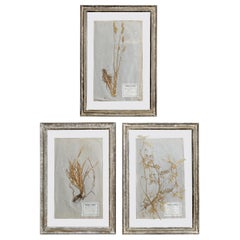
Set of 3 framed Antique Herb Specimens P T Husnot
Located in Hastings, GB
Beautiful set of 3 Framed antique herb specimens taken from the private collection of acclaimed French bryologist PT Husnot, these are from his private collection of specimens and ha...
Category
French Belle Époque Antique Mid-19th Century Decorative Art
Materials
Glass, Pine
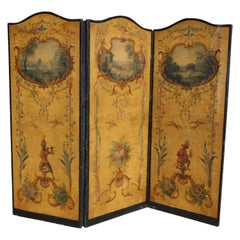
French Three Panel Decorative Painted Canvas Screen with Musical Monkeys C. 1830
Located in Charleston, SC
French three panel decorative painted canvas folding screen with dogs playing in landscape scenes, perched musical monkeys, and foliage motif. Early 19th century.
Category
French Louis Philippe Antique Mid-19th Century Decorative Art
Materials
Canvas, Wood, Paint
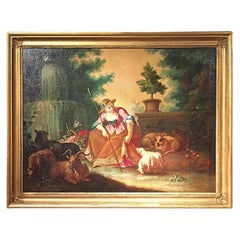
After Boucher Large Rococo Styled Pastoral Scene Possibly of a Series
Located in Nashville, TN
Probably inspired by the earlier Boucher's Spring (of the 4 Seasons series), shepherdess with her flock and baskets of flowers. Colorful in an antique (possibly original) frame (with...
Category
French Rococo Antique Mid-19th Century Decorative Art
Materials
Canvas
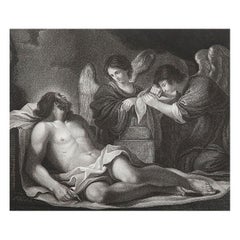
Original Antique Print of Christ In The Sepulchre After Guercino . C.1850
Located in St Annes, Lancashire
Great image after Guercino
Fine steel engraving
Published by Jones circa 1850
Unframed.
Free shipping
Category
English Renaissance Antique Mid-19th Century Decorative Art
Materials
Paper
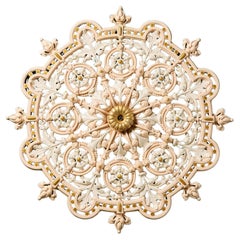
Antique Victorian Cast Iron Ceiling Rose Panel
Located in Wormelow, Herefordshire
An antique Victorian style cast iron English ceiling rose wall panel.
Dating to circa 1850, this panel is evocative of Victorian style with its finely cast design and repeating patt...
Category
English Victorian Antique Mid-19th Century Decorative Art
Materials
Metal, Iron
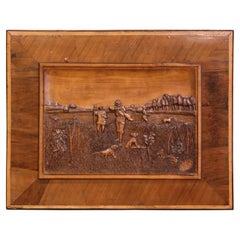
19th Century French Black Forest Hand Carved Hunt Scene Wall Decor
Located in Dallas, TX
Decorate a ranch, hunting lodge or simply a man's office with this elegant antique wall decor. Crafted in France circa 1870, the hand carved artwork...
Category
French Black Forest Antique Mid-19th Century Decorative Art
Materials
Walnut
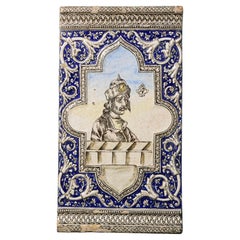
Large 19th Century Persian Qajar Pottery Islamic Tile
Located in Wormelow, Herefordshire
A rare large 19th century Persian Qajar pottery Islamic tile.
In a large scale painted with a depiction of a Persian prince within a shaped cartouche flanked by scrolling foliage and vines.
An excellent decorative wall piece for collectors of ceramic history.
Qajar era (1785–1925)
The Qajar era was a time of struggle to maintain Persian tradition and identity while embracing innovation and modernity.
The rarely explored field of Qajar ceramics...
Category
Persian Antique Mid-19th Century Decorative Art
Materials
Ceramic
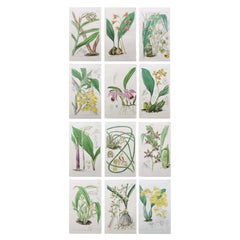
Set of 12 Original Antique Botanical Prints- Orchids. Curtis. Dated 1837
Located in St Annes, Lancashire
Wonderful set of 12 orchid prints.
Lithographs after drawings mainly by W.Fitch
Original hand color
Published by Curtis. Dated 1837 and 1838
Unframed.
Free shipping
Category
English Georgian Antique Mid-19th Century Decorative Art
Materials
Paper
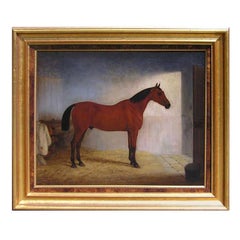
English Oil on Canvas Horse Portrait in Burl Walnut Gilt Frame, Signed. C. 1866
Located in Charleston, SC
English oil on canvas horse portrait in burl walnut giltwood and beaded molded edge frame. Signed & Dated by Artist "J. Brown Coventry 1866"
Category
English William IV Antique Mid-19th Century Decorative Art
Materials
Canvas, Wood, Giltwood, Paint
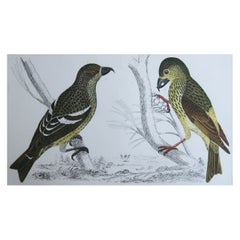
Original Antique Print of Crossbills, 1847
Unframed
Located in St Annes, Lancashire
Great image of crossbills
Unframed. It gives you the option of perhaps making a set up using your own choice of frames.
Lithograph after Cpt. brown with original hand color.
...
Category
English Folk Art Antique Mid-19th Century Decorative Art
Materials
Paper
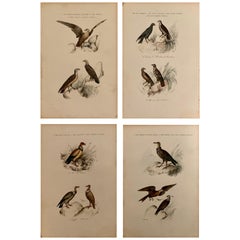
Set Of 4 European Hand Colored Prints Of Birds From 1830
Located in Haddonfield, NJ
A set of 4 hand colored birds prints, from 1830. By Comte, Achille Joseph (1802-1866),
"Keepsake d´histoire naturelle. Description des oiseaux. Suivie d´un exposé de l art de les pré...
Category
French Biedermeier Antique Mid-19th Century Decorative Art
Materials
Paper

$476 Sale Price / set
20% Off
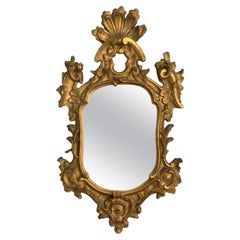
Gilded Mirror Regency Style 19th Century
Located in Beuzevillette, FR
Very beautiful mirror, Regency style, a transitional style between the Louis XIV and Louis XV styles. One recognizes this style with its numerous volutes, shells and leaves. A very d...
Category
French Regency Antique Mid-19th Century Decorative Art
Materials
Mirror, Wood
$1,705 Sale Price
20% Off
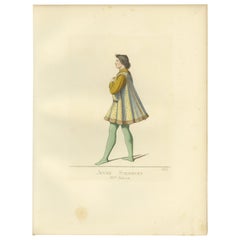
Antique Print of a Young Man from Siena by Bonnard, 1860
Located in Langweer, NL
Antique print titled ‘Jeune Siennois, XVe Siecle.’ Original antique print of a young man from Siena, Italy, 15th century. This print originates from 'Costumes historiques de femmes d...
Category
Antique Mid-19th Century Decorative Art
Materials
Paper
$94 Sale Price
20% Off
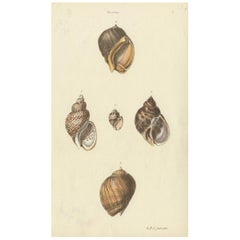
Antique Hand-colored Print of Eburna "Sea Snails", Published circa 1833
Located in Langweer, NL
Antique print illustrating various eburna species. Eburna is a genus of sea snails, marine gastropod mollusks in the family Olividae. Engraved by G.B.S. Jun ...
Category
Antique Mid-19th Century Decorative Art
Materials
Paper
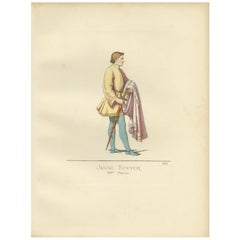
Antique Print of a Young Squire, Italy, 14th Century, by Bonnard, 1860
Located in Langweer, NL
Antique print titled ‘Jeune Ecuyer, XIVe Siecle.’ Original antique print of a young squire, Italy, 14th century. This print originates from 'Costum...
Category
Antique Mid-19th Century Decorative Art
Materials
Paper
$94 Sale Price
20% Off
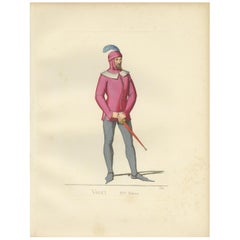
Antique Print of a Member of the Calza Society, 15th Century, by Bonnard, 1860
Located in Langweer, NL
Antique print titled ‘Compagnie de la Calza, XVe Siecle.’ Original antique print of a member of the Calza Society, Italy 15th century. This print originates from 'Costumes historique...
Category
Antique Mid-19th Century Decorative Art
Materials
Paper

$94 Sale Price
20% Off
Antique Print of an Italian Valet or Servant by Bonnard, 1860
Located in Langweer, NL
Antique print titled ‘Valet, XIVe Siecle.’ Original antique print of an Italian valet or servant, 14th century. This print originates from 'Costumes historiques de femmes du XIII, XI...
Category
Antique Mid-19th Century Decorative Art
Materials
Paper
$94 Sale Price
20% Off
Antique Print of Cimabue, 14th Century, by Bonnard, 1860
Located in Langweer, NL
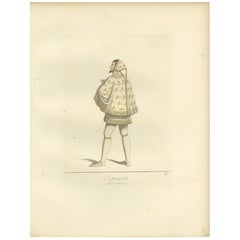
Antique print titled ‘Cimabue, XIVe Siecle.’ Original antique print of Cimabue, an Italian painter and designer of mosaics from Florence. This print originates from 'Costumes histori...
Category
Antique Mid-19th Century Decorative Art
Materials
Paper
$94 Sale Price
20% Off
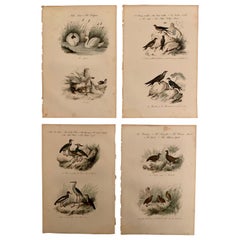
Set of 4 European Hand Colored Prints of Birds from 1830
Located in Haddonfield, NJ
A set of 4 hand colored birds prints, from 1830. By Comte, Achille Joseph (1802-1866),
"Keepsake d´histoire naturelle. Description des oiseaux. Suivie d´un exposé de l art de les pré...
Category
French Biedermeier Antique Mid-19th Century Decorative Art
Materials
Paper
$476 Sale Price / set
20% Off
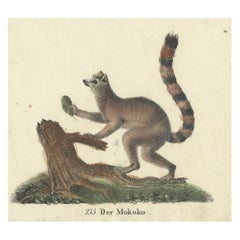
Original Antique Animal Print of a Ring-Tailed Lemur
Lemur Catta
Monkey, 1833
Located in Langweer, NL
Original antique print titled 'Der Mokoko'. Antique print of a mokoko or Ring-tailed lemur (Lemur catta).
The ring-tailed lemur (Lemur catta) is a large strepsirrhine primate and ...
Category
Antique Mid-19th Century Decorative Art
Materials
Paper
$227 Sale Price
20% Off
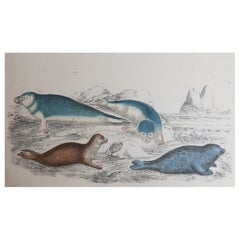
Original Antique Print of Seals, 1847
Unframed
Located in St Annes, Lancashire
Great image of seals.
Unframed. It gives you the option of perhaps making a set up using your own choice of frames.
Lithograph after Cpt. brown with original hand color.
Published...
Category
English Folk Art Antique Mid-19th Century Decorative Art
Materials
Paper
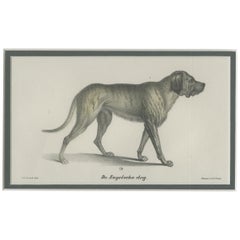
Antique Print of an English Mastiff Dog by Schinz
1845
Located in Langweer, NL
Antique print titled 'De Engelsche Dog'. Original antique print of an English Mastiff (?) dog. This print originates from 'Volledige Natuurlijke Histor...
Category
Antique Mid-19th Century Decorative Art
Materials
Paper
$94 Sale Price
20% Off
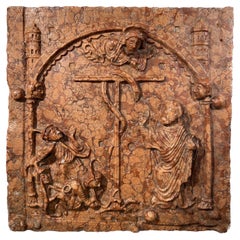
19th Century Moses
the Bronze Serpent Italian Marmo Rosso Di Verona Low Relief
Located in Encinitas, CA
Moses and the bronze serpent depicted in low relief carving in Italian Marmo Ross di Verona.
Handcrafted replica of a Tau Cross XIII century artifac...
Category
Italian Baroque Antique Mid-19th Century Decorative Art
Materials
Marble
$3,900 Sale Price
40% Off
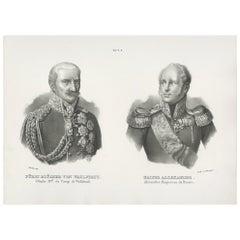
Antique Print of Gebhard Leberecht von Blücher and Alexander I of Russia (1845)
Located in Langweer, NL
Antique print titled 'Fürst Blücher von Wahlstatt - Kaiser Allexander. Bluche Mal. de Camp de Wahlstadt - Alexandre Empereur de Russie'. This print depicts Gebhard Leberecht von Blücher and Alexander I...
Category
Antique Mid-19th Century Decorative Art
Materials
Paper
$236 Sale Price
20% Off
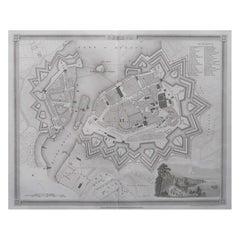
Original Antique Map or City Plan of Geneva, Switzerland. Circa 1835
Located in St Annes, Lancashire
Nice map of Geneva
Drawn and engraved by J.Dower
Published by Orr & Smith. C.1835
Unframed.
Free shipping
Category
English Antique Mid-19th Century Decorative Art
Materials
Paper
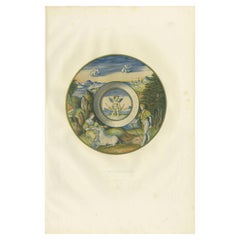
Antique Print of a Plate with a Unicorn of Museo Correr by Delange
1869
Located in Langweer, NL
Antique print titled 'Plat Musée Correr, a Venise'. Large format, color lithographed plate of a plate with a unicorn and various figures of the collection of Museo Correr in Venice, ...
Category
Antique Mid-19th Century Decorative Art
Materials
Paper
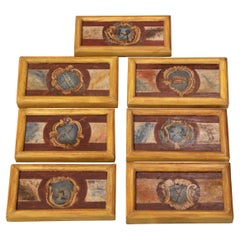
19th Century Italian Hand Painted Heraldic Panels with Family Crests – Set of 7
Located in Dallas, TX
Bring color and historic charm to a study, library, or office with this suite of seven antique heraldic wall panels. Crafted in Italy circa 1870, each rectangular board features a ce...
Category
Italian Antique Mid-19th Century Decorative Art
Materials
Wood
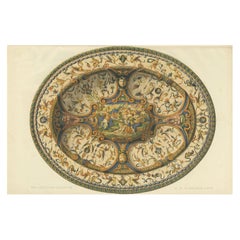
Antique Lithograph of Italian Faience Dish, Grotesque Style, Delange, 1869
Located in Langweer, NL
Antique Lithograph of Italian Faience Dish, Grotesque Style, Delange, 1869
Large-format antique lithograph of an Italian faience dish (plat) richly decorated in the grotesque style....
Category
French Antique Mid-19th Century Decorative Art
Materials
Paper
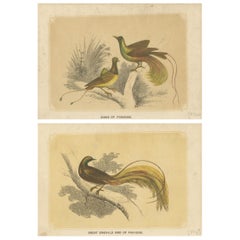
Set of 2 Antique Bird Prints, Bird of Paradise, by Bicknell
circa 1855
Located in Langweer, NL
Set of two antique bird prints titled 'Birds of Paradise' and 'Great Emeral Bird of Paradise'. These prints originate from 'The Natural History of The Sacred Scriptures, and Guide to...
Category
Antique Mid-19th Century Decorative Art
Materials
Paper
$165 Sale Price / set
20% Off
Antique Print of a native of the Ombai Strait,
circa 1840
Located in Langweer, NL
Antique print titled 'Naturel de l'ile d'Ombai'. Lithograph of a native of the Ombai Strait, Indonesia. Source unknown, to be determined. Published, circa 1840.
Category
Antique Mid-19th Century Decorative Art
Materials
Paper

$94 Sale Price
20% Off
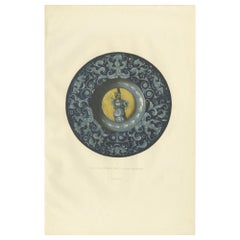
Antique Print of a Plate of Prince Ladislas Czartoryski by Delange,
1869
Located in Langweer, NL
Antique print titled 'Plat - Collection du Prince Ladislas Czartoryski'. Large format, color lithographed plate of a plate of the collection of Ladislas Czartoryski. This print origi...
Category
Antique Mid-19th Century Decorative Art
Materials
Paper
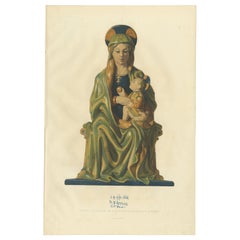
Antique Print of Madonna with Her Child by Delange
1869
Located in Langweer, NL
Antique print titled 'Madone - Collection de Mr. le Marquis (..)'. Large format, color lithographed plate of Madonna with her child. This print originates from 'Recueil de Faiences I...
Category
Antique Mid-19th Century Decorative Art
Materials
Paper
$710 Sale Price
20% Off
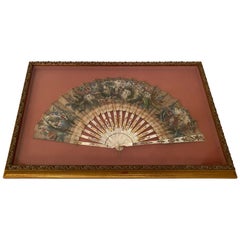
19th Century French Painted Paper and Mother of Pearl Fan
Located in Brea, CA
19th century French painted paper and mother of pearl fan, shadow-box framed antique ladies fan, made of mother of pearl with a hand embellished re...
Category
French French Provincial Antique Mid-19th Century Decorative Art
Materials
Mother-of-Pearl
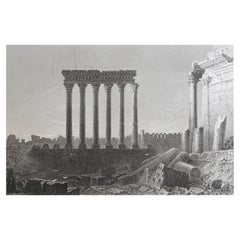
Original Antique Print of The Temple of Baalbek, Lebanon. C.1850
Located in St Annes, Lancashire
Wonderful image of The Temple of Baalbek
Fine steel engraving after W.H Bartlett
Published by Jackson C.1850
Unframed.
Free shipping
Category
English Classical Roman Antique Mid-19th Century Decorative Art
Materials
Paper
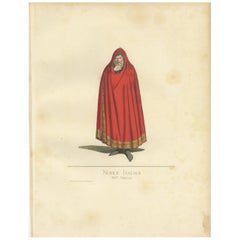
Antique Print of an Italian Nobleman, 14th Century, by Bonnard, 1860
Located in Langweer, NL
Antique print titled ‘Noble Italien, XIVe Siecle.’ Original antique print of an Italian nobleman, 14th century. This print originates from 'Costumes historiques de femmes du XIII, XI...
Category
Antique Mid-19th Century Decorative Art
Materials
Paper
$75 Sale Price
20% Off
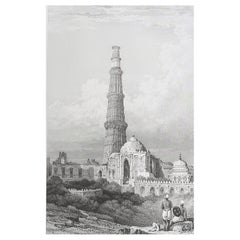
Original Antique Print of Qutb Minar, Delhi, India. Dated 1832
Located in St Annes, Lancashire
Wonderful image of the Qutb Minar minaret in Delhi
Fine steel engraving after Prout
Published by Fisher. Dated 1832
The measurement given is the paper size
Unframed.
Category
British Islamic Antique Mid-19th Century Decorative Art
Materials
Paper
Original Antique Print of the Ancient City of Petra After David Roberts c 1840
Located in St Annes, Lancashire
Wonderful image of Petra, Jordan
Fine steel engraving after David Roberts
Published circa 1840
The measurement given is the paper size
Unframed.
Category
German Greco Roman Antique Mid-19th Century Decorative Art
Materials
Paper

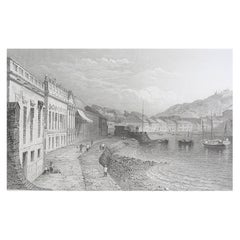
Original Antique Print of Macao, China. Dated 1832
Located in St Annes, Lancashire
Wonderful image of Macao
Fine steel engraving after Purser
Published by Fisher. Dated 1832
The measurement given is the paper size
Unframed.
Category
German Greco Roman Antique Mid-19th Century Decorative Art
Materials
Paper
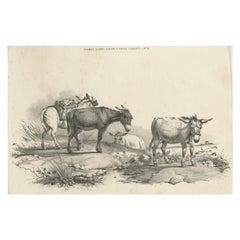
No. 10 Antique Print of Donkeys by Cooper, 1839
Located in Langweer, NL
Antique print of various donkeys. This print originates from 'Cattle Subjects' by Thomas Sidney Cooper. He was an English landscape painter ...
Category
British Antique Mid-19th Century Decorative Art
Materials
Paper
No. 7 Antique Print of Cattle by Cooper
Located in Langweer, NL
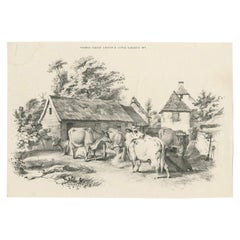
Antique print of various cows.This print originates from 'Cattle Subjects' by Thomas Sidney Cooper. He was an English landscape painter note...
Category
Antique Mid-19th Century Decorative Art
Materials
Paper
No. 21 Antique Print of Oxen by Cooper,
1839
Located in Langweer, NL
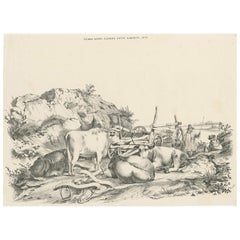
Antique print of various oxen, a cart and farmers. This print originates from 'Cattle Subjects' by Thomas Sidney Cooper. He was an English landscape painter noted for his images of c...
Category
Antique Mid-19th Century Decorative Art
Materials
Paper
Antique Print of the Yellow Skulpin Fish by J. Couch, circa 1870
Located in Langweer, NL
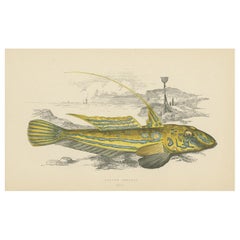
Antique fish print titled 'Yellow Skulpin'. This print originates from 'Fishes of the British Islands' by Jonathan Couch. Jonathan Couch (1789–1870) was one of the pioneering natural...
Category
Antique Mid-19th Century Decorative Art
Materials
Paper
Antique 1857 New York City Map by Humphrey Phelps, Framed in Burlwood
Located in Black Rock, CT
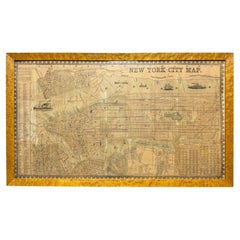
A unique 1857 New York City map published by Humphrey Phelps, showing Manhattan, Brooklyn, Jersey City and Hoboken. Engraved in exquisite detail with a full street index, ward bounda...
Category
American American Classical Antique Mid-19th Century Decorative Art
Materials
Burl, Paper
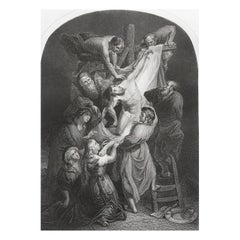
Original Antique Print After Rubens, Jesus Christ Descent from the Cross, C.1850
Located in St Annes, Lancashire
Wonderful image after Rubens
Fine steel engraving.
Published C.1850
Unframed.
Category
English Renaissance Antique Mid-19th Century Decorative Art
Materials
Paper
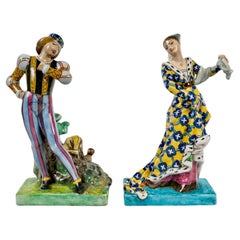
Théodore Deck (1823-1891), Courtly Love, Rare Pair of Faience Figures , c.1860
Located in Saint-Ouen, FR
Théodore Deck (1823-1891)
Courtly Love
Polychrome enamelled earthenware
Pair of subjects representing two lovers in the Middle Ages
Each signed below with the stamp “Th.Deck”
Extr...
Category
French Renaissance Revival Antique Mid-19th Century Decorative Art
Materials
Faience
$14,922 Sale Price / set
30% Off
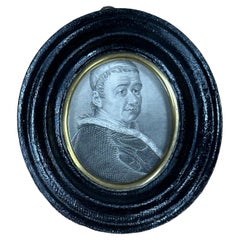
Framed Engraving Portrait Renaissance Medici Pope, Leo X (1474-1521), 1860s
Located in Nuernberg, DE
An extraordinary Original Lithograph of Renaissance Medici Pope, Leo X (1474-1521).
Beautiful hand crafted Biedermeier Frame. We believe it is from the 1860s. Viewable picture size ...
Category
German Biedermeier Antique Mid-19th Century Decorative Art
Materials
Glass, Wood
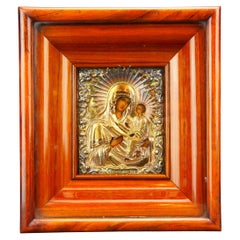
1861 Russain Icon Holly Mother of Tihvin Tempera on Wood Gilt 84 Silver Kiot
Located in Malmö, SE
Antique Russian Orthodox Icon of Theotokos of Tikhvin , Holly Mother of Tihvin / Тихвинская икона Божией Матери in Russian - the copy of one of the most celebrated Orthodox Christian...
Category
Russian Other Antique Mid-19th Century Decorative Art
Materials
Gold Leaf
Original Antique Print of a Racehorse, 1847
Unframed
Located in St Annes, Lancashire
Great image of a racehorse.
Unframed. It gives you the option of perhaps making a set up using your own choice of frames.
Lithograph after George Stubbs with original hand color.
...
Category
English Folk Art Antique Mid-19th Century Decorative Art
Materials
Paper

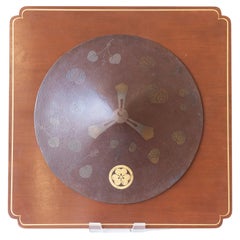
19th Century Japanese Jingasa (Soldier
s Battle Hat) on Lacquer Display panel
Located in New York, NY
An antique Japanese jingasa (foot soldier's hat).
Jingasa (battle hats) were typically worn by common foot soldiers (ashigaru) during feudal Japan, serving as a lightweight alternat...
Category
Japanese Antique Mid-19th Century Decorative Art
Materials
Wood, Lacquer
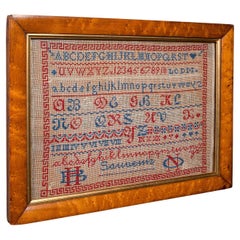
Antique Needlework Sample, English, Framed, Embroidery, Decor, William IV, 1835
Located in Hele, Devon, GB
This is an antique needlework sampler. An English, framed embroidered panel, dating to the William IV period, circa 1835. A fascinating exam...
Category
British William IV Antique Mid-19th Century Decorative Art
Materials
Cotton, Glass
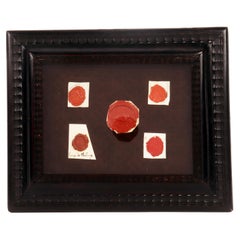
Collection of five framed wax impressions from seals, France 1850.
Located in Milan, IT
The collection is contained in a guilloche frame with a wavy edge. Inside there is a panel covered in velvet on which five sealing wax stamps are applied. The seals, clockwise from t...
Category
French Antique Mid-19th Century Decorative Art
Materials
Velvet, Wood
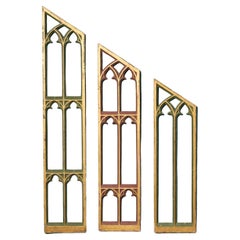
Set of 3 Antique Ecclesiastical Diagonal Panels
Located in Wormelow, Herefordshire
A set of 3 antique Ecclesiastical style carved panels in diagonal form. These tracery panels of Pugin style make for decorative wall art or, once glazed, elaborate windows in a perio...
Category
English Gothic Antique Mid-19th Century Decorative Art
Materials
Wood, Pine
Read More
At Colonial Williamsburg, Everything Old Is New Again
With the help of a new director, the Virginia institution's folk art and decorative arts museums are undergoing extensive upgrades.
New York’s Hirschl & Adler Showcases the American Workmanship and Design Panache of Neoclassical Treasures
The gallery's latest exhibition proves that museum-quality pieces entice and inspire, whether in traditional or more modern interiors.
More Ways To Browse
Douglas Homer
Dr No Chairs
Drawer Pulls Hardware Brass
Drawers Lions Feet
Dresden Figurines
Drexel Display Cabinet
Drexel Heritage Campaign
Drexel Heritage Georgian
Drexel Heritage Glass Cabinet
Drexel Modern Line
Duck Audubon
Duckworth Ruth
Dunbar Tambour
Dust Pan
Dutch Tea Cabinet
Dutch Walnut Burl Cabinet
E F Caldwell Clocks
E Fremiet