East Asian Paintings
to
69
396
85
510
18
8
Height
to
Width
to
24
8
7
2
2
1
1
56
209
245
26
95
49
35
11
1
11
7
3
1
6
8
7
6
274
214
201
143
94
46,762
9,686
6,496
5,794
2,855
536
531
536
4
4
3
2
2
Place of Origin: East Asian
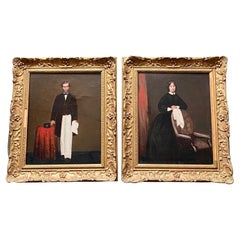
19th Century China Trade Pair of Portraits of Sea Captain and Wife
Located in Nantucket, MA
19th Century China Trade Pair of Portraits of Sea Captain and Wife, circa 1850s, matched pair of Chinese Export oil on canvas full length portraits of a Sea Captain and his wife, painted on commission in Hong Kong or a related China Trade port. The captain wears a double breasted wool greatcoat over a high collar white shirt with bow tie, black waistcoat...
Category
1850s Victorian Antique East Asian Paintings
Materials
Canvas
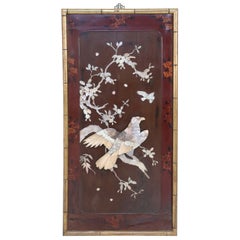
Chinese Panel Art Depicting Birds and Branches in Raised Mother of Pearl Pieces
Located in Queens, NY
Chinese panel art featuring a raised bird perched on a flowering tree branch detailed in pieces of mother of pearl against a burgundy and brown floral bordered background in a carved...
Category
20th Century Chinese Export East Asian Paintings
Materials
Mother-of-Pearl, Wood
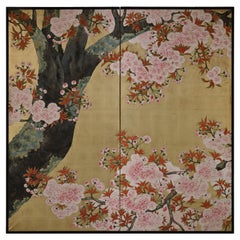
Early 20th Century Japanese Cherry Blossom Screen by Kano Sanrakuki
Located in Kyoto, JP
Cherry Blossoms
Kano Sanrakuki (1898-1981)
Showa period, circa 1930
2-panel Japanese Screen
Color, gofun and gold leaf on paper
Against a backdrop of gold-leafed ground, the lichen covered trunk and branches of the life-sized cherry blossom tree reach out and beyond the confines of the pictorial surface. The overall composition has a feeling of flatness which draws emphasis to the surface and the three-dimensionality of the cherry blossoms. Painstakingly built-up layers of thickly applied shell-white gofun detail the voluminous blossoms and cover large areas of this tour-de-force of Japanese Nihonga painting. By simplifying the background, minimizing the number of colors and depicting the blossoms with such heavy relief, the artist has emphasized the stunning presence of the cherry tree. The type of tree depicted is the Yae-Zakura; a double-layered type of cherry blossom famed for its beauty and strength. When we think of Japanese cherry blossoms, the first thing that comes to mind is Somei Yoshino variety, which has a single flower with five almost white petals. This type is fragile and easily blown away by strong wind or rain. Most of the double-flowered cherry blossoms begin to bloom when the Somei-Yoshino falls, and the flowering period lasts longer than that of the Somei-Yoshino.
Kano Sanrakuki originally studied painting at the Kyoto City Arts and Crafts School under the tutelage of Yamamoto Shunkyo...
Category
Early 20th Century Showa East Asian Paintings
Materials
Gold Leaf
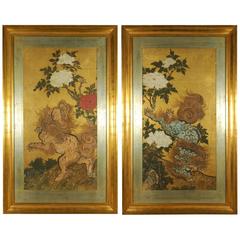
Pair of Antique Japanese Paintings of Karashishi, Edo Period, 18th Century
Located in Prahran, Victoria
A rare pair of antique Japanese Karashishi paintings in a landscape of rocks and peony flowers on gold leaf ground in fine handmade frames, Edo period, early 18th century. The Karash...
Category
Early 18th Century Edo Antique East Asian Paintings
Materials
Gold Leaf
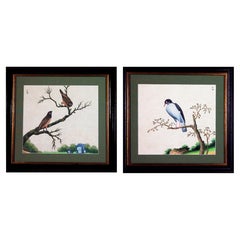
Chinese Export Watercolor Exotic Bird Paintings on Paper
Located in Downingtown, PA
Natural History of the East: Pair of Fine Chinese Export Bird Watercolors
(c. 1800–1820)
A superb pair of early 19th-century Chinese Export ...
Category
Early 18th Century Chinese Export Antique East Asian Paintings
Materials
Paper
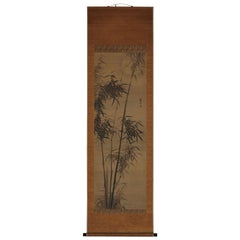
Japanese Painting, Hanging Scroll, 19th Century Bamboo in Moonlight
Located in Kyoto, JP
Bamboo in moonlight
Gamo Rakan (1784-1866)
Hanging scroll, ink on silk.
Dimensions:
Scroll: 201 cm x 58 cm
Image: 137 cm x 45 cm
In this early 19th century work by Gamo Rakan a light ink wash applied to the silk background silhouettes the moon and suggests the atmosphere of early evening. Even though it is a literati subject, Rakan’s bamboo is quite realistic with a strong decorative style. The painting finds its inspiration from Chinese Ming dynasty painters who often used a single-tone, jet black stroke to emphasize the calligraphic nature of bamboo.
In a different era, decorative would have been seen as somewhat unrefined. But increasingly in the Edo period, it was the hallmark of high style. The Japanese people, in particular the rising merchant class, had gradually become apathetic toward the traditional Sesshu and Kano schools of painting. Chinese professional and amateur painters living in the port of Nagasaki during the 18th century had a profound effect on Japanese painting and the freshness of their style and its decorative appeal contributed greatly to its popularity. Gamo Rakan’s teacher, Tani Buncho...
Category
Early 19th Century Edo Antique East Asian Paintings
Materials
Silk
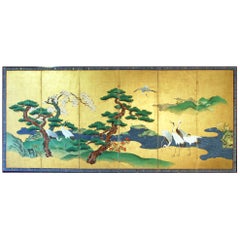
Japanese Folding Screen Six Panels Painted on Gold Leaf
By Japanese Studio
Located in Brescia, IT
Paravento a sei pannelli di scuola giapponese Kano: paesaggio con bellissime ed eleganti gru vicino al fiume, con alberi di pino e sakura.
Dipinto a mano con pigmenti minerali ed inc...
Category
Early 19th Century Edo Antique East Asian Paintings
Materials
Gold Leaf
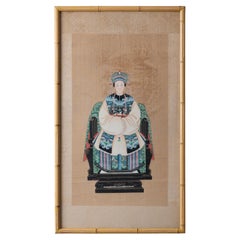
Chinese Ancestor Painting
Located in Savannah, GA
A Chinese ancestor painting on silk in faux bamboo frame, 20th century.
17 ¼ by 30 inches
Category
20th Century Other East Asian Paintings
Materials
Silk, Wood
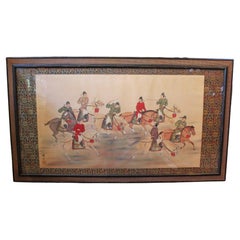
Circa 1970 Chinese Traditional Style Painting on Silk of Warriors on Horseback
Located in Chapel Hill, NC
Traditional Chinese style painting on silk of warriors on horseback, circa 1970. Signature & seal lower left. In the Chinese Tang style. Framed with woven silk border under plexiglas...
Category
Late 20th Century Tang East Asian Paintings
Materials
Brass
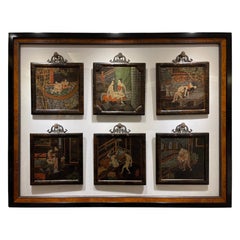
Set of Six Japanese Ido Period Shunga
Erotica
Hanging Lacquered Wood Panels
Located in North Miami, FL
These magnificent lacquered wood panels have been mounted together on a lucite panel. Each panel has its original hanging handle. The panels are hanging on antique railroad...
Category
18th Century Edo Antique East Asian Paintings
Materials
Metal, Iron
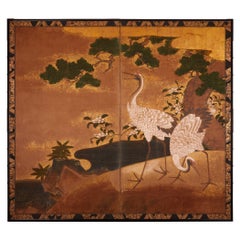
Japanese Two-Panel Screen: Cranes on Gold
Located in Hudson, NY
Early Kano School painting of pine trees overlooking two beautifully painted cranes and floral design in a natural setting by water’s edge. Mineral pig...
Category
Late 18th Century Antique East Asian Paintings
Materials
Gold, Gold Leaf
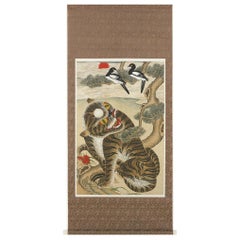
Korean Jakhodo Minhwa Folk Scroll Painting
Located in Atlanta, GA
A Korean Folk Art painting mounted as a hanging scroll. The watercolor on paper was likely dated from 1930s-1940s. The work depicts a "Jakhodo" theme (...
Category
1930s Folk Art Vintage East Asian Paintings
Materials
Paper
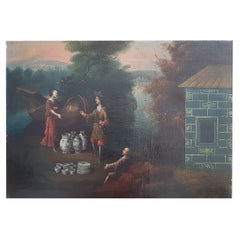
Oil on Canvas Depicting a Porcelain Sales Woman, Chinese School, 18th Century
Located in Langweer, NL
Interesting 18th century painting, Chinese School, for the European market, depicting a porcelain sales woman dealing with European traders.
Medium: Oil on canvas. Measures: 62.5 x...
Category
18th Century Antique East Asian Paintings
Materials
Canvas

$18,193 Sale Price
47% Off
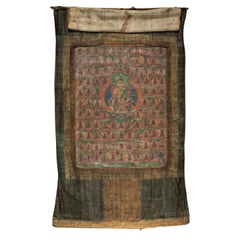
18th Century Tibetan Thangka Of Amitayus Buddha
Located in Dallas, TX
A THANGKA DEPICTING AMITAYUS, 18TH CENTURY
Tibet. Distemper on cloth, with a silk brocade frame, mounted as a hanging scroll with wood handles. Finely painted with Amitayus seated i...
Category
Mid-18th Century Tibetan Antique East Asian Paintings
Materials
Silk
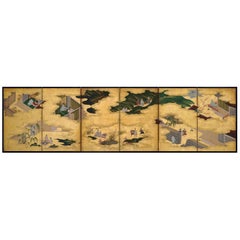
Japanese Screen Painting, Circa 1700
Tales of Ise
by Tosa Mitsusuke
By Tosa Mitsusuke 1
Located in Kyoto, JP
A six-fold Japanese screen by Tosa Mitsusuke (1675-1710), Japan 17th-18th century, Edo period.
The signature reads Shoroku-i ge Tosa sa Konoe Shogen Mit...
Category
Late 17th Century Edo Antique East Asian Paintings
Materials
Gold Leaf
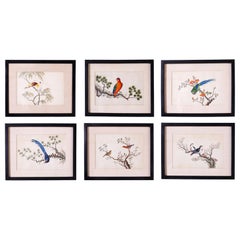
Set of Six Chinese Watercolors of Song Birds
Located in Palm Beach, FL
Set of six Chinese watercolors on paper of song birds in trees executed in a distinctive delicate style with bold colors. Presented in wood...
Category
Early 20th Century Chinese Export East Asian Paintings
Materials
Paint
$6,250 / set
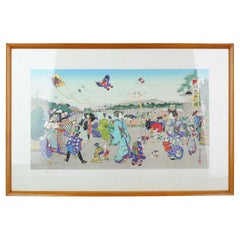
Antique Japanese Blockprint Painting Japan Edo or Meiji
Located in Amsterdam, Noord Holland
Antique Japanese Blockprint Painting Japan Edo or Meiji.
A very nice blockprint.
Additional information:
Type: Paintings, Scrolls & Prints
Region of Origin: Japan
Country of Manufa...
Category
19th Century Antique East Asian Paintings
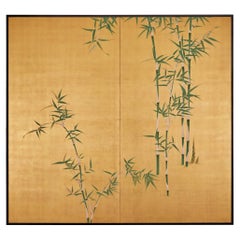
Japanese Two Panel Screen: Young Bamboo on Gold
Located in Hudson, NY
Symbolizing the Sun, gold is often used in shrines and temples in Japan. Gold has been extensively recognized to represent wealth, while bamboo is said to bring good luck due to its ability to regenerate in the forest. A beautiful composition of the two together...
Category
Late 19th Century Antique East Asian Paintings
Materials
Gold
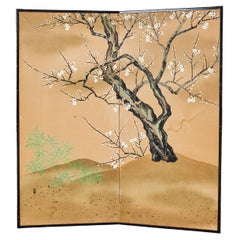
Japanese Showa Two Panel Screen Blossoming Prunus Tree
Located in Rio Vista, CA
Serene Japanese Showa period two-panel folding byobu screen depicting a large spring blossoming prunus tree or plum tree. Beautifully painted with ink and natural color pigments on m...
Category
20th Century Showa East Asian Paintings
Materials
Brass
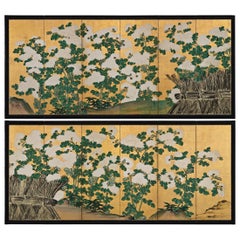
Mid-18th Century Japanese Screen Pair, One Hundred Flowers, Chrysanthemums
Located in Kyoto, JP
Omori Soun (b. 1704)
Chrysanthemums - One Hundred Flowers
A Pair of Six-fold Japanese Screens. Ink, color, gofun and gold leaf on paper.
Dating ...
Category
Mid-18th Century Edo Antique East Asian Paintings
Materials
Gold Leaf
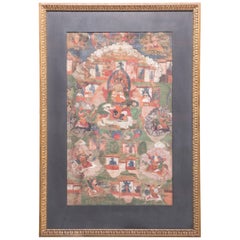
Tibetan Thangka of Vaishravana, c. 1850
Located in Chicago, IL
Thangkas are devotional paintings displayed by Buddhists in monasteries, temples, and even their homes. This 19th-century Tibetan Thangka is rich with historical figures and symbolism arranged around the Viashravana in the painting's center. This lesser deity is the god of wealth...
Category
Mid-19th Century Tibetan Antique East Asian Paintings
Materials
Fabric, Paint
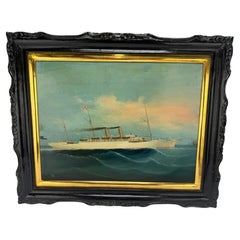
Chinese Export Maritime Painting of the Steam Yacht Empress of China 19th C.
Located in Atlanta, GA
Chinese Export Maritime Painting of the Steam Yacht Empress of China
Oil on canvas laid to board, in original black lacquered and giltwood frame
China Trade, likely Hong Kong or Cant...
Category
Late 19th Century Chinese Export Antique East Asian Paintings
Materials
Giltwood, Paint
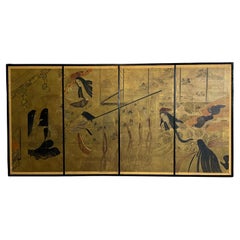
Large Painting of a Japanese Scene After the Tale of Genji
Located in Pasadena, CA
This painting is an illustration of the classic Japanese novel, "The Tale of Genji," written by Murasaki Shikibu. It captures the aristocratic atmosp...
Category
19th Century Han Antique East Asian Paintings
Materials
Paper, Paint
$2,200 Sale Price
31% Off
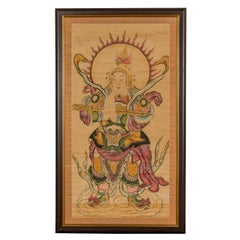
Framed Hand-Painted Parchment Painting of a Celestial Warrior with Silk Matting
Located in Yonkers, NY
A Qing Dynasty period hand-painted Celestial warrior on parchment with silk matting in custom frame. This Qing Dynasty period hand-painted depiction of a Celestial warrior is rich in...
Category
19th Century Qing Antique East Asian Paintings
Materials
Composition
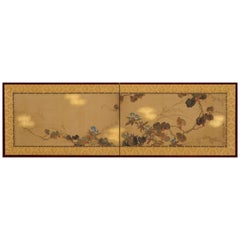
Japanese Screen Painting, Early 19th Century, Autumn Flowers by Sakai Hoitsu
Located in Kyoto, JP
A two-fold Japanese screen by the Rimpa school artist Sakai Hoitsu (1761-1828), Japan, 19th century, Edo period.
This small Japanese folding screen pai...
Category
Early 19th Century Edo Antique East Asian Paintings
Materials
Wood, Silk
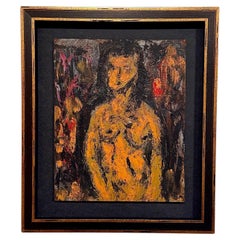
Mojin Nagasaki Abstract Nude 1952 Japan
Located in Oakland, CA
This beautiful vintage oil painting abstract nude by Japanese artist Morin Nagasaki, created around 1952, was acquired in Tokyo. It boasts an amazing texture and execution, beautiful...
Category
1950s Modern Vintage East Asian Paintings
Materials
Wood, Paint, Paper
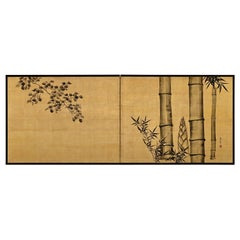
19th Century Japanese Screen for Tea-Ceremony, Ink Bamboo and Plum on Gold Leaf
Located in Kyoto, JP
Three Friends of Winter
Nakajima Raisho (1796-1871)
Late Edo period, circa 1850
Ink and gold leaf on paper.
This is a double-sided Japanese Furosaki or tea-ceremony screen from the mid 19th century; bamboo and plum on the front, young pines the back. It by Nakajima Raisho, a master painter of the Maruyama school in the late Edo and early Meiji periods. In this work Raisho combines exquisite ink brushwork with large open spaces of brilliant gold-leaf to inspire the viewers imagination. Rather than naturalism, he is searching for the phycological impression of the motifs, resulting in abstraction and stylization. His simplification of the motifs the result of looking to capture the inner nature of the objects. This art motif is known as Sho Chiku Bai, or the Three Friends of Winter. Evergreen pine connotes steadfastness, bamboo suggests both strength and flexibility, while plum blossoms unfurling on snow-laden branches imply hardiness. Combined, this trio is emblematic of Japanese new year. Chinese literati were the first to group the three plants together due to their noble characteristics. Like these resilient plants flowering so beautifully in winter, it was expected of the scholar-gentleman to cultivate a strong character with which he would be able to show the same degree of perseverance and steadfastness even during times of adverse conditions.
The screen would have been placed near the hearth of a room used for the Japanese tea ceremony, shielding the fire from draughts and also forming a stimulating and decorative backdrop behind the tea utensils. It would have been used in the Hatsugama, or first tea-ceremony of the new year.
Nakajima Raisho (1796-1871) originally studied under Watanabe Nangaku before entering the school of Maruyama Ozui. He was the highest ranking Maruyama school painter at the end of the Edo period and was known as one of the ‘Four Heian Families’ along with Kishi...
Category
Mid-19th Century Edo Antique East Asian Paintings
Materials
Gold Leaf
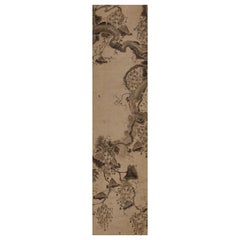
17th Century Korean Grapevine and Squirrel Scroll Painting, Mid Joseon Period
Located in Kyoto, JP
Anonymous. Korean, 17th century. Joseon period.
Hanging scroll. Ink on paper.
Seal: Shinso
Dimensions:
Scroll: H. 200 cm x W. 31 cm (79” x 12”)
Image: H. 122 cm x W. 29.5 cm (48” x 11.5”)
The grapevine came to China and then Korea from western Asia via the silk road trade routes. By the mid-Joseon period, it was one of the most popular subjects for Korean literati painters. Grapevines were painted as a singular subject or, less commonly, in combination with squirrels, which are associated with children due to their playful nature. Together, grapevines and squirrels embody wishes for abundant offspring and wealth.
For the Korean literati artist the twisting vines, curling tendrils and round, plump grapes provided ample opportunity for expressive "brush play”. In this painting the artist has abstracted the scene and is seemingly unconcerned with discontinuities and proportion. Vines spring up from nowhere, grapes hang in random clusters and the squirrel’s head appears as if twisted backwards. For the vines and leaves we can feel a sense of speed in the brushstrokes, imparting a dynamic feel which is at once intense and animated. This contrasts dramatically with the countless tiny strokes of ink which realistically capture the texture of the squirrel’s fur...
Category
17th Century Other Antique East Asian Paintings
Materials
Paper
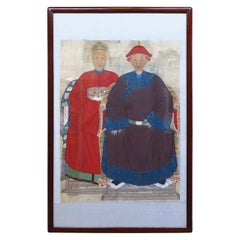
Chinese Ancestor Painting Qing Dynasty
Located in New York, NY
Qing Dynasty Chinese Ancestor painting. Antique Chinese Ancestor paintings are sought after for their warm colors and traditional pa...
Category
1890s Qing Antique East Asian Paintings
Materials
Paper
$1,600 Sale Price
60% Off
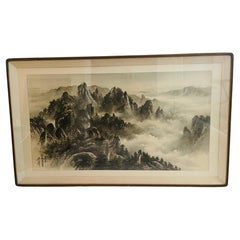
Large Antique Chinese Landscape Watercolor Painting
Located in Boca Raton, FL
Large impressive antique Chinese landscape painting, signed and framed under glass. Mixed media on paper, watercolor, ink and gouache.
Category
1940s Chinese Export Vintage East Asian Paintings
Materials
Paper
$1,015 Sale Price
65% Off
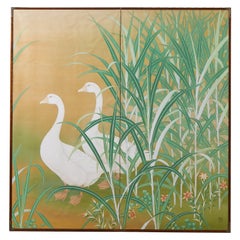
Japanese Meiji Two Panel Screen Geese and Reeds
Located in Rio Vista, CA
Fantastic Japanese late Meiji period two-panel byobu screen by Hashimoto Koshu. The large screen features two white geese amid brightly colored reeds. The symbolism of geese and reeds was introduced to Japan from China in the 13th century. This was a popular subject for Japanese zen artists of the period. Beautifully crafted with exceptional brush strokes and details. Made with natural pigments in dramatic vivid colors of white, pink, and mint green on a silk background of gilt. Circa 1900 with artist seal on bottom right corner. Koshu studied Western art under...
Category
20th Century Meiji East Asian Paintings
Materials
Silk, Wood, Paper
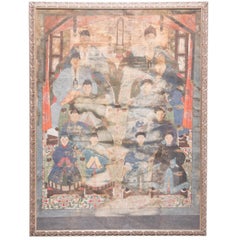
Monumental Chinese Ancestral Portrait, c. 1900
Located in Chicago, IL
Reflecting the role that ancestor worship played in Chinese culture, this Qing-dynasty painting depicts several generations of family, dressed in intricately-detailed and brilliantly...
Category
Late 19th Century Qing Antique East Asian Paintings
Materials
Linen
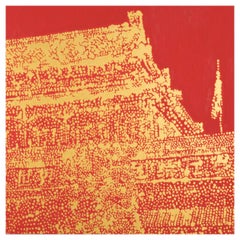
"Tiananmen Lion" by Ren Hui
By Ren Hui
Located in Chicago, IL
This painting, like most of Ren Hui’s exquisite artworks, celebrates his subjects using a pointillist style that he calls “uncomplicated and honest.” The beautiful pattern of gold on...
Category
21st Century and Contemporary Modern East Asian Paintings
Materials
Canvas, Paint
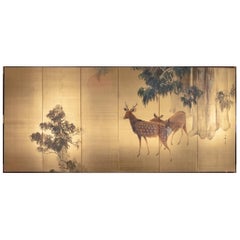
Japanese Six-Panel Screen Buck and Doe at Dawn
Located in Hudson, NY
Japanese six-panel screen: Buck and doe at dawn. Showa period (1926-1989) painting of a rising sun seen through a woodland scene with a pair of deer. In Japan, deer are thought to be...
Category
Early 20th Century Showa East Asian Paintings
Materials
Bronze
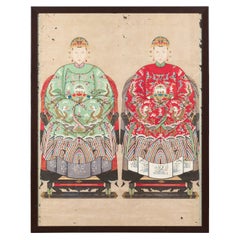
Qing Dynasty Painting of a Royalty Related Couple with Dragon Motifs
Located in Yonkers, NY
A Chinese late Qing Dynasty period framed painting from the early 20th century of a royalty related couple with dragon motifs painted on a linen canvas. Created in China during the late Qing Dynasty in the early years of the 20th century, this custom framed painting depicts a couple wearing either a red (a symbol of luck in China) or green robe. The depiction of dragons relates them to the Imperial family, but having four claws and not five as codified, the couple is likely part of the royal family, not the Imperial couple themselves. Accented with typical motifs such as bats, flaming pearls and rain-filled clouds, the robes are filled with symbols. Wearing ornate headdresses, the couple is sitting on elegant chairs. Set inside custom made frames, the paintings show great signs of age. While the entire piece measures 40.5"W x 1"D x 53"H, the painting itself is 36.5"W x 49". With its vivid colors and interesting subject, this Chinese Qing Dynasty painting...
Category
Early 20th Century Qing East Asian Paintings
Materials
Fabric, Plexiglass
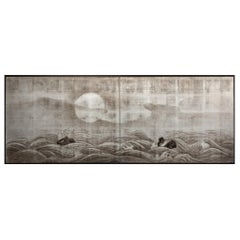
Japanese Two Panel Screen Moon Rising Over Turbulent Ocean Landscape
Located in Hudson, NY
Contemporary sumie (ink) painting on silver.
Category
1960s Showa Vintage East Asian Paintings
Materials
Paper
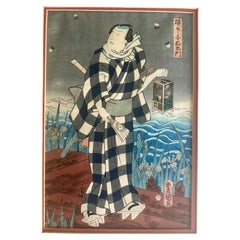
Japanese woodblock print by Utagawa Kunisada (1786 – 1865) Edo Period
Located in Palm Springs, CA
Original Japanese woodblock print by Utagawa Kunisada (1786 – 1865) created around 1855. It depicts the Kabuki actor Bandō Takesaburō I (or Seki Sanjuro) as Gokuin Sen'emon, a charac...
Category
1850s Antique East Asian Paintings
Materials
Wood, Paper
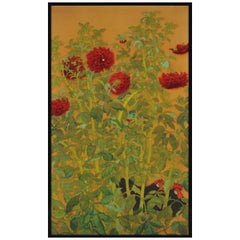
Japanese Painting, Framed Panel, Dahlias and Roosters, circa 1920
Located in Kyoto, JP
Tanaka Tessen (b.1890)
Dahlias and Roosters
Taisho period, circa 1920
Framed painting. Mineral pigments and ink on silk.
Dimensions (framed):
H. 159 cm x W. 97 cm x D. 2.5 cm (62.5” x 38” x 1”)
An ornate and complex composition in which the artist explores almost the entire painting surface. The coloration is bold and evocative and the tinted silk ground recreates the warm golden glow of sunset. Soft, luminous brushwork details the black feathers of the roosters, which seem to cloud and blur in counterpoint to the sharper points of the eyes and beaks. Their brilliant red combs balance the composition, echoing the rich burgundy hues of the dahlias; the flowers exquisite and lifelike. Dahlias were an exotic subject favored by painters of the Taisho era.
The painting belongs to the school of Kyoto Nihonga, exemplifying the principles of decorative elegance and consumate brush technique with which it was intimately associated. Painters of the time relied on the Shijo school method, basing the forms of the composition from life sketches. Sometimes they were then integrated with elements derived from Chinese bird and flower...
Category
1920s Taisho Vintage East Asian Paintings
Materials
Wood, Silk
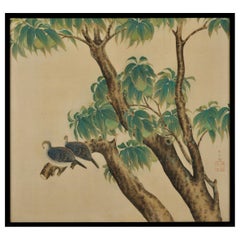
Japanese Framed Silk Painting, Turtledoves and Peaches, Taisho Era, circa 1920
Located in Kyoto, JP
Nakamura Daizaburo
Turtledoves in a Peach Tree
Taisho period, circa 1920
Framed painting. Mineral pigments, ink and gofun on silk
Signed: Daizaburo
Dimensions (framed)...
Category
1910s Taisho Vintage East Asian Paintings
Materials
Wood, Silk
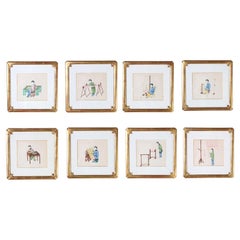
Set of Eight Chinese Watercolors of Working Women
Located in Palm Beach, FL
Rare antique set of eight Chinese watercolors depicting women in various occupations executed in a traditional delicate style on pith. Presented in a gilt carved wood Asian style fra...
Category
Early 20th Century Chinese Export East Asian Paintings
Materials
Paint
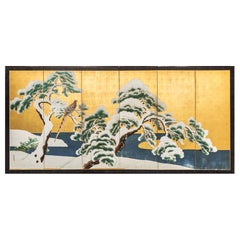
Japanese Six Panel Screen: Snow Scene
Located in Hudson, NY
Kano school painting of a pheasant in a snowy pine. Artist signature reads: Hokkyo Shunyo. Mineral pigments on gold leaf with silk brocade border.
Category
Early 19th Century Antique East Asian Paintings
Materials
Gold Leaf
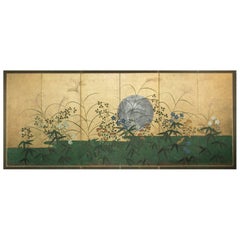
19th Century Japanese Six Panel Screen: Silver Moon Rising Over Summer Field
Located in Hudson, NY
Japanese Six Panel Screen: Silver Moon Rising Over Summer Field. Rimpa Style painting of a moon rising over summer flowers and grasses, including cockscomb and blue bellflowers. Pa...
Category
Late 19th Century Meiji Antique East Asian Paintings
Materials
Gold Leaf
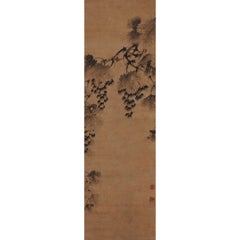
Korean Painting, Wall Panel, 17th Century Ink Grapevine
Located in Kyoto, JP
Grapevine
Anonymous. Korean, 17th century.
Wall panel, ink on paper.
Upper seal:
Kou Kinun in
Lower seal:
Kaigen
Dimensions:
Measures: 98.5 cm x 29.5 cm (39” ...
Category
17th Century Other Antique East Asian Paintings
Materials
Wood, Paper
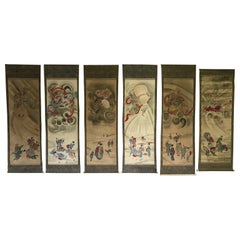
Set of 6 Large Kakemonos Japanese Mythology, 19th Century Japan circa 1800 Edo
Located in Beuzevillette, FR
Beautiful set of 6 large kakemonos from 19th century Japanese mythology.
Paper support with a canvas pasted on the paper
Wonderful set that is part of Japan's history and beliefs
When not hung, the Kakemonos are rolled up.
circa 1800 - Japan - Edo Period
A kakemono translates as "object to hang". In Japan this refers to a painting or calligraphy, most often done on silk or paper framed in a scroll that was intended to be hung on walls or in public lighting. This particular form, which allows them to be in a roll, dates back to the Tang dynasty in China (this would be related to the copying and preservation of ancient Buddhist texts). A Kami is a deity or spirit worshipped in the Shinto religion. A Yokai is a spirit, ghost, demon, or strange apparition from the creatures of Japanese folklore.
Each of these kakemonos represents a unique story:
- A kami, a Japanese deity, is shown painting a rainbow. Indeed, he performs the action with his right hand while his left hand holds a kind of basket with three pots of paint. This kami has a rather closed attitude. He is standing in a dark and tormented sky. Below this figure, 8 villagers are dressed in traditional Japanese clothes. Their faces are softened. They are not afraid of the elements made by the kami above their heads.
- A character with an unreal look is holding a kind of jar with his two hands, which he spills on human figures above. This being is floating in the air, probably a character from mythology, perhaps Susanoo. Underneath, villagers on umbrellas. They are trying to protect themselves as best they can from what is falling on them. One of them is carrying baskets with fish on her shoulders. A character in the background is thrown forward and falls.
- On this kakemono, the god Raijin, dressed in a white and blue outfit, strikes the sky with his two drum hammers to create lightning and its thunderous sound. Surrounded by Tomoe and a long red scarf, Raijin, enraged and with dishevelled hair, creates a dark and violent storm. The villagers seem frightened by this meteorological phenomenon. One of the villagers can be seen fainting in the arms of a man. This scene may seem chaotic, but Japanese legend tells us that once a field is struck by lightning, the harvest is good.
- On this kakemono, we see an unreal-looking figure holding a fan, as if he were sweeping away the bad weather, or simply producing gusts of wind. He is probably the kami of wind and air, Shina tsu-hiko. The figures below him seem surprised by so much wind. An umbrella flies away on the left, the women hold their hair and scarf, the clothes are caught in the power of the wind, there is even a woman on the ground on the bottom left.
- This Kakemono represents a short moment. This Raiju is a yokai (ghost spirit...
Category
19th Century Edo Antique East Asian Paintings
Materials
Paper
$2,585 Sale Price / set
20% Off
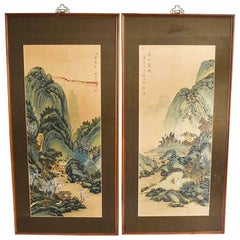
Asian Wood Panel Paintings Diptych Brass Hardware Flora and Fauna Scene Chinese
Located in Oklahoma City, OK
Vintage Han Palace Art Co. scroll framed oil painting wood diptych carved panels. The original tag on back. This is a vintage piece from the 1950s or 1960s....
Category
Late 20th Century Chinoiserie East Asian Paintings
Materials
Wood, Paint, Paper
$2,250 Sale Price / set
25% Off
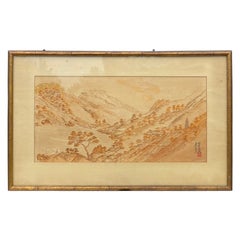
Antique Japanese Water Color on Silk
Located in Westfield, MA
Experience the serene beauty of this Antique Japanese Watercolor on Silk, a delicate artwork that captures the essence of Japan's rich cultural heritage. This exquisite piece portray...
Category
Early 20th Century Anglo-Japanese East Asian Paintings
Materials
Silk
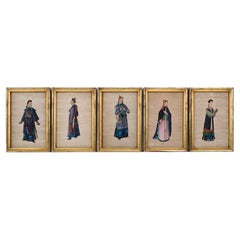
Collection of Five 19th Century Chinese Export Gouache Portraits on Pith Paper
Located in London, GB
A Collection of Five 19th Century Chinese Export Gouache Portraits on Pith Paper
C.1850
Depicting Court Figures in Imperial Dress
Framed and gla...
Category
19th Century Antique East Asian Paintings
Materials
Paper
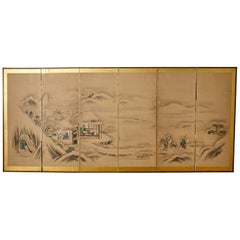
Japanese Six Panel Kano School Winter Landscape Screen
Located in Rio Vista, CA
Large Japanese Meiji period six-panel screen depicting a winter landscape with a Chinese sage visiting friends in a country villa. Ink and vivid color pigments on mulberry paper mounted to a gilt background. Painted in the 19th century Kano school...
Category
19th Century Meiji Antique East Asian Paintings
Materials
Metal
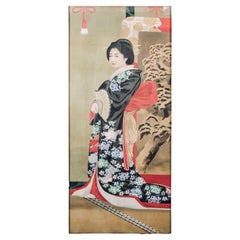
Set of Six Japanese Meiji Period Imperial Portrait Paintings on Silk , Ca. 1880s
Located in New York, NY
Meiji Period (1868-1912) – Ca. 1880/1890
This group of portraits was shown at Chicago World’s Fair in 1893.
DIMENSIONS (Framed)
Width: 24” inches
Height: 57.5
Category
1880s Japonisme Antique East Asian Paintings
Materials
Silk
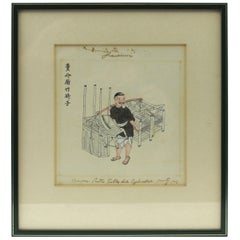
Antique Chinese Water Color Painting of Furniture Seller Qing Dynasty, 19th C.
Located in Amsterdam, Noord Holland
Sharing this lovely painting. It has handwriting in German on it. Translating the Chinese. We have a series of these. See second picture for similar paintings.
Additional informatio...
Category
19th Century Qing Antique East Asian Paintings
Materials
Porcelain
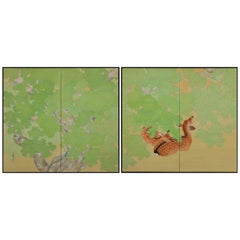
Early 20th Century Pair of Japanese Folding Screens, Deer Under Maple Trees
Located in Kyoto, JP
Deer under maples
Late Taisho period, circa 1925-1930
Pair of two-panel screens. Ink and pigment on silk.
Signature: Goho
Seal: Goho
A pair of two-fold Japanese silk screens...
Category
1920s Taisho Vintage East Asian Paintings
Materials
Wood, Paper, Silk
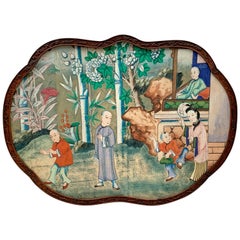
Large Antique Chinese Hand Painted Wallpaper Section in Carved Hardwood Frame
Located in Austin, TX
A wonderfully charming large and colorful Chinese hand painted wallpaper section in a carved and shaped hardwood frame. The wallpaper dates to the first half of the 20th century or e...
Category
Early 20th Century Chinese Export East Asian Paintings
Materials
Hardwood, Paper
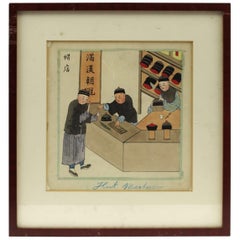
Antique Chinese Water Color Painting of Hat Shop Qing Dynasty, 19th Century
Located in Amsterdam, Noord Holland
Sharing this lovely painting. It has handwriting in German on it. Translating the Chinese. We have a series of these. See second picture for similar paintings.
Additional informatio...
Category
19th Century Qing Antique East Asian Paintings
Materials
Porcelain
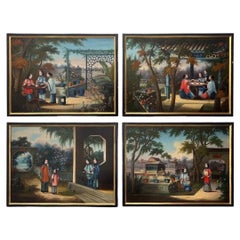
(4) Chinese Export Oil on Canvas Exterior Scenes C. 1840 National Gallery Prov.
Located in Atlanta, GA
Chinese Export, mid 19th century.
An exceptional and original 4 piece set of Chinese Export oil paintings on canvas depicting exterior ga...
Category
Mid-19th Century Chinese Export Antique East Asian Paintings
Materials
Gold Leaf
$23,196 Sale Price / set
20% Off
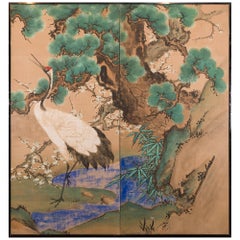
Japanese Two Panel Screen Manchurian Crane and Turtles
Located in Hudson, NY
In Japan, cranes symbolize fidelity as they mate for life and turtles symbolize longevity. Additionally, this screen also has the Japanese motif of sho-chiku-bai, or the three friends of winter (pine, plum, and bamboo). So called the three friends of winter because all three flourish during the cold months. This screen was originally fusuma doors...
Category
Mid-19th Century Edo Antique East Asian Paintings
Materials
Paper
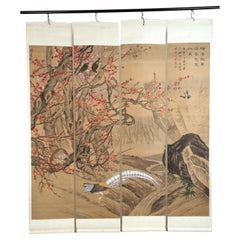
Set of Four Japanese Silk Hanging Scrolls Screens C.1920
Located in London, GB
A stunning set of four Japanese silk mounted vertical hanging scrolls.
Dating from C.1920 Taisho Period.
The watercolour and ink on silk depicts a larg...
Category
1920s Japonisme Vintage East Asian Paintings
Materials
Silk
$5,985 Sale Price / set
20% Off
Japanese Painting. Bird and Flower. 19th century copy of Lu Ji by Ogata Tomin.
Located in Kyoto, JP
Ogata Tomin (1839 -1895)
Birds in a spring landscape
Ink and colour on silk.
Inscription reads:
“Copy of Lu Ji, painted with heartfelt appreciation”
“Painted by Tomin Ogat...
Category
Late 19th Century Ming Antique East Asian Paintings
Materials
Silk
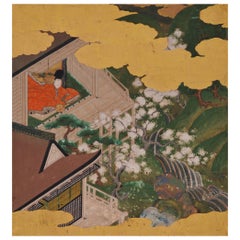
Japanese Painting, 17th Century, Tale of Genji, Tosa School
Located in Kyoto, JP
Illustration to an unidentified chapter of the Tale of Genji (Genji Monogatari)
Tosa School (second half of the 17th Century)
Ink, pigment, gofun and...
Category
Late 17th Century Edo Antique East Asian Paintings
Materials
Gold Leaf
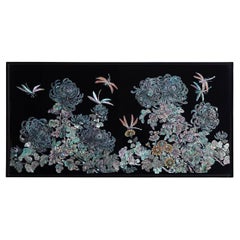
Handcrafted Floral Painting on Wood Panel by Arijian Chrysanthemum 02
By Arijian, Jian Yoo
Located in Namyangju-si, KR
Handcrafted mother-of-pearl painting with Chrysanthemum design.
Category
2010s East Asian Paintings
Materials
Wood
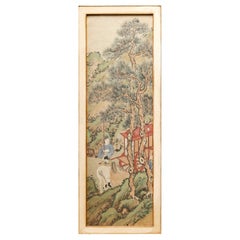
Antique Chinese School Ink, Watercolor and Gouache on Paper - Framed Under Glass
Located in Morristown, NJ
Chinese School (likely 19th c.), ink, watercolor and gouache on laid paper, apparently mounted on backing sheet, no signature or mark detected, framed under glass.
A traditional Chi...
Category
1880s Chinese Export Antique East Asian Paintings
Materials
Glass, Wood, Paint, Paper
Still Thinking About These?
All Recently ViewedMore Ways To Browse
Gold Coin Glasses
Gold Match Box
Grand Tour Oil Lamp
Grand Tour Red
Grape Bucket
Green Porcelain Parrots
Green Tara Statue
Greyhound Table
Guan Yu
Gucci Bar Set 1970
Guilloche Pill Box
Gunnar Tibergaard Nielsen
Haeger Sculpture
Hampton And Sons
Hand Painted Accent Cabinet
Handblown Glass Decanter
Hart Iron
Headrest Ceramic