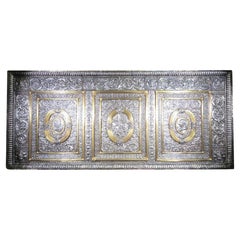
17th Century Wall Decorations

to
637
1,457
555
2,046
Height
to
Width
to
280
12
4
4
2
2
1
1
1
1
8,453
17,955
37,969
11,102
5,784
14,975
10,707
965
455
1,303
1,867
1,537
3,000
3,772
3,846
2,184
1,350
1,155
621
361
216
208
899
229
219
217
209
2,046
2,046
2,046
45
18
12
11
8
Period: 17th Century
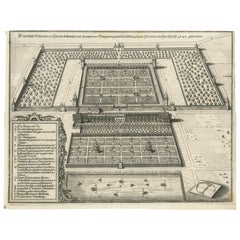
Baroque Garden and Palace near Vienna – Antique Architectural Engraving, 1649
Located in Langweer, NL
Baroque Garden and Palace near Vienna – Antique Architectural Engraving, 1649 This is a beautifully detailed 17th-century engraving, depicting a formal Baroque garden layout in Vien...
Category

German Antique 17th Century Wall Decorations

Materials

Paper

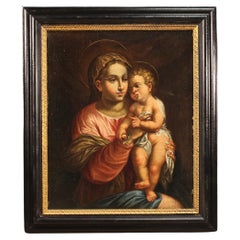
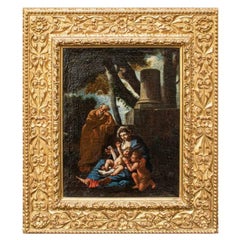
17th Century Oil on Canvas Italian Religious Painting Virgin with Child, 1670
Located in Vicoforte, Piedmont
Antique Italian painting from the late 17th century. Framework oil on canvas depicting a religious subject Virgin with child of good pictorial quality. Framework of excellent proport...
Category

Italian Antique 17th Century Wall Decorations

Materials

Canvas

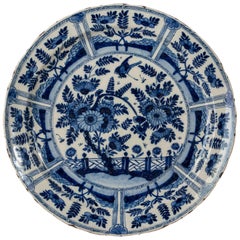
Large Delft Blue and White Charger, Late 17th Century
Located in New York, NY
Possible signature of Jan Jansz van der Laen.
Category

Danish Antique 17th Century Wall Decorations

Materials

Ceramic

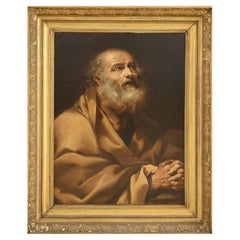
AURELIANO MILANI attrib (Bologna 1675-Rome 1749) "The Repentance of Saint Peter"
Located in Madrid, ES
AURELIANO MILANI (attributed) (Bologna, 1675 - Rome, 1749) "The Repentance of Saint Peter" Oil on canvas, 75x58.5 cm without frame 85cm x 68.5cm with frame Aureliano Milani (Bologna,...
Category

Italian Baroque Antique 17th Century Wall Decorations

Materials

Paint

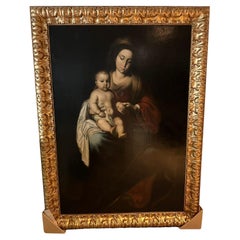
Important Circle Esteban Murillo "The Virgin and Child"
Located in Madrid, ES
Important Circolo Esteban Murillo "The Virgin and Child" oil on canvas Provenance: Private, Monte Carlo 150cm x 105cm Murillo received several commissions for paintings featuring Vi...
Category

Spanish Baroque Antique 17th Century Wall Decorations

Materials

Paint

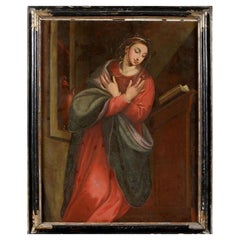
PULZONE Scipione (1554 - 1598) School "Virgin of Sorrows" 17th Century
Located in Madrid, ES
PULZONE Scipione (1554 - 1598) School "Virgin of Sorrows" 17th Century Oil on canvas marouflaged on canvas "Virgin of Sorrows". Follower of Scipione Pulzone. Italian school. Perio...
Category

Italian Baroque Antique 17th Century Wall Decorations

Materials

Paint

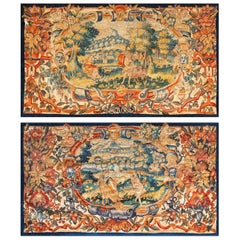
17th Century Pair of Flemish Tapestry in Baroque Style
Located in New York, NY
17th Century Pair of Flemish Tapestry ( 2' x 3'4" - 62 x 102 )
Category

Belgian Baroque Antique 17th Century Wall Decorations

Materials

Wool, Silk

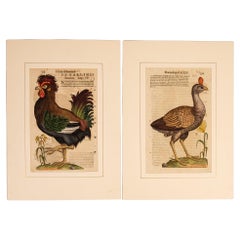
Pair of Old Ornithology Prints
Located in Alessandria, Piemonte
Pair of old very rare Ornithology prints "History of birds" by Ulisse Aldrovanti - Bologna 1646 - at Nicolao Tebaldipo - engraving with non-contemporany colors.
Category

Italian Other Antique 17th Century Wall Decorations

Materials

Paper

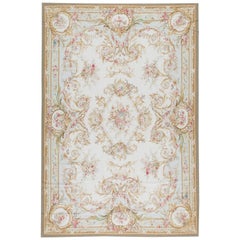
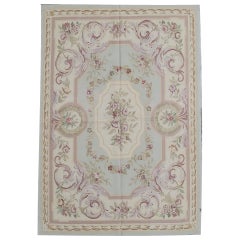
17th Century Traditional French Aubusson Style Flat-Weave Rug
Located in Secaucus, NJ
Handwoven Recreation of the Classic French flat-weave Aubusson rugs that have been found in the finest homes and palaces since the late 17th century. Size: 11' 1'' x 16' 3''.
Category

Chinese Aubusson Antique 17th Century Wall Decorations

Materials

Wool

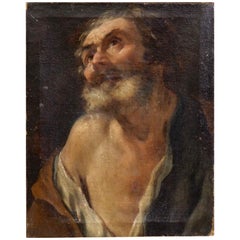
Italian Old Master Painting, 17th Century, Oil on Canvas
Located in Aalsgaarde, DK
Italian old master painting, 17th century, oil on canvas. Good condition Measures: H. 54 W. 43 cm H. 21.2 W. 16.9 in.
Category

Italian Antique 17th Century Wall Decorations

Materials

Paint

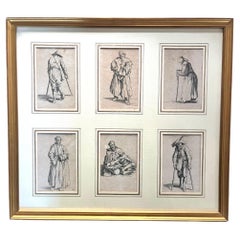
CALLOT - Set of 6 engravings Les Gueux - framed - 17th - Jacques CALLOT - France
Located in Beuzevillette, FR
Magnificent set of 6 engravings from the series Les Gueux from the 17th century by Jacques CALLOT (1592-1635). These 6 original engravings from the series Les Gueux were magnificentl...
Category

French Louis XIII Antique 17th Century Wall Decorations

Materials

Paper

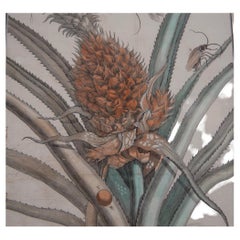
Pair of 17th Century Pineapple Engravings
Located in Hawthorne, CA
Artist unknown for this pair of pineapple paintings from 17th century. Beautifully gilt-framed and matted.
Category

American Modern Antique 17th Century Wall Decorations

Materials

Paper

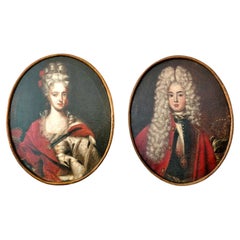
1600s Paintings of French Nobility
Located in Cesena, FC
1600s Paintings of French Nobility 1600s Portraits of Nobility: Seventeenth-century Paintings Size: 18.5 x 14.6 inches French Artist Featured here are six oval paintings depicting ...
Category

French Antique 17th Century Wall Decorations

Materials

Canvas, Wood, Paint

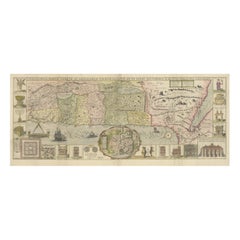
1632 Decorative Map of the Holy Land, Insets of Jerusalem and Biblical Artefacts
Located in Langweer, NL
Title: 1632 Decorative Map of the Holy Land with Insets of Jerusalem and Biblical Artefacts Description: This richly detailed map of the Holy Land, published in 1632, offers a fa...
Category

Antique 17th Century Wall Decorations

Materials

Paper

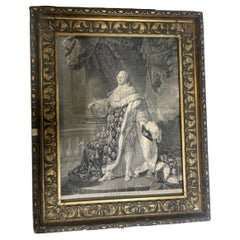
Portrait of King Louis XVI in Coronation Regalia
Located in Los Angeles, CA
Engraved by Charles-Clément Bervic (1756-1822). After Charles Clement "Bervic" Balvay (French, 1756-1822), "Marie Antoinette de Lorraine - D'Autriche, Reine de France" and "Louis Sei...
Category

French French Provincial Antique 17th Century Wall Decorations

Materials

Other

Couple of Italian Paintings Depicting Capricci, Francesco Aviani ‘1662-1715’
Located in IT
Francesco Aviani (Italy - Venice, 25-11-1662 / 1715) att. Couple of paintings depicting Capricci Oil on canvas, 135 x 183 cm, without frame The two large and fine paintings depict two illusionistic architectural renderings, with views of colonnades and arched buildings, animated by figures. The compositions are characterized by the harmony with which the painter introduces the sumptuous architectural monuments, the mirrors of water, the buildings in the distance and the views of the landscape. Dominates with a color on the tones of brown and ochre that stands out on the blue sky, marked by some cloud of steam. The insertion of the figures to enliven the architectural views also balances with the set. The Capriccio, an artistic genre that has made its way into Italian painting since the 17th Century, is characterized by the representation of fantastic architectures or prospective inventions, sometimes combined with elements drawn freely from reality. The two paintings are an example of this type and they are a very interesting and Fine artwork. The remarkable pictorial quality emerges both from the composition of the ensemble and from the way in which the artist describes the views with great attention to detail, highlights and refined, perfectly realistic, chiaroscuro. The same must be recognized for the figures: these are described with a wise brushstroke, quick and quick touches give the dynamism of the moment that is captured, as if time had stopped to show and narrate what is happening. The painting on the right represents a large Baroque building in stone and paved with marbles, two floors, with moving façade, large columns with corinthian columns, a large portal with a staircase with large footsteps, a balustrade with string, from which some figures appear, and two equestrian monuments in bronze. The sumptuous building overlooks a large POOL of water, with a gushing fountain, around which some characters sit. In the second floor is described a white palace from which rises a tower crowned by a structure with wrought iron loggia. In addition there is a bridge and some architectural ruins behind which some mountainous reliefs fade towards the horizon. On the staircase is described a particular scene. The people seem to be part of a very precise story. A woman, in the shadow of a parasol supported by a servant, would seem to drive out of the palace a man, who, taken under his arm by two maidens with a determined attitude, is led to a boat. The scene could be identified with the biblical episode of the parable of the prodigal son (Luke 15,11-32), at the moment when the prodigal son is robbed and driven away by the harlots. The episode tells of a man with two children. The youngest said to his father: “Father, give me the part of my inheritance”. And the father divided the substances. After not many days, the youngest son, collected his things, left for a far country and there he lost his substances with prostitutes and living as a debaucher. When he had spent everything, there came a great famine in that country and he began to find himself in need. Reduced to hunger, he was forced to be a pig herder to survive. He therefore meditated in his heart to go to his father and ask for his forgiveness and to be welcomed anew, even as a servant. While still on the road, however, the father saw him and ran towards him, receiving him with open arms. He then ordered his servants to prepare a great feast for the occasion, killing for the purpose the "fatty calf". The firstborn did not understand why his brother was given such treatment, and reminded the parent that he, who had always obeyed him, had never received a single kid to celebrate with his friends. The father answered him: «Son, you are always with me and everything that is mine is yours; but it was necessary to celebrate and rejoice, because this brother of yours was dead and came back to life, was lost and was found». The parable of the prodigal son was often portrayed in painting and the scene he finds most is certainly that of returning home in his father’s arms. Among the many is a canvas by the famous painter Giovanni Paolo Pannini (or Panini) (Italy – Piacenza, 1691– Rome, 1765) kept at the Hallsborough Gallery in London. Rather rare, however, is the scene of the prodigal son driven and robbed by harlots. There is an engraving by Hans Collaert II (1561-1620) in which this moment is described in the background compared to the moment, narratively later, in which he is penitent among the pigs. The second painting, certainly pendant of the first, represents a similar palace, with some characters overlooking the balustrade marcapiano and other figures around the large bathtub quadrilobata. In the foreground is described a monument with two large stone sculptures. In the distance some architectural elements and, beyond, the mountains are lost on the horizon. The studies related to the numerous painters of architectural views and caprices, active in Italy, and the archival documents found, which could better clarify commissions, biographies and certain works, are scarce and sporadic. Therefore there are still many difficulties in reconstructing a catalogue of autograph works for each author. Through paintings in private collections, in museums and paintings passed on the antique market it is however possible to advance some attributions in order to better delineate the various artistic figures. The style of the works studied here leads to a dating that runs between the 17th and 18th Centuries, with obvious influences dictated by the perspectives of the brothers Galli Bibiena. The analysis of the architectures and the chromatic palette suggests that we are in the presence of a northern Italian and Venetian author. Observing the decorations and the volutes, the brightness and the perspective disposition in fact, we find several analogies with those used by the Vicenza painter Francesco Aviani, excellent in pictorial perspective and architectural views. The biographical profile of Francesco Aviani (Italy - Vicenza, 1662-1715) was essentially traced in 1956 by Andreina Ballarin, then re-visited by Federica Spadotto in 2014 and Giancarlo Sestieri in 2015. Certain documents about his life are scarce, as are the documented works. He was born in Venice, probably on 25 November 1662, to Bernardo and a Magdalene whose surname is unknown, and was baptized on 3 December 1662. Between 1701 and 1703 he worked, together with his brother MarCo, sculptor, for the fresco decoration (now illegible) of the church villa in Soella (Vicenza). On October 16, 1703 he married Isabella Carcano. On March 26, 1715 he made a will and died on April 3 of the same year, in Vicenza. The frescoes in the refectory of the sanctuary of Monte Berico in Vicenza are considered authentic works by Aviani, probably made in 1708; the paintings preserved in the Civic Museum of Vicenza: “Landscape with Lazzaro and the rich Epulone”; “Christ among the doctors”; “The miraculous fishing”, works not datable but with attribution corroborated by style. In addition, the frescoes in the east and west corridors of the Villa La Rotonda, near Vicenza; the fresco in the apse basin of the chapel of the church S. Croce, Vicenza, now destroyed; the frescoes of the central hall of Villa Camerini a Montruglio (1714) and a painting of a “Porto Regio”, of which we have a print engraved by Dall'Acqua. From his works emerges the artistic background that animated the Venetian culture in the early eighteenth century. The scenic grandeur with which Aviani treats the architecture also suggests a stay in Emilia of the painter, in which he could have come into contact with the environment of the Bibiena. These contacts would be confirmed by the press of Cristoforo Dall'Acqua (Vicenza 1734-1787), “Il porto regio”, after a painting of Aviani. The press was part of a group of engravings, representing royal buildings, reproducing paintings of the Bibiena. In the eyes of Dall’Acqua, therefore, Aviani’s work was not foreign among those of the Emilians. Inside the sumptuous architectural whims, Aviani often depicts biblical scenes, in which the characters share the space and the narrative rhythm, along with figures drawn from everyday scenes, memories of the Veronese and Bassano heritage. Also in the works covered by this study the author does not seem to want to give up a biblical subject, though the purpose of the paintings appears to be clearly a staging scenography-architectural within which the characters are relegated to the role of extras. From the examination of the architectural Capriccio gathered under the name of Aviani then emerge common elements. The comparison between these works and the works in question highlights the proximity of the compositions. The imposing and scenic architectures are in fact equally characterized by the perspective-scenographic ability diffused in emilian “quadraturisti” and in Bibiena work. In fact, you can see the spectacular slender architecture in the lower part, the loggias that create chiaroscuro games with arches and binate columns placed on massive bases and overhung by projecting cornices. Significant also the comparison with two paintings with architectural whims in a night vision attributed to Francesco Aviani. In Aviani’s works it is possible to find a certain knowledge of the Roman Codazzi paint nd its early development of the eighteenth century, developed with the Locatelli, the Pannini and the less known Domenico Roberti. To Roberti have been recently attributed two works that have some compositional affinity with the canvases in question. The same can be done for a work on the antique market, attributed to Pietro Francesco...
Category

Italian Baroque Antique 17th Century Wall Decorations

Materials

Canvas

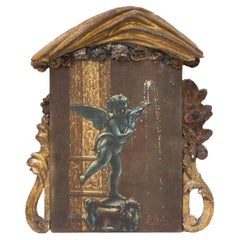
18th Century Italian Signed Oil Painting with Fragments and Lazurite Gems
Located in Dublin, Dalkey
17th century Italian oil painting of an angel fountain signed by the artist. The painting is framed with an 18th century Italian hand-carved and gilded fragments adorned with lazurit...
Category

Italian Rococo Antique 17th Century Wall Decorations

Materials

Crystal, Multi-gemstone

17th Century Traditional French Aubusson Style Flat-Weave Rug
Located in Secaucus, NJ
Handwoven Recreation of the classic French flat-weave Aubusson rugs that have been found in the finest homes and palaces since the late 17th century.
Category

Chinese Aubusson Antique 17th Century Wall Decorations

Materials

Wool

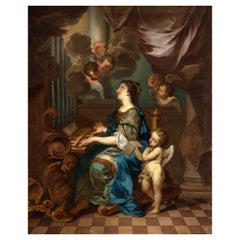
17th Century, Italian Painting with Saint Cecilia with Angels in Concert
Located in IT
17th century Roman school, Santa Cecilia with angels in concert, oil painting on canvas The valuable painting, in excellent condition, depicts Sa...
Category

Italian Baroque Antique 17th Century Wall Decorations

Materials

Canvas

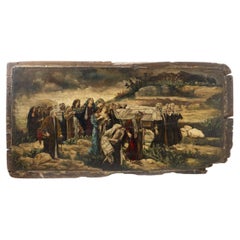
European School - Burial Of Lazarus
Located in Porto, PT
This dramatic “Burial of Lazarus”, executed in oil on wood during the 17th century, is a compelling example of Baroque religious painting. The work captures the poignant moment of La...
Category

Antique 17th Century Wall Decorations

Materials

Paper

European School - Burial Of Lazarus
$3,000 Sale Price
50% Off
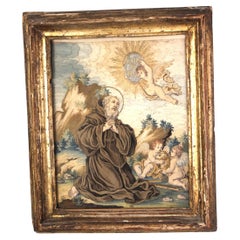
18th Century Saint Francis of Paola with Cherubs
Located in Seaford, GB
Spain, Circa 1750 Hand-painted silk Giltwood frame Devotional artwork A rare and exquisitely detailed 18th-century Spanish devotional panel, finely executed on silk and depicting ...
Category

Spanish George II Antique 17th Century Wall Decorations

Materials

Silk

17th Century Rest on The Flight to Egypt Emilian school Painting Oil on Canvas
Located in Milan, IT
17th century, Emilian school Rest on the flight to Egypt Oil on canvas, 42 x 33 cm Frame 65 x 55 cm The present Holy Family, ...
Category

Italian Antique 17th Century Wall Decorations

Materials

Canvas

Eudamidas Final Moments: A Scene from Lucian s Toxaris, or Friendship, ca.1680
Located in Langweer, NL
Title: "Testament of Eudamidas of the City of Corinth" Description: This print depicts a scene from Lucian's 'Toxaris, or Friendship,' where Corinthian Eudamidas is seen lying in a ...
Category

Antique 17th Century Wall Decorations

Materials

Paper

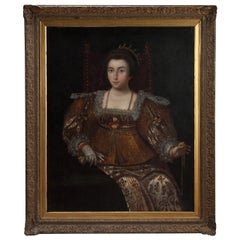
17th Century Spanish Oil on Canvas Depicting a Queen
Located in Tarzana, CA
A 17th century Spanish oil painting on canvas depicting a queen witting on a throne with a crown on her head wearing an elaborate costume in brown Gray Red and Beige. She is wearing ...
Category

Spanish Antique 17th Century Wall Decorations

Materials

Canvas

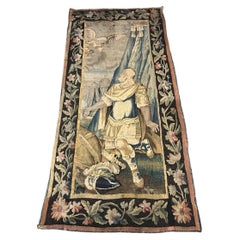
17th Century Aubusson Tapestry Remnant
Located in Houston, TX
A fragment of a 17th-century Aubusson tapestry depicts a man on his knee looking upward, visited by a radiant angel. Rich colors and intricate details capture the moment of divine en...
Category

French Baroque Antique 17th Century Wall Decorations

Materials

Wool, Silk

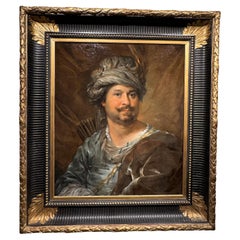
Man Dressed In Oriental Style Carrying A Quiver, Holland 17th Century
Located in PARIS, FR
Portrait of a man dressed in oriental style, carrying a quiver. In Flanders and Holland in the 17th century, it was fashionable to be depicted in oriental costume, reflecting the imp...
Category

Antique 17th Century Wall Decorations

Materials

Canvas

French School 17th Century"Portrait with Coat of Arms Margueritte de Boutteville
Located in Madrid, ES
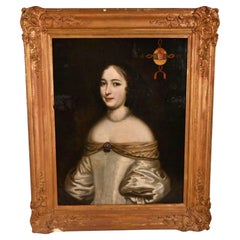
French School of 1659 17th century "Portrait with Coat of arms of Margueritte Pierre de Boutteville" around 1659 Oil on canvas with coat of arms and dated top right Provenance: Bel...
Category

French Baroque Antique 17th Century Wall Decorations

Materials

Paint

Oil on canvas, (attributed to Giacinto Brandi, Rome)
Located in Rome, IT
Oil on canvas, (attribuito Giacinto Brandi , Roma 1621 – 19 January 1691 ) L'educazione di Bacco ADDITIONAL PHOTOS, INFORMATION OF THE LOT AND QUOTE FOR SHIPPING COST CAN BE REQUEST ...
Category

European Antique 17th Century Wall Decorations

Materials

Canvas

Italian Still Life Painting of a Cat with Game
Located in Essex, MA
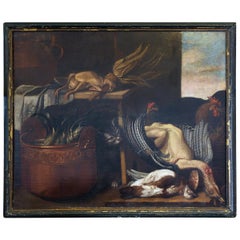
Relined canvas depicting birds prepared for dining with table and cat peeking out considering dining himself with live roosters in the background and copper pot filled with vegetables.
Category

Italian Antique 17th Century Wall Decorations

Materials

Canvas

Early Depiction of Sati Ritual, Widow Burning on Pyre, Dutch Engraving c.1601
Located in Langweer, NL
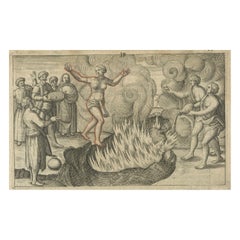
Title: Early Depiction of Sati Ritual, Widow Burning on Pyre, Dutch Engraving c.1601 Description: An exceptional early 17th-century Dutch engraving illustrating the Hindu ritual of ...
Category

Dutch Antique 17th Century Wall Decorations

Materials

Paper

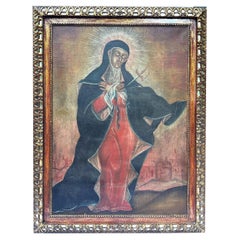
Late 17th Century Our Lady of Sorrows - Spanish Colonial oil on Canvas
Located in Rio De Janeiro, BR
This 17th-century oil on canvas from Spanish Colonial Peru features a striking depiction of Our Lady of Sorrows. The Virgin is shown with a somber expr...
Category

Peruvian Spanish Colonial Antique 17th Century Wall Decorations

Materials

Canvas

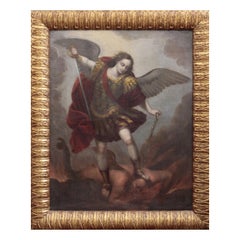
SPANISH SCHOOL FROM THE LATE 17TH CENTURY. "Saint Michael the Archangel"
Located in Madrid, ES
SPANISH SCHOOL FROM THE LATE 17TH CENTURY. "Saint Michael the Archangel" Oil on canvas. 104x82 cm. Relined. Frame in molded and gilded wood. good condition
Category

Spanish Baroque Antique 17th Century Wall Decorations

Materials

Paint

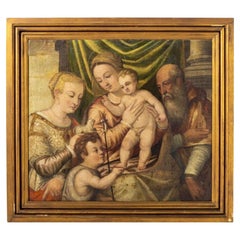
Flemish School 17th Century
Located in Madrid, ES
Flemish school 17th century "Our Lady with the Child Jesus, St. John, St. Elizabeth and Zacarias". Oil on canvas Relined. Dimensions: 74 x 84 cm good conditions.
Category

Dutch Baroque Antique 17th Century Wall Decorations

Materials

Paint

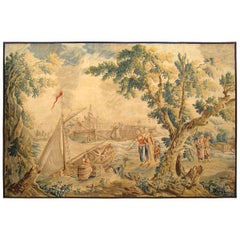
Late 17th Century French Aubusson Rustic Tapestry with a Boat Unloading Cargo
Located in New York, NY
A French Aubusson rustic tapestry from the late 17th century, depicting several villagers on either side of a large tree in the right foreground, watching the cargo being unloaded from a large vessel docked by the verdant river bank at left, with the turbulent sea at center, and other ships docked by the riverside cityscape in the left distance. Enclosed by a narrow monochromatic border. Wool with silk inlay. Measures: 10’1” H x 13’9” W This tapestry was probably woven after a design by the French painter Claude-Joseph Vernet (1714-1789), renowned for his Marines, or maybe by his student Charles Grenier de Lacroix also known as Lacroix de Marseille...
Category

French Aubusson Antique 17th Century Wall Decorations

Materials

Wool

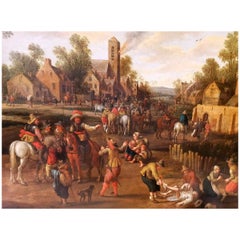
"Soldiers Looting a Village" 17th Century Oil on Panel Dutch School
Located in Madrid, ES
Soldiers looting a village XVII century oil on panel Oil on panel: 75 x 110 cm Signed and dated 1650 lower left Sold at Christie's Amsterdam, 11/18/93 For 130,000 DG = 60,827 € - joint purchase invoice for the year 93 About painter dutch painter Utrecht 1586 - 1666 Utrecht Painter of genre scenes, generally of peasants, views and landscapes of villages and towns (including some winter landscapes) and some religious and allegorical subjects (mainly at the beginning of his career). We do not know under whom our painter studied. Seeing the Flemish character of his work, some scholars believe that he could have studied in Flanders, in Antwerp. Droochsloot was a versatile and productive painter. The central museum in his hometown of Utrecht holds 15 of his paintings, showing the diversity of his work, many other museums exhibit his works Our painting represents a scene that took place during the Eighty Years' War. This Dutch War of Independence from Spain was a long, slow war that lasted from 1568 to 1648. The war began with a Protestant uprising in Flanders and Holland against the Spanish...
Category

Dutch Baroque Antique 17th Century Wall Decorations

Materials

Paint

Lombard school, 17th century, Still life with flowers
Located in Milan, IT
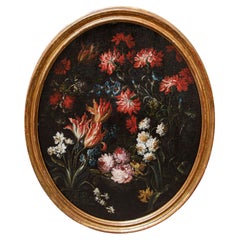
Lombard School, 17th century Still Life with Flowers Oil on canvas, 52 x 60 cm Framed, 67 x 76 cm The oil on canvas under consideration, depicting a floral jubilation emerging f...
Category

Other Antique 17th Century Wall Decorations

Materials

Canvas

Antique Map of the Spice Islands Moluccas , Indonesia by W. Blaeu, circa 1640
Located in Langweer, NL
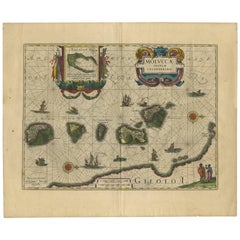
Antique map titled 'Moluccae Insulae Celeberrimae'. Highly decorative antique map of the Spice Islands (Moluccas) published by W. Blaeu (circa 1640). This map features a large inset ...
Category

Dutch Antique 17th Century Wall Decorations

Materials

Paper

Decorative Set of 3 Antique Botanical Prints, Wildflowers of Leipzig 1690s
Located in Langweer, NL
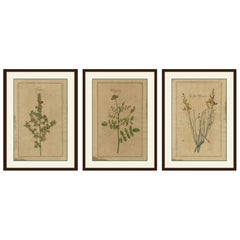
Rivinus botanicals: Anonis, Hedysarum & Genista hispanica, Leipzig, 1690s Set of three late-17th/early-18th-century botanical copper engravings with period hand-colour, attributed t...
Category

German Antique 17th Century Wall Decorations

Materials

Paper

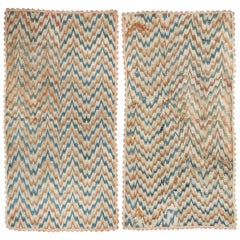
Bargello Flamestitch Silk Embroidery Florence Spetchley Park Bed Curtains Pair
Located in BUNGAY, SUFFOLK
Spetchley park, Bargello, silk, bed curtains adapted into wall hangings in the 19th century • The use of silk, patterning and size suggests that these striking Bargello hangings were almost certainly conceived as bed curtains. In the Green Chamber at Parham House the State Bed is hung with Bargello curtains, pelmets and valences c1620. Like the Parham bed curtains, the Spetchley Park bed curtains have two horizontal pattern repeats in each drop. Needless to say, surviving bed curtains from this period are exceptionally rare as they had value as hangings and for upholstering domestic objects when removed from the bed. • The Spetchley Park bed curtains are really beautiful and luxurious. They were made as elite objects and have not lost their gravitas or their character and charm. • The Spetchley Park bed curtains were adapted into wall hangings in the 19th century. They are versatile and could easily be reinstated as curtains or panels within larger curtains. • Bargello work has a classic timeless quality to it and blends with most decorative schemes whether period or contemporary Each panel is made from two sections of bargello. The step (pattern) comprising two rows of short vertical stitches over two threads of graduating numbers of stitches up and down with two rows of long vertical stiches over six threads of graduating numbers of stitches up and down. Worked in graduating shades of blue, green, brown, red, tan and ivory silks on a hessian ground. The four edges of each hanging are faced with a 19th century, dusky pink fan...
Category

Italian Baroque Antique 17th Century Wall Decorations

Materials

Silk

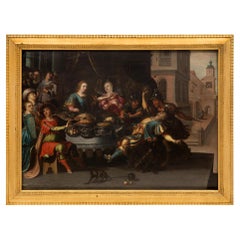
Dutch 17th Century Oil on Wood Painting in the Manner of Frans Francken
Located in West Palm Beach, FL
A sensational Dutch 17th century Oil on Wood painting in the manner of Frans Francken. The painting depicts the scene of a feast with a young male and female enjoying a feast while musicians are playing music in the background. To the left of the table that are spectators who are turning their heads away from two guards killing a traitor seated at the table. In the background you have architectural buildings and additional figures. At the bottom center is a pet monkey...
Category

Dutch Antique 17th Century Wall Decorations

Materials

Canvas, Giltwood

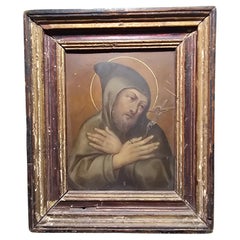
17th-Century Oil on Copper – Saint Francis of Assisi
Located in Madrid, ES
Exceptional oil painting on copper from the 17th century, depicting Saint Francis of Assisi in a moment of deep devotion. The artwork showcases fine detailing, characteristic of the ...
Category

Antique 17th Century Wall Decorations

Materials

Copper

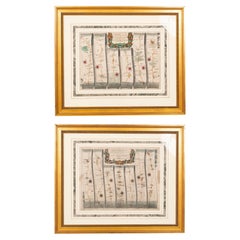
Pair of Road Maps of England by John Ogilby
Located in Essex, MA
The first road maps of England. London to Holyhead and London to Carlisle. Nicely framed and matted. These are plates removed from a book. These are fir...
Category

English Antique 17th Century Wall Decorations

Materials

Paper

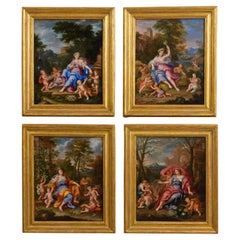
17th century, Four French Paintings Depicting The Seasons, Circle of Noel Coypel
Located in IT
Four paintings depicting the seasons, circle of Noel Coypel, second half of the 17th century Oil on canvas Measures: cm W 37 x H 46 x D 2 cm (canvas) The four paintings, presented in...
Category

French Baroque Antique 17th Century Wall Decorations

Materials

Canvas

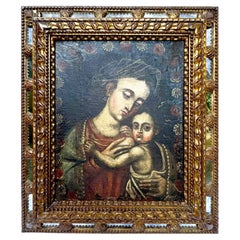
Late 17th Century Spanish Colonial Our Lady and Baby Jesus
Located in Rio De Janeiro, BR
This late 17th-century oil on canvas from Peru, depicting the Virgin Mary and baby Jesus, is a striking example of Spanish Colonial art. The work reflects the deep religiosity and de...
Category

Peruvian Spanish Colonial Antique 17th Century Wall Decorations

Materials

Canvas

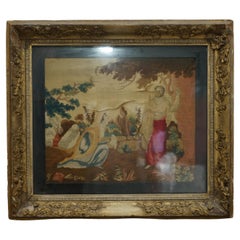
Ancient 17th-18th Century Silk Hand Woven Tapestry, 300-400 Years Old Must See
Located in West Sussex, Pulborough
We are delighted to offer for sale this stunning original 17th - 18th century silk embroidered and stitched tapestry A very good looking and decorative piece, I'm sure there is s...
Category

Danish Dutch Colonial Antique 17th Century Wall Decorations

Materials

Silk

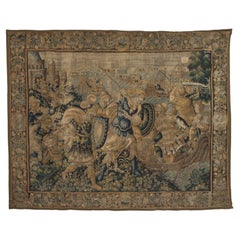
Flemish Tapestry Depicting a Cavalry Battle before a Fortress, Brussels, c. 1700
Located in Tarzana, CA
A large Flemish tapestry, likely 17th century (Baroque period), woven in wool and silk. The central scene depicts an epic battle narrative with armored knights on horseback, shields ...
Category

European Baroque Antique 17th Century Wall Decorations

Materials

Tapestry, Wool, Silk

Antique painting Martyrdom of St. Bartholomew from the 17th century
Located in Cesena, FC
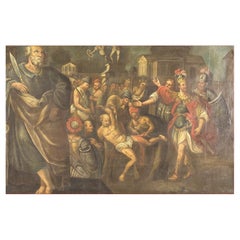
Antique painting Martyrdom of St. Bartholomew, by northern European painter of the 17th century Oil on canvas 100 x 150 cm Painting based on a subject by Martin de Vos (1532-1603) a...
Category

Belgian Antique 17th Century Wall Decorations

Materials

Canvas

Important Italian School 17th century Portrait of Emperor Vespasian
Located in Madrid, ES
Italian School 17th century Portrait of Emperor Vespasian, bust; oil on canvas, 77.6 x 65.6 cm. Provenance: Private collection, U...
Category

Italian Baroque Antique 17th Century Wall Decorations

Materials

Paint

END OF THE 17th CENTURY PAIR OF PAINTINGS WITH FLOWER VASES
Located in Firenze, FI
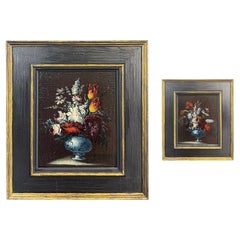
Beautiful pair of oil paintings on canvas, mounted on panel and framed in ebonized and gilded wood. The pictorial technique used favors chiaroscuro, with the representation of a vase...
Category

Italian Antique 17th Century Wall Decorations

Materials

Canvas, Giltwood, Paint

Antique Map of the Strait of Malacca, Malay Peninsula Dutch Indies, c.1670
Located in Langweer, NL
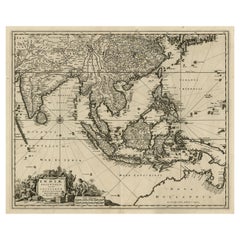
Antique map titled 'Indiae Orientalis, nec non Insularum Adiacentium Nova Descriptio.' Map of Southeast Asia. The map centers on the Strait of Malacca and Malay Peninsula. It ext...
Category

Antique 17th Century Wall Decorations

Materials

Paper

18th Century Italian Oil on Canvas Painting with Battle by Antonio Calza
By Antonio Calza
Located in IT
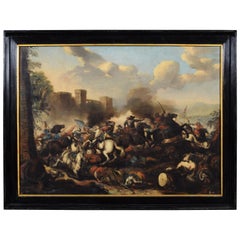
Antonio Calza (Italy, Verona, 1653-18th April 1725) "Battle between Christian and Turkish cavalry with castle" The painting depicts a bloody battle between Christian and Turkish cavalry. Characterized by dynamism, intensity of color and light, the main scene occupies the lower horizontal section of the canvas, optically interrupted by the black fumes of the shots from which emerge, on the left, the towers of a fortress. On the right, in the distance you can see the combat in progress in the countryside, beyond which you can see the pale presence of hills that create a fifth, marking the horizon. To frame the scene contributes to the left, against light and in the foreground, a portion of the wall. The painter, however, introduces a horse on the ground, of which we see only the back, a ruse to involve the observer making him become active and participate in the scene. In the foreground, lifeless bodies, wounded horses and, scattered on the ground, weapons and a drum enhance the drama of the clash. The excitement and expressive force, the intense chromatic range attentive to the conditions of light and the fine brushstrokes, decisive and dramatic, suggests the attribution to Antonio Calza, one of the most important painters of battles of the seventeenth century, excellent student and continuator of the greatest interpreter of the genre, Jacques Courtois called il Borgognone (Saint-Hyppolite 1621 - Rome 1676). Il Borgognone, although not having had a real school or direct students, places itself as a primary reference point by the Italian and foreign "battaglisti". The genre of battle painting found great success in the collections of the Italian and European nobility of the seventeenth and eighteenth centuries. The battles of the Italian Renaissance, in which the scene converged towards a precise protagonist, evolve towards a type of combat "without hero". The bloody realism of the details and the dynamic development of the narrative confuse the figure of the protagonist, when present, to give importance to the swirl of horses and armed fighters, among which, moreover, does not emerge a winner. The certain documents relating to the life and movements of Antonio Calza are scarce; it was equally difficult to reconstruct, from the critics, a catalogue of autograph works. Through paintings in private collections, in museums and paintings passed on the antiques market it has been possible to identify a copious corpus of works that can be traced back to his hand. The work of art historians, together with that of antique dealers, in conferring proper attributions in order to best outline the figure of Calza, continues but studies are still in progress. In this sense, the work of Giancarlo Sestieri should certainly be noted, who investigated the artistic production of the battaglisti and Calza, thus allowing the comparison of the numerous photographic works reported, to identify and recognize the stylistic qualities that distinguish the corpus of paintings assigned to him today. Antonio Calza was born in 1653 in Italy, in Verona and in 1664 he entered the school of Carlo Cignani in Bologna, dedicating himself to painting battles and landscapes. He then perfected in Rome, where he knew the works of the then undisputed head of the sector, Jacques Courtois called the Burgundian. In 1675 he returned to Verona and married an 88-year-old widow who, dying, left him a rich inheritance. Much appreciated by the nobility and the bourgeoisie, he received numerous commissions. Bartolomeo Dal Pozzo (Le Vite de' pittori, de gli scultori et architetti veronesi, 1718) praises "three great paintings of battles...
Category

Italian Baroque Antique 17th Century Wall Decorations

Materials

Canvas

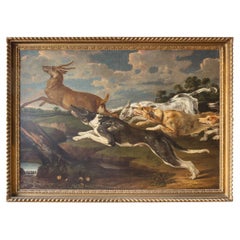
Oil on Canvas; Hounds Chasing a Stag, Studio of Frans Snyders, Antwerp 1579-1657
By Frans Snyders
Located in London, GB
This powerful hunting scene is closely associated to the work of Antwerp-born seventeenth century painter and draughtsman Frans Snyders, widely considered the “progenitor of Flemish Baroque still-life and animal painting.” Having grown up surrounded by artists, Snyders was initially apprenticed to Pieter Brueghel the Younger (1564-1637/38), scion of a well-established family of painters. Like many of his contemporaries in Northern Europe, to complete his education he then travelled to Italy, staying mainly in Rome and Milan (1608-09). Once back in Flanders, his profile as a skilled young painter – who had refined his craft by studying the masters of Italian art – came to the attention of Sir Peter Paul Rubens (1577-1640), in whose Antwerp studio Snyders entered as an assistant in about 1610, and with whom he would go on to collaborate on a number of important commissions for years to come. In 1611, Snyders further strengthened his ties with the local community of painters by marrying Margaretha de Vos, sister to Cornelis and Paul de Vos, two artists with whom he would also regularly collaborate. Thanks to the lessons learned in Italy and in Rubens’ studio, Snyders soon achieved the ability to create rhythmic and dynamic compositions, infused with vibrant colours and powerful naturalistic effects. Centred on the theme of the still life, his market scenes and representations of richly stocked pantries and larders embodied the buoyant and confident spirit of seventeenth-century Antwerp, a trading port with a wealthy merchant class and aristocracy (Still Life with Dead Game, Fruits, and Vegetables in a Market, 1614, The Art Institute of Chicago; Still-Life with Fowl and Game, 1614, Wallraf-Richartz Museum, Cologne). Flowers from all seasons and dead game are portrayed alongside baskets overflowing with fruit, precious gilt vessels and Chinese Wanli porcelain...
Category

Belgian Antique 17th Century Wall Decorations

Materials

Paint

17th Century Italian School "ECCE AGNUS DEI"
Located in Madrid, ES
17th century Italian School "ECCE AGNUS DEI" oil on canvas Dec. 70 x 90 cm good condition.
Category

Italian Baroque Antique 17th Century Wall Decorations

Materials

Paint

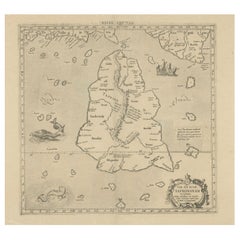
Rare Original Antique Ptolemy Map of Ceylon, Present Day Sri Lanka
Located in Langweer, NL
Original antique map titled 'Tab XII Asiae Taprobanam (..)'. For this map of Toprobana (Sri Lanka), Ptolemy drew on the accounts of travelers and sailors and though the information was secondhand and often inaccurate, it represented the most advanced account of the world's geography at that time. This map depicts the island with the typical misconceptions of the period with the enlarged island straddling the Equator and nearly divided by a ridge of mountains. A small part of India is incorrectly shown in the northeast corner of the map and a spurious coastline labeled Gangem fills the upper right corner. The stipple engraved sea contains an oriental ship...
Category

Antique 17th Century Wall Decorations

Materials

Paper

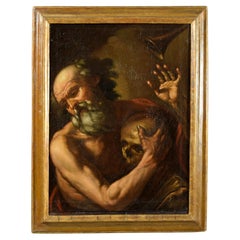
17th Century, Italian Painting Saint Jerome Hears the Trumpet of Judgment
Located in IT
Saint Jerome Hears the Trumpet of Judgment, Neapolitan School, 17th Century This exquisite oil-on-canvas painting depicts Saint Jerome hearing the trumpet of the angel of the Last Ju...
Category

Italian Baroque Antique 17th Century Wall Decorations

Materials

Canvas

17th Century Italian School Biblical Scene
Located in Marseille, FR
17th century oil on canvas representation of the "Feeding of the 4,000" of Italian school.
Category

French Baroque Antique 17th Century Wall Decorations

Materials

Canvas

17th Century Flemish Baroque Tapestry Fragment in Later Giltwood Frame. Belgium.
Located in Los Angeles, CA
An exquisite 17th-century Flemish Baroque tapestry fragment, beautifully preserved and presented in a later giltwood frame. This fragment captures the richness of Baroque artistry wi...
Category

Belgian Antique 17th Century Wall Decorations

Materials

Tapestry

17th Century Annunciation Painting Oil on Canvas Workshop of Nuvolone
Located in Milan, IT
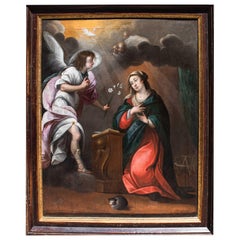
17th century, Nuvolone workshop Annunciation Measures: Oil on canvas, 98.50 x 127.00 cm - with frame 144 x 115 Depicted is a canonical Annunciation which sees Mary on her knees ...
Category

Italian Antique 17th Century Wall Decorations

Materials

Canvas

Italian Oil painting on canvas of Jesus Christ with a crown of thorns, 1600s
Located in MIlano, IT
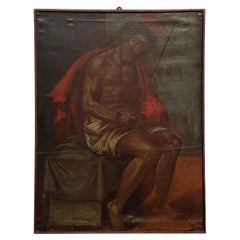
Italian Oil painting on canvas of Jesus Christ with a crown of thorns, 1600s Oil painting on canvas with sacred subject. The painting depicts Jesus Christ sitting and dressed only i...
Category

Italian Antique 17th Century Wall Decorations

Materials

Canvas, Wood

17th-Century Italian Silver and Gilt Silver Altar Panel (Paliotto)
Located in Madrid, ES
This extraordinary 17th-century altar panel, known as a "Paliotto," is a remarkable example of Italian ecclesiastical art. Expertly crafted from worked silver and gilded silver, the ...
Category

Antique 17th Century Wall Decorations

Materials

Sterling Silver

Read More

Punk Rock and Rebellion Animate London’s Hit Yoshitomo Nara Show

The exhibition includes his portraits of wide-eyed kids with mayhem on their minds, as well as some of the artist’s personal belongings.

Whether Painted or Papered, Muraled Walls Make Bold Statements in the Home

The ancient practice of covering walls in artistic scenery is back.

In Francks Deceus’s ‘Mumbo Jumbo #5,’ the Black Experience Is . . . Complicated

Despite the obstacles, the piece’s protagonist navigates the chaos without losing his humanity.

12 Floral-Accented Rooms with a Handmade, Folkloric Feel

Who needs a flower garden? Just use your imagination — and some beautifully patterned wallpaper or fabric — to bring the outdoors in.

This Wolf Kahn Pastel Is the Epitome of Beauty at Its Most Essential

A longtime admirer of Kahn’s work, 1stDibs editorial director Anthony Barzilay Freund explores why it’s relevant now more than ever.

Why Jules Chéret Was the King of the Modern Poster

The streets of fin-de-siècle Paris were set aglow with colorful poster ads, thanks to the printing techniques invented by Jules Chéret. Now, the Milwaukee Art Museum is celebrating this undersung talent in America's first solo show dedicated his exuberant works.

Anna Condo’s Multifaceted Career Spans Film, Photography and NFTs

From her historic Manhattan townhouse, the talented creator and curator of 1stDibs' latest NFT exhibition tells us about the art in her home and how she got involved with cryptoart.

How Keith Rivers Went from NFL Linebacker to Blue-Chip Art Aficionado

The former football player is as serious about becoming a great contemporary-art patron as he once was about making tackles. Here, Rivers tells us how he got the collecting bug and how his tastes have evolved over the years.

Still Thinking About These?

All Recently Viewed