Edwardian Brooches
Antique Edwardian jewelry is named for King Edward VII of Great Britain, who ruled from 1901 until 1910. Classic Edwardian necklaces, engagement rings, earrings and other jewelry are often overshadowed by the more popular style of the era, Art Nouveau, which is a shame. At its best, Edwardian jewelry was all about the exquisite diamond, platinum and pearl creations made by such famous names as Cartier and Boucheron.
Edward introduced incredibly formal Buckingham Palace court presentations, balls and soirées, resulting in a huge demand for diamond jewels starting with his coronation in 1902. Dozens of tiaras and formal jewels in an updated 18th-century style were purchased from French jewelers Boucheron and Chaumet and from Russia’s Fabergé. The court jewelers Asprey, Garrard, Carrington and the newly opened London branch of Cartier were all overwhelmed with orders for sumptuous diamond jewelry to be worn at the king’s elaborate coronation.
During the Edwardian era, pearls were more valuable than diamonds. The pear-shaped pearl La Peregrina, for example, belonged to some of the most fabulous and strongest women in history and bounced among royal courts in Spain, France and Russia for several centuries. So while today the scale and clarity of a diamond ring matters, back then the size and quantity of your pearls was more important a declaration of wealth. And just as Victorian notions of propriety and femininity began to change after Queen Victoria died in 1901, jewelry design also evolved but there was some overlap with late Victorian styles.
Women of the Edwardian period sported bejeweled headpieces like tiaras and bandeaus with feathered aigrettes. Another popular piece of jewelry that is said to have been directly inspired by Queen Alexandra were colliers de chien, or dog collars — today's choker necklaces — which consisted of either a ribbon decorated with a brooch, a gemstone or several strands of pearls strung closely together.
Two major jewelry houses, Cartier and Boucheron, were founded in the mid-1850s, and by the beginning of the 20th century, the wealthy considered them household names. The Cartier brand became even more desirable once the house became the official jewelry supplier to King Edward VII. Cartier took this title seriously and designed some of the most innovative jewelry of its day, since it was willing to experiment with new materials like platinum and because it was mindful of fashion trends. Filigree settings also became popular. This saw-piercing technique was decorative and at the same time created a sense of lightness.
Perhaps even more important than Cartier’s use of platinum was the founding of De Beers Consolidated Mines Limited in 1888. The discovery of new diamond mines made the stone more affordable and prompted the introduction of new gemstone cuts. It is not uncommon to see Edwardian jewels with baguette or briolette diamonds.
Find antique Edwardian rings, bracelets, watches and other jewelry on 1stDibs.
Early 20th Century Edwardian Brooches
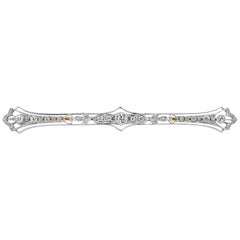
Diamond, 18k Gold, Platinum, Yellow Gold
Early 20th Century British Edwardian Brooches
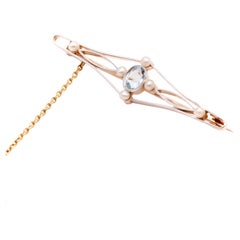
Aquamarine, Pearl, 15k Gold, White Gold, Yellow Gold