Belgium Figurative Sculptures
to
43
450
75
10
76
61
313
85
83
150
39
6
10
20
32
4
9
25
21
5
5
93
65
19
13
11
11
7
4
3
2
2
1
1
1
1
202
134
123
122
100
7,865
7,705
389
143
86
81
51
Height
to
Width
to
535
481
481
30
14
3
3
3
Item Ships From: Belgium
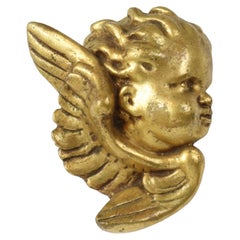
Angel Cherub Head Gilded Plaster Gold Wall Decoration 17cm
Located in Poperinge, BE
Vintage angel or cherub head with wings, made of gilded plaster, second half of the 20th century.
A charming gold wall decoration, ideal for Christmas. This item is in excellent vin...
Category
1970s European Baroque Vintage Belgium Figurative Sculptures
Materials
Plaster
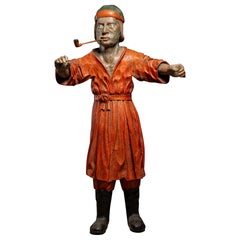
19th C Tobacco Shop Publicity Statue smoking a pipe - polychromed wood.
Located in Leuven , BE
19th C Tobacco Shop Publicity Statue smoking a pipe -polychromed wood.In perfect state -stands tall on its own.
Category
Late 19th Century French Antique Belgium Figurative Sculptures
Materials
Hardwood
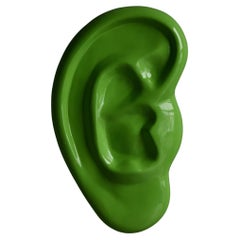
Fibreglass Contemporary Ear Sculpture, France, 2010s
Located in Antwerp, BE
A striking ear sculpture crafted from smooth fibreglass and finished in vivid, high-gloss green. Created in the 2010s, it reflects contemporary design’s fascination with scale, mater...
Category
2010s European Belgium Figurative Sculptures
Materials
Fiberglass
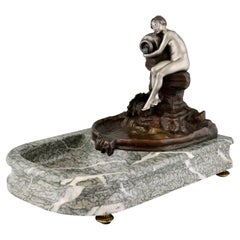
Art Nouveau Bronze Sculptural Tray Indoor Fountain with Nude by Suzanne Bizard
By Susanne Bizard
Located in Antwerp, BE
Art Nouveau bronze sculptural tray indoor fountain with seated nude holding a vase signed by Suzanne Bizard.
Patinated bronze on impressive marble tr...
Category
Early 1900s French Art Nouveau Antique Belgium Figurative Sculptures
Materials
Marble, Bronze
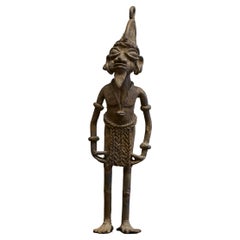
Early 20th Century West African Tribal Figurine in Cast Brass
Located in Meer, VAN
Early 20th Century West African Tribal Figurine in Cast Brass.
Very distinct early to mid 20th century tribal figurine in cast brass from the west of Africa. Great and very typical ...
Category
Early 20th Century African Tribal Belgium Figurative Sculptures
Materials
Brass
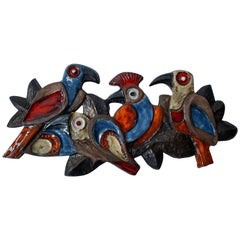
Ceramic Wall Sculpture with Birds
Located in Antwerp, BE
Ceramic wall art sculpture with birds.
Belgium 1960s.
Width:55 cm.
Height:28 cm.
depth:3 cm.
Category
Mid-20th Century Belgian Mid-Century Modern Belgium Figurative Sculptures
Materials
Ceramic

$1,744 / item
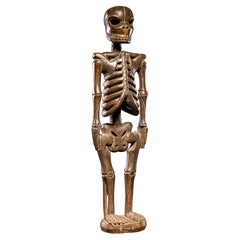
Ceremonial hardwood Skeleton from a single piece of wood, Nigeria.
Located in Leuven , BE
An uncommon form, the abstract teeth filled mouthed figure standing straight on an integral base.
Category
20th Century Nigerian Belgium Figurative Sculptures
Materials
Hardwood
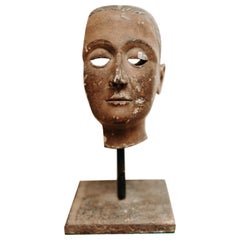
18th century Spanish polychromed wooden Santos head
Located in Brecht, BE
a polychromed wooden Santos head, found in Spain, mid 18th century,
height is 16 cm with foot 24 cm, width 9 cm with foot 12 cm, depth 7 cm with foo...
Category
Mid-20th Century Spanish Belgium Figurative Sculptures
Materials
Fruitwood
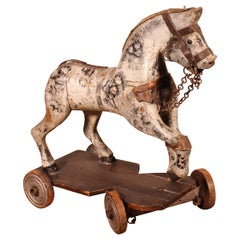
19th Century Polychrome Wooden Horse
Located in Brussels, Brussels
Elegant little carved wooden horse from the 19th century in polychrome wood
Very beautiful polychromy which has a lot of charm
Old child's toy with the front wheels which moves
...
Category
19th Century British Aesthetic Movement Antique Belgium Figurative Sculptures
Materials
Fruitwood
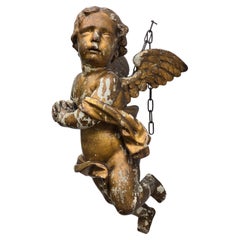
18th Century Baroque Hanging Giltwood Cherub
Located in Antwerp, BE
A rare and sculpturally powerful 18th century Baroque cherub, fully carved in the round and originally conceived as a hanging ecclesiastical sculpture. Retaining its original gilded ...
Category
Mid-18th Century Italian Baroque Antique Belgium Figurative Sculptures
Materials
Giltwood
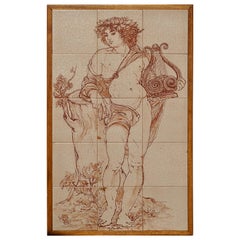
Mid-Century Modern Tiled Wall Panels Plaques of Bacchus by Bertoni
Located in Antwerp, BE
A terrific ceramic wall piece of Bacchus by the Italian ceramic artist H Bertoni.
This piece features a roman male figure with an harp resting on a s...
Category
Mid-20th Century Italian Hollywood Regency Belgium Figurative Sculptures
Materials
Wood, Ceramic
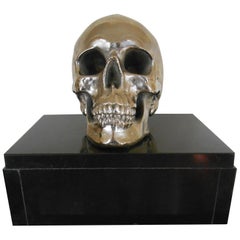
Massive Nickeled Resin Skull Signed Y.D., Belgium, 1989
Located in Brussels, BE
Heavy resin skull, nickel -plated.
Signed and dated Y.D.89 at the base.
Category
1980s Belgian Mid-Century Modern Vintage Belgium Figurative Sculptures
Materials
Resin
$1,395 Sale Price
20% Off
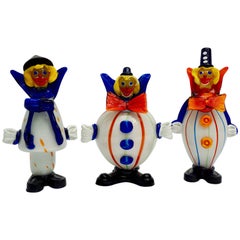
Set of Three Murano Glass Clowns
Located in Antwerp, BE
Three Murano glass clowns, Italy, 1970s.
Left clown: Height 26 cm, width 15 cm, depth 10 cm.
Middle clown: 23 cm, width 18 cm, depth 14 cm.
Right clown: 27 cm, width 15 cm, depth ...
Category
Mid-20th Century Italian Mid-Century Modern Belgium Figurative Sculptures
Materials
Glass, Murano Glass
$811 / item
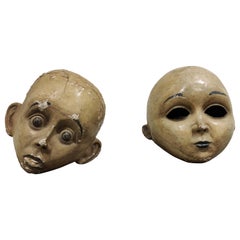
Large Antique Papier Maché Carnival Masks, 1900s
Located in Leuven, Vlaams Gewest
For sale are these rare, large early 20th century carnival masks made from wood and painted papier maché.
Although looking a little creepy and intriguing they have a great decorat...
Category
Early 1900s French Folk Art Antique Belgium Figurative Sculptures
Materials
Wood, Paper
$2,345 / set
1970
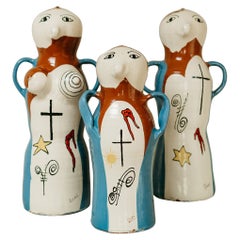
s Spanish Buxo ceramic figures ..
Located in Brecht, BE
the family ! rare to find these 3 Buxo vases together ..
decorative fun objects that will bring a smile to your face ..
mama 67 cm high x 30 cm wide and 28 cm deep
papa 67 cm high x...
Category
Mid-20th Century Spanish Belgium Figurative Sculptures
Materials
Ceramic
$3,548 / set
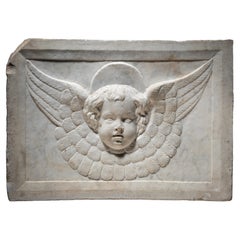
Cercle of Jacopo della Pila - Marble relief depicting a winged Cherub
Located in Bruxelles, BE
Cercle of Jacopo della Pila (Lombard, in Naples 1471-1502)
Marble relief depicting a winged Cherub
Naples, second half of15th century
40 x 57 x 12 cm
Exquisitely carved, this relief portrays a winged cherub with cascading hair and delicate features. The cherub's plump, smooth countenance, rounded cheeks, outlined lips, and finely drawn nose emanate a sense of tenderness. The quadrangular module, is adorned with a carved frame. The relief ascends gradually, transitioning from the low relief of the wings to the high relief of the head.
The rectangular frame and the subtly curved form of the artwork suggest that the relief likely adorned the upper part of an arch or a vaulted chapel. The type is that of the perspective room with a coffered ceiling decorated with figures of winged cherubs, which is found in various Neapolitan chapels of the 15th century. Coffered ceilings attest to the recovery of antiquity and the search for luxury in Renaissance architecture, first in Florence, then in Rome and Naples. The majority of the numerous family chapels and tombs built during the late fifteenth century in south of Italy employ the new formal vocabulary of the Florentine Renaissance in a self-confident manner that permitted a broad spectrum of variations.
The escalating admiration for the classical world, coupled with the development of perspective, significantly contributed to the Renaissance endorsement of coffered ceilings. This artistic and constructive device drew inspiration from the intricate marble patterns observed in historical landmarks such as the Arch of Titus, the Temple of Vesta in Tivoli, the Pantheon, and the Basilica of Maxentius. A distilled product of both mathematical and artistic cultures, deeply scrutinizing the ancient world, the coffered ceiling plays a vital role in the perspective construction of space with its regular and directional geometry. The motif of the coffered ceiling decorated with cherubs in relief was introduced in Naples by Francesco Laurana in the plastic decoration of the Arch of Castelnuovo. Laurana's impact on the art scene in the south of Italy was profound. The introduction of the winged cherub into the region's artistic vocabulary bridged the gap between the classical and the contemporary, creating a synthesis that resonated with both aesthetic and spiritual sensibilities. His influence extended beyond the immediate visual appeal, shaping the cultural identity of the Renaissance in southern Italy. Although the plastic decoration of the Arch of Castelnuovo cannot certainly be ascribed to a mature Renaissance style, it was precisely on this occasion that the sculptors who worked there could get to know and export throughout the Italian peninsula that type of "Florentine classicism" which, even in the 15th century Naples, was conditioned by the Burgundian culture imported into the Kingdom by Alfonso of Aragon himself, with artists called from Spain and Northern Europe. The coffered ceiling, with its geometric patterns and Laurana's winged cherubs nestled within, became a symbol of refinement and cultural sophistication. The relief sculptures, carefully integrated into the overall design, transformed the ceiling into a celestial realm, inviting viewers to contemplate the divine while immersed in the grandeur of the Renaissance space.
Similar winged cherubs appears also in the Naples cathedral. Within the renowned Succorpo Chapel, a mesmerizing marble coffered ceiling adorned with cherubs epitomizes the splendor of the Neapolitan Renaissance. The interplay of light and shadow on the textured surface of the marble coffered ceiling introduces an ethereal dimension, providing an immersive visual experience for observers. The geometric precision and the repeated patterns, reminiscent of classical motifs, establish a sense of harmony and balance that has become the hallmark of the Neapolitan interpretation of Florentine Renaissance aesthetics.
Although probably intended to be admired from a distance, this cherub is intricately detailed and exquisitely rendered: the face and hair are elegantly outlined and the feathers are textured through juxtaposed lines. The marble, both figurative and decorative, adheres to the principles of balance and restrained ornamentation typical of the « Florentine Classicism ». Harmonious shapes and gracefully orchestrated curves , rooted in the classical repertoire, converge to evoke a sense of ethereal beauty. The surface displays the masterful use of a chisel to intricately carve the feathers and facial features, creating an almost abstract quality.
This work is a testament to a sculptor of great skill and rich figurative knowledge, seamlessly blending classical firmness in contours with a refined treatment of the marble's surface. The combination of tradition and innovation point to a stylistic idiom from Lombardy, in particular we can find some comparaisons with the works of Jacopo della Pila, sculptor of Lombard origin working in Naples in the second half of the 15th century. He is documented there between 1471 and 1502, and is a protagonist of the Aragon Renaissance in the second half of the Quattrocento, together with the other great Northern sculptor active in the kingdom, Domenico Gagini.
the first commission he received dates back to August 9, 1471, when Jacopo publicly committed to sculpting the funerary monument of Archbishop Nicola Piscicelli to be placed in the Cathedral of Salerno. The last known work is an altar ordered on July 29, 1502, by the noble Jacopo Rocco for the church of San Lorenzo Maggiore in Naples. Between these two chronological extremes (1471-1502), we must place the fervent activity of the artist, who had trained in Rome, perhaps under the guidance of Paolo Romano but also engaged in dialogue with other major artists of the city, especially Isaia da Pisa. He enriched his experience in Naples, initially drawing inspiration from the works of Domenico Gagini and later from the Tuscan masterpieces of Antonio Rossellino and Benedetto da Maiano destined for the church of Santa Maria di Monteoliveto. Jacopo della Pila's artistic personality is thus based on a complex interplay of influences, contributing to the definition of a highly personal style.
Close comparaison can be made between our cherub and the winged angels reliefs...
Category
15th Century and Earlier Italian Renaissance Antique Belgium Figurative Sculptures
Materials
Marble
$23,093 Sale Price
20% Off
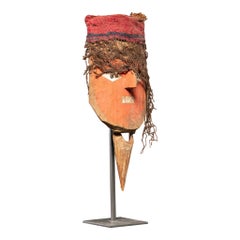
Ethnic Design-Chancay original Mummy Bundle Mask
Located in Leuven , BE
A hand-carved funerary mask meant to attach to a larger mummy bundle. The plank-form mask is painted with a broad red face accented with white, diamond-shaped eyes, a rectangular mou...
Category
Late 19th Century Peruvian Antique Belgium Figurative Sculptures
Materials
Textile, Wood
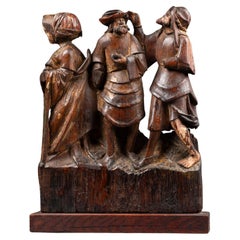
Group of Altarpiece - Antwerpen, 16th century
Located in Bruxelles, BE
Group of altarpiece representing the life of a Saint, Saint Renualde?
Engraved by the sign of Antwerp hand on the hat of the central character
Carved oak, traces of polychromy
Fir...
Category
16th Century Belgian Renaissance Antique Belgium Figurative Sculptures
Materials
Oak
$11,546 Sale Price
40% Off
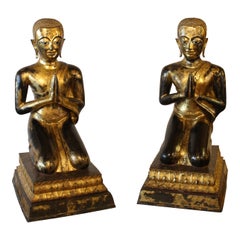
Pair of Monk in Bronze-18 ° Century-Ayuttheya
Located in Brussels, Brussels
Rare pair of monks from the 18th century-Ayutthaya-Thailand
Superb pair of large lacquered and gilt bronze monks
very beautiful face and expression ...
Category
18th Century Thai Other Antique Belgium Figurative Sculptures
Materials
Bronze
$21,048 / set
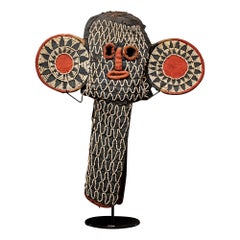
Ethnic Design-Very early Bamileke Elephant Mask embroided with trade beads.
Located in Leuven , BE
Bamileke Kuosi Elephant masks comprise cloth panels and hoods woven from plantain fiber over raffia. On this background glass beads are stitched in geometric patterns. The basic form depicts salient features of the elephant—a long trunk and large ears. The hood fits tightly over the masker's head, and two hanging panels, one behind and one in front, partially conceal the body. The front panel is the elephant trunk, and the two large, stiff circles hinged to either side of the head are its ears, which flap as the masker dances. While the mask symbolizes an elephant, the face is human. Eyeholes provide visibility, and a nose and mouth with teeth are normally present. The glass beads used on these earlier masks were nineteenth-century trade beads of Venetian or Czechoslovakian manufacture, used as well in exchange for slaves. Elephant mask costumes...
Category
Early 20th Century Cameroonian Belgium Figurative Sculptures
Materials
Beads, Organic Material
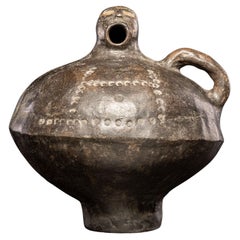
Ethnic Design-Anthropomorphic ceramic vessel, Luba People, DRC.
Located in Leuven , BE
This vessel vividly illustrates anthropomorphic design through its bold depiction of a human-like figure. The spout is sculpted as an open-mouthed face, complete with stylized eyes a...
Category
Early 20th Century Congolese Belgium Figurative Sculptures
Materials
Terracotta
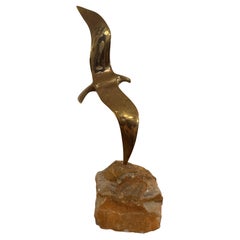
Flying Bird Sculpture by Curtis Jeré, 1970s
By Curtis Jeré
Located in Antwerp, BE
A dynamic Brass bird in flight designed by "Curtis Jeré" is the shared pseudonym of two American artists and designers, Curtis Freiler and Jerry Fels. They are best known for their d...
Category
1970s American Mid-Century Modern Vintage Belgium Figurative Sculptures
Materials
Stone, Copper
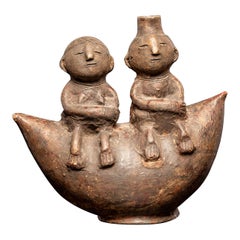
Ethnic Design-Crescent shaped terracotta pot, Solongo People, DRC
Located in Leuven , BE
Terracotta pot of roughly crescent shape featuring a pair of naively modelled human figures seated on the concave edge, each with arms folded to the abdomen and feet pointing downwar...
Category
Early 20th Century Congolese Belgium Figurative Sculptures
Materials
Terracotta
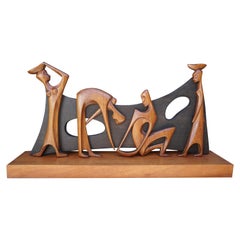
Figurative Wooden Sculpture by F Tamba
Located in Antwerp, BE
Highly rare and decorative elegant scene in wood of a man making respectfully advances to a lady, with female servants bringing food. Made in Congo in the 20th century, and offered b...
Category
Mid-20th Century Congolese Mid-Century Modern Belgium Figurative Sculptures
Materials
Wood
$2,646 Sale Price
35% Off
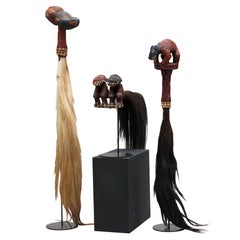
Ethnic Design-Three Decorative Beaded Flywhisks , Cameroon Grasslands
Located in Leuven , BE
The Royal Fly Whisks (ethnic names: see leng koko or beuka) used in dances are made of carved wood to which horse tails are attached. These tails are veritable war trophies cut from ...
Category
Mid-20th Century Cameroonian Belgium Figurative Sculptures
Materials
Burlap, Wood, Beads
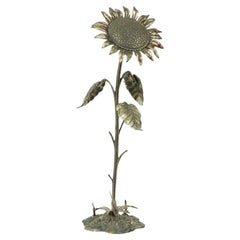
Large Sunflower Ashtray Silver Plated Bronze S. Agudo 62cm
Located in Poperinge, BE
Beautiful large ashtray in the shape of a sunflower, made of silvered bronze, signed S. Agudo, Spain, circa mid-20th century.
A rare and original object. The petals can be removed a...
Category
Mid-20th Century Spanish Art Nouveau Belgium Figurative Sculptures
Materials
Bronze
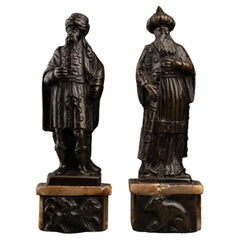
Two rare Figures in Turkish Attire - Venice, early 17th century
Located in Bruxelles, BE
Rare Bronzes Depicting two Figures in Turkish Attire
Possibly Suleiman the Magnificent at two different ages
bronzes, alabaster bases
Venice, early 17th century
19,5 x 6 x 5 cm
These two rare bronze statuettes represent two figures dressed in elaborate "Turkish" attire. They are mounted on alabaster bases with bronze reliefs—one featuring the winged lion of Venice, and the other possibly symbolizing Turkey with a wolf depiction.
One figure wears a grand külah, a spherical turban with a cone top, signifying royal authority, while the other has a wrapped turban, denoting rank and religious identity. Their garments are richly detailed with intricate engravings, suggesting luxurious fabrics of the Ottoman court.
The statuettes may represent Suleiman the Magnificent at two different stages of life, as both young and old. The sultan depicted alongside the winged lion corresponds to a description from a Venetian delegate in 1534, when Suleiman was 43. At that time, he had conquered Iraq from the Safavids and achieved a decisive victory over the Papal fleet at the Battle of Preveza. He was described as having large eyes, an aquiline nose, and long red mustaches—traits visible in Cristofano dell'Altissimo’s portrait of Suleiman in the Uffizi Gallery in Florence.
Unlike Mehmed II, who commissioned portraits by European artists for diplomatic purposes, Suleiman did not directly order such representations. Instead, his likeness spread through works by artists like Albrecht Dürer, based on sketches made by diplomats. Following his capture of Belgrade in 1521, his victory over Hungary in 1526, and his siege of Vienna...
Category
17th Century Italian Renaissance Antique Belgium Figurative Sculptures
Materials
Alabaster, Bronze
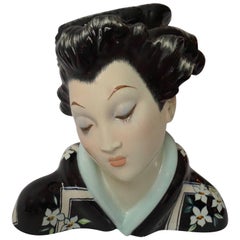
Japanese Porcelain Sculpture of a Geisha
Located in Antwerp, BE
Japanese porcelain sculpture of a Geisha, signed Lavorazione.
Width:34 cm.
Height:30 cm.
Depth:28 cm.
Category
Mid-20th Century Italian Mid-Century Modern Belgium Figurative Sculptures
Materials
Porcelain
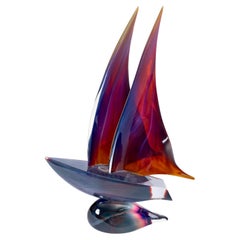
Dino Rosin: Murano sailboat, calcedonia glass sculpture
By Dino Rosin
Located in Zemst, BE
Sailboat by Dino Rosin
Dino Rosin (°Italy °1948) is a Murano based artist.
Big glass sculpture in calcedonia technique.
Handcrafted and mouthblown.
This unique item was created in...
Category
Late 20th Century Italian Mid-Century Modern Belgium Figurative Sculptures
Materials
Art Glass, Blown Glass
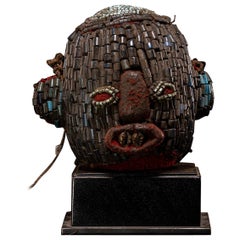
Bamileke Old Anthropomorphic Trophy Head Embroidered with European Glass Beads
Located in Leuven , BE
Bamileke Old Anthropomorphic Trophy Head embroidered with European
Glass Beads, Grasslands People, and Cameroon.
Private collection Brussels
Worn by chiefs and other notables on cer...
Category
20th Century Cameroonian Belgium Figurative Sculptures
Materials
Wood, Beads
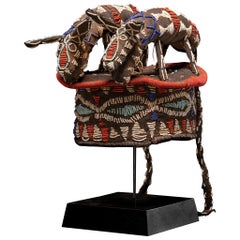
Bamileke Decorative Dance Crest, embroidered with European Glass Beads
Located in Leuven , BE
Bamileke Decorative Dance Crest, embroidered with European Glass Beads, Grasslands People, Cameroon.
Private collection Brussels
The raffia splint is covered with cloth and c...
Category
Mid-20th Century Cameroonian Belgium Figurative Sculptures
Materials
Beads, Burlap
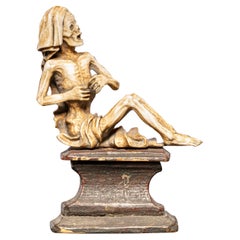
Exceptional allegory of death, carved bone, Southern Germany, Tyrol, 18th-19th
Located in Leuven , BE
Exceptional allegory of death in carved bone. Depiction of a leper wrapped in a stole. Southern Germany, Tyrol, 18th-19th century. Superb quality of carving, showing no signs of mech...
Category
Late 18th Century German Antique Belgium Figurative Sculptures
Materials
Bone
18th C, Southern France, Madonna and Child, Carved and Polychrome Wood
Located in Leuven , BE
Although the 18th century, the period of the Enlightenment in France, spawned thinkers who criticised the privileges of the clergy and the truthfulness of certain dogmas, the Roman Catholic faith was very much present in everyday life. Since king Louis XIV had issued the Edict of Fontainebleau in 1685, Protestantism was banned. This Madonna with child illustrates the daily practice of faith. Like many 18th-century Madonna statues...
Category
18th Century French Antique Belgium Figurative Sculptures
Materials
Wood
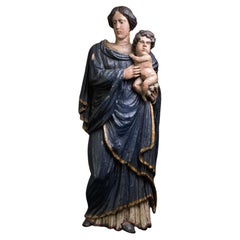
Renaissance Harpy - Italy, 16th century
Located in Bruxelles, BE
Renaissance Harpy
bronze
Italy, 16th century
15 x 12 x 5,5 cm
This expressive bronze figure represents a harpy, a mythological creature with the body of a bird and the head and tor...
Category
16th Century Italian Renaissance Antique Belgium Figurative Sculptures
Materials
Bronze
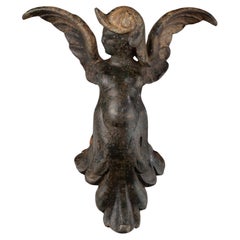
Acrobatic Man Bronze Sculpture By Pieter Florizoon (1937-2015)
Located in Linkebeek, BE
Acrobatic Man Bronze Sculpture By Pieter Florizoon (1937-2015)
Sculpture - Decoration - Vintage
Measures : 36cmx24cm H:42cm
Wear consistent with age and use.
Category
20th Century Brutalist Belgium Figurative Sculptures
Materials
Bronze
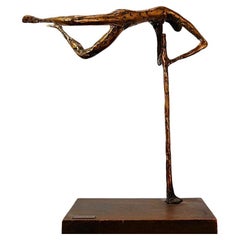
Pair of Monumental Figural Supports Columns Representing Atlas or Hercules
Located in Antwerp, BE
Two carved of oak columns or pedestals, each of a muscular male figure, representing Atlas or Hercules, the head inclined forward and supporting as well with the shoulders a square p...
Category
Early 20th Century Italian Art Deco Belgium Figurative Sculptures
Materials
Wood
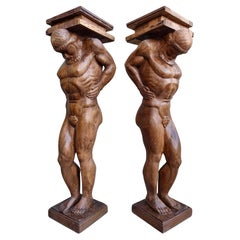
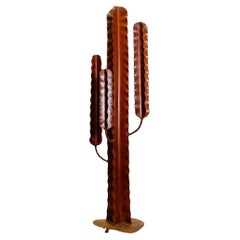
Rust-effect patinated metal cactus sculpture H:172cm
Located in Linkebeek, BE
Rust-effect patinated metal cactus sculpture H:172cm
Decoration - Indoor - Wabi Sabi
Measures : 50x50cm H:172cm
Material : Metal
Category
21st Century and Contemporary Belgium Figurative Sculptures
Materials
Metal
Study of a Satyr - Italy, early 19th century
Located in Bruxelles, BE
Study of a Satyr
Bronze, cast using the lost-wax (cire perdue) method
Italy, early 19th century
14 x 7 x 10 cm
This evocative bronze sculpture represents a satyr, the half-human, h...
Category
Early 19th Century Italian Modern Antique Belgium Figurative Sculptures
Materials
Bronze

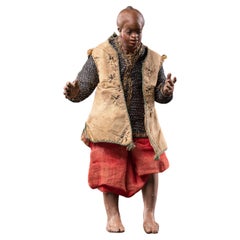
Neopolitan Santon in Terracotta Fixed on a wooden base
Located in Leuven , BE
Neapolitan nativity scenes are very different from those seen in churches due to the importance of secular settings. They are not limited to staging the child Jesus surrounded by the holy family. Still, they managed to reproduce the daily life of the Neapolitans of the seventeenth and eighteenth centuries. The elegance of the figuration and the fineness of the execution of these santons also reveals the quality of the know-how of the Neapolitan artisans. The markets, hotels, dances, itinerant vendors, beggars, taverns, various trades, guarding herds, the royal procession and all that was within reach of everyday life or fantasy had their place in the Neapolitan crèches...
Category
20th Century European Belgium Figurative Sculptures
Materials
Stone
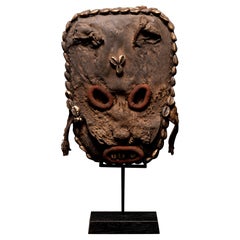
Decorative Grassland Leopard skin Mask, Cameroon
Located in Leuven , BE
Decorative Grassland Leopard skin Mask
Private collection Brussels
The raffia splint is covered with cloth and colourful miniature glass beads in vario...
Category
Mid-20th Century Cameroonian Belgium Figurative Sculptures
Materials
Beads, Organic Material
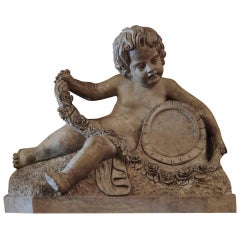
18th Century Sculpted Verona Marble Putto
Located in Vosselaar, BE
Depictions of young angelic boys are also known as putti, or putto for a single one. Since the 17th century on they remained popular and are found in various forms. Perhaps the most known version is Cupid. Looking at their attributes time periods can be narrowed down. In this example we see a rose Guirlande and a medaillon which are typical for the late 18th- early 19th century. The Rosso Verona Marble...
Category
Late 18th Century Italian Neoclassical Antique Belgium Figurative Sculptures
Materials
Marble
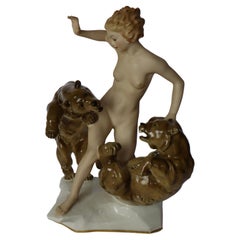
Art-déco porcelain statue: "Jealousy" by Karl Tutter, Hutschenreuther
By Hutschenreuther
Located in Zemst, BE
Big late art-déco figurine in porcelain created by the sculptor Karl Tutter
Named: " Jealousy"
Naked women with 2 bear coughs
Manufactered by Hutschenreuther
High quality porcelain: ...
Category
1940s German Art Deco Vintage Belgium Figurative Sculptures
Materials
Porcelain
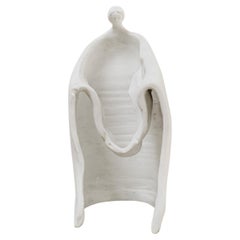
1970
s plaster figurative sculpture Madonna
Located in Brecht, BE
motherhood ... plaster decorative figure of a Madonna, made in the 1970's in France ...
Category
Mid-20th Century French Belgium Figurative Sculptures
Materials
Plaster
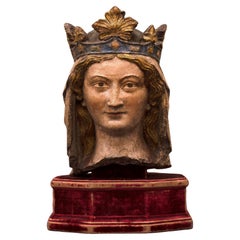
Gothic crowned Head - Île de France, 14th century
Located in Bruxelles, BE
Head of a crowned Virgin
Île-de-France, first half of 14th century.
H26 x 14 x 14 cm
Provenance :
- Private Collection, Paris France (1960)
- Private Collection Tuscany, Italy (19...
Category
15th Century and Earlier French Gothic Antique Belgium Figurative Sculptures
Materials
Stone
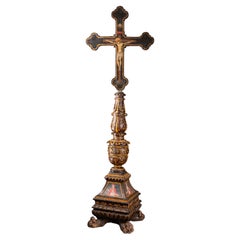
renaissance wooden candelabrum and painted cross - Umbria, 16th century
Located in Bruxelles, BE
Base of a carved wooden candelabrum, polychrome and gilded; cross painted on both sides.
Umbria or Tuscany, 16th century
136 x 43,5 x 30 cm
(The cross and the base of the candelabrum were later assembled)
The base of the candelabrum is intricately carved and adorned with polychrome and gilded finishes. The shafts take on the shape of balusters reminiscent of ancient columns, feature ornate foliage decorations, garlands and winged cherub faces. The feet are crafted in the likeness of lion paws. The base is further embellished with depictions of four saint martyrs, among them Saint Barbara and Saint Catherine of Alexandria. The plasticity of the figures, outlined with strong contour lines, the clear and vibrant colors, are stylistic elements linked to the Umbrian tradition of the sixteenth century.The precisely defined and elegant drawing, along with the clear color palette applied with refined chiaroscuro modulations, became the signature of a style that would leave a lasting mark on the era to come. This is exemplified by a preference for vibrant, multicolored images, accentuated in this case by the use of red and pink in the saint's attire.
A notable addition, introduced later, is a polylobed cross painted on both sides. On one side, the Crucifixion is vividly portrayed:The treatment of the corpus itself is in line with High Medieval practice, emphasizing pathos by showing Jesus dead, his arms sagging from the weight of the body. The upper section displaying a pelican pecks at her breast to feed her young with her own blood; a symbol of the sacrifice of Christ on the cross whose body and blood similarly nourishes the celebrant during Mass.
The lower part depicts Golgotha. On the reverse side, the Resurrection is artistically presented in a Renaissance iconography, reminiscent of the renowned composition painted by Piero della Francesca, now housed in the Civic Museum of Sansepolcro. In terms of composition, with the frontal depiction of Christ holding the banner, this motif became particularly widespread in central Italy, spanning from Tuscany to Umbria throughout the 16th century..
The double-sided construction suggests that it may also have been carried in liturgical processions. In Umbria from the 14th century, the use of portable crosses painted on both sides had become a widespread practice, aimed at satisfying the monastic clientele that had significantly increased following the establishment of new religious communities.
The earliest surviving Tuscan painted crucifix represent Christ as Christus Triumphans, or the “Triumphant Christ” with his head up and eyes open. This form was supplanted in the 13th century with the Christus Patiens, or “Suffering Christ” type who is shown often with his head fallen on his shoulder and his eyes closed, as In our cross. The iconography of the suffering Christ appears to have developed out of a new interest in Christ’s human nature, the development of the feast of Corpus Christi and with increased importance given to the Eucharist. The process of humanizing the figure of Christ reaches its peak with the abandonment of all the previous expressive conventions in favor of more realistic details we can observe in this Crucifix, such as the swollen belly, the arms stretched to the limit of muscle tearing, the body falling heavily forward, the abundant blood on
the wounds, and the cross firmly embedded in the rock of Calvary.
It's worth noting that Renaissance candelabra...
Category
16th Century Italian Renaissance Antique Belgium Figurative Sculptures
Materials
Wood, Giltwood
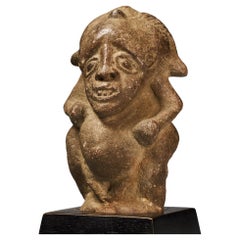
Ancient Stone Statue, West Africa possibly Sierra Leone
Located in Leuven , BE
These sculptures are considered manifestations of their deceased ancestors and are placed in ancestor shrines.
Category
20th Century Sierra Leonean Belgium Figurative Sculptures
Materials
Terracotta
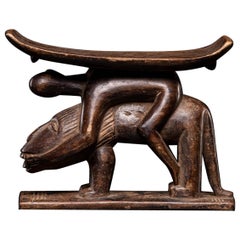
Ashanti Headrest Stool Carved Wood Tribal Art Ghana Africa
Located in Leuven , BE
Ashanti Headrest Stool Carved Wood Tribal Art Ghana Africa
Carved from a single piece of wood, the African Ashanti head rest, Ghana, has a curved top raised on a pedestals depicti...
Category
Early 20th Century Ghanaian Belgium Figurative Sculptures
Materials
Wood
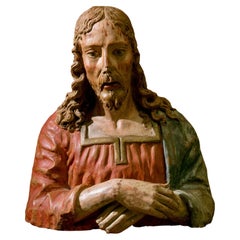
Terracotta Bust of Christ as the Redeemer, 15th Century
Located in Bruxelles, BE
A terracotta bust of Christ as The Redeemer
Tuscany or Emilia Romagna, late 15th century
Measures: 46 x 43 x 21 cm
This powerful, moving bust of...
Category
15th Century and Earlier Italian Renaissance Antique Belgium Figurative Sculptures
Materials
Terracotta
$17,319 Sale Price
20% Off
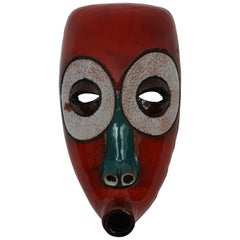
At Manteto Ceramic Wall Mask
Located in Antwerp, BE
Ceramic mask, Baku Ghana.
Signed:AT Manteto,Baku 1974.
Measures: Height 32 cm.
Width 17 cm.
Depth 8 cm.
Category
Mid-20th Century Ghanaian Mid-Century Modern Belgium Figurative Sculptures
Materials
Ceramic
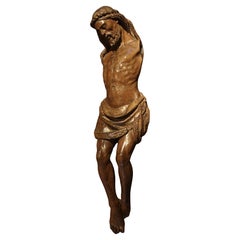
Christ - Umbria, second half of the 15th century
Located in Bruxelles, BE
Christ
Umbria, Orvieto?
Second half of the 15th century
77 x 16.5 cm
Category
15th Century and Earlier Italian Renaissance Antique Belgium Figurative Sculptures
Materials
Walnut
$7,667 Sale Price
25% Off
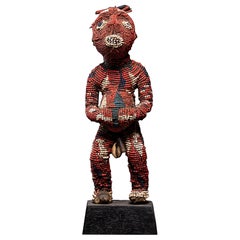
Bamum Decorative Wooden Ancestor Figure Embroidered with European Glass Beads
Located in Leuven , BE
Bamum Decorative Wooden Ancestor Figure embroidered with European Glass Beads, Grasslands People , Cameroon
Private collection Brussels
These commemorative statuettes ,representing a...
Category
Mid-20th Century Cameroonian Belgium Figurative Sculptures
Materials
Wood, Beads
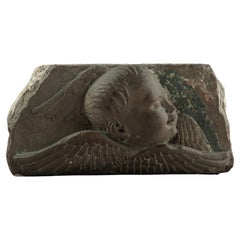
Renaissance Winged Cherub Relief
- Florence, 15th century
Located in Bruxelles, BE
Renaissance Winged Cherub Relief
Florence, Second Half of the 15th Century
Stone with traces of polychromy
Provenance: Important private collection, Northern Italy
This exceptional...
Category
15th Century and Earlier Italian Renaissance Antique Belgium Figurative Sculptures
Materials
Stone
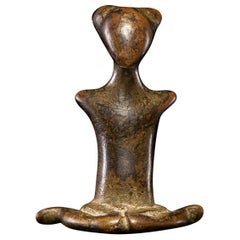
Ethnic Design-Bronze sitting female statue, Kulango People, Ivory Coast
Located in Leuven , BE
This bronze statuette of striking modernity,in a minimalist and refined style is part of an eminently small corpus. The fluidity of the forms and the remarkable purity of the figurin...
Category
Early 20th Century Ivorian Belgium Figurative Sculptures
Materials
Bronze
1930
s Italian Sculpture Attributed to Pietro Chiesa
Located in Brecht, BE
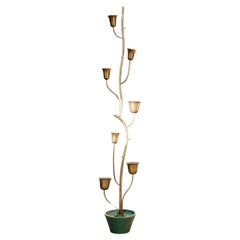
Elegant and chic this gilt wood and brass floral sculpture,
Attributed to Pietro Chieasa, Italian artist, a rare and unique find.
Category
Early 20th Century Italian Belgium Figurative Sculptures
Materials
Brass
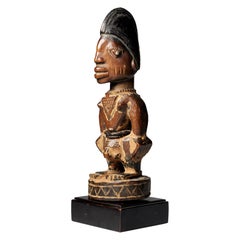
Carved Twin figure Ibeji Yoruba People, Nigeria
Located in Leuven , BE
A finely carved significant Yoruba Male Ibeji figure with a tall headdress, expressive eyes, original bead belt and heavy wear and polish from native use. Areas of encrusted camwood ...
Category
20th Century Nigerian Belgium Figurative Sculptures
Materials
Wood
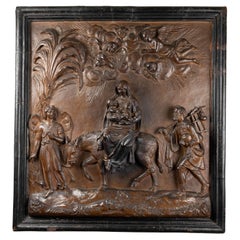
Large Terracotta Relief - Lombardy, First Half of 17th Century
Located in Bruxelles, BE
Large Terracotta relief of the flight into Egypt
Lombardy, first half of 17th century
Painted terracotta
91 x 85 x 11,5 cm
This event in the early life of Christ is recounted i...
Category
17th Century Italian Baroque Antique Belgium Figurative Sculptures
Materials
Terracotta
$62,544 Sale Price
20% Off
Art Deco style sculpture hoop dancer Briand Marcel Bouraine for Max le Verrier
By Max Le Verrier, Marcel-André Bouraine
Located in Antwerp, BE
Art Deco style sculpture hoop dancer signed by Briand, the pseudonym of Marcel Bouraine, cast by the Le Verrier Foundry.
Patinated Art Metal on a Belgian Black marble base.
Danseuse...
Category
2010s French Art Deco Belgium Figurative Sculptures
Materials
Belgian Black Marble, Metal

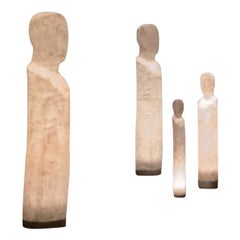
Set of 4 Anonymus Family Light Sculptures by Atelier Haute Cuisine
Located in Geneve, CH
A Set of 3 Anonymus Family Light Sculptures by Atelier Haute Cuisine
Dimensions: 180 x 28 cm, 185 x 34, 210 x 41, 170 x 27 cm
Materials: Fiberglass, UV, Weather Resistant Topcoat, ...
Category
2010s Belgian Modern Belgium Figurative Sculptures
Materials
Fiberglass
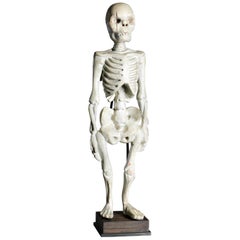
Ethno Design Standing Human Skeleton Sculptured in Wood, South East Asia
Located in Leuven , BE
The sculpture dates from the beginning of the 20th century and has a wonderful patina.
Category
Early 20th Century Burmese Belgium Figurative Sculptures
Materials
Wood
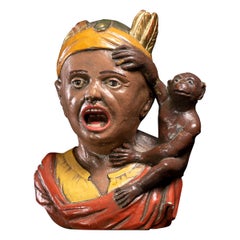
Rare dutch "Gaper" statue with monkey on his shoulder.
Located in Leuven , BE
A gaper is a stone or wooden figurehead, often depicting a Moor, Muslim, or North African. The figurehead first appeared in the late 16th century as a hangout sign used outside the storefronts of drug stores in the Netherlands. The meaning of gaper is the same in English; the figurehead is always displayed with an open mouth, sometimes with a pill resting on his tongue. The gaper's gaping tongue could represent the intake of medicine and grimace represents the bitter taste of the medicine. The gaper takes on various appearances that are symbolic of the origin for the pharmacist...
Category
20th Century Dutch Belgium Figurative Sculptures
Materials
Plaster
Still Thinking About These?
All Recently ViewedMore Ways To Browse
Bergman Bronze Arab
Big Head Sculpture
Blanc De Chine Figurines
Borghese Gladiator
Bronze Augustus
Bronze Garanti Paris
Bronze Head Roman
Bronze Seated Hermes
Brutalist Sculpture Woman
Carved Marble Angel
Carved Wood Chinese Figures
Cherub With Grapes
Collection Porcelain Figurines
Dummy Board
Dying Gaul Sculpture
Egyptian Sarcophagus
Erotic Italy
Flapper Nude