Berkshires - Furniture
to
180
493,458
448,274
1,347
73
32
111
77
48
47
44
36
36
34
33
29
25
23
21
18
14
13
8
1
118
489
740
105
275
234
65
25
22
50
40
28
36
27
25
10
6
495
443
209
179
171
762
419
384
236
207
1,452
1,418
1,426
17
11
10
7
6
Item Ships From: Berkshires
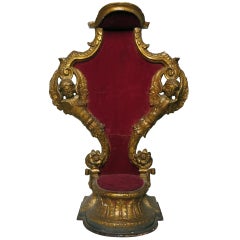
A Portuguese Polychrome
Giltwood Presentoir, 18th Century
Located in Sheffield, MA
A Portuguese Baroque Polychrome
Giltwood Presentoir
18th Century
With elaborate scroll and flower carved canopy and framework
Height 30 in. Width 18 in. Depth 10 in.
...
Category
18th Century and Earlier Portuguese Baroque Antique Berkshires - Furniture
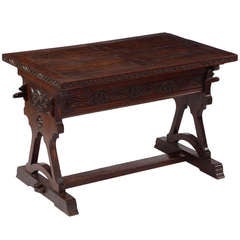
A Rare 18th Century Walnut Center Table Possibly Iberian
Located in Sheffield, MA
A Rare 18th Century
Walnut Center Table
Possibly Iberian
The rectangular top over a carved frieze
with two drawers resting on a joined stretcher base
Height 28 ½ in. Width 43 in...
Category
18th Century and Earlier Spanish Antique Berkshires - Furniture
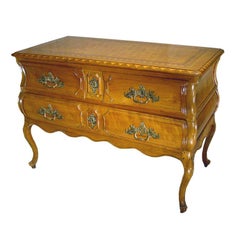
A Rare
Louis XV Bois Clair
Parquetry Commode
By Jean-Francois Hache
Located in Sheffield, MA
Attributed to Jean Francois HacheThe parquetry rectangular top with molded edge, above a bombe case with two short and one long paneled drawer, over a scalloped apron, raised on cabr...
Category
18th Century and Earlier French Antique Berkshires - Furniture
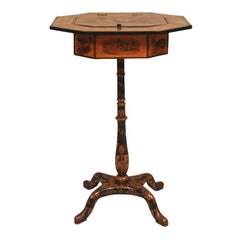
A Fine Regency Penwork
Painted Stand Attributed toJohn Bromely
By John Bromely
Located in Sheffield, MA
The stand decorated with painted panels and pen work, the hinged top with a painted panel opening to a compartment, on a pen work base with cabriole legs, on pad feet.
Category
20th Century English Berkshires - Furniture
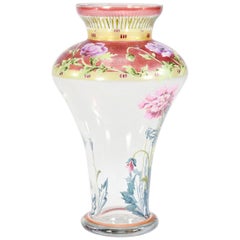
Art Nouveau Hand Blown Vase with Transparent Enamel Hand Painted Poppies
Located in Great Barrington, MA
This shapely and beautifully decorated, hand blown vase is hand painted in the Art Nouveau style and favourite subject-Poppies! The all-over transparent enamel...
Category
1890s European Art Nouveau Antique Berkshires - Furniture
Materials
Glass
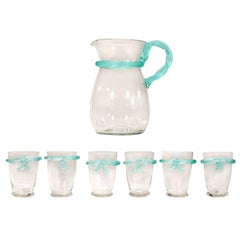
Unusual Hand Blown Crystal Beverage Set W/ Applied Bows
By Whitefriars
Located in Great Barrington, MA
This charming set for 6 includes a pitcher and 6 matching goblets each with an elaborately applied turquoise "ribbon" tied into a "bow". Perfect for a summer afternoon of lemonade o...
Category
Early 20th Century English Berkshires - Furniture
Materials
Crystal
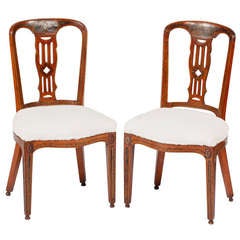
A Pair of Late George III Painted Satinwood Side Chairs, early19th Century
Located in Sheffield, MA
Each with a molded hooped backrest with pierced splat,
the padded serpentine seat raised on fluted straight legs
Category
19th Century English Georgian Antique Berkshires - Furniture
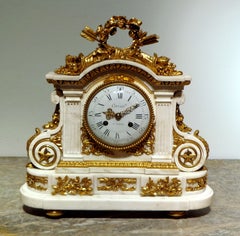
A Fine Louis XVI Marble
Gilt Bronze Clock by Jean Corrier
By Jean Corrier
Located in Sheffield, MA
A Fine Louis XVI
Marble
Gilt Bronze Clock
18th Century
Signed Corrier A Paris
A large Louis XVI ormolu French clock by Corrier à Paris. The symmetrical case has numer...
Category
18th Century and Earlier French Antique Berkshires - Furniture
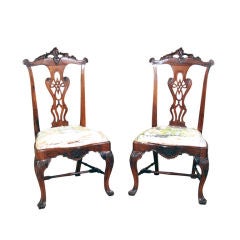
An Important Pair of Portuguese Rococo Rosewood Side Chairs
Located in Sheffield, MA
Each back with a stylized foliate crest rail above an elaborately carved splat, on a serpentine seat on cabriole legs terminating in carved pad feet, joined by shaped stretchers
Category
18th Century and Earlier Portuguese Antique Berkshires - Furniture
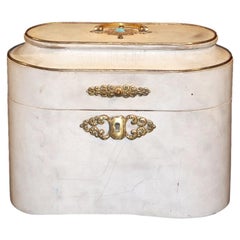
A Fine French Charles X Oval Box
Located in Sheffield, MA
A Leather box with two decanters inside
Category
19th Century French Antique Berkshires - Furniture
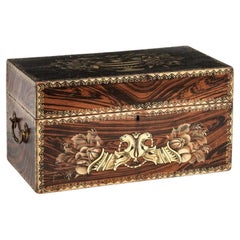
Federal Grain Painted and Stenciled Document Box 19th Century American
Located in Hudson, NY
A spectacular and fine, dovetailed poplar, rosewood grain painted and ebonized document box. The gold stenciling is of a very fine quality. Retains the original fire gilded steel bai...
Category
Early 19th Century American Federal Antique Berkshires - Furniture
Materials
Gold, Steel

Price Upon Request
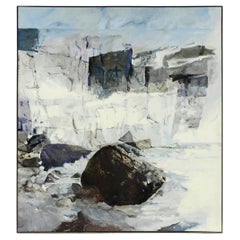
Balcomb Greene "The Cliffs", 1978
By Balcomb Greene
Located in Hudson, NY
The Cliffs by Balcomb Greene painted in 1978. Signed on the front titled and dated on the reverse.
Paintings of the Montauk coast by Balcomb Greene are few and far between. This painting likely created at his Studio in Montauk New York. Painting is in excellent original condition and retains the original gallery frame.
provenance: Estate of Gertrude B. Pascal / Gifted from the previous in 1987, The Frances Lehman Loeb Art Center, Vassar College, Poughkeepsie, NY / Christie's, New York 2012 / Private Collection, New Jersey
Public collections:
Baltimore Museum of Art, Baltimore, MD
Brooklyn Museum, Brooklyn, NY
Cleveland Museum of Art, Cleveland, OH
The Art Institute of Chicago, Chicago, IL
Corcoran Gallery of Art, Washington, D.C.
Guild Hall, East Hampton, NY
Wadsworth Atheneum, Hartford, CT
Museum of Fine Arts, Houston, TX
Indianapolis Museum of Art, Indianapolis, IN
Metropolitan Museum of Art, New York, NY
Museum of Modern Art, New York, NY
National Museum of American Art, Washington, D.C.
Joslyn Art Museum, Omaha, NE
Pennsylvania Academy of the Fine Arts, Philadelphia, PA
Norton Simon Museum, Pasadena, CA
Portland Museum of Art, Portland, OR
Neuberger Museum, Purchase, NY
Solomon R. Guggenheim Museum, New York, NY
Parrish Museum, Southampton, NY
Whitney Museum of American Art, New York, NY
Walker Art Center, Minneapolis, MN
Butler Institute of American Art, Youngstown, OH
Boca Museum of Art, Boca Raton, FL
Over a lifespan of 86 years, Balcomb Greene followed his muse wherever it led, unfettered by what had come before, unafraid of where the future might lead. Despite a series of different pathways explored, his purpose remained ever constant: to express truth as he found it and communicate it to a broader audience. In the 1930s, Greene was a young artist committed to abstraction as his expressive language. Greene’s paintings and collages of the 1930s reflect the influence of Pablo Picasso and Piet Mondrian and put him in the company of fellow Americans, including Ibram Lassaw, Josef Albers, Ilya Boltowsky and George L. K. Morris, all among the founding members, in 1936, of American Abstract Artists.
John Wesley Greene, his christened name which he never legally changed, was born in 1904 in Millville, New York, the third child and only son of Methodist minister The Reverend Bertram Stillman Greene (1864–1929) and Florence Stover Greene (1876–1911). His family on both sides were Revolutionary-era colonists, originally living in Connecticut and Vermont before joining the Yankee migration to the western frontier of New York State. In 1922, John Wesley Greene enrolled at Syracuse University aided by a scholarship for the sons of Methodist ministers and intending to fulfill the promise of his name and follow his father into the ministry. As with so many before and after him, the liberal education he absorbed at Syracuse broadened his horizons and reshaped his life plan. Studying philosophy, psychology, and literature, along the way he separated himself from organized religion. During his senior year, on a visit to The Metropolitan Museum of Art in New York City, Greene was introduced to Gertrude Glass (1904–1956), an art student and the Brooklyn-born daughter of Latvian Jewish immigrants.
Following Greene’s graduation, the two married in 1926 and went to Europe. They stopped briefly in Paris but spent most of their time in Vienna where Greene had a fellowship to study psychology. When they returned to New York in 1927, Greene enrolled in a master’s program in ‘English literature at Columbia University. When his thesis advisor rejected his essay topic on the “fallen woman” in seventeenth-century literature as inappropriate, he left without a degree. From 1928 until 1931, Greene taught English at Dartmouth College in Hanover, New Hampshire. At some point, he stopped using his given name, John, and began to call himself, more distinctively, Balcomb, the family name of his paternal grandmother.
While Greene wrote three novels (all unpublished) during his teaching years at Dartmouth, his wife was a working artist, and he eventually developed an interest of his own in painting. In 1931, Greene gave up his teaching position and he and Gertrude went to Paris, determined to immerse themselves in the modern art ferment they had briefly experienced in their earlier visit. For young Americans with no prescribed agenda, a receptiveness to innovation, and wide-open eyes and minds. Paris, in 1931, offered a rich stew of approaches to modern art. The city absorbed and transmuted an international mélange of styles—cubism, orphism, futurism, dadaism, constructivism, neoplasticism, suprematism, de Stijl, Bauhaus—France encountering Holland, Germany, Italy, and Russia with Pablo Picasso from Spain, Constantin Brancusi from Romania, and Jacques Lipchitz from Lithuania. As a sculptor, Gertrude Greene...
Category
1970s American Mid-Century Modern Vintage Berkshires - Furniture
Materials
Canvas, Paint
Price Upon Request
Still Thinking About These?
All Recently ViewedMore Ways To Browse
Chinese Stoneware Jar
Chinoiserie Turquoise
Clock Heart
Clocks 3 Piece Set
Cobalt Blue Dish
Comedy And Tragedy Mask
Compote Vase
Concrete Head
Conservatory Table
Coral Crab
Cowtan And Tout
Crystal Bowl And Pedestal
Crystal Jar Lid
Cupid Enamelled
Curtis Jere Enamel
Danish Chest Of 6 Drawers
Danish Dog
Dark Glass Bottle