Continental Europe Mantel Clocks
to
68
363
31
33
245
85
31
46
17
10
7
3
9
9
2
2
1
3
2
5
49
43
36
25
21
10
7
6
5
4
3
1
1
1
354
250
138
122
73
394
1,305
774
374
268
31
19
13
Height
to
Width
to
394
367
392
25
17
8
6
4
Item Ships From: Continental Europe
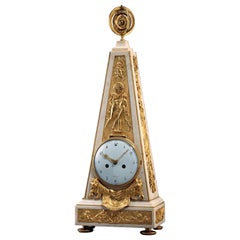
Unusually Large 18th Century Louis XVI Ormolu and Marble Obelisk Mantel Clock
Located in Worpswede / Bremen, DE
The movement is contained in an unusually large (67 cm!) white marble obelisk which is surmounted by an armillary sphere finial. The front with a panel chased with nymphs supporting ...
Category
Late 18th Century French Louis XVI Antique Continental Europe Mantel Clocks
Materials
Marble, Ormolu
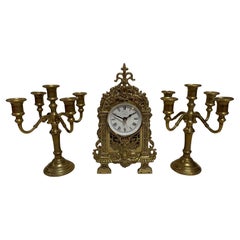
Vintage italy 1990s bronze 4 flame clock and candelabra
By Mice di rugiano domenico e c. s.n.c.
Located in Cantù, IT
Vintage italy 1990s bronze 4 flame clock and candelabra
Category
20th Century Italian Other Continental Europe Mantel Clocks
Materials
Bronze
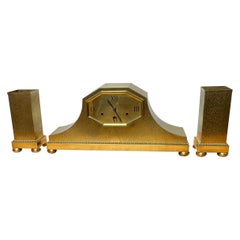
Top Quality Art Deco Clock Set / Vases, Polished Brass w Westminster Sound Chime
Located in Lisse, NL
Interesting and very attractive Art Deco mantle / mantel clock, circa 1920.
Some of the most attractive designs date from the Art Deco era and this remarkable clock set is no excep...
Category
Early 20th Century European Art Deco Continental Europe Mantel Clocks
Materials
Brass, Bronze
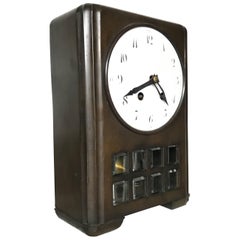
Rare Art Deco / Bauhaus Bronze Table or Mantel Clock by Lenzkirch / C.Kühling
By Lenzkirch
Located in Lisse, NL
Bronze table clock from the transitional period between Art Nouveau and Art Deco.
This rare bronze table clock is by Lenzkirch and it dates from the transitional period of the Jugen...
Category
Early 20th Century German Art Deco Continental Europe Mantel Clocks
Materials
Bronze, Enamel
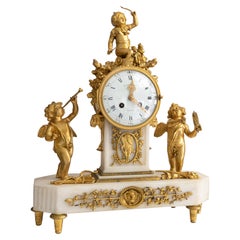
French Bronze Dore Mantle Table Clock by Leveque Guéret, 19th Century
By Guéret Frères
Located in Lisbon, PT
Louis XVI gilded bronze watch. Enamelled dial with hollow hands
White marble pedestal richly decorated with gilded bronze, and in the center a bas-relief with an ibex / goat symbol ...
Category
19th Century French Louis XVI Antique Continental Europe Mantel Clocks
Materials
Marble, Metal, Brass, Bronze, Ormolu

$5,918 Sale Price
20% Off
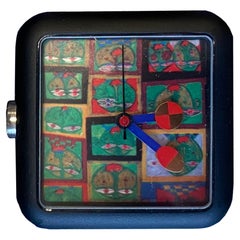
Watch 3 Designed by the Austrian Artist Hundertwasser, 1995
By Hundertwasser
Located in Saint ouen, FR
Watch designed by the Austrian artist Hundertwasser.
Rare watch, new from stock.
Sold with box and certificate.
Circa : 1995
Diameter : 4 cm
Length of the...
Category
1990s Continental Europe Mantel Clocks
Materials
Steel
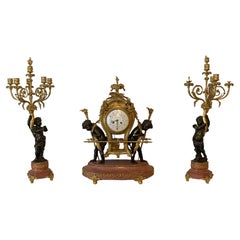
Clock Set in Marble and Bronze by F.Gervais
By Ferdinand Gervais
Located in Los Angeles, CA
Truly unique clock set in pink marble and bronze decorative piece of art
the clock is modelled in the image of an 18 century sedan chair that is covered ...
Category
1870s French Louis XVI Antique Continental Europe Mantel Clocks
Materials
Marble, Bronze
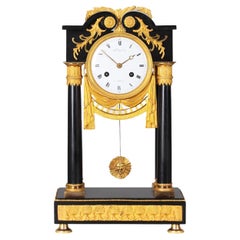
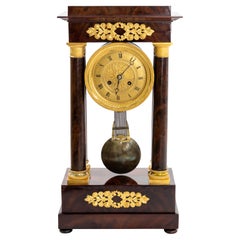
French Directoire Pendule, Black Marble, Firegilded Bronze, circa 1800
Located in Greven, DE
Antique portal clock
France
marble, bronze, enamel
Directoire around 1800
Dimensions: H x W x D: 46 x 28 x 14 cm
Description:
Antique portal c...
Category
Early 19th Century French Directoire Antique Continental Europe Mantel Clocks
Materials
Belgian Black Marble, Bronze
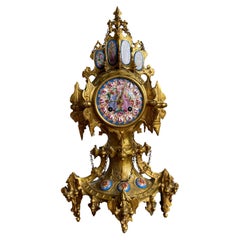
Unique Gothic Revival Gilt Bronze Table or Desk Clock w Rare Porcelain Plaques
By W.H. Tooke
Located in Lisse, NL
Wonderful clock for the collectors of truly stylish Gothic antiques, by W.H.Tooke, Paris.
Finding this unique (Germany made) Gothic table clock again felt like a blessing. The overall design is remarkable, but the combination of the craftsmanship of the bronze components and the hand crafted and hand painted Gothic porcelain plaques is what takes this clock to the next level. Whenever you find a piece that is this good then you can rest assure that there is a maker's mark. This late 1800s work of beauty was made and marked by the prolific Parisian clock...
Category
Late 19th Century German Gothic Revival Antique Continental Europe Mantel Clocks
Materials
Bronze
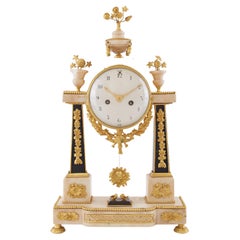
Mantel Clock 18th Century Louis XV Period
Located in Warsaw, PL
This striking mantel clock is a fine example of the Empire style, a period characterized by its grandeur and inspiration from classical antiquity. The clock showcases a masterful com...
Category
18th Century French Louis XV Antique Continental Europe Mantel Clocks
Materials
Marble, Bronze
$2,164 Sale Price
35% Off
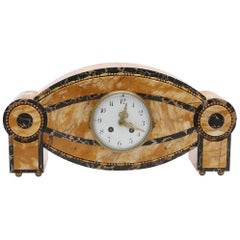
Carlo Bugatti Style Art Deco Marble Clock
By Carlo Bugatti
Located in Vienna, AT
French Art Deco marble mantel clock in the style of Carlo Bugatti in original condition. France, first half of the 20th century, measures: length 42 cm.
Original condition.
Category
1930s French Art Deco Vintage Continental Europe Mantel Clocks
Materials
Marble, Brass
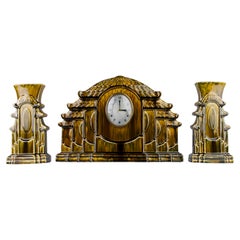
Sarreguemines, Mantel Clock "Pagoda", France, 1940s
By Sarreguemines
Located in PARIS, FR
Superb and rare Sarreguemines "Pagoda" model mantel clock. Ceramic of brown crackled enamel. Side pieces signed Sarreguemines and numbered 5410. Central piece...
Category
1940s French Vintage Continental Europe Mantel Clocks
Materials
Ceramic
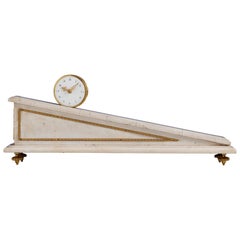
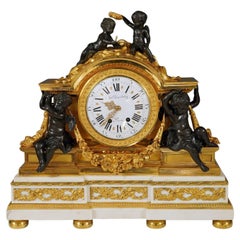
Rare 18th Century Louis XVI Ormolu and White Marble Inclined Plane Mantel Clock
Located in Worpswede / Bremen, DE
An extremely rare Louis XVI mantel clock 'a cremaillere', a movement driven by its own weight, where the moving drum barrel is running down an inclined whi...
Category
Late 18th Century French Louis XVI Antique Continental Europe Mantel Clocks
Materials
Marble, Ormolu
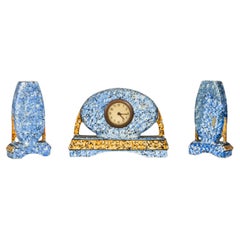
Art Deco Blue Ceramic Majolique Mantel Table Clock Set, Holiday Gift Idea
By Wasmuel Majolica
Located in Lisbon, PT
An Art Deco blue ceramic Majolique mantel clock set by Manufacturer Faïencerie de la Majolique de Wasmuel.
This fireplace clock has a matching a pair of vases.
The pieces of blue fa...
Category
20th Century Belgian Art Deco Continental Europe Mantel Clocks
Materials
Metal
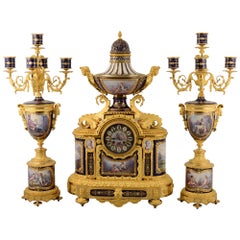
$2,330 Sale Price / set
20% Off
Garniture, clock and candelabra. Bronze, porcelain. France, 19th century.
Located in Madrid, ES
Garnish with clock and candelabra in porcelain and gilt bronze. France, 19th century.
Mechanism in perfect working order.
Fireplace garnish composed of a clock and two five-light candelabras, all three pieces made by combining gilt bronze, with relief elements and round bulges and cold-chiseled details, and porcelain decorated with low-temperature enamels, including gold enamel. The porcelain pieces follow models from the Sèvres National Manufacture of the 18th century, with large pictorial cartouches on a cobalt blue background adorned with golden plant motifs. The set follows a historicist design that combines baroque and neoclassical elements with enamelled scenes of Rococo inspiration, representing landscapes and scenes with mythological themes alluding to the arts and the goddess Venus. The clockwork is stamped “Chles. MT”, with serial number 17420. The main glazed porcelain plates are signed DP Boncher. The clock follows an architectural structure, with an oval base with a prominent front in plan, raised on four molded feet in the shape of a top, on which a large ornamental vase is placed. This plinth has a distinct pinto and, above it, a main body as a façade, with a circular pediment that houses the clock face. This includes black enamelled Roman numerals on white medallions with a gold border, arranged around the central representation of a putti reclining among clouds, holding a floral garland and accompanied by musical instruments. Among the medallions that house the numbers, a small jeweled decoration that evokes pearls and embedded rubies, which is echoed in the secondary areas of the body of the piece and also the vase, always combined with delicate golden filigrees.
On both sides of the sphere are two female portraits of ladies from the 18th century, in oval frames. Below, a classically inspired scene with a muse holding musical instruments, probably Euterpe or Erató, accompanied by a putti reading a sheet of music. On the sides of the clock body, two large curved rectangular plates house highly pictorial enameled landscapes, worked with the same miniaturist precision as the rest of the enameled cartouches. These are landscapes of romantic heritage, again inspired by the 18th century, with ideal settings for a twilight atmosphere, featuring classical ruins. The vase that tops the body of the clock has a hemispherical tank, shoulders ending in an edge, an openwork truncated conical neck, which opens smoothly towards the shoulders, and a domed lid, also openwork. The handles are figurative, in bronze, with two female sisters crowned with flowers, of clear Greco-Latin inspiration, worked in a round shape. In the tank, the vase houses two enameled porcelain cartouches, the front one with two putti and a dove - a symbolic allusion to Venus - and the back one with musical instruments. The design of the clock is completed by two thick bronze S-shaped plant braces, under the vase, and counter moldings and plant motifs cast in relief and cold chiseled, combining matte and polished finishes. The candelabras follow a similar design, with large vases of neoclassical design on pedestals, in this case cylindrical, raised on four low feet of turned design. The bases house porcelain cartouches with scenes of putti related to the arts; In one of them we see two putti practicing painting, and in the other two others in a scene related to classical lyric poetry, with one putto writing while the other, holding a lyre, raises a laurel wreath above his head. The cartouches that occupy the front of the candelabra vases...
Category
19th Century French Neoclassical Revival Antique Continental Europe Mantel Clocks
Materials
Metal, Bronze, Other
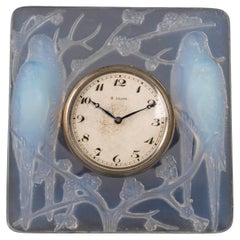
1926 René Lalique - Clock Inséparables Parrrots Opalescent Glass Mechanical
By René Lalique
Located in Boulogne Billancourt, FR
Clock "Inséparables" (Parrots) made in opalescent glass by René Lalique in 1926.
Original working mechanical movement.
Molded signature.
Perfect condition. 8-day movement in working...
Category
1920s European Art Deco Vintage Continental Europe Mantel Clocks
Materials
Glass
Mantel Clock 18th Century Louis XV Period, by Seigneurel À Paris
Located in Warsaw, PL
A Louis XV style marble mantel clock. Enamel dial with Roman numerals, signed with a red inscription "Seigneurez A Paris", finely pierced, engraved gold-plated hands, a broken arch (...
Category
Late 18th Century French Louis XV Antique Continental Europe Mantel Clocks
Materials
Malachite
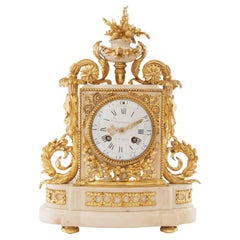
$3,127 Sale Price
25% Off
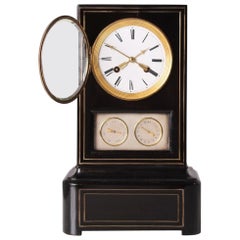
19th Century Table Clock with Calendar, Ebonized Wood, France, circa 1840-1860
Located in Greven, DE
Antique mantel clock with calendar in ebonised wood.
France
Wood, brass
Mid 19th century
Dimensions: H x W x D: 37 x 22 x 17 cm
Description:
French mantel clock from around 1840-1860.
The case is made of ebonised wood with brass thread inlays.
On the front we see behind glass the white dial with black roman numerals and gilded bezel. Also gold-plated are the beautiful original arrow-shaped hands.
The hands of the two-part calendar are also in the same design. On the left is the day of the week and on the right the day of the month.
On the back is a wooden flap that protects the movement from dust. If we open the flap, we see the high-quality French 14...
Category
Mid-19th Century French Antique Continental Europe Mantel Clocks
Materials
Wood
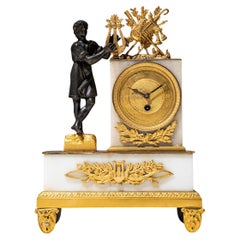
Mantel Clock with Orpheus Figure, 19th Century
Located in Greding, DE
Neoclassical mantel clock composed of patinated and fire-gilded bronze with white marble. The movement is positioned on the right, finely chiseled and adorned with laurel appliqués. ...
Category
19th Century European Neoclassical Antique Continental Europe Mantel Clocks
Materials
Marble, Bronze
$3,006 / set
L
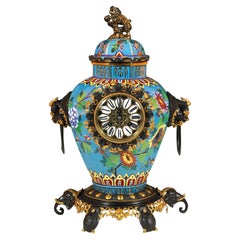
Escalier de Cristal, Oriental Clock, France, circa 1890
By L
Escalier de Cristal
Located in PARIS, FR
Rare Chinese style clock in the shape of a covered pot, in porcelain painted in imitation of Chinese cloisonné enamel and decorated with a two-patina bronze mount. The dome-shaped co...
Category
1880s French Chinoiserie Antique Continental Europe Mantel Clocks
Materials
Bronze, Enamel
A-E Beurdeley, « The Coronation of Science » Clock, France, circa 1880
By Emmanuel-Alfred Beurdeley
Located in PARIS, FR
Signed on the dial A. Beurdeley Paris
Mechanism signed J LEFEBVRE FILS PARIS
Rare Louis XVI style clock in mercury-gilded and patinated chiseled bronze and white marble. In the form of an arched pediment, it is decorated with four Cupids, two carrying a garland of flowers highlighting the dial, and two others symbolizing the coronation of Science. The molded base in white marble, with a double recess, is decorated with a ribboned torus, a frieze of ribboned oak leaves and interlacing, and rests on six flattened ball feet.
Related work :
In 1774, the bronze-caster Robert Osmond (1711-1789) designed a first model known as “architectural drawing” illustrating The Coronation of Science. Also called The Children of France, it is decorated with a putti crowning a young girl drawing with a compass and delivered to Versailles by Lépine, clockmaker to the King since 1762, for the apartment of Madame Royale in the Princes’ Wing, on December 28, 1778. (see photo attached)
This clock is described in the inventory of Versailles clocks...
Category
1870s French Louis XVI Antique Continental Europe Mantel Clocks
Materials
Marble, Bronze
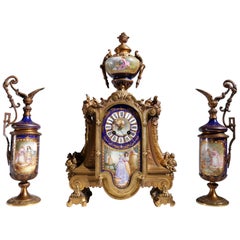
Gilt Bronze Sevres Style Clock Garniture, 19th Century
Located in Boven Leeuwen, NL
Beautiful 18th century Rococo manner gilt bronze mantel clock with elegant Sèvres style bleu / navy colored porcelain.
The porcelain is very delicately hand painted with a landscape on one side of the vases and figures on a staircase on the other.
Gorgeous gold details on a deep blue and jeweled background.
The clock has a painting on the top with 2 ladies...
Category
Late 19th Century French Rococo Antique Continental Europe Mantel Clocks
Materials
Bronze
$6,254 Sale Price / set
20% Off
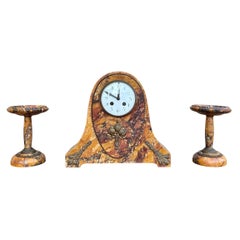
Art Deco Clock With Marble Trim, 1890s, Set Of 3
By Societe Clusienne
Located in BÉTERA, ES
Classic French mantel clock from the early 20th century, manufactured by the prestigious Société Clusienne in Cluses, the birthplace of high-quality watchmaking. Mounted on a veined ...
Category
Early 20th Century French Art Deco Continental Europe Mantel Clocks
Materials
Bronze
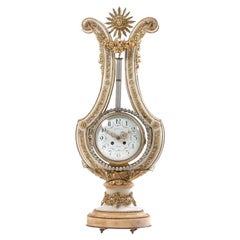
Very Impressive French 19th Century Neoclassical Lyre-Form Clock
By Etienne LeNoir
Located in Saint-Ouen, FR
An impressive French 19th century Neoclassical Lyre-form clock with jeweled pendulum.
Amazing quality white and yellow marble 19th century French Lyre-Form clock mounted all over with gilt bronze...
Category
1850s French Louis XVI Antique Continental Europe Mantel Clocks
Materials
Crystal, Marble, Enamel, Ormolu
$7,216 Sale Price
52% Off
Charles X Pendule, France around 1830
Located in Greding, DE
Portal clock on rectangular stepped base in mahogany veneer with small squeeze feet and fire-gilded applications in the form of rose festoons. The stepped...
Category
1830s French Charles X Antique Continental Europe Mantel Clocks
Materials
Bronze
$3,656 Sale Price
20% Off
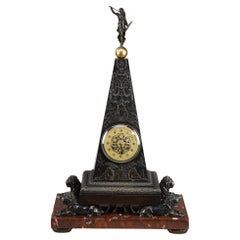
Obelisk clock in patinated and gilt bronze, Charles X
Located in Paris, FR
Very large clock, halfway between a pyramid and an obelisk, in patinated and gilded bronze, resting on four antique-style lions and a cherry-red marble veneer base. Bas-relief orname...
Category
1820s French Charles X Antique Continental Europe Mantel Clocks
Materials
Marble, Bronze
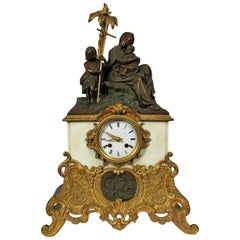
Pendulum Clock Bronze
Marble Representing Virgin Child
St John the Baptist
Located in Beuzevillette, FR
Very beautiful fireplace clock in marble, patinated and gilded bronze representing the Virgin Mary sitting on a rock holding the infant Jesus in her arms, with at their side st John ...
Category
19th Century French Louis XV Antique Continental Europe Mantel Clocks
Materials
Marble, Bronze
$2,309 Sale Price
76% Off
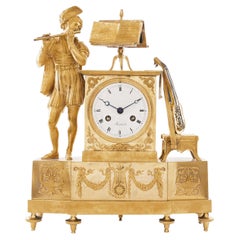
Mantel Clock 19th Century Styl Empire by Ferdinand Berthoud À Paris
Located in Warsaw, PL
Ormolu bronze mantel clock flanked by a troubadour and musical instruments, signed 'Ferdinand Berthoud a Paris'.
The end of the 18th and beginning of the 19th century was a crucial time in which new technological advances helped to make watches more accurate and more portable. During the 1790s, the production of gilded bronze increased considerably as working conditions improved. The freedom of trade initiated by the French Revolution allowed many casters to develop large factories. The new factory environment gave them a chance to execute all stages of bronze work including drawing, casting, gilding, assembly, and trade of art objects. While the bronzers took creative liberty in creating all kinds of clocks in contrast to the noble and rigorous structure carried by the movement of neoclassicism. Under the reign of Empire, the case designs started gradually to develop away from a proportionate and strict classicism towards a baroque style and revival style. The rediscovery of medieval civilization was one of the intellectual curiosities of the beginning of the 19th century, with much input from the Ancien Régime and its institutions, rites and the medieval churches in which family ceremonies occurred.
This early nineteenth-century figural mantel clock is surmounted by a medieval musician. To be more precise, it is a french troubadour. Troubadours were known for composing and performing lyric poetry for the nobility back during medieval times. The clock is featuring a chiselled bronze troubadour, dressed in medieval fashion while holding a flute, playing a tune from sheet music called "Du Troubadour" that is resting on top of the rectangular clock case. In addition to that, the clock features a gilt bronze lute or vielle resting on a small stool on the opposite side of the clock’s case. The white enamel dial features the inscription Berthoud and is underlined by a bronze entourage chiselled with palmette motif, plus encompassed by c-scrolls and wreaths. The original hands are in blued steel and encircled by Roman numerals indicating hour next to Arabic numerals indicating minutes.
The small details that adorn the hexagonal plinth are reliefs, depicting two water fountains or basins on both sides with a lyre in between. The sculpted image of a lyre raised above the background features also foliage garlands tied on top with ribbons. The clock rests on seven spinning feet.
The clock was made in the well-known workshop of the Berthoud’s family that was recognized for their excellent work by the King.
Berthoud Clockmakers History.
Ferdinand Berthoud was a horologist and author of extensive treatises on timekeeping as well as a Swiss clockmaker serving the king of France, that produced many marine clocks, including a weight-driven version that inspired the first American sea-going clock. He was born in Plancemont, Switzerland, the son of an architect and judiciary. In 1741 he began a three-year apprenticeship as a clockmaker under his brother, Jean-Henri. He made his first marine chronometer in 1754 (sent for trial in 1761) and in 1764 was appointed a member of the Royal Society, London and Horloger Mécanicien de Sa Majesté et de la Marine ayant l'inspection de la construction des Horloges Marines. In 1769, Ferdinand Berthoud sent for his nephew Pierre-Louis Berthoud (1754–1813), commonly known as Louis Berthoud, a talented young watchmaker and clockmaker, inviting him to come to Paris from Couvet, Switzerland, to pursue his apprenticeship. Louis helped Ferdinand manufacture and repair the sea clocks...
Category
Late 18th Century French Louis XVI Antique Continental Europe Mantel Clocks
Materials
Bronze
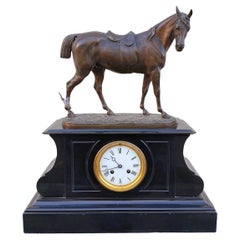
Emile Loiseau, Horse Clock, 19th Century
Located in MARSEILLE, FR
Black marble clock, topped with a spelter horse with a brown bronze-style patina, signed Emile Loiseau
Some chips on the marble and on the keyhole on th...
Category
Late 19th Century French Napoleon III Antique Continental Europe Mantel Clocks
Materials
Marble, Spelter
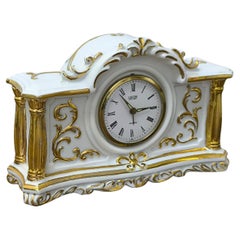
A Gilded Whisper of Time - Vintage LANDEX Mantel Clock with Classical Flourish
Located in Bochum, NRW
🎁 A Gift for the Season of Memory
As winter draws near and homes fill with candlelight and conversation, this clock becomes more than décor - it becomes a gesture. A gift for the co...
Category
Mid-20th Century Japanese Rococo Continental Europe Mantel Clocks
Materials
Porcelain
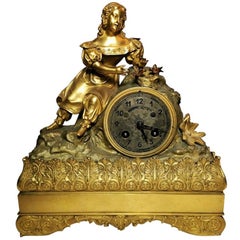
Louis XVI Style French Mantel Clock in Gilded Bronze
Located in Prato, Tuscany
We kindly suggest you read the whole description, because with it we try to give you detailed technical and historical information to guarantee the authenticity of our objects.
Sump...
Category
Early 19th Century French Louis XVI Antique Continental Europe Mantel Clocks
Materials
Bronze
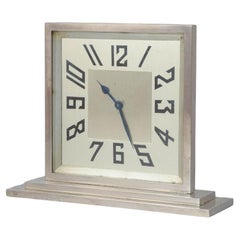
Art Deco silver-plated mantel clock on a rectangular base. Sweden, 1930s
Located in København, Copenhagen
Art Deco silver-plated mantel clock.
Elegant square-shaped manuel clock on a rectangular base with geometric Art Deco design. Dial with painted black stylised numerals and blued ste...
Category
1930s Italian Art Deco Vintage Continental Europe Mantel Clocks
Materials
Silver Plate
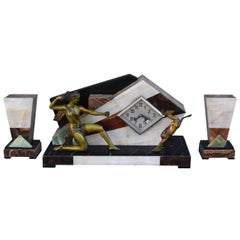
1930s Modernist Art Deco Mantel Clock
Located in Marseille, FR
1930s modernist Art Deco mantel clock in onyx. Hunter and antelope on the front.
Category
1930s Art Deco Vintage Continental Europe Mantel Clocks
Materials
Onyx, Marble
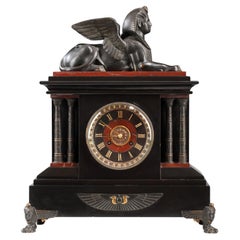
$661 / item
Neo-Egyptian Bronze and Marble Clock Attributed to G.Servant, France, Circa 1870
By Georges Emile Henri Servant
Located in PARIS, FR
A black and red marble clock in the shape of an Egyptian temple attributed to G. Servant, flanked by double columns inscribed with hieroglyphs and ornated with a winged uraeus, all made in two patina bronze. The clock is surmounted by a patinated bronze sphinx. Resting on four bronze faces wearing the nemes and terminating in lion paw feet.
Georges Emile Henri Servant (circa 1828-1890) who took over his father in 1855 at their foundry, rue Vieille-du-Temple, in Paris, specialized in the production of neo-Egyptian style clocks, very popular in France since 1860s, and also the making of Greek style decorative objects. He drew considerable attention to the high quality of his bronzes at the 1855 Paris Universal Exhibition and then at the 1862 London Exhibition. At this time Servant exported up to 40% of his production, principally to the United States, where for instance, his sphinx clocks were sold with great success by Louis Tiffany Inc. or Hamann & Roche of New York (A similar clock is now exposed at the Metropolitan Museum of Art, New York). But his success came really at the 1867 Paris Universal Exhibition, where he was awarded a gold medal for his neo-Greek and Egyptian works (Les Merveilles...
Category
1870s French Egyptian Revival Antique Continental Europe Mantel Clocks
Materials
Marble, Bronze
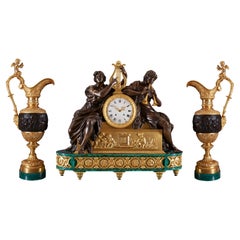
Clock and vase Set 19th Century Louis Philippe Charles X style with 8-song
Located in Warsaw, PL
This antique clock set is a luxurious masterpiece, perfect for adding elegance to hotel lobbies, grand living rooms, spacious hallways, and museums. ...
Category
Late 19th Century French Charles X Antique Continental Europe Mantel Clocks
Materials
Malachite, Bronze
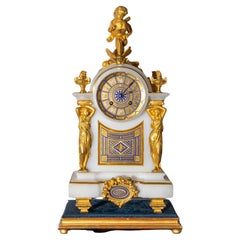
Alabaster Mantel Clock, sig. McDonald Glasgow, 19th century
Located in Greding, DE
Mantel clock in an alabaster case with Roman hours, cobalt blue and gilded decoration in the form of caryatids, flaming urns and a winged putto riding a butterfly. The clock stands o...
Category
19th Century Antique Continental Europe Mantel Clocks
Materials
Alabaster
Porcelain And Gilt Bronze Clock, Napoleon III, 19th Century
Located in MARSEILLE, FR
Louis XVI style clock in gilded bronze and porcelain: the base is very richly decorated: putti heads, flower garlands, knots and rosettes and porcelain plates decorated with golden s...
Category
19th Century French Louis XVI Antique Continental Europe Mantel Clocks
Materials
Bronze
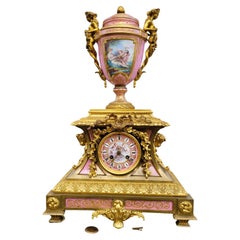
Mantel Clock 18th Century Louis Xv Period by Estienne Menu À, Paris
Located in Warsaw, PL
This stunning antique bracket clock is a fine example of luxurious 18th-century European design, combining meticulous craftsmanship with timeless...
Category
Late 18th Century French Louis XV Antique Continental Europe Mantel Clocks
Materials
Bronze
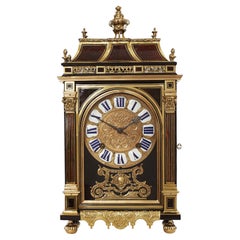
Early 19th Century Mantel Clock signed Gustaf Undén
By Gustaf Undén
Located in Ljungby, SE
A burnished gilded Empire mantel clock in the form of an oil lamp. The dial is signed by Gustaf Undén (clockmaker from 1800-1829), made in Stockholm. The dial has a small enamel repa...
Category
Early 19th Century Swedish Antique Continental Europe Mantel Clocks
Materials
Bronze
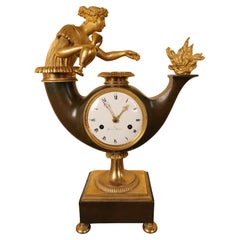
Rare Late 18th Century Neoclassical Louis XVI Ormolu Mantel Clock
Located in Worpswede / Bremen, DE
The circular white-enameled dial signed ”Detour Paris” with Roman hours and Arabic quarter marks, a further inner Arabic chapter ring for the day of month. Pierced gilt hands and a b...
Category
Late 18th Century French Neoclassical Antique Continental Europe Mantel Clocks
Materials
Marble, Bronze, Enamel
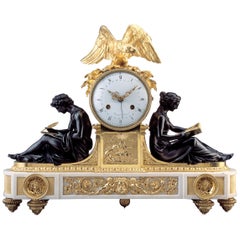
Large Napoleon III Period Gilt Bronze Mantel Set, 19th Century
Located in Saint-Ouen, FR
Large Napoleon III period gilt bronze mantel set, cloisonné with red and pink enamel, 19th century.
Napoleon III period mantel set, 19th century, in gilt bronze, cloisonné with red ...
Category
19th Century French Napoleon III Antique Continental Europe Mantel Clocks
Materials
Bronze
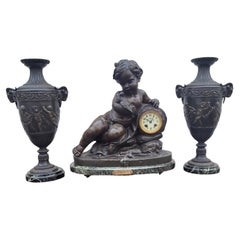
Mantelpiece The Message By J Castellamare, 19th Century
Located in MARSEILLE, FR
Mantelpiece set consisting of 3 pieces, a clock and 2 vases, all in patinated spelter and green marble
The clock is decorated with a Cupid tenderly holding a bird in his arms, leanin...
Category
19th Century French Louis XVI Antique Continental Europe Mantel Clocks
Materials
Marble, Spelter
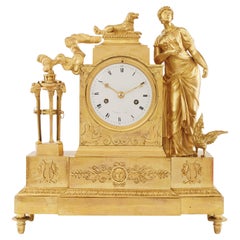
Mantel Clock 19th Century Styl Empire by Hartmann À Paris
Located in Warsaw, PL
An exceptional 19th-century Empire-style mantel clock by Hartmann à Paris, meticulously crafted in gilt bronze. This distinguished timepiece showcases a finely detailed white enamel ...
Category
Early 19th Century French Empire Antique Continental Europe Mantel Clocks
Materials
Bronze
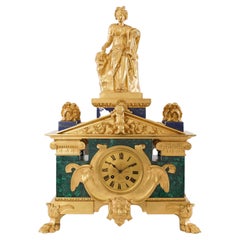
Mantel Clock 19th Century, Napoleon III Period
Located in Warsaw, PL
A beautiful clock made of bronze and malachite in an intense green and blue color. The clock stands on four decorated feet in the shape of paws. At the foot of the dial there is a cu...
Category
19th Century French Napoleon III Antique Continental Europe Mantel Clocks
Materials
Malachite, Bronze
$12,027 Sale Price
20% Off
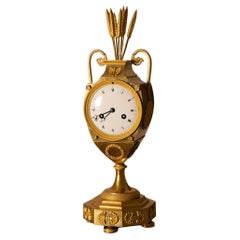
Charles X Fire-Gilt Mantle Clock, France, 1830s
Located in Greding, DE
Fire-gilt bronze mantle clock with an amphora-shaped case on an octagonal stand and applied decorations in the form of ears of grain, velaria, laurel wreaths and butterflies. The ena...
Category
1830s German Charles X Antique Continental Europe Mantel Clocks
Materials
Bronze
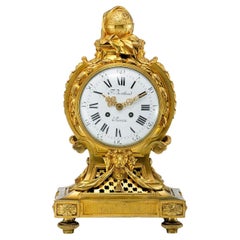
Large Louis XVI-style pendulum clock Paris, late 19th century
Located in Berlin, DE
Large Louis XVI-style pendulum clock
France, late 19th century
Bronze, gilt. On gyratory feet, a tapered, partially latticed case with lion masks, drapery, and scale decoration on th...
Category
1860s French Antique Continental Europe Mantel Clocks
Materials
Bronze
$4,782 Sale Price
20% Off
Vintage Alarm Clock, 1970s
Located in Roma, IT
Vintage Alarm Clock is a decorative object realized in the 1970s.
A vintage clock light blue colored.
The perfect gift for a jump to the past.
N...
Category
1970s European Vintage Continental Europe Mantel Clocks
Materials
Metal
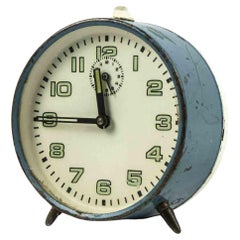
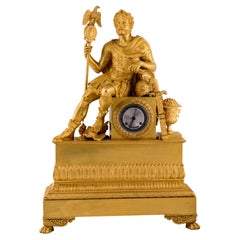
Table clock, Aníbal Barca. Ormolu bronze, metal. France, 19th century.
Located in Madrid, ES
Table clock, Aníbal Barca. Ormolu bronze, metal. France, 19th century.
Table clock with Paris machinery and a case made of mercury-gilded bronze. in mercury-gilded bronze, with a rectangular base on four rectangular base on four legs (the front ones decorated with scrolls and decorated with scrolls and ending in claws), decorated with a series of mouldings in relief with vegetal and architectural elements. vegetal and architectural elements in relief. The dial The dial (metal with Roman numerals for the hours) is set within a square shape, on which sits the male figure that decorates the piece. A bearded man, dressed in armour (a muscular loriga or cuirass) and a cape fixed over one shoulder with a fibula, resting his left arm on the helmet holding a rolled-up document, and with his left hand document, and with his left hand he holds a Roman standard (another Roman standard (another is broken, under his foot). Note, to the right and next to a sword, a vase full of rings.
vase full of rings.
Hannibal Barca (247-183 BC) was a Carthaginian general and statesman who was well known for his Carthaginian general and statesman, well known for his the ancient Roman Empire. No He was often depicted as counting the rings of fallen Roman knights in
the fallen Roman knights at the battle of Cannas (216 BC). , as can be seen in the sculpture by
sculpture by Sébastien Slodtz (made in 1704, Louvre Museum, Paris), where he also carries a Roman banner. Roman standard. With these two elements (vase with rings and with rings and a banner) is also shown on a table clock...
Category
19th Century European Neoclassical Revival Antique Continental Europe Mantel Clocks
Materials
Bronze, Other
Napoleon III Style Clock Made Out of Porcelain and Gilded Bronze
Located in SAINT-OUEN-SUR-SEINE, FR
This beautiful clock was made out of porcelain and gilded bronze during Napoleon III period. The porcelain dial indicates the hours with Roman numerals. It is decorated with gilded r...
Category
19th Century French Napoleon III Antique Continental Europe Mantel Clocks
Materials
Bronze
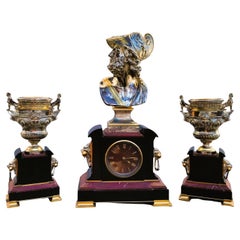
Antique Bronze Trim, Clock And Urns, 19th Century
Located in MARSEILLE, FR
Clock set composed of 3 pieces, a clock and 2 urns, in bronze with a gold and silver patina, on a black and red marble base.
Inspired by neo-Greek, this set presents numerous refere...
Category
19th Century French Grand Tour Antique Continental Europe Mantel Clocks
Materials
Marble, Bronze
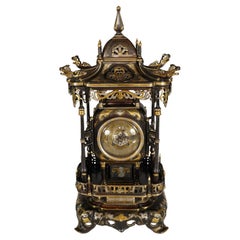
"Pagoda" Clock attr. to L
Escalier de Cristal, France, circa 1885
By L
Escalier de Cristal
Located in PARIS, FR
Beautiful Japonisme clock in openwork patinated bronze with gold and silver highlights in the shape of a pagoda, at the corners presenting stylized dragons above uprights imitating b...
Category
1880s French Japonisme Antique Continental Europe Mantel Clocks
Materials
Bronze
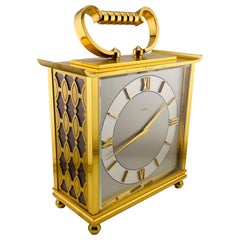
20C Le COUTURE LUXOR BRASS CLOCK
Located in Berlin, DE
Luxor Fire place clock high quality
gilted clock
Luxor
Category
20th Century European Continental Europe Mantel Clocks
Materials
Brass
$923 Sale Price
20% Off
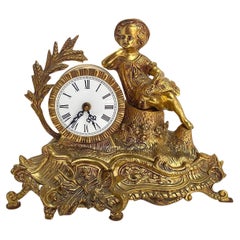
Midcentury Mantel Bronze Clock with Boy Figurine from France, circa 1960s
Located in Bastogne, BE
Victorian style gilded spelter figural mantel clock from the Mid -20th century.
Featuring a well-cast bronze figure of a young boy / child dressed in Victorian era garment, sheaves ...
Category
1960s French Vintage Continental Europe Mantel Clocks
Materials
Bronze
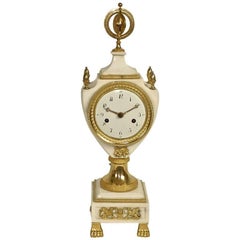
Louis XVI White Marble and Gilt-Bronze Mantle Clock
Located in Berlin, DE
Louis XVI white marble and gilt bronze marble clock, the white enamel dial with Arabic numerals within a lyra-shaped marble case surmounted by pi...
Category
Late 18th Century French Louis XVI Antique Continental Europe Mantel Clocks
Materials
Carrara Marble, Bronze, Enamel
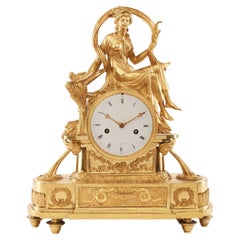
Mantel Clock 19th Century Styl Empire by Cérés À Paris
Located in Warsaw, PL
Empire clock signed à Paris
The mantel clock is in gilded bronze representing Ceres as a goddess of fertility, agriculture, grain crops and motherly relationships. In ancient Rom...
Category
Early 19th Century French Empire Antique Continental Europe Mantel Clocks
Materials
Bronze
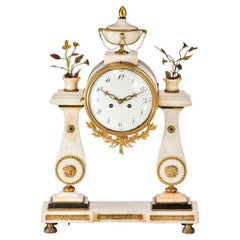
Antique French Louis XVI portal clock, Paris, circa 1880
Located in Berlin, DE
Antique French Louis XVI portal clock, Paris, circa 1880
White and black marble, bronze, gilt. On gyratory feet and a recessed base, two angular baluster columns crowned with vases a...
Category
19th Century French Napoleon III Antique Continental Europe Mantel Clocks
Materials
Alabaster, Marble, Bronze
$1,847 Sale Price
20% Off
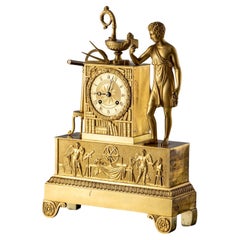
Mantel Clock, Allegory of the Sciences, France around 1830
Located in Greding, DE
Fireplace clock made of fire-gilt bronze with a rectangular base with a relief depicting winged putti with the attributes of the various sciences. Above it is a clock case in the sha...
Category
1830s French Antique Continental Europe Mantel Clocks
Materials
Bronze
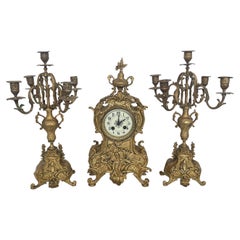
Antique Gilt Bronze Triptych - Fireplace Clock with Pair of Candelabra
By Mice di rugiano domenico e c. s.n.c.
Located in Cantù, IT
Extraordinary decorative triptych consisting of a mantel clock and a pair of five-armed candelabra, made of finely chiseled gilt bronze. This elegant ensemble, distinctly Rococo in s...
Category
19th Century Italian Rococo Antique Continental Europe Mantel Clocks
Materials
Bronze
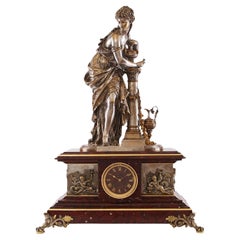
Mantel Clock 19th Century Napoleon III Period by Moreau Mathu
By Mathurin Moreau
Located in Warsaw, PL
An exceptional example of 19th-century French craftsmanship, this mantel clock by the renowned sculptor Moreau Mathu embodies the opulence and refinement ...
Category
Mid-19th Century French Napoleon III Antique Continental Europe Mantel Clocks
Materials
Silver, Bronze
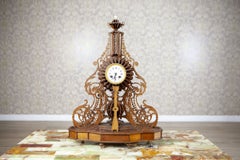
$5,628 Sale Price
28% Off
Unique Mantel Clock in Elaborate Exotic Wood Case, Late 19th Century
Located in Opole, PL
Unique Mantel Clock in Elaborate Exotic Wood Case, Late 19th Century
Presenting a truly exceptional 19th-century mantel clock—an exquisite piece of horological artistry and woodwork...
Category
Late 19th Century French Antique Continental Europe Mantel Clocks
Materials
Brass
$2,020 Sale Price
20% Off
Still Thinking About These?
All Recently ViewedMore Ways To Browse
Bronze Lion Clock
Cloisonne Clocks
Four Glass Clock Antique Clocks
French Clock With Sculpture
French Four Glass Clock
French Renaissance Clock
Gillion Paris
H H French Wood Mantel Clocks
Imperial Clocks
Le Roy And Fils Clock
Mantel Clock Dome
3 Piece Antique French Clock Garniture
3 Piece French Clock
Antique Black Slate Clock
Antique China Mantel Clocks
Art Nouveau Mantle
Bisque Clock
Black Forest Mantle Clock