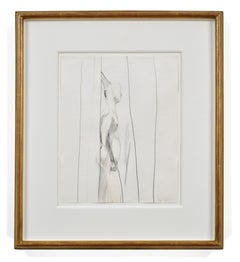
England - Nude Drawings and Watercolors
to
118
115
69
76
48
2
Overall Width
to
Overall Height
to
36
191
84
4
7
8
8
3
2
5
4
4
49
36
36
33
13
11
5
5
3
2
1
231
77
2
255
158
127
115
100
55
47
46
44
9
7
5
4
3
3
3
3
2
2
2
123
97
71
57
53
22
14
14
8
7
128
9
312
1,244
1,111
Item Ships From: England
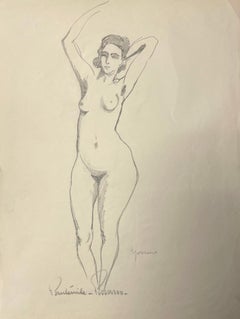
Yvonne debout by Paulémile Pissarro - Nude drawing of the artist
s wife
By Paul Emile Pissarro
Located in London, GB
THIS WORK IS SOLD UNFRAMED
Yvonne debout by Paulémile Pissarro (1884-1972)
Pencil on paper
30.5 x 26 cm (12 x 10 ¹/₄ inches)
Signed lower centre, P...
Category
1920s Post-Impressionist England - Nude Drawings and Watercolors
Materials
Paper, Pencil
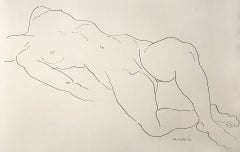
Essence of Line, Ink Nude Study, Early 20th Century Drawing, Signed and Dated
Located in London, GB
Ink on paper, signed and dated '34 lower left
Image size: 9 3/4 x 15 inches (24.75 x 24.5 cm)
Mounted and framed
A unique drawing, this work is typical of Brodzky's early nudes with its economy in the use of the line and the seemingly relaxed, informal pose of the model. The spontaneous feel of many of Brodsky's drawings does in a way indicate that the works, such as the present drawing, are purely sketches and studies. In fact, Brodsky was known for making perhaps twenty or thirty drawings at a sitting and of those he preserved perhaps only a handful, only those that 'pass his rigorous censorship sum up qualities resulting from the perfect collaboration of hand and eye and sensibility' (Forty Drawings by Horace Brodsky, by James Laver, 1935, p.15).
Laver continued to write that 'Brodsky preferred a pose that showed the body from an unexpected angle, daringly foreshortened or with the weight of the various parts freed from the monotony of the standing pose. He liked to see his models from above, the limbs relaxed, and.... he made many of his drawings from a step-ladder drawn up close to the platform on which the model is lying'.
Horace Brodsky
Horace Ascher Brodzky (30 January 1885 – 11 February 1969) was an Australian-born artist and writer most of whose work was created in London and New York. His work included paintings, drawings and linocuts, of which he was an early pioneer. An associate in his early career of many leading artists working in Britain of his period, including Henri Gaudier-Brzeska, Mark Gertler, and members of the Vorticism movement, he ended his life relatively neglected.
Brodzky was born in Kew, Melbourne in 1885 to the Australian journalist Maurice Brodzky (a Jewish immigrant to Australia from Poland), and his wife Flora, née Leon. In his youth he assisted his father in the production of the magazine Table Talk.
Brodzky studied initially at the National Gallery School in Melbourne. In 1904 his father was bankrupted after exposing corruption, and Horace moved with his family to San Francisco.
In 1908, Brodzky went to London where he studied during 1911 at the City and Guilds South London Technical Art School. He became an acquaintance and follower of Walter Sickert. Amongst his friends was Henri Gaudier-Brzeska who created in 1913 a portrait bust of Brodzky (now in the Tate Gallery, London), and whose biography he wrote in 1933. Brodzky is said to have been so engrossed in talk when he visited Gaudier-Brzeska's studio in the King's Road, that he missed the last bus to Herne Hill where he lived.
Brodzky travelled to Italy with the poet John Gould Fletcher and this led to his first London exhibition, "Paintings and Sketches of Italian and Sicilian Scenes" (c. 1911), of which one painting was selected for the 1912 Venice Biennale. He was in fact the first Australian to be exhibited at the Biennale. In 1914 his work was exhibited along with that of other Jewish artists, including Mark Gertler and David Bomberg, in the Whitechapel Gallery. Brodzky became a member of The London Group. During this period he was a pioneer of the technique of linocut, in which medium he has been said to have "excelled". His early oils reveal the influence of both Gertler and Bomberg. Among his works of this period are portraits of Jacob Epstein and Jacob Kramer.
In 1915 Brodzky moved to New York, with an introduction to the art patron John Quinn. There he worked as a poster artist and an arts journalist, and in 1917 helped Quinn organize a New York exhibition of Vorticist artists. In 1919 he married Bertha Greenfield; they were to have three sons. In 1920 Egmont Arens...
Category
1930s Modern England - Nude Drawings and Watercolors
Materials
Paper, Ink
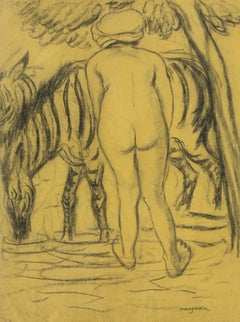
Jeune Femme de Dos au Zèbre by Georges Manzana Pissarro - Nude drawing
By Georges Henri Manzana Pissarro
Located in London, GB
Jeune Femme de Dos au Zèbre by Georges Manzana Pissarro (1871-1961)
Charcoal on paper
66 x 49 cm (26 x 19 ¼ inches)
Signed lower right, Manzana
Executed circa 1915
This work is acco...
Category
1910s Post-Impressionist England - Nude Drawings and Watercolors
Materials
Paper, Charcoal
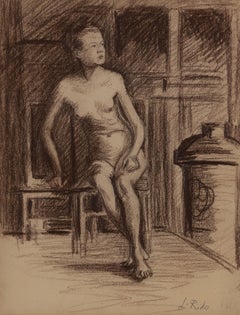
Nu Assise by Ludovic-Rodo Pissarro - Nude drawing
By Ludovic-Rodo Pissarro
Located in London, GB
Nu Assise by Ludovic-Rodo Pissarro (1878-1952)
Charcoal on paper
31.3 x 24.2 cm (12 ⅜ x 9 ½ inches)
Signed lower right, L.Rodo
This work of art is accompanied by a certificate of authenticity signed and dated by Lélia Pissarro.
Artist biography:
Ludovic-Rodolphe Pissarro, born in Paris in 1878, was Camille Pissarro’s fourth son. Encouraged by his father, he began drawing from nature at an early age. He was familiarly known as “Rodo” and generally signed his works "Ludovic-Rodo", or early on in his career simply "Rodo".
The impact of Camille’s art and teaching on Rodo was considerable. His artistic production encompassed a wide range of media, including oil painting, tempera, watercolour, gouache, wood engraving, drawing and lithography. Rodo exhibited regularly at the Salon des Indépendants over a forty-year period.
In 1894, at the age of sixteen, Rodo published his first wood engravings in the anarchist journal, Le Père Peinard. When Camille left France for the safety of Belgium during the anarchist upheavals of the same year, Rodo joined him there.
Rodo moved into his first studio in Montmartre with his brother Georges in 1898. Works of this early important period until just after the death of his father in 1903 were post-impressionist and clearly painted under the influence of his father.
By 1904 living in Paris, he found the nightlife and the habitués of the cafes, theatres, circuses and cabarets compelling subjects for his work and changed dramatically the style of his painting, affiliating himself to the Fauve artists. Rodo became close to artists such as Kees Van Dongen, Maurice de Vlaminck and Raoul Dufy. In 1905 he participated in the first Fauve exhibition at the Salon des Indépendants. In 1907 he visited Van Dongen in Rotterdam and the two artists continued to paint together, something they often did in Paris.
In 1914 he married, though he never had children. Later that year at the outbreak of the War Rodo moved to England. Over the next seven years he lived mainly in and around West London. He worked closely with his brother Lucien to establish in 1915 the Monarro Group, formed with the aim of exhibiting work by contemporary artists inspired by Impressionism. Many of the works produced by Rodo while he was in England were of London landmarks but, he was also interested in the urbanisation of West London. After 1921, when Rodo had already returned to France, he divided his time between Paris and Les Andelys in Normandy, living and working closely with his elder brother Georges Manzana.
Despite his rich artistic heritage and his achievements as an artist, Rodo is perhaps best remembered for his contribution to art history. For ten years he researched and compiled a catalogue of his father’s paintings...
Category
Early 1900s Post-Impressionist England - Nude Drawings and Watercolors
Materials
Paper, Charcoal
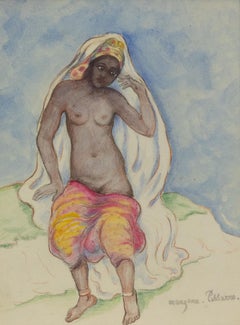
Moroccan Dancer by Georges Manzana Pissarro - Nude drawing
By Georges Henri Manzana Pissarro
Located in London, GB
Moroccan Dancer by Georges Manzana Pissarro (1871-1961)
Watercolour, coloured crayon and pencil
26.3 x 20.2 cm ( 10 ⅜ x 8 inches)
Signed lower right, Manzana - Pissarro.
Executed c...
Category
1940s Post-Impressionist England - Nude Drawings and Watercolors
Materials
Paper, Crayon, Watercolor, Pencil
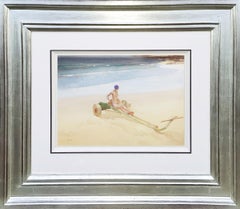
Amanda
By William Russell Flint
Located in Belgravia, London, London
Watercolour on paper
Paper size: 16 x 22 inches
Framed size: 30 x 26 inches
Signed lower left
Category
20th Century Impressionist England - Nude Drawings and Watercolors
Materials
Paper, Watercolor

$34,356
Nude Reading by LUDOVIC-RODO PISSARRO -Figurative work on paper, School of Paris
By Ludovic-Rodo Pissarro
Located in London, GB
*UK BUYERS WILL PAY AN ADDITIONAL 20% VAT ON TOP OF THE ABOVE PRICE
Nude Reading by LUDOVIC-RODO PISSARRO (1878-1952)
Black and colour pencil on paper
3...
Category
Early 1900s Post-Impressionist England - Nude Drawings and Watercolors
Materials
Pencil, Color Pencil, Paper

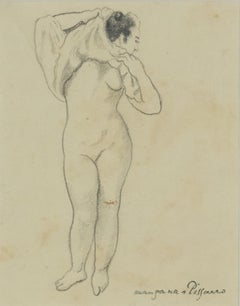
Undressing by Georges Manzana Pissarro - Nude drawing
By Georges Henri Manzana Pissarro
Located in London, GB
Undressing by Georges Manzana Pissarro (1871-1961)
Pencil on paper
13.6 x 10.6 cm (5 ³/₈ x 4 ¹/₈ inches)
Signed with Estate stamp lower right, manzana- Pissarro
This work is accompa...
Category
20th Century Post-Impressionist England - Nude Drawings and Watercolors
Materials
Paper, Pencil
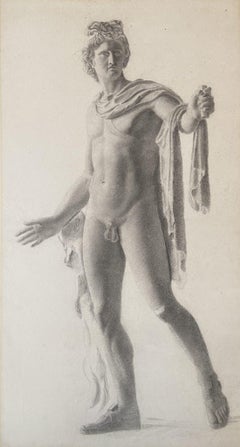
Study of the Apollo Belvedere, Graphite Sketch, 19th Century
Located in London, GB
Graphite on paper
Image size: 13 3/4 x 26 inches (35 x 66 cm)
This is most likely to be a drawing from an Academy student, executed as part of their academic training. The academic ...
Category
19th Century England - Nude Drawings and Watercolors
Materials
Graphite
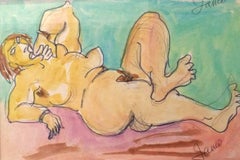
Reclining Nude
By Marcel Janco
Located in London, GB
MARCEL JANCO 1895-1984
Bucarest 1895-1984 Ein Hod (Rumanian/Israeli)
Title: Reclining Nude
Technique: Original signed Watercolour and Ink on paper
s...
Category
Dada England - Nude Drawings and Watercolors
Materials
Ink, Paper, Watercolor
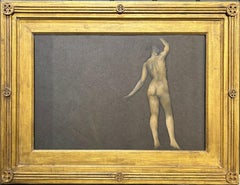
Study of a Standing Female Nude
By Evelyn de Morgan
Located in London, GB
Evelyn de Morgan
Study of a Standing Female Nude
1855 - 1917
Black chalk and pastel on grey paper
Image size: 12 ½ x 19 inches (48.2 x 31.7 cm)
Pre-Raphaelite style frame
Provenance
J.S. Mass & Co., Ltd., London, J.X. Reynolds & Co., Ltd.
Once she had graduated from the Slade School of Art, Evelyn continued to draw every day for the rest of her life. Her drawings are enlightening not only for their skill and subject matter, but also for their ability to teach us her working process. From loose compositional sketches, Evelyn swiftly progressed to detailed life studies for the figures in her paintings. Choosing to draw mainly on a grey wove paper in pencil and pastel, Evelyn produced hundreds of figure studies. Her rigorously-examined double studies of clothed and nude figures are particularly fascinating and underline the artist’s obsession with the human form and her desire for accuracy. A deep understanding of anatomy is obvious in this drawing and looking at the work you feel as though you can reach out and feel the muscle and bone under the skin, that you could feel the pulse of life through the soft skin.
Evelyn de Morgan
Born into a landowning family, from an early age Evelyn De Morgan, née Pickering, demonstrated a precocious artistic talent and a passionate desire to pursue a career as an artist, writing in her diary on her seventeenth birthday ‘Art is eternal, life is short… I have not a moment to lose’ (Evelyn De Morgan’s Diary, 30 August 1872, De Morgan Foundation Archive). Her maternal uncle, the artist John Roddam Spencer-Stanhope encouraged her talents and accompanied her on her first formative journeys to Italy where she discovered the Renaissance masters, particularly Botticelli. Overcoming initial parental opposition, Evelyn enrolled at the newly formed Slade School in 1873, one of the first women to do so.
The Slade revolutionised women’s artistic education by allowing female students to study the nude from life alongside their male counterparts. Whilst at the Slade she began to submit work under her middle name Evelyn, rather than her Christian name Mary, as its gender ambiguity offered a chance for her work to be judged on its own merit.
One of her tutors, Edward Poynter...
Category
20th Century Victorian England - Nude Drawings and Watercolors
Materials
Paper, Chalk, Pastel
Price Upon Request
Shower Study II, 20th Century, David Hockney, Drawing, Modern British
By David Hockney
Located in London, GB
David Hockney
Shower Study 2, 1963
signed with the artist's initials, titled and dated 'Shower Study 2 DH. '63' (lower right)
wax crayon and graphite on paper
12 3/8 x 9 7/8 in (31.4...
Category
21st Century and Contemporary Modern England - Nude Drawings and Watercolors
Materials
Wax Crayon, Graphite