Geneva - Figurative Prints
to
23
508
68
93
2
3
Overall Width
to
Overall Height
to
380
174
31
28
20
15
1
107
65
54
43
36
1
659
14
1
27
26
54
128
244
105
38
1
577
96
428
299
277
156
142
113
92
78
50
27
16
16
14
14
14
14
13
13
13
13
414
185
32
19
13
6
3
19,306
17,439
Item Ships From: Geneva
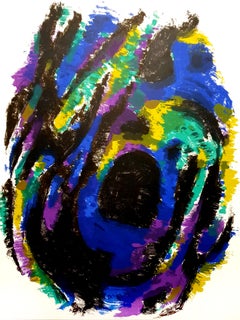
Alfred Manessier - Original Lithograph
By Alfred Manessier
Located in Collonge Bellerive, Geneve, CH
Alfred Manessier - Original Lithograph
Colorful Abstraction
1962
From XXe Siecle
Dimensions: 32 x 24
Edition: G. di San Lazzaro.
Unsigned and unumbered as issued
Category
1960s Modern Geneva - Figurative Prints
Materials
Lithograph

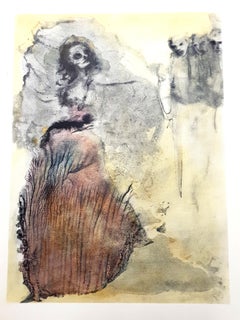
Leonor Fini - Walking Dead - Original Lithograph
By Leonor Fini
Located in Collonge Bellerive, Geneve, CH
Leonor Fini - Walking Dead - Original Lithograph
The Flowers of Evil
1964
Conditions: excellent
Edition: 500
Dimensions: 46 x 34 cm
Editions: Le Cercle ...
Category
1960s Modern Geneva - Figurative Prints
Materials
Lithograph
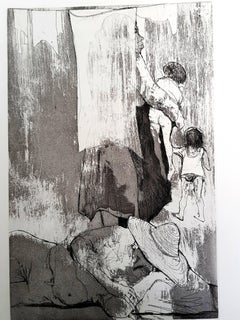
Jean Jansem - Original Etching
By Jean Jansem
Located in Collonge Bellerive, Geneve, CH
Jean Jansem - Original Etching
Title: Loneliness
Dimensions: 40 x 30 cm
Edition of 175
Paper: vélin de Rives
1974
Unsigned and unumbered as issued
Category
1970s Modern Geneva - Figurative Prints
Materials
Etching
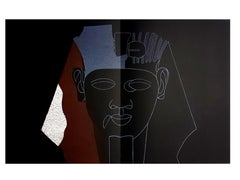
Eduardo Arroyo - Sphinx - Original Lithograph
By Eduardo Arroyo
Located in Collonge Bellerive, Geneve, CH
Eduardo Arroyo - Sphinx - Original Lithograph
1984
Conditions: excellent
Edition: 495
Dimensions: 37,3 x 58 cm
Editions: Trinckvel
Category
1980s Modern Geneva - Figurative Prints
Materials
Lithograph
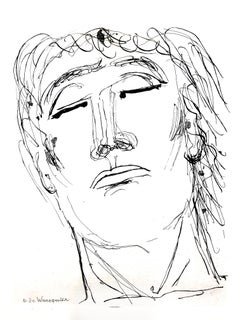
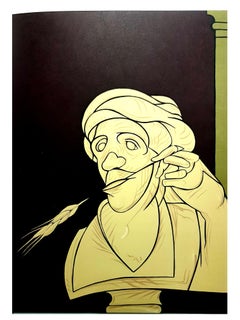
Henry de Waroquier - Portrait - Original Etching
By Henry de Waroquier
Located in Collonge Bellerive, Geneve, CH
Henry de Waroquier - Portrait - Original Etching
Paris, Le Gerbier, 1946
Edition of 340
Signed in the plate
Category
1940s Modern Geneva - Figurative Prints
Materials
Etching
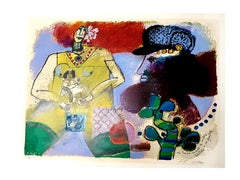
Théo Tobiasse - A Man Talking About Mornings - Original Lithograph
By Théo Tobiasse
Located in Collonge Bellerive, Geneve, CH
Théo Tobiasse
Title: Un Homme Raconte les Matins
Signed and Numbered
Dimensions: 57 x 76 cm
Information : Edition of 175
Condition : Excellent
Category
1980s Surrealist Geneva - Figurative Prints
Materials
Lithograph
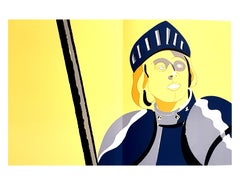
Eduardo Arroyo - Jeanne d
Arc - Original Lithograph
By Eduardo Arroyo
Located in Collonge Bellerive, Geneve, CH
Eduardo Arroyo - Jeanne d'Arc - Original Lithograph
1984
Conditions: excellent
Edition: 495
Dimensions: 37,3 x 58 cm
Editions: Trinckvel
Category
1980s Modern Geneva - Figurative Prints
Materials
Lithograph
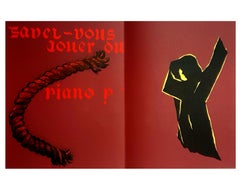
Eduardo Arroyo - Can You Play Piano ? - Original Lithograph
By Eduardo Arroyo
Located in Collonge Bellerive, Geneve, CH
Eduardo Arroyo - Can You Play Piano ? - Original Lithograph
1984
Conditions: excellent
Edition: 495
Dimensions: 37,3 x 58 cm
Editions: Trinckvel
Category
1980s Modern Geneva - Figurative Prints
Materials
Lithograph
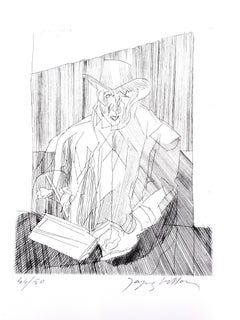
Jacques Villon - Man - Original Etching
By Jacques Villon
Located in Collonge Bellerive, Geneve, CH
Jacques Villon - Man- Original Etching
1951
Signed in pencil and numbered
Dimensions : 34.8 x 25 cm
Category
1950s Modern Geneva - Figurative Prints
Materials
Etching
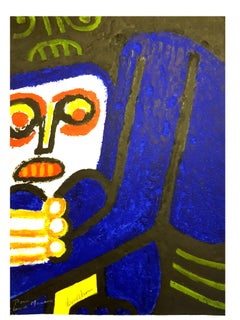
Eduardo Arroyo - Awaken Heart - Original Lithograph
By Eduardo Arroyo
Located in Collonge Bellerive, Geneve, CH
Eduardo Arroyo - Awaken Heart - Original Lithograph
1984
Conditions: excellent
Edition: 495
Dimensions: 37,3 x 58 cm
Editions: Trinckvel
Category
1980s Modern Geneva - Figurative Prints
Materials
Lithograph
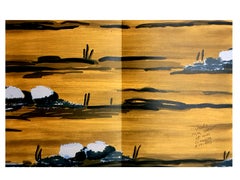
Bengt Lindstrom - Original Handsigned Engraving
By Bengt Lindström
Located in Collonge Bellerive, Geneve, CH
Bengt Lindström - Original Handsigned Engraving
The Seven Deadly Sins.
76 x 56 cm
Signed in pencil by Bengt Lindström
Paris, ABCD, 1976.
Original etching in color
Limited edition 90 ex.
This is the unique copy offered to Claude Manesse,
The story of B. Lindström was collected by Frederick Towarnicki, assisted by Agathe Malet-Buisson. The engravings were drawn on the presses of Claude Manesse.
Bengt Lindström (1925-2008)
Bengt Lindström was born on September 3rd, 1925 in Storsjökapell, a small isolated village in the Swedish province of Norrland. The young child thus grew up in that vast, mythical and harsh expanse of mounts, glistening lakes and endless forests known as Lapland. His father was a primary school teacher who was fond of Lapps and who showed great interest in their ethnic group and culture. The child was only three days old when Lapp King Kroik, his godfather, administered the Baptism of the Earth, where the child is conveyed between two roots of a tree to grant him protection from the Gods. Lapps as well as local lumberjacks would occasionally abandon their silent ways to tell him and reveal the tales, legends and mysteries of the Great White North.
1935-1945 : He left Storsjökapell and headed to Härnösand, where he wrote short science-fiction novellas, became a renowned athlete and began to paint.
1944-1946 : Isaac Grünewald Art School in Stockholm, Sweden. Study drawing with Aksel Jörgensen at the Copenhagen Fine Arts School in Denmark. He realized his first two lithographs, Meditation and Le Modèle Etendu (The Stretched Model).
1947-1952 : He arrived in Paris. He travelled to Italy, where he visited Florence and Assisi, developing a deep fascination for Giotto and Cimabue. He was granted a scholarship by Swedish magazine Aftontidningen, which helped him move into a workshop in Arcueil, France. He began working on mosaics.
1953-1967 : He returned to Paris, once again taking up lithography and engraving, which holds a vital position in his work. He moved into a workshop in Rueil-Malmaison. This was the start of his collaboration with the Rive Gauche Gallery in Paris. London Tooth
Sons Gallery Director M. Cochrane purchased a large number of his works. He left the workshop in Rueil-Malmaison to settle in Savigny-sur-Orge, France. He began taking to figurative art with Masks, Gods and Monsters. He exhibited with the Nouvelle Figuration Group at the Mathias Feld Gallery. He also began working with the Ariel Gallery in Paris.
1968-1978 : Lindström completed a series of 10 lithographs about Scandinavian mythology. He also completed a series of drypoint works. An association with the Protée Gallery in Toulouse, France, led to exhibitions at the Protée Gallery II in Paris starting in 1984. He executed a large mural painting the Grand Hotel in Härnösand, Sweden. He also made two large frescoes for the Nacksta-Sundsvall covered market in Sweden. He took to sharing his working time between the workshop in Savigny-sur-Orge and the one in Sundsvall. He began collaboration that was to last several years with the ABCD Gallery in Paris, which provided exclusive publication for his engravings and strong ink work. Les Hommes du Nord (Men of the North) was the first of the major tapestries. He published a boxed set album, Eddan, Eddan, Eddan, illustrating Scandinavian mythology. Together with Jacques Putman, he completed two editions of bronze sculptures, Les Enfants Sauvages (The Wild Children).
1979-1982 : He worked on glass, making thirty dishes and goblets for renowned Swedish glassmaker Kosta Boda. He painted a car for Volvo, Sweden’s leading car manufacturer. Then, close to his birthplace, he painted gigantic tarpaulins over forty metres high, covering the slopes of the neighbouring Våladalen Mountain, as a protest against the building of a dam. This action caused a sensation and provoked fierce reactions. He also created small painted papier mâché sculptures, Têtes (Heads), as well as some gold and silver jewellery.
1983 : He exhibited seven monumental 3x2.5m works at the Art and History Museum in Stockholm: Les Grands Dieux Ase (The Great Aesir Gods), depicting the gods from Scandinavian mythology: Thor, Odin, Frej, Balder, Ymer, Loki and Unknown God, as well as acrylic paintings about the Valkyries. Les Grands Dieux was ultimately exhibited in a purpose-built chapel adjoining the Midlanda Contemporary Arts Centre in 1996. He completed Thor’s Hammer, a monumental sculpture.
1985-1990 : He lived also in the Alicante region, where Spanish friends found him a new workshop. While there he completed Novelda, an album of lithographs featuring poems by Spanish poet Paco Pastor. He completed a new mural, 5mx5m, for the Västeras Science Institute in Sweden. He then started working with the San Carlo Gallery in Milan, Italy, which coordinated all of the Italian events. Major exhibitions and retrospectives were held in Italy, Belgium, Luxembourg, Germany and Spain. He created two boxed set albums, containing series of 10 aquatints, Monde Autre et Chamanes (Otherworld and Shamans), featuring poems by Michel Perrin.
1991-1994 : He went back to working in black and white, completing some very-large-format works. In Murano, in association with the San Carlo Gallery, he created Grands Verres (Large Glasses), a series of large vases and sculptures made of crystal. He painted Kåtan Mimi, an 8x9m Lapp tent, for the town of Arjeplog in Swedish Lapland. He completed a couple of 2m-high painted polyester sculptures, Lui et Elle (Him and Her). He then made a new series of crystal glasses and sculptures in Murano, Italy. He completed Présence (Presence), a new 3.5x2.7m tapestry for the municipality of Timrå, Sweden. He started on the Grands Initiés (Great Insiders) series, all large format and mixed black and white techniques. He finished the strong series about Norse gods.
1995-1996 : He moved into a new workshop in Paris. A retrospective was held at the Sundsvall Museum in Sweden, and on that occasion he painted a monumental 700-m² canvass, Le Géant sur la montagne (The Giant on the Mountain), which was hung all summer long on the mountain slope facing the town. He went on to complete a suite of six silkscreen prints on the same theme. Then he inaugurated the Y, a monumental sculpture. Lindström then completed Temps Zéro (Zero Time), a watch made for Swatch. One of his works, L’hiver (Winter), made the cover of the first 1996 issue of Telerama, the leading French weekly. In association with Sydkraft Sweden, he painted a fresco for the municipality of Örebro on a 17m-high tank with a surface area of 3,000 m², located at the crossroads of major Swedish motorways, by the entrance to the Åbyverket industrial estate. He also created a 6.5m-high Tången sculpture made of painted concrete in Ånge, which was inaugurated on September 3rd in the presence of their Majesties the King and Queen of Sweden.
1997-1999 : He began working on ceramics in Albisolla, Italy. He also completed a new 30m-high fresco for the town of Örebro, located close to the tank he had painted in 1996 near Åbyverket. The year saw the inauguration of the Midlanda Contemporary Arts Centre in Sweden, which harbours the collection of the Bengt and Michèle Lindström Foundation, featuring the entire engravings collection (about 800 works), as well as a selection of paintings and sculptures. He completed a 4x10m mural in the lobby of the University of Eskilstuna, Sweden, and also completed two monumental frescoes on the Akkats dam and a mural on the power station facing Jokkmokk in Swedish Lapland.
2000-2003 : He painted all of the sides of a semi-articulated lorry for Scania, Sweden’s main truck manufacturer. In Italy, he completed a new series of crystal sculptures with Adriano Bérengo. He finished the Great Prophets, a series of 2x2m oil on canvass works. Swiss publisher Ides et Calendes published a small but luxurious monograph, with text by Françoise Monnin. A notebook was also published, Le Visage dans l’Art de Bengt Lindström (Faces in the Art of Bengt Lindström). He completed a substantial series of large blue acrylic paintings, Femmes (Women).
2003 : Bengt fell ill and was unable to paint, but the exhibitions went on.
2004 : Saw the release of the film by Dag Jonzon and Hans Östbom, produced by Dell’arte AB and Östbom Filmbild, about the life of Bengt Lindström. Entitled Lindström - Le Diable de la couleur et de la forme (Lindström – The Colour and Form Devil), the film was produced thanks to support from Film Västernorrland, Länsstyrelsen Västernorrland and Sveriges Television. It was broadcast on Swedish television channels. That same year, the Midlanda Contemporary Arts Centre was closed as a result of municipal policy.
2005-2007 : The 6m-high sculpture Le Loup (The Wolf), made for PEAB, was inaugurated in Botkyrka-Stockholm. Lindström – The Colour and Form Devil was screened at the Paris Swedish Cultural Centre and released on DVD. The Michèle and Bengt Lindström Foundation was donated and transferred to the Länsmuseet i Västernorrland in Härnösand, Sweden, where a special room was prepared to host Les Grands Dieux Ase. Edition of the 1998 Ceramics, created in association with Francis Dellile’s ”La Tuilerie” workshop. The Bengt Lindström Collection was inaugurated at, Murberget, the Länsmuseet i Västernorrland in Härnösand, Sweden. He illustrated Sinfonietta för Juliana, a collection of poems by Italian poet and art critic Sebastiano Grasso. On January 29th, 2008, Bengt Lindström passed away at his home in Sweden.
2008-2012 : The Fondation Krimaro presents the first volume of the works of Bengt Lindström in his collection. Numerous exhibitions-tribute to the work are presented in major cities in Europe.
2012 : Retrospective - Black and White in the engravings - Museum of Härnösand, Murberget, Sweden.
Main exhibitions
1952 Fair Réalités Nouvelles – New realities, Paris, France.
1953 Craven Gallery, Paris, France.
1954 Gummeson Gallery, Stockholm, Sweden. Fair Salon d’Octobre, Paris, France.
1958 Breteau Gallery, Paris, France.
1959 Autour du Spontanéisme – Around the sontaneity, Stockholm, Sweden. L’Europe Nouvelle – The new Europe, LaUnited Statesnne, Switzerland.
1960 Rive Gauche Gallery, Paris, France.
1961 Tooth Gallery, London, England. Le Zodiaque Gallery, Brussels, Belgium. Fair Salon de Mai, Paris, France.
1962 Nouvelle Figuration – New Figuration , Mathias Fels Gallery, Paris, France,
1964 Nord-Sud – North-South, in several cities in Sweden. Ariel Gallery, Paris, France, 15 artists of my generation. Museum of Fine Arts in Gent, Belgium, Figuration-Défiguration – Figuration – Disfigurement.
1965 Rive Gauche Gallery. Paris, France. Nord Gallery, Lille, France. Birch Gallery, Copenhagen, Denmark.
1966 Museum of Modern Art, Gothenburg, Sweden.
1967 Veranneman Gallery, Brussels, Belgium. Carnegie Institute, Pittsburgh, United States. Seibu Gallery, Tokyo, Japan, 23 peintres in Paris.
1968 Ariel Gallery, Paris, France, followed by six exhibitions until 1976.
1969 La Pochade Gallery, Paris, France. Protée Gallery, Toulouse, France, who exhibited him in Paris, Gallery Protée II, from 1984.
1973 Galliera Museum, Paris, France.
1974 Gallery 111, Lisbon, Portugal.
1982 Gallery Protée-Arco, Madrid, Spain and Fair Foire de Cologne, Germany.
1983 Historia Museum, Stockholm, Sweden, The Ase gods and the Valkyries.
1984 Gallery Arcano XXI, Lisbon, Portugal. Gallery Christian Cheneau, Paris, France. Museum Château comtal, Carcassonne, France.
1985 Gallery Italia, Alicante, Spain.
1986 Gallery Sala Gaspar, Barcelona, Spain. Gallery Juan Mordo-Arco, Madrid, Spain. Gallery Italia, Alicante, Spain. Museum of Salamanca, Salamanca, Spain. Gallery Three Continents, New-York, United States. Gallery Protée, Toulouse France, Autour du Roi Lear – Around King Lear.
1987 Gallery Kostel, Paris, France. Gallery Zwirner, Cologne, Germany. Gallery Leu, Rottach-Egern, Germany.
1988 Maison du Lot, Figeac, France. Gallery Protée, Paris, France. Gallery Michèle Sadoun, Paris, France
1989 Gallery Michèle Sadoun, Paris, France, La terre des ancêtres - The Land pf the ancestors. Gallery Protée, Paris, France, Nomads. Gallery Raab, London, England.
1990 Gallery Michèle Sadoun, Paris, France. Centre Culturel de Brest, France.
1991 Gallery Michèle Sadoun, Paris, France.
1992 Archotèque, Saint-Denis, La Réunion, France. Museum of Vesoul, Vesoul, France. Gallery San Carlo, Milan, Italy.
1993 Gallery 111, Lisbon, Portugal. Tonnellerie du Cognac Monnet...
Category
1970s Modern Geneva - Figurative Prints
Materials
Engraving
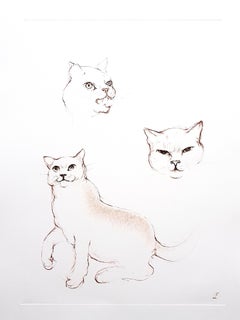
Leonor Fini - Cats - Original Etching
By Leonor Fini
Located in Collonge Bellerive, Geneve, CH
Leonor Fini - Cats - Original Engraving
Mme.Helvetius' Cats
Original etching created in 1985, Printed Signature (LF).
Conditions: excellent
Edition: 100
Support: Arches paper.
Dimensions: Paper dimensions: 44 x 28 cm
Editions: Moret, Paris.
Leonor Fini is considered one of the most important women artists of the mid-twentieth century, along with Leonora Carrington, Frida Kahlo, Meret Oppenheim, Remedios Varo, and Dorothea Tanning – most of whom Fini knew well. Her career, which spanned some six decades, included painting, graphic design, book illustration, product design (the renowned torso-shaped perfume bottle for Schiaparelli’s Shocking), and set and costume design for theatre, ballet, opera, and film. In this compellingly readable, exhaustively researched account, author Peter Webb brings Fini’s provocative art and unconventional personal life, as well as the vibrant avant-garde world in which she revolved, vividly in life.
Born in Buenos Aires in 1907 (August 30 – January 18, 1996, Paris) to Italian and Argentine parents, Leonor grew up in Trieste, Italy, raised by her strong-willed, independent mother, Malvina. She was a virtually self-taught artist, learing anatomy directly from studying cadavers in the local morgue and absorbing composition and technique from the Old Masters through books and visits to museums.
Fini’s fledging attempts at painting in Trieste let her to Milan, where she participated in her first group exhibition in 1929, and then to Paris in 1931.
Her vivacious personality and flamboyant attire instantly garnered her a spotlight in the Parisian art world and she soon developed close relationships with the leading surrealist writers and painters, including Paul Eluard, Salvador Dali, Man Ray, and Max Ernst, who became her lover for a time. The only surrealist she could not abide because of his misogyny was André Breton. Although she repeatedly exhibited with them, she never considered herself a surrealist. The American dealer Julien Levy,
very much impressed by Fini’s painting and smitten by her eccentric charms, invited her to New York in 1936, where she took part in a joint gallery exhibition with Max Ernst and met many American surrealists, including Joseph Cornell and Pavel Tchelitchew. Her work was included in MoMA’s pivotal Fantastic Art, Dada and Surrealism exhibition, along with De Chirico, Dali, Ernst, and Yves Tanguy.
In 1939 in Paris she curated an exhibition of surrealist furniture for her childhood friend Leo Castelli for the opening of his first gallery.
Introductions to her exhibition catalogues were written by De Chirico, Ernst, and Jean Cocteau.
A predominant theme of Fini’s art is the complex relationship between the sexes, primarily the interplay between the dominant female and the passive, androgynous male. In many of her most powerful works, the female takes the form of a sphinx, often with the face of the artist. Fini was also an accomplished portraitist; among her subjects were Stanislao Lepri...
Category
1980s Modern Geneva - Figurative Prints
Materials
Etching
Jacques Villon - Two Cubist Vases - Original Etching
By Jacques Villon
Located in Collonge Bellerive, Geneve, CH
Jacques Villon - Two Cubist Vases - Original Etching
1950
Signed in pencil
Edition of 40
Jacques Villon (1875 - 1963)
Jacques Villon was born Gaston Duchamp on July 31, 1875, in Da...
Category
1950s Modern Geneva - Figurative Prints
Materials
Etching
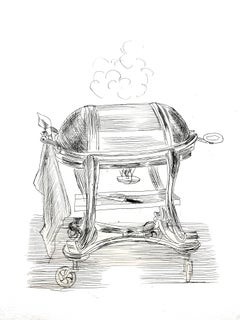
Raoul Dufy - Cuisine - Original Etching
By Raoul Dufy
Located in Collonge Bellerive, Geneve, CH
Raoul Dufy - Cuisine - Original Etching
Dimensions: 13 x 10".
Edition of 200
1940
Edition Les Bibliophiles du Palais, Paris
Unsigned and unumbered as issued
Category
1940s Modern Geneva - Figurative Prints
Materials
Etching
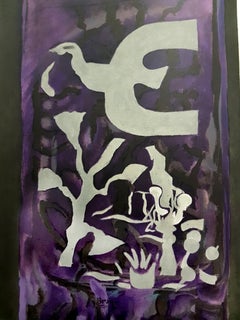
Lithograph after Georges Braque
Located in Collonge Bellerive, Geneve, CH
Lithograph after Georges Braque
From the deluxe art review, Derrière le Mirroir
1964
Printed signature
Dimensions: 38 x 28 cm
DLM No. 148, 1964
Edition: Foundation Maeght at Saint P...
Category
1960s Modern Geneva - Figurative Prints
Materials
Lithograph
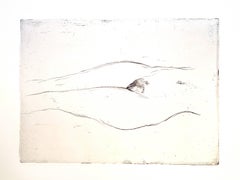
Jean Gabriel Domergue - Women
s Love - Original Etching
By Jean-Gabriel Domergue
Located in Collonge Bellerive, Geneve, CH
Original Etching by Jean-Gabriel Domergue
Dimensions: 33 x 25 cm
1924
Edition of 100
This artwork is part of the famous portfolio The Afternoon of a Faun.
Jean-Gabriel Domergue
Jea...
Category
1920s Impressionist Geneva - Figurative Prints
Materials
Lithograph
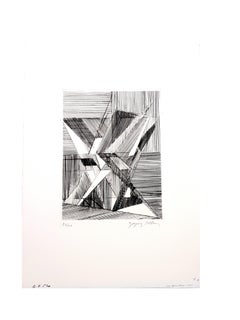
Valerio Adami - Original Lithograph
By Valerio Adami
Located in Collonge Bellerive, Geneve, CH
Valerio Adami - Original Lithograph
1976
Dimensions: 32 x 25 cm
Revue XXe Siècle
Edition: Cahiers d'art published under the direction of G. di San Lazzaro.
Valerio ADAMI was born ...
Category
1970s Abstract Geometric Geneva - Figurative Prints
Materials
Lithograph
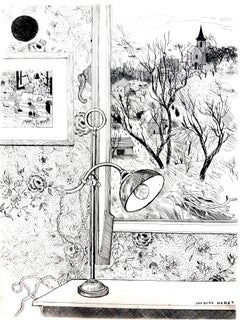
Jacques Maret - Dreamy Desk - Original Etching
Located in Collonge Bellerive, Geneve, CH
Jacques Maret - Dreamy Desk - Original Etching
Paris, Le Gerbier, 1946
Edition of 340
Jacques Maret was a French visual artist who was born in 1900. Several works by the artist have...
Category
1940s Modern Geneva - Figurative Prints
Materials
Etching
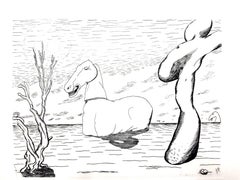
Roger Vieillard - Surrealist Horse - Original Etching
By Roger Vieillard
Located in Collonge Bellerive, Geneve, CH
Roger Vieillard - Surrealist Horse - Original Etching
Paris, Le Gerbier, 1946
Edition of 340
Roger Vieillard was born in Mans, France on February 9, 1907 and was classically educate...
Category
1940s Modern Geneva - Figurative Prints
Materials
Etching
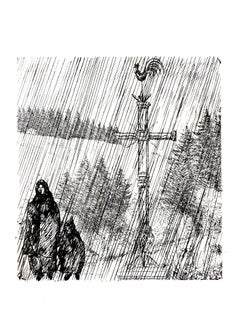
Jean Émile Laboureur - Under the Cross - Original Etching
By Jean-Emile Laboureur
Located in Collonge Bellerive, Geneve, CH
Jean Émile Laboureur - Under the Cross - Original Etching
Paris, Le Gerbier, 1946
Edition of 340
JEAN-ÉMILE LABOUREUR
Founder in 1923 of the Soci...
Category
1940s Modern Geneva - Figurative Prints
Materials
Etching
Edouard Goerg - Magic Jungle - Original Etching
By Edouard Goerg
Located in Collonge Bellerive, Geneve, CH
Edouard Goerg - Magic Jungle - Original Etching
Paris, Le Gerbier, 1946
Edition of 340
Edouard Joseph Goerg ‘Edouard Goerg’: Born of French parents Edouard Joseph Goerg left Austral...
Category
1940s Modern Geneva - Figurative Prints
Materials
Etching
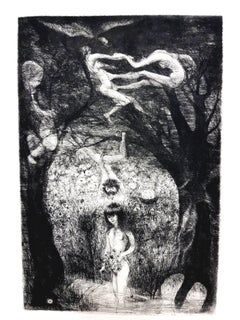
Leonor Fini - Surrealist Portraits - Handsigned Original Lithograph
By Leonor Fini
Located in Collonge Bellerive, Geneve, CH
Leonor Fini - Surrealist Portraits
Original Lithograph
Handsigned
Dimensions: 38 x 28 cm
Leonor Fini is considered one of the most important women artists of the mid-twentieth century, along with Leonora Carrington, Frida Kahlo, Meret Oppenheim, Remedios Varo, and Dorothea Tanning – most of whom Fini knew well. Her career, which spanned some six decades, included painting, graphic design, book illustration, product design (the renowned torso-shaped perfume bottle for Schiaparelli’s Shocking), and set and costume design for theatre, ballet, opera, and film. In this compellingly readable, exhaustively researched account, author Peter Webb brings Fini’s provocative art and unconventional personal life, as well as the vibrant avant-garde world in which she revolved, vividly in life.
Born in Buenos Aires in 1907 (August 30 – January 18, 1996, Paris) to Italian and Argentine parents, Leonor grew up in Trieste, Italy, raised by her strong-willed, independent mother, Malvina. She was a virtually self-taught artist, learing anatomy directly from studying cadavers in the local morgue and absorbing composition and technique from the Old Masters through books and visits to museums.
Fini’s fledging attempts at painting in Trieste let her to Milan, where she participated in her first group exhibition in 1929, and then to Paris in 1931.
Her vivacious personality and flamboyant attire instantly garnered her a spotlight in the Parisian art world and she soon developed close relationships with the leading surrealist writers and painters, including Paul Eluard, Salvador Dali, Man Ray, and Max Ernst, who became her lover for a time. The only surrealist she could not abide because of his misogyny was André Breton. Although she repeatedly exhibited with them, she never considered herself a surrealist. The American dealer Julien Levy,
very much impressed by Fini’s painting and smitten by her eccentric charms, invited her to New York in 1936, where she took part in a joint gallery exhibition with Max Ernst and met many American surrealists, including Joseph Cornell and Pavel Tchelitchew. Her work was included in MoMA’s pivotal Fantastic Art, Dada and Surrealism exhibition, along with De Chirico, Dali, Ernst, and Yves Tanguy.
In 1939 in Paris she curated an exhibition of surrealist furniture...
Category
1970s Modern Geneva - Figurative Prints
Materials
Lithograph
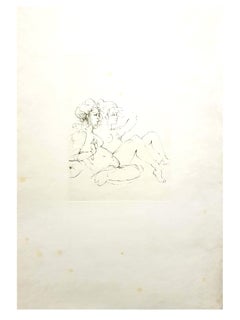
Le Goût de Bonheur: one plate
By (after) Pablo Picasso
Located in Collonge Bellerive, Geneve, CH
Artist: Pablo Picasso (after)
Medium: lithograph, Arches paper
Portfolio: Le Goût de Bonheur
Year: 1970
Edition: Total of 1998 copies (666 each in G...
Category
1960s Modern Geneva - Figurative Prints
Materials
Lithograph
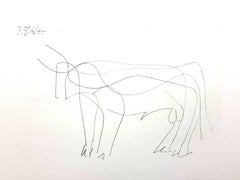
Alexander Calder - Original Lithograph - Behind the Mirror
By Alexander Calder
Located in Collonge Bellerive, Geneve, CH
Alexander Calder - Original Lithograph - Behind the Mirror
2 Original lithographs on the same paper (recto/verso, on both paper sides) produced in 1976
Conditions: Good Conditions
D...
Category
1970s Modern Geneva - Figurative Prints
Materials
Lithograph
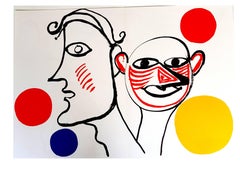
Alexander Calder - Original Lithograph - Behind the Mirror
By Alexander Calder
Located in Collonge Bellerive, Geneve, CH
Alexander Calder - Original Lithograph - Behind the Mirror
1 Original lithograph created in 1976
Framed
Dimensions: 38 x 28 cm
Source: Derrière le miroir (DLM), n°221, 1976
Alexand...
Category
1970s Modern Geneva - Figurative Prints
Materials
Lithograph
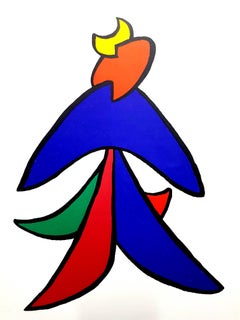
Max Ernst - The Soldier - Original Lithograph
By Max Ernst
Located in Collonge Bellerive, Geneve, CH
Max Ernst (1891-1976)
Georges Ribemont-Dessaignes, La Ballade du Soldat, Pierre Chave, Vence, 1972
Colour lithographs on Arches paper
1972
Edition : 199
Dimensions: 40 x 30 cm
Refe...
Category
1970s Modern Geneva - Figurative Prints
Materials
Lithograph
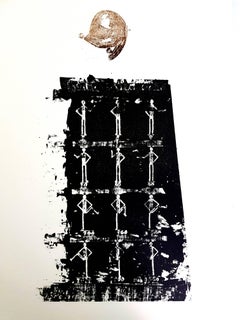
Le Goût de Bonheur: one plate (Croquis)
By (after) Pablo Picasso
Located in Collonge Bellerive, Geneve, CH
Artist: Pablo Picasso (after)
Medium: lithograph, Arches paper
Portfolio: Le Goût de Bonheur
Year: 1970
Edition: Total of 1998 copies (666 each in G...
Category
1960s Modern Geneva - Figurative Prints
Materials
Lithograph
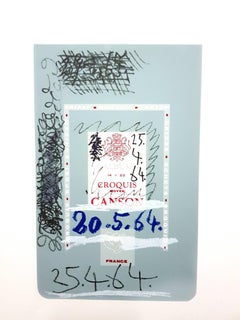
Max Ernst - The Soldier - Original Lithograph
By Max Ernst
Located in Collonge Bellerive, Geneve, CH
Max Ernst (1891-1976)
Georges Ribemont-Dessaignes, La Ballade du Soldat, Pierre Chave, Vence, 1972
Colour lithographs on Arches paper
1972
Dimensions: 40 x 30 cm
Reference: Spies &...
Category
1970s Modern Geneva - Figurative Prints
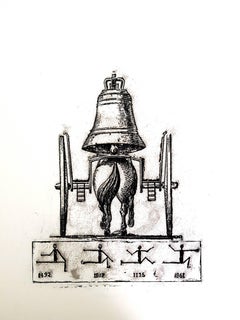
Max Ernst - The Soldier - Original Lithograph
By Max Ernst
Located in Collonge Bellerive, Geneve, CH
Max Ernst (1891-1976)
Georges Ribemont-Dessaignes, La Ballade du Soldat, Pierre Chave, Vence, 1972
Colour lithographs on Arches paper
1972
Dimensions: 40 x 30 cm
Reference: Spies &...
Category
1970s Modern Geneva - Figurative Prints
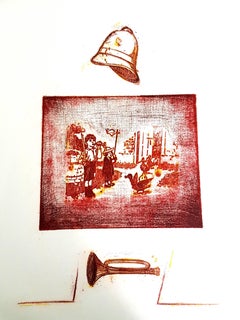
Jean Picart Le Doux - Sunshine - Original Salins Earthenware
By Jean Picart Le Doux
Located in Collonge Bellerive, Geneve, CH
Original Salins Earthenware Plate
Artist: Jean Picart Le Doux
Title: Sunshine
Signed in the back of the plate
Dimensions: Diameter: 24 cm
Edited by Salins Earthenware
Jean Picart le Doux, French (1902 - 1982)
Jean Picart Le Doux, born in Paris January 31, 1902 and died in 1982, was a French painter and painter-cartonnier the revival of contemporary tapestry.
He is the son of the painter Charles Picart Le Doux (1881-1959).
Without specialized training, he made his debut in bookbinding and publishing, and then he turned to advertising and graphic arts and publishing his first works in 1935. His first tapestry dating from 1943 after winning the Grand Prix of the theater poster exhibition in the imaging.
He met Jean Lurçat and, with Marc Saint-Saëns, gather around him in 1947 for the Association of painters cardboard tapestry.
In 1950, he projects the idea of the Alliance Graphique Internationale, during the meeting with exhibitors of an exhibition of their work in Basel, two other French designers Jean Jacques Colin and Nathan, and two graphic designers Swiss, Fritz Buhler and Donald Brown...
Category
1960s Modern Geneva - Figurative Prints
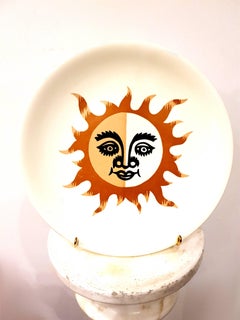
Max Ernst - The Soldier - Original Lithograph
By Max Ernst
Located in Collonge Bellerive, Geneve, CH
Max Ernst (1891-1976)
Georges Ribemont-Dessaignes, La Ballade du Soldat, Pierre Chave, Vence, 1972
Colour lithographs on Arches paper
1972
Dimensions: 40 x 30 cm
Reference: Spies &...
Category
1970s Modern Geneva - Figurative Prints
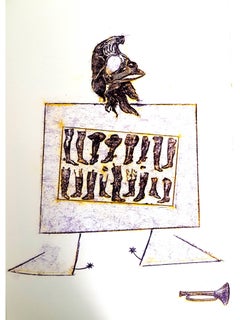
Le Gôut du Bonheur: one plate
By (after) Pablo Picasso
Located in Collonge Bellerive, Geneve, CH
Artist: Pablo Picasso (after)
Medium: lithograph, Arches paper
Portfolio: Le Goût de Bonheur
Year: 1970
Edition: Total of 1998 copies (666 each in German, French and English)
Sheet S...
Category
1970s Modern Geneva - Figurative Prints
Materials
Lithograph
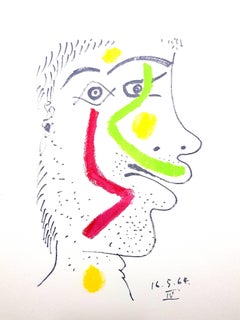
Max Ernst - The Soldier - Original Lithograph
By Max Ernst
Located in Collonge Bellerive, Geneve, CH
Max Ernst (1891-1976)
Georges Ribemont-Dessaignes, La Ballade du Soldat, Pierre Chave, Vence, 1972
Colour lithographs on Arches paper
1972
Dimensions: 40 x 30 cm
Reference: Spies &...
Category
1970s Modern Geneva - Figurative Prints
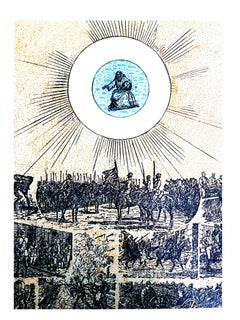
Bengt Lindstrom - Original Handsigned Engraving
By Bengt Lindström
Located in Collonge Bellerive, Geneve, CH
Bengt Lindström - Original Handsigned Engraving
The Seven Deadly Sins.
76 x 56 cm
Signed in pencil by Bengt Lindström
Paris, ABCD, 1976.
Original etching in color
Limited edition 90 ex.
This is the unique copy offered to Claude Manesse,
The story of B. Lindström was collected by Frederick Towarnicki, assisted by Agathe Malet-Buisson. The engravings were drawn on the presses of Claude Manesse.
Bengt Lindström (1925-2008)
Bengt Lindström was born on September 3rd, 1925 in Storsjökapell, a small isolated village in the Swedish province of Norrland. The young child thus grew up in that vast, mythical and harsh expanse of mounts, glistening lakes and endless forests known as Lapland. His father was a primary school teacher who was fond of Lapps and who showed great interest in their ethnic group and culture. The child was only three days old when Lapp King Kroik, his godfather, administered the Baptism of the Earth, where the child is conveyed between two roots of a tree to grant him protection from the Gods. Lapps as well as local lumberjacks would occasionally abandon their silent ways to tell him and reveal the tales, legends and mysteries of the Great White North.
1935-1945 : He left Storsjökapell and headed to Härnösand, where he wrote short science-fiction novellas, became a renowned athlete and began to paint.
1944-1946 : Isaac Grünewald Art School in Stockholm, Sweden. Study drawing with Aksel Jörgensen at the Copenhagen Fine Arts School in Denmark. He realized his first two lithographs, Meditation and Le Modèle Etendu (The Stretched Model).
1947-1952 : He arrived in Paris. He travelled to Italy, where he visited Florence and Assisi, developing a deep fascination for Giotto and Cimabue. He was granted a scholarship by Swedish magazine Aftontidningen, which helped him move into a workshop in Arcueil, France. He began working on mosaics.
1953-1967 : He returned to Paris, once again taking up lithography and engraving, which holds a vital position in his work. He moved into a workshop in Rueil-Malmaison. This was the start of his collaboration with the Rive Gauche Gallery in Paris. London Tooth
Sons Gallery Director M. Cochrane purchased a large number of his works. He left the workshop in Rueil-Malmaison to settle in Savigny-sur-Orge, France. He began taking to figurative art with Masks, Gods and Monsters. He exhibited with the Nouvelle Figuration Group at the Mathias Feld Gallery. He also began working with the Ariel Gallery in Paris.
1968-1978 : Lindström completed a series of 10 lithographs about Scandinavian mythology. He also completed a series of drypoint works. An association with the Protée Gallery in Toulouse, France, led to exhibitions at the Protée Gallery II in Paris starting in 1984. He executed a large mural painting the Grand Hotel in Härnösand, Sweden. He also made two large frescoes for the Nacksta-Sundsvall covered market in Sweden. He took to sharing his working time between the workshop in Savigny-sur-Orge and the one in Sundsvall. He began collaboration that was to last several years with the ABCD Gallery in Paris, which provided exclusive publication for his engravings and strong ink work. Les Hommes du Nord (Men of the North) was the first of the major tapestries. He published a boxed set album, Eddan, Eddan, Eddan, illustrating Scandinavian mythology. Together with Jacques Putman, he completed two editions of bronze sculptures, Les Enfants Sauvages (The Wild Children).
1979-1982 : He worked on glass, making thirty dishes and goblets for renowned Swedish glassmaker Kosta Boda. He painted a car for Volvo, Sweden’s leading car manufacturer. Then, close to his birthplace, he painted gigantic tarpaulins over forty metres high, covering the slopes of the neighbouring Våladalen Mountain, as a protest against the building of a dam. This action caused a sensation and provoked fierce reactions. He also created small painted papier mâché sculptures, Têtes (Heads), as well as some gold and silver jewellery.
1983 : He exhibited seven monumental 3x2.5m works at the Art and History Museum in Stockholm: Les Grands Dieux Ase (The Great Aesir Gods), depicting the gods from Scandinavian mythology: Thor, Odin, Frej, Balder, Ymer, Loki and Unknown God, as well as acrylic paintings about the Valkyries. Les Grands Dieux was ultimately exhibited in a purpose-built chapel adjoining the Midlanda Contemporary Arts Centre in 1996. He completed Thor’s Hammer, a monumental sculpture.
1985-1990 : He lived also in the Alicante region, where Spanish friends found him a new workshop. While there he completed Novelda, an album of lithographs featuring poems by Spanish poet Paco Pastor. He completed a new mural, 5mx5m, for the Västeras Science Institute in Sweden. He then started working with the San Carlo Gallery in Milan, Italy, which coordinated all of the Italian events. Major exhibitions and retrospectives were held in Italy, Belgium, Luxembourg, Germany and Spain. He created two boxed set albums, containing series of 10 aquatints, Monde Autre et Chamanes (Otherworld and Shamans), featuring poems by Michel Perrin.
1991-1994 : He went back to working in black and white, completing some very-large-format works. In Murano, in association with the San Carlo Gallery, he created Grands Verres (Large Glasses), a series of large vases and sculptures made of crystal. He painted Kåtan Mimi, an 8x9m Lapp tent, for the town of Arjeplog in Swedish Lapland. He completed a couple of 2m-high painted polyester sculptures, Lui et Elle (Him and Her). He then made a new series of crystal glasses and sculptures in Murano, Italy. He completed Présence (Presence), a new 3.5x2.7m tapestry for the municipality of Timrå, Sweden. He started on the Grands Initiés (Great Insiders) series, all large format and mixed black and white techniques. He finished the strong series about Norse gods.
1995-1996 : He moved into a new workshop in Paris. A retrospective was held at the Sundsvall Museum in Sweden, and on that occasion he painted a monumental 700-m² canvass, Le Géant sur la montagne (The Giant on the Mountain), which was hung all summer long on the mountain slope facing the town. He went on to complete a suite of six silkscreen prints on the same theme. Then he inaugurated the Y, a monumental sculpture. Lindström then completed Temps Zéro (Zero Time), a watch made for Swatch. One of his works, L’hiver (Winter), made the cover of the first 1996 issue of Telerama, the leading French weekly. In association with Sydkraft Sweden, he painted a fresco for the municipality of Örebro on a 17m-high tank with a surface area of 3,000 m², located at the crossroads of major Swedish motorways, by the entrance to the Åbyverket industrial estate. He also created a 6.5m-high Tången sculpture made of painted concrete in Ånge, which was inaugurated on September 3rd in the presence of their Majesties the King and Queen of Sweden.
1997-1999 : He began working on ceramics in Albisolla, Italy. He also completed a new 30m-high fresco for the town of Örebro, located close to the tank he had painted in 1996 near Åbyverket. The year saw the inauguration of the Midlanda Contemporary Arts Centre in Sweden, which harbours the collection of the Bengt and Michèle Lindström Foundation, featuring the entire engravings collection (about 800 works), as well as a selection of paintings and sculptures. He completed a 4x10m mural in the lobby of the University of Eskilstuna, Sweden, and also completed two monumental frescoes on the Akkats dam and a mural on the power station facing Jokkmokk in Swedish Lapland.
2000-2003 : He painted all of the sides of a semi-articulated lorry for Scania, Sweden’s main truck manufacturer. In Italy, he completed a new series of crystal sculptures with Adriano Bérengo. He finished the Great Prophets, a series of 2x2m oil on canvass works. Swiss publisher Ides et Calendes published a small but luxurious monograph, with text by Françoise Monnin. A notebook was also published, Le Visage dans l’Art de Bengt Lindström (Faces in the Art of Bengt Lindström). He completed a substantial series of large blue acrylic paintings, Femmes (Women).
2003 : Bengt fell ill and was unable to paint, but the exhibitions went on.
2004 : Saw the release of the film by Dag Jonzon and Hans Östbom, produced by Dell’arte AB and Östbom Filmbild, about the life of Bengt Lindström. Entitled Lindström - Le Diable de la couleur et de la forme (Lindström – The Colour and Form Devil), the film was produced thanks to support from Film Västernorrland, Länsstyrelsen Västernorrland and Sveriges Television. It was broadcast on Swedish television channels. That same year, the Midlanda Contemporary Arts Centre was closed as a result of municipal policy.
2005-2007 : The 6m-high sculpture Le Loup (The Wolf), made for PEAB, was inaugurated in Botkyrka-Stockholm. Lindström – The Colour and Form Devil was screened at the Paris Swedish Cultural Centre and released on DVD. The Michèle and Bengt Lindström Foundation was donated and transferred to the Länsmuseet i Västernorrland in Härnösand, Sweden, where a special room was prepared to host Les Grands Dieux Ase. Edition of the 1998 Ceramics, created in association with Francis Dellile’s ”La Tuilerie” workshop. The Bengt Lindström Collection was inaugurated at, Murberget, the Länsmuseet i Västernorrland in Härnösand, Sweden. He illustrated Sinfonietta för Juliana, a collection of poems by Italian poet and art critic Sebastiano Grasso. On January 29th, 2008, Bengt Lindström passed away at his home in Sweden.
2008-2012 : The Fondation Krimaro presents the first volume of the works of Bengt Lindström in his collection. Numerous exhibitions-tribute to the work are presented in major cities in Europe.
2012 : Retrospective - Black and White in the engravings - Museum of Härnösand, Murberget, Sweden.
Main exhibitions
1952 Fair Réalités Nouvelles – New realities, Paris, France.
1953 Craven Gallery, Paris, France.
1954 Gummeson Gallery, Stockholm, Sweden. Fair Salon d’Octobre, Paris, France.
1958 Breteau Gallery, Paris, France.
1959 Autour du Spontanéisme – Around the sontaneity, Stockholm, Sweden. L’Europe Nouvelle – The new Europe, LaUnited Statesnne, Switzerland.
1960 Rive Gauche Gallery, Paris, France.
1961 Tooth Gallery, London, England. Le Zodiaque Gallery, Brussels, Belgium. Fair Salon de Mai, Paris, France.
1962 Nouvelle Figuration – New Figuration , Mathias Fels Gallery, Paris, France,
1964 Nord-Sud – North-South, in several cities in Sweden. Ariel Gallery, Paris, France, 15 artists of my generation. Museum of Fine Arts in Gent, Belgium, Figuration-Défiguration – Figuration – Disfigurement.
1965 Rive Gauche Gallery. Paris, France. Nord Gallery, Lille, France. Birch Gallery, Copenhagen, Denmark.
1966 Museum of Modern Art, Gothenburg, Sweden.
1967 Veranneman Gallery, Brussels, Belgium. Carnegie Institute, Pittsburgh, United States. Seibu Gallery, Tokyo, Japan, 23 peintres in Paris.
1968 Ariel Gallery, Paris, France, followed by six exhibitions until 1976.
1969 La Pochade Gallery, Paris, France. Protée Gallery, Toulouse, France, who exhibited him in Paris, Gallery Protée II, from 1984.
1973 Galliera Museum, Paris, France.
1974 Gallery 111, Lisbon, Portugal.
1982 Gallery Protée-Arco, Madrid, Spain and Fair Foire de Cologne, Germany.
1983 Historia Museum, Stockholm, Sweden, The Ase gods and the Valkyries.
1984 Gallery Arcano XXI, Lisbon, Portugal. Gallery Christian Cheneau, Paris, France. Museum Château comtal, Carcassonne, France.
1985 Gallery Italia, Alicante, Spain.
1986 Gallery Sala Gaspar, Barcelona, Spain. Gallery Juan Mordo-Arco, Madrid, Spain. Gallery Italia, Alicante, Spain. Museum of Salamanca, Salamanca, Spain. Gallery Three Continents, New-York, United States. Gallery Protée, Toulouse France, Autour du Roi Lear – Around King Lear.
1987 Gallery Kostel, Paris, France. Gallery Zwirner, Cologne, Germany. Gallery Leu, Rottach-Egern, Germany.
1988 Maison du Lot, Figeac, France. Gallery Protée, Paris, France. Gallery Michèle Sadoun, Paris, France
1989 Gallery Michèle Sadoun, Paris, France, La terre des ancêtres - The Land pf the ancestors. Gallery Protée, Paris, France, Nomads. Gallery Raab, London, England.
1990 Gallery Michèle Sadoun, Paris, France. Centre Culturel de Brest, France.
1991 Gallery Michèle Sadoun, Paris, France.
1992 Archotèque, Saint-Denis, La Réunion, France. Museum of Vesoul, Vesoul, France. Gallery San Carlo, Milan, Italy.
1993 Gallery 111, Lisbon, Portugal. Tonnellerie du Cognac Monnet...
Category
1970s Modern Geneva - Figurative Prints
Materials
Engraving
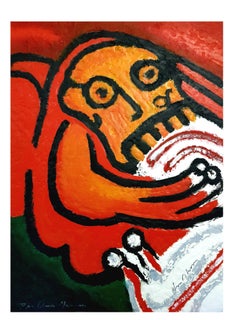
Antoni Clavé - Original Lithograph - For Pushkin
s Queen of Spades
By Antoni Clavé
Located in Collonge Bellerive, Geneve, CH
Antoni Clavé - Original Lithograph - For Alexander Pushkin's Queen of Spades
Dimensions: 325 x 247 mm.
1946
Original lithograph of Antoni Clavé
Editio...
Category
1940s Modern Geneva - Figurative Prints
Materials
Lithograph
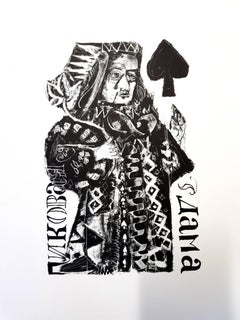
Antoni Clavé - Original Lithograph - For Pushkin
s Queen of Spades
By Antoni Clavé
Located in Collonge Bellerive, Geneve, CH
Antoni Clavé - Original Lithograph - For Alexander Pushkin's Queen of Spades
Dimensions: 325 x 247 mm.
1946
Original lithograph of Antoni Clavé
Edition: 300
The Queen of Spades. Tr...
Category
1940s Modern Geneva - Figurative Prints
Materials
Lithograph
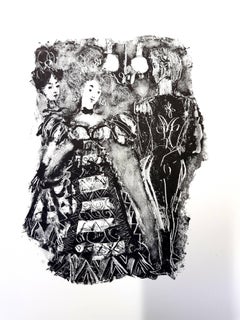
Jean Cocteau - Marine Mountains - Original Lithograph
By Jean Cocteau
Located in Collonge Bellerive, Geneve, CH
Jean Cocteau - Marine Mountains - Original Lithograph
Dimensions: 38 x 28 cm
Edition: 200
In Rives
From: COCTEAU. — VERDET (André). Montagnes marines. S. l. (Paris), Les Messagers du...
Category
1960s Modern Geneva - Figurative Prints
Materials
Lithograph
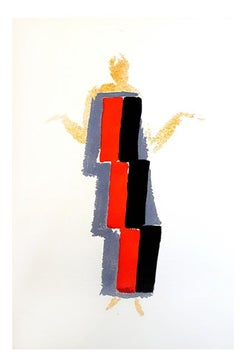
Living Painting - Colour Pochoir
By (after) Sonia Delaunay
Located in Collonge Bellerive, Geneve, CH
after Sonia Delaunay
Full-page, colour pochoir after costume designs by Sonia Delaunay
Edition 331/500 copies on Velin Aussedat
Dimensions: 28.5 x 19.5 cm.
From 27 Living Paintings. [Milano, Edizioni del Naviglio, 1969]. Jacques Damase. Robes Poèmes, Introduction. Text by Guillaume Apollinaire and Blaise Cendrars.
Sonia Delaunay was known for her vivid use of color and her bold, abstract patterns, breaking down traditional distinctions between the fine and applied arts as an artist, designer and printmaker.
Born Sarah Stern on November 14, 1885 in Gradizhsk, Ukraine, she was adopted in 1890 by her maternal uncle, Henri Terk, a lawyer in St. Petersburg, where she grew up, exposed to music and art, and learning several foreign languages. In 1903, she moved to Germany to study drawing with Ludwig Schmidt-Reutler (1863–1909) at the Karlsruhe academy of fine arts; Arnold Schoenberg (1874–1951), composer-to-be, was among her classmates there. In 1905, she traveled to Paris where she attended art classes at the Académie de la Palette, learned printmaking from Rudolf Grossman (1889–1941), and met Amédée Ozenfant (1886–1966), André Dunoyer de Segonzac (1884–1974), and Jean-Louis Boussingault (1883–1943). Sonia spent much of her time at exhibitions and galleries in Paris, which showed works by Paul Cézanne, Vincent Van Gogh, Pierre Bonnard, and Edouard Vuillard, as well as Les Fauves, Henri Matisse and André Derain. She did, however, maintain contact with Germany, exhibiting at the Galerie Der Sturm, Berlin, in 1913, 1920 and 1921.
During her first year in Paris, Sonia met the German collector and art-dealer, Wilhelm Uhde (1874–1947), whom she married on December 5, 1908, and whose Montparnasse gallery, the Galerie Notre-Dame des Champs, showed her first solo exhibition. Through Uhde, Sonia encountered many painters, including Pablo Picasso, Georges Braque, Maurice de Vlaminck, and Robert Delaunay (1885–1941). In 1910, Sonia divorced Uhde by mutual agreement, married Delaunay that same year, and gave birth to their son, Charles, in January 1911.
Together Sonia and Robert Delaunay pursued the study of color, influenced by theories of Michel-Eugène Chevreul (1786–1889). Sonia’s interest in simultaneous contrast, as evidenced in her early collages, book bindings, small painted boxes...
Category
1960s Abstract Geometric Geneva - Figurative Prints
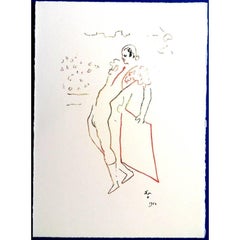
Jean Cocteau (after) - The Toreador - Lithograph
By Jean Cocteau
Located in Collonge Bellerive, Geneve, CH
Lithograph after a drawing by Jean Cocteau
Title: The Toreador
1971
Signed in the plate
Dimensions: 38 x 28 cm
Lithograph made for the portfolio "Gitans et Corridas" published by Soc...
Category
1960s Modern Geneva - Figurative Prints
Materials
Lithograph
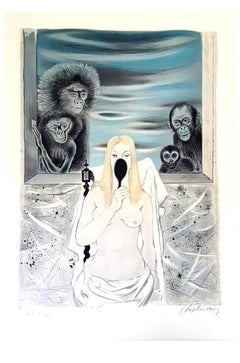
Roger Chapelain-Midy - Original Handsigned Lithograph - Ecole de Paris
By Roger Chapelain Midy
Located in Collonge Bellerive, Geneve, CH
Roger Chapelain-Midy
Original Handsigned Lithograph
Dimensions: 76 x 54 cm
Edition: HC XXI/XXX
HandSigned and Numbered
Ecole de Paris au seuil de la mutation des Arts
Sentiers Editi...
Category
1970s Modern Geneva - Figurative Prints
Materials
Lithograph
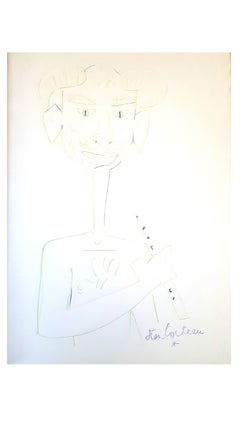
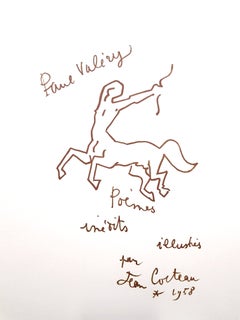
Jean Cocteau - For Paul Valery - Original Lithograph
By Jean Cocteau
Located in Collonge Bellerive, Geneve, CH
Original Lithograph by Jean Cocteau
Title: Paul Valery Poems
Signed in the plate
Dimensions: 32 x 25.5 cm
Edition: 200
1959
Publisher: Bibliophiles Du Palais
Unnumbered as issued
Category
1950s Modern Geneva - Figurative Prints
Materials
Lithograph
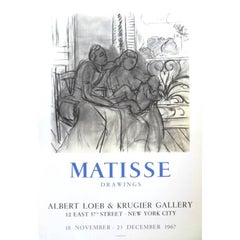
Vintage Exhibition Poster - "Henri Matisse - Drawings - New-York"
By (after) Henri Matisse
Located in Collonge Bellerive, Geneve, CH
Vintage Exhibition Poster - Henri Matisse - Drawings - New-York
after Henri MATISSE
1967
75 x 52 cm
References : Poster for the 1967 exhibition at Albert LOEB & KRUGIER Gallery in N...
Category
1960s Modern Geneva - Figurative Prints
Materials
Lithograph
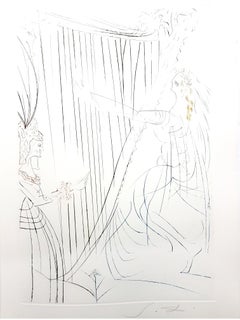
Salvador Dali - Queen Iseult and her daughter
By Salvador Dalí
Located in Collonge Bellerive, Geneve, CH
Salvador Dali - Queen Iseult and her daughter - Original Etching
Dimensions: 45 x 33 cm
Edition: 125
1970
Signed in pencil.
On Arches Vellum
References : Field 70-10 (p. 60-61)
Category
1970s Surrealist Geneva - Figurative Prints
Materials
Etching
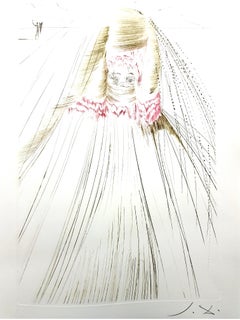
Salvador Dali - The Queen with Silk Tunic
By Salvador Dalí
Located in Collonge Bellerive, Geneve, CH
Salvador Dali - The Queen with Silk Tunic - Original Etching
Dimensions: 45 x 33 cm
Edition: 125
1970
Signed in pencil.
On Arches Vellum
References : Field 70-10 (p. 60-61)
Category
1970s Surrealist Geneva - Figurative Prints
Materials
Etching
Eduardo Arroyo - French Freedom - Original Lithograph
By Eduardo Arroyo
Located in Collonge Bellerive, Geneve, CH
Eduardo Arroyo - French Freedom - Original Lithograph
1984
Conditions: excellent
Edition: 495
Dimensions: 37,3 x 58 cm
Editions: Trinckvel
Category
1980s Modern Geneva - Figurative Prints
Materials
Lithograph
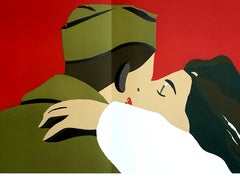
Leonor Fini - The Cane - Original Handsigned Lithograph
By Leonor Fini
Located in Collonge Bellerive, Geneve, CH
Leonor Fini - The Cane - Original Handsigned Lithograph
Les Elus de la Nuit
1986
Conditions: excellent
Handsigned and Numbered
Edition: 230
Dimensions: 38 x 2...
Category
1980s Modern Geneva - Figurative Prints
Materials
Lithograph
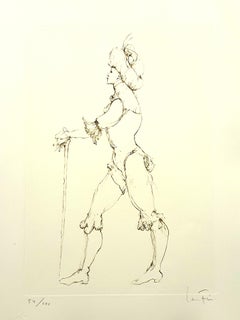
Leonor Fini - Thinking - Original Lithograph
By Leonor Fini
Located in Collonge Bellerive, Geneve, CH
Leonor Fini - Thinking - Original Lithograph
The Flowers of Evil
1964
Conditions: excellent
Edition: 500
Dimensions: 46 x 34 cm
Editions: Le Cercle du Livre Précieux, Paris
Unsigne...
Category
1960s Modern Geneva - Figurative Prints
Materials
Lithograph
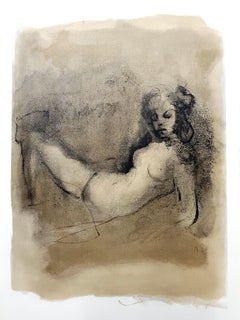
Leonor Fini - Rejection - Original Lithograph
By Leonor Fini
Located in Collonge Bellerive, Geneve, CH
Leonor Fini - Rejection - Original Lithograph
The Flowers of Evil
1964
Conditions: excellent
Edition: 500
Dimensions: 46 x 34 cm
Editions: Le Cercle du Livre Précieux, Paris
Unsign...
Category
1960s Modern Geneva - Figurative Prints
Materials
Lithograph
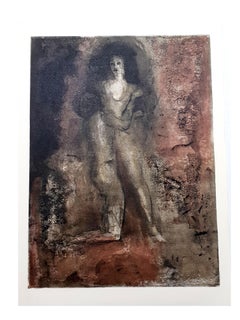
Jacques Villon - Woman - Original Etching
By Jacques Villon
Located in Collonge Bellerive, Geneve, CH
Jacques Villon - Woman - Original Etching
Circa 1949
Signed in pencil and numbered
Dimensions : 34.8 x 25 cm
Category
1940s Modern Geneva - Figurative Prints
Materials
Etching
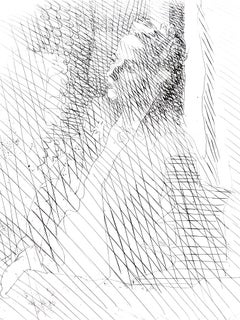
Leonor Fini - Red-Haired Girl - Original Lithograph
By Leonor Fini
Located in Collonge Bellerive, Geneve, CH
Leonor Fini - Red-Haired Girl - Original Lithograph
The Flowers of Evil
1964
Conditions: excellent
Edition: 500
Dimensions: 46 x 34 cm
Editions: Le Cercle du Livre Précieux, Paris
...
Category
1960s Modern Geneva - Figurative Prints
Materials
Lithograph
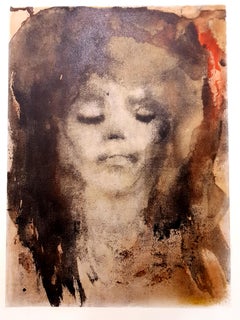
Eduardo Arroyo - Resistance in the Snow - Original Lithograph
By Eduardo Arroyo
Located in Collonge Bellerive, Geneve, CH
Eduardo Arroyo - Resistance in the Snow - Original Lithograph
1984
Conditions: excellent
Edition: 495
Dimensions: 37,3 x 58 cm
Editions: Trinckvel
Category
1980s Modern Geneva - Figurative Prints
Materials
Lithograph

Jacques Villon - Nude - Original Etching
By Jacques Villon
Located in Collonge Bellerive, Geneve, CH
Jacques Villon - Nude - Original Etching
1947
Signed in pencil and numbered
Dimensions : 55.6 x 39.5 cm
Category
1940s Modern Geneva - Figurative Prints
Materials
Etching
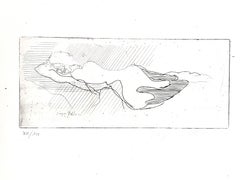
André Derain - Ovid
s Heroides - Original Etching
By André Derain
Located in Collonge Bellerive, Geneve, CH
André Derain - Ovid's Heroides
Original Etching
Edition of 134
Dimensions: 32 x 25 cm
Ovide [Marcel Prevost], Héroïdes, Paris, Société des Cent-une, 1938...
Category
1930s Modern Geneva - Figurative Prints
Materials
Etching
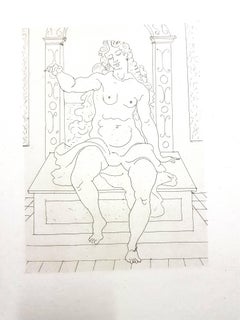
Raoul Dufy - Farm Pigs - Original Etching
By Raoul Dufy
Located in Collonge Bellerive, Geneve, CH
Raoul Dufy - Farm Pigs - Original Etching
Dimensions: 13 x 10".
Edition of 200
1940
Edition Les Bibliophiles du Palais, Paris
Unsigned and unumbered as issued
Category
1940s Modern Geneva - Figurative Prints
Materials
Etching
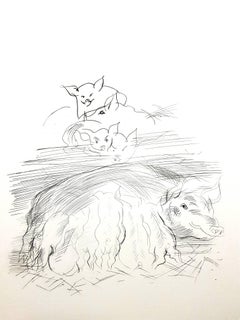
Georges Braque - Original Lithograph
By Georges Braque
Located in Collonge Bellerive, Geneve, CH
Georges Braque - Original Lithograph
1963
Dimensions: 32 x 24 cm
Andre Sauret, Monte Carlo
The father of Cubism
Three Cubist that distinguishes art historian periods were initiated and developed by Georges Braque: The Cubist Cézanne (1907-1909), Executive (1909-1912) and synthetic (1912-1922).
Post-Impressionist and fawn, Braque no longer adheres to the contingency of a decorative way or the other. Cézanne’s paintings exhibited at the Grand Palais during the retrospective of 1907 are a revelation: Cézanne sought and invented a pictorial language. In his footsteps, Braque went to the South with the reasons of the Master. He returned with Estaque landscapes and surprising Ciotat it keeps Cezanne geometric model and retains the “passages” continuity from one surface to another to create the sensation of “turning around” of the object represented. But he wants to go after the consequences of the vision of Cezanne. In his paintings Houses in L’Estaque (1908) it simplifies the volumes of houses, neglects detail by removing doors and windows: the plastic rhythm that builds the table. Large Nude , a masterpiece of the period, can be considered the first work of Cézanne cubism .
Systematizing and deepening Braque discoveries open the door analytical cubism. In 1909, his painting became more cerebral than sensual. The pattern is recreated in the two-dimensionality of the canvas, leaving aside any illusionistic perspective. In Still Life with Violin, objects are analyzed facets according to their characteristic elements, each facet referring to a particular view of the object. There are so many facets of points selected view: Table reflects the knowledge of the object and the ubiquity of the eye. Moreover, Braque is looking for the essence of the objects in the world rather than their contingency, which explains the absence of light source and use of muted colors (gray, ocher), contingent aspects of the object . But formal logic has stepped facets, erased any anecdote to the object and ultimately led to his painting a hermetic more marked on the edge of abstraction (see the series of Castle Roche-Guyon ).
Braque, anxious to keep the concrete and refusing at all costs that the logic of Cubism takes the paintings to abstract, reintroduced signs of reality in his paintings in 1912 marks the beginning of Synthetic Cubism. Historians speak of “signs of real” rather than reality because what interests Braque, this is not to put reality into a table, but to create a painting which, by its language, refers to the real. To do this, he invented two major techniques XX th century inclusions and contributions. The inclusions consist of painting objects that have no real depth, materials (wallpaper in Nature morte aux playing cards faux wood is a pictorial inclusion) or letters (calligraphic inclusion in Portuguese ), made first brush and a few months later stencil. Contributions are defined in contrast with the collage on canvas of foreign materials: glued or sand paper, sawdust, etc.. Regarding the collages, Braque used for the first time in September 1912 a piece of adhesive paper imitating faux wood Compote and Glass , then the packet envelope of tobacco Bock in 1912-1913, or an advertisement in Damier , 1913). Inputs and inclusions refer to an external object in the table, without “emulate” this object. Away from their appearances, objects are represented in closest essence of the objects in the real world sense.
This is also the time of Synthetic Cubism that Braque invented paper sculpture. There are, unfortunately, and no one is living proof of a photograph makes it possible to realize: Paper and paperboard.
Métamorphoses period(1961-1963).
In 1961, Georges Braque worked on a Greek head for the Louvre, which obsesses him, and he wishes to free his mind. He tried several times to bring out the paint and the result was unsatisfactory. He thinks the ultimate metamorphosis its Greek head projected in three dimensions. He calls in his studio of Baron Heger Loewenfeld, master lapidary, and he communicates his enthusiasm during the “fateful encounter.” Nine months later, in honor of the eighty years of Georges Braque, Heger Loewenfeld offers the Master of the ring Circe: the famous Greek head finally exorcised, carved in an onyx. Braque Loewenfeld then asked to identify other issues that haunt him.
From dated and signed by Georges Braque, Heger gouaches Loewenfeld shapes works in the fields of jewelery, lapidary art...
Category
1960s Modern Geneva - Figurative Prints
Materials
Lithograph
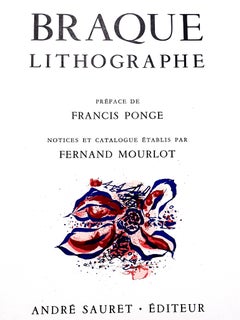
(after) Max Ernst - Blue Bird - Stencil
By (after) Max Ernst
Located in Collonge Bellerive, Geneve, CH
Max Ernst (after) - Blue Bird - Stencil
Published in the deluxe art review, XXe Siecle, 1958
Dimensions: 32 x 25 cm
Publisher: G. di San Lazzaro.
Max Ernst was born in Bruhl, a place near Cologne, in Germany. He was raised in a strict Catholic family, and both of his parents were disciplinarians who were dedicated to training their children into God-fearing and talented individuals. Although his father was deaf, Ernst learned so much from him, particularly when it comes to painting. In fact, much of his early years were lived under the inspiration of his father who was also a teacher. He was the one who introduced painting to Ernst at an early age.
In 1914, Ernst attended the University of Bonn where he studied philosophy. However, he eventually dropped out of school because he was more interested in the arts. He claimed that his primary sources of interest included anything that had something to do with painting. Moreover, he became fascinated with psychology, among other subjects in school.
Primarily, Ernst's love for painting was the main reason why he became deeply interested with this craft and decided to pursue it later on in his life. During his early years, he became familiar with the works of some of the greatest artists of all time including Claude Monet, Paul Cezanne and Vincent van Gogh. He was also drawn to themes such as fantasy and dream imagery, which were among the common subjects of the works of Giorgio de Chirico.
During World War I, Ernst was forced to join the German Army, and he became a part of the artillery division that exposed him greatly to the drama of warfare. A soldier in the War, Ernst emerged deeply traumatized and highly critical of western culture. These charged sentiments directly fed into his vision of the modern world as irrational, an idea that became the basis of his artwork. Ernst's artistic vision, along with his humor and verve come through strongly in his Dada and Surrealists works; Ernst was a pioneer of both movements.
It was Ernst's memories of the war and his childhood that helps him create absurd, yet interesting scenes in his artworks. Soon, he took his passion for the arts seriously when he returned to Germany after the war. With Jean Arp, a poet and artist, Ernst formed a group for artists in Cologne. He also developed a close relationship with fellow artists in Paris who propagated Avant-Garde artworks.
In 1919, Ernst started creating some of his first collages, where he made use of various materials including illustrated catalogs and some manuals that produced a somewhat futuristic image. His unique masterpieces allowed Ernst to create his very own world of dreams and fantasy, which eventually helped heal his personal issues and trauma. In addition to painting and creating collages, Ernst also edited some journals. He also made a few sculptures that were rather queer in appearance.
In 1920s, influenced by the writings of psychologist Sigmund Freud, the literary, intellectual, and artistic movement called Surrealism sought a revolution against the constraints of the rational mind; and by extension, they saw the rules of a society as oppressive. Surrealism also embraces a Marxist ideology that demands an orthodox approach to history as a product of the material interaction of collective interests, and many renown Surrealism artists later on became 20th century Counterculture symbols such as Marxist Che Guevara. In 1922 Ernst moved to Paris, where the surrealists were gathering around Andre Breton. In 1923 Ernst finished Men Shall Know Nothing of This, known as the first Surrealist painting. Ernst was one of the first artists who apply The Interpretation of Dreams by Freud to investigate his deep psyche in order to explore the source of his own creativity. While turning inwards unto himself, Ernst was also tapping into the universal unconscious with its common dream imagery.
Despite his strange styles, Ernst gained quite a reputation that earned him some followers throughout his life. He even helped shape the trend of American art during the mid-century, thanks to his brilliant and extraordinary ideas that were unlike those of other artists during his time. Ernst also became friends with Peggy Guggenheim, which inspired him to develop close ties with the abstract expressionists.
When Ernst lived in Sedona, he became deeply fascinated with the Southwest Native American navajo art. In fact, the technique used in this artwork inspired him and paved the way for him to create paintings that depicted this style. Thus, Ernst became a main figure of this art technique, including the rituals and spiritual traditions included in this form of art. Pollock, aside from the other younger generations of abstract expressionists, was also inspired by sand painting of the Southwest...
Category
1950s Surrealist Geneva - Figurative Prints
Materials
Stencil
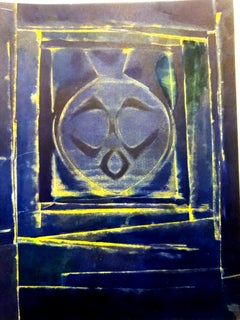
Hermine David - Workers - Original Etching
By Hermine David
Located in Collonge Bellerive, Geneve, CH
Hermine David - Workers - Original Etching
Paris, Le Gerbier, 1946
Edition of 340
Signed in the plate
Category
1940s Modern Geneva - Figurative Prints
Materials
Etching
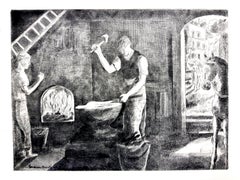
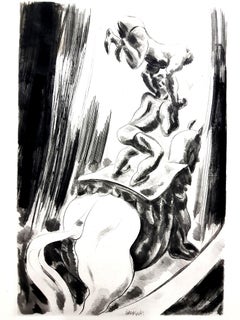
Jean Gabriel Daragnès - Circus - Original Etching
By Jean Gabriel Daragnès
Located in Collonge Bellerive, Geneve, CH
Jean Gabriel Daragnès - Circus - Original Etching
Paris, Le Gerbier, 1946
Edition of 340
Jean-Gabriel Daragnes, French (1886 - 1950)
Daragnes
Jean-Gabriel Daragnès was highly regar...
Category
1940s Modern Geneva - Figurative Prints
Materials
Etching
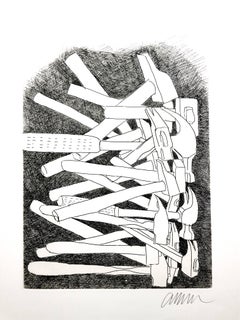
Arman - Accumulations - Original Signed Etching
By Arman
Located in Collonge Bellerive, Geneve, CH
Arman - Accumulations - Original Signed Etching
Title: Accumulations
Signed
Dimensions: 57 x 38 cm
1980s
Arman
Armand Pierre Fernandez was ...
Category
1990s Realist Geneva - Figurative Prints
Materials
Etching
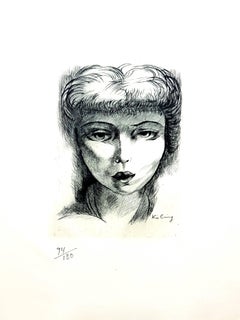
Moise Kisling - Woman - Etching
Located in Collonge Bellerive, Geneve, CH
Moise Kisling - Woman
Etching
Edition of 130
Dimensions: 38 x 28 cm
Moïse Kisling, born Mojżesz Kisling (January 22, 1891 – April 29, 1953), was a Polish-born French painter.[1] He...
Category
1970s Modern Geneva - Figurative Prints
Still Thinking About These?
All Recently ViewedMore Ways To Browse
Annette Ollivary
Annika Tucksmith
Anthony Alonso
Anthony Brunelli
Anthony Gibbs On Sale
Anthony Rickards On Sale
Antique Fishing Pole
Antique Orchard Painting
Antique Original Paintings Boston
Antique Peddlers Cart
Antique Pioneer Wagons
Antique Sexton
Antique Sock Stretchers
Ariane Wyss
Armand Fouquet
Arthur Maynard
Arthur Prince Spear
Artist Alan King