Japan - Paintings and Screens
to
5
268
1,108
400
217
50
1
22
1
22
67
128
51
37
13
12
1
1
7
1
12
6
3
143
132
100
76
65
254
244
240
3
1
268
265
266
26
2
1
1
1
Item Ships From: Japan
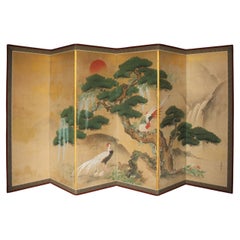
B2 Japanese Antiques Kano School, 6panel folding screen, Pine Tree and Pheasant
Located in Niiza, JP
Material: Paper, Wooden Frame
Single: W600×H1760mm
Unfolded Size: W3640mm 12kg
Folded Size: W620×H1760×D100mm
Estimated packaging (sandwiched with 5-10mm plywood):
21cm x 72cm x 18...
Category
19th Century Japanese Antique Japan - Paintings and Screens
Materials
Paper
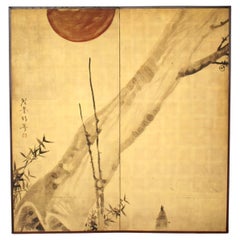
JapaneseAntiques Terasaki kogyo, Gold background, Bamboo and plum folding screen
Located in Niiza, JP
material: paper and cloth
Unfolded size: 1600 x 1660 mm
Can be folded in half: 800 x 1660 mm, 6 kg
Estimated packing size: (Sandwich with 12mm plywood)
10 × 95 × 185cm 30kg
A bold ...
Category
20th Century Japan - Paintings and Screens
Materials
Paper
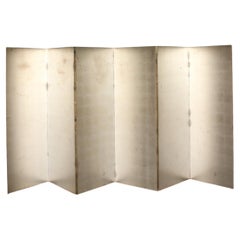
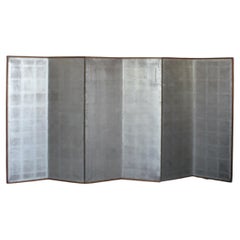
B22 Japanese Antiques 6panels, Silver Paper, folding Screen, black edge
Located in Niiza, JP
Silver foil folding screen
Material: Paper pasted on wooden frame
1 piece: Width 595 x Height 1740 x Depth 18 mm
Expanded size: Width 3610 mm
Folded size: Width 615 x Height 1740 x D...
Category
20th Century Japanese Japan - Paintings and Screens
Materials
Paper
Large Collotype Print by Ryunosuke Fukui
from "Maiko" Series
- print no 3
Located in Fukuoka, JP
A large print created by Ryunosuke Fukui, a highly acclaimed modernist artist from Japan who lived between 1923 and 1986. Fukui's art has been exhibited in many prestigious museums a...
Category
20th Century Showa Japan - Paintings and Screens
Materials
Other

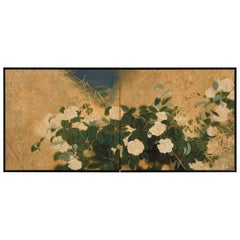
Circa 1925. Taisho era Japanese Nihonga Screen. Camellia
Bamboo.
Located in Kyoto, JP
Anonymous
Camellia & Bamboo
Taisho era
Two-panel Japanese Screen. Mineral pigment, gofun and ink on silk.
A small Japanese Nihonga screen capturing...
Category
Early 20th Century Japanese Taisho Japan - Paintings and Screens
Materials
Silk
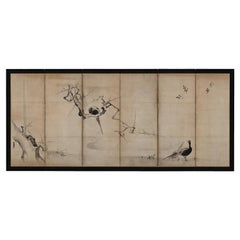
17th Century Japanese Screen. Ink Plum Tree
Birds by Kano Naonobu.
Located in Kyoto, JP
Kano Naonobu (1607-1650)
Plum Tree and Birds
Six-fold Japanese Screen. Ink and slight color on paper.
In this evocative ink work spread over a six-panel folding screen, we see the consummation of the elegance and refinement of the Edo Kano school. This 17th century screen is a rare surviving example of a large-scale bird and flower painting by Kano Naonobu, the younger brother of Kano Tanyu...
Category
17th Century Japanese Edo Antique Japan - Paintings and Screens
Materials
Wood, Paper
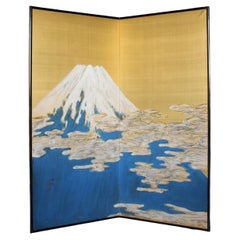
B89 Japanese Painting Art, Mount Fuji Goldback Screen Byobu, 2-panels
Located in Niiza, JP
One piece: W690×H1500mm×D20mm,
Unfolded size: W1380mm
Folded size: W690×H1500×D35mm, 5kg
Estimate packing size: (sandwiched with 5-10mm plywood): 10cm x 75cm x 157cm, 19kg
Painted b...
Category
20th Century Japanese Japan - Paintings and Screens
Materials
Paper
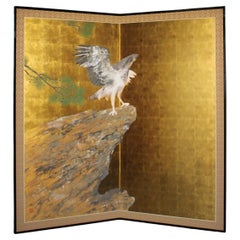
B86 Japanese Painting Art, Hawk, Gold Screen Byobu, 2-panels
Located in Niiza, JP
Material: Gold Paper on wooden frame
One piece: W900×H1760mm×D20mm,
Unfolded size: W1800mm
Folded size: W900×H1760×D40mm, 6kg
Estimate packing size: (sandwiched with 5-10mm plywood):...
Category
20th Century Japanese Japan - Paintings and Screens
Materials
Paper
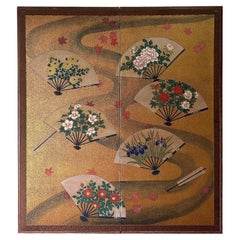
Dancing Fans of the Seasons
Located in Fukuoka, JP
In Japanese art, folding fans (ōgi) are symbols of prosperity and the unfolding path of life, as their shape widens outward like a journey toward new horizons. Each fan on this scree...
Category
20th Century Japanese Showa Japan - Paintings and Screens
Materials
Wood, Paper
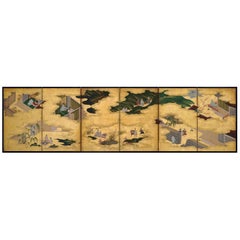
Japanese Screen Painting, Circa 1700
Tales of Ise
by Tosa Mitsusuke
By Tosa Mitsusuke 1
Located in Kyoto, JP
A six-fold Japanese screen by Tosa Mitsusuke (1675-1710), Japan 17th-18th century, Edo period.
The signature reads Shoroku-i ge Tosa sa Konoe Shogen Mit...
Category
Late 17th Century Japanese Edo Antique Japan - Paintings and Screens
Materials
Gold Leaf
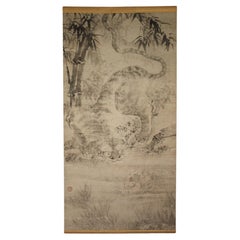
K25 Japanese Antiques A large hanging scroll, Tiger Ink on paper painted
Located in Niiza, JP
Ink on paper, Scroll head: wood
Image size: 860(W) x 1670(H) [mm]
Scroll mounting: 1030(W) x 2220(H) [mm]
Box size: 90(W) x 90(H) x 1140(D) [mm] 2kg
Estimated packing size: 150(W) x...
Category
19th Century Japanese Antique Japan - Paintings and Screens
Materials
Fabric, Paper
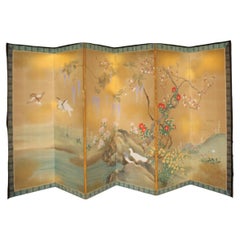
B10 Japanese Antiques 6panels, Paper, folding Screen with Flower & bird painting
Located in Niiza, JP
Flower and bird painting
Material: Paper on wooden frame, colored
One piece: W660×H1825mm×D20mm,
Unfolded size: W3860mm, 16kg
Folded size: W660×H1825×D110mm
Packaging (sandwiched wit...
Category
19th Century Japanese Antique Japan - Paintings and Screens
Materials
Paper
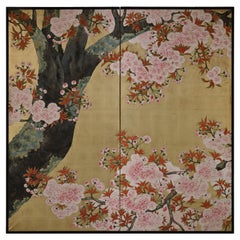
Early 20th Century Japanese Cherry Blossom Screen by Kano Sanrakuki
Located in Kyoto, JP
Cherry Blossoms
Kano Sanrakuki (1898-1981)
Showa period, circa 1930
2-panel Japanese Screen
Color, gofun and gold leaf on paper
Against a backdrop of gold-leafed ground, the lichen covered trunk and branches of the life-sized cherry blossom tree reach out and beyond the confines of the pictorial surface. The overall composition has a feeling of flatness which draws emphasis to the surface and the three-dimensionality of the cherry blossoms. Painstakingly built-up layers of thickly applied shell-white gofun detail the voluminous blossoms and cover large areas of this tour-de-force of Japanese Nihonga painting. By simplifying the background, minimizing the number of colors and depicting the blossoms with such heavy relief, the artist has emphasized the stunning presence of the cherry tree. The type of tree depicted is the Yae-Zakura; a double-layered type of cherry blossom famed for its beauty and strength. When we think of Japanese cherry blossoms, the first thing that comes to mind is Somei Yoshino variety, which has a single flower with five almost white petals. This type is fragile and easily blown away by strong wind or rain. Most of the double-flowered cherry blossoms begin to bloom when the Somei-Yoshino falls, and the flowering period lasts longer than that of the Somei-Yoshino.
Kano Sanrakuki originally studied painting at the Kyoto City Arts and Crafts School under the tutelage of Yamamoto Shunkyo...
Category
Early 20th Century Japanese Showa Japan - Paintings and Screens
Materials
Gold Leaf
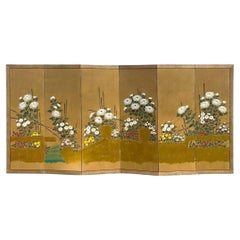
Garden of Chrysanthemums
Located in Fukuoka, JP
Against a shimmering golden background, chrysanthemums bloom in white, crimson, and yellow — flowers that in Japanese culture symbolize longevity, nobility, and the eternal cycle of ...
Category
Late 19th Century Japanese Meiji Antique Japan - Paintings and Screens
Materials
Gold Leaf

$3,430
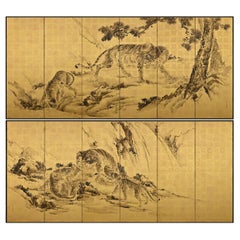
Japanese Screen Pair, Tigers by Kishi Renzan, Late Edo Period
Located in Kyoto, JP
Kishi Renzan (1804-1859)
Tigers
Pair of six-panel Japanese screens.
Ink and gold-leaf on paper.
In this monochromatic pair of six-fold Japanese screens painted on gold-leaf, Kishi Renzan has created a breathtaking composition of a family of tigers. The screens are filled with a sense of drama which is conveyed by both the subject matter and the wet, expressive brushwork. The running mountain stream and the towering waterfall allude to refreshment during the summer months and we feel the tiger families familiarity and security within their environment. Renzan’s master, Kishi Ganku...
Category
Mid-19th Century Asian Edo Antique Japan - Paintings and Screens
Materials
Gold Leaf
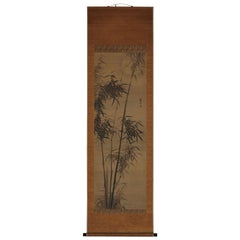
Japanese Painting, Hanging Scroll, 19th Century Bamboo in Moonlight
Located in Kyoto, JP
Bamboo in moonlight
Gamo Rakan (1784-1866)
Hanging scroll, ink on silk.
Dimensions:
Scroll: 201 cm x 58 cm
Image: 137 cm x 45 cm
In this early 19th century work by Gamo Rakan a light ink wash applied to the silk background silhouettes the moon and suggests the atmosphere of early evening. Even though it is a literati subject, Rakan’s bamboo is quite realistic with a strong decorative style. The painting finds its inspiration from Chinese Ming dynasty painters who often used a single-tone, jet black stroke to emphasize the calligraphic nature of bamboo.
In a different era, decorative would have been seen as somewhat unrefined. But increasingly in the Edo period, it was the hallmark of high style. The Japanese people, in particular the rising merchant class, had gradually become apathetic toward the traditional Sesshu and Kano schools of painting. Chinese professional and amateur painters living in the port of Nagasaki during the 18th century had a profound effect on Japanese painting and the freshness of their style and its decorative appeal contributed greatly to its popularity. Gamo Rakan’s teacher, Tani Buncho...
Category
Early 19th Century Japanese Edo Antique Japan - Paintings and Screens
Materials
Silk
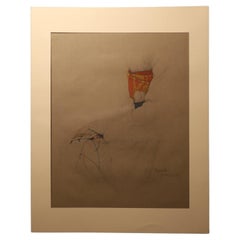
Large Collotype Print by Ryunosuke Fukui
from "Maiko" Series
- print no 10
Located in Fukuoka, JP
A large print created by Ryunosuke Fukui, a highly acclaimed modernist artist from Japan who lived between 1923 and 1986. Fukui's art has been exhibited in many prestigious museums a...
Category
20th Century Showa Japan - Paintings and Screens
Materials
Other
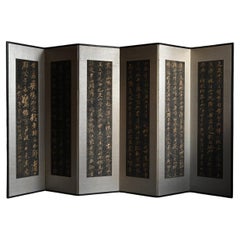
Old Japanese woodblock print folding screen/room partition/object
Located in Sammu-shi, Chiba
This is a woodblock-printed folding screen made in Japan during the Showa period, featuring writings by a Chinese calligrapher.
It is a passage from a story written by a famous Chin...
Category
20th Century Japanese Showa Japan - Paintings and Screens
Materials
Paper
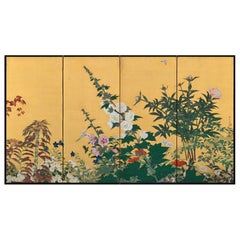
Early 20th Century Japanese Screen. Flowers of the Four Seasons.
Located in Kyoto, JP
Anonymous
Flowers of the Four Seasons
A four-panel Japanese screen. Ink, gofun and pigments on gold leaf.
This Japanese screen is a rich visual celebration of the flowers of the fo...
Category
Early 20th Century Japanese Taisho Japan - Paintings and Screens
Materials
Gold Leaf
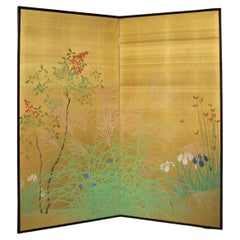
B36 Japanese Antiques Gold background flowers folding screen, 2-panel
Located in Niiza, JP
Material: Paper & Silk-like fabric, wooden frame
1 piece: Width 760 x Height 1520 x Depth 20 mm
Expanded size: Width 1520 mm
Folded size: Width 760 x Height 1520 x Depth 40 mm, weigh...
Category
20th Century Japanese Japan - Paintings and Screens
Materials
Silk, Paper
B73 Old Japanese 6panels, Silver Paper, folding Screen, red remmed
Located in Niiza, JP
Silver-paper folding screen
Material: Paper on wooden frame
One piece: W615×H1740mm×D15mm,
Unfolded size: W3680mm
Folded size: W615×H1740×D100mm, 9kg
Estimate packing size: (sandwich...
Category
20th Century Japanese Japan - Paintings and Screens
Materials
Paper
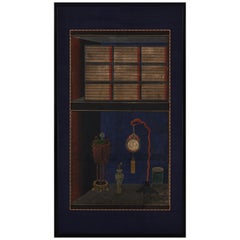
Korean Chaekgeori painting. 19th Century Joseon. Books
Scholars’ Accouterments
Located in Kyoto, JP
Books and Scholars’ Accouterments; Chaekgeori
Second half of the 19th century
Korean framed panel. Ink and color on paper.
This Korean Chaekgeori...
Category
Late 19th Century Korean Edo Antique Japan - Paintings and Screens
Materials
Paper
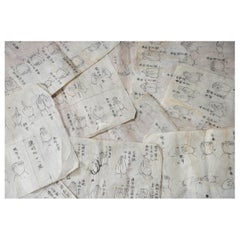
Early 20th century 10-pieces set of Japanese Practitioner’s Hand-Sign Manuscript
Located in Chiba, JP
MUDRA OF ESOTERIC BUDDHISM
A set of 10 handwritten practitioner’s charts depicting various mudras (symbolic hand gestures) used in Mikkyo — Japanese Esoteric Buddhism. These gesture...
Category
Early 20th Century Japanese Meiji Japan - Paintings and Screens
Materials
Paper
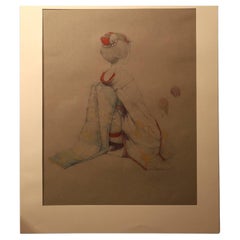
Large Collotype Print by Ryunosuke Fukui
from "Maiko" Series
- print no 6
Located in Fukuoka, JP
A large print created by Ryunosuke Fukui, a highly acclaimed modernist artist from Japan who lived between 1923 and 1986. Fukui's art has been exhibited in many prestigious museums a...
Category
20th Century Showa Japan - Paintings and Screens
Materials
Other
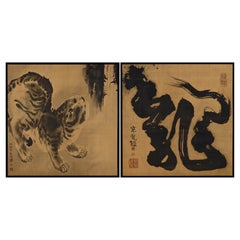
19th Century Japanese Paintings. Zenga Tiger and Dragon by Inoue Kanshu.
Located in Kyoto, JP
Inoue Kanshu (1807-1880)
Zenga Tiger and Dragon
19th century
Pair of framed Japanese paintings. Ink on silk.
Dimensions (each): W. 114 cm x H. 115 cm (45” x 45”)
Presented here ...
Category
Mid-19th Century Japanese Meiji Antique Japan - Paintings and Screens
Materials
Silk
B41 Japanese Antiques 6panels, Silver Paper, folding Screen, brown-rimmed
Located in Niiza, JP
Material: Paper, wooden frame
1 piece: Width 435 x Height 1370 x Depth 18 mm
Expanded size: Width 2650 mm
Folded size: Width 455 x Height 1370 x Depth 100 mm, weight 9 kg
Packaging (...
Category
20th Century Japanese Japan - Paintings and Screens
Materials
Paper
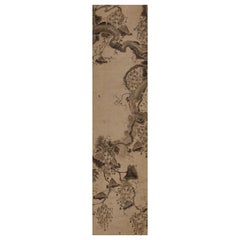
17th Century Korean Grapevine and Squirrel Scroll Painting, Mid Joseon Period
Located in Kyoto, JP
Anonymous. Korean, 17th century. Joseon period.
Hanging scroll. Ink on paper.
Seal: Shinso
Dimensions:
Scroll: H. 200 cm x W. 31 cm (79” x 12”)
Image: H. 122 cm x W. 29.5 cm (48” x 11.5”)
The grapevine came to China and then Korea from western Asia via the silk road trade routes. By the mid-Joseon period, it was one of the most popular subjects for Korean literati painters. Grapevines were painted as a singular subject or, less commonly, in combination with squirrels, which are associated with children due to their playful nature. Together, grapevines and squirrels embody wishes for abundant offspring and wealth.
For the Korean literati artist the twisting vines, curling tendrils and round, plump grapes provided ample opportunity for expressive "brush play”. In this painting the artist has abstracted the scene and is seemingly unconcerned with discontinuities and proportion. Vines spring up from nowhere, grapes hang in random clusters and the squirrel’s head appears as if twisted backwards. For the vines and leaves we can feel a sense of speed in the brushstrokes, imparting a dynamic feel which is at once intense and animated. This contrasts dramatically with the countless tiny strokes of ink which realistically capture the texture of the squirrel’s fur...
Category
17th Century Korean Other Antique Japan - Paintings and Screens
Materials
Paper
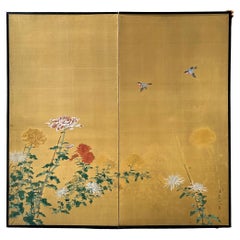
Japanese Screens: Echo of Chrysanthemums
Located in Fukuoka, JP
Echo of Chrysanthemums captures the quiet dialogue between form and reflection. Against a radiant gold-leaf ground, blooming chrysanthemums rise in graceful color harmony — white, cr...
Category
19th Century Japanese Edo Antique Japan - Paintings and Screens
Materials
Gold Leaf
$5,785 Sale Price
35% Off
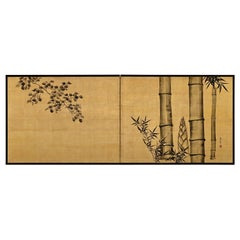
19th Century Japanese Screen for Tea-Ceremony, Ink Bamboo and Plum on Gold Leaf
Located in Kyoto, JP
Three Friends of Winter
Nakajima Raisho (1796-1871)
Late Edo period, circa 1850
Ink and gold leaf on paper.
This is a double-sided Japanese Furosaki or tea-ceremony screen from the mid 19th century; bamboo and plum on the front, young pines the back. It by Nakajima Raisho, a master painter of the Maruyama school in the late Edo and early Meiji periods. In this work Raisho combines exquisite ink brushwork with large open spaces of brilliant gold-leaf to inspire the viewers imagination. Rather than naturalism, he is searching for the phycological impression of the motifs, resulting in abstraction and stylization. His simplification of the motifs the result of looking to capture the inner nature of the objects. This art motif is known as Sho Chiku Bai, or the Three Friends of Winter. Evergreen pine connotes steadfastness, bamboo suggests both strength and flexibility, while plum blossoms unfurling on snow-laden branches imply hardiness. Combined, this trio is emblematic of Japanese new year. Chinese literati were the first to group the three plants together due to their noble characteristics. Like these resilient plants flowering so beautifully in winter, it was expected of the scholar-gentleman to cultivate a strong character with which he would be able to show the same degree of perseverance and steadfastness even during times of adverse conditions.
The screen would have been placed near the hearth of a room used for the Japanese tea ceremony, shielding the fire from draughts and also forming a stimulating and decorative backdrop behind the tea utensils. It would have been used in the Hatsugama, or first tea-ceremony of the new year.
Nakajima Raisho (1796-1871) originally studied under Watanabe Nangaku before entering the school of Maruyama Ozui. He was the highest ranking Maruyama school painter at the end of the Edo period and was known as one of the ‘Four Heian Families’ along with Kishi...
Category
Mid-19th Century Japanese Edo Antique Japan - Paintings and Screens
Materials
Gold Leaf
B51 Old Japanese Antiques Silver folding screen, Byobu 2panel
Located in Niiza, JP
Unfolded size: 1700 x 1675 x 20 mm
Foldable: 850 x 1675 x 40 mm, 7kg
Estimated size after packaging (sandwiched between 9 mm plywood):
11 cm x 93 cm x 175 cm Weight 25KG
An atmosp...
Category
19th Century Japanese Antique Japan - Paintings and Screens
Materials
Fabric, Paper
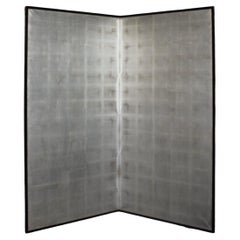
K26 Japanese Antiques A large hanging scroll, Bamboo Tiger Ink on Silk painted
Located in Niiza, JP
Ink on Silk, Scroll head: wood
Image size: 1400(W) x 930(H) [mm]
Scroll mounting: 1470(W) x 1350(H) [mm]
Box size: 100(W) x 90(H) x 1590(D) [mm] 3kg
Estimated packing size: 150(W) x...
Category
19th Century Japanese Antique Japan - Paintings and Screens
Materials
Fabric, Paper
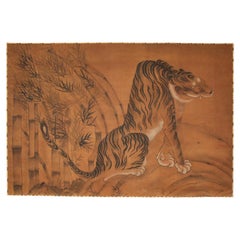
B11 Japanese Antiques 6panels, Paper, folding Screen with Flower & bird painting
Located in Niiza, JP
Bird and flower painting
Material: Paper on wooden frame, colored
One piece: W660×H1825mm×D20mm,
Unfolded size: W3860mm, 16kg
Folded size: W660×H1825×D110mm
Packaging (sandwiched wit...
Category
19th Century Japanese Antique Japan - Paintings and Screens
Materials
Paper
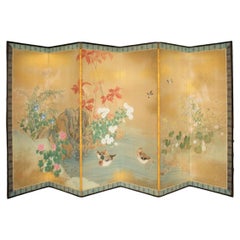
Japanese Painting, Framed Panel, Dahlias and Roosters, circa 1920
Located in Kyoto, JP
Tanaka Tessen (b.1890)
Dahlias and Roosters
Taisho period, circa 1920
Framed painting. Mineral pigments and ink on silk.
Dimensions (framed):
H. 159 cm x W. 97 cm x D. 2.5 cm (62.5” x 38” x 1”)
An ornate and complex composition in which the artist explores almost the entire painting surface. The coloration is bold and evocative and the tinted silk ground recreates the warm golden glow of sunset. Soft, luminous brushwork details the black feathers of the roosters, which seem to cloud and blur in counterpoint to the sharper points of the eyes and beaks. Their brilliant red combs balance the composition, echoing the rich burgundy hues of the dahlias; the flowers exquisite and lifelike. Dahlias were an exotic subject favored by painters of the Taisho era.
The painting belongs to the school of Kyoto Nihonga, exemplifying the principles of decorative elegance and consumate brush technique with which it was intimately associated. Painters of the time relied on the Shijo school method, basing the forms of the composition from life sketches. Sometimes they were then integrated with elements derived from Chinese bird and flower...
Category
1920s Japanese Taisho Vintage Japan - Paintings and Screens
Materials
Wood, Silk
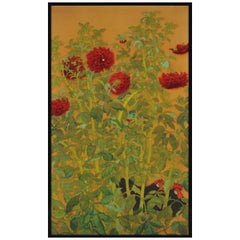
Japanese screen: Summer Breeze on Gold
Located in Fukuoka, JP
Period: Taishō–Shōwa
Size: 170 cm x 378 cm (67 in x 149 in)
SKU: 2481
Dimensions: 170 cm x 378 cm (67 in x 149 in)
Bathed in the gentle shimmer of gold leaf, Summer Breeze on Gold ...
Category
Early 20th Century Asian Showa Japan - Paintings and Screens
Materials
Wood, Paper
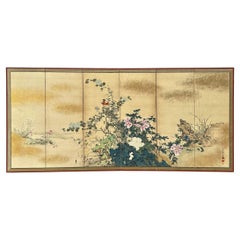
Peonies in Summer Light
Located in Fukuoka, JP
The screen blossoms with peonies — flowers often celebrated in Japanese art as symbols of prosperity, honor, and beauty. Painted in soft pinks and whites, they radiate under a gentle...
Category
20th Century Japanese Showa Japan - Paintings and Screens
Materials
Paper, Wood
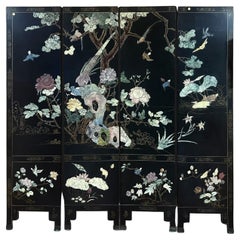
$4,830
Chinese Screen with Semi-Precious Stone
Located in Fukuoka, JP
This magnificent Chinese folding screen captivates with its deep black lacquer surface, richly adorned with inlays of semi-precious stones. The composition depicts a luxuriant garden...
Category
Early 20th Century Chinese Japan - Paintings and Screens
Materials
Multi-gemstone
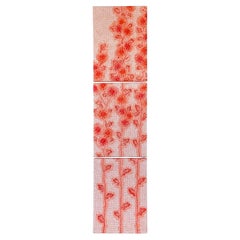
Mid 20th Century kimono textile art " Growing ~ Longevity ~" by ikasu Pink Japan
By Kimono ikasu
Located in Setagaya City, JP
<< About this canvas
This set is a depiction of a tall chrysanthemum stem, entirely dyed in a traditional shibori technique.
<< Period / Story
The haori featured in this canvas was created and used during the late Showa period (1960-80ies).
<< Explanation and meaning of pattern and colors
A charming chrysanthemum flowers all around a stem seem to reach the heavens.
The chrysanthemum flower, which retains its vitality long after being cut, symbolizes longevity, purification from malevolent spirits, and good fortune. In ancient times, during the Kamakura period (1185-1333), emperors loved the chrysanthemum pattern, and it remains the most prestigious flower and the emblem of the Japanese imperial family...
Category
1970s Japanese Japonisme Vintage Japan - Paintings and Screens
Materials
Canvas, Silk
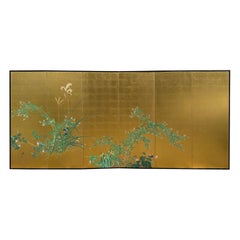
Circa 1920. Taisho era Japanese Nihonga Screen. Dahlias
Cockscomb.
Located in Kyoto, JP
Kawabe Kasho (b.1892)
Dahlias & Cockscomb
Taisho era. Circa 1920
Two-panel Japanese Screen. Mineral pigments and ink on silk.
This exquisite two-panel Japanese folding screen, pa...
Category
Early 20th Century Japanese Taisho Japan - Paintings and Screens
Materials
Silk
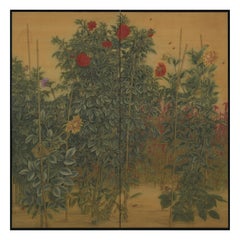
Japanese Screen Painting, Early 19th Century, Autumn Flowers by Sakai Hoitsu
Located in Kyoto, JP
A two-fold Japanese screen by the Rimpa school artist Sakai Hoitsu (1761-1828), Japan, 19th century, Edo period.
This small Japanese folding screen pai...
Category
Early 19th Century Japanese Edo Antique Japan - Paintings and Screens
Materials
Wood, Silk
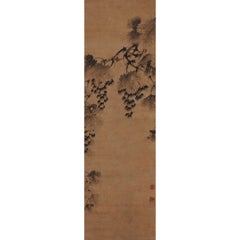
Korean Painting, Wall Panel, 17th Century Ink Grapevine
Located in Kyoto, JP
Grapevine
Anonymous. Korean, 17th century.
Wall panel, ink on paper.
Upper seal:
Kou Kinun in
Lower seal:
Kaigen
Dimensions:
Measures: 98.5 cm x 29.5 cm (39” ...
Category
17th Century Korean Other Antique Japan - Paintings and Screens
Materials
Wood, Paper
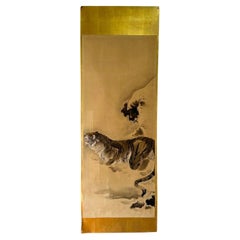
Late 19th century (Meiji period) painting depicting tiger
Located in Fukuoka, JP
Antique Tiger Painting on Paper – Meiji Period
A striking depiction of a tiger, painted on paper and signed by the artist. This work was originally part of a Japanese byobu folding ...
Category
Late 19th Century Japanese Meiji Antique Japan - Paintings and Screens
Materials
Gold Leaf
Mid-18th Century Japanese Screen Pair, One Hundred Flowers, Chrysanthemums
Located in Kyoto, JP
Omori Soun (b. 1704)
Chrysanthemums - One Hundred Flowers
A Pair of Six-fold Japanese Screens. Ink, color, gofun and gold leaf on paper.
Dating ...
Category
Mid-18th Century Japanese Edo Antique Japan - Paintings and Screens
Materials
Gold Leaf
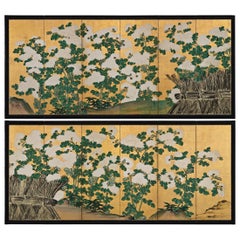
Showa Golden Mallow Screen
Located in Fukuoka, JP
This exquisite two-panel screen from the Showa period features a lush depiction of mallows in vibrant hues set against a luxurious golden background. The mallow flower, known in Japa...
Category
20th Century Japanese Showa Japan - Paintings and Screens
Materials
Gold Leaf
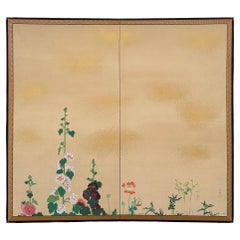
Mid 19th Century Framed Japanese Painting. Snail, Wasp
Hollyhock.
Located in Kyoto, JP
Obata Tosho (1812-1886)
Snail, Wasp & Hollyhock
Late Edo period, mid 19th Century
Framed Japanese Painting. Ink and color on paper.
Individually framed 19th century bird and flow...
Category
Mid-19th Century Japanese Edo Antique Japan - Paintings and Screens
Materials
Paper
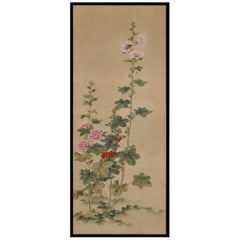
B50 Old Japanese Antiques a folding screen, Byobu 2panel, Peacock
Located in Niiza, JP
Unfolded size: 1700 x 1720 x 18 mm
Foldable: 855 x 1720 x 36 mm, 6kg
Estimated size after packaging (sandwiched between 9 mm plywood):
8 cm x 92 cm x 180 cm Weight 25KG
This paint...
Category
19th Century Japanese Antique Japan - Paintings and Screens
Materials
Wood, Paper
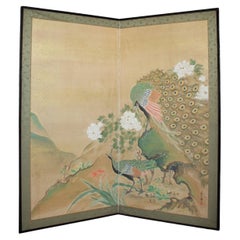
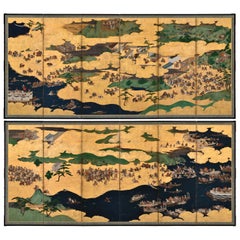
Late 17th Century Japanese Screen Pair. Battle of Ichi-no-tani and Yashima.
Located in Kyoto, JP
Anonymous
Late 17th Century
Battle of Ichi-no-tani & Yashima
Dimensions: Each Screen: H. 175 cm x W. 385 cm (69” x 151.5”)
This pair of Japanese screens depict two significant battles from the Genpei War (1180–85), as recounted in the Tale of the Heike, a semi-historical epic chronicling the conflict between rival clans for control of Japan, written in the early 1200s.
Each screen portrays a single battle through a series of small episodes, framed by gold clouds, landscape elements, and architectural features. True to the style of many screens inspired by The Tale of the Heike, the scenes are rendered in lavish colors and gold, downplaying the brutality of the warfare. Although based on real events, these narratives often glorified and romanticized the heroic feats of the warriors. Viewers at the time would have been familiar with the story’s details, leading to a proliferation of paintings on folding screens inspired by this theme from the late Muromachi to the early Edo periods.
On the right screen, we see the Minamoto’s attack on the Taira, who have retreated from the capital, Kyoto, toward the sea. The central building represents the temporary Taira headquarters, where Taira soldiers are holding the young Emperor Antoku. The Minamoto plan to launch a surprise attack from the rear after descending the steep cliff known as Ichi-no-tani, depicted at the top center. This scene highlights the tactical brilliance of Minamoto commander Yoshitsune and the courage of his men.
The left screen captures moments from the Battle of Yashima...
Category
Late 17th Century Japanese Edo Antique Japan - Paintings and Screens
Materials
Gold Leaf
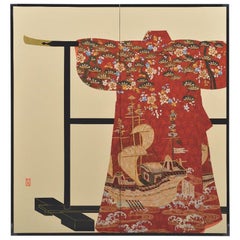
Japanese Large Red Silk Brocade Gilded Two Panel Folding Screen
Located in Takarazuka, JP
Exquisite contemporary Japanese two panel folding screen or "byobu" featuring genryoku style handcrafted silk raised kimono in cream and gold needlework on a mesmerizing red background. Tagasode is the way a genryoku kosode kimono is hung over a kimono rack...
Category
21st Century and Contemporary Japanese Japan - Paintings and Screens
Materials
Gold
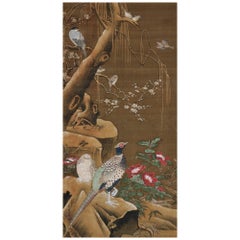
Japanese Painting. Bird and Flower. 19th century copy of Lu Ji by Ogata Tomin.
Located in Kyoto, JP
Ogata Tomin (1839 -1895)
Birds in a spring landscape
Ink and colour on silk.
Inscription reads:
“Copy of Lu Ji, painted with heartfelt appreciation”
“Painted by Tomin Ogat...
Category
Late 19th Century Japanese Ming Antique Japan - Paintings and Screens
Materials
Silk
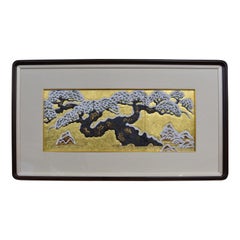
Japanese Contemporary Gold Leaf Brown Framed Porcelain Panel by Master Artist, 3
Located in Takarazuka, JP
Exquisite museum quality Japanese contemporary framed porcelain panel art work consisting of three pieces intricately hand-painted showcasing a wintry ...
Category
21st Century and Contemporary Japanese Meiji Japan - Paintings and Screens
Materials
Gold Leaf
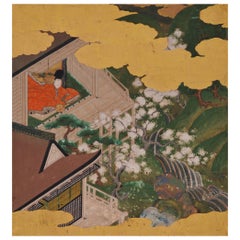
Japanese Painting, 17th Century, Tale of Genji, Tosa School
Located in Kyoto, JP
Illustration to an unidentified chapter of the Tale of Genji (Genji Monogatari)
Tosa School (second half of the 17th Century)
Ink, pigment, gofun and...
Category
Late 17th Century Japanese Edo Antique Japan - Paintings and Screens
Materials
Gold Leaf
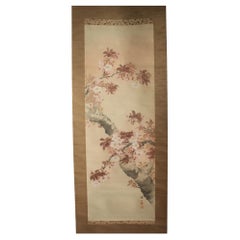
K10 Japanese Antiques Hanging scroll, Cherry blossom painting, silk
Located in Niiza, JP
Cherry blossom painting
Silk Scroll tip: wood
Image size: 410 (W) x 1200 (H) [mm]
Scroll mounting: 570 (W) x 2180 (H) [mm]
Box size: 80 x 75 x 700 mm 970g
Comes with a box, although...
Category
19th Century Japanese Antique Japan - Paintings and Screens
Materials
Silk
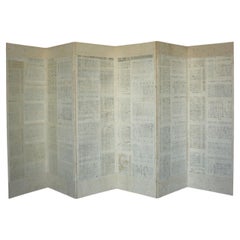
B82 Old Japanese antiques 6panels, Plain folding screen with the base left as is
Located in Niiza, JP
Plain folding screen with the base left as is
Material: Paper on wooden frame
One piece: W580×H1740mm×D15mm,
Unfolded size: W3500mm
Folded size: W590×H1740×D100mm, 7kg
Estimate packi...
Category
20th Century Japanese Japan - Paintings and Screens
Materials
Paper
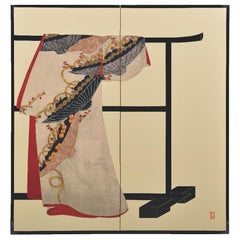
Japanese Contemporary Silk Red Black Cream Hand-Crafted Two Panel Folding Screen
Located in Takarazuka, JP
Exceptional Japanese contemporary two panel "byobu" or folding screen featuring genryoku style handcrafted silk raised kimono Japanese decorative art in crimson red, cream and gold o...
Category
21st Century and Contemporary Japanese Meiji Japan - Paintings and Screens
Materials
Gold
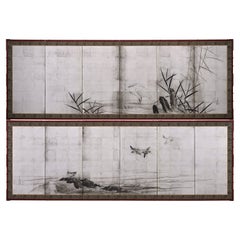
Japanese Silver Screen Pair, Meiji Period, Herons
Plovers, Shijo School
Located in Kyoto, JP
Heron & Plovers
Ink and silver leaf on paper
Maekawa Bunrei (1837-1917)
A pair of low six-panel Japanese screens by Maekawa Bunrei, a later master of the Kyoto based Shijo school of painting. On the right screen a solitary white heron stands motionless in a stream. On the left screen plovers play along a shoreline. The elegant forms are executed employing fluid, minimalistic ink brushstrokes. The soft brushstrokes and the sharp light of the silver leaf lend the scenes a sense of translucence. The sophisticated composition superbly exploits the long, horizontal pictorial surface of the pair of folding screens...
Category
Early 1900s Japanese Meiji Antique Japan - Paintings and Screens
Materials
Silver Leaf
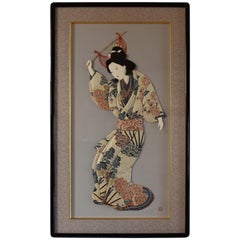
Japanese Contemporary Brocade Silk Handcrafted Framed Oshie Decorative Art
Located in Takarazuka, JP
Exquisite Japanese contemporary framed oshie wall decorative art piece, recreating a famous painting from Meiji period featuring a Japanese dancer holding a net with cherry blossom ...
Category
21st Century and Contemporary Japanese Meiji Japan - Paintings and Screens
Materials
Brocade, Silk
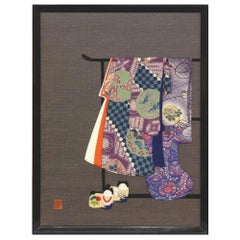
Japanese Contemporary Framed Blue Purple Gray Silk Brocade Decorative Art
Located in Takarazuka, JP
Japanese contemporary framed three-dimensional decorative art piece in Japanese traditional silk and brocade in soft green, blue and purple on a deep gray background, recreating an 1...
Category
21st Century and Contemporary Japanese Meiji Japan - Paintings and Screens
Materials
Brocade, Silk
Fine Japanese Floral Painting Scroll, Taisho Period, Early 20th Century
Located in Fukuoka, JP
A superb early 20th-century Japanese hanging scroll (kakejiku) from the Taisho period, featuring an elegant and vibrant floral painting. The artwork is executed with refined skill an...
Category
Early 20th Century Japanese Taisho Japan - Paintings and Screens
Materials
Wood, Paper
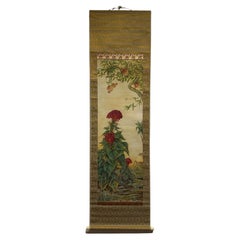
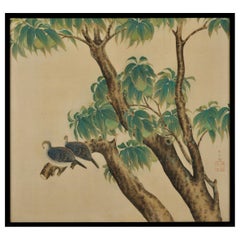
Japanese Framed Silk Painting, Turtledoves and Peaches, Taisho Era, circa 1920
Located in Kyoto, JP
Nakamura Daizaburo
Turtledoves in a Peach Tree
Taisho period, circa 1920
Framed painting. Mineral pigments, ink and gofun on silk
Signed: Daizaburo
Dimensions (framed)...
Category
1910s Japanese Taisho Vintage Japan - Paintings and Screens
Materials
Wood, Silk
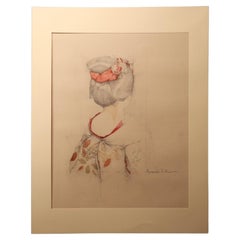
Large Collotype Print by Ryunosuke Fukui
from "Maiko" Series
- print no 7
Located in Fukuoka, JP
A large print created by Ryunosuke Fukui, a highly acclaimed modernist artist from Japan who lived between 1923 and 1986. Fukui's art has been exhibited in many prestigious museums a...
Category
20th Century Showa Japan - Paintings and Screens
Materials
Other
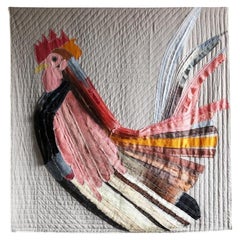
sky color bird by Blue Tip Atelier
Located in Sammu-shi, Chiba
Title : sky color bird
Japan / 2024s
Size : w1620 x h1635 mm
Scraps of fabric used in the Sky series are used to express birds in the colours of the sky.
The materials used are li...
Category
2010s Japanese Modern Japan - Paintings and Screens
Materials
Linen
Still Thinking About These?
All Recently ViewedMore Ways To Browse
Tara Thangka
6 Panel Folding Screen Chinese
Antique Chinese Red Lacquer Screen
Asian 3 Panel Screen
Chinese Brass Pagoda
Chinese Court Paintings
Chinese Lacquer Pearl Panel
Gold 6 Panel Screen
Gold Paper Byobu
Japanese Falcon
Japanese Fish Painting
Japanese Painted Fan
Japanese Screen Horses
Japanese Six Panel Screen Cranes
Joseon Paintings
Korean Panel Screen
Korean Plate
Korean Scroll Painting