Los Angeles - Paintings

to
94
12,817
6,426
348
46
33
Height
to
Width
to
60
25
17
13
9
7
5
4
4
2
1
1
1
1
22
79
247
79
40
79
97
16
5
7
7
7
18
25
27
26
21
240
219
214
161
78
193
193
182
93
35
427
423
427
10
9
6
4
4
Item Ships From: Los Angeles
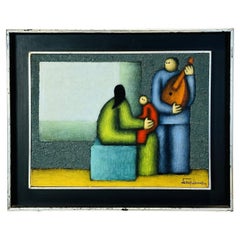
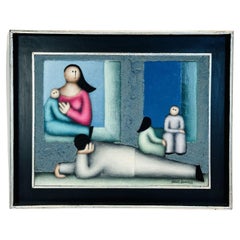
Acrylic on Masonite Painting by Jesus Leuus, Mexico 1970 s
By Jesus Leuus
Located in Los Angeles, CA
Introducing our exquisite Acrylic on Masonite Painting by renowned Mexican artist, Jesus Leuus, created in 1979. This captivating piece showcases a heartwarming scene of a family en...
Category

1970s Organic Modern Vintage Los Angeles - Paintings

Materials

Acrylic, Masonite

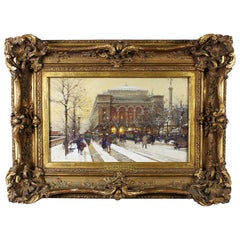
Eugène Galien-Laloue "Theatre du Chatelet" Watercolor and Gouache
By Eugene Galien-Laloue
Located in Los Angeles, CA
Eugène Galien-Laloue (1854-1941) "Theatre du Chatelet" watercolor and gouache on paper signed 'E Galien Laloue' lower left, within a giltwood and gesso c...
Category

Early 1900s French Belle Époque Antique Los Angeles - Paintings

Materials

Glass, Giltwood, Paper

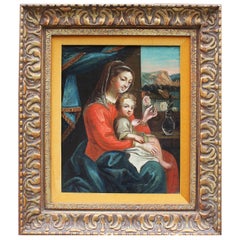
Italian Mid-19th Century Oil on Board Representing a "Mother and Child"
Located in Los Angeles, CA
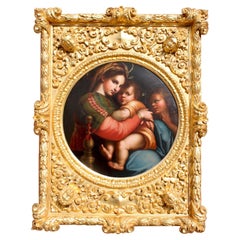
An Italian mid-19th century oil on board representing a "Mother and Child". The Renaissance revival style painting in the manner of a Raphaelite Madonna and Child, of a seated young ...
Category

Mid-19th Century Italian Renaissance Revival Antique Los Angeles - Paintings

Materials

Wood, Giltwood

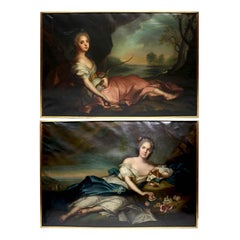
Pair of French Oil on Canvas "Diana Flora" After Jean-Marc Nattier
By Jean-Marc Nattier
Located in Los Angeles, CA
A Pair of French Oil on Canvas Marie Adelaide Of France As Diana And Henriette Of France As Flora, after the originals by Jean-marc Nattier (French 1685-1766). Marie-Adelaide (1732-1800), depicted as a seated Diana, was the third daughter of Louis XV, the original work by Nattier is currently on display at the Galleria degli Uffizi, Florence. Henriette Of France, depicted as a seated Flora. Henriette was also considered the favorite daughter...
Category

Early 20th Century French Louis XV Los Angeles - Paintings

Materials

Canvas, Giltwood

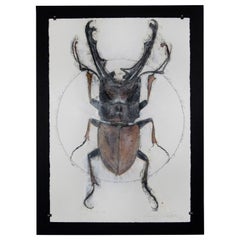
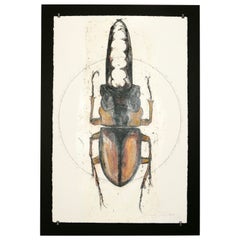
Scarab Beetles 1 by Luciano Di Concetto
By Luciano di Concetto
Located in Los Angeles, CA
One of the most important contemporary French painters is Luciano Di Concetto whose stylized work is becoming famous worldwide. His work displays contrasts of light and dark, richne...
Category

21st Century and Contemporary French Los Angeles - Paintings

Materials

Paper

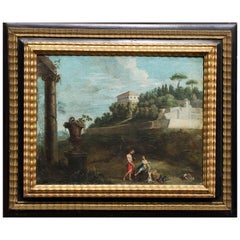
After Pieter van Bloemen Oil on Canvas Hunting Ruins Scene
Located in Los Angeles, CA
School of Pieter van Bloemen (Flemish, 1657-1720) oil on Canvas "Hunting & Ruins Scene". The capriccio scene depicting two male hunters in robes, on...
Category

19th Century Belgian Renaissance Revival Antique Los Angeles - Paintings

Materials

Canvas, Wood, Giltwood

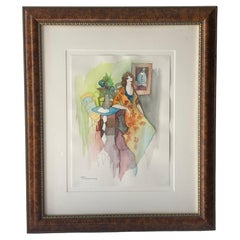
Itzchak Tarkay Watercolor Painting, Signed, Label
By Itzchak Tarkay 2
Located in Los Angeles, CA
Beautiful watercolor by the well known artist Tarkay, This work was purchased in a charity auction and retains label also art work measure 16x 12 inches,...
Category

1990s American Post-Modern Los Angeles - Paintings

Materials

Paint

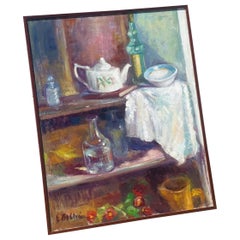
Vintage Still Life Oil Painting
Located in Los Angeles, CA
Stunning original still life oil painting, original artists frame.
Category

21st Century and Contemporary Los Angeles - Paintings

Materials

Canvas, Paint

After Raffaello Sanzio 1483-1520 Raphael La Madonna della Seggiola Oil on Canvas
By (after) Raphael (Raffaello Sanzio da Urbino)
Located in Los Angeles, CA
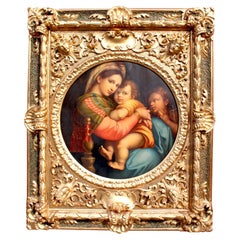
A Fine Italian 19th Century Oil Painting on Canvas "La Madonna della Seggiola" after Raphael (Raffaello Sanzio da Urbino 1483-1520). The circular painted canvas depicting a seated Madonna holding an infant Jesus Christ next to a child Saint John the Baptist, all within a massive carved gilt wood and gesso frame, which is identical to the frame on Raphael's original artwork. This painting is a 19th Century copy of Raphael's Madonna della Seggiola painted in 1514 and currently exhibited and part of the permanent collection at the Palazzo Pitti, Galleria Palatina, Florence, Italy. The bodies of the Virgin, Christ, and the boy Baptist fill the whole picture. The tender, natural looking embrace of the Mother and Child, and the harmonious grouping of the figures in the round, have made this one of Raphael's most popular Madonnas. The isolated chair leg is reminiscent of papal furniture, which has led to the assumption that Leo X himself commissioned the painting. A retailer's label reads " Fred K/ Keer's Sons - Framers and Fine Art Dealers - 917 Broad St. Newark, N.J." - Another label from the gilder reads "Carlo Bartolini - Doratore e Verniciatori - Via Maggio 1924 - Firenze". Circa: 1890-1900. Subject: Religious painting Canvas diameter: 28 inches (71.1 cm) Frame height: 54 inches (137.2 cm) Frame width: 42 1/2 inches (108 cm) Frame depth: 5 1/2 inches (14 cm) Raffaello Sanzio da Urbino (Italian, March 28 or April 6, 1483 - April 6, 1520), known as Raphael, was an Italian painter and architect of the High Renaissance. His work is admired for its clarity of form, ease of composition, and visual achievement of the Neoplatonic ideal of human grandeur. Together with Michelangelo and Leonardo da Vinci, he forms the traditional trinity of great masters of that period. Raphael was enormously productive, running an unusually large workshop and, despite his death at 37, leaving a large body of work. Many of his works are found in the Vatican Palace, where the frescoed Raphael Rooms were the central, and the largest, work of his career. The best known work is The School of Athens in the Vatican Stanza della Segnatura. After his early years in Rome much of his work was executed by his workshop from his drawings, with considerable loss of quality. He was extremely influential in his lifetime, though outside Rome his work was mostly known from his collaborative printmaking. After his death, the influence of his great rival Michelangelo was more widespread until the 18th and 19th centuries, when Raphael's more serene and harmonious qualities were again regarded as the highest models. His career falls naturally into three phases and three styles, first described by Giorgio Vasari: his early years in Umbria, then a period of about four years (1504–1508) absorbing the artistic traditions of Florence, followed by his last hectic and triumphant twelve years in Rome, working for two Popes and their close associates. Raphael was born in the small but artistically significant central Italian city of Urbino in the Marche region, where his father Giovanni Santi was court painter to the Duke. The reputation of the court had been established by Federico III da Montefeltro, a highly successful condottiere who had been created Duke of Urbino by the Pope - Urbino formed part of the Papal States - and who died the year before Raphael was born. The emphasis of Federico's court was rather more literary than artistic, but Giovanni Santi was a poet of sorts as well as a painter, and had written a rhymed chronicle of the life of Federico, and both wrote the texts and produced the decor for masque-like court entertainments. His poem to Federico shows him as keen to show awareness of the most advanced North Italian painters, and Early Netherlandish artists as well. In the very small court of Urbino he was probably more integrated into the central circle of the ruling family than most court painters. Federico was succeeded by his son Guidobaldo da Montefeltro, who married Elisabetta Gonzaga, daughter of the ruler of Mantua, the most brilliant of the smaller Italian courts for both music and the visual arts. Under them, the court continued as a centre for literary culture. Growing up in the circle of this small court gave Raphael the excellent manners and social skills stressed by Vasari. Court life in Urbino at just after this period was to become set as the model of the virtues of the Italian humanist court through Baldassare Castiglione's depiction of it in his classic work The Book of the Courtier, published in 1528. Castiglione moved to Urbino in 1504, when Raphael was no longer based there but frequently visited, and they became good friends. He became close to other regular visitors to the court: Pietro Bibbiena and Pietro Bembo, both later cardinals, were already becoming well known as writers, and would be in Rome during Raphael's period there. Raphael mixed easily in the highest circles throughout his life, one of the factors that tended to give a misleading impression of effortlessness to his career. He did not receive a full humanistic education however; it is unclear how easily he read Latin. Early Life and Works His mother Màgia died in 1491 when Raphael was eight, followed on August 1, 1494 by his father, who had already remarried. Raphael was thus orphaned at eleven; his formal guardian became his only paternal uncle Bartolomeo, a priest, who subsequently engaged in litigation with his stepmother. He probably continued to live with his stepmother when not staying as an apprentice with a master. He had already shown talent, according to Vasari, who says that Raphael had been "a great help to his father". A self-portrait drawing from his teenage years shows his precocity. His father's workshop continued and, probably together with his stepmother, Raphael evidently played a part in managing it from a very early age. In Urbino, he came into contact with the works of Paolo Uccello, previously the court painter (d. 1475), and Luca Signorelli, who until 1498 was based in nearby Città di Castello. According to Vasari, his father placed him in the workshop of the Umbrian master Pietro Perugino as an apprentice "despite the tears of his mother". The evidence of an apprenticeship comes only from Vasari and another source, and has been disputed—eight was very early for an apprenticeship to begin. An alternative theory is that he received at least some training from Timoteo Viti, who acted as court painter in Urbino from 1495.Most modern historians agree that Raphael at least worked as an assistant to Perugino from around 1500; the influence of Perugino on Raphael's early work is very clear: "probably no other pupil of genius has ever absorbed so much of his master's teaching as Raphael did", according to Wölfflin. Vasari wrote that it was impossible to distinguish between their hands at this period, but many modern art historians claim to do better and detect his hand in specific areas of works by Perugino or his workshop. Apart from stylistic closeness, their techniques are very similar as well, for example having paint applied thickly, using an oil varnish medium, in shadows and darker garments, but very thinly on flesh areas. An excess of resin in the varnish often causes cracking of areas of paint in the works of both masters. The Perugino workshop was active in both Perugia and Florence, perhaps maintaining two permanent branches. Raphael is described as a "master", that is to say fully trained, in December 1500. His first documented work was the Baronci altarpiece for the church of Saint Nicholas of Tolentino in Città di Castello, a town halfway between Perugia and Urbino. Evangelista da Pian di Meleto, who had worked for his father, was also named in the commission. It was commissioned in 1500 and finished in 1501; now only some cut sections and a preparatory drawing remain. In the following years he painted works for other churches there, including the Mond Crucifixion (about 1503) and the Brera Wedding of the Virgin (1504), and for Perugia, such as the Oddi Altarpiece. He very probably also visited Florence in this period. These are large works, some in fresco, where Raphael confidently marshals his compositions in the somewhat static style of Perugino. He also painted many small and exquisite cabinet paintings in these years, probably mostly for the connoisseurs in the Urbino court, like the Three Graces and St. Michael, and he began to paint Madonnas and portraits. In 1502 he went to Siena at the invitation of another pupil of Perugino, Pinturicchio, "being a friend of Raphael and knowing him to be a draughtsman of the highest quality" to help with the cartoons, and very likely the designs, for a fresco series in the Piccolomini Library in Siena Cathedral. He was evidently already much in demand even at this early stage in his career. Influence of Florence Raphael led a "nomadic" life, working in various centres in Northern Italy, but spent a good deal of time in Florence, perhaps from about 1504. Although there is traditional reference to a "Florentine period...
Category

Early 1900s Italian Baroque Antique Los Angeles - Paintings

Materials

Canvas, Giltwood

Oil on Canvas by Italian-Brazilian Painter Maria Polo
By Maria Polo
Located in Los Angeles, CA
Oil on Canvas by Maria Polo Signed MARIA POLO and dated 1968 Maria Polo (Venice, Italy, 1937 – Rio de Janeiro, Brazil, 1983). Painter, designer, engraver and vitralista. Studied at...
Category

1960s Brazilian Vintage Los Angeles - Paintings

Materials

Canvas, Paint

Robert Loughlin Original Drawing on Cardboard
By Robert Loughlin
Located in Los Angeles, CA
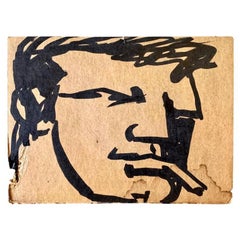
Great original drawing by Robert Loughlin on cardboard. Image of 'the Brute' with cigarette facing to the right. Signed RL on the back. Water stain on bottom right. Over 20 original ...
Category

1980s American Vintage Los Angeles - Paintings

Materials

Paper

Mother and Colt Horse Painting
Located in Los Angeles, CA
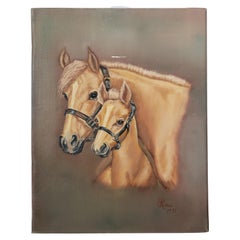
Mother and Colt Horse painting. Signed and dated 1971.
Category

20th Century American Adirondack Los Angeles - Paintings

Materials

Canvas, Paint

Mother and Colt Horse Painting
$716 Sale Price
20% Off
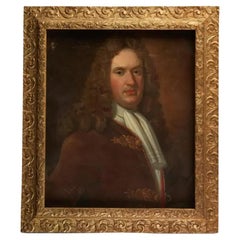
Antique 18c British School Portrait of a Gentleman
Located in LOS ANGELES, CA
Antique 18c British School Portrait of a Gentleman.
Category

18th Century British Louis XV Antique Los Angeles - Paintings

Materials

Canvas, Giltwood

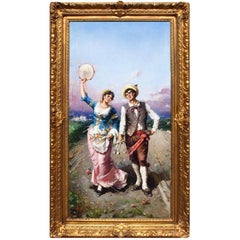
Francesco Peluso (Italian, 1836-1916) An Oil on Canvas "The Village Celebration"
By Francesco Peluso
Located in Los Angeles, CA
Francesco Peluso (Italian, 1836-1916) a fine Italian 19th-20th century oil on canvas "The Village Celebration" depicting a young couple of villagers dressed for Spring festivities and walking through a dirt road while playing musical instruments. The girl playing a tambourine and the boy a wooden noise maker...
Category

Late 19th Century Italian Country Antique Los Angeles - Paintings

Materials

Gesso, Canvas, Wood

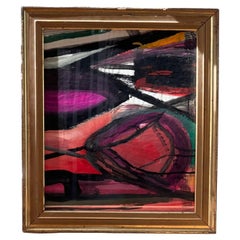
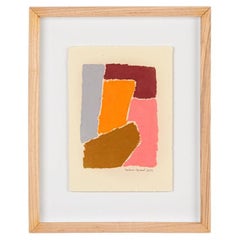
An abstract expressionist painting by Bernard Segal, mid 20th century
Located in View Park, CA
An original abstract expressionist work on paper by Bernard Segal (1907-1986), New York mid 20th century. In predominant tones of magenta, licorice, and grenadine and with slight tou...
Category

Mid-20th Century American Expressionist Los Angeles - Paintings

Materials

Wood, Paint, Paper

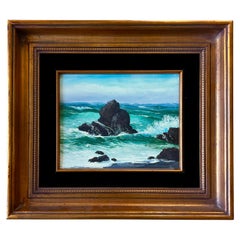
Painting « Crashing Waves » by Virginia Lynn, Oil on Canvas, 20th Century
Located in View Park, CA
Crashing waves: a painting by Virginia Lynn, oil on canvas, 20th century. Expert brushwork from this American artist shows the tide crashing upon basalt ...
Category

Mid-20th Century American Los Angeles - Paintings

Materials

Canvas, Wood, Giltwood, Paint

Mexican Painting by Jesus Mariano Leuus, Signed Dated 1982
By Jesus Leuus
Located in Los Angeles, CA
Introducing a magnificent Mexican painting by renowned artist Jesus Mariano Leuus, signed and dated in 1982. This captivating artwork depicts a scene ...
Category

1980s Mexican Modern Vintage Los Angeles - Paintings

Materials

Acrylic, Masonite

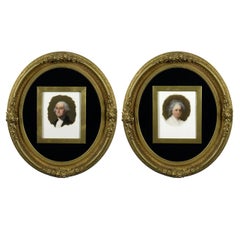
Fine Pair of 19th Century Porcelain Plaques of George and Martha Washington
By KPM Porcelain
Located in Los Angeles, CA
A fine pair of Continental 19th century porcelain plaques each depicting George Washington, the first President of the United States and his wife Martha Washington within an ornate V...
Category

Late 19th Century German American Colonial Antique Los Angeles - Paintings

Materials

Porcelain, Gesso, Giltwood

Framed Gouache on Paper Drawing by Jean-Jacques Blot
By Jean Jacques Blot
Located in Los Angeles, CA
Framed gouache on paper drawing by Jean-Jacques Blot. Signed: "Jean Blot 88".
Category

Late 20th Century French Los Angeles - Paintings

Materials

Paper

After Raffaello Sanzio 1483-1520 Raphael La Madonna della Seggiola Oil on Canvas
By (after) Raphael (Raffaello Sanzio da Urbino)
Located in Los Angeles, CA
A Fine Italian 19th Century Oil Painting on Canvas "La Madonna della Seggiola" after Raphael (Raffaello Sanzio da Urbino 1483-1520). The circular painted canvas depicting a seated Madonna holding an infant Jesus Christ next to a child Saint John the Baptist, all within a massive carved two-tone gilt wood, gilt-patinated and gesso frame, which is identical to the frame on Raphael's original artwork. This painting is a 19th Century copy of Raphael's Madonna della Seggiola painted in 1514 and currently exhibited and part of the permanent collection at the Palazzo Pitti, Galleria Palatina, Florence, Italy. The bodies of the Virgin, Christ, and the boy Baptist fill the whole picture. The tender, natural looking embrace of the Mother and Child, and the harmonious grouping of the figures in the round, have made this one of Raphael's most popular Madonnas. The isolated chair leg is reminiscent of papal furniture, which has led to the assumption that Leo X himself commissioned the painting. Circa: 1890-1900. Subject: Religious painting Painting diameter: 28 inches (71.1 cm) Frame height: 55 1/8 inches (140 cm) Frame width: 46 inches (116.8 cm) Frame depth: 5 1/8 inches (13 cm) Raffaello Sanzio da Urbino (Italian, March 28 or April 6, 1483 - April 6, 1520), known as Raphael, was an Italian painter and architect of the High Renaissance. His work is admired for its clarity of form, ease of composition, and visual achievement of the Neoplatonic ideal of human grandeur. Together with Michelangelo and Leonardo da Vinci, he forms the traditional trinity of great masters of that period. Raphael was enormously productive, running an unusually large workshop and, despite his death at 37, leaving a large body of work. Many of his works are found in the Vatican Palace, where the frescoed Raphael Rooms were the central, and the largest, work of his career. The best known work is The School of Athens in the Vatican Stanza della Segnatura. After his early years in Rome much of his work was executed by his workshop from his drawings, with considerable loss of quality. He was extremely influential in his lifetime, though outside Rome his work was mostly known from his collaborative printmaking. After his death, the influence of his great rival Michelangelo was more widespread until the 18th and 19th centuries, when Raphael's more serene and harmonious qualities were again regarded as the highest models. His career falls naturally into three phases and three styles, first described by Giorgio Vasari: his early years in Umbria, then a period of about four years (1504–1508) absorbing the artistic traditions of Florence, followed by his last hectic and triumphant twelve years in Rome, working for two Popes and their close associates. Raphael was born in the small but artistically significant central Italian city of Urbino in the Marche region, where his father Giovanni Santi was court painter to the Duke. The reputation of the court had been established by Federico III da Montefeltro, a highly successful condottiere who had been created Duke of Urbino by the Pope - Urbino formed part of the Papal States - and who died the year before Raphael was born. The emphasis of Federico's court was rather more literary than artistic, but Giovanni Santi was a poet of sorts as well as a painter, and had written a rhymed chronicle of the life of Federico, and both wrote the texts and produced the decor for masque-like court entertainments. His poem to Federico shows him as keen to show awareness of the most advanced North Italian painters, and Early Netherlandish artists as well. In the very small court of Urbino he was probably more integrated into the central circle of the ruling family than most court painters. Federico was succeeded by his son Guidobaldo da Montefeltro, who married Elisabetta Gonzaga, daughter of the ruler of Mantua, the most brilliant of the smaller Italian courts for both music and the visual arts. Under them, the court continued as a centre for literary culture. Growing up in the circle of this small court gave Raphael the excellent manners and social skills stressed by Vasari. Court life in Urbino at just after this period was to become set as the model of the virtues of the Italian humanist court through Baldassare Castiglione's depiction of it in his classic work The Book of the Courtier, published in 1528. Castiglione moved to Urbino in 1504, when Raphael was no longer based there but frequently visited, and they became good friends. He became close to other regular visitors to the court: Pietro Bibbiena and Pietro Bembo, both later cardinals, were already becoming well known as writers, and would be in Rome during Raphael's period there. Raphael mixed easily in the highest circles throughout his life, one of the factors that tended to give a misleading impression of effortlessness to his career. He did not receive a full humanistic education however; it is unclear how easily he read Latin. Early Life and Works His mother Màgia died in 1491 when Raphael was eight, followed on August 1, 1494 by his father, who had already remarried. Raphael was thus orphaned at eleven; his formal guardian became his only paternal uncle Bartolomeo, a priest, who subsequently engaged in litigation with his stepmother. He probably continued to live with his stepmother when not staying as an apprentice with a master. He had already shown talent, according to Vasari, who says that Raphael had been "a great help to his father". A self-portrait drawing from his teenage years shows his precocity. His father's workshop continued and, probably together with his stepmother, Raphael evidently played a part in managing it from a very early age. In Urbino, he came into contact with the works of Paolo Uccello, previously the court painter (d. 1475), and Luca Signorelli, who until 1498 was based in nearby Città di Castello. According to Vasari, his father placed him in the workshop of the Umbrian master Pietro Perugino as an apprentice "despite the tears of his mother". The evidence of an apprenticeship comes only from Vasari and another source, and has been disputed—eight was very early for an apprenticeship to begin. An alternative theory is that he received at least some training from Timoteo Viti, who acted as court painter in Urbino from 1495.Most modern historians agree that Raphael at least worked as an assistant to Perugino from around 1500; the influence of Perugino on Raphael's early work is very clear: "probably no other pupil of genius has ever absorbed so much of his master's teaching as Raphael did", according to Wölfflin. Vasari wrote that it was impossible to distinguish between their hands at this period, but many modern art historians claim to do better and detect his hand in specific areas of works by Perugino or his workshop. Apart from stylistic closeness, their techniques are very similar as well, for example having paint applied thickly, using an oil varnish medium, in shadows and darker garments, but very thinly on flesh areas. An excess of resin in the varnish often causes cracking of areas of paint in the works of both masters. The Perugino workshop was active in both Perugia and Florence, perhaps maintaining two permanent branches. Raphael is described as a "master", that is to say fully trained, in December 1500. His first documented work was the Baronci altarpiece for the church of Saint Nicholas of Tolentino in Città di Castello, a town halfway between Perugia and Urbino. Evangelista da Pian di Meleto, who had worked for his father, was also named in the commission. It was commissioned in 1500 and finished in 1501; now only some cut sections and a preparatory drawing remain. In the following years he painted works for other churches there, including the Mond Crucifixion (about 1503) and the Brera Wedding of the Virgin (1504), and for Perugia, such as the Oddi Altarpiece. He very probably also visited Florence in this period. These are large works, some in fresco, where Raphael confidently marshals his compositions in the somewhat static style of Perugino. He also painted many small and exquisite cabinet paintings in these years, probably mostly for the connoisseurs in the Urbino court, like the Three Graces and St. Michael, and he began to paint Madonnas and portraits. In 1502 he went to Siena at the invitation of another pupil of Perugino, Pinturicchio, "being a friend of Raphael and knowing him to be a draughtsman of the highest quality" to help with the cartoons, and very likely the designs, for a fresco series in the Piccolomini Library in Siena Cathedral. He was evidently already much in demand even at this early stage in his career. Influence of Florence Raphael led a "nomadic" life, working in various centres in Northern Italy, but spent a good deal of time in Florence, perhaps from about 1504. Although there is traditional reference to a "Florentine period...
Category

Early 1900s Italian Baroque Antique Los Angeles - Paintings

Materials

Canvas, Giltwood

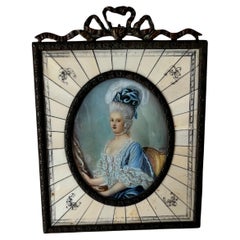
Hand Painted Miniature Portrait of a Lady ca. late 19th C. Bronze and Bone Frame
Located in Los Angeles, CA
A late 19th Century hand painted mature portrait in a bone and Bronze frame with velvet backing and bronze twig like stand. An impeccable piece and lovely on the desk or shelf. A w...
Category

19th Century European Victorian Antique Los Angeles - Paintings

Materials

Bronze

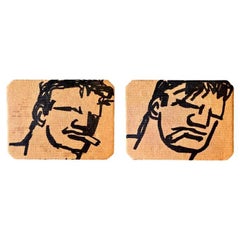
Robert Loughlin Original Diptych of Drawings on Cardboard
By Robert Loughlin
Located in Los Angeles, CA
Great pair of original drawings by Robert Loughlin on cardboard. One image of 'the Brute' with cigarette facing left and the other with the cigarette facing to the right. Great pair ...
Category

1980s American Vintage Los Angeles - Paintings

Materials

Paper

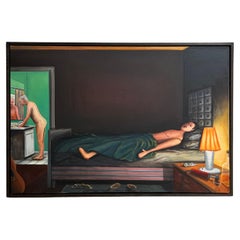
Painting by Inga Uwais “Adventures of Man Love Doll #6”, Oil on Canvas, 2012
Located in View Park, CA
A painting by Inga Uwais aka Chris Langdon (b. 1952) « Adventures of Man Love Doll #6 », oil on canvas, 2012. From the private collection of Laura Lee Stearn...
Category

21st Century and Contemporary American Los Angeles - Paintings

Materials

Canvas, Paint

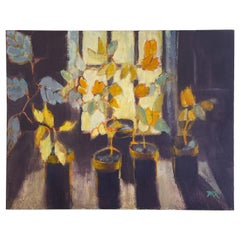
Vintage Still Life Oil Painting
Located in Los Angeles, CA
Original oil painting self portrait of the late Donald K Ryan. Donald K Ryan’s work spans mostly from the 80s to the early 2000s. Throughout...
Category

20th Century American Los Angeles - Paintings

Materials

Canvas, Paint

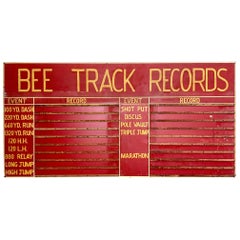
Massive Hand Painted High School Track and Field Sign
Located in Los Angeles, CA
Vintage track and field sign from the early 1970s. Hand painted red sign with yellow lettering. Taken down from a California high school. Horizontal wo...
Category

1970s American Vintage Los Angeles - Paintings

Materials

Wood, Paint

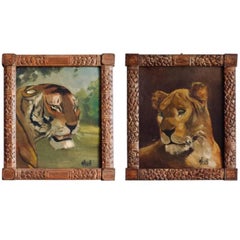
Pair of Tiger and Lion Art Deco Framed Paintings
Located in Los Angeles, CA
Pair of tiger and lion Art Deco framed paintings. Oil on panel. Beautiful carved wood frames.
Category

1930s French Art Deco Vintage Los Angeles - Paintings

Materials

Paint, Hardwood

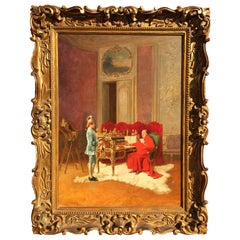
Charles Edouard Edmond Delort Oil on Canvas "Game for the Cardinal"
By Charles Edouard Edmond Delort
Located in Los Angeles, CA
Charles Edouard Edmond Delort (French, 1841-1895) oil on canvas "Game for the Cardinal", depicting a seated cardinal behind an ornate French Louis XV roll-top Bureau du Roi, after the model by Jean-François Oeben currently at Versailles, a young boy delivering a game bird as a gift, all inside an ornately paneled and upholstered wall room with parquet floors and centred with a white bear skin rug...
Category

19th Century French Rococo Antique Los Angeles - Paintings

Materials

Canvas, Wood

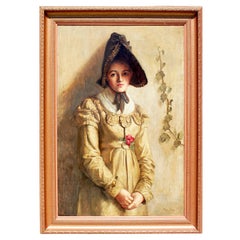
Fanny Sugars (British, 1856-1933) Oil on Canvas A Standing Girl Wearing a Bonnet
Located in Los Angeles, CA
Fanny Sugars (British, 1856-1933) A Charming Victorian Era Oil on Canvas Depicting a Portrait of Standing Young Girl Wearing a Bonnet, within a later giltwood frame. Signed and Dated: 'Fanny Sugars / 1881' (lower right). Museums: Lancaster City Museums Miss Dalton, possibly Alzira Eloise Dalton (1889–1983) c. 1904 by Fanny Sugars (1856–1933) Lancaster Maritime Museum Miss Dalton, possibly Alzira Eloise Dalton (1889–1983) by Fanny Sugars (1856–1933) Manchester Art Gallery My Mother by Fanny Sugars (1856–1933) Fanny Sugars (1856–1933) Is recorded in Union List of Artist Names - Getty Research Fanny Sugers (1856–1933) is recorded as having exhibited at The Royal Academy Of Art in London, 1903. Exhibition No. 1160 - Portrait of a Lady. Article from Woman, Art and Money in Late Victorian and Edwardian England - The Hustle and the Scramable: Fanny Sugars was a ‘well-known Manchester artist’ who had been the only artist out of forty-one nominees to be elected to the Manchester Academy membership in 1897. ‘Women’s Doings’, Hearth and Home, 11 March 1897, 722. 64 ‘Women’s Doings’, Hearth and Home, 29 March 1900, 883. 65 Cherry, Painting Women, 70. 66 Arthur Fish, Henrietta Rae...
Category

Late 19th Century English Antique Los Angeles - Paintings

Materials

Canvas, Giltwood

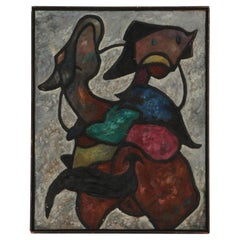
Mixed Media Composition "Desert Rider, " by Charles Melohs, circa 1956
Located in Los Angeles, CA
Charles Melohs (American, 1908 – 1982) Desert Rider, circa 1956 Mixed media composition on canvas Signed to the lower left Inscribed to the verso Intr...
Category

1950s American Expressionist Vintage Los Angeles - Paintings

Materials

Canvas

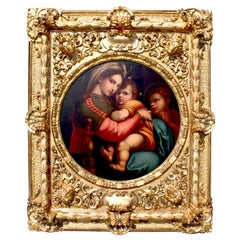
After Raffaello Sanzio 1483-1520 Raphael La Madonna della Seggiola Oil on Canvas
By Raphael (Raffaello Sanzio da Urbino)
Located in Los Angeles, CA
A fine Italian 19th century oil painting on canvas "La Madonna della Seggiola" after Raphael (Raffaello Sanzio da Urbino 1483-1520) The circular canvas depicting a seated Madonna holding an infant Jesus Christ next to a child Saint John the Baptist, all within a massive carved gilt wood and gesso frame (all high quality gilt is original) which is identical to the frame on Raphael's original artwork. This painting is a 19th Century copy of Raphael's Madonna della Seggiola painted in 1514 and currently exhibited and part of the permanent collection at the Palazzo Pitti, Galleria Palatina, Florence, Italy. The bodies of the Virgin, Christ, and the boy Baptist fill the whole picture. The tender, natural looking embrace of the Mother and Child, and the harmonious grouping of the figures in the round, have made this one of Raphael's most popular Madonnas. The isolated chair leg is reminiscent of papal furniture, which has led to the assumption that Leo X himself commissioned the painting, circa 1890-1900. Subject: Religious painting Measures: Canvas height: 29 1/4 inches (74.3 cm) Canvas width: 29 1/4 inches (74.3 cm) Painting diameter: 28 1/4 inches (71.8 cm) Frame height: 57 7/8 inches (147 cm) Frame width: 45 1/2 inches (115.6 cm) Frame depth: 5 1/8 inches (13 cm).   Raffaello Sanzio da Urbino (Italian, March 28 or April 6, 1483 - April 6, 1520), known as Raphael, was an Italian painter and architect of the High Renaissance. His work is admired for its clarity of form, ease of composition, and visual achievement of the Neoplatonic ideal of human grandeur. Together with Michelangelo and Leonardo da Vinci, he forms the traditional trinity of great masters of that period. Raphael was enormously productive, running an unusually large workshop and, despite his death at 37, leaving a large body of work. Many of his works are found in the Vatican Palace, where the frescoed Raphael Rooms were the central, and the largest, work of his career. The best known work is The School of Athens in the Vatican Stanza della Segnatura. After his early years in Rome much of his work was executed by his workshop from his drawings, with considerable loss of quality. He was extremely influential in his lifetime, though outside Rome his work was mostly known from his collaborative printmaking. After his death, the influence of his great rival Michelangelo was more widespread until the 18th and 19th centuries, when Raphael's more serene and harmonious qualities were again regarded as the highest models. His career falls naturally into three phases and three styles, first described by Giorgio Vasari: his early years in Umbria, then a period of about four years (1504–1508) absorbing the artistic traditions of Florence, followed by his last hectic and triumphant twelve years in Rome, working for two Popes and their close associates. Raphael was born in the small but artistically significant central Italian city of Urbino in the Marche region, where his father Giovanni Santi was court painter to the Duke. The reputation of the court had been established by Federico III da Montefeltro, a highly successful condottiere who had been created Duke of Urbino by the Pope - Urbino formed part of the Papal States - and who died the year before Raphael was born. The emphasis of Federico's court was rather more literary than artistic, but Giovanni Santi was a poet of sorts as well as a painter, and had written a rhymed chronicle of the life of Federico, and both wrote the texts and produced the decor for masque-like court entertainments. His poem to Federico shows him as keen to show awareness of the most advanced North Italian painters, and Early Netherlandish artists as well. In the very small court of Urbino he was probably more integrated into the central circle of the ruling family than most court painters. Federico was succeeded by his son Guidobaldo da Montefeltro, who married Elisabetta Gonzaga, daughter of the ruler of Mantua, the most brilliant of the smaller Italian courts for both music and the visual arts. Under them, the court continued as a centre for literary culture. Growing up in the circle of this small court gave Raphael the excellent manners and social skills stressed by Vasari. Court life in Urbino at just after this period was to become set as the model of the virtues of the Italian humanist court through Baldassare Castiglione's depiction of it in his classic work The Book of the Courtier, published in 1528. Castiglione moved to Urbino in 1504, when Raphael was no longer based there but frequently visited, and they became good friends. He became close to other regular visitors to the court: Pietro Bibbiena and Pietro Bembo, both later cardinals, were already becoming well known as writers, and would be in Rome during Raphael's period there. Raphael mixed easily in the highest circles throughout his life, one of the factors that tended to give a misleading impression of effortlessness to his career. He did not receive a full humanistic education however; it is unclear how easily he read Latin. Early Life and Works His mother Màgia died in 1491 when Raphael was eight, followed on August 1, 1494 by his father, who had already remarried. Raphael was thus orphaned at eleven; his formal guardian became his only paternal uncle Bartolomeo, a priest, who subsequently engaged in litigation with his stepmother. He probably continued to live with his stepmother when not staying as an apprentice with a master. He had already shown talent, according to Vasari, who says that Raphael had been "a great help to his father". A self-portrait drawing from his teenage years shows his precocity. His father's workshop continued and, probably together with his stepmother, Raphael evidently played a part in managing it from a very early age. In Urbino, he came into contact with the works of Paolo Uccello, previously the court painter (d. 1475), and Luca Signorelli, who until 1498 was based in nearby Città di Castello. According to Vasari, his father placed him in the workshop of the Umbrian master Pietro Perugino as an apprentice "despite the tears of his mother". The evidence of an apprenticeship comes only from Vasari and another source, and has been disputed—eight was very early for an apprenticeship to begin. An alternative theory is that he received at least some training from Timoteo Viti, who acted as court painter in Urbino from 1495.Most modern historians agree that Raphael at least worked as an assistant to Perugino from around 1500; the influence of Perugino on Raphael's early work is very clear: "probably no other pupil of genius has ever absorbed so much of his master's teaching as Raphael did", according to Wölfflin. Vasari wrote that it was impossible to distinguish between their hands at this period, but many modern art historians claim to do better and detect his hand in specific areas of works by Perugino or his workshop. Apart from stylistic closeness, their techniques are very similar as well, for example having paint applied thickly, using an oil varnish medium, in shadows and darker garments, but very thinly on flesh areas. An excess of resin in the varnish often causes cracking of areas of paint in the works of both masters. The Perugino workshop was active in both Perugia and Florence, perhaps maintaining two permanent branches. Raphael is described as a "master", that is to say fully trained, in December 1500. His first documented work was the Baronci altarpiece for the church of Saint Nicholas of Tolentino in Città di Castello, a town halfway between Perugia and Urbino. Evangelista da Pian di Meleto, who had worked for his father, was also named in the commission. It was commissioned in 1500 and finished in 1501; now only some cut sections and a preparatory drawing remain. In the following years he painted works for other churches there, including the Mond Crucifixion (about 1503) and the Brera Wedding of the Virgin (1504), and for Perugia, such as the Oddi Altarpiece. He very probably also visited Florence in this period. These are large works, some in fresco, where Raphael confidently marshals his compositions in the somewhat static style of Perugino. He also painted many small and exquisite cabinet paintings in these years, probably mostly for the connoisseurs in the Urbino court, like the Three Graces and St. Michael, and he began to paint Madonnas and portraits. In 1502 he went to Siena at the invitation of another pupil of Perugino, Pinturicchio, "being a friend of Raphael and knowing him to be a draughtsman of the highest quality" to help with the cartoons, and very likely the designs, for a fresco series in the Piccolomini Library in Siena Cathedral. He was evidently already much in demand even at this early stage in his career. Influence of Florence Raphael led a "nomadic" life, working in various centres in Northern Italy, but spent a good deal of time in Florence, perhaps from about 1504. Although there is traditional reference to a "Florentine period...
Category

19th Century Italian Baroque Antique Los Angeles - Paintings

Materials

Gesso, Canvas, Wood

Contemporary Abstract Painting with Frame
Located in Los Angeles, CA
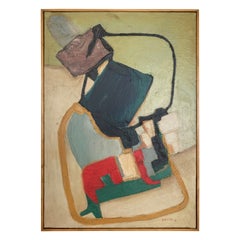
A unique contemporary framed painting... no real subject matter, but wonderfully colorful and a very nice decorative piece for a grouping or to stand alone. The piece has not been re...
Category

20th Century Los Angeles - Paintings

Materials

Paint

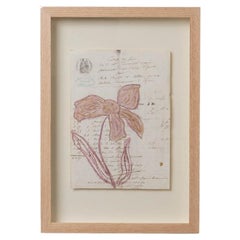
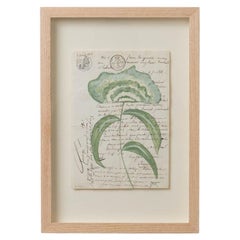
Voyage by Afsoon Thayer
Located in Los Angeles, CA
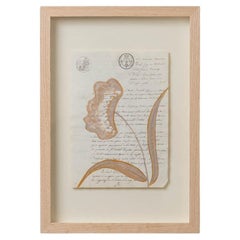
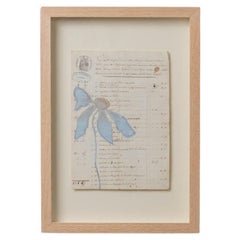
Beautiful acrylic painting on a 1800s paper by contemporary artist Afsoon Thayer. Flower motif painted with Farrow and ball and gold leaf on an original 1800s Napoleon III French Rep...
Category

2010s American Los Angeles - Paintings

Materials

Plexiglass, Walnut, Paint, Paper

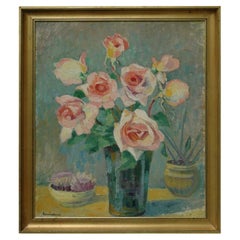
Bouquet of Roses by Hermine David, Oil on Cardboard Linen, Signed
By Jules Pascin, Hermine David
Located in Los Angeles, CA
Bouquet of roses by Hermine David, oil on cardboard linen, signed. Framed. Hermine Lionette Cartan David (19 April 1886 in Paris – 1 December 1970 in ...
Category

1930s European Art Deco Vintage Los Angeles - Paintings

Materials

Canvas, Wood, Paint

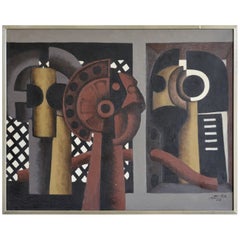
Oil on Canvas by José Herrera
By José Herrera
Located in Los Angeles, CA
Oil on Canvas by José Herrera (Spanish, 1943-). Signed and dated 1973. Original stainless steel frame. A beautiful piece.
Category

1970s Spanish Modern Vintage Los Angeles - Paintings

Materials

Stainless Steel

Scarab Beetles Three by Luciano Di Concetto
By Luciano di Concetto
Located in Los Angeles, CA
One of the most important contemporary French painters is Luciano Di Concetto whose stylized work is becoming famous worldwide. His work displays contrasts of light and dark, richnes...
Category

21st Century and Contemporary French Los Angeles - Paintings

Materials

Paper

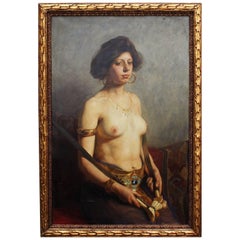
Karl Viktor Mayr, Austrian Oil on Canvas "An Exotic Nude Girl"
By Karl Viktor Mayr
Located in Los Angeles, CA
Karl Viktor Mayr (Austrian, 1882-1974) a very fine Austrian oil on canvas "An Exotic Nude Girl" depicting a young semi-nude woman, revealing her breast...
Category

Early 1900s Austrian Folk Art Antique Los Angeles - Paintings

Materials

Canvas, Giltwood

Loire by Afsoon Thayer
Located in Los Angeles, CA
Beautiful acrylic painting on a 1800s paper by contemporary artist Afsoon Thayer. Flower motif painted with Farrow and ball and gold leaf on an original 1800s Napoleon III French Rep...
Category

2010s American Los Angeles - Paintings

Materials

Plexiglass, Walnut, Paint, Paper

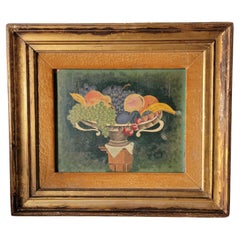
19th C Early Still Life Oil Painting in Original Frame
Located in Los Angeles, CA
This Fine 19th c still life painting is in the original gilded frame. This Folk Art painting is in great as found condition.
Category

19th Century American Adirondack Antique Los Angeles - Paintings

Materials

Velvet, Wood, Paint

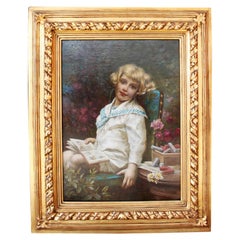
Hans Zatzka, Austrian (1859-1945) Oil on Canvas "Young Girl in a Sailor s Suit
By Hans Zatzka
Located in Los Angeles, CA
Hans Zatzka, Austrian (1859-1945) A Fine Oil on Canvas "Portrait of Haunz Javorasky Als Knabe Dressed as a Sailor" within a carved gildwood frame. The charming portrait depicts a sea...
Category

Early 1900s Austrian Belle Époque Antique Los Angeles - Paintings

Materials

Canvas, Giltwood

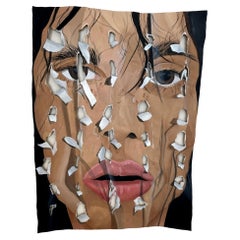
Torn Original Painting
Located in Los Angeles, CA
Original painting by German artist Johannes Hemann. Painting on wooden board. Experimental painting with the illusion of cut holes on paper. Stunning...
Category

2010s North American Los Angeles - Paintings

Materials

Paint, Wood

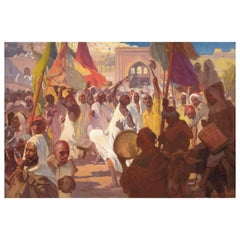
Very Fine and Large Orientalist Oil on Canvas Titled "Ashura Rituals, Tangier"
By Gordon B. Coutts 1
Located in Los Angeles, CA
Gordon B. Coutts (Scottish/American, 1868-1937) A very fine and large orientalist oil on canvas titled "Ashura Rituals, Tangier" (Arabic: عاشوراء‎ ʻĀshūrā’ - Urdu: عاشورا‎ - Persian: عاشورا‎ - Turkish: Aşure Günü). Signed and inscribed: 'Gordon Coutts/TANGIER' (lower right), circa 1920. Provenance: The Fisher Art Museum, University of Southern California. Gordon Coutts led a peripatetic career, born in Aberdeen, Scotland, he then studied and travelled to Glasgow, London, Paris and Rome before settling in Melbourne, Australia in 1891. In 1896 he moved to Sydney, where he taught at the Art Society of New South Wales, before returning back to Europe in 1899. With the climate of northern Europe detrimental to Coutts' poor health, he moved with his wife, Alice Grey, to the United States where he became a frequent exhibitor at the Bohemian Club in San Francisco. In 1920 he travelled to Tangiers, Morocco where, dressed as an Arab, he passed from tribe to tribe observing the lifestyle, customs and practices of the the village people and Bedouins. The present work depicts the celebration of Ashura. The day of Ashura is commemorated by Shi'ite Muslims; "A day of pain, pilgrimage and pageantry, it is one of the holiest in their religion. The word Ashura means 10, and refers to the tenth day of Muharram, the first month of the Islamic calendar. This is a period of mourning and cleansing, which marks the martyrdom of Hussein, grandson of the Prophet Muhammad...
Category

Early 20th Century Moroccan Other Los Angeles - Paintings

Materials

Canvas

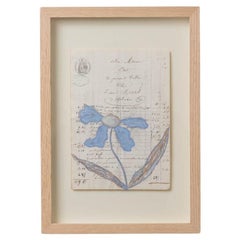
Rully by Afsoon Thayer
Located in Los Angeles, CA
Beautiful acrylic painting on a 1800s paper by contemporary artist Afsoon Thayer. Flower motif painted with Farrow and ball and gold leaf on an original 1800s Napoleon III French Rep...
Category

2010s American Los Angeles - Paintings

Materials

Plexiglass, Walnut, Paint, Paper

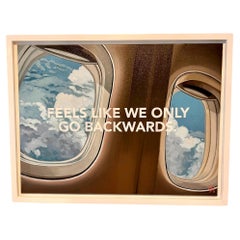
"FEELS LIKE WE ONLY GO BACKWARDS" - Original Oil on Canvas Painting, 2023
Located in Los Angeles, CA
Original oil on canvas Pop Art painting by local Los Angeles artist. Reminiscent of works by Ed Ruscha. Painting of interior view of airplane looking...
Category

2010s American Los Angeles - Paintings

Materials

Canvas, Paint

Lilou by Afsoon Thayer
Located in Los Angeles, CA
Beautiful acrylic painting on a 1800s paper by contemporary artist Afsoon Thayer. Flower motif painted with Farrow and ball and gold leaf on an original 1800s Napoleon III French Rep...
Category

2010s American Los Angeles - Paintings

Materials

Plexiglass, Walnut, Paint, Paper

Beaute by Afsoon Thayer
Located in Los Angeles, CA
Beautiful acrylic painting on a 1800s paper by contemporary artist Afsoon Thayer. Flower motif painted with Farrow and ball and gold leaf on an original 1800s Napoleon III French Rep...
Category

2010s American Los Angeles - Paintings

Materials

Plexiglass, Walnut, Paint, Paper

Bouquet of Roses by Hermine David, Oil on Cardboard Linen, Signed
By Jules Pascin, Hermine David
Located in Los Angeles, CA
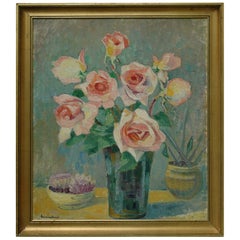
Bouquet of Roses by Hermine David, oil on cardboard linen, signed. Framed. Hermine Lionette Cartan David (19 April 1886 in Paris – 1 December 1970 in Bry-sur-Marne) was a French painter and the wife of Jules Pascin, also a painter. She became one of the Ecole de Paris artists...
Category

1930s European Art Deco Vintage Los Angeles - Paintings

Materials

Canvas, Wood, Paint

Francois Gilot Lithograph The Greek Horse
Located in Los Angeles, CA
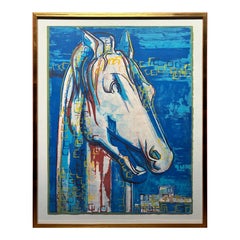
Original lithograph, in turquoise, brick red, royal blue and saffron. Signed by the artist in pencil within the image in the lower right corner. Numbered 20/100 in pencil in the bott...
Category

1960s American Vintage Los Angeles - Paintings

Materials

Paint

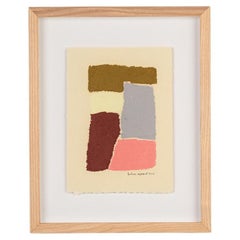
Abstract Oil Painting by French Artist Hortense Reynaud
Located in Los Angeles, CA
Beautiful oil painting by contemporary French artist Hortense Reynaud. Abstract design painted with oil pastels in varying colors. Thick quality paper...
Category

2010s French Los Angeles - Paintings

Materials

Plexiglass, Oak, Paint, Paper

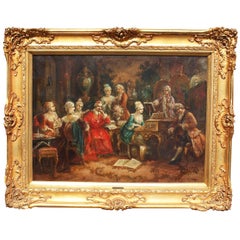
Heinz Pinggera, "Music Recital for the Cardinal" Oil on Canvas
By Heinz Pinggera
Located in Los Angeles, CA
Heinz Pinggera (Italian, b 1900) "A Recital for the Cardinal" oil on canvas within a gilt-wood and gesso frame. The interior 18th century rococo scene depicting a seated Cardinal or ...
Category

Early 20th Century Italian Rococo Los Angeles - Paintings

Materials

Canvas, Giltwood

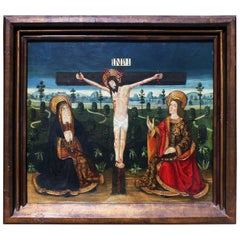
Hispano-Portuguese 19th Century Oil Painting on Board, Icon "The Crucifixion"
Located in Los Angeles, CA
An Hispano-Portuguese 19th century oil on board depiction of "The Crucifixion". The baroque icon style painting depicting the Crucifixion of Jesus Christ outside the city walls of Jerusalem, north of Mount Zion...
Category

19th Century Spanish Baroque Revival Antique Los Angeles - Paintings

Materials

Wood

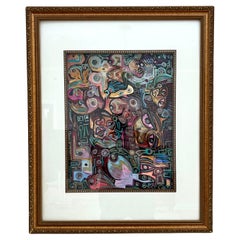
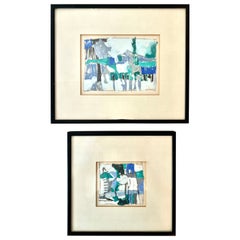
Pair of Gouache and Acrylic Modern Abstract Framed Artwork
Located in Los Angeles, CA
Pair of wonderful Modern Paintings using Gouache and acrylic paint. The pieces are not signed, but are a great duo - the larger is 10"wide x 8.5 Tall, the smaller is 7.5 Wide x 8" t...
Category

20th Century Modern Los Angeles - Paintings

Materials

Metal

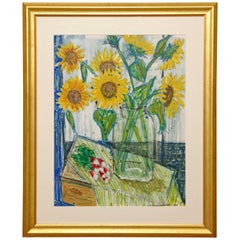
Sunflower Painting by French Artist Nicolas Hammel
By Nicolas Hammel
Located in New York, NY
Beautiful mixed media still life of Sunflowers and Radishes by listed South of France Artist Nicolas Hammel. This painting on paper is a mix of gouache, oil crayons and watercolors ...
Category

1990s French Los Angeles - Paintings

Materials

Wood, Paint, Paper, Crayon

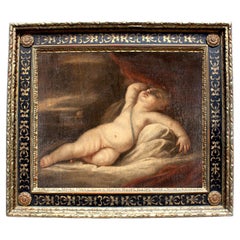
Manner Titian, Oil on Canvas Sleeping Cupid
Located in Los Angeles, CA
Manner of Titian (Tiziano Vecelli - Italian, 1485-1576) An Oil on Canvas "Sleeping Cupid" within a gilt and black decorated gesso frame. A label on reve...
Category

17th Century Italian Renaissance Antique Los Angeles - Paintings

Materials

Gesso, Canvas, Giltwood

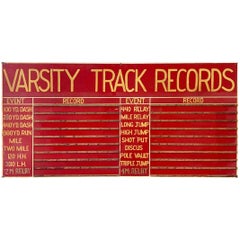
Massive Hand Painted Varsity High School Track and Field Sign
Located in Los Angeles, CA
Varsity track and field sign from the early 1970s. Hand painted red sign with yellow lettering. Horizontal wood slates to hold name cards of record hol...
Category

1970s American Vintage Los Angeles - Paintings

Materials

Wood, Paint

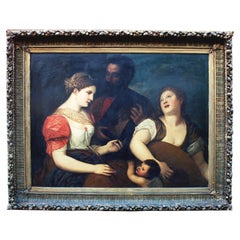
"An Allegory of Love" 19th C. Oil on Canvas After Titian - Tiziano Vecellio
Located in Los Angeles, CA
A Large and Impressive 19th Century Continental Oil on Canvas "An Allegory of Love" after the original work by Titian - Tiziano Vecellio (Italian 1488-1576), within an ornate gilt-wo...
Category

19th Century Italian Baroque Antique Los Angeles - Paintings

Materials

Canvas

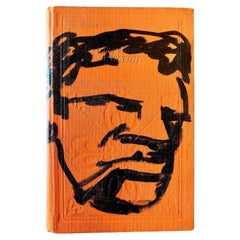
Robert Loughlin Original Drawing on a Book
By Robert Loughlin
Located in Los Angeles, CA
Fantastic original drawing by Robert Loughlin on an old orange book. Looks to be an old Russian book. Orange book with black drawing of 'the Brute' on the ...
Category

1980s American Vintage Los Angeles - Paintings

Materials

Paper

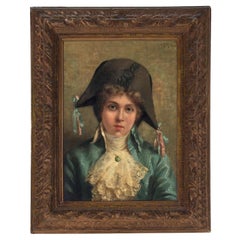
Napoleone Luigi Grady (Italian, 1860-1949) Oil on Canvas "Boy with Bicorne Hat"
Located in Los Angeles, CA
Napoleone Luigi Grady (Italian, 1860-1949) A Very Fine Oil on Canvas "A Young Man Bicorne Hat". The beautifully executed artwork depicting a posing young boy in full period celebrato...
Category

Late 19th Century Italian Napoleon III Antique Los Angeles - Paintings

Materials

Canvas, Giltwood

Abstract Oil Painting by French Artist Hortense Reynaud
Located in Los Angeles, CA
Beautiful oil painting by contemporary French artist Hortense Reynaud. Abstract design painted with oil pastels in varying colors. Thick quality paper and signed by the artist. Each ...
Category

2010s French Los Angeles - Paintings

Materials

Plexiglass, Oak, Paint, Paper

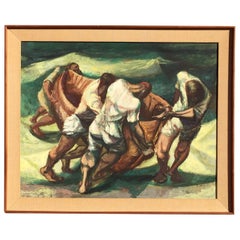
Francis De Erdely Watercolor and Pencil "Mexican Shark Fisherman"
By Francis De Erdely 2
Located in Los Angeles, CA
Francis De Erdely (Hungarian/American, 1904-1959) “Mexican Shark Fishermen” water color and Pencil on Paper within a pine frame and protective glass, circa 1930. Signed: ‘De Erdely’...
Category

Early 20th Century American Folk Art Los Angeles - Paintings

Materials

Glass, Pine, Paper

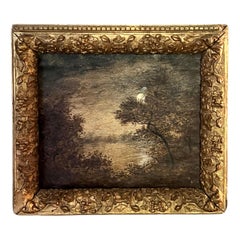
Ralph Albert Blakelock Original Oil Painting Evening Landscape with Moon
By Ralph Albert Blakelock
Located in Los Angeles, CA
Oil on Canvas Painting by Ralph Albert Blakelock. Know for his landscapes, Blakelock ((1847-1919, American), in this landscape captures lush landscape peaking beyond an open space wi...
Category

19th Century American Antique Los Angeles - Paintings

Materials

Canvas, Giltwood, Paint

Still Thinking About These?

All Recently Viewed