Manhattan - Decorative Art
to
180
521
11,146
5,059
483
25
13
Height
to
Width
to
48
18
11
8
6
3
2
2
2
2
1
1
1
1
1
11
86
386
38
165
114
49
32
19
66
34
26
22
10
12
19
3
296
265
88
49
48
283
231
179
133
52
521
510
510
7
6
6
5
3
Item Ships From: Manhattan
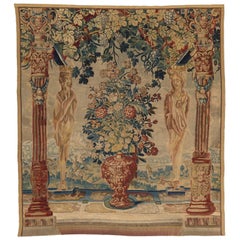
Antique 16th Century Pergola Tapestry with Vase of Flowers
Located in New York, NY
Antique pergola tapestry handwoven in wool and silk in Bruges, Belgium in the mid-16th Century.
Pergola tapestries are typified by a harmony between ...
Category
18th Century and Earlier Belgian Renaissance Antique Manhattan - Decorative Art
Materials
Silk, Wool, Tapestry
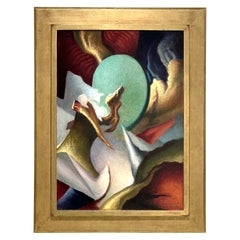
"FANTASY" Oil on Canvas by Thomas Hart Benton
By Thomas Hart Benton
Located in New York, NY
"FANTASY" by Thomas Hart Benton. Oil on canvas laid on wood with a gorgeous gold gilded frame. Price upon request.
Category
1940s American Mid-Century Modern Vintage Manhattan - Decorative Art
Materials
Canvas, Paint
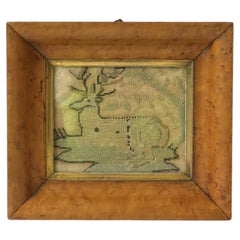
Buck Deer Animal Needlepoint Wall Art W/Birdseye Maple Frame Black Forest Style
Located in New York, NY
A buck deer animal needlepoint artwork wall art with Birdseye maple frame, circa 20th century, Europe.
Dimensions: 10.13" Width x 8.94" Height....
Category
Mid-20th Century European Black Forest Manhattan - Decorative Art
Materials
Glass, Birdseye Maple
Original Charles Kiffer Lithograph of Alhambra Theatre Maurice Chevalier
By Charles Kiffer
Located in New York, NY
This beautiful original Mid-Century Modern lithograph was created for the inauguration of the new Alhambra Theater, featuring Maurice Chevalier, circa 1948. It features the actor don...
Category
1940s American Mid-Century Modern Vintage Manhattan - Decorative Art
Materials
Paper

Vintage Persian Baktiari Oriental Rug, in Room size, w/ Medallion
Located in New York, NY
Vintage Persian Baktiari Oriental rug, Room size
A vintage Baktiari oriental rug, size 10'0" x 10'0", circa 1940. This handsome hand-woven geometric rug features a central medalli...
Category
1940s Persian Vintage Manhattan - Decorative Art
Materials
Wool

$5,116 Sale Price
20% Off
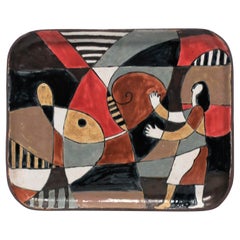
Abstract Artwork Painting Pottery Tray
Located in New York, NY
A very beautiful hand-crafted pottery artwork tray with abstract and figural design. A beautiful piece for a wall, table, vanity, or other. Colors include black, white, red/burgundy/...
Category
Late 20th Century Manhattan - Decorative Art
Materials
Ceramic, Terracotta, Pottery
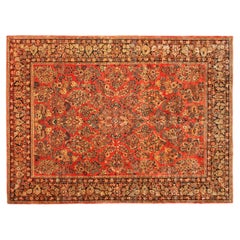
Antique Persian Sarouk Oriental Rug, in Room Size, with Intricate Floral Design
Located in New York, NY
Antique Persian Sarouk Oriental rug, circa 1920, room size.
An antique Persian Sarouk oriental rug, size 11'7" x 9'0", circa 1920. This lovely hand-knotted wool rug features an in...
Category
1920s Persian Vintage Manhattan - Decorative Art
Materials
Wool
$7,996 Sale Price
20% Off
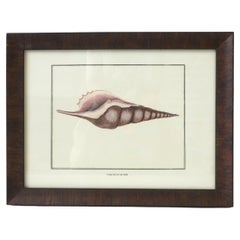
Italian Seashell Print Artwork Wall Art
Located in New York, NY
A beautiful Italian seashell framed print, circa late-20th century, Italy. Seashell print is from Florence, Italy, as reads on back white label. On fro...
Category
Late 20th Century Italian Manhattan - Decorative Art
Materials
Glass, Wood, Paper
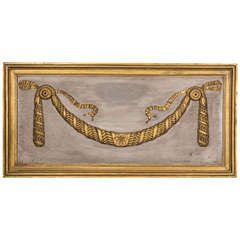
Italian, 18th Century Decorative Panel
By Bonzanigo
Located in New York, NY
A neoclassical painted and gilded overdoor panel in the manner of Giuseppe Maria Bonzanigo, circa 1790.
Category
1790s Italian Neoclassical Antique Manhattan - Decorative Art
Materials
Wood
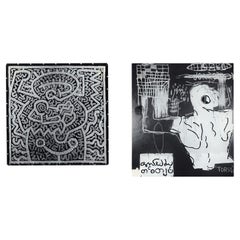
Modern Expressionists Catalogue 1984 (Basquiat Haring)
By Keith Haring
Located in Brooklyn, NY
Modern Expressionists Exhibition Catalogue 1984:
Published on the occasion of Modern Expressionists: German, Italian and American Painters by Sidney Janis Gallery. Featuring works by...
Category
1980s North American Mid-Century Modern Vintage Manhattan - Decorative Art
Materials
Paper
$200 Sale Price
20% Off
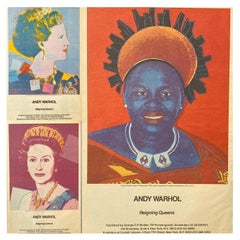
Warhol African Queens Advertisements, 1985
By Andy Warhol
Located in Brooklyn, NY
Vintage original advertisements for Warhol Queens at Leo Castelli gallery. Set of 3 circa 1985.
Offset print on newspaper stock.
Measures: 11 x 17 inches.
Minor signs of handling; o...
Category
1980s Vintage Manhattan - Decorative Art
Materials
Paper
$320 Sale Price / set
20% Off
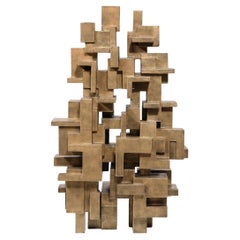
Modernist Isometric Grid Sculpture in Patented Gold Finish by Dan Schneiger
By Dan Schneiger
Located in New York, NY
This beautiful and dynamic isometric grid sculpture was realized by the esteemed American artist Dan Schneiger in the United States circa 2010. In dialo...
Category
2010s American Modern Manhattan - Decorative Art
Materials
Resin
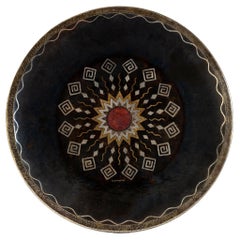
Claudius Linossier "Étoile Rayonnante" Dinanderie Copper Charger
By Claudius Linossier
Located in New York, NY
This rare French Art Deco monumental dinanderie copper charger, by Claudius Linossier, is composed of hammered copper and brass with geometric concentric and triangular silver patina...
Category
1930s French Art Deco Vintage Manhattan - Decorative Art
Materials
Silver, Brass, Copper
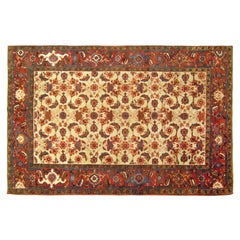
Antique Persian Heriz Karaja Oriental Rug, Small Size, w/ Herati Design
Located in New York, NY
Antique Persian Heriz Karaja Oriental rug, in small size.
An antique Persian Heriz Karaja oriental rug, size 6'0" x 4'8", ...
Category
1920s Persian Vintage Manhattan - Decorative Art
Materials
Wool
$4,476 Sale Price
20% Off
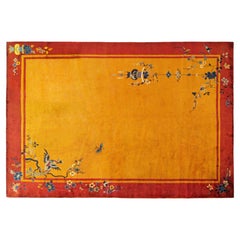
Antique Chinese Art Deco Oriental Rug, in Room Size, W Art Deco Motifs
Located in New York, NY
Antique Chinese Art deco Rug, Room size, circa 1920.
A one-of-a-kind antique Chinese Art deco oriental carpet, hand-knotted with medium th...
Category
1920s Persian Vintage Manhattan - Decorative Art
Materials
Wool
$5,116 Sale Price
20% Off
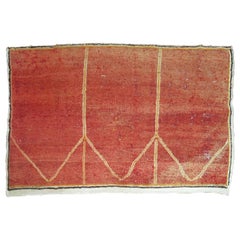
Zabihi Collection Antique Turkish Anatolian Throw Rug
Located in New York, NY
A quirky Mid-century Central Turkish Anatolian rug woven horizontally.
3'9'' x 5'9''
Category
20th Century Turkish Islamic Manhattan - Decorative Art
Materials
Wool
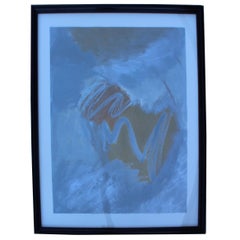
Rowann Villency Abstract Artwork
Located in New York, NY
1980s large abstract painting by NY artist Rowann Villency. With black lacquered frame and Lucite.
Artwork measurements height 48'', width 36.75".
Category
20th Century American Mid-Century Modern Manhattan - Decorative Art
Materials
Paper
$4,500 Sale Price
47% Off
Gray Blue 20th Century Antique Persian Oriental Rug Mat Size Rug
Located in New York, NY
Gray, light blue, brow, hint of red 20th century Persian Senneh mat size rug.
Measures: 1'7" x 2'8"
Antique Senneh rugs are one of the most distinc...
Category
20th Century Persian American Colonial Manhattan - Decorative Art
Materials
Wool
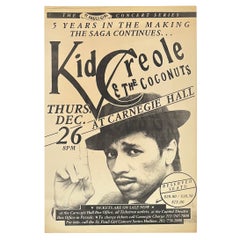
Vintage Kid Creole Concert Poster 1985
Located in Brooklyn, NY
Vintage Kid Creole and the Coconuts 1985 concert poster:
This rare Kid Creole and the Coconuts announcement/poster was published on the occasion of his December 26th, 1985 show at Carnegie Hall. This was the band's debut performance at Carnegie Hall, and it was written about in the New York Times: "THE POP LIFE; CARNEGIE HALL DEBUT FOR KID CREOLE" (December 25th, 1985).
Medium: Offset printed concert poster.
Dimensions: 11 x 17 inches.
Good overall vintage condition.
Unsigned from an edition of unknown.
American latin pop band founded by August Darnell aka Thomas Browder in 1980 in New York City. Fronted by Kid Creole (2) backed by the trio of The Coconuts and also featuring Coati Mundi, they enjoyed most of their success in the eighties. Their debut album was critically well-received but not successful commercially. Their second album was a concept album matched with a New York Public Theater stage production; it received positive reviews, with Darnell recognized as a clever lyricist and astute composer, arranger and producer. Their international breakthrough came with their third album, 1982's Tropical Gangsters, which hit #3 in the UK and spun off three Top 10 hits with Stool Pigeon, Annie, I'm Not Your Daddy and I'm A Wonderful Thing, Baby ; Dear Addy also made the Top 40. In the US the album was retitled Wise Guy and reached #145, and I'm a Wonderful Thing, Baby flirted with the R&B charts. Dixit Darnell: "In the Savannah Band I’d modelled my style on 1930s/40s jazz singer and showman Cab Calloway, and I created Kid Creole as an extreme version of that, a sort of lounge lizard...
Category
1980s American Mid-Century Modern Vintage Manhattan - Decorative Art
Materials
Paper
$240 Sale Price
20% Off
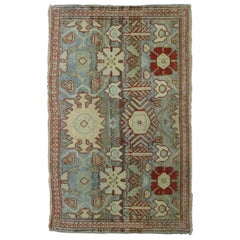
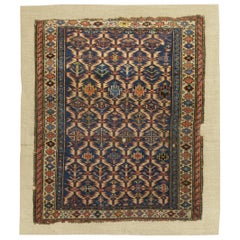
Zabihi Collection Antique Caucasian Rug Stitched on Linen
Located in New York, NY
A mid-19th-century Caucasian Kuba rug hand-stitched onto a canvas like Linen Fabric. This item can be used preferably as a wall piece or floor covering, and it can be walked on if de...
Category
19th Century Unknown Tribal Antique Manhattan - Decorative Art
Materials
Wool, Linen
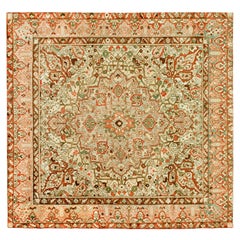
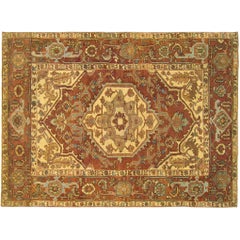
Antique Persian Serapi Oriental Rug, in Small Square Size, with Ivory Medallion
Located in New York, NY
An antique Persian Serapi oriental rug, size 6'2 x 5'0, circa 1900. This handsome hand-knotted wool rug features a rare ivory field at center, wit...
Category
Early 1900s Persian Antique Manhattan - Decorative Art
Materials
Wool
$5,996 Sale Price
25% Off
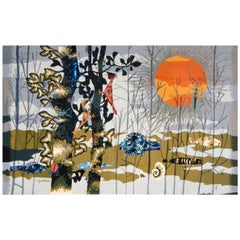
Rene Fumeron Aubusson Tapestry
By Rene Fumeron
Located in New York, NY
Mid-Century tapestry designed by Rene Fumeron (1921-2003) and woven at Atelier Pinton Freres in Aubusson, France. Woven in wool, it dates to 1964 and entitled "Comme La Lune". The a...
Category
Mid-20th Century French Mid-Century Modern Manhattan - Decorative Art
Materials
Wool, Tapestry
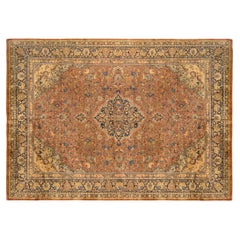
Antique Persian Sarouk Oriental Rug, in Room Size, with Central Medallion
Located in New York, NY
Antique Persian Sarouk oriental rug, circa 1920, room size.
An antique Persian Sarouk oriental rug, size 13'8"" x 10'0"", circa ...
Category
1920s Persian Vintage Manhattan - Decorative Art
Materials
Wool
$7,676 Sale Price
20% Off
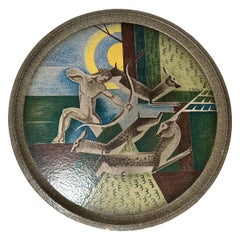
Glazed Earthenware Wall Plate by Ewald Dahlskog, Dated 1930
Located in New York, NY
Provenance:
Doctor Nils Stenram, Malmo
Then by descent
Dahlskog was one of Sweden's leading ceramic and glass artists in the 20th century. Ewald was a prominent designer of high-qua...
Category
1930s Swedish Vintage Manhattan - Decorative Art
Materials
Earthenware
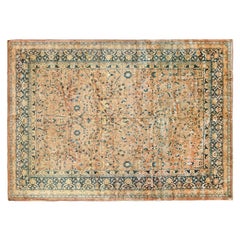
Antique Indian Agra Rug, Room Size, Allover Design and Flowers
Located in New York, NY
Antique Indian Agra Oriental rug, size 11'9" H x 9'0" W.
An antique Indian Agra Oriental Rug, size 11'9" H x 9'0" W, in Room size, circa 1910. This fine floral wool rug features a f...
Category
1910s Indian Vintage Manhattan - Decorative Art
Materials
Wool
$6,396 Sale Price
33% Off
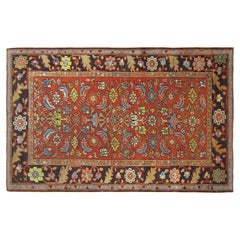
Antique Persian Bidjar Oriental Rug, in Small Size, with Herati Design
Located in New York, NY
Antique Persian Bidjar Rug, Small size, circa 1900.
A one-of-a-kind antique Persian Bidjar Oriental Carpet, hand-knotted with soft wool pile. This beautiful rug features a repeati...
Category
Early 1900s Persian Antique Manhattan - Decorative Art
Materials
Wool
$2,556 Sale Price
20% Off
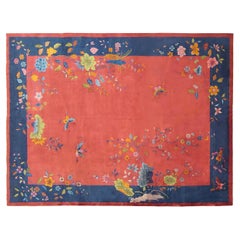
Antique Chinese Art deco Oriental Rug, in Room size W Chinese Motifs and Flowers
Located in New York, NY
Antique Chinese Art deco rug, Room size, circa 1920
A one-of-a-kind antique Chinese Art deco oriental carpet, hand-knotted with medium thi...
Category
1920s Persian Vintage Manhattan - Decorative Art
Materials
Wool
$3,836 Sale Price
31% Off
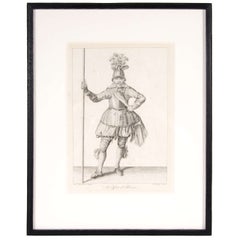
Antique Copper Engraving of an Officer of Pikeman by Francis Grose
By Francis Grose
Located in New York, NY
Francis Grose entered the army early in life and served in the cavalry, infantry, and militia.He had a profound knowledge of antiquities and spent the greater part of his life collec...
Category
19th Century English Renaissance Revival Antique Manhattan - Decorative Art
Materials
Paper
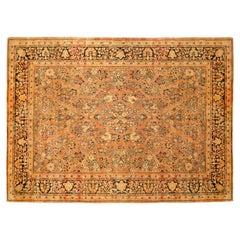
Vintage Persian Sarouk Oriental Rug, in Room Size, with Intricate Floral Design
Located in New York, NY
Vintage Persian Sarouk Oriental rug, circa 1930, Room size
A vintage Persian Sarouk oriental rug, size 10'1" x 8'3", circa 1930. This lovely hand-knotted wool rug features an intr...
Category
1930s Persian Vintage Manhattan - Decorative Art
Materials
Wool
$5,756 Sale Price
20% Off
Early 20th Century Armenian Pottery Plate from Jerusalem
Located in New York, NY
Extremely rare Armenian pottery plate depicting the mosaic floor at the ancient synagogue of Beit Alpha in Israel, circa 1920.
Jerusalem's ancient Arm...
Category
1920s Israeli Vintage Manhattan - Decorative Art
Materials
Pottery
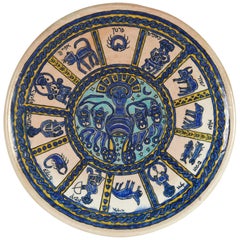
Antique Ferahan Sarouk Oriental Rug, in Small Size, with a Central Medallion
Located in New York, NY
Antique Ferahan Sarouk Oriental Rug, circa 1900, Small size
An antique Ferahan Sarouk oriental rug, size 6'5" x 4'4", circa 1900. This lovely hand-knotted wool rug features a centra...
Category
Early 1900s Persian Antique Manhattan - Decorative Art
Materials
Wool
$3,836 Sale Price
20% Off
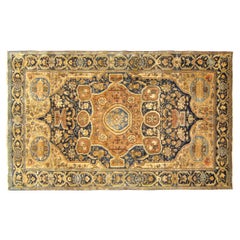
Antique Chinese Oriental Rug, in Room Size, W Open Field and Flowers
Located in New York, NY
Antique Chinese Art deco rug, Room size, circa 1920
A one-of-a-kind antique Chinese Art deco oriental carpet, hand-knotted with medium thi...
Category
1920s Persian Vintage Manhattan - Decorative Art
Materials
Wool
$5,756 Sale Price
28% Off
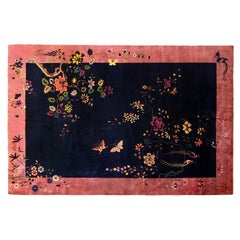
Antique Hand-Knotted Turkish Oushak Oriental Carpet
Located in New York, NY
Antique Turkish Oushak Decorative Oriental Carpet, Room size, with Red Field
A gorgeous antique Turkish Oushak carpet, circa 1920, size 13'5 x 10'7. This lovely carpet features mult...
Category
1920s European Vintage Manhattan - Decorative Art
Materials
Wool
$9,596 Sale Price
20% Off
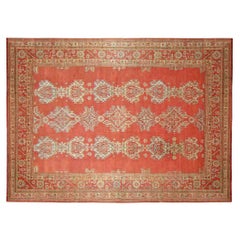
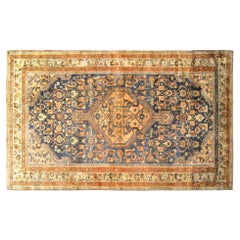
Antique Persian Hamadan Oriental Rug, in Small Size, w/ Central Medallion
Located in New York, NY
Antique Persian Hamadan Oriental rug, Small size
An antique Persian Hamadan oriental rug in small size, size 5'10”x 3'7”, circa 1920. This lovely hand-knotted carpet features a cent...
Category
1920s Persian Vintage Manhattan - Decorative Art
Materials
Wool
$1,916 Sale Price
20% Off
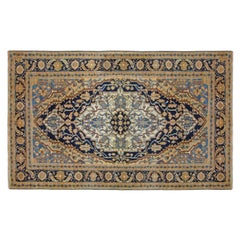
Antique Ferahan Sarouk Oriental Rug, in Small Size, with Central Medallion
Located in New York, NY
Antique Ferahan Sarouk oriental rug, circa 1910, small size
An antique Ferahan Sarouk oriental rug, size 6'8" x 4'2", circa 1910. This lovely...
Category
1910s Persian Vintage Manhattan - Decorative Art
Materials
Wool
$3,836 Sale Price
20% Off
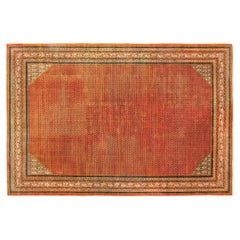
Vintage Persian Saraband Oriental Rug, in Room size, W/ Paisley Design
Located in New York, NY
Vintage Persian Saraband Rug, Room size, circa 1940
A one-of-a-kind vintage Persian Saraband Oriental Carpet, hand-knotted with thick and lustrous wool pile. This classic carpet...
Category
1940s Persian Vintage Manhattan - Decorative Art
Materials
Wool
$7,676 Sale Price
20% Off
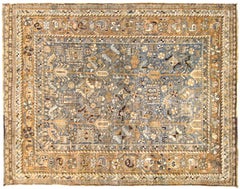
Vintage Persian Shiraz Oriental Rug, in Small Square Size, with Soft Earth Tones
Located in New York, NY
A vintage Persian Shiraz oriental rug, size 5'1 H; x 4'4 W, circa 1940. This lovely small hand-knotted wool carpet features a variety of stylized tribal design elements on the soft b...
Category
1940s Persian Vintage Manhattan - Decorative Art
Materials
Wool
$2,595 Sale Price
20% Off
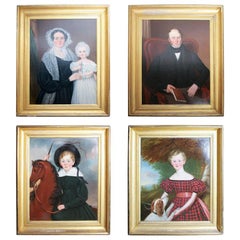
The Tollemache Family Set of Four Oil Paintings
Located in New York, NY
A beautiful example of English family portraits
The family of baron Tollemache have owned Helmington hall in Ipswich, England for hundreds of years and served as knights and squir...
Category
19th Century British Antique Manhattan - Decorative Art
$25,000 / set
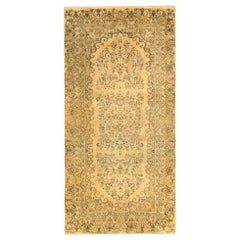
Antique Persian Kerman Oriental Rug, Runner Size, with Floral Elements
Located in New York, NY
Antique Persian Kerman oriental carpet, size 10'2" H x 4'9" W, circa 1920.
This antique hand-knotted Persian rug features a strik...
Category
1920s Persian Vintage Manhattan - Decorative Art
Materials
Wool
$6,396 Sale Price
20% Off
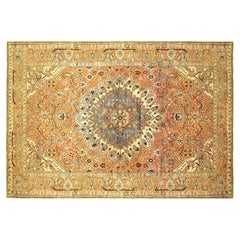
Vintage Persian Baktiari Oriental Rug, in Small Size, W/ Central Medallion
Located in New York, NY
Vintage Persian Baktiari Oriental rug, Small size
A vintage Baktiari oriental rug, size 8'2" x 5'5", circa 1940. This handsome hand-woven geometric rug features a central medallio...
Category
1940s Persian Vintage Manhattan - Decorative Art
Materials
Wool
$2,556 Sale Price
20% Off
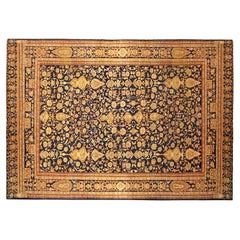
Antique Ferahan Sarouk Oriental Rug, in Room Size, with Intricate Floral Design
Located in New York, NY
Antique Ferahan Sarouk oriental rug, circa 1900, room size.
An antique Ferahan Sarouk oriental rug, size 12' 5" x 9' 0", circa 1900. This lovely hand-knotted wool rug features an in...
Category
Early 1900s Persian Antique Manhattan - Decorative Art
Materials
Wool
$12,796 Sale Price
20% Off
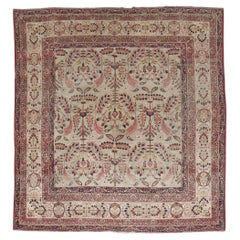
Zabihi Collection Lavar Kerman Large 19th Century Square Rug
Located in New York, NY
A worn square size late 19th century Lavar Kerman Rug with an all-over floral pattern on a pale green background
Details
rug no. j4794
size 9' 7" x 10' 10"
Category
Late 19th Century Romantic Antique Manhattan - Decorative Art
Materials
Wool
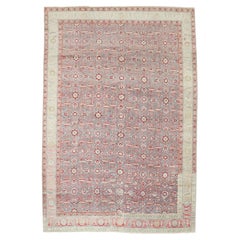
Zabihi Collection Antique Persian Tabriz Rug
Located in New York, NY
an early 20th Century Persian Tabriz Small Room size rug
Details
rug no. j4677
size 7' 1" x 9' 10" (216 x 300 cm)
Category
20th Century Persian American Colonial Manhattan - Decorative Art
Materials
Wool
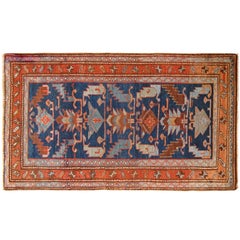
Antique Persian Hamadan Oriental Rug, Small Size, Geometric Design
Earth Tones
Located in New York, NY
An antique Persian Hamadan oriental rug, size 6'2 x 4'0, circa 1920. This small, handwoven wool carpet features a large-scale geometric design in the blue central field, which is enc...
Category
1920s Persian Vintage Manhattan - Decorative Art
Materials
Wool
$2,795 Sale Price
20% Off
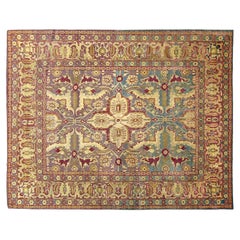
Antique Indian Agra Oriental Rug, Room Size, W/ Central Medallion
Located in New York, NY
Antique Indian Agra oriental rug, size 9'4" H x 8'0"
An antique Indian Agra oriental rug, size 9'4" H x 8'0" W, in Room size, circa 1890. This fine floral wool rug features a cent...
Category
1890s Indian Antique Manhattan - Decorative Art
Materials
Wool
$6,396 Sale Price
20% Off
Zabihi Collection Antique Persian Green Tabriz Rug
Located in New York, NY
Circa 1920 persian tabriz rug in greens and ruby red
Details
rug no. j1615
size 9' 4" x 11' 9" (284 x 358 cm)
Category
20th Century Persian American Colonial Manhattan - Decorative Art
Materials
Wool
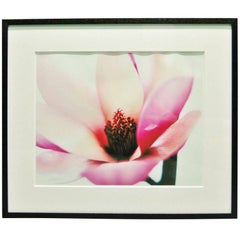
"Dogwood" Photograph by Sung An
By Sung An
Located in NYC, NY
A photograph by Sung An of the dogwood flower native to eastern North America.
Category
21st Century and Contemporary American Manhattan - Decorative Art
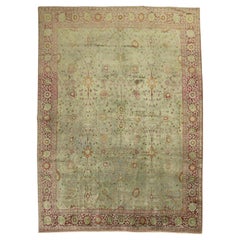
Antique Indian Lahore Oriental Rug, Room Size, W/ Symmetrical Design
Located in New York, NY
Antique Indian Lahore Oriental Rug, size 12'2" H x 9'0" W
An antique Indian Lahore Oriental Rug, size 12'2" H x 9'0" W, in Room size, circa 1890. This fine floral wool rug features...
Category
1890s Indian Antique Manhattan - Decorative Art
Materials
Wool
$9,596 Sale Price
25% Off
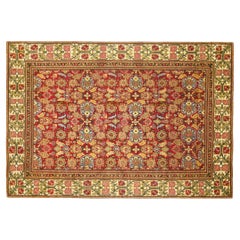
Antique Persian Heriz Karaja Oriental Rug, Small Size, w/ Multiple Medallions
Located in New York, NY
Antique Persian Heriz Karaja Oriental rug, size 5'7" x 4'9".
An antique Persian Heriz Karaja oriental rug, size 5'7" x 4'9...
Category
1910s Persian Vintage Manhattan - Decorative Art
Materials
Wool
$5,116 Sale Price
20% Off
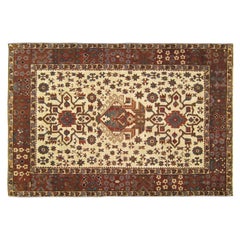
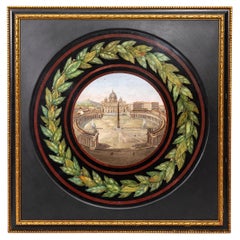
Large Antique Italian Micro Mosaic plaque of St. Peters Square, Rome mid 1800
s
By Vatican Mosaic Studio
Located in New York, NY
A Very Large and Exceptionally Fine Quality Antique Italian Micro-Mosaic Plaque Depicting "The Saint Peter Square" in Rome. The center medallion surrounded by a beautiful Laurel Wreath in multiple shades of Green Mosaic amidst a black Belgium Marble border. The interior rounded subject depicts Saint Peter Square which is found in Rome, Italy. The entire center panel is made up of a captivating array of tesserae in a variety of shapes and colors, which create this stunning mosaic construct. When inspected from up-close, small rectangular tesserae are found in an assortment of colors, which include: white, green, blue, red, black, brown, orange etc. When the subject is seen from afar, a fantastic image of the entire Saint Peter Square can be viewed as if a painting has been created. The oil on canvas of this scene, by was sold in Christie's Auction for over $2,000,000 USD. The plaque rests in a custom ebonized and gilt square frame. This can be used as a decorative object on the wall to serve as a painting, or, be converted to a table-top by mounting it on a table stand.
Rome, Circa: 1850
Giovanni Paolo Panini (Piacenza 1691-1765 Rome), View of Saint Peter's Square, Rome.
From Christie's Auction:
Giovanni Paolo Panini arrived in Rome in 1711, painting capricci and architectural pieces in a vigorous if slightly eccentric style, and by 1719, when he was admitted to the Academy of St. Luke and the virtuosi al Pantheon, he was a rising star in the Roman art world. From around 1719-1726 he was much in demand for decorative frescoes, including quadratura, ornament and landscape and other genres, often in collaboration with figure or flower painters. During this period he worked for Cardinal Patrizi at Villa Patrizi, Cardinal Annibale Albani at Palazzo Albani (now del Drago) alle Quattro Fontane, Livio de Carolis at Palazzo de Carolis, Cardinal Alberoni at Palazzo Alberoni, Innocent XIII Conti in the Quirinal and in the library of S. Croce in Gerusalemme. In 1724 he married Caterina Gosset, the sister-in-law of Nicolas Vleughels, the director of the French Academy in Rome, to which he was admitted in 1732, and as a result he was much patronized by the French. During the 1720s he developed his figure style away from the awkwardness of his early works into one that concentrated on groups of stylishly-dressed aristocrats and skillfully modelled bystanders, sibyls and pseudo-antique figures. These he noted down in drawings (such as a sketchbook in the British Museum) that he drew upon to populate his paintings. He also began to receive commissions to design and record temporary festivals, often for French ambassadors to Rome.
By the beginning of the 1730s Panini was developing a distinctive subgenre of the capriccio in which recognizable monuments are placed in imaginary topographical relationships, which were well-received in the classicizing era of Clement XII Corsini. In 1732 he was one of the panel of judges for the competition instituted by Clement for the Lateran façade, and in the following year painted an impressive View of Piazza del Quirinale for the pope. At about this time he was developing his best-known topographical subjects, interior views of St Peter's and the Pantheon, which were much in demand, to judge by the number of extant versions extending into the 1750s. By about 1734 he was beginning to attract the attention of English patrons, who ordered sets of Roman views, such as those at Marble Hill House (1738) and Castle Howard. In 1736, through Filippo Juvarra, he received important commissions from Philip V of Spain for scenes of the life of Christ in the Chinoiserie room at La Granja in Spain (1736). From as early as the 1720s he had been producing some vedute (view-paintings), initially based on prototypes by Gaspar van Wittel, and he developed the genre in subsequent decades in works that would include impressive panoramic views of the Forum or Palatine, although his staple genre was the capriccio rather than the veduta. He also expanded his repertory of church interiors, adding such churches as S. Paolo fuori le Mura and S. Agnese in Piazza Navona, as well as church interiors recording special events. His son by his first marriage, Giuseppe (1718-1805), began to support him in architectural and festival design projects.
By the 1740s Panini was at the peak of his powers, and evidently had a considerable workshop helping him meet demand, especially of capricci to be used as overdoors and other decorative installations. Giovanni Paolo was successful in elevating himself socially above the usual artisanal status of genre painters, and would sometimes include a self-portrait in paintings commissioned by the great and powerful. He also appears to have been successful financially, and owned a substantial palazzo in via Monserrato. He increasingly concentrated on important commissions, such as a view of the Lottery in Piazza Montecitorio (London, National Gallery, 1743-1744), the designs for the festival decorations for the birth of the Dauphin in Palazzo Farnese (Waddesdon Manor, 1751), or the view of an imaginary picture gallery housing the collection of Cardinal Valenti Gonzaga (Wadsworth Atheneum, 1749). In the mid-1750s he received an important series of commissions from the Duc de Choiseul, French ambassador to Rome and soon to become one of the most powerful men in France, that included his best-known compositions, Ancient Rome (Roma Antica) and Modern Rome (Roma Moderna). These large paintings, of which there are three sets (in Boston and Stuttgart, the Metropolitan Museum, and the Louvre) represent imaginary picture galleries based on the Valenti Gonzaga composition but hung with what purport to be Panini's own vedute of ancient and modern sites respectively (with corresponding pieces of sculpture). These paintings sum up the eighteenth-century canon of the greatest works of architecture and sculpture, and the equivalence between modern and ancient Rome. By this time Panini was being assisted by his son by his second marriage, Francesco (1748-1800), who was a skilled draughtsman and painter who continued his father's work after his death in 1765.
The Farnborough Hall paintings
The Piazza S. Pietro and the Campidoglio are important vedute by Panini painted in 1750 and originally installed, with other works by Panini and Canaletto, in the seat of the Holbech family, Farnborough Hall, Warwickshire (National Trust). Farnborough Hall had been inherited in 1717 by William Holbech (circa 1699-1771), who is documented on the Grand Tour in Florence, Rome and Venice from late 1732 until his return home at the end of April 1734 with his brother Hugh. Holbech is said to have gone on the Grand Tour to recover from a broken heart and to have spent a considerable time there prior to these documented appearances. During his time in Rome he acquired two Paninis, which were seen by an anonymous antiquary around 1746, who referred to various sculptures "all brought from Rome with two pictures, one of the Rotunda, and the other of diverse buildings by Panino" (British Library, Add. MS 6230, pp. 31-32). The Rotunda (the Pantheon) is a painting now in a private collection in New York, and is signed and dated 1734. The Diverse Buildings, which was probably one of Panini's capricci, has not been identified. On his Grand Tour Holbech seems also to have acquired two Canalettos, although they are not mentioned by the antiquary, who may only have had eyes for things Roman.
In about 1746-1747, Holbech remodelled the house by creating a Saloon, now the dining room, at the back of the house. This room, the entrance hall, the staircase, library and closet were stuccoed by William Perritt of York, and a bill for this work dated 14 November 1750 survives (or survived until recently; G. Beard, Decorative Plasterwork in Great Britain, London, 1975, p. 233). The two Canalettos acquired on the Grand Tour were installed in the Saloon, together with two new works commissioned from Canaletto, who was then in England and working nearby at Warwick Castle in 1748. The two Paninis acquired on the Grand Tour may have been installed in the Library, as Alastair Laing assumes (op. cit.), while three new works commissioned from Panini in Rome were placed in the Hall and Saloon: the Piazza S. Pietro for the overmantel in the Hall (fig. 1), the Campidoglio as the overmantel in the Saloon (fig. 2), and an Interior of St Peter's (now in Detroit) (fig. 3) on the adjacent wall facing the windows. Two of the Canalettos flanked the Campidoglio, while the others were on the opposite wall. The Interior of St Peter's was therefore effectively the fifth member of the Canaletto set, distinct from the two overmantels.
Holbech's installation of his Canalettos and Paninis in fixed stucco frames was unusual for England in 1750, and had probably been inspired by what he had seen on his Grand Tour in Northern Italy, where fixed stucco installations of canvases were common in the 1720s and 1730s (Cornforth, II, p. 51). The Campidoglio and the Interior of St Peter's are both signed and dated 1750, a date that corresponds to the payments for the stucco.
The commission for the new Paninis would have been made through an agent, possibly the Roman dealer in antiquities Belisario Amidei from whom some of the antique busts in the Hall were acquired in 1745, who was also a picture dealer; or perhaps the painter Pietro Berton, who on 7 December 1750 shipped a Panini to England.
The paintings were sold to Savile Gallery in 1929 and replaced by copies by one Mohammed Ayoub. The four Canalettos were exhibited at Savile Gallery in 1930 and entered the London art trade, finding their way at various times to Augsburg, Melbourne, Ottawa and a private collection. The Paninis seem to have been resold immediately to Knoedler & Co. in New York. When the stucco was removed from the library by Holbech's great-grandson, another William Holbech, shortly after his succession in 1812, the Interior of the Pantheon and the Diverse Buildings may have been taken down. Although there is no record of either painting being at Farnborough subsequently, the Interior of the Pantheon at least must have remained there, since it appeared at Knoedler's in 1930 at about the same time as the other Paninis, and was presumably acquired at the same time from the same source.
The Campidoglio was a rare subject for Panini: this is the only known extant version, apart from fictive versions in the Metropolitan Museum (1757) (figs. 4) and Louvre (1759) versions of his Roma Moderna composition (but not in the first Boston version of 1757). Probably Holbech insisted on the choice of subject in order to represent the centre of Rome's civic administration to complement the religious one of St Peter's. The Campidoglio may have been of interest to English patrons because it represented the seat of a form of government they were more comfortable with than the papacy. For example, Canaletto painted the subject, together with English subjects, for Thomas Hollis, 'the most bigoted of all Republicans' in 1755, who may have wanted to 'represent London as the heir to the legacy of Ancient Rome and Renaissance Italy' (see Michael Liversidge and Jane Farrington, eds., Canaletto and England, exhibition catalogue, Birmingham Museums and Art Gallery, London, 1993, p. 25). Canaletto also painted the subject for Sir Richard Neave, Ist Baronet (1731-1814) of Dagnam Park, Essex, at the end of his English stay or shortly afterwards (i.e. 1755-1766) (sold, Sotheby's, London, 10 July 2002, lot 8). Like Holbech, Neave mixed Venetian and Roman subjects, but his Roman subjects steer clear of St Peter's: the others were the Piazza del Quirinale and Piazza Navona. While Holbech had gone to both Venice and Rome and commissioned views of both cities, Rome sets the keynote for his decoration: antique busts line the Hall, and its religious and civic centres are the overmantels in the Hall and Saloon respectively.
The Piazza S. Pietro
The Piazza S. Pietro shows the piazza much as it appears today, apart from the absence of Valadier's late eighteenth-century clocks on the towers. Bernini's colonnade (1656-1667), both ends of which are visible, reaches out its arms to embrace the viewer. In the center of the piazza is the obelisk moved by Sixtus V in 1586 from the left side of the church where it had formed part of the Circus of Nero. On either side are two fountains, the one on the right by Carlo Maderno (1613) and the one on the left created to match it by Carlo Fontana in 1677. Beyond is the rectangular forecourt to the church, the piazza retta, leading to the façade by Maderno, completed in 1610, and the dome by Michelangelo, Giacomo della Porta and Domenico Fontana. To the right of the façade the roof of the Sistine Chapel is just visible, followed by the Cortile di S. Damaso, the palace of the Swiss Guards and the palace of Paul V. A Cardinal is being driven in a carriage across the piazza at the right in the direction of the Borgo Nuovo and Ponte S. Angelo with his blue-liveried retinue and subsidiary carriages. Unlike the later versions of the subject that depict the Duke de Choiseul, there seems to be no intent to portray any particular cardinal: the procession of a cardinal here is presented simply as characteristic activity within the piazza. Various groups of figures, including well-dressed women in brightly colored dresses, Swiss Guards, priests, gentlemen, idlers and a pilgrim are distributed around the piazza. In the foreground an imaginary heap of fallen masonry provides visual interest in an otherwise dead space.
Panini painted the Piazza S. Pietro on a number of occasions, and his works falls into two types, one with the viewpoint shifted slightly to left of the axis, as in the Farnborough Hall version, and one with it shifted slightly to the right. The first type is based on a composition by Gaspar van Wittel, of which there are numerous versions from 1684 until 1721 (Fig. 9 van Wittel). The work by Panini that seems closest to Van Wittel and therefore probably the earliest is the version in the Circolo della Caccia, Rome, which has been dated to the second half of the 1730s, but is probably a decade or so earlier. Another, on the London art market in 2002-2009, and a version with workshop participation at Sotheby's, Milan (20 November 2007, lot 137) and currently on the art market in Rome, are closer to an important painting in Toledo (Arisi no. 308) that is signed and dated 1741 (fig. 6).
Van Wittel employed a wide format (about 2:1), showed both of the end faces of the colonnade almost to their full extent, and introduced the theme of a heap of masonry to enliven the foreground. His choice of perspective implies a viewpoint located in the small piazza between the Borgo Nuovo and Borgo Vecchio, now the Piazza Pio XII at the top of the Via della Conciliazione. From this viewpoint a building at the left tended to interfere with the view of the end of the left arm, as can be seen from the Nolli map...
Category
1850s Italian Louis XVI Antique Manhattan - Decorative Art
Materials
Glass
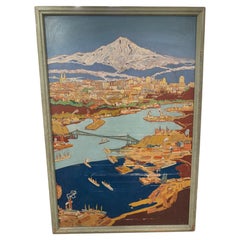
Pair of Mid-Century Alaskan Paintings
Located in New York, NY
Handpicked by Buyers at Ann-Morris Inc.
Category
Late 20th Century Manhattan - Decorative Art
Materials
Canvas
$19,950 / set
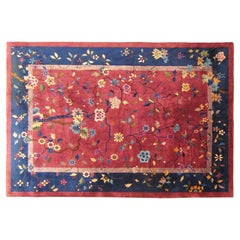
Antique Chinese Oriental Rug, in Room Size, with Flowers and Red and Blue Tones
Located in New York, NY
Antique Chinese rug, room size, circa 1920.
A one-of-a-kind antique Chinese oriental carpet, hand-knotted with medium thickness wool pile. This beautiful hand-knotted rug features f...
Category
1920s Persian Vintage Manhattan - Decorative Art
Materials
Wool
$3,996 Sale Price
20% Off
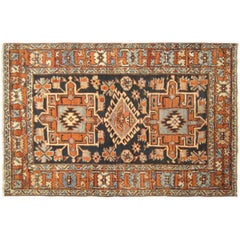
Antique Persian Heriz Karaja Oriental Rug, in Small Square Size with Jewel Tones
Located in New York, NY
An antique Persian Heriz Karaja oriental rug, circa 1920, size 4'2 x 3'7. This handsome hand-knotted wool rug features a symmetrical series of central medallions on the uncluttered n...
Category
1920s Persian Vintage Manhattan - Decorative Art
Materials
Wool
$2,595 Sale Price
20% Off
Vintage Persian Baktiari Oriental Rug, in Small Room size, w/ Medallion
Located in New York, NY
A vintage Persian Baktiari oriental rug, size 8'0" x 5'6", circa 1940. This brilliant handwoven wool carpet features a dynamic diamond-shaped medallion at center, surrounded by a var...
Category
1940s Persian Vintage Manhattan - Decorative Art
Materials
Wool
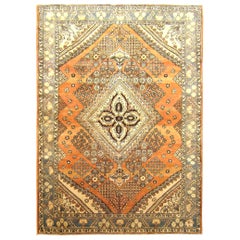
$3,196 Sale Price
20% Off
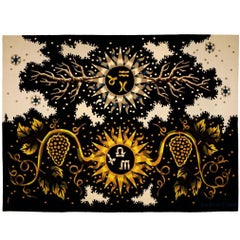
Jean Picart Le Doux Mid-Century Aubusson Tapestry
By Jean Picart Le Doux
Located in New York, NY
Mid-Century Aubusson tapestry designed by Jean Picart Le Doux (1902-1982) and handwoven at Atelier Pinton in Aubusson France. Woven in the mid-1960s, entitled "Autumn-Hiver", it depi...
Category
Mid-20th Century French Mid-Century Modern Manhattan - Decorative Art
Materials
Wool, Tapestry
Andrianna Shamaris Framed Courrèges Bonjour Scarf from Paris France
By Andrianna Shamaris
Located in New York, NY
Courrèges silk scarf in excellent condition found in Paris, France. Features bold pop-art style colors and shapes with the Courrèges logo. Set in ...
Category
2010s French Modern Manhattan - Decorative Art
Materials
Wood, Teak, Reclaimed Wood

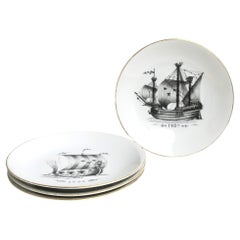
Swedish Rörstrand Nautical Black and White Porcelain Plates
By Rörstrand
Located in New York, NY
A beautiful set of four (4) Swedish nautical porcelain plates by Rörstrand, circa 20th century, Sweden. Plates are nautical themed with antique sailing ships...
Category
20th Century Swedish Manhattan - Decorative Art
Materials
Porcelain
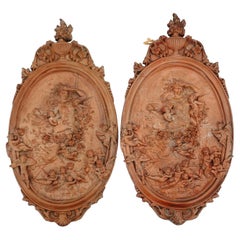
Pair Terracotta Neoclassical Bas-Relief Plaques Depicting Goddess and Angels
Located in New York, NY
Matched pair of bas-relief plaques in the neoclassical style crafted from molded plaster with terracotta patina, depicting a goddes among the clouds, surrounded by angels in flight.
Category
Mid-20th Century English Neoclassical Manhattan - Decorative Art
Materials
Plaster
Large Modern French Tapestry by J.L Viard
By J.L. Viard
Located in NYC, NY
A tapestry by French artist J.L Viard for Murmure des Sylves. Tightly woven wool and wool blends.
Signed on the front and again the reverse tag with an edition 21 of 100.
Category
1970s French Modern Vintage Manhattan - Decorative Art
Materials
Wool
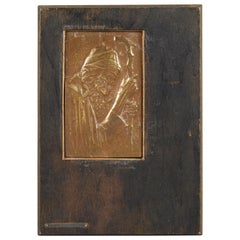
Early 20th Century Brass Plaque by Bezalel School Jerusalem
Located in New York, NY
Bezalel brass plaque depicting a Jewish elder next to the Western Wall, made in Jerusalem, circa 1920, bearing a small metal label engraved "Bezalel Jeru...
Category
Early 20th Century Israeli Manhattan - Decorative Art
Materials
Brass
Read More
At Colonial Williamsburg, Everything Old Is New Again
With the help of a new director, the Virginia institution's folk art and decorative arts museums are undergoing extensive upgrades.
New York’s Hirschl & Adler Showcases the American Workmanship and Design Panache of Neoclassical Treasures
The gallery's latest exhibition proves that museum-quality pieces entice and inspire, whether in traditional or more modern interiors.
Still Thinking About These?
All Recently ViewedMore Ways To Browse
Wedgwood Encaustic
White Ceramic Cat
White Ceramic Swan
Wicker Lounge Chair Outdoor
Widdicomb Hardware
Widdicomb Highboy
Wiener Werkstatte Bowl
Wiener Werkstatte Pottery
Wild Boar Tusk
William Eaton Sterling
William Hodgins
Williamsburg Shell Sterling Silver Flatware
Wind Dining Table
Wine Bottle Holder 7 Bottles
Wolf Carved
Woman Playing Harp
Wood Butter Churn
Wooden Deer