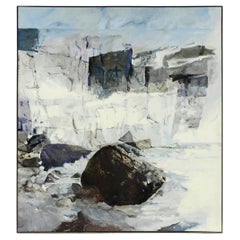
The Cliffs by Balcomb Greene painted in 1978. Signed on the front titled and dated on the reverse.
Paintings of the Montauk coast by Balcomb Greene are few and far between. This painting likely created at his Studio in Montauk New York. Painting is in excellent original condition and retains the original gallery frame.
provenance: Estate of Gertrude B. Pascal / Gifted from the previous in 1987, The Frances Lehman Loeb Art Center, Vassar College, Poughkeepsie, NY / Christie's, New York 2012 / Private Collection, New Jersey
Public collections:
Baltimore Museum of Art, Baltimore, MD
Brooklyn Museum, Brooklyn, NY
Cleveland Museum of Art, Cleveland, OH
The Art Institute of Chicago, Chicago, IL
Corcoran Gallery of Art, Washington, D.C.
Guild Hall, East Hampton, NY
Wadsworth Atheneum, Hartford, CT
Museum of Fine Arts, Houston, TX
Indianapolis Museum of Art, Indianapolis, IN
Metropolitan Museum of Art, New York, NY
Museum of Modern Art, New York, NY
National Museum of American Art, Washington, D.C.
Joslyn Art Museum, Omaha, NE
Pennsylvania Academy of the Fine Arts, Philadelphia, PA
Norton Simon Museum, Pasadena, CA
Portland Museum of Art, Portland, OR
Neuberger Museum, Purchase, NY
Solomon R. Guggenheim Museum, New York, NY
Parrish Museum, Southampton, NY
Whitney Museum of American Art, New York, NY
Walker Art Center, Minneapolis, MN
Butler Institute of American Art, Youngstown, OH
Boca Museum of Art, Boca Raton, FL
Over a lifespan of 86 years, Balcomb Greene followed his muse wherever it led, unfettered by what had come before, unafraid of where the future might lead. Despite a series of different pathways explored, his purpose remained ever constant: to express truth as he found it and communicate it to a broader audience. In the 1930s, Greene was a young artist committed to abstraction as his expressive language. Greene’s paintings and collages of the 1930s reflect the influence of Pablo Picasso and Piet Mondrian and put him in the company of fellow Americans, including Ibram Lassaw, Josef Albers, Ilya Boltowsky and George L. K. Morris, all among the founding members, in 1936, of American Abstract Artists.
John Wesley Greene, his christened name which he never legally changed, was born in 1904 in Millville, New York, the third child and only son of Methodist minister The Reverend Bertram Stillman Greene (1864–1929) and Florence Stover Greene (1876–1911). His family on both sides were Revolutionary-era colonists, originally living in Connecticut and Vermont before joining the Yankee migration to the western frontier of New York State. In 1922, John Wesley Greene enrolled at Syracuse University aided by a scholarship for the sons of Methodist ministers and intending to fulfill the promise of his name and follow his father into the ministry. As with so many before and after him, the liberal education he absorbed at Syracuse broadened his horizons and reshaped his life plan. Studying philosophy, psychology, and literature, along the way he separated himself from organized religion. During his senior year, on a visit to The Metropolitan Museum of Art in New York City, Greene was introduced to Gertrude Glass (1904–1956), an art student and the Brooklyn-born daughter of Latvian Jewish immigrants.
Following Greene’s graduation, the two married in 1926 and went to Europe. They stopped briefly in Paris but spent most of their time in Vienna where Greene had a fellowship to study psychology. When they returned to New York in 1927, Greene enrolled in a master’s program in ‘English literature at Columbia University. When his thesis advisor rejected his essay topic on the “fallen woman” in seventeenth-century literature as inappropriate, he left without a degree. From 1928 until 1931, Greene taught English at Dartmouth College in Hanover, New Hampshire. At some point, he stopped using his given name, John, and began to call himself, more distinctively, Balcomb, the family name of his paternal grandmother.
While Greene wrote three novels (all unpublished) during his teaching years at Dartmouth, his wife was a working artist, and he eventually developed an interest of his own in painting. In 1931, Greene gave up his teaching position and he and Gertrude went to Paris, determined to immerse themselves in the modern art ferment they had briefly experienced in their earlier visit. For young Americans with no prescribed agenda, a receptiveness to innovation, and wide-open eyes and minds. Paris, in 1931, offered a rich stew of approaches to modern art. The city absorbed and transmuted an international mélange of styles—cubism, orphism, futurism, dadaism, constructivism, neoplasticism, suprematism, de Stijl, Bauhaus—France encountering Holland, Germany, Italy, and Russia with Pablo Picasso from Spain, Constantin Brancusi from Romania, and Jacques Lipchitz from Lithuania. As a sculptor,
Gertrude Greene...