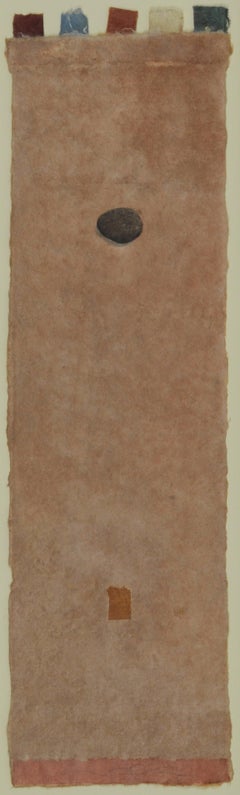
Ohio - Abstract Drawings and Watercolors
to
3
44
17
5
2
1
Overall Width
to
Overall Height
to
1
61
8
1
6
9
3
9
12
9
6
3
54
5
3
1
1
43
23
3
27
27
16
16
9
6
5
5
3
3
21
1
4,355
2,685
Item Ships From: Ohio
Sea Forms
By Ray H. French
Located in Fairlawn, OH
Signed and dated center right edge; Annotated "48" lower left
Provenance:
Estate of the artist
One of a suite of 120 drawings that the artist did in 1 month.
Most were sold thro...
Category
1960s Abstract Ohio - Abstract Drawings and Watercolors
Materials
Ink, Pen
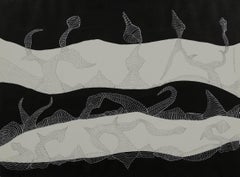
Untitled
By Peter Marks
Located in Fairlawn, OH
Unsigned
Provenance:
Estate of the artist
Peter Marks (1935 -2010)
Peter Marks was born in New York City on January 18, 1935. A lifetime New Yorker, Marks graduated from the Hig...
Category
21st Century and Contemporary Abstract Ohio - Abstract Drawings and Watercolors
Materials
Crayon
$450 Sale Price
50% Off
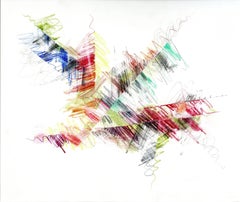
Untitled Abstraction
By Peter Marks
Located in Fairlawn, OH
Unsigned as per usual
Enamel paint and ink on tracing paper
Provenance:
Estate of the Artist
Peter Marks (1935 -2010)
Peter Marks was born in New York City on January 18, 1935....
Category
Early 2000s Abstract Ohio - Abstract Drawings and Watercolors
Materials
India Ink
$450 Sale Price
50% Off
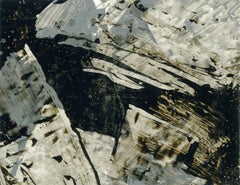
Untitled (Six Chinese Style Wash Drawings)
By Peter Marks
Located in Fairlawn, OH
Unsigned
Provenance:
Estate of the artist
Sheet: 14 x 17";
Image: 4 7/16 x 12"
Peter Marks (1935 -2010)
Peter Marks was born in New York City on January 18, 1935. A lifetime ...
Category
Early 2000s Abstract Ohio - Abstract Drawings and Watercolors
Materials
Ink
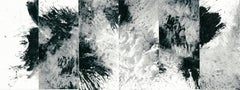
The Dead Tiger
By Dorothy Dehner
Located in Fairlawn, OH
The Dead Tiger
Ink and watercolor on paper, 1955
Signed and dated in ink (see photo)
Condition: Aging to the entire sheet (it's 78 years old)
Image/Sheet size: 18 1/4 x 23 inches
On...
Category
1950s Abstract Ohio - Abstract Drawings and Watercolors
Materials
Watercolor
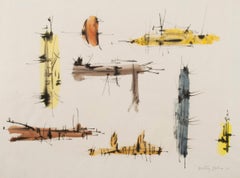

Untitled (Yellow, Gray and Pink)
By Gene Davis
Located in Fairlawn, OH
Untitled (Yellow, Gray and Pink)
Pastel on paper, 1981
Signed and dated lower right
Condition: Excellent
Sheet size: 12 x 18 inches
Frame size: 15 x 21 inches
Provenance: Jan Cowles
...
Category
1980s Abstract Ohio - Abstract Drawings and Watercolors
Materials
Pastel
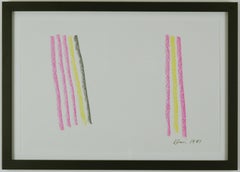
Untitled (Inspired by a Chinese scroll painting)
By Peter Marks
Located in Fairlawn, OH
Untitled (Inspired by a Chinese scroll painting)
Collage with ink on 6 paper elements
Unsigned
Provenance: Estate of the Artist
Condition: Excellent
Image size: 4 x 12 inches
Support...
Category
Early 2000s Abstract Ohio - Abstract Drawings and Watercolors
Materials
Ink
Black and White Cat
By Sam Spanier
Located in Fairlawn, OH
Black and White Cat
Ink and watercolor on paper, c. 1970
Unsigned
Provenance:
Estate of the artist (Estate No. 737)
Condition: Excellent
Image/Sheet size: 4 3/4 x 6 1/4 inches
Sam Spanier (1925-2008)
Born in Brooklyn New York, Sam Spanier studied painting with Hans Hofmann (1949–50) and also at the Taos Valley Art School (1951). His formative years as a working artist were spent in Paris (1951–52), where he also became involved with the work of G. I. Gurdjieff, through his disciple, Mme. Jeanne de Salzmann.
By 1953, Spanier’s work had already begun to meet with critical acclaim. That year, he had his first solo gallery show, and was selected by Milton Avery and Hans Hofmann to receive the prestigious Lorian Fund Award. His second solo exhibition, in 1955, was curated by renowned museum director, Gordon Washburn. Spanier’s early work was reviewed by Dore Ashton, Donald Judd, Fairfield Porter, Stuart Preston, and Irving Sandler, among other significant critics of the period.
Spanier’s spiritual path increasingly became the central focus of both his life and his art. In 1960, he was introduced to the teachings of Sri Aurobindo, which led to visits to the Sri Aurobindo Ashram in Pondicherry, India, in 1962 and 1964, during which he was inspired to leave New York City and found Matagiri (in 1968)—a spiritual center in Woodstock, New York—with his lifelong partner, Eric Hughes. The work he embarked upon there bifurcates his life as an artist, separating him from New York’s art world, and radically altering the trajectory of his career. From that point forward, it would be difficult, perhaps impossible, to consider his artistic endeavor apart from the life of dedication he had undertaken, and to which he remained committed.
As early as 1954, Dore Ashton had recognized in Sam Spanier a “haptic visionary;” in 1960, Irving Sandler wrote that the people in Spanier’s paintings “seem to have witnessed some transfiguring event.” In his later paintings—usually worked in oil pastel on panel or paper—made during intermittent creative periods, from the mid-1970s to the final years of his life, the artist’s inner life remains always apparent in his subject matter; and from the portraits and abstract Buddha-like figures and heads, to the fantasy landscapes, the paintings are redolent with a rich intensity of color and light that can only be described as inspired.
Sam Spanier’s works are in the collections of the Historical Society of Woodstock Museum, and the Woodstock Artists Association & Museum. He received the Woodstock Artists Association Lifetime Achievement Award in 2007.
Selected Solo Exhibitions:
Urban Gallery, New York (1954, 1955, 1956); Wittenborn Gallery, New York (1958); Gallery Mayer, New York (1958, 1959, 1960); Unison Gallery, New Paltz (1986, 1995, 2009); Limner Gallery, New York (1988); Fletcher Gallery, Woodstock, New York (1999).
Selected Group Exhibitions:
Salon des Comparaisons, Musée d’Art Moderne, Paris, France (1952); October Exhibition of Oil Paintings, New York City Center Gallery, New York (1954); Salon de Mai, Musée d’Art moderne de la ville de Paris, Centre Culturel de Saint-Germain-en-Laye, Paris, France (1954); Carnegie International, Carnegie Institute, Pittsburgh, Pennsylvania (1955); Les Plus Mauvais Tableaux, Galerie Prismes, Paris (1955);
Première Exposition Internationale de l’Art Plastique Contemporain, Musée des Beaux-Arts de la Ville de Paris (1956); Recent Paintings USA: The Figure, The Museum of Modern Art (1960); Winter’s Work, Woodstock Artists Association, Woodstock, New York (1985); Juried Group Show, Woodstock Artists Association, Woodstock, New York (1986); Woodstock Artists, Self-Portraits, Historical Society of Woodstock Museum, Woodstock, New York (1988); Portraits, Albert Shahinian Fine Art, Poughkeepsie, New York (2003); The World We Live In, Upstate Art, Phoenicia, New York (2003); Show of Heads, Limner Gallery, Phoenicia, New York (2004).
Selected Writings on the Artist:
Dore Ashton, “Sam Spanier,” Art Digest (May 1, 1954) and “Sam Spanier,” The New York Times (March 16, 1960); Cassia Berman, “Sam Spanier: A Divine Calling,” Woodstock Times (February 7, 2008); Lawrence Campbell, “Sam Spanier: Exhibition of Paintings at Urban Gallery,” Art News...
Category
1970s Abstract Ohio - Abstract Drawings and Watercolors
Materials
Ink, Watercolor
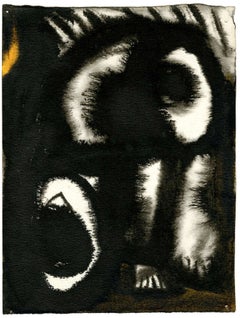
Chorus Line
By Sam Spanier
Located in Fairlawn, OH
Chorus Line
Oil pastel on paper, c. 1960's
Signed (see photo)
Provenance: Estate of the Artist
Estate of the artist (Estate No. 745)
Condition: Excellent
Image/Sheet size: 5 3/4 x 4 inches
Sam Spanier (1925-2008)
Born in Brooklyn New York, Sam Spanier studied painting with Hans Hofmann (1949–50) and also at the Taos Valley Art School (1951). His formative years as a working artist were spent in Paris (1951–52), where he also became involved with the work of G. I. Gurdjieff, through his disciple, Mme. Jeanne de Salzmann.
By 1953, Spanier’s work had already begun to meet with critical acclaim. That year, he had his first solo gallery show, and was selected by Milton Avery and Hans Hofmann to receive the prestigious Lorian Fund Award. His second solo exhibition, in 1955, was curated by renowned museum director, Gordon Washburn. Spanier’s early work was reviewed by Dore Ashton, Donald Judd, Fairfield Porter, Stuart Preston, and Irving Sandler, among other significant critics of the period.
Spanier’s spiritual path increasingly became the central focus of both his life and his art. In 1960, he was introduced to the teachings of Sri Aurobindo, which led to visits to the Sri Aurobindo Ashram in Pondicherry, India, in 1962 and 1964, during which he was inspired to leave New York City and found Matagiri (in 1968)—a spiritual center in Woodstock, New York—with his lifelong partner, Eric Hughes. The work he embarked upon there bifurcates his life as an artist, separating him from New York’s art world, and radically altering the trajectory of his career. From that point forward, it would be difficult, perhaps impossible, to consider his artistic endeavor apart from the life of dedication he had undertaken, and to which he remained committed.
As early as 1954, Dore Ashton had recognized in Sam Spanier a “haptic visionary;” in 1960, Irving Sandler wrote that the people in Spanier’s paintings “seem to have witnessed some transfiguring event.” In his later paintings—usually worked in oil pastel on panel or paper—made during intermittent creative periods, from the mid-1970s to the final years of his life, the artist’s inner life remains always apparent in his subject matter; and from the portraits and abstract Buddha-like figures and heads, to the fantasy landscapes, the paintings are redolent with a rich intensity of color and light that can only be described as inspired.
Sam Spanier’s works are in the collections of the Historical Society of Woodstock Museum, and the Woodstock Artists Association & Museum. He received the Woodstock Artists Association Lifetime Achievement Award in 2007.
Selected Solo Exhibitions:
Urban Gallery, New York (1954, 1955, 1956); Wittenborn Gallery, New York (1958); Gallery Mayer, New York (1958, 1959, 1960); Unison Gallery, New Paltz (1986, 1995, 2009); Limner Gallery, New York (1988); Fletcher Gallery, Woodstock, New York (1999).
Selected Group Exhibitions:
Salon des Comparaisons, Musée d’Art Moderne, Paris, France (1952); October Exhibition of Oil Paintings, New York City Center Gallery, New York (1954); Salon de Mai, Musée d’Art moderne de la ville de Paris, Centre Culturel de Saint-Germain-en-Laye, Paris, France (1954); Carnegie International, Carnegie Institute, Pittsburgh, Pennsylvania (1955); Les Plus Mauvais Tableaux, Galerie Prismes, Paris (1955);
Première Exposition Internationale de l’Art Plastique Contemporain, Musée des Beaux-Arts de la Ville de Paris (1956); Recent Paintings USA: The Figure, The Museum of Modern Art (1960); Winter’s Work, Woodstock Artists Association, Woodstock, New York (1985); Juried Group Show, Woodstock Artists Association, Woodstock, New York (1986); Woodstock Artists, Self-Portraits, Historical Society of Woodstock Museum, Woodstock, New York (1988); Portraits, Albert Shahinian Fine Art, Poughkeepsie, New York (2003); The World We Live In, Upstate Art, Phoenicia, New York (2003); Show of Heads, Limner Gallery, Phoenicia, New York (2004).
Selected Writings on the Artist:
Dore Ashton, “Sam Spanier,” Art Digest (May 1, 1954) and “Sam Spanier,” The New York Times (March 16, 1960); Cassia Berman, “Sam Spanier: A Divine Calling,” Woodstock Times (February 7, 2008); Lawrence Campbell, “Sam Spanier: Exhibition of Paintings at Urban Gallery,” Art News (April 1, 1954); Sam Feinstein, “Sam Spanier: Exhibition of Paintings at Urban Gallery,” Art Digest (March 1, 1955); Pat Horner, “Big Heart, Timeless Art —Sam Spanier Retrospective at Fletcher Gallery, Woodstock Times (July 1, 1999); Donald Judd, “In the Galleries: Sam Spanier,” Arts Magazine (April 1960); Liam Nelson, “Human Force...
Category
1960s Abstract Ohio - Abstract Drawings and Watercolors
Materials
Oil Crayon
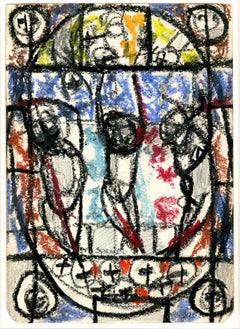
Untitled
By Shoichi Ida
Located in Fairlawn, OH
Untitled
molded mud-dried paper with collage elements, 1996
Signed and dated lower edge (see photo)
Annotated and titled verso
Sheet size: 24 x 7 inches
Provenance: Ralph Drake, fir...
Category
1990s Abstract Ohio - Abstract Drawings and Watercolors
Materials
Mixed Media