South Carolina - Figurative Prints
to
20
171
13
1
Overall Width
to
Overall Height
to
81
16
9
5
3
3
1
13
9
6
6
6
9
11
164
1
2
8
45
56
33
3
4
4
1
6
108
72
2
120
64
58
49
34
32
20
18
13
10
9
8
7
7
6
6
6
6
5
5
58
53
36
27
11
19,286
17,432
Item Ships From: South Carolina
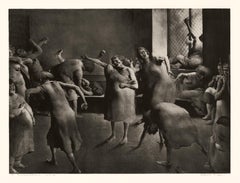
Psychopathic Ward
— Socially-Conscious Realism
By Robert Riggs
Located in Myrtle Beach, SC
Robert Riggs, 'Psychopathic Ward', 2-color lithograph, c. 1940, edition c. 50, Beall 60, Bassham 78. Signed, titled, and numbered '14' in pencil. Signed in the stone, lower right. A ...
Category
1940s Realist South Carolina - Figurative Prints
Materials
Lithograph
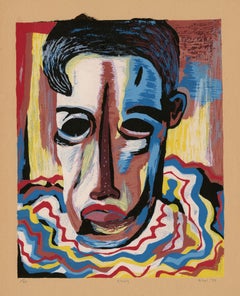
Clown
— WPA American Expressionism
By Leon Bibel
Located in Myrtle Beach, SC
Leon Bibel, 'Clown', color serigraph, 1939, edition 20. Signed, dated, titled, and numbered '/20' in pencil. A fine, richly-inked, painterly impression, with fresh colors, on buff la...
Category
1930s American Modern South Carolina - Figurative Prints
Materials
Screen
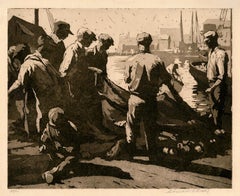
Mending Nets
— Cape Ann Regionalism, Rockport
Located in Myrtle Beach, SC
Christian Dull, 'Mending Nets', aquatint, c. 1930, edition 50. Signed and numbered '50/-' in pencil. A fine impression, on cream laid paper, the full sheet with margins (1/2 to 1 1/2...
Category
1920s American Modern South Carolina - Figurative Prints
Materials
Aquatint
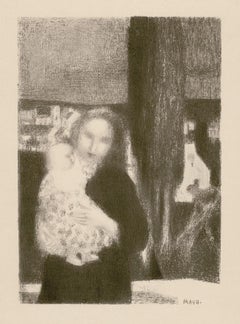
Untitled (Mother and Child)
By Maurice Denis
Located in Myrtle Beach, SC
Maurice Denis, Untitled (Mother and Child), lithograph, 1897, edition not stated. Signed in the stone, lower right. Annotated in linotype 'MAURICE DENIS, ORIGINAL LITHOGRAPHIE PAN III' in the lower left sheet corner. A fine, atmospheric impression, in warm, dark gray ink, on buff wove paper, with full margins (2 1/2 to 1 3/4 inches); a small discoloration in the bottom left sheet corner, otherwise in good condition. Image size 8 5/8 x 6 7/8 inches; sheet size 13 7/8 x 10 5/8 inches. As published in 'Pan', the leading German magazine of the period devoted to art and literature. Matted to museum standards, unframed.
Collection: Los Angeles County Museum of Art.
Reproduced: German Expressionist Prints...
Category
1890s Symbolist South Carolina - Figurative Prints
Materials
Lithograph
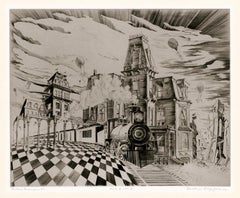
Fantasia Americana, 1880
— Mid-Century American Surrealism
By Lawrence Kupferman
Located in Myrtle Beach, SC
Lawrence Kupferman, 'Fantasia Americana – 1880', drypoint etching with sandground, 1943. Signed, titled, and annotated 'Series A, 1971 2/6' in pencil. A superb, richly-inked impression, on heavy, cream wove paper, with full margins (2 1/2 to 3 1/2 inches); the paper slightly lightened within the original mat opening, otherwise in excellent condition. One of only 6 impressions printed in 1971, with the added sandground grey background tint. Archivally matted to museum standards, unframed.
Image size 11 13/16 x 14 3/4 inches; sheet size 18 x 20 1/4 inches.
Collections: National Gallery of Art, Zimmerli Art Museum (Rutgers University).
ABOUT THE ARTIST
Lawrence Kupferman (1909 - 1982) was born in the Dorchester neighborhood of Boston and grew up in a working-class family. He attended the Boston Latin School and participated in the high school art program at the Museum of Fine Arts, Boston. In the late 1920s, he studied drawing under Philip Leslie Hale at the Museum School—an experience he called 'stultifying and repressive'. In 1932 he transferred to the Massachusetts College of Art, where he first met his wife, the artist Ruth Cobb. He returned briefly to the Museum School in 1946 to study with the influential expressionist German-American painter Karl Zerbe.
Kupferman held various jobs while pursuing his artistic career, including two years as a security guard at the Museum of Fine Arts, Boston. During the 1930s he worked as a drypoint etcher for the Federal Art Project, creating architectural drawings in a formally realistic style—these works are held in the collections of the Fogg Museum and the Smithsonian American Art Museum. In the 1940s he began incorporating more expressionistic forms into his paintings as he became progressively more concerned with abstraction. In 1946 he began spending summers in Provincetown, Massachusetts, where he met and was influenced by Mark Rothko, Hans Hofmann, Jackson Pollock, and other abstract painters. At about the same time he began exhibiting his work at the Boris Mirski Gallery in Boston.
In 1948, Kupferman was at the center of a controversy involving hundreds of Boston-area artists. In February of that year, the Boston Institute of Modern Art issued a manifesto titled 'Modern Art and the American Public' decrying 'the excesses of modern art,' and announced that it was changing its name to the Institute of Contemporary Art (ICA). The poorly conceived statement, intended to distinguish Boston's art scene from that of New York, was widely perceived as an attack on modernism. In protest, Boston artists such as Karl Zerbe, Jack Levine, and David Aronson formed the 'Modern Artists Group' and organized a mass meeting. On March 21, 300 artists, students, and other supporters met at the Old South Meeting House and demanded that the ICA retract its statement. Kupferman chaired the meeting and read this statement to the press:
“The recent manifesto of the Institute is a fatuous declaration which misinforms and misleads the public concerning the integrity and intention of the modern artist. By arrogating to itself the privilege of telling the artists what art should be, the Institute runs counter to the original purposes of this organization whose function was to encourage and to assimilate contemporary innovation.”
The other speakers were Karl Knaths...
Category
1940s Surrealist South Carolina - Figurative Prints
Materials
Drypoint, Etching

$680 Sale Price
20% Off
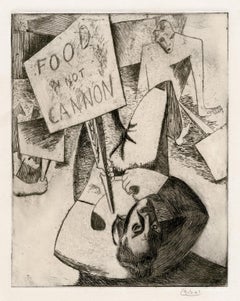
Food Not Cannon
— WPA Modernist Work of Social Conscience
By Leon Bibel
Located in Myrtle Beach, SC
Leon Bibel, 'Food Not Cannon', etching, 1937, edition 12 (an early state, probably unique). Signed in pencil. A fine impression, on cream wove paper, with full margins (7/8 to 2 1/8 ...
Category
1930s American Modern South Carolina - Figurative Prints
Materials
Etching
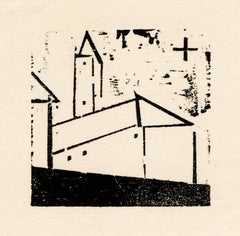
Church with Star
– Artist
s Personal Letterhead, Bauhaus Modernism
By Lyonel Feininger
Located in Myrtle Beach, SC
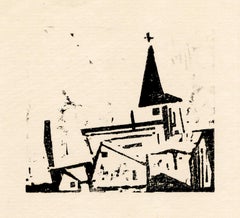
Lyonel Feininger, 'Church with Star (Kirche mit Stern)', woodcut, 1936, one of a small but unknown number of letterhead proofs; Prasse W265. Annotated 'W 265' (Feininger catalogue number) and inventory no. '2808' in pencil, in the bottom right sheet corner. A fine impression, on cream, laid letterhead stock; hinge remains on the left and right top sheet edges, verso, in excellent condition. Very scarce.
Image size 2 3/8 x 2 3/8 inches; sheet size 10 1/16 x 7 1/16 inches. Archivally sleeved, unmatted.
ABOUT THE ARTIST
Lyonel Feininger (1871-1956) was born in New York City into a musical family—his father was a violinist and composer, his mother was a singer and pianist. He studied violin with his father, and by the age of 12, he was performing in public, but he also drew incessantly, most notably the steamboats and sailing ships on the Hudson and East Rivers, and the landscape around Sharon, Conn., where he spent time on a farm owned by a family friend. At the age of 16 he left New York to study music and art in Germany, from where his parents emigrated. Drawn more to the visual arts, he attended schools in Hamburg, Berlin, and Paris from 1887 to 1892.
After completing his studies, Feininger began his artistic career as a cartoonist and illustrator, his originality leading him to great success. In 1906, after working for a dozen years in Germany, he was offered a job as a cartoonist at the Chicago Tribune, the largest circulation newspaper in the Midwest. He worked there for a year, inventing what became the standard design for the comic strip: in the words of John Carlin, “an overall pattern. . . that allowed the page to be read both as a series of elements one after the other, like language and as a group of juxtaposed images, like visual art.” His originality did not end there: he went on to become one of the great abstract painters. Like Kandinsky, music was his model, but Kandinsky only knew music from the outside—as a listener (inspired initially by Wagner, then by Schoenberg)—while Feininger knew it from the inside. He lived in Paris from 1906 to 1908, during which time he met and was influenced by the work of progressive painters Robert Delaunay and Jules Pascin, as well as that of Paul Cezanne and Vincent van Gogh. He began painting full-time, developing his distinctive Iyrical style based on Cubist and Expressionist idioms and a concern for the emotive qualities of light and color. He exhibited with the Der Blaue Reiter group in 1913, and in 1917, he had his first solo exhibition at Galerie Der Sturm in Berlin.
One year after his solo exhibition, in 1918, Feininger began making woodcuts. He became enamored with the medium, producing an impressive 117 in his first year of exploring the printmaking medium. In 1919 at the invitation of the architect Walter Gropius, he was appointed the first master at the newly formed Staatliches Bauhaus in Weimar. His woodcut of a cathedral crowned...
Category
1930s Bauhaus South Carolina - Figurative Prints
Materials
Woodcut
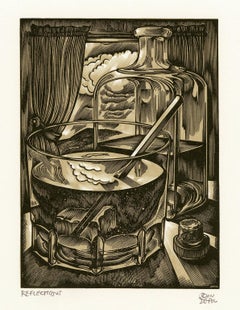
Reflections
By John DePol
Located in Myrtle Beach, SC
John DePol, 'Reflections', chiaroscuro wood engraving, 1979, edition 160 in 1983. Signed, dated and titled in pencil. Signed in the block, lower right. A superb impression, on cream ...
Category
1970s American Modern South Carolina - Figurative Prints
Materials
Woodcut
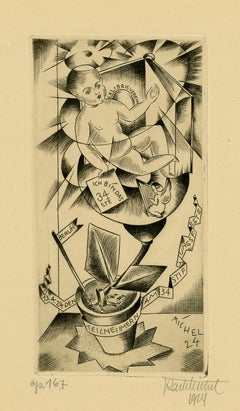
Ex Libris Verein
— 1920s German Expressionism
By Karl Michel
Located in Myrtle Beach, SC
Karl Michel, 'Ex Libris Verein' (New Year's Ex Libris Club Announcement), etching, 1924. Signed, dated, and numbered 'op. 167' in pencil. Signed and dated in...
Category
1920s Expressionist South Carolina - Figurative Prints
Materials
Etching
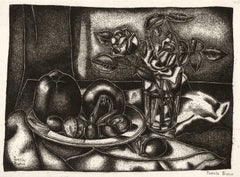
Fruit Piece
— American Modernism, Woman Artist
Located in Myrtle Beach, SC
Pamela Bianco, 'Fruit Piece', lithograph, c. 1925. Signed and titled in pencil. Signed in the stone, lower left. Annotated 'No. 8' in pencil, upper right...
Category
1920s American Modern South Carolina - Figurative Prints
Materials
Lithograph
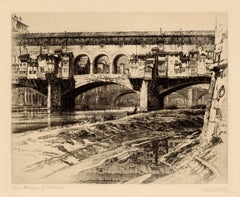
Bridges of Florence
— Firenze Impressionism
Located in Myrtle Beach, SC
Alonzo C. Webb, 'Bridges of Florence', etching, 1929, edition 100. Signed and titled in pencil. Signed and dated in the plate, lower left. A superb, richly-inked impression, in warm ...
Category
1920s American Impressionist South Carolina - Figurative Prints
Materials
Etching
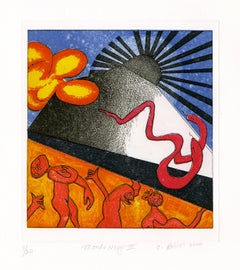
Mondo Negro III
— African American artist
By Camille Billops
Located in Myrtle Beach, SC
Camille Billops, 'Mondo Negro III', color etching, 2000, edition 20. Signed, dated, titled, and numbered '7/20' in pencil. A superb, richly-inked impre...
Category
Early 2000s Contemporary South Carolina - Figurative Prints
Materials
Etching
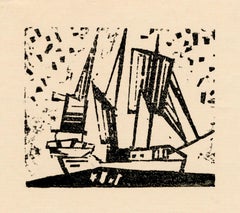
Three Masted Ship, 2
– Artist
s Personal Letterhead, Bauhaus Modernism
By Lyonel Feininger
Located in Myrtle Beach, SC
Lyonel Feininger, 'Three Masted Ship, 2 (Dreimastiges Schiff, 2)', woodcut, 1937, one of a small but unknown number of letterhead proofs; Prasse W296. Feininger estate stamp and inventory no. 'W 865' in pencil, bottom left sheet corner. Annotated 'W 296' and 'on block : 3702a' in pencil, bottom right sheet corner.
A fine impression, on cream, laid, letterhead stock; hinge remains on the left and right top sheet edges, verso, in excellent condition. Very scarce.
Image size 2 1/4 x 2 11/16 inches; sheet size 10 x 6 3/4 inches. Archivally sleeved, unmatted.
Exhibited: 'Lyonel Feininer, Woodcuts Used As Letterheads'; Associated American Artists; Feb 4 - March 2, 1974; New York, NY.
ABOUT THE ARTIST
Lyonel Feininger (1871-1956) was born in New York City into a musical family—his father was a violinist and composer, his mother was a singer and pianist. He studied violin with his father, and by the age of 12, he was performing in public, but he also drew incessantly, most notably the steamboats and sailing ships on the Hudson and East Rivers, and the landscape around Sharon, Conn., where he spent time on a farm owned by a family friend. At the age of 16 he left New York to study music and art in Germany, from where his parents emigrated. Drawn more to the visual arts, he attended schools in Hamburg, Berlin, and Paris from 1887 to 1892.
After completing his studies, Feininger began his artistic career as a cartoonist and illustrator, his originality leading him to great success. In 1906, after working for a dozen years in Germany, he was offered a job as a cartoonist at the Chicago Tribune, the largest circulation newspaper in the Midwest. He worked there for a year, inventing what became the standard design for the comic strip: in the words of John Carlin, “an overall pattern. . . that allowed the page to be read both as a series of elements one after the other, like language and as a group of juxtaposed images, like visual art.” His originality did not end there: he went on to become one of the great abstract painters. Like Kandinsky, music was his model, but Kandinsky only knew music from the outside—as a listener (inspired initially by Wagner, then by Schoenberg)—while Feininger knew it from the inside. He lived in Paris from 1906 to 1908, during which time he met and was influenced by the work of progressive painters Robert Delaunay and Jules Pascin, as well as that of Paul Cezanne and Vincent van Gogh. He began painting full-time, developing his distinctive Iyrical style based on Cubist and Expressionist idioms and a concern for the emotive qualities of light and color. He exhibited with the Der Blaue Reiter group in 1913, and in 1917, he had his first solo exhibition at Galerie Der Sturm in Berlin.
One year after his solo exhibition, in 1918, Feininger began making woodcuts. He became enamored with the medium, producing an impressive 117 in his first year of exploring the printmaking medium. In 1919 at the invitation of the architect Walter Gropius, he was appointed the first master at the newly formed Staatliches Bauhaus in Weimar. His woodcut of a cathedral crowned...
Category
1930s Bauhaus South Carolina - Figurative Prints
Materials
Woodcut
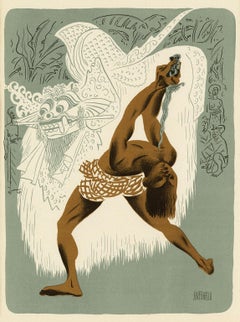
Kris Dancer, Bali
By Albert Al Hirschfeld
Located in Myrtle Beach, SC
Al Hirschfeld, 'Kris Dancer, Bali', color lithograph, 1941, edition 1,000. Signed in the stone, lower right. A fine, clean impression, with fresh colors, on cream wove paper, the ful...
Category
1940s American Modern South Carolina - Figurative Prints
Materials
Lithograph
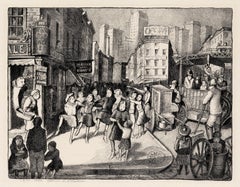
Hurdy Gurdy Ballet
— New York City American Scene, Ashcan School
By Glenn O. Coleman
Located in Myrtle Beach, SC
Glenn O. Coleman, 'Hurdy Gurdy Ballet', lithograph 1928, edition 50. Signed, dated, and numbered '14/50' in pencil. Titled in the bottom left margin, in an...
Category
1920s Ashcan School South Carolina - Figurative Prints
Materials
Lithograph
$3,840 Sale Price
20% Off
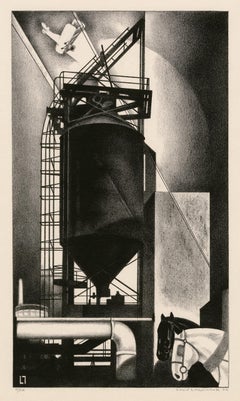
Tanks #1
— American Precisionism
By Louis Lozowick
Located in Myrtle Beach, SC
Louis Lozowick, 'Tanks #1', lithograph, 1929, edition 50, Flint 39. Signed, titled, and numbered '11/50' in pencil. Signed with the artist's monogram in the stone, lower left. A superb, richly-inked impression, on cream wove paper, the full sheet with margins (3/4 to 1 7/8 inches), in excellent condition. Matted to museum standards.
Image size 13 15/16 x 8 1/16 inches (355 x 204 mm), sheet size 15 3/4 x 11 1/4 inches (400 x 286 mm).
Exhibited: 'The American Scene: Prints from Hopper to Pollock', Stephen Coppel, The British Museum, 2008.
Literature: 'Prints and Their Creators, A World History', Carl Zigrosser, Crown Publishers Inc, 1974; 'American Lithographers...
Category
1920s American Modern South Carolina - Figurative Prints
Materials
Lithograph
Church with House and Tree
– Artist
s Personal Letterhead, Bauhaus Modernism
By Lyonel Feininger
Located in Myrtle Beach, SC
Lyonel Feininger, 'Church with House and Tree (Kirche mit Haus und Baum)', woodcut, 1936, one of a small but unknown number of letterhead proofs; Prasse W290 V. Inscribed 'J. F. note paper', in pencil, in the artist’s hand; with the Feininger estate stamp and catalog no. 'W 859' in pencil. Annotated 'W.290 V state 3609' in pencil, in the bottom right sheet corner.
A fine impression, on cream, laid letterhead stock; hinge remains on the left and right top sheet edges, verso, in excellent condition. Very scarce.
Image size 2 3/8 x 2 3/4 inches; sheet size 10 x 7 5/16 inches. Archivally sleeved, unmatted.
Exhibited: 'Lyonel Feininer, Woodcuts Used As Letterheads'; Associated American Artists; Feb 4 - March 2, 1974; NY, NY.
ABOUT THE ARTIST
Lyonel Feininger (1871-1956) was born in New York City into a musical family—his father was a violinist and composer, his mother was a singer and pianist. He studied violin with his father, and by the age of 12, he was performing in public. Still, he also drew incessantly, most notably the steamboats and sailing ships on the Hudson and East Rivers, and the landscape around Sharon, Conn., where he spent time on a farm owned by a family friend. At the age of 16 he left New York to study music and art in Germany, from where his parents emigrated. Drawn more to the visual arts, he attended schools in Hamburg, Berlin, and Paris from 1887 to 1892.
After completing his studies, Feininger began his artistic career as a cartoonist and illustrator, his originality leading him to great success. In 1906, after working for a dozen years in Germany, he was offered a job as a cartoonist at the Chicago Tribune, the largest circulation newspaper in the Midwest. He worked there for a year, inventing what became the standard design for the comic strip: in the words of John Carlin, “an overall pattern. . . that allowed the page to be read both as a series of elements one after the other, like language and as a group of juxtaposed images, like visual art.” His originality did not end there: he went on to become one of the great abstract painters. Like Kandinsky, music was his model, but Kandinsky only knew music from the outside—as a listener (inspired initially by Wagner, then by Schoenberg)—while Feininger knew it from the inside. He lived in Paris from 1906 to 1908, during which time he met and was influenced by the work of progressive painters Robert Delaunay and Jules Pascin, as well as that of Paul Cezanne and Vincent van Gogh. He began painting full-time, developing his distinctive Iyrical style based on Cubist and Expressionist idioms and a concern for the emotive qualities of light and color. He exhibited with the Der Blaue Reiter group in 1913, and in 1917, he had his first solo exhibition at Galerie Der Sturm in Berlin.
One year after his solo exhibition, in 1918, Feininger began making woodcuts. He became enamored with the medium, producing an impressive 117 in his first year of exploring the printmaking medium. In 1919 at the invitation of the architect Walter Gropius, he was appointed the first master at the newly formed Staatliches Bauhaus in Weimar. His woodcut of a cathedral crowned...
Category
1930s Bauhaus South Carolina - Figurative Prints
Materials
Woodcut
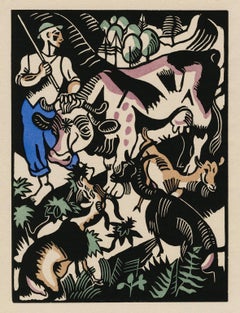
Der Hirte (The Shepherd) — original hand-coloring
Located in Myrtle Beach, SC
Richard Seewald, 'Der Hirte (The Shepherd)', woodcut with hand coloring, c. 1919. Unsigned as published in 'Genius', Vol 1, no. 1, 1919. A fine, richly...
Category
1910s Expressionist South Carolina - Figurative Prints
Materials
Woodcut
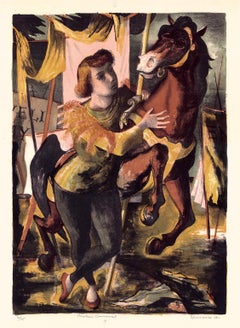
Broken Carousel
— Mid-Century American Symbolism
By Benton Murdoch Spruance
Located in Myrtle Beach, SC
'Broken Carousel', color lithograph, 1950, edition 35, Fine and Looney 285. Signed, titled, and numbered '18/35' in pencil. Initialed in the stone, lower right. A fine, richly-inked ...
Category
1950s American Modern South Carolina - Figurative Prints
Materials
Lithograph
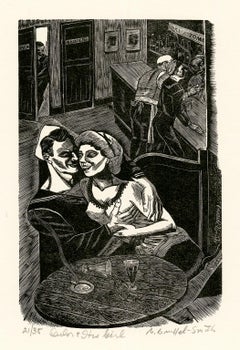
Sailor and His Girl
—Mid-Century Modernism, WWII
By Bernard Brussel-Smith
Located in Myrtle Beach, SC
Bernard Brussel-Smith, 'Sailor and His Girl', wood engraving, 1941, edition 35. Signed, titled, and numbered '21/35' in pencil. Signed in the block, lower right. A superb, richly-in...
Category
1940s American Modern South Carolina - Figurative Prints
Materials
Woodcut
The Yankee
— America
s Cup, 1934
By Jacques La Grange
Located in Myrtle Beach, SC
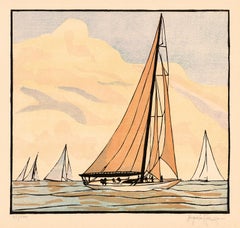
Jacques La Grange, 'The Yankee', color woodcut, edition 500, 1934. Signed and numbered '25/500' in pencil. A fine impression, with fresh colors, on cream wove paper, with margins (1 1/8 to 1 1/4 inches), in excellent condition. A work from La Grange’s celebrated series of woodcuts 'Drama and Color in the America's Cup Races'. Image size 10 x 10 11/16 inches (254 x 271 mm); sheet size 12 1/4 x 13 1/4 inches (311 x 337 mm). Archivally matted to museum standards, unframed.
When the artist created this print in 1934, the 'Yankee' was one of the most promising yachts eligible for the America's Cup but ultimately 'Rainbow' was chosen to defend against England's 'Endeavor' in that year's race. The 'Endeavor' was built for Thomas Sopwith who used his aviation design expertise to ensure the yacht was the most advanced of its day with a steel hull and mast. She was launched in 1934 and won many races in her first season but the Cup challenge was blighted by a strike of Sopwith's professional crew prior to departing for America. Forced to rely mainly on keen amateurs, who lacked the necessary experience, the campaign failed. 'Rainbow' won the series 4–2. This was one of the most contentious of the America's Cup battles and prompted the headline "Britannia rules the waves and America waives the rules."
ABOUT THE ARTIST
Jacques La Grange was born in Clanwilliam (near Cape Town) in South Africa in 1895. He studied at London University and later immigrated to the United States. La Grange established himself as a painter, illustrator, and printmaker specializing in nautical subjects. He and his wife, Helen La Grange, published 'Drama and Color in the America's Cup Races' in 1934 and 'Clipper Ships of America and Great Britain 1833-1869', in 1936. Both were deluxe hardcover limited edition volumes with signed original color woodblock prints. La Grange had solo exhibitions at the Buchanan Gallery in 1929; the Babcock Gallery and the 56th Street Gallery, New York, in 1930; and at the Nicholas Roerich...
Category
1930s American Modern South Carolina - Figurative Prints
Materials
Woodcut
$560 Sale Price
20% Off
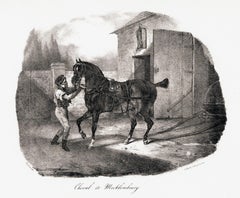
Cheval de Mecklembourg
— 19th-Century French Romanticism
By Jean Louis Andre Theodore Gericault
Located in Myrtle Beach, SC
Théodore Géricault 'Cheval de Mecklembourg' (Mecklembourg Horse), lithograph, 1822, 2nd state of 4, Delteil 47. Signed in the matrix 'Gericault', lower left. Published by Godefroy En...
Category
1820s Romantic South Carolina - Figurative Prints
Materials
Lithograph
Times Square
— 1920s Modernism
By Adriaan Lubbers
Located in Myrtle Beach, SC
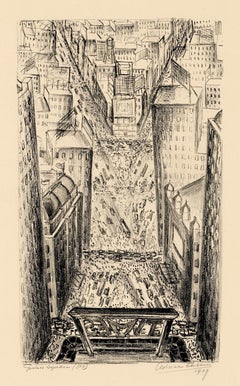
Adriaan Lubbers, 'Times Square', lithograph, 1929, edition 50. Signed, dated, titled, and editioned '(50)' in pencil. A fine impression, on cream wove paper, with full margins (2 1/2...
Category
1920s Modern South Carolina - Figurative Prints
Materials
Lithograph
Little Locomotive
– Artist
s Personal Letterhead, Bauhaus Modernism
By Lyonel Feininger
Located in Myrtle Beach, SC
Lyonel Feininger, 'Little Locomotive (Kleine Lokomotive)', woodcut, 1936, one of a small but unknown number of letterhead proofs; Prasse W158. Annotated 'W 158' (Feininger catalogue number) and '1936' in pencil, in the bottom right sheet corner.
A fine impression, on cream, laid letterhead stock; hinge remains on the left and right top sheet edges, verso, in excellent condition. Very scarce.
Image size 2 1/4 x 3 5/16 inches; sheet size 10 x 7 inches. Archivally sleeved, unmatted.
Exhibited: 'Lyonel Feininer, Woodcuts Used As Letterheads'; Associated American Artists; Feb 4 - March 2, 1974; New York, NY.
Collections: Cleveland Museum of Art, Museum of Modern Art, Staatliche Museen zu Berlin (East Berlin KK).
ABOUT THE ARTIST
Lyonel Feininger (1871-1956) was born in New York City into a musical family—his father was a violinist and composer, his mother was a singer and pianist. He studied violin with his father, and by the age of 12, he was performing in public, but he also drew incessantly, most notably the steamboats and sailing ships on the Hudson and East Rivers, and the landscape around Sharon, Conn., where he spent time on a farm owned by a family friend. At the age of 16 he left New York to study music and art in Germany, from where his parents emigrated. Drawn more to the visual arts, he attended schools in Hamburg, Berlin, and Paris from 1887 to 1892.
After completing his studies, Feininger began his artistic career as a cartoonist and illustrator, his originality leading him to great success. In 1906, after working for a dozen years in Germany, he was offered a job as a cartoonist at the Chicago Tribune, the largest circulation newspaper in the Midwest. He worked there for a year, inventing what became the standard design for the comic strip: in the words of John Carlin, “an overall pattern. . . that allowed the page to be read both as a series of elements one after the other, like language and as a group of juxtaposed images, like visual art.” His originality did not end there: he went on to become one of the great abstract painters. Like Kandinsky, music was his model, but Kandinsky only knew music from the outside—as a listener (inspired initially by Wagner, then by Schoenberg)—while Feininger knew it from the inside. He lived in Paris from 1906 to 1908, during which time he met and was influenced by the work of progressive painters Robert Delaunay and Jules Pascin, as well as that of Paul Cezanne and Vincent van Gogh. He began painting full-time, developing his distinctive Iyrical style based on Cubist and Expressionist idioms and a concern for the emotive qualities of light and color. He exhibited with the Der Blaue Reiter group in 1913, and in 1917, he had his first solo exhibition at Galerie Der Sturm in Berlin.
One year after his solo exhibition, in 1918, Feininger began making woodcuts. He became enamored with the medium, producing an impressive 117 in his first year of exploring the printmaking medium. In 1919 at the invitation of the architect Walter Gropius, he was appointed the first master at the newly formed Staatliches Bauhaus in Weimar. His woodcut of a cathedral crowned...
Category
1930s Bauhaus South Carolina - Figurative Prints
Materials
Woodcut
Search
— Australian Romanticism
Located in Myrtle Beach, SC
Thomas Balfour Garrett, 'Search', monotype in colors, c. 1910, a unique impression. Signed and titled in pencil. A superb, painterly impression with fresh colors on off-white, wove p...
Category
1910s Romantic South Carolina - Figurative Prints
Materials
Monotype
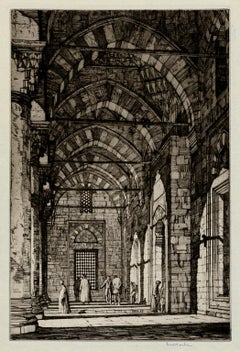
Mosque of the Sultan Bayazid, Constantinople — Vintage Realism
By Louis Conrad Rosenberg
Located in Myrtle Beach, SC
Louis Conrad Rosenberg, 'Mosque of the Sultan Bayazid, Constantinople', etching, 1927. Signed in pencil. Initialed and dated in the plate, lower left. A fine, richly-inked impression...
Category
1920s American Realist South Carolina - Figurative Prints
Materials
Drypoint
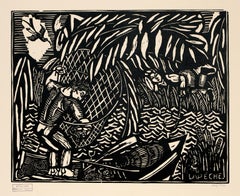
La Pêche
(Fishing) — French Cubist Woodcut
By Raoul Dufy
Located in Myrtle Beach, SC
Raoul Dufy, 'La Pêche' (Fishing), woodcut, 1910, from the second edition of 220 printed in 1953. With the estate stamp 'ATELIER RAOUL DUFY' in the lower left margin. Numbered '106/220' in pencil, lower right. Titled in the block, lower right. A superb, richly-inked impression, on heavy, cream wove paper, the full sheet with wide margins (3 to 5 inches), slight toning at the sheet edges, well away from the image; otherwise in excellent condition. Archivally sleeved, unmatted.
Image size 12 1/2 x 15 13/16 inches (318 x 402 mm); sheet size 19 9/16 x 25 3/4 inches (497 x 654 mm).
From the suite of four woodcuts entitled 'Les Plaisirs de la Paix' (The Pleasures of Peace), originally published by Éditions de La Sirène, Paris in 1926. The other three works in the series are 'La Danse' (The Dance), 'La Chase' (The Hunt), and 'L'amore' (Love). See our other listings for 'La Danse' and 'L'amore'.
Collections: Cleveland Museum of Art, Minneapolis Art...
Category
1910s Cubist South Carolina - Figurative Prints
Materials
Woodcut
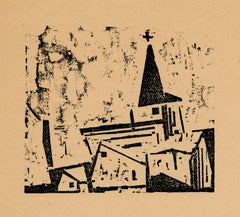
Church with House and Tree
– Artist
s Personal Letterhead, 1940s Modernism
By Lyonel Feininger
Located in Myrtle Beach, SC
Lyonel Feininger, 'Church with House and Tree (Kirche mit Haus und Baum)', woodcut, 1936, one of a small but unknown number of letterhead proofs; Prasse W290 IV. Annotated 'PW 290 state IV / IV 3669', in pencil, in the bottom right sheet corner. With the artist's typed address and date adjacent to the letterhead image: 'Falls Village, Connecticut September 26th, 1940'.
A fine impression, on buff, wove letterhead stock; several small losses, and tears, in the sheet edges (not affecting the image area); a crease in the bottom right sheet edge, otherwise in good condition. Very scarce.
Image size: 2 3/8 x 2 3/4 inches; sheet size 11 x 8 5/8 inches. Archivally sleeved, unmatted.
Feininger moved from Germany to New York City in 1938 and began spending his summers in Falls Village in 1940.
Exhibited: 'Lyonel Feininer, Woodcuts Used As Letterheads'; Associated American Artists; Feb 4 - March 2, 1974; New York, NY.
ABOUT THE ARTIST
Lyonel Feininger (1871-1956) was born in New York City into a musical family—his father was a violinist and composer, his mother was a singer and pianist. He studied violin with his father, and by the age of 12, he was performing in public, but he also drew incessantly, most notably the steamboats and sailing ships on the Hudson and East Rivers, and the landscape around Sharon, Conn., where he spent time on a farm owned by a family friend. At the age of 16 he left New York to study music and art in Germany, from where his parents emigrated. Drawn more to the visual arts, he attended schools in Hamburg, Berlin, and Paris from 1887 to 1892.
After completing his studies, Feininger began his artistic career as a cartoonist and illustrator, his originality leading him to great success. In 1906, after working for a dozen years in Germany, he was offered a job as a cartoonist at the Chicago Tribune, the largest circulation newspaper in the Midwest. He worked there for a year, inventing what became the standard design for the comic strip: in the words of John Carlin, “an overall pattern. . . that allowed the page to be read both as a series of elements one after the other, like language and as a group of juxtaposed images, like visual art.” His originality did not end there: he went on to become one of the great abstract painters. Like Kandinsky, music was his model, but Kandinsky only knew music from the outside—as a listener (inspired initially by Wagner, then by Schoenberg)—while Feininger knew it from the inside. He lived in Paris from 1906 to 1908, during which time he met and was influenced by the work of progressive painters Robert Delaunay and Jules Pascin, as well as that of Paul Cezanne and Vincent van Gogh. He began painting full-time, developing his distinctive Iyrical style based on Cubist and Expressionist idioms and a concern for the emotive qualities of light and color. He exhibited with the Der Blaue Reiter group in 1913, and in 1917, he had his first solo exhibition at Galerie Der Sturm in Berlin.
One year after his solo exhibition, in 1918, Feininger began making woodcuts. He became enamored with the medium, producing an impressive 117 in his first year of exploring the printmaking medium. In 1919 at the invitation of the architect Walter Gropius, he was appointed the first master at the newly formed Staatliches Bauhaus in Weimar. His woodcut of a cathedral crowned...
Category
1930s Bauhaus South Carolina - Figurative Prints
Materials
Woodcut
Sailing
— Modernism, New York City WPA
Located in Myrtle Beach, SC
Fred Becker, 'Sailing', wood engraving, c. 1935, edition c. 25. Signed and titled in pencil. A fine, richly-inked impression, on off-white wove paper; with full margins (1 to 2 15/16...
Category
1930s Modern South Carolina - Figurative Prints
Materials
Woodcut
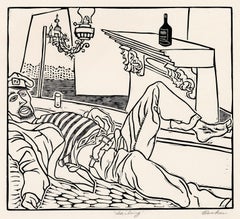
$720 Sale Price
20% Off
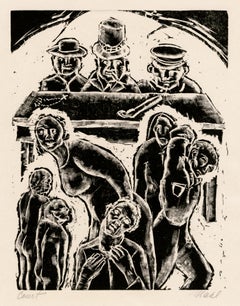
Court
— WPA Social Conscience, Woman Artist
Located in Myrtle Beach, SC
Claire Mahl Moore, 'Court' also 'The Authorities', woodcut, 1936, edition 5. Signed 'Mahl' and titled in pencil. A fine, richly-inked impression, on ...
Category
1930s Expressionist South Carolina - Figurative Prints
Materials
Woodcut
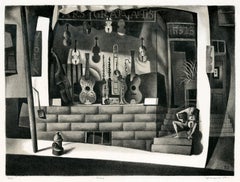
Nero
— Mid-Century American Modernism
By Benton Murdoch Spruance
Located in Myrtle Beach, SC
Benton Spruance, 'Nero', 2-color lithograph, edition 35, 1944, Fine and Looney 233. Signed, dated, titled and annotated 'Ed 35' in pencil. Initialed 'BS' in the image, lower right. A...
Category
Mid-20th Century American Modern South Carolina - Figurative Prints
Materials
Lithograph
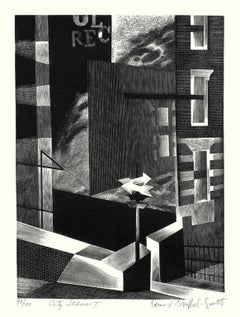
City Scene I — Mid-Century Modernism, Precisionism
By Bernard Brussel-Smith
Located in Myrtle Beach, SC
Bernard Brussel-Smith, 'City Scene I', wood engraving, 1949, edition 100. Signed, titled, and numbered '93/100' in pencil. A superb, richly-inked impression, on white wove paper, wi...
Category
1940s American Modern South Carolina - Figurative Prints
Materials
Woodcut
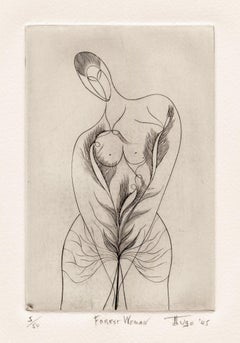
Forest Woman
— Mid-Century Surrealism, Atelier 17
Located in Myrtle Beach, SC
Ian Hugo, 'Forest Woman', engraving, 1945, edition 50. Signed, dated, titled, and numbered '5/50' in pencil. With the blind stamp 'madeleine-claude jobrack E...
Category
1940s Surrealist South Carolina - Figurative Prints
Materials
Engraving
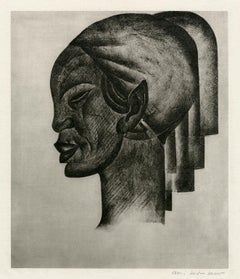
Untitled (Profile of an African Woman) — 1920s Modernism
By Boris Lovet-Lorski
Located in Myrtle Beach, SC
Boris Lovet-Lorski, 'Untitled (Profile of a Black Woman)', lithograph, edition 250, 1929. Signed and numbered 14 in pencil. Number 14 of Volume 2, a series of 10 lithographs publishe...
Category
1920s Art Deco South Carolina - Figurative Prints
Materials
Lithograph
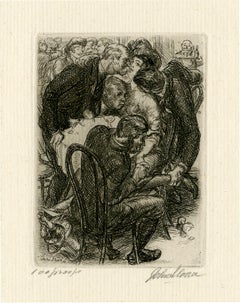
New Year’s Eve and Adam
By John Sloan
Located in Myrtle Beach, SC
John Sloan, 'New Year's Eve and Adam', etching, 1918, edition 100, (only 85 printed), Morse 190. Signed, titled and annotated '100 proofs' in pencil. Signed and dated in the plate, l...
Category
1910s Ashcan School South Carolina - Figurative Prints
Materials
Etching
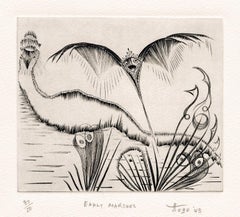
Early Marshes
— Mid-Century Surrealism, Atelier 17
Located in Myrtle Beach, SC
Ian Hugo, 'Early Marshes', from the portfolio 'Ten Engravings'. engraving, 1943, edition 50. Signed, dated, titled, and numbered '37/50' in pencil. A fine impression, with delicate overall plate tone, on cream wove paper, the full sheet with margins (2 5/8 to 7 inches), in excellent condition.
With the blind stamp 'madeleine-claude jobrack EDITIONS', in the bottom right margin. Matted to museum standards, unframed.
Image size 5 x 5 7/8 inches (127 x 149 mm); sheet size 15 x 11 inches (381 x 279 mm).
Ian Hugo originally created "Ten Engravings" in 1945 and the portfolio included a foreword by his partner and collaborator, Anais Nin. In 1978, Hugo republished the portfolio with Madeleine-Claude Jobrack, an American master printmaker who studied under Stanley William Hayter at Atelier 17, Paris, and with Johnny Friedlaender. When Jobrack returned to the States she managed the Robert Blackburn Printmaking Studio in New York before opening her own printing studio, Madeleine-Claude Jobrak Editions.
“The sign of the true artist is one who creates a complete universe, invents new plants, new animals, new figures to transfer to us a new vision of the universe in which dream and reality fuse. Ian Hugo's plants have eyes, the birds have the delicacy of dragonflies, their feathers have the shape of fans. Humor is apparent in every gesture. He uses a fine spider web to give a feeling of flight, speed, lightness. The body of a woman reveals the structure of a leaf, a plant. Wings are moving in a world unified by mythological themes. This is an animated world, humorous and levitating, elusive and decorative, which by its unique forms and shapes gives us the sensation of a rebirth, a liberation from the usual, the familiar, a visit to a new planet.”
—Anais Nin, from the forward to the portfolio ‘Ten Engravings’
ABOUT THE ARTIST
Ian Hugo was born Hugh Parker Guiler in Boston, Massachusetts, on February 15, 1898. His childhood was spent in Puerto Rico—a "tropical paradise," the memory of which stayed with him and surfaced in both his engravings and his films. He attended school in Scotland and graduated from Columbia University where he studied economics and literature.
Hugo was working with the National City Bank when he met and married author Anais Nin in 1923. The couple moved to Paris the following year, where Nin's diary and Guiler's artistic aspirations flowered. Guiler feared his business associates would not understand his interests in art and music, let alone those of his wife, so he began a second, creative life as Ian Hugo. Ian and Anais moved to New York in 1939. The following year he took up engraving and etching, working at Stanley William Hayter’s experimental printmaking workshop Atelier 17, established at the New School for Social Research.
Hugo began producing surreal images often used to illustrate Nin's books. For Nin, his unwavering love and financial support were indispensable—Hugo was the "fixed center, core... my home, my refuge" (Sept. 16, 1937, Nearer the Moon, The Unexpurgated Diary of Anais Nin, 1937-!939). Fictionalized portraits of Higo and Nin appear in Philip Kaufman's 1990 film drama of a literary love triangle, Henry & June.
Inspired by comments that viewers saw motion in his engravings, Hugo took up filmmaking. He asked the avant-garde filmmaker Sasha Hammid for instruction but was told, "Use the camera yourself, make your own mistakes, make your own style." Hugo embarked on an exploration of the film medium as a vehicle to delve into his dreams, his unconscious, and his memories. Without a specific plan, He would collect resonant images, then reorder or superimpose them, seeking a sense of self-connection through the poetic juxtapositions he created. These intuitive explorations resembled the mystical evocations of his engravings, which he described in 1946 as "hieroglyphs of a language in which our unconscious is trying to convey important, urgent messages."
In the underwater world of his film ‘Bells of Atlantis,’ the light originates from the world above the surface; it is otherworldly, out of place, yet essential. In ‘Jazz of Lights,’ the street lights of Times Square become in Nin's words, "an ephemeral flow of sensations." This flow that she also calls "phantasmagorical" had a crucial impact on Stan Brakhage, who said that without Jazz of Lights (1954), "there would have been no Anticipation of the Night" his autobiographical film which ushered in a new era of experimental modernist filmmaking.
Hugo lived the last two decades of his life in a New York apartment high above street level. In the evenings, surrounded by an electrically illuminated man...
Category
1940s Surrealist South Carolina - Figurative Prints
Materials
Engraving
Naked Young Man Sitting On Lopped Branch; Naked Young Woman Sitting on a Branch.
By Eric Gill
Located in Myrtle Beach, SC
Wood engraving, 1930, edition small, Physick 642 / 643. Initialed in pencil.
Two blocks printed on a single sheet: fine impressions on cream laid Japan with full margins (1 1/2 to 2...
Category
1930s Art Deco South Carolina - Figurative Prints
Materials
Woodcut
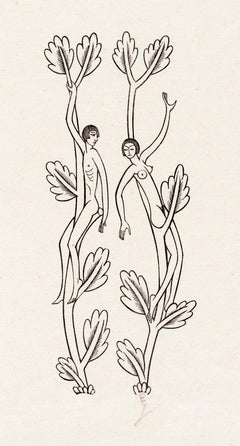
Tropical Wash Day
— Mid-Century Modernism
Located in Myrtle Beach, SC
'Tropical Wash Day', aquatint, edition 100, 1946. Signed in pencil. Signed and dated in the plate, lower left. A superb, richly-inked impression, on heavy cream wove paper, with full...
Category
1940s American Modern South Carolina - Figurative Prints
Materials
Aquatint
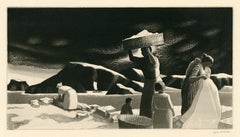
The Sixth Avenue Spur, New York City
— American Expressionism
By Frederick K. Detwiller
Located in Myrtle Beach, SC
Frederick K. Detwiller, 'The Sixth Avenue Spur, New York City', lithograph, 1924, edition 20. Signed, dated, titled, and annotated 'Lith 20' in pencil. Inscribed 'To my Friend Herbert L. Jones' in pencil. Signed and dated, in the stone, lower right; initialed and dated '1927' in the stone, lower left. A fine, richly-inked impression, on cream wove paper, with margins (7/8 to 1 1/4 inches); slight toning in the top left sheet edge, otherwise in good condition. Scarce.
Image size 20 1/2 x 14 inches (521 x 356 mm); sheet size 22 1/2 x 16 inches (572 x 406 mm). Archivally matted to museum standards, unframed.
ABOUT THE IMAGE
The Sixth Avenue El was constructed in the late 1870s by the Gilbert Elevated Railway and reorganized as the Metropolitan Elevated Railway. By 1878, it was running from Rector Street to 58th Street. Soon after that, it was taken over by the Manhattan Railway Company, with three other Manhattan elevated train lines. The company built a connection, the ‘spur’ by which it turned west on 53rd Street to merge with the 9th Avenue El—paralleling the present-day route of the 6th Avenue subway.
The Sixth Avenue El served the “Ladies Mile” shops (including the Siegel-Cooper emporium, whose building now houses Bed...
Category
1920s Ashcan School South Carolina - Figurative Prints
Materials
Lithograph
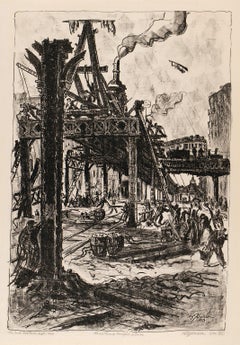
Viel Gluck 1923
— New Year
s Greeting - German Expressionism
By Karl Michel
Located in Myrtle Beach, SC
Karl Michel, 'Viel Gluck 1923 Wunscht Karl Michel', etching, 1923, edition not stated but small. Signed, dated, and numbered 'op. 136' in pencil. Signed in the image, lower right. A...
Category
1920s Expressionist South Carolina - Figurative Prints
Materials
Etching
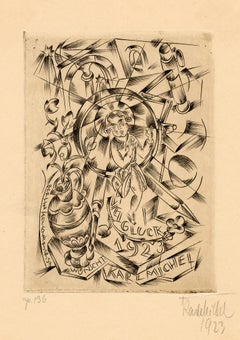
Le maréchal flamand
(The Flemish Blacksmith) — 19th-Century French Romanticism
By Jean Louis Andre Theodore Gericault
Located in Myrtle Beach, SC
Théodore Géricault 'Le maréchal flamand' (The Flemish Blacksmith) from the series ‘Etudes, de chevaux lithographiés,’ lithograph, 1822, 2nd state ...
Category
1820s Romantic South Carolina - Figurative Prints
Materials
Lithograph
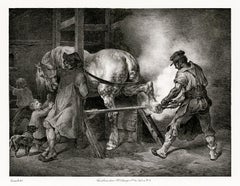
Set Pieces: Vanity of Trust
— Mid-Century American Modernism
By Benton Murdoch Spruance
Located in Myrtle Beach, SC
'Set Pieces: Vanity of Trust', color lithograph, 1949, edition 40, Fine and Looney 279. Signed, titled, dated and numbered '23/40' in pencil. A fine, impression with fresh colors, on...
Category
1940s American Modern South Carolina - Figurative Prints
Materials
Lithograph
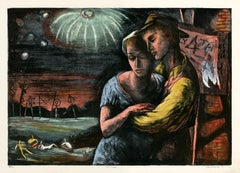
Roadside, Collonges-La Rouge
By John DePol
Located in Myrtle Beach, SC
John DePol, 'Roadside, Collonges-La Rouge', chiaroscuro wood engraving, 1980, edition 160 in 1983. Signed, dated, and titled in pencil. Signed in the block, l...
Category
1980s American Modern South Carolina - Figurative Prints
Materials
Woodcut
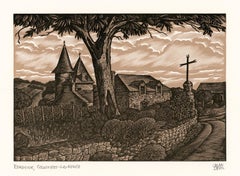
de Young Mansion
– San Francisco
— California WPA, Woman Artist
Located in Myrtle Beach, SC
Marguerite Redman Dorgeloh, 'de Young Mansion – San Francisco', lithograph, c. 1937, edition 25. Signed and titled in pencil. A fine, richly-inked impr...
Category
1930s American Modern South Carolina - Figurative Prints
Materials
Lithograph
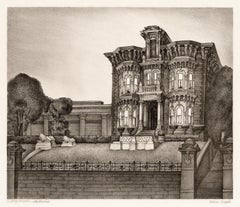
Gardenias
— Mid-Century Floral Abstraction
By Mary Van Blarcom
Located in Myrtle Beach, SC
Mary Van Blarcom, 'Gardenias', color serigraph, c. 1945, edition small. Signed 'Van B' in pencil in the image, lower right. Titled in pencil, bottom left sheet corner. A rich, painterly impression, with fresh colors, on cream wove paper; the full sheet with margins (5/16 to 1 1/16 inches), in excellent condition. Image size 6 x 8 3/8 inches; sheet size 6 7/8 x 10 1/4 inches. Matted to museum standards, unframed.
ABOUT THE ARTIST
Painter, printmaker and craftsperson, Mary Van Blarcom was born in Newark, New Jersey and studied at Wellesley College. She was a member of the National Serigraph Society where she served on the board of trustees from 1945 through 1952 and was 1st vice-president from 1949-51. She was also a member of the National Association of Women Artists, the Artists Equity Association, the American Color Print Society, the New Jersey Artists Association (Director), and Artists of Today.
Van Blarcom exhibited actively throughout the 1940’s at many prominent art organizations including: Montclair Art Museum, 1941-45 and 1947-51 (prize, 1948); Society of Independent Artists, 1942-44; Artists of Today, 1942-46; Elisabeth Ney Museum, 1943; Northwest Printmakers, 1944, 1946-49; Laguna Beach Art Association, 1945-47, 1949; National Association of Women Artists, 1945-50, (prize, 1946); Library of Congress, 1946-47; Museum of Modern Art travelling exhibition, 1945-47; Carnegie Institute, 1947; Serigraph Gallery, 1946, 1951 (solo); American Color Print Society, 1947-52; Newark Museum, 1947-48, 1951; California State Library, 1947, 1949; National Serigraph Society, 1949 (prize), 1950 (prize); University of Chile, 1950; New Jersey State Museum, 1950; Philadelphia Art Alliance, 1951; and the Main Gallery, NY, 1952.
Van Blarcom’s work is in the collections of the Newark Public Library, U.S. Library of Congress; the American Association of University Women; New York Public Library; Tel-Aviv Museum, Alabama Polytechnic Institute, Princeton Print Club...
Category
1940s American Modern South Carolina - Figurative Prints
Materials
Screen
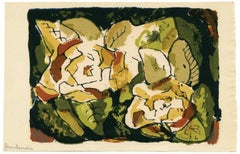
Humming Birds and Orchids
— Vintage White Line Color Woodcut
Located in Myrtle Beach, SC
Wuanita Smith, 'Humming Birds and Orchids', white-line color woodcut, circa 1930, edition 50. Signed and titled in pencil. Annotated '50 edition', 'no 5'...
Category
1930s American Modern South Carolina - Figurative Prints
Materials
Woodcut

Crown of Roses
— Mid-century Modernism
By Mary Van Blarcom
Located in Myrtle Beach, SC
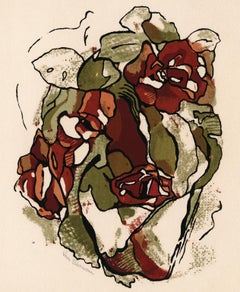
Mary Van Blarcom, 'Crown of Roses', color serigraph, c. 1945, edition not stated but small. Signed in pencil beneath the image, lower left. Titled in pencil, bottom left sheet corner. A rich painterly impression, with fresh colors, on cream laid paper, with full margins (3/8 to 7/8 inch), in excellent condition. Matted to museum standards, unframed.
Image size 8 13/16 x 12 11/16 inches; sheet size 9 1/2 x 8 5/16 inches.
ABOUT THE ARTIST
Painter, printmaker, and craftsperson, Mary Van Blarcom was born in Newark, New Jersey, and studied at Wellesley College. She was a member of the National Serigraph Society, where she served on the board of trustees from 1945 through 1952 and was 1st vice-president from 1949-51. She was also a member of the National Association of Women Artists, the Artists Equity Association, the American Color Print Society, the New Jersey Artists Association (Director), and Artists of Today.
Van Blarcom exhibited actively throughout the 1940s at many prominent art organizations, including Montclair Art Museum, 1941-45 and 1947-51 (prize, 1948); Society of Independent Artists, 1942-44; Artists of Today, 1942-46; Elisabeth Ney Museum, 1943; Northwest Printmakers, 1944, 1946-49; Laguna Beach Art Association, 1945-47, 1949; National Association of Women Artists, 1945-50, (prize, 1946); Library of Congress, 1946-47; Museum of Modern Art Traveling Exhibition, 1945-47; Carnegie Institute, 1947; Serigraph Gallery, 1946, 1951 (solo); American Color Print Society, 1947-52; Newark Museum, 1947-48, 1951; California State Library, 1947, 1949; National Serigraph Society, 1949 (prize), 1950 (prize); University of Chile, 1950; New Jersey State Museum, 1950; Philadelphia Art Alliance, 1951; and the Main Gallery, NY, 1952.
Van Blarcom’s work is represented in the collections of the Newark Public Library, the U.S. Library of Congress; the American Association of University Women; the New York Public Library; Tel-Aviv Museum, Alabama Polytechnic Institute, Princeton Print Club...
Category
1940s American Modern South Carolina - Figurative Prints
Materials
Screen
$320 Sale Price
20% Off
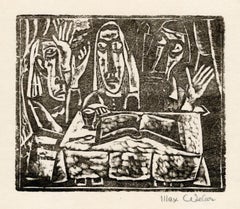
Feast of Passover
— American Expressionism
By Max Weber
Located in Myrtle Beach, SC
Max Weber, Untitled 'Feast of Passover', woodcut, 1920, edition proofs—this impression from the edition of 25 printed in 1956, Rubenstein 30. Signed in pencil...
Category
1920s Expressionist South Carolina - Figurative Prints
Materials
Woodcut
Ninth Inning
Located in Myrtle Beach, SC
Sylvia Mayzer Rantz, 'Ninth Inning', lithograph, 1949, edition 24. Signed, dated, titled, and numbered '9/24' in pencil. A fine, richly-inked impression, on cream wove paper. The ful...
Category
1940s American Realist South Carolina - Figurative Prints
Materials
Lithograph
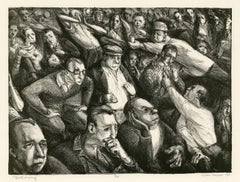
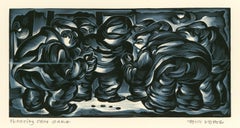
Floating Crap Game
By John DePol
Located in Myrtle Beach, SC
John DePol, 'Floating Crap Game, chiaroscuro wood engraving, 1958, edition 145. Signed, titled, numbered 'Ed. 145' and dated '3/1958'. Signed in the block, lower right. A fine, rich ...
Category
Mid-20th Century American Modern South Carolina - Figurative Prints
Materials
Woodcut
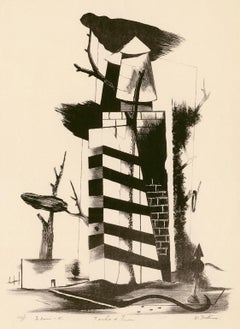
Tanks
Trees — Mid-century American Surrealism
Located in Myrtle Beach, SC
Karl Eugene Fortess, 'Tanks & Trees', lithograph, c. 1940, edition 100. Signed, titled, and numbered '100/P' in pencil. Inscribed 'For Usui - K.' in the bottom left margin. A fine, richly-inked impression, on cream wove paper, with full margins (1 1/2 to 2 1/2 inches); a slight crease across the top right sheet corner, well away from the image; otherwise in excellent condition. Image size 13 1/8 x 10 inches; sheet size 17 3/8 x 13 3/16 inches. Matted to museum standards, unframed.
Provenance: Estate of Francis Pratt.
Francis and her husband Bumpei Usui...
Category
1940s Surrealist South Carolina - Figurative Prints
Materials
Lithograph
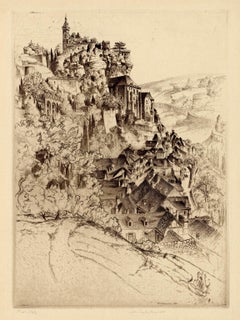
Racamadour (French Church Series #10) — Lyrical Realism
By John Taylor Arms
Located in Myrtle Beach, SC
'Rocamadour' (French Church Series # 10), etching, 1927, edition 50, Fletcher 186. Signed, dated, and annotated 'First State' in pencil. Titled and dated 'Rocamadour 1926' in the plate, bottom right. A superb, finely detailed impression, in dark brown ink, on buff laid Japan paper, with full margins (1 to 1 7/8 inches), in excellent condition.
Image size 13 3/4 x 10 inches (349 x 254 mm); sheet size 15 3/4 x 13 5/8 inches (400 x 346 mm). Matted to museum standards, unframed.
Literature: illustrated in Dorothy Noyes Arms, 'Churches of France', The Macmillan Company, 1929.
Impressions of this work are in the permanent collections of the Blanton Museum of Art, Chrysler Museum of Art, Cleveland Museum of Art, Davis Museum (Wellesley), McNay Art Museum, Metropolitan Museum of Art, Rhode Island School of Design Museum, and the Whitney Museum of Art.
ABOUT THE SUBJECT
Rocamadour is a small clifftop village in south-central France. It is known for the Cité Réligieuse complex of religious buildings, accessed via the Grand Escalier staircase. It includes the Chapelle Notre-Dame, with its Black Madonna statue, and the Romanesque-Gothic Basilica of St-Sauveur.
ABOUT THE ARTIST
“John Taylor Arms will live on and on and future generations centuries from now will marvel at his work... . As a friend and as a man, he fully matched his superb work.” —John Winkler, printmaker
Born in Washington, D.C. in 1887, John Taylor Arms attended the Lawrenceville School and began the study of law at Princeton University. In 1907, he transferred to the Massachusetts Institute of Technology and took up the study of architecture. Arms evolved his unique drafting style, with its highly realistic, precise detail and exquisitely rendered effects of light, from his experience and practice as an architectural student. He graduated in 1911 and completed a master’s degree the following year. He then worked as a draftsman with the well-known Carrere and Hastings Company in New York.
In 1913 Arms was given a hobbyist’s etching set, and he began to dabble with copperplate and acid. In 1915, after copying a handful of prints by Jongkind and other Etching Revivalists, Arms created his first original etching. His early experiments were picturesque views of European villages, reflecting the influence of Whistler. He inked and printed several of these plates in color in the manner of Charles Mielatz...
Category
1920s American Realist South Carolina - Figurative Prints
Materials
Etching
$720 Sale Price
20% Off
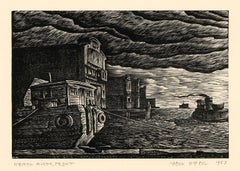
North River Front (Hudson River)
By John DePol
Located in Myrtle Beach, SC
John DePol, 'North River Front', chiaroscuro wood engraving, 1953, edition not stated. Signed, dated, and titled in pencil. Signed in the block, lower left...
Category
Mid-20th Century American Modern South Carolina - Figurative Prints
Materials
Woodcut
Horse Attacked by Tiger
— 19th-Century French Romanticism
By Jean Louis Andre Theodore Gericault
Located in Myrtle Beach, SC
Théodore Géricault (after), 'Tigre dévorant un cheval' (Tiger Devouring a Horse), lithograph, 3rd state of 3, Clement 97, c. 1820. Lettered 'Volmar ...
Category
1820s Romantic South Carolina - Figurative Prints
Materials
Lithograph
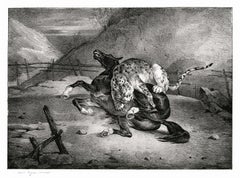
Girl and Cat
— 1930s American Modernism
By Benton Murdoch Spruance
Located in Myrtle Beach, SC
'Girl and Cat', lithograph, 1935, edition 33, Fine and Looney 121. Signed, titled, dated, and numbered '5/33' in pencil. A superb, richly-inked impression...
Category
1930s American Modern South Carolina - Figurative Prints
Materials
Lithograph
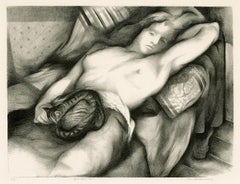
New Rochelle - Before the Wind
By Werner Drewes
Located in Myrtle Beach, SC
'New Rochelle - Before the Wind', drypoint, 1931, edition 30 (only a few impressions printed), Rose l.163. Signed, dated '1932' and numbered '1 – XXX' in ...
Category
1930s Modern South Carolina - Figurative Prints
Materials
Drypoint
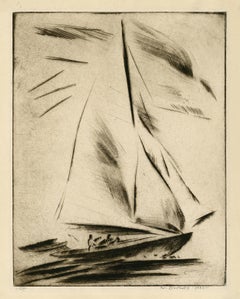
Slack Rope Artist
By Benton Murdoch Spruance
Located in Myrtle Beach, SC
Benton Spruance, 'Slack Rope Artist', lithograph, 1930, edition 30, Fine and Looney 35. Signed and titled in pencil. Numbered '2' in the bottom right margin. A fine impression, with ...
Category
1930s American Modern South Carolina - Figurative Prints
Materials
Lithograph
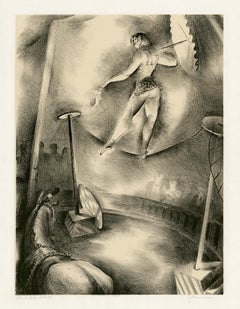
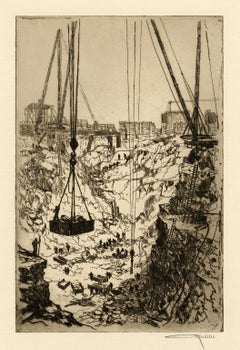
Bedrock
— Construction of the New Yorker Hotel
By Otto Kuhler
Located in Myrtle Beach, SC
Otto Kuhler, 'Bedrock', etching, 1928, edition 25, Kennedy 29. Signed and titled in pencil. A superb, richly-inked impression in brown/black ink, with skilfully wiped plate tone; on ...
Category
1920s American Realist South Carolina - Figurative Prints
Materials
Etching
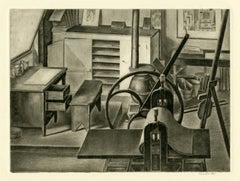
Studio Interior No. 1 — 1930s Masterwork
By Armin Landeck
Located in Myrtle Beach, SC
Armin Landeck, 'Studio Interior No. 1', 1935, drypoint, edition 100, Kraeft 56. Signed in pencil. Signed in the plate, lower right. A fine, richly-inked impression, on cream laid pap...
Category
1930s American Realist South Carolina - Figurative Prints
Materials
Drypoint
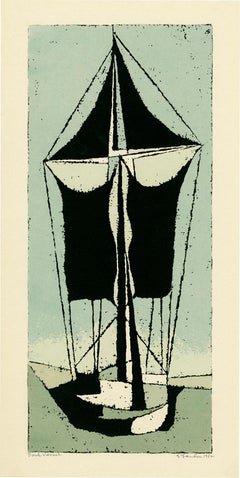
Dark Vessel
— Mid-Century Modern
By Edward August Landon
Located in Myrtle Beach, SC
Edward Landon, 'Dark Vessel', color serigraph, 1952, edition 50, Ryan 51. Signed, dated, and titled in pencil. A superb impression, with fresh colors, on c...
Category
Mid-20th Century American Modern South Carolina - Figurative Prints
Materials
Screen
$600 Sale Price
20% Off