Stockholm - Figurative Paintings
to
32
68
43
57
18
19
Overall Width
to
Overall Height
to
28
94
83
12
19
13
7
5
2
13
37
25
20
2
1
106
98
137
56
47
36
30
27
21
17
17
16
16
13
11
11
10
9
8
8
7
7
200
198
132
132
48
2
2
1
1
1
182
1
22,240
20,837
Item Ships From: Stockholm
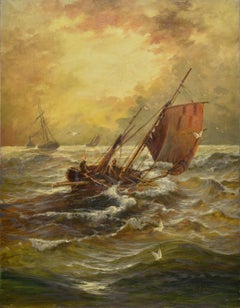
19th Century British Seascape Oil Painting Fishermen in Storm Signed Fletcher
Located in Stockholm, SE
This Romantic oil painting from the late 19th century, attributed to the noted British maritime artist Edwin Henry Eugene Fletcher (1857-1945), depicts a dramatic scene: in the foreg...
Category
Late 19th Century Realist Stockholm - Figurative Paintings
Materials
Canvas, Wood, Oil
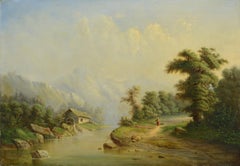
1880 Original Romantic Pastoral Oil Painting Alpine River with Watermill Signed
Located in Stockholm, SE
This exquisite oil on canvas from 1880 captures a vibrant summer landscape in the Alps. It presents a picturesque nook: a small watermill with a grassy roof sits by a quiet river, a ...
Category
1880s Realist Stockholm - Figurative Paintings
Materials
Canvas, Wood, Oil
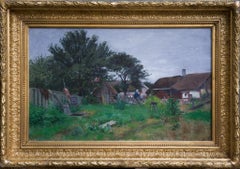
Garden with Blooming Chestnut Trees, France
Located in Stockholm, SE
Viggo Loos lists the painting under works from 1875 as a "Skåne farmstead," but this is likely incorrect. Skånberg was in France at that time. In this composition, he incorporates a ...
Category
1870s Post-Impressionist Stockholm - Figurative Paintings
Materials
Canvas, Oil
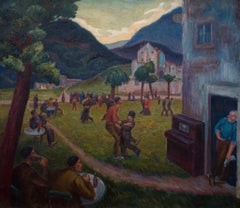
Popular Dance at Corsica, I. By Swedish Artist Dick Beer, c.1924
Located in Stockholm, SE
Dick Beer (b. London 1893 - d. Stockholm 1938)
Folkliv på Korsika, I (Popular Dance at Corsica, I)
oil on canvas
signed Dick Beer
c. 1924
canvas dimensions 88 x 100 cm
Exhibited:
The Royal Academy Stockholm 1973;
Millesgården – Dick Beer – Impressionist & Kubist, 2012
Dick Beer was born in 1893 in London as Richard Beer, the youngest of five brothers. His father, John Beer (1853-1906), was a watercolourist who was born in Stockholm and left Sweden at the age of 17. John Beer instructed his sons in drawing and painting, among other things. A number of sketchbooks bear testimony to the boys’ talent.
Dick Beer’s parents died in 1906 and 1907. Barely 15 years old, Beer arrived in Sweden as an orphan. First he lived with relatives and finally he ended up at Reverend Laurell in Västergötland.
Dick Beer began his artistic studies at the Althin School of Painting in Stockholm in 1908 and continued at the Royal Academy of Arts in the autumn of 1910, but in September 1912 he broke off his studies and travelled to Paris. He rented a studio and enrolled at the Colarossi and Grande Chaumière academies.
In the summer of 1913, Dick Beer travelled to Pont-Aven in Bretagne in order to paint. In September the same year, he held his first solo exhibition in Stockholm which he gave the French title Exposition des tableaux de Bretagne et autour de Paris. The exhibition proved a success. Many of the paintings were executed in a light palette in a style inspired by the impressionists.
In 1914, Dick Beer undertook an extensive study trip to Italy, Tunis, Morocco and Spain, which resulted in canvases overflowing with colours and light. When the French army mobilised, he volunteered and was enlisted in the French Foreign Legion. In 1915 Dick Beer sustained severe head injuries in a grenade attack, which resulted in deafness and a nervous condition that would plague him for the rest of his life. Two of his brothers died the following year, fighting for the English army.
Dick Beer was hospitalised and convalesced at Château de Rochefort. Here he started painting again, in an impressionist style, a painting dominated by blue and green hues.
In 1918, Dick Beer married Ruth Öhrling, a dentist, and their son John was born later in the year. During this time, Beer began experimenting with cubist painting and created several large compositions, including the painting “The Arab Café”.
In the years that followed, Dick Beer was based in Paris, where he often moved house. He was instructed by André Lhote, who encouraged his students to work freely in the studio and provided them with individual critique. Beer often travelled to Bretagne or Provence. His artist friends came from all over Europe and included Amedeo Modigliani. Dick Beer exhibited fairly regularly in Paris between 1919 and 1934 and made a name for himself in French artist circles.
In the summers, Ruth regularly rented a house in the countryside, often at Lake Mälaren. She kept a large house with many models and friends and there was a lot of painting and discussions. In 1933, the couple divorced but Ruth still loved Dick...
Category
1920s Post-Impressionist Stockholm - Figurative Paintings
Materials
Canvas, Oil
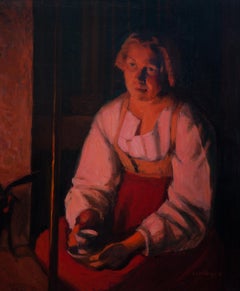
Moments of Reflection Depicting a Woman Sitting by the Fire, Original Oil Paint
By Sam Uhrdin
Located in Stockholm, SE
We are pleased to present a captivating painting by the artist Sam Uhrdin (1886-1964). This beautiful artwork depicts a woman from Dalarna, sitting in front of a warm, glowing fire. The entire painting is bathed in a soft, radiant light, particularly illuminating her face and traditional white/red attire. The woman appears contemplative, lost in thought, perhaps thinking of someone dear to her heart. She is depicted in a kitchen, taking a moment to relax after a day's chores in her home.
Sam Uhrdin's artistic journey began in the early 1900s, he traveled to Stockholm in 1903 to further continue his studies in painting. He worked as a painter during the day and attended various evening schools in the evenings. In 1906, he journeyed to America to work as a sign painter, but he mainly ended up working as an upholsterer. Returning to Leksand in 1909 via London and Paris, his artistic talent gained recognition, and with the help of some patrons, he began studying at the Royal Academy of Fine Arts in 1911, occasionally attending Althin's painting school in Stockholm. Financial circumstances cut his study time short, and his skill as a portrait painter earned him numerous portrait commissions, which further occupied his time.
In 1921, Uhrdin received a scholarship from the Royal Academy, enabling him to embark on a study trip in 1922 to the Netherlands, Belgium, and France, which he had to cut short due to his wife's illness. He later visited places like Spain and Portugal.
Uhrdin's breakthrough came with his portrait of the former Prime Minister Nils Edén, which he executed in 1919. In 1921, he portrayed the participants of the Swedish Academy. Among other representatives of official Sweden captured by Uhrdin were Gustav V, Manne Siegbahn, Ludvig Stavenow, and bishops Gottfrid and Einar Billing. In 1932, he held a solo exhibition at Konstnärshuset in Stockholm, and he participated in various exhibitions, including the Swedish Artists' Association in Stockholm in 1917, Swedish Art at Valand-Chalmers in Gothenburg in 1923, Dalarna Artists displayed at Liljevalchs Konsthall in 1936, and the National Museum's traveling exhibition "Barnet i konsten" (Children in Art...
Category
1940s Realist Stockholm - Figurative Paintings
Materials
Canvas, Oil
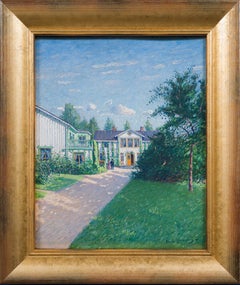
Courtyard With Elegantly Dressed Couple, Original Oil Painting
Located in Stockholm, SE
This exquisite painting, "Courtyard With Elegantly Dressed Couple" by the Swedish artist Carl Johansson, is a vibrant illustration of life at the turn of the 20th century. Dating bac...
Category
Early 1900s Post-Impressionist Stockholm - Figurative Paintings
Materials
Oil, Wood Panel
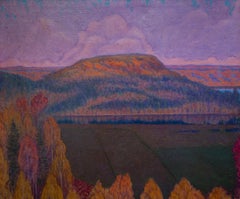
Two Paintings in One, Art Nouveau Landscape And Winter Landscape. Oak Frame
Located in Stockholm, SE
Alfred Ekstam, a renowned artist from Mangskog, Sweden, is known for his exquisite landscape paintings. We are excited to present this painting by Ekstam, which is extra special because it is painted on both sides, offering two beautiful landscapes in one, with a reversible frame that can be turned over without having to take it down from the wall.
On one side, you will be mesmerized by a stunning Art Nouveau landscape with a purple tone, featuring a mountain in the background, a lake, and trees in the foreground with shades of yellow, red, and green. On the other side, you will see a winter landscape with five red houses, likely to be Ekstam's own farm in Knaggen. The winter scene showcases sun rays shining down on the houses...
Category
1910s Art Nouveau Stockholm - Figurative Paintings
Materials
Canvas, Oil

$21,137 Sale Price
20% Off
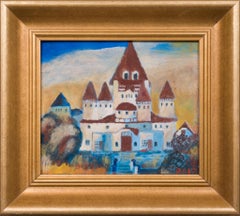
A Visionary White Castle in Miniature
Located in Stockholm, SE
This small yet striking painting by Primus Mortimer Pettersson (18.5 x 21.5 cm) encapsulates the essence of his artistic vision—an imagined world where reality and dream blur into on...
Category
20th Century Post-Impressionist Stockholm - Figurative Paintings
Materials
Oil, Board
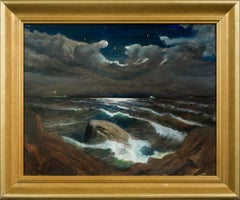
Dramatic Storm over Sandhamn, Sweden, 1943
Located in Stockholm, SE
This striking seascape, painted in 1943 by Jacob Löfgren, most likely depicts a view from Sandhamn, a location he frequently captured in his works. Four years earlier, he created ano...
Category
1940s Symbolist Stockholm - Figurative Paintings
Materials
Oil, Board
$4,227 Sale Price
20% Off
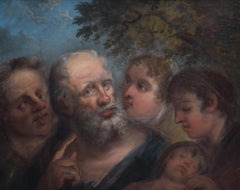
Asklepios and His Followers
Located in Stockholm, SE
This captivating work belongs to Elias Martin’s later period, characterized by his exploration of historical, biblical, and mythological themes. As Mikael Ahlund, Director of the Gus...
Category
1810s Old Masters Stockholm - Figurative Paintings
Materials
Canvas, Oil
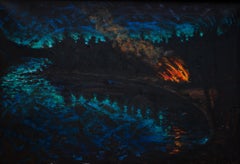
"Walpurgis Night Reflections" by Jonny Oppenheimer
Located in Stockholm, SE
We are proud to present "Walpurgis Night Reflections," an enchanting painting by the German-Swedish artist Jonny Oppenheimer (1923-2005).
This piece is a captivating representation ...
Category
Mid-20th Century Stockholm - Figurative Paintings
Materials
Canvas, Oil
$1,891 Sale Price
25% Off
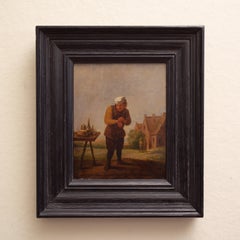
A Peasant Removing a Plaster: The Sense of Touch. By a Follower of David Teniers
By David Teniers the Younger
Located in Stockholm, SE
David Teniers the Younger (1610-1690) Follower of
A Peasant Removing a Plaster: The Sense of Touch
signed T on the table
oil on panel
panel size 7,20 x 5,55 inches (18,3 x 14,4 cm)...
Category
Early 18th Century Old Masters Stockholm - Figurative Paintings
Materials
Oil, Panel
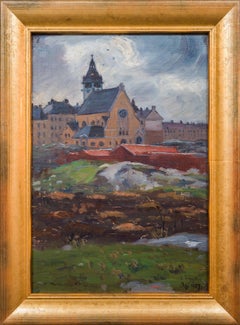
Sankt Matteus Church in Stockholm, 1907
Located in Stockholm, SE
The painting we have for sale, executed by Swedish artist Erik Tryggelin on May 3rd, 1907, presents an atmospheric and dynamic view of Sankt Matteus Church in Stockholm. This piece i...
Category
Early 1900s Post-Impressionist Stockholm - Figurative Paintings
Materials
Oil, Board
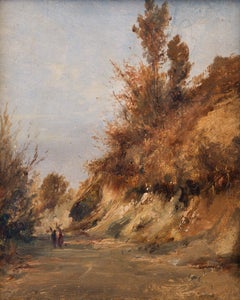
Autumn Pathway, by a Follower of Carl Blechen
Located in Stockholm, SE
The painting shown is a serene landscape, inspired by the renowned German artist Carl Blechen, known for his dramatic and romantic landscapes. Though crea...
Category
19th Century Stockholm - Figurative Paintings
Materials
Canvas, Oil
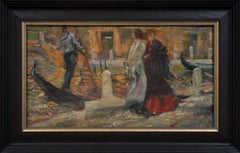
Venetian Scene with Gondoliers by Swedish Artist Allan Österlind
Located in Stockholm, SE
"Venetian Scene with Gondoliers" is an evocative portrayal of Venice, capturing the essence of the city’s romantic allure and bustling waterways. Created during Allan Österlind’s stu...
Category
1880s Stockholm - Figurative Paintings
Materials
Oil, Board
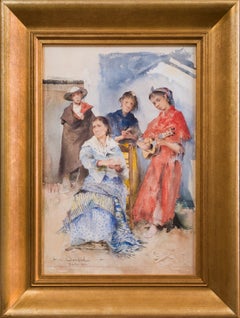
Everyday Life Scene From Sevilla, 1893, Watercolor by Allan Österlind
Located in Stockholm, SE
Allan Österlind, a Swedish artist who became a well known figure in French art circles, beautifully captures the essence of Andalusian culture in his 1893 watercolor painting, "Sevil...
Category
1890s Stockholm - Figurative Paintings
Materials
Paper, Watercolor
$4,227 Sale Price
20% Off
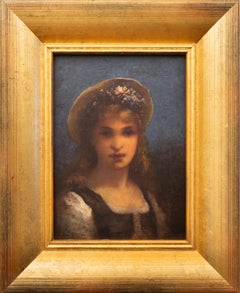
French Girl with Flowered Hat with Impressive Sfumato Technic by Leon Richet
By Leon Richet
Located in Stockholm, SE
Introducing a stunning portrait by renowned French artist Léon Richet (1847-1907), depicting a young girl adorned with a beautiful floral wreath and a hat perched atop her head. This...
Category
Late 19th Century Barbizon School Stockholm - Figurative Paintings
Materials
Oil, Panel
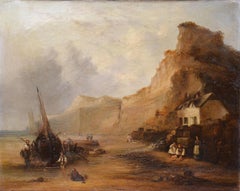
19th Century Oil Painting Sussex Coast Fishermen Returning Maritime Scene
Located in Stockholm, SE
This captivating mid 19th century oil on canvas depicts a touching maritime scene along England's Sussex coast, renowned for its dramatic white chalk cliffs and centuries-old fishing...
Category
Mid-19th Century Realist Stockholm - Figurative Paintings
Materials
Canvas, Wood, Oil
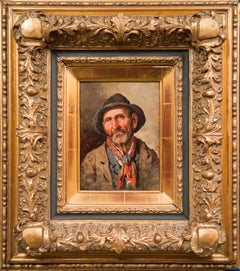
An Italian Man With Hat and Scarf by Italian Artist Giuseppe Giardinello
Located in Stockholm, SE
For sale is a beautiful small portrait by the Italian artist Giuseppe Giardinello, whose life spanned from 1887 to 1920. This work of art is a remarkable representation of Giardinell...
Category
Early 20th Century Post-Impressionist Stockholm - Figurative Paintings
Materials
Oil, Wood Panel
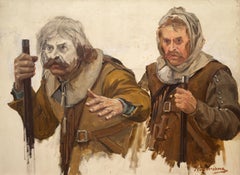
Oil Sketch for the Painting "Gustavus II Adolphus before the Battle of Lützen"
Located in Stockholm, SE
This is an oil sketch for the famous painting "Gustavus II Adolphus before the Battle of Lützen" today in the Göteborgs Konstmuseum's collection.
There is something special with an ...
Category
1890s Stockholm - Figurative Paintings
Materials
Canvas, Oil
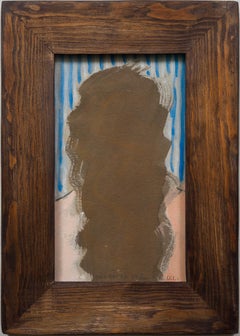
Hompage Magritte, Called Woman Seen From Behind, Original Gouache
Located in Stockholm, SE
This gouache painting by Ulf Linde, a multifaceted Swedish figure, presents a unique portrayal of a woman seen from behind, set against a blue and white...
Category
20th Century Surrealist Stockholm - Figurative Paintings
Materials
Gouache, Board
$4,707 Sale Price
20% Off
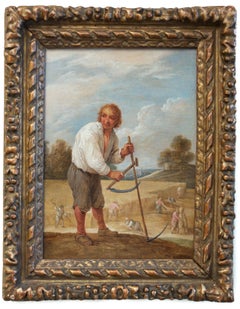
Peasants in a Cornfield (Boer in het veld) by David Teniers the Younger
By David Teniers the Younger
Located in Stockholm, SE
Remembering the magic of everyday life moments in the art of David Teniers:
The art of David Teniers the Younger (1610–1690) coincided with the heyday of the Flemish Baroque and captured a great variety of motifs of his time. In this painting of a seemingly simple peasant scene lies keys to understanding both the imaginative mind of Teniers as well as why this time period produced some of the most iconic works in all of art history.
As indicated by the name, Teniers was more or less born into his profession. As the son of David Teniers the elder, himself a painter who studied under Rubens, the younger David received training in art from a very young age and had no less than three brothers who also became painters. Because of his father’s frequent financial failures that even at times saw him imprisoned, David the younger helped to rescue the family from ruin through painting copies of old masters. Essentially, the young Teniers was confronted with painting as both a passion and creative expression as well as a necessity during difficult times, an experience that would shape much of his capacity and sensitivity in his coming life.
Despite the hardships, the talent and determination of Teniers was recognized and quickly expanded his possibilities. He had already spent time in France and possibly also England when he was hired by his father’s former teacher Rubens to help with a prestigious commission with mythological paintings, now considered lost, for Philip IV the king Spain. In 1644–54 Teniers was appointed dean of the Antwerp Guild of Saint Luke, manifesting his esteemed position within the artistic community. A few years afterwards he took an important step when relocating to Brussels, where Teniers yet again found new career opportunities that would prove to be very successful.
As the keeper of the collections of Archduke Leopold Wilhelm, a role similar to what we now refer to as an art advisor, Teniers purchased hundreds of important artworks that manifested the prominent status of the Archduke’s collection while at the same time providing an unusual access to inspiration and knowledge for Teniers himself. Since he kept on painting during the same time, his creative scope must have seemed almost bewildering in the great variety of images and stories that he surrounded himself with.
Regardless of how glamorous and culturally stimulating the career of Teniers was, he was as open to the charm and existential importance of everyday life as he was to works of great masters and luxurious collectibles. In his impressive repertoire of genres with everything from exquisite royal portraits, interiors, landscapes and history paintings he always added something new and inventive, highlighting the possibilities of art and importance of an experimental and intuitive mind. It is difficult to single out one aspect or genre to summarize his legacy, since it lies much more in the broad virtuosity across many motifs, although he is particularly remembered for farm scenes and meticulously depicted interiors where other paintings and artworks are captured with an astonishing precision. However, the fact that he is still today one of the most known and celebrated names of the Dutch Golden Age is a proof to the magic of his work, which continues to spark dialogue and wonder in the contemporary viewer of his works.
The farm boy in the field in this painting, which likely dates to the mature part of his career, is a wonderful entry into the mind of Teniers. In the tightly cropped motif, we see him standing right in the middle of the busy harvest when men, women and everyone capable were sent out in the field to collect the crop that formed the very core of their diet and survival. In the background we see a fresh blue sky interspersed with skillfully painted clouds, some trees reaching their autumnal colours and in the far distance the glimpse of a small church and village. The presence of a church in a landscape, so typical of Dutch art, served both a symbolic and visual function as a representation of faith while at the same time defining scale and distance.
In the field, the work is in full action with the farmers spread out in various positions, all in the midst of hard and sweaty labour. While they are portrayed as having nothing else than the work on their mind, our farm boy seems to have his attention directed elsewhere. Standing there with his white, half open shirt, flowy curls and strong, sturdy body; his gaze is directed away, out of the picture and the scythes in his hands. He looks almost smirking, expressed with tremendous subtlety in the slight smile of his lips and big eyes, being just in the middle of losing focus on the work. What is it that steals his attention? What has he seen, or realized, or felt – to break him free of the arduous task of harvesting, if but for a moment?
Here starts the wondering and the questions that are the hallmark of a great piece of art. Instead of explicitly locking in the motif in overly clear symbolism Teniers has chosen an open ended, subtle yet striking moment for us to consider. While it of course can be related to numerous other farm scene depictions of this time, and clever usages of gazes and real-life scenes to underscore various moral or symbolic meanings, the painting can be much more of a contemplation than an explanation or illustration. The ordinary nature and understated yet emotionally textured composition of the motif gives greater space for our own reactions and thoughts. Has he seen a pretty farm girl just passing by? Is he fed up with the farm life, joyously dreaming away for a minute, imagining another future? Or is he simply in need of distraction, looking away and ready for anything that can steal his attention?
One quality that never seem to have escaped Teniers was that of curiosity. During all of his career he constantly investigated, expanded and experimented with not only the style and technique of painting, but with the vision of art itself. Being credited with more or less introducing farm motifs for a broader audience not only tells us of his ability to understand the demand for different motifs, but the sensitivity to transform seemingly ordinary parts of life into deep aesthetic experiences, far beyond their expected reach. The farm boy in this painting is, of course, exactly that. But with the help of one smirk the entire picture is charged with a different energy, awakening many contrasts and relationships between the calm landscape, the hard work and his own breach of effectivity, holding sharp scythes while thinking or seeing something else.
It is no wonder Teniers chose to work with farm scenes as a way of investigating these intricate and delicate plays on expectations and surprises, clarity and ambivalence. It invites us to an appreciation of human everyday life that connects us with the people of 17th century...
Category
Late 17th Century Old Masters Stockholm - Figurative Paintings
Materials
Canvas, Oil
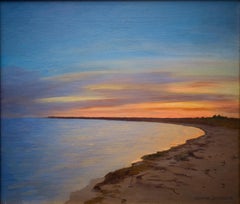
Beach Curve in the Evening Light by Swedish Artist Herman Österlund, 1920s
Located in Stockholm, SE
Herman Österlund was a Swedish artist best known for his beautiful depictions of the west coast of Sweden.
He moved to Stockholm in 1896 and passed the test for entering the Royal A...
Category
1920s Realist Stockholm - Figurative Paintings
Materials
Canvas, Oil
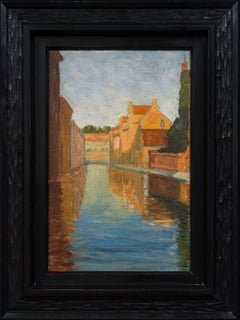
Bruges (Brügge), 1894 by Symbolist Painter Olof Sager-Nelson.
Located in Stockholm, SE
Provenance:
Ina Colliander, relative of the artist;
A private collection, Sweden;
Bukowskis, Stockholm, Important Winter Sale, 2025, lot 711.
Exhibited:
Thielska Gallery, Stockholm,...
Category
1890s Symbolist Stockholm - Figurative Paintings
Materials
Canvas, Oil
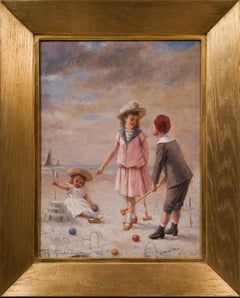
Enfants à la plage Oil Painting on Wood Panel, Signed, Circa 1865-1875
Located in Stockholm, SE
Albert Roosenboom was a Belgian genre painter celebrated for his elegant depictions of everyday life in the mid to late 19th century. A pupil of the renowned Constantin Meunier, Roos...
Category
1870s Romantic Stockholm - Figurative Paintings
Materials
Oil, Wood Panel
Read More
See Kent Monkman’s Magical Realist Take on Frontier History
With a solo show at the Denver Art Museum and a commission from the Met, the Cree Canadian painter has become an international sensation.
Cecilia Vicuña Merges Politics, Science and Spirituality in Her Poetic Art
The Chilean creator, who has been living in exile in New York for decades, is having a major moment, receiving the biggest exhibitions, commissions and awards an artist could dream of.