Texas - Sculptures and Carvings

to
15
206
2,062
1,356
203
3
5
2
1
1
1
73
48
82
3
34
22
14
6
3
4
1
1
1
6
2
79
66
62
39
36
190
113
76
49
29
206
206
206
1
1
1
1
1
Item Ships From: Texas
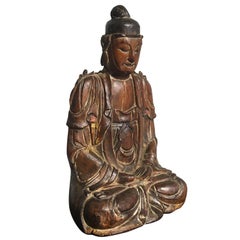
Small Song Dynasty Carved Wood Bodhisattva, 13th Century, China
Located in Austin, TX
A small and very fine Chinese carved sandalwood figure of a bodhisattva, possibly Avalokiteshvara (Guan Yin), Song Dynasty (960 to 1276), circa 13th ...
Category

15th Century and Earlier Chinese Antique Texas - Sculptures and Carvings

Materials

Hardwood

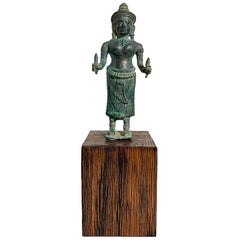
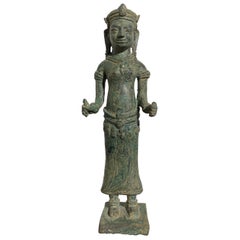
Khmer Bronze Uma, Angkor Wat Style, 12th Century, Cambodia
Located in Austin, TX
A small Khmer bronze figure of the Hindu goddess Uma, Angkor Period, Style of Angkor Wat, circa 12th century, Cambodia. This small Khmer bronze devotiona...
Category

15th Century and Earlier Cambodian Antique Texas - Sculptures and Carvings

Materials

Bronze

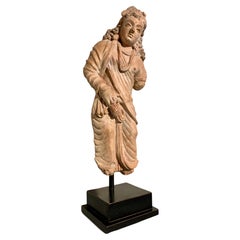
Gandharan Terracotta Figure of the Bodhisattva Maitreya, 4th-6th Century
Located in Austin, TX
A very rare and decidedly charming half-scale terracotta sculpture of the bodhisattva Maitreya, the Buddha of the Future, ancient region of Gandha...
Category

15th Century and Earlier Pakistani Antique Texas - Sculptures and Carvings

Materials

Terracotta

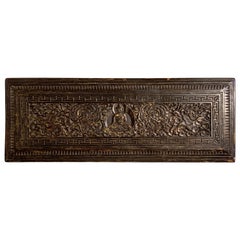
Nepalese Carved and Painted Buddhist Manuscript Cover, 15th Century
Located in Austin, TX
A fine and unusual wooden book or manuscript cover with a carved exterior and painted interior, 15th century, Nepal. The exterior of the manuscript cover exuberantly carved with ...
Category

15th Century and Earlier Nepalese Tibetan Antique Texas - Sculptures and Carvings

Materials

Wood

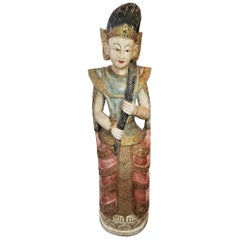
Early 20C Thai Goddess of Love Polychrome Statue
Located in Dallas, TX
PRESENTING A GORGEOUS Early 20C Thai Goddess of Love Polychrome Statue. Made in Thailand in the early 20th Century, circa 1920. Hand carved wooden statu...
Category

Early 20th Century Thai Country Texas - Sculptures and Carvings

Materials

Hardwood, Giltwood, Paint

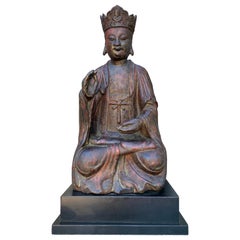
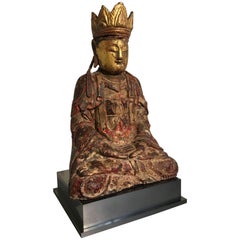
Chinese Qing Dynasty Lacquered Wood Guanyin, 18th Century, Southern China
Located in Austin, TX
A Chinese early Qing Dynasty carved and lacquered wood figure of Guanyin, Southern China, 17th/18th century. Guanyin, the Bodhisattva of Compassion and Mercy, is portrayed seated in dhyanasana, one hand raised in viktara mudra, the gesture of teaching and discourse. The great bodhisattva is dressed in heavy, loose robes tied at the chest, with a mantle draped over his shoulders. He looks serenely outwards from heavily lidded eyes. Guanyin's face carved beautifully with somewhat feminine features. A large five pointed crown sits upon his head. The larger leaves of the crown carved with indistinct images of the Buddha. The statue was originally fully lacquered in the deep red gilt lacquer typical of Southern Chinese Buddhist sculpture...
Category

Early 18th Century Chinese Qing Antique Texas - Sculptures and Carvings

Materials

Wood

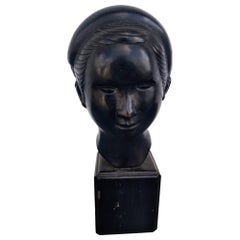
7" Nguyen Thanh Le bronze sculpture
Located in Pasadena, TX
Nguyen Thanh Le was a prolific Vietnamese artist from Saigon. This sculpture is patinated in black and sits atop a black enameled wood base. A lot of his works were purchased by the ...
Category

20th Century Vietnamese Texas - Sculptures and Carvings

Materials

Bronze

7" Nguyen Thanh Le bronze sculpture
$1,120 Sale Price
20% Off
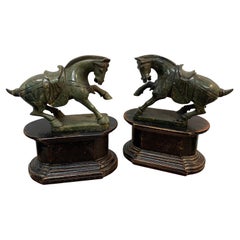
Pair of Chinese Export Hardstone Horses and Stands
Located in West Palm Beach, FL
Pair of Chinese export hardstone horses and stands, each one finely carved of a standing horse with one leg up, facing left and right. Removable from the associated lacquered stands....
Category

20th Century Chinese Chinese Export Texas - Sculptures and Carvings

Materials

Precious Stone, Lacquer

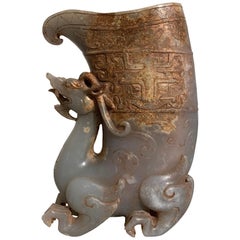
Chinese Hardstone Carved Mythical Beast Rhyton Vessel, 20th Century
Located in Austin, TX
An early 20th century Chinese Republic period carved hardstone drinking vessel, called a rhyton, in the form of a mythical pixiu. The archaistic vessel carved in the Han Dynasty style from a single block of lavender gray nephrite and featuring a large horn-shaped cup being supported by a mythical pixiu. The pixiu carved with a nice sense of motion, head reared back, mouth open, and claws bared. The cup bearing a design of large horned taotie ogre masks on either side. The stone with areas of artificial "calcified" patination.  The pixiu is an ancient beast from...
Category

Early 20th Century Chinese Han Texas - Sculptures and Carvings

Materials

Jade

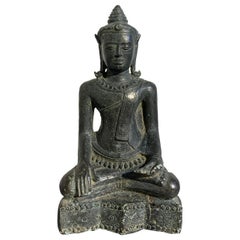
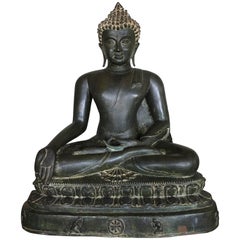
Thai Lopburi Cast Bronze Seated Buddha, 13th Century
Located in Austin, TX
A fine early Thai Lopburi figure of a crowned and adorned Buddha, cast bronze, mid-13th century. The unusual figure of the Buddha sits in virasana upon a stylized lotus pedestal. He is dressed in the traditional monastic robes, but also adorned with a crown and jewelry, including earrings, a necklace, and jeweled belt. His hands in an atypical combination of mudras. His right hand in bhumisparsha mudra, reaching down to touch the earth, while his left hand held somewhat outwards, seemingly in varada mudra, the gesture of granting favours or wishes. The palm of his outstretched hand marked with the dharmachakra, the Wheel of the Law, representing Buddhist teaching. The bronze with a beautiful silvery patina. Lopburi was an independent Mon kingdom with strong ties to the Khmer Angkor...
Category

15th Century and Earlier Thai Antique Texas - Sculptures and Carvings

Materials

Bronze

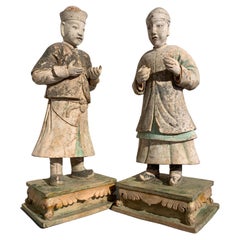
Pair Large Chinese Ming Dynasty Glazed and Painted Pottery Figures, 16th Century
Located in Austin, TX
A striking pair of large Chinese glazed and painted pottery figures, Ming Dynasty (1368 to 1644), circa 16th century, China. The impressive and realistically modeled figures each portrayed standing upright upon a sancai (three color) glazed pedestal of kang table form. The man is dressed in a short black surcoat over a long robe and pants, a smart cap upon his head. His face is warm and welcoming, with wide eyes and a slight smile on his lips. He holds his hands out in front of him, palms up, almost as if shrugging, though presumably originally holding an object or offering, now lost. The woman of slightly smaller stature, and dressed in a longer surcoat over a long robe and skirt. She wears a fitted cap upon her head. Her hands also held out in front, grasping long lost objects. Her face is slightly more severe, with a somewhat pinched look, and slight frown upon her lips. The size of these figures is remarkable, as is the realism and attention to detail, almost as if they were modeled after real people, as opposed to the more common and generic Ming Dynasty pottery...
Category

16th Century Chinese Ming Antique Texas - Sculptures and Carvings

Materials

Pottery

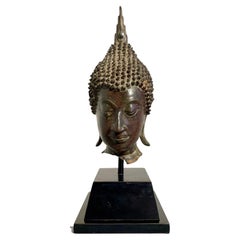
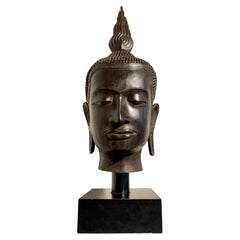
Thai Sukhothai Cast Bronze Buddha Head, 15th/16th Century, Thailand
Located in Austin, TX
An exquisite Thai cast bronze Buddha head, Sukhothai kingdom, circa 15th century, Thailand. The Buddha's pleasing face, with its narrow, oval ...
Category

15th Century and Earlier Thai Antique Texas - Sculptures and Carvings

Materials

Bronze

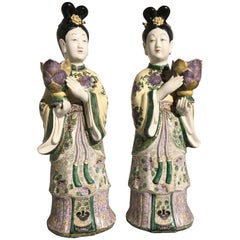
Pair of Chinese Export Porcelain Court Lady Candle Holders, Mid-20th Century
Located in Austin, TX
A lovely pair of Chinese export porcelain candle holders in the form of court ladies holding lotus blossoms, mid 20th century, circa 1960's, China. Modeled after 18th century Qianlo...
Category

Mid-20th Century Chinese Qing Texas - Sculptures and Carvings

Materials

Porcelain

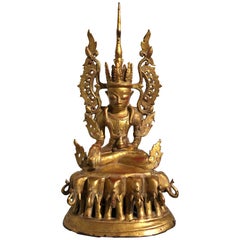
Burmese Arakan Lacquered and Gilt Bronze Healing Buddha, 18th Century
Located in Austin, TX
An unusual 18th century Burmese Arakan style red lacquered and richly gilt cast bronze figure of the Crowned Medicine Buddha, commonly referred to as Bhaishajyaguru. The Supreme Healer is portrayed seated in vajrasana (full lotus position) upon a throne of nine elephants, symbolizing the practice of samatha, or calming the mind (mindfulness) - specifically the nine stages of calm abiding. The hand in his lap holds a jar of healing salve. His other hand rests gently on his knee in varada mudra, the gesture of wish fulfilling, offering a myrobalan seed, a fruit said to be capable of healing emotional ills. The Healing Buddha...
Category

Mid-18th Century Burmese Antique Texas - Sculptures and Carvings

Materials

Bronze

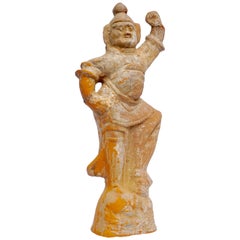
Tang Dynasty Painted Terracotta Sculpture of a Lokapala
By Tang Dynasty
Located in Dallas, TX
Tang Dynasty terracotta Pottery Tomb figure of the Lokapala Warrier Deity. Figure molded wearing heavy armor, standing in a dynamic pose with left arm raised in a threatening gesture...
Category

15th Century and Earlier Chinese Tang Antique Texas - Sculptures and Carvings

Materials

Terracotta

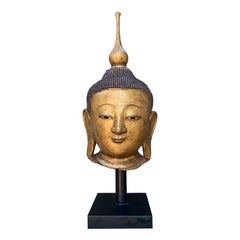
Monumental Shan Burmese Gilt Lacquer Buddha Head, Early 20th Century
Located in Austin, TX
A Burmese gilt dry lacquer monumental head of the Buddha, Shan States, Myanmar (Burma), early 20th century. This monumental dry lacquer and gilt head ...
Category

Early 20th Century Burmese Texas - Sculptures and Carvings

Materials

Shell, Lacquer

Large Burmese Bronze Medicine Buddha, Pagan Style, Late 19th Century
Located in Austin, TX
A large and magnificent cast bronze image of the Medicine Buddha, Bhaisajyaguru, rendered in the Burmese Pagan style, and most likely based on a period example that was either damaged or lost, 19th century, Burma or Thailand. He can be identified as the Medicine Buddha by the hand that rests in his lap, with his middle finger touching the thumb. A medicine pot or fruit stem would originally have been placed in his upturned palm. The face of this Buddha has been sculpted masterfully. He has a beautiful heart shaped face topped by hair neatly arranged in the typical "snail shell curls", and surmounted by a high ushnisha. Long, pendulous earlobes frame his face, a symbol of his princely past. He gazes serenely outwards from heavily lidded, downcast eyes, a content smile upon his full, lush lips. The Buddha is portrayed seated in vajrasana (full lotus position), his elegant hands displayed in varada mudra, the gesture of granting favors and fulfilling wishes. Long, exquisite fingers extended, the thumb and middle finger touching in a gesture of compassion. He is clothed in a simple kasaya wrapped around his body and over one shoulder, leaving the shoulder and part of his chest bare. The diaphanous garment clings to his body, outlining his well proportioned and graceful, almost sensuous, form. The excess material pooled in neat pleats in front of him. A sash thrown over his shoulder. He sits upon a double lotus base upon a raised platform. The platform features two kneeling attendants, usually interpreted as the monks Ananda and Kasyapa. Between them is a circular disc representing the Wheel of Dharma. Contained in the disk is a flower with eight petals, symbolizing the eightfold path, one of the principle teachings of the Buddha. The sides and back of the platform featuring a series of singha, or lions, representative of the Buddha's royal past. An applied lacquer patina covers the entirety of the image. Large deposits of ash (from incense) are present between the curls of the hair, as well as some the other crevices, indicating this image was the subject of worship for many years. Bhaisajyaguru, also called the Medicine Buddha, or Buddha of Healing, is a revered figure in the Buddhist pantheon as a master able to cure suffering, both physical and spiritual, through his teachings. The Pagan Empire ruled most of present day Burma (Myanmar) from 849 to 1297. The capital, Bagan, served as a both the center of government and religion, where Buddhism reigned supreme. Bagan was also at a crossroads of the Buddhist world, with influence from India, Nepal, Tibet, China, and even Indonesia shaping their culture. As such, Pagan Buddha...
Category

Late 19th Century Burmese Antique Texas - Sculptures and Carvings

Materials

Bronze

Chinese Ming Dynasty Carved, Painted and Giltwood Amitayus Buddha
Located in Austin, TX
A beautiful and serene Chinese Ming dynasty carved wood figure of the Buddha Amitayus, the Buddha of long life, and a form of Amitabha Buddha. He is seated in dhyanassana, dressed in...
Category

17th Century Chinese Ming Antique Texas - Sculptures and Carvings

Materials

Wood

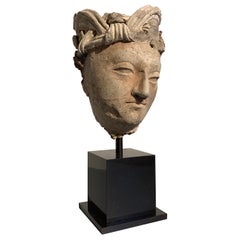
Gandharan Stucco Head of a Bodhisattva, Region of Hadda, 3rd-5th Century
Located in Austin, TX
A striking Gandharan molded stucco head of a male Bodhisattva, tentatively identified as Manjushri, ancient region of Gandhara, probably Hadda or surrounding area, 3rd-5th century. The Bodhisattva is sculpted of stucco in an idealized manner as a youthful male, with soft and kind features, a benign expression on his face. He wears an elaborate pleated turban wrapped around his head, with two sweeping lobes at the front. His turban secured on one side by a small image of a roaring lion. The lion may be read as a reference to Manjushri, the Bodhisattva of Wisdom, who is often depicted as riding or subduing a roaring lion, a metaphor for taming the wild thoughts of the mind. Manjushri gazes outwards in a beatific manner from almond shaped eyes, a gentle smile on his lips. The eyes at different levels when looking at the sculpture head on, indicating the original placement of the head was meant to be viewed at an angle. Remnants of pigments to the eyes, nose, mouth and ears. Mounted on a custom black metal stand. Hadda was an important center of Buddhist learning in the early history of Greco Buddhist Gandhara, and at one time may have housed a bone relic of the historical Buddha, Shakyamuni. The sculpture and architecture of Hadda followed Hellenistic artistic conventions faithfully, leading some scholars to believe the distinct Greco Buddhist style of Gandhara was first developed in Hadda before spreading to the rest of the region. The kingdom of Gandhara was situated at a crossroads of trade and cultures. Being one of the last remnants of Alexander the Great's Empire, the inhabitants of the Greco-Bactrian Buddhist kingdom preserved Greek culture and heritage for centuries after the decline of the Greek Empire...
Category

15th Century and Earlier Afghan Hellenistic Antique Texas - Sculptures and Carvings

Materials

Stucco

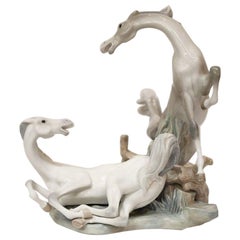
Lladro Porcelain Horse sculpture
Located in Dallas, TX
Lladro Porcelain Horse Grouping Sculpture.
Category

Late 20th Century Texas - Sculptures and Carvings

Materials

Porcelain

Lladro Porcelain Horse sculpture
$960 Sale Price
20% Off
Large Over Life-Sized Vintage Thai Bronze Buddha Head, circa 1970 s
Located in Austin, TX
An large and impressive vintage Thai cast bronze Buddha head, U-Thong style, 1970's, Thailand. The larger than life-sized head beautifully c...
Category

1970s Thai Vintage Texas - Sculptures and Carvings

Materials

Bronze

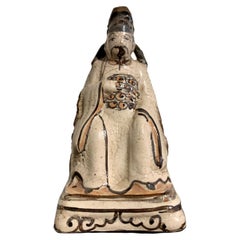
Chinese Small Cizhou Glazed Figure of a Daoist Deity, Song to Ming Dynasty
Located in Austin, TX
A small and charming Chinese cizhou ware glazed pottery figure of a Taoist deity or official, Song to Ming Dynasty, 13th - 15th century, China, ex. Christi...
Category

15th Century and Earlier Chinese Ming Antique Texas - Sculptures and Carvings

Materials

Stoneware

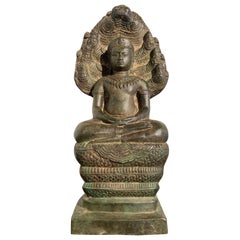
Khmer Cast Bronze Buddha Sheltered by Naga, 19th Century, Cambodia
Located in Austin, TX
A well cast Khmer style bronze figure of an adorned Buddha sheltered by a Naga, Buddha Muchalinda, 19th century or earlier, Cambodia. The sculpture in th...
Category

19th Century Cambodian Antique Texas - Sculptures and Carvings

Materials

Bronze

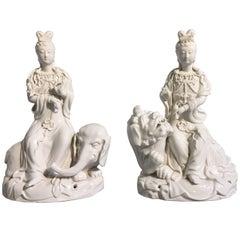
Pair of Vintage Blanc de Chine Figures of Guanyin Riding an Elephant and Lion
Located in Austin, TX
A lovely pair of Chinese Blanc de Chine figures of Guanyin (Avalokiteshvara) seated upon animals, Republic Period, circa 1930s. Guanyin, the Bo...
Category

1930s Chinese Chinoiserie Vintage Texas - Sculptures and Carvings

Materials

Porcelain

Chinese Ming Dynasty Carved Wood Budda
Located in Dallas, TX
A carved wood Budda from the Shanxi region, made during the Ming Dynasty. The carved figure has an ancient polychrome finish.
Category

Mid-17th Century Chinese Ming Antique Texas - Sculptures and Carvings

Materials

Wood

Chinese Yellow Glazed Mythical Beast, Xiezhi, Qing Dynasty, 19th Century, China
Located in Austin, TX
A fantastic and charming Chinese yellow glazed porcelain model of a mythical unicorn, xiezhi, Qing Dynasty, 19th century, China. The xiezhi is a ...
Category

Early 19th Century Chinese Qing Antique Texas - Sculptures and Carvings

Materials

Porcelain, Wood

Korean Carved and Giltwood Buddha, Joseon Dynasty, 19th Century
Located in Austin, TX
A sublime and well carved Korean lacquered and gilt wood figure of Amitabha Buddha (Amita Bul), Joseon Dynasty, early 19th century, Korea. The Budd...
Category

Early 19th Century Korean Antique Texas - Sculptures and Carvings

Materials

Wood

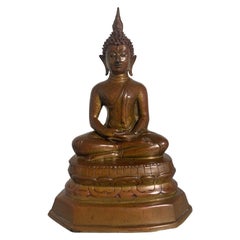
Thai Gilt Bronze Buddha Marvijaya, Rattanakosin Period, 19th Century, Thailand
Located in Austin, TX
A lovely Thai lacquered and gilt cast bronze figure of the historical Buddha, Shakyamuni, portrayed in Maravijaya, Rattanakosin Period, early to mid 19th century, Thailand. The B...
Category

Mid-19th Century Thai Antique Texas - Sculptures and Carvings

Materials

Bronze

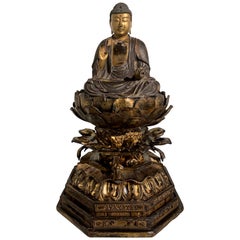
Japanese Giltwood Medicine Buddha, Yakushi Nyorai, Muromachi Period 16th Century
Located in Austin, TX
A striking Japanese late Muromachi Period (1333-1573) lacquered and giltwood figure of Yakushi Nyorai, the Medicine Buddha, seated upon an elaborate car...
Category

16th Century Japanese Edo Antique Texas - Sculptures and Carvings

Materials

Rock Crystal

Northern Thai Lan Na Bronze Buddha Seated in Meditation, 15th-16th Century
Located in Austin, TX
A lovely northern Thai cast bronze seated meditating Buddha statue with shell inlaid eyes, style of Wat Chedi Luang, Lan Na Kingdom, region of Chiang Mai, 15th-16th century.  The statue of the historical Buddha, Shakyamuni, is portrayed in dhyanasana, seated upon a double lotus pedestal atop a raised platform. His legs in virasana, the half lotus position, hands in dhyana mudra, the gesture of meditation. The Buddha's face is youthful and pleasant, reminiscent of faces of contemporaneous Sukhothai Buddha...
Category

16th Century Thai Antique Texas - Sculptures and Carvings

Materials

Bronze

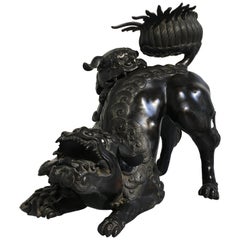
Large Late Qing Dynasty Chinese Cast Bronze Buddhistic Foo Lion Censer
Located in Austin, TX
A large and powerfully cast Chinese bronze censer in the form of two Buddhistic lions, Qing dynasty, late 19th century. The censer is well cast with a strong sense of movement, featuring a pair of fierce Buddhistic lions playfully antagonizing each other. Locked in a mock battle, the smaller lion...
Category

Late 19th Century Chinese Qing Antique Texas - Sculptures and Carvings

Materials

Bronze

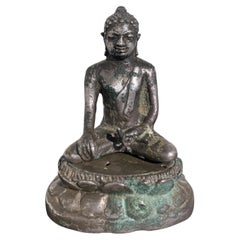
Central Javanese Cast Silver Transcendent Buddha, 9th-12th Century, Indonesia
Located in Austin, TX
An exceedingly rare Javanese cast silver figure a Transcendent Buddha, probably the Dhayani Buddha Akshobhya, early classical Javanese period, 9th - 12th century, Java, Indonesia. ...
Category

15th Century and Earlier Javanese Antique Texas - Sculptures and Carvings

Materials

Silver

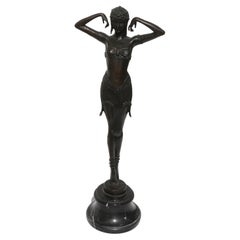
Bronze 19" Chiparus Style Ballerina Sculpture
Located in Pasadena, TX
Bronze Chiparus signed Re-strike Ballerina Sculpture 5”x 19”
Category

20th Century American Art Nouveau Texas - Sculptures and Carvings

Materials

Bronze

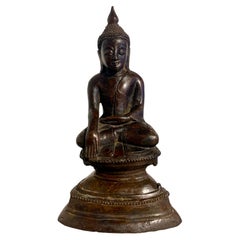
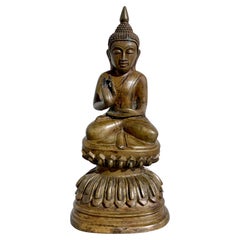
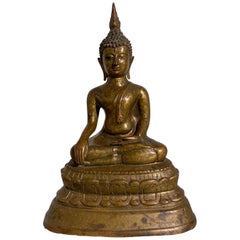
Burmese Bronze Ava Style Buddha, 19th / 20th Century, Burma
Located in Austin, TX
A small and charming Burmese cast bronze Buddha in the Ava style, late 19th or early 20th century, Myanmar (Burma). The image depicts the historical Buddha, Shakyamuni, seated in ...
Category

Early 20th Century Burmese Texas - Sculptures and Carvings

Materials

Bronze

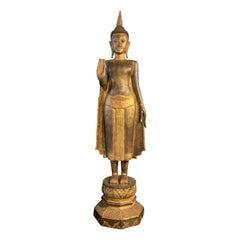
Large Carved Gilt Teak Standing Buddha, Northern Thailand, Early 20th Century
Located in Austin, TX
A large, tall Thai standing carved teak wood Buddha, lacquered and gilt, with hand raised in abhaya mudra, far Northern Thailand or possibly Laos, early 20th century. Near life-siz...
Category

Early 20th Century Thai Texas - Sculptures and Carvings

Materials

Teak

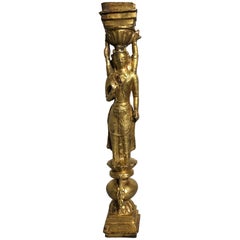
Densatil Gilt Bronze Caryatid Figure, Tibet, 15th Century
Located in Austin, TX
A heavy and solidly cast, richly gilt, bronze caryatid figure from Densatil Monastery, Central Tibet, early 15th century or earlier. Cast in the form of two four armed figures standing back to back in tribhanga (thrice bent position) on a lotus platform, this piece would originally have served as a pillar for a larger seated deity...
Category

15th Century and Earlier Tibetan Tibetan Antique Texas - Sculptures and Carvings

Materials

Bronze

Pair of Japanese Edo Period Musha Ningyo Courtier Dolls
Located in Austin, TX
Two exquisite Japanese musha ningyo dolls, crafted as courtiers, Edo Period, early 19th century, Japan. The older man can be identified as the h...
Category

Early 19th Century Japanese Edo Antique Texas - Sculptures and Carvings

Materials

Shell, Brocade, Silk, Glass, Wood, Paint, Paper
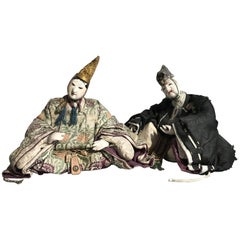
Burmese Shan Ava Style Cast Bronze Buddha, 19th/20th Century, Burma
Located in Austin, TX
A delightful Shan Burmese cast bronze seated Buddha in the Ava style, late 19th or early 20th century, Burma. The Buddha sits upon a high, well cast double lotus pedestal. He is s...
Category

Early 20th Century Burmese Texas - Sculptures and Carvings

Materials

Bronze

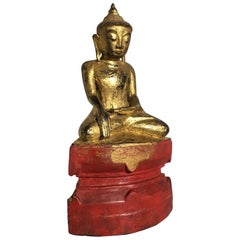
Shan Burmese Lacquered and Gilt Wood Buddha, Ava Period, 18th Century
Located in Austin, TX
A rare and exquisite 18th century Ava period Shan Burmese figure of the Buddha. Carved from a single block of wood, lacquered and gilt, the immensely s...
Category

Mid-18th Century Burmese Antique Texas - Sculptures and Carvings

Materials

Teak

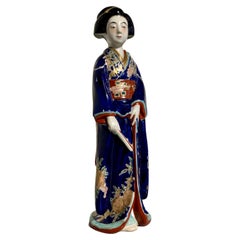
Japanese Kutani Porcelain Figure of a Geisha or Bijin, Showa Era, 1930 s, Japan
Located in Austin, TX
A lovely Kutani porcelain model of a beautiful woman, bijin, or perhaps a geisha, Showa era, circa 1930's, Japan. A charming and delightful Japanese Kutani enameled porcelain figure of a bijin or geisha, early Showa Era, circa 1930's, Japan. The elegant figure of a beautiful woman, called a bijin, or perhaps a geisha, is portrayed dressed in full kimono and holding a closed folding fan in one hand. Her kimono of a rich and deep blue hue, with images of plump pomegranates in gilt. Her wide obi of a striking red color, and patterned with branches of pink blossoms. One foot, clad in a white tabi...
Category

1930s Japanese Showa Vintage Texas - Sculptures and Carvings

Materials

Porcelain

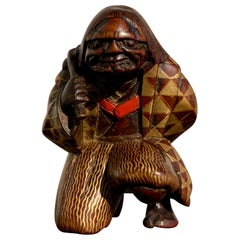
Carved Boxwood and Lacquer Netsuke of a Noh Dancer, Meiji Period, Japan
Located in Austin, TX
A fine lacquer decorated carved boxwood netsuke of a Noh dancer in a Hannya role, unsigned, Meiji period, late 19th century, Japan. The boxwood netsuke finely carved as a kneeling Noh dancer dressed in striking geometric patterned robes. The actor holds an opened war fan behind their back in one hand, a Shinto wand slung over the shoulder in the other. The war fan, tessen, decorated in red lacquer with a golden rising sun at the center. Tessen were sturdy fans used by samurai as protective devices, and sometimes as weapons. The wand, called an onusa, is a traditional Shinto ritual implement comprised of folded paper streamers, shide, attached to a wooden wand, often used in purification rituals. Here, the shide are crafted from silver maki-e, with the handle of the natural boxwood. The actor wears a fierce and unearthly hannya mask...
Category

1890s Japanese Meiji Antique Texas - Sculptures and Carvings

Materials

Boxwood, Lacquer

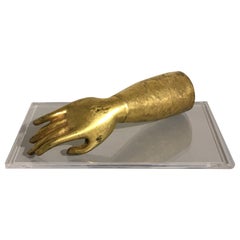
Tibetan Gilt Bronze Arm of the Buddha, Early 19th Century
Located in Austin, TX
A stunningly graceful life-sized arm and hand of the Buddha, Tibet, late 18th or early 19th century. The hand is beautifully cast, with long, elega...
Category

Early 19th Century Tibetan Tibetan Antique Texas - Sculptures and Carvings

Materials

Bronze

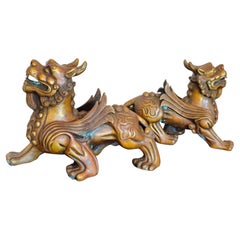
Pair of Chinese Bronze Pixiu Winged Lion Figure Feng Shui Mythical Beast Statue
Located in Forney, TX
A stunning pair of excellent quality bronze Pixiu wealth dragon mythical creatures with visually striking scattered verdigris bluish green patina! Well known in Chinese culture and...
Category

Early 20th Century Chinese Qing Texas - Sculptures and Carvings

Materials

Bronze

Lopburi Style Cast Bronze Figure of Uma, 13th-14th Century, Thailand
Located in Austin, TX
A charming and unusual cast bronze figure of the Hindu goddess Uma, Lopburi Style, 13th-14th century, Thailand. Uma, the Hindu goddess of love and beauty, also known as Parvati, i...
Category

15th Century and Earlier Thai Antique Texas - Sculptures and Carvings

Materials

Bronze

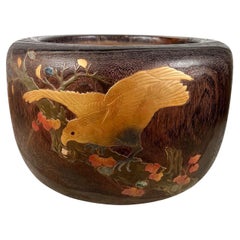
Meiji Period Japanese Hibachi with Gilded Eagle
Located in Dallas, TX
An exceptional Meiji Period, circa 1870 Japanese hibachi featuring a finely detailed gilded eagle in flight. The craftsmanship reflects the artistry and refinement characteristic of ...
Category

1870s Japanese Antique Texas - Sculptures and Carvings

Materials

Copper

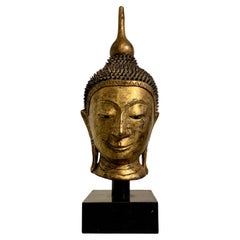
Vintage Shan Burmese Style Gilt Dry Lacquer Buddha Head, circa 1960s, Thailand
Located in Austin, TX
A serene vintage Buddha head of gilt dry lacquer in the Shan Burmese style, but made in Thailand for the export market, circa 1960s, mounted on a b...
Category

1960s Thai Vintage Texas - Sculptures and Carvings

Materials

Laminate, Lacquer

Thai Gilt Bronze Seated Buddha, Lan Na Kingdom, Chiang Mai, Late 15th Century
Located in Austin, TX
A rare and beautiful Thai cast and gilt bronze seated Buddha with shell inlaid eyes, style of Wat Chedi Luang, Lan Na Kingdom, Northern Thailand, region of Chiang Mai, late 15th cent...
Category

15th Century and Earlier Thai Antique Texas - Sculptures and Carvings

Materials

Bronze

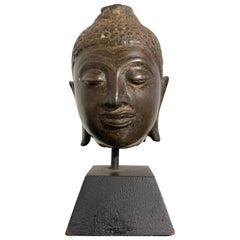
Small Thai Chiang Saen Bronze Head of the Buddha, 16th Century
Located in Austin, TX
A small and charming fragmentary cast bronze Buddha head with traces of gilding and lacquer, Lan Na Kingdom, Chiang Saen style, 16th century, Thailand. ...
Category

16th Century Thai Antique Texas - Sculptures and Carvings

Materials

Bronze

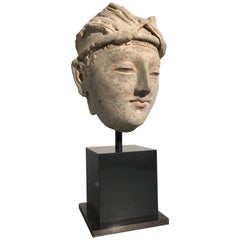
Gandharan Stucco Head of a Donor, 4th-5th Century
Located in Austin, TX
A sublime molded stucco head of a young male donor from the ancient region of Gandhara, 4th-5th century. The youthful nobleman sculpted in an idealized...
Category

15th Century and Earlier Pakistani Hellenistic Antique Texas - Sculptures and Carvings

Materials

Stucco

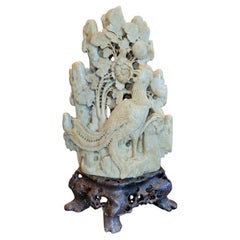
20C Medium Chinese Soapstone Carving
Located in Dallas, TX
Presenting a lovely 20c medium Chinese soapstone carving. Made in China in the early 20th century circa 1930. This is a medium/tall gre...
Category

Early 20th Century Chinese Chinese Export Texas - Sculptures and Carvings

Materials

Soapstone

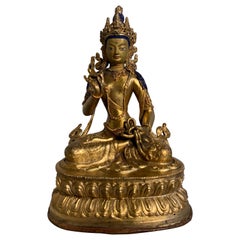
Nepalese Gilt Bronze Bodhisattva Amoghapasha? , Early to Mid-20th Century
Located in Austin, TX
A beautiful and unusual gilt bronze figure of a Bodhisattva, possibly Amoghapasha, Nepal, early to mid-20th century, circa 1930s or 1940s. The regal figure possibly depicting the bodhisattva Amoghapasha, the Unfailing Lasso. The enlightened being is portrayed seated upon a high double lotus pedestal. He is dressed as an Indian prince, wearing a luxurious foliate patterned dhoti around his waist and a billowing scarf around his shoulders. . His torso bare save for the jeweled necklaces and the sacred thread. A five pointed crown with an image of Amitabha Buddha in the central point graces his head. His princely face cold painted with beautiful detail, his hair colored blue with crushed lapis lazuli, indicating his peaceful nature. Amoghapasha holds a lasso in one hand, an axe in the other. He is considered an emanation of Avalokiteshvara. A bodhisattva of compassion, Amoghapasha is so named because of the lasso he holds in his hand. The lasso represents his vast compassion which is thought to extend to encompass all beings, bringing them into a state of perfection and enlightenment. The copper base plate, seemingly a later replacement, has been inscribed with a visvajra (double vajra...
Category

Mid-20th Century Nepalese Tibetan Texas - Sculptures and Carvings

Materials

Lapis Lazuli, Bronze

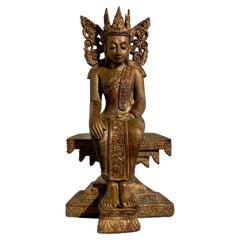
Burmese Carved Hardwood Crowned Buddha Seated in Western Pose, Mid 20th Century
Located in Austin, TX
A sublime Burmese carved, lacquered and gilt hardwood crowned Buddha seated in a "western pose", early to mid 20th century, Burma (Myanmar). The elegant and graceful Buddha is portrayed wearing an elaborate six pointed crown with two large "wings" to the side, and a simple robe wrapped around the body and draped over one shoulder. He is seated upon a high stepped throne, his feet resting upon a double lotus pedestal. The Buddha's face is serene. He stares out in the distance calmly, with eyes slightly downcast, and a slight smile on his face. His long, pendulous earlobes blend in with the wings of the elaborate crown upon his head. A lotus bud finial would originally have surmounted the head, but is now missing. He holds one hand in his lap, palm up in a meditative gesture. His other hand rests gently on his knee. This pose, with the Buddha seated upon a raised throne, with both legs planted on the floor, is often referred to as a "western pose". The pose is most often associated with the Bodhisattva Maitreya...
Category

Mid-20th Century Burmese Texas - Sculptures and Carvings

Materials

Hardwood, Lacquer

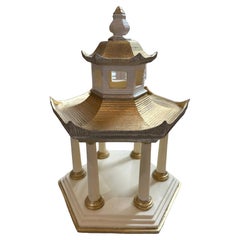
Classical Chinoiserie Style Garden Pavilion Model with Gilt Dome
Located in Dallas, TX
An elegant classical chinoiserie style garden pavilion model with a gilt dome and accents. Wood structure that is painted white. Supported by six columns with gilt trim and accents a...
Category

Late 20th Century American Texas - Sculptures and Carvings

Materials

Gold Leaf

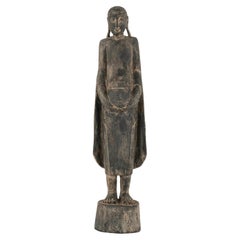
Early 20th Century Guan Yin
Located in Houston, TX
Early 19th Century carved wood Asian Guan Yin sculpture.
Category

Early 20th Century Asian Texas - Sculptures and Carvings

Materials

Wood

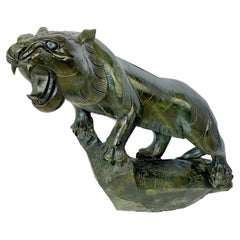
Large Scale Chinese Carved Nephrite Tiger Sculpture
Located in Harlingen, TX
A large scale hand carved solid natural nephrite jade tiger statue. Dark green overall with swirls of dark & light green, yellow and cream. Dimensions: 14"W x 28"D x 24"H Pleas...
Category

Late 20th Century Chinese Texas - Sculptures and Carvings

Materials

Jade

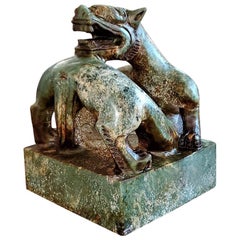
Vintage Chinese Green Brown Jadeite Serpentine Foo Dog Chop Seal
Located in Dallas, TX
PRESENTING A RARE Vintage Chinese Green & Brown Jadeite Serpentine Foo Dog Chop Seal. Hong Kong/Chinese, circa 1950. A fantastically carved Foo Dog in a co...
Category

Mid-20th Century Chinese Meiji Texas - Sculptures and Carvings

Materials

Serpentine, Jade

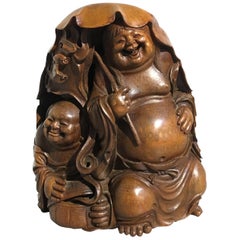
Chinese Qing Dynasty Carved Bamboo HeHe ErXian Group, 19th Century
Located in Austin, TX
A wonderful Chinese bamboo figural carving featuring the Taoist immortal twins of eternal youth, known as the HeHe ErXian, Qing dynasty, 19th century. F...
Category

19th Century Chinese Qing Antique Texas - Sculptures and Carvings

Materials

Bamboo

Large Antique Khmer Carved Gilt Lacquered Standing Buddha Figure Statue
Located in Forney, TX
A beautiful antique Khmer hand carved wooden Buddhist figure. Originating in Cambodia, Laos, Vietnam or Thailand, 19th century or earlier, the exceptional Southeast Asian antique...
Category

19th Century Southeast Asian Antique Texas - Sculptures and Carvings

Materials

Wood, Lacquer

6 Elegant Ming Dynasty Court Attendants in Glazed Terracotta, China 1368-1644 AD
Located in San Pedro Garza Garcia, Nuevo Leon
A fine set of a six court attendants as in the Forbidden City of Beijing, elegantly dressed in a Green & Red Daopao – a traditional men’s formal attire from the Ming Dynasty dated 1368-1643 A.D. – with glazed robes and Red Pigment remains in their hat and belts. They stand in an honorary posture atop a red plinth, some with orifices in their hands, where spirit objects were placed to comfort or satisfy the deceased. The heads are detachable, as often seen on the larger figures from this period. They are accompanied by a Certificate of Authenticity, and Certificate of Expertise by Jean-Yves Nathan - a leading authority specialized in Far East Archaeology from the CEDEA (The European Confederation of Art Experts). Burial figurines of graceful dancers, mystical beasts, and everyday objects reveal both how people in early China approached death and how they lived. Since people viewed the afterlife as an extension of worldly life, these figurines, called mingqi, sometimes referred as “spirit utensils” or “vessels of ghosts” disclose details of routine existence and provide insights into belief systems over a thousand-year period. The Ming dynasty was the ruling dynasty of China – then known as the Empire of the Great Ming – for 276 years (1368–1644 AD). Founded by Chu Yuan-chang, the rebel leader that was successful in removing the mongols from the throne. Chinese control was re-asserted in China and eastern Asia. Literature became more important, schools were created, and the justice system was reformed. The Ming dynasty is described by some as "one of the greatest eras of orderly government and social stability in human history,” was the last imperial dynasty in China ruled by ethnic Han Chinese. The practice of burying ceramic objects with the deceased went into decline from the 10th to the 14th Century AD. There was a revival in placing miniature representations of glazed terracotta objects such a furniture, food offerings, horses, miniature statues...
Category

15th Century and Earlier Chinese Ming Antique Texas - Sculptures and Carvings

Materials

Terracotta

Sculpture / Phrygian Helmet on a Halberd with Crossed Horns
Located in Dallas, TX
a French sculpture, paint and parcel gilt metal, of a Phrygian helmet (with gilt details) including gilt feather trim, on a halberd, with crossed horn and a gold trumpet, a gilt ribb...
Category

19th Century English Antique Texas - Sculptures and Carvings

Materials

Iron

Still Thinking About These?

All Recently Viewed