Tri-State Area - Drawings and Watercolor Paintings

to
390
1,779
1,150
1,056
477
401
Overall Width
to
Overall Height
to
15
48
2,162
2,622
10
24
40
80
113
172
425
336
375
208
10
1,207
1,032
454
385
132
130
120
117
73
36
28
21
20
4
2,605
1,869
355
1,648
898
789
687
504
452
288
274
242
226
212
184
157
139
133
125
114
102
84
82
2,821
2,440
1,857
1,177
1,052
278
141
120
104
96
1,486
1,022
4,863
18,765
18,185
Item Ships From: Tri-State Area
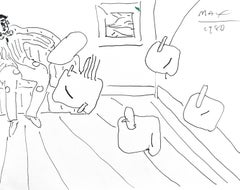
Seated Man, Peter Max
By Peter Max
Located in Fairfield, CT
Artist: Peter Max (1937) Title: Seated Man Year: 1980 Medium: Ink on archival paper Size: 9 x 11.5 inches Condition: Excellent Inscription: Signed by the artist PETER MAX (1937- ) P...
Category

1980s Pop Art Tri-State Area - Drawings and Watercolor Paintings

Materials

Ink

Seated Man, Peter Max
$4,400 Sale Price
20% Off
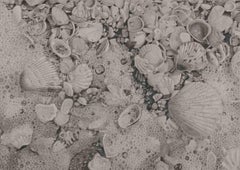
Seashells 6, Beach-strewn seashells from Sanibel Island, Graphite on Paper
By Mary Reilly
Located in New York, NY
This drawing reveals the artist's mastery of the medium and her connection to her subjects. In this one, we peek beach-strewn seashells from her travels to Sanibel Island boast bubbl...
Category

2010s American Realist Tri-State Area - Drawings and Watercolor Paintings

Materials

Paper, Graphite

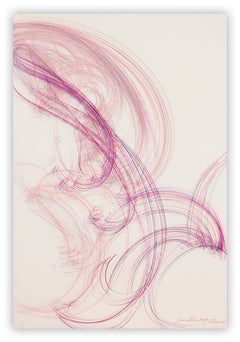
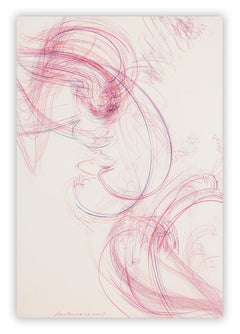
Love Affair 6 (Abstract drawing)
By Jaanika Peerna
Located in London, GB
Love Affair 6 (Abstract drawing) Colour pencil on two layers of Mylar — Unframed. Love Affairs" is a series of drawings on two layers of thin, translucent paper resembling ice. Each...
Category

2010s Abstract Expressionist Tri-State Area - Drawings and Watercolor Paintings

Materials

Color Pencil, Mylar

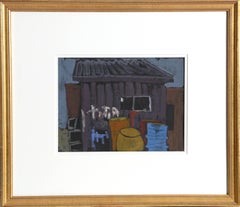
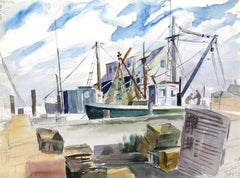
Provincetown Dock, Modern Gouache Painting by Joseph Solman 1962
By Joseph Solman
Located in Long Island City, NY
Artist: Joseph Solman, American (1909 - ) Title: Provincetown Dock Year: 1962 Medium: Gouache on black paper, signed and dated l.c. Size: 9 x 11.5 inches Frame Size: 19 x 22 inches
Category

1960s Color-Field Tri-State Area - Drawings and Watercolor Paintings

Materials

Gouache

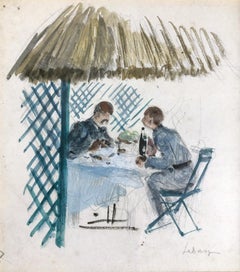
Two Seated Men
By Henri Lebasque
Located in New York, NY
Two Seated Men” by Henri Lebasque (1865-1937) Pencil and watercolor on paper 6 x 5 inches unframed (15.24 x 12.7 cm) Signed on bottom right Description: In ...
Category

20th Century Tri-State Area - Drawings and Watercolor Paintings

Materials

Watercolor, Pencil

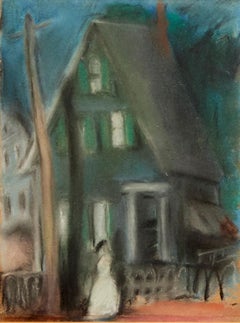
"Night Stroll" Amy Londoner, Ashcan School, Figurative Nocturne
By Amy Londoner
Located in New York, NY
Amy Londoner Beach at Atlantic City, circa 1922 Signed lower right Pastel on paper Sight 23 x 18 inches Amy Londoner (April 12, 1875 – 1951) was an American painter who exhibited at the 1913 Armory Show. One of the first students of the Henri School of Art in 1909. Prior to the Armory Show of 1913, Amy Londoner and her classmates studied with "Ashcan" painter Robert Henri at the Henri School of Art in New York, N.Y. One notable oil painting, 'The Vase', was painted by both Henri and Londoner. Londoner was born in Lexington, Missouri on April 12, 1875. Her parents were Moses and Rebecca Londoner, who moved to Leadville, Colorado, by 1880. In 1899, Amy took responsibility for her father who had come to Los Angeles from Leadville and had mental issues. By 1900, Amy was living with her parents and sister, Blanche, in the vicinity of Leadville, Denver, Colorado. While little was written about her early life, Denver City directories indicated that nineteenth-century members of the family were merchants, with family ties to New York, N.Y. The family had a male servant. Londoner traveled with her mother to England in 1907 then shortly later, both returned to New York in 1909. Londoner was 34 years old at the time, and, according to standards of the day, should have married and raised a family long before. Instead, she enrolled as one of the first students at the Henri School of Art in 1909. At the Henri School, Londoner established friendships with Carl Sprinchorn (1887-1971), a young Swedish immigrant, and Edith Reynolds (1883-1964), daughter of wealthy industrialist family from Wilkes-Barre, PA. Londoner's correspondence, which often included references to Blanche, listed the sisters' primary address as the Hotel Endicott at 81st Street and Columbus Avenue, NYC. Other correspondence also reached Londoner in the city via Mrs. Theodore Bernstein at 252 West 74th Street; 102 West 73rd Street; and the Independent School of Art at 1947 Broadway. In 1911, Londoner vacationed at the Hotel Trexler in Atlantic City, NJ. As indicated by an undated photograph, Londoner also spent time with Edith Reynolds and Robert Henri at 'The Pines', the Reynolds family estate in Bear Creek, PA. Through her connections with the Henri School, Londoner entered progressive social and professional circles. Henri's admonition, phrased in the vocabulary of his historical time period, that one must become a "man" first and an artist second, attracted both male and female students to classes where development of unique personal styles, tailored to convey individual insights and experiences, was prized above the mastery of standardized, technical skill. Far from being dilettantes, women students at the Henri School were daring individuals willing to challenge tradition. As noted by former student Helen Appleton Read, "it was a mark of defiance,to join the radical Henri group." As Henri offered educational alternatives for women artists, he initiated exhibition opportunities for them as well. Troubled by the exclusion of work by younger artists from annual exhibitions at the National Academy of Design, Henri was instrumental in organizing the no-jury, no-prize Exhibition of Independent Artists in 1910. About half of the 103 artists included in the exhibition were or had been Henri students, while twenty of the twenty-six women exhibiting had studied with Henri. Among the exhibition's 631 pieces, nine were by Amy Londoner, including the notorious 'Lady with a Headache'. Similarly, fourteen of Henri's women students exhibited in the groundbreaking Armory Show of 1913, forming about eight percent of the American exhibitors and one-third of American women exhibitors. Of the nine documented works submitted by Londoner, five were rejected, while four pastels of Atlantic City beach scenes, including 'The Beach Umbrellas' now in the Remington Collection, were displayed. Following Henri's example, Londoner served as an art instructor for younger students at the Modern School, whose only requirement was to genuinely draw what they pleased. The work of dancer Isadora Duncan, another artist devoted to the ideals of a liberal education, was also lauded by the Modern School. Henri, who long admired Duncan and invited members of her troupe to model for his classes, wrote an appreciation of her for the Modern School journal in 1915. She was also the subject of Londoner's pastel Isadora Duncan and the Children: Praise Ye the Lord with Dance. In 1914, Londoner traveled to France to spend summer abroad, living at 99 rue Notre Dames des Champs, Paris, France. As the tenets of European modernism spread throughout the United States, Londoner showed regularly at venues which a new generation of artists considered increasingly passe, including the annual Society of Independent Artists' exhibitions between 1918 and 1934, and the Salons of America exhibition in 1922. Londoner also exhibited at the Morton Gallery, Opportunity Gallery, Leonard Clayton Gallery and Brownell-Lambertson Galleries in NYC. Her painting of a 'Blond Girl' was one of two works included in the College Art Associations Traveling Exhibition of 1929, which toured colleges across the country to broad acclaim. Londoner later in life suffered from illnesses then suffered a stroke which resulted in medical bills significantly mounting over the years that her old friends from the Henri School, including Carl Sprinchorn, Florence Dreyfous, Florence Barley, and Josephine Nivison Hopper, scrambled to raise funds and find suitable long-term care facilities for Londoner. Londoner later joined Reynolds in Bear Creek, PA. Always known for her keen wit, Londoner retained her humor and concern for her works even during her illness, noting that "if anything happens to the Endicott, I guess they will just throw them out." Sprinchorn and Reynolds, however, did not allow this to happen. In 1960, Londoner's paintings 'Amsterdam Avenue at 74th Street' and 'The Builders' were loaned by Reynolds to a show commemorating the Fiftieth Anniversary of the Exhibition of Independent Artists in 1910, presented at the Delaware Art Center, Wilmington, DE. In the late 80's, Francis William Remington, 'Bill Remington', of Bear Creek Village PA, along with his neighbor and artist Frances Anstett Brennan, both had profound admiration for Amy Londoner's art work and accomplishments as a woman who played a significant role in the Ashcan movement. Remington acquired a significant number of Londoner's artwork along with Frances Anstett Brenan that later was part of an exhibition of Londoner's artwork in April 15 of 2007, at the Hope Horn...
Category

1910s Ashcan School Tri-State Area - Drawings and Watercolor Paintings

Materials

Paper, Pastel

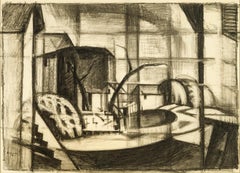
Study for Old Canal, Red and Blue (Rockaway, Morris Canal)
By Oscar Florianus Bluemner
Located in New York, NY
Oscar Bluemner was a German and an American, a trained architect who read voraciously in art theory, color theory, and philosophy, a writer of art criticism both in German and English, and, above all, a practicing artist. Bluemner was an intense man, who sought to express and share, through drawing and painting, universal emotional experience. Undergirded by theory, Bluemner chose color and line for his vehicles; but color especially became the focus of his passion. He was neither abstract artist nor realist, but employed the “expressional use of real phenomena” to pursue his ends. (Oscar Bluemner, from unpublished typescript on “Modern Art” for Camera Work, in Bluemner papers, Archives of American Art, Smithsonian Institution, as cited and quoted in Jeffrey R. Hayes, Oscar Bluemner [1991], p. 60. The Bluemner papers in the Archives [hereafter abbreviated as AAA] are the primary source for Bluemner scholars. Jeffrey Hayes read them thoroughly and translated key passages for his doctoral dissertation, Oscar Bluemner: Life, Art, and Theory [University of Maryland, 1982; UMI reprint, 1982], which remains the most comprehensive source on Bluemner. In 1991, Hayes published a monographic study of Bluemner digested from his dissertation and, in 2005, contributed a brief essay to the gallery show at Barbara Mathes, op. cit.. The most recent, accessible, and comprehensive view of Bluemner is the richly illustrated, Barbara Haskell, Oscar Bluemner: A Passion for Color, exhib. cat. [New York: Whitney Museum of American Art, 2005.]) Bluemner was born in the industrial city of Prenzlau, Prussia, the son and grandson of builders and artisans. He followed the family predilection and studied architecture, receiving a traditional and thorough German training. He was a prize-winning student and appeared to be on his way to a successful career when he decided, in 1892, to emigrate to America, drawn perhaps by the prospect of immediate architectural opportunities at the Chicago World’s Fair, but, more importantly, seeking a freedom of expression and an expansiveness that he believed he would find in the New World. The course of Bluemner’s American career proved uneven. He did indeed work as an architect in Chicago, but left there distressed at the formulaic quality of what he was paid to do. Plagued by periods of unemployment, he lived variously in Chicago, New York, and Boston. At one especially low point, he pawned his coat and drafting tools and lived in a Bowery flophouse, selling calendars on the streets of New York and begging for stale bread. In Boston, he almost decided to return home to Germany, but was deterred partly because he could not afford the fare for passage. He changed plans and direction again, heading for Chicago, where he married Lina Schumm, a second-generation German-American from Wisconsin. Their first child, Paul Robert, was born in 1897. In 1899, Bluemner became an American citizen. They moved to New York City where, until 1912, Bluemner worked as an architect and draftsman to support his family, which also included a daughter, Ella Vera, born in 1903. All the while, Oscar Bluemner was attracted to the freer possibilities of art. He spent weekends roaming Manhattan’s rural margins, visiting the Bronx, Brooklyn, Queens, and New Jersey, sketching landscapes in hundreds of small conté crayon drawings. Unlike so many city-based artists, Bluemner did not venture out in search of pristine countryside or unspoiled nature. As he wrote in 1932, in an unsuccessful application for a Guggenheim Fellowship, “I prefer the intimate landscape of our common surroundings, where town and country mingle. For we are in the habit to carry into them our feelings of pain and pleasure, our moods” (as quoted by Joyce E. Brodsky in “Oscar Bluemner in Black and White,” p. 4, in Bulletin 1977, I, no. 5, The William Benton Museum of Art, Storrs, Connecticut). By 1911, Bluemner had found a powerful muse in a series of old industrial towns, mostly in New Jersey, strung along the route of the Morris Canal. While he educated himself at museums and art galleries, Bluemner entered numerous architectural competitions. In 1903, in partnership with Michael Garven, he designed a new courthouse for Bronx County. Garven, who had ties to Tammany Hall, attempted to exclude Bluemner from financial or artistic credit, but Bluemner promptly sued, and, finally, in 1911, after numerous appeals, won a $7,000 judgment. Barbara Haskell’s recent catalogue reveals more details of Bluemner’s architectural career than have previously been known. Bluemner the architect was also married with a wife and two children. He took what work he could get and had little pride in what he produced, a galling situation for a passionate idealist, and the undoubted explanation for why he later destroyed the bulk of his records for these years. Beginning in 1907, Bluemner maintained a diary, his “Own Principles of Painting,” where he refined his ideas and incorporated insights from his extensive reading in philosophy and criticism both in English and German to create a theoretical basis for his art. Sometime between 1908 and 1910, Bluemner’s life as an artist was transformed by his encounter with the German-educated Alfred Stieglitz, proprietor of the Little Galleries of the Photo-Secession at 291 Fifth Avenue. The two men were kindred Teutonic souls. Bluemner met Stieglitz at about the time that Stieglitz was shifting his serious attention away from photography and toward contemporary art in a modernist idiom. Stieglitz encouraged and presided over Bluemner’s transition from architect to painter. During the same period elements of Bluemner’s study of art began to coalesce into a personal vision. A Van Gogh show in 1908 convinced Bluemner that color could be liberated from the constraints of naturalism. In 1911, Bluemner visited a Cézanne watercolor show at Stieglitz’s gallery and saw, in Cézanne’s formal experiments, a path for uniting Van Gogh’s expressionist use of color with a reality-based but non-objective language of form. A definitive change of course in Bluemner’s professional life came in 1912. Ironically, it was the proceeds from his successful suit to gain credit for his architectural work that enabled Bluemner to commit to painting as a profession. Dividing the judgment money to provide for the adequate support of his wife and two children, he took what remained and financed a trip to Europe. Bluemner traveled across the Continent and England, seeing as much art as possible along the way, and always working at a feverish pace. He took some of his already-completed work with him on his European trip, and arranged his first-ever solo exhibitions in Berlin, Leipzig, and Elberfeld, Germany. After Bluemner returned from his study trip, he was a painter, and would henceforth return to drafting only as a last-ditch expedient to support his family when his art failed to generate sufficient income. Bluemner became part of the circle of Stieglitz artists at “291,” a group which included Marsden Hartley, John Marin, and Arthur Dove. He returned to New York in time to show five paintings at the 1913 Armory Show and began, as well, to publish critical and theoretical essays in Stieglitz’s journal, Camera Work. In its pages he cogently defended the Armory Show against the onslaught of conservative attacks. In 1915, under Stieglitz’s auspices, Bluemner had his first American one-man show at “291.” Bluemner’s work offers an interesting contrast with that of another Stieglitz architect-turned-artist, John Marin, who also had New Jersey connections. The years after 1914 were increasingly uncomfortable. Bluemner remained, all of his life, proud of his German cultural legacy, contributing regularly to German language journals and newspapers in this country. The anti-German sentiment, indeed mania, before and during World War I, made life difficult for the artist and his family. It is impossible to escape the political agenda in Charles Caffin’s critique of Bluemner’s 1915 show. Caffin found in Bluemner’s precise and earnest explorations of form, “drilled, regimented, coerced . . . formations . . . utterly alien to the American idea of democracy” (New York American, reprinted in Camera Work, no. 48 [Oct. 1916], as quoted in Hayes, 1991, p. 71). In 1916, seeking a change of scene, more freedom to paint, and lower expenses, Bluemner moved his family to New Jersey, familiar terrain from his earlier sketching and painting. During the ten years they lived in New Jersey, the Bluemner family moved around the state, usually, but not always, one step ahead of the rent collector. In 1917, Stieglitz closed “291” and did not reestablish a Manhattan gallery until 1925. In the interim, Bluemner developed relationships with other dealers and with patrons. Throughout his career he drew support and encouragement from art cognoscenti who recognized his talent and the high quality of his work. Unfortunately, that did not pay the bills. Chronic shortfalls were aggravated by Bluemner’s inability to sustain supportive relationships. He was a difficult man, eternally bitter at the gap between the ideal and the real. Hard on himself and hard on those around him, he ultimately always found a reason to bite the hand that fed him. Bluemner never achieved financial stability. He left New Jersey in 1926, after the death of his beloved wife, and settled in South Braintree, Massachusetts, outside of Boston, where he continued to paint until his own death in 1938. As late as 1934 and again in 1936, he worked for New Deal art programs designed to support struggling artists. Bluemner held popular taste and mass culture in contempt, and there was certainly no room in his quasi-religious approach to art for accommodation to any perceived commercial advantage. His German background was also problematic, not only for its political disadvantages, but because, in a world where art is understood in terms of national styles, Bluemner was sui generis, and, to this day, lacks a comfortable context. In 1933, Bluemner adopted Florianus (definitively revising his birth names, Friedrich Julius Oskar) as his middle name and incorporated it into his signature, to present “a Latin version of his own surname that he believed reinforced his career-long effort to translate ordinary perceptions into the more timeless and universal languages of art” (Hayes 1982, p. 189 n. 1). In 1939, critic Paul Rosenfeld, a friend and member of the Stieglitz circle, responding to the difficulty in categorizing Bluemner, perceptively located him among “the ranks of the pre-Nazi German moderns” (Hayes 1991, p. 41). Bluemner was powerfully influenced in his career by the intellectual heritage of two towering figures of nineteenth-century German culture, Johann Wolfgang von Goethe and Georg Wilhelm Friedrich Hegel. A keen student of color theory, Bluemner gave pride of place to the formulations of Goethe, who equated specific colors with emotional properties. In a November 19, 1915, interview in the German-language newspaper, New Yorker Staats-Zeitung (Abendblatt), he stated: I comprehend the visible world . . . abstract the primary-artistic . . . and after these elements of realty are extracted and analyzed, I reconstruct a new free creation that still resembles the original, but also . . . becomes an objectification of the abstract idea of beauty. The first—and most conspicuous mark of this creation is . . . colors which accord with the character of things, the locality . . . [and which] like the colors of Cranach, van der Weyden, or Durer, are of absolute purity, breadth, and luminosity. . . . I proceed from the psychological use of color by the Old Masters . . . [in which] we immediately recognize colors as carriers of “sorrow and joy” in Goethe’s sense, or as signs of human relationship. . . . Upon this color symbolism rests the beauty as well as the expressiveness, of earlier sacred paintings. Above all, I recognize myself as a contributor to the new German theory of light and color, which expands Goethe’s law of color through modern scientific means (as quoted in Hayes 1991, p. 71). Hayes has traced the global extent of Bluemner’s intellectual indebtedness to Hegel (1991, pp. 36–37). More specifically, Bluemner made visual, in his art, the Hegelian world view, in the thesis and antithesis of the straight line and the curve, the red and the green, the vertical and the horizontal, the agitation and the calm. Bluemner respected all of these elements equally, painting and drawing the tension and dynamic of the dialectic and seeking ultimate reconciliation in a final visual synthesis. Bluemner was a keen student of art, past and present, looking, dissecting, and digesting all that he saw. He found precedents for his non-naturalist use of brilliant-hued color not only in the work Van Gogh and Cezanne, but also in Gauguin, the Nabis, and the Symbolists, as well as among his contemporaries, the young Germans of Der Blaue Reiter. Bluemner was accustomed to working to the absolute standard of precision required of the architectural draftsman, who adjusts a design many times until its reality incorporates both practical imperatives and aesthetic intentions. Hayes describes Bluemner’s working method, explaining how the artist produced multiple images playing on the same theme—in sketch form, in charcoal, and in watercolor, leading to the oil works that express the ultimate completion of his process (Hayes, 1982, pp. 156–61, including relevant footnotes). Because of Bluemner’s working method, driven not only by visual considerations but also by theoretical constructs, his watercolor and charcoal studies have a unique integrity. They are not, as is sometimes the case with other artists, rough preparatory sketches. They stand on their own, unfinished only in the sense of not finally achieving Bluemner’s carefully considered purpose. The present charcoal drawing is one of a series of images that take as their starting point the Morris Canal as it passed through Rockaway, New Jersey. The Morris Canal industrial towns that Bluemner chose as the points of departure for his early artistic explorations in oil included Paterson with its silk mills (which recalled the mills in the artist’s childhood home in Elberfeld), the port city of Hoboken, Newark, and, more curiously, a series of iron ore mining and refining towns, in the north central part of the state that pre-dated the Canal, harkening back to the era of the Revolutionary War. The Rockaway theme was among the original group of oil paintings that Bluemner painted in six productive months from July through December 1911 and took with him to Europe in 1912. In his painting journal, Bluemner called this work Morris Canal at Rockaway N.J. (AAA, reel 339, frames 150 and 667, Hayes, 1982, pp. 116–17), and exhibited it at the Galerie Fritz Gurlitt in Berlin in 1912 as Rockaway N. J. Alter Kanal. After his return, Bluemner scraped down and reworked these canvases. The Rockaway picture survives today, revised between 1914 and 1922, as Old Canal, Red and Blue (Rockaway River) in the collection of the Hirshhorn Museum and Sculpture Garden, Smithsonian Institution, Washington D. C. (color illus. in Haskell, fig. 48, p. 65). For Bluemner, the charcoal expression of his artistic vision was a critical step in composition. It represented his own adaptation of Arthur Wesley’s Dow’s (1857–1922) description of a Japanese...
Category

20th Century American Modern Tri-State Area - Drawings and Watercolor Paintings

Materials

Paper, Charcoal

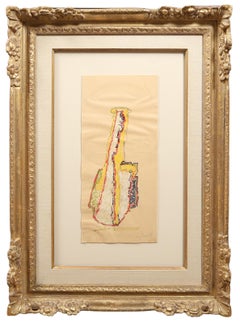
"Yellow Coconut", 1981, Drawing by John Chamberlain
By John Chamberlain
Located in Long Island City, NY
Artist: John Chamberlain, American (1927 - 2011) Title: Yellow Coconut Year: 1981 Medium: Marker and pencil on newsprint, signed 'JC' l.r. Image Size: 19.25 x 8.5 inches Size: 19.25 ...
Category

1980s Abstract Expressionist Tri-State Area - Drawings and Watercolor Paintings

Materials

Newsprint, Permanent Marker, Pencil

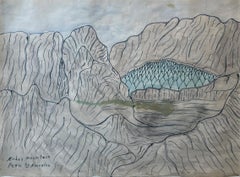
"Andes Mountains Peru South America, " Joseph Yoakum, Black Folk Art Landscape
By Joseph Yoakum
Located in New York, NY
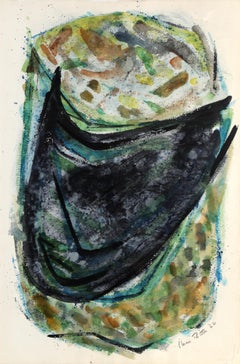
Joseph Yoakum Andes Mountains Peru So America, circa 1960s Colored pencil and ballpoint pen on paper 7 1/4 x 10 1/2 inches Provenance: Karen Lennox Gallery, Chicago Private Collection, South Dakota Yoakum began drawing in the early 1960s. Most of his work consists of radiantly colored landscapes with mountains, water, trees, and winding roads in abstract and complex configurations. his period of greatest activity — 1965 to 1970 — when he usually made one drawing a day. Yoakum maintained he had seen all the places represented in his drawings, a statement that may not be true in some instances. He traveled a great deal, beginning in his early teens when he ran away from home and became a circus handyman. Yoakum’s drawings can be considered memory images growing out of either actual or imagined experiences. All of his drawings have titles that grew longer and more specific over the years. He dated his works with a rubber stamp — an oddly impersonal, labor-saving device. Although Joseph Yoakum gave vastly different accounts of his background, he was, throughout his life, classified as an African American. Sometimes Yoakum claimed that he was a full-blooded ​“Nava-joe” Indian, one of twelve or thirteen children born to a farmer on an Indian reservation in Window Rock, Arizona. At other times he insisted that he was of African-American descent. He described his mother as a strong woman who was a doctor and knowledgeable in the use of herbal medicines. Yoakum’s family moved to Kansas City, Missouri, during his early childhood. His father was employed briefly in the railroad yards prior to settling permanently on a farm in nearby Walnut Grove...
Category

1960s Folk Art Tri-State Area - Drawings and Watercolor Paintings

Materials

Paper, Watercolor, Ballpoint Pen, Color Pencil

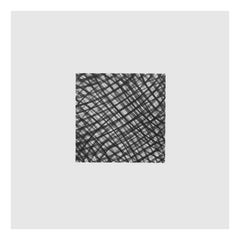
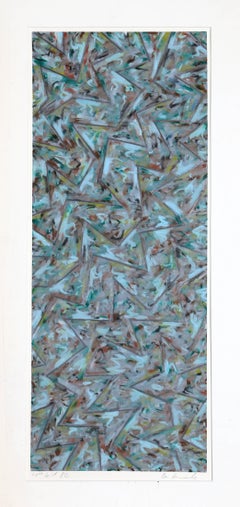
A.121-013- abstract geometric black and white ink drawing on mylar
By Patrick Carrara
Located in New York, NY
abstract geometric black and white ink drawing on mylar framed in white frame For over twenty years now Patrick Carrara has lived in Brooklyn, where he has maintained a studio and s...
Category

21st Century and Contemporary Abstract Geometric Tri-State Area - Drawings and Watercolor Paintings

Materials

Mylar, Archival Ink

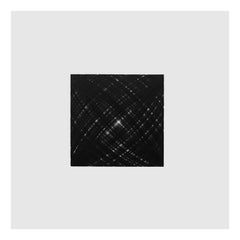
A. 161-014- abstract geometric black and white ink drawing on mylar
By Patrick Carrara
Located in New York, NY
Abstract geometric black and white ink drawing on mylar framed in white wood frame with UV Plexiglass. For over twenty years now Patrick Carrara has lived in Brooklyn, where he has m...
Category

21st Century and Contemporary Abstract Geometric Tri-State Area - Drawings and Watercolor Paintings

Materials

Mylar, Archival Ink

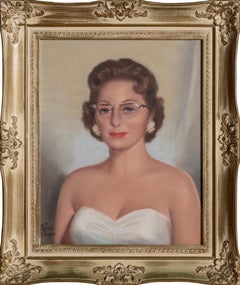
Portrait of a Woman, Framed Pastel Drawing by Peter Driben
By Peter Driben
Located in Long Island City, NY
Peter Driben, best known as an American pin-up artist, was perhaps one of the most productive pin-up artists of the 1940s and 1950s. Driben's pinups delighted the American public from the beginning of World War II until the great baby boom of the 1950s. This portrait of a woman...
Category

Mid-20th Century American Realist Tri-State Area - Drawings and Watercolor Paintings

Materials

Pastel

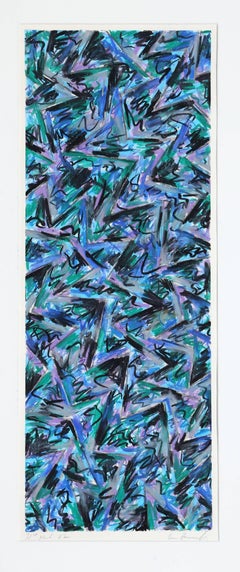
31st of March, Oil Pastel Drawing by Ben Hancocks
By Ben Hancocks
Located in Long Island City, NY
Artist: Ben Hancocks Title: 31st of March Year: 1982 Medium: Oil Pastel on Paper, signed and dated Paper Size: 34 x 15 inches [86.36 x 38.1 cm] Image Size: 27.5 x 10 in. [69.85 x 25....
Category

1980s Abstract Expressionist Tri-State Area - Drawings and Watercolor Paintings

Materials

Paper, Oil Pastel

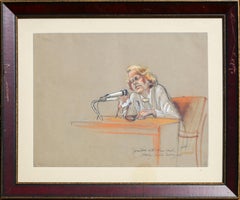
Jean Harris on the Witness Stand, Pencil and Ink on Paper by Marilyn Church
Located in Long Island City, NY
This drawing depicts a moment from one of the longest trials in US history, when Jean Harris, a headmistress of a school for girls in Virginia, was tried f...
Category

1980s Tri-State Area - Drawings and Watercolor Paintings

Materials

Ink, Permanent Marker, Pencil

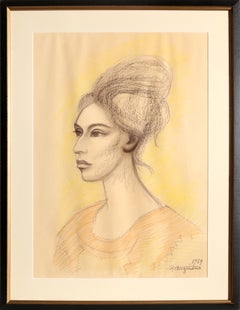
Portrait of a Woman, Pastel Portrait Drawing by Raul Anguiano
By Raul Anguiano
Located in Long Island City, NY
Artist: Raul Anguiano, Mexican (1919 - 2006) Title: Portrait of a Woman Year: 1964 Medium: Pastel on Paper, signed and dated l.r. Size: 31 x 22 inches Frame Size: 39 x 30 inches
Category

1960s Modern Tri-State Area - Drawings and Watercolor Paintings

Materials

Pastel

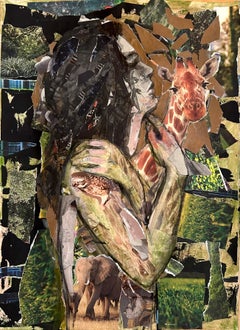
Eve, female, nature, animals elephant giraffe
By Audrey Anastasi
Located in Brooklyn, NY
These collages were created first in the presence of a model, working quickly, in charcoal and pastel, and again, later, alone, furiously tearing and pasting images from magazines, v...
Category

2010s American Modern Tri-State Area - Drawings and Watercolor Paintings

Materials

Mixed Media, Archival Paper

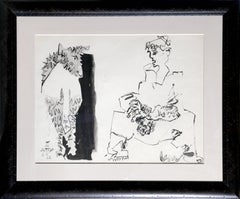
Seated Woman and Bull Figure, Modern Drawing by Jose Ortega
By José Ortega
Located in Long Island City, NY
Jose Ortega, Spanish (1921 - 1991) Title: Seated Woman and Bull Figure Year: 1962 Medium: Watercolor on BFK Rives, signed and dated l.l. Size: 20 x 25...
Category

1960s Modern Tri-State Area - Drawings and Watercolor Paintings

Materials

Watercolor

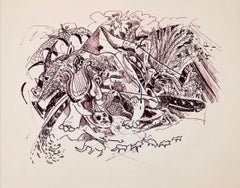
(Abstract Mythological Landscape) Untitled, 2001, Ian Hornak — Drawing
By Ian Hornak
Located in Fairfield, CT
Artist: Ian Hornak (1944-2002) Title: (Abstract Mythological Landscape) Untitled Year: 2001 Medium: Ink on archival paper Size: 11 x 14 inches Condition: Good Provenance: Estate of I...
Category

Early 2000s Photorealist Tri-State Area - Drawings and Watercolor Paintings

Materials

Ink, Archival Paper

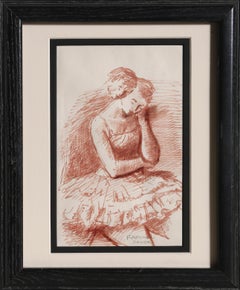
Pensive Dancer, Modern Ink Drawing by Raphael Soyer
By Raphael Soyer
Located in Long Island City, NY
Artist: Raphael Soyer, Russian/American (1899 - 1987) Title: Pensive Dancer Year: circa 1956 Medium: Pencil on Paper, signed lower right Paper Size: 8 x 5 inches Frame: 11.5 x 9.5 i...
Category

1950s American Modern Tri-State Area - Drawings and Watercolor Paintings

Materials

Ink, Archival Paper

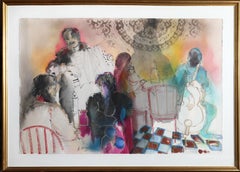
Restaurant Scene with Band, Contemporary Pastel and Watercolor by Batia Magal
By Batia Magal
Located in Long Island City, NY
Restaurant Scene with Band Batia Magal, Israeli (1951) Watercolor and Pastel on Paper, Signed l.c. Size: 31 in. x 48 in. (78.74 cm x 121.92 cm) Frame ...
Category

1980s Contemporary Tri-State Area - Drawings and Watercolor Paintings

Materials

Pastel, Watercolor

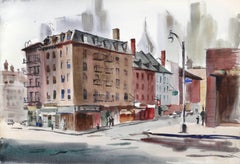
Fulton Street, Watercolor by Eve Nethercott
By Eve Nethercott
Located in Long Island City, NY
Artist: Eve Nethercott, American (1925 - 2015) Title: Fulton Street (P5.31) Year: 1961 Medium: Watercolor on Paper Size: 15 x 22 in. (38.1 x 55.88 cm)
Category

1960s Expressionist Tri-State Area - Drawings and Watercolor Paintings

Materials

Watercolor

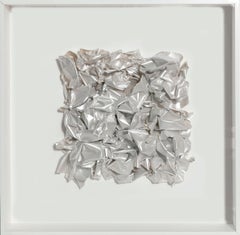
Unique 3-D Wall Sculpture in Shadow Box Frame
By Rosana Castrillo Diaz
Located in Long Island City, NY
Artist: Rosana Castrillo Diaz Title: Untitled Date: 2011 Medium: Mica Paint on paper Dimensions: 25 x 25 x 3.25 inches Frame Dimensions: 26.75 x 26.75 inches
Category

2010s Minimalist Tri-State Area - Drawings and Watercolor Paintings

Materials

Mixed Media

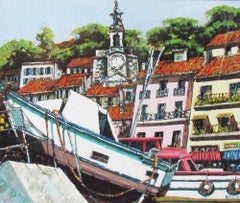
17 Heures a Sete, France
By Dwight Baird
Located in Brooklyn, NY
This original watercolor by Dwight Baird, titled 17 heures à Sète, France, captures a vibrant and picturesque scene in the small port of Sète. Known for his ability to bring scenes t...
Category

Late 20th Century Contemporary Tri-State Area - Drawings and Watercolor Paintings

Materials

Watercolor

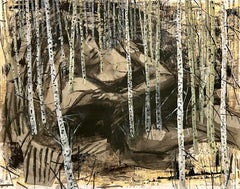
Birch Mystery, trees, female figure, neutral tones, collage on archival paper
By Audrey Anastasi
Located in Brooklyn, NY
Paper paint charcoal collage Paper charcoal collage These collages were created first in the presence of a live model, working quickly, in charcoal and again, later, alone in the stu...
Category

2010s Surrealist Tri-State Area - Drawings and Watercolor Paintings

Materials

Charcoal, Archival Paper, Acrylic, Mixed Media

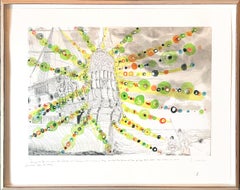
Seeing Don Quixote and Sancho etching, hand coloring watercolor, signed Framed
By Santi Moix
Located in New York, NY
Santi Moix Seeing Don Quixote and Sancho ("the famous pair"), ca. 2008 Drypoint, etching and abrasion with hand coloring with watercolor, along with graphite annotations Hand signed ...
Category

Early 2000s Contemporary Tri-State Area - Drawings and Watercolor Paintings

Materials

Mixed Media, Watercolor, Graphite, Drypoint, Etching

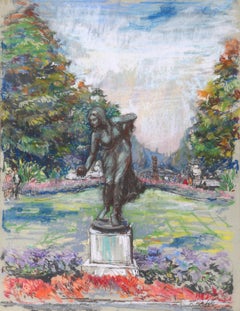
Statue in the Park, Pastel Drawing by Kamil Kubik
By Kamil Kubik
Located in Long Island City, NY
Statue in the Park by Kamil Kubik, Czech/American (1930–2011) Pastel on Paper, signed l.r. Size: 19.5 x 25.5 in. (49.53 x 64.77 cm)
Category

1990s Contemporary Tri-State Area - Drawings and Watercolor Paintings

Materials

Paper, Pastel

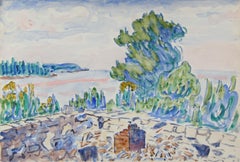
New England Landscape, Watercolor by Allen Tucker
By Allen Tucker
Located in Long Island City, NY
Artist: Allen Tucker, American (1866 - 1939) Title: New England Landscape Year: 1936 Medium: Watercolor, signed and dated Size: 19 in. x 28 in. (...
Category

1930s American Impressionist Tri-State Area - Drawings and Watercolor Paintings

Materials

Watercolor

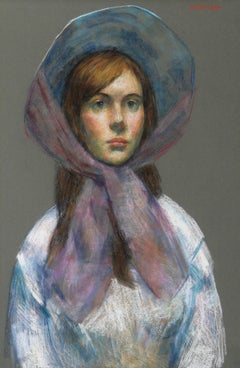
Girl with Bonnet, Pastel Portrait by Thomas Strickland
By Thomas Strickland
Located in Long Island City, NY
Artist: Thomas Strickland, American (1923 - 1999) Title: Girl with Bonnet Year: circa 1970 Medium: Pastel on Paper, signed u.r. Size: 25.5 in. x 19.7...
Category

1970s American Modern Tri-State Area - Drawings and Watercolor Paintings

Materials

Oil Pastel

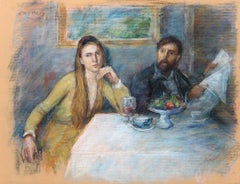
Couple at Table (Self-Portrait), Impressionist Pastel by Thomas Strickland
By Thomas Strickland
Located in Long Island City, NY
Artist: Thomas Strickland Title: Couple at Table (Self-Portrait) Year: circa 1970 Medium: Pastel on Paper, signed u.l. Size: 19.75 in. x 25.5 in. (50.17 cm x 64.77 cm)
Category

1970s American Realist Tri-State Area - Drawings and Watercolor Paintings

Materials

Pastel

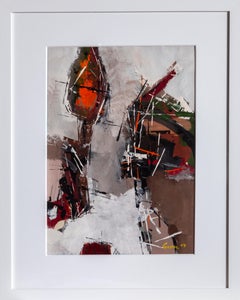
Abstract Expressionist Gouache Painting by Sidney Gross 1959
By Sidney Gross
Located in Long Island City, NY
An Abstract expressionist gouache painting by American artist, Sid Gross. Date: 1959 Gouache on paper, signed and dated lower right Image Size: 18.5 x 12 inches Frame Size: 28 x 22 ...
Category

1950s Abstract Expressionist Tri-State Area - Drawings and Watercolor Paintings

Materials

Gouache

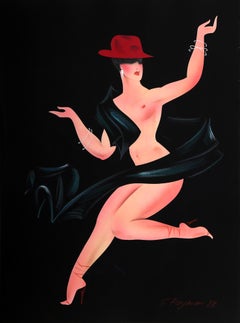
Semi-Nude, Art Deco Collage and Pastel Painting on Paper by Erik Freyman
By Erik Freyman
Located in Long Island City, NY
An 80's style Art Deco work on paper of a Dancing Nude Lady by contemporary artist Erik Freyman. Collage with pastels on paper, signed lower right.
Category

1980s Pop Art Tri-State Area - Drawings and Watercolor Paintings

Materials

Paper, Pastel

Abstract #4, Contemporary Watercolor by Chris Ritter
Located in Long Island City, NY
This unique abstract work is a watercolor by American artist Chris Ritter. The use of broad gestural movement and bold colors creates an engaging composit...
Category

1960s Tri-State Area - Drawings and Watercolor Paintings

Materials

Watercolor

Hampton Bays, Watercolor by Eve Nethercott
By Eve Nethercott
Located in Long Island City, NY
Artist: Eve Nethercott, American (1925 - 2015) Title: Hampton Bays (P6.24) Year: 1958 Medium: Watercolor on Paper Size: 22 x 30 in. (55.88 x 76.2 cm)
Category

1950s Expressionist Tri-State Area - Drawings and Watercolor Paintings

Materials

Watercolor

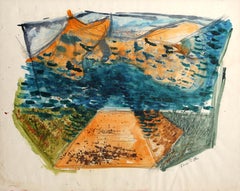
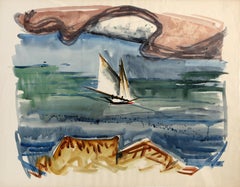
Ocean Seascape, Abstract Watercolor by Chris Ritter
Located in Long Island City, NY
This unique work is a watercolor by American artist Chris Ritter. The painting depicts an abstract seascape with a single sailboat clearly visible in the ...
Category

1960s Tri-State Area - Drawings and Watercolor Paintings

Materials

Watercolor

Black Sweep on Green, Abstract Watercolor Painting on Paper by Chris Ritter
Located in Long Island City, NY
This unique abstract work is a watercolor by American artist Chris Ritter. The use of broad gestural movement and bold colors creates an engaging composit...
Category

1960s Tri-State Area - Drawings and Watercolor Paintings

Materials

Watercolor

Abstract #6, Watercolor Painting on Paper by Chris Ritter
Located in Long Island City, NY
This unique abstract work is a watercolor by American artist Chris Ritter. The use of broad gestural movement and bold colors creates an engaging composit...
Category

1960s Tri-State Area - Drawings and Watercolor Paintings

Materials

Watercolor

Abstract #3, Abstract Watercolor by Chris Ritter
Located in Long Island City, NY
This unique abstract work is a watercolor by American artist Chris Ritter. The use of broad gestural movement and bold colors creates an engaging composit...
Category

1960s Tri-State Area - Drawings and Watercolor Paintings

Materials

Watercolor

Abstract #7, Abstract Watercolor by Chris Ritter
Located in Long Island City, NY
This unique abstract work is a watercolor by American artist Chris Ritter. The use of broad gestural movement and bold colors creates an engaging composit...
Category

1960s Modern Tri-State Area - Drawings and Watercolor Paintings

Materials

Watercolor

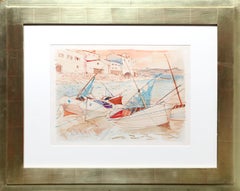
Sailboats at Shore, Framed Modern Watercolor by Charles Levier
By Charles Levier
Located in Long Island City, NY
Sailboats at Shore by Charles Levier, French (1920–2003) Date: circa 1965 Watercolor on Paper, signed l.r. Image Size: 11 x 16 inches Size: 19.5 x 25 in. (49.53 x 63.5 cm) Frame: 24 ...
Category

1960s Fauvist Tri-State Area - Drawings and Watercolor Paintings

Materials

Watercolor

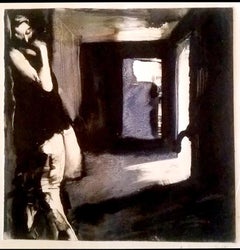
Sleepwalking at the Olcott, mystery monochromatic narrative noir
By Tom Bennett
Located in Brooklyn, NY
Monotype on paper
Category

2010s American Modern Tri-State Area - Drawings and Watercolor Paintings

Materials

Paper, Monotype

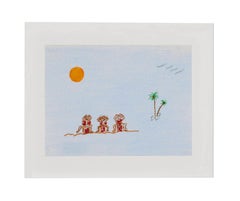
Javier Calleja Drawing 1999 (early Javier Calleja)
By Javier Calleja
Located in NEW YORK, NY
Javier Calleja 199 drawing: A rare, early drawing by Javier Calleja featuring classic Calleja character stylings in a tropical setting. Medium: Mixed media on paper. Dimensions: 5....
Category

1990s Pop Art Tri-State Area - Drawings and Watercolor Paintings

Materials

Paper, Mixed Media

Sculpture Study, Abstract Gouache on Guarro paper by James Wolfe
By James Wolfe
Located in Long Island City, NY
James Wolfe, American (1944 - ) - Sculpture Study, Year: 1986, Medium: Gouache on Guarro paper, signed and dated in pencil, Size: 22.25 x 30 in. (56.52 x 76.2 cm)
Category

1980s Abstract Expressionist Tri-State Area - Drawings and Watercolor Paintings

Materials

Gouache

Seated Nude, Modern Pastel Drawing on Paper by Ben Benn
By Ben Benn
Located in Long Island City, NY
Artist: Ben Benn, Polish/American (1884 - 1983) Title: Seated Nude Year: 1923 Medium: Pastel on Paper, signed and dated l.r. Size: 24 x 18 in. (60.96 x 45.72 ...
Category

1920s Modern Tri-State Area - Drawings and Watercolor Paintings

Materials

Pastel

Seated Nude, Modern Watercolor with Pastel by Byron Browne
By Byron Browne
Located in Long Island City, NY
Artist: Byron Brown (American 1907 - 1961) Title: Seated Nude Year: 1957 Medium: Pastel and Watercolor on Paper, signed and dated l.r. Size: 25.5 x 19.5 in...
Category

1950s American Modern Tri-State Area - Drawings and Watercolor Paintings

Materials

Pastel, Watercolor

Staircase/Ladder, Op Art Drawing by William Schwedler
By William Schwedler
Located in Long Island City, NY
This abstract composition by William Schwedler includes several geometric forms and shapes that are placed alongside straight, angled lines. Untitled 1 Artist: William Schwedler, A...
Category

1970s Abstract Tri-State Area - Drawings and Watercolor Paintings

Materials

Graphite

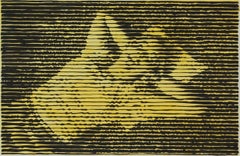
Sun Solitude, yellow and black work on paper, woman sunbathing, stripes
By Charles Buckley
Located in New York, NY
Acrylic ink on paper. Paper size: 8.75" x 13.5" Frame size: 16.5" x 21.25" Charles Buckley lives and works in Brooklyn, NY. His current work, entitled “Striation Series,” demonstrat...
Category

2010s Contemporary Tri-State Area - Drawings and Watercolor Paintings

Materials

Paper, Ink

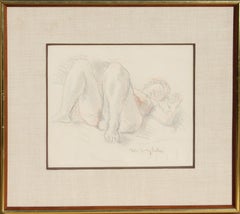
Reclining Nude, Framed Original Modern Pastel Drawing on Paper by Moses Soyer
By Moses Soyer
Located in Long Island City, NY
Reclining Nude Moses Soyer, American (1899–1974) Date: circa 1960 Pastel on Paper, signed Size: 9 in. x 10.5 in. (22.86 cm x 26.67 cm) Frame Size: 16 x 17 inches
Category

1960s American Realist Tri-State Area - Drawings and Watercolor Paintings

Materials

Pastel

Colorful Abstract Painting by Robert Kautz
By Robert Kautz
Located in Long Island City, NY
Artist: Robert Kautz, Austrian Title: untitled Year: 2001 Medium: Acrylic and Mixed Media on Paper, signed Size: 25.5 in. x 19.5 in. (59.69 cm x 49.53 cm)
Category

Early 2000s Abstract Expressionist Tri-State Area - Drawings and Watercolor Paintings

Materials

Acrylic

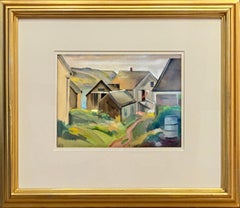
Monhegan Path, Summer
Located in New York, NY
Albert Wein had a retrospective and he was called a classical modernist by art critics. He is primarily regarded as one of America's great sculptors but he loved doing drawings, wat...
Category

1940s American Modern Tri-State Area - Drawings and Watercolor Paintings

Materials

Watercolor

Love Affair 9 (Abstract drawing)
By Jaanika Peerna
Located in London, GB
Love Affair 9 (Abstract drawing) Colour pencil on two layers of Mylar — Unframed. Love Affairs" is a series of drawings on two layers of thin, translucent paper resembling ice. Each...
Category

2010s Abstract Expressionist Tri-State Area - Drawings and Watercolor Paintings

Materials

Mylar, Color Pencil

24th April, Abstract Expressionist Oil Pastel Drawing by Ben Hancocks
By Ben Hancocks
Located in Long Island City, NY
Artist: Ben Hancocks Title: 24th April Year: 1982 Medium: Oil Pastel on Paper, signed and dated Paper Size: 34 x 15 inches [86.36 x 38.1 cm] Image Size: 27.5 x 11 in. [69.85 x 27.94 cm]
Category

1980s Abstract Expressionist Tri-State Area - Drawings and Watercolor Paintings

Materials

Paper, Oil Pastel

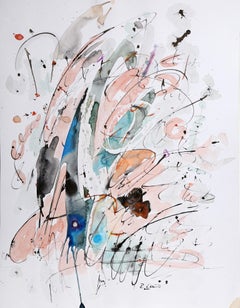
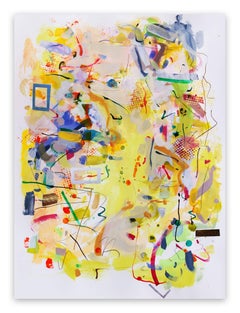
Spring (Abstract Expressionism painting)
By Gina Werfel
Located in London, GB
Acrylic and mixed media on paper - Unframed Werfel employs expressive, lyrical gestures that create bursts of movement and energy. Her color choices create a range of tones from the...
Category

2010s Abstract Expressionist Tri-State Area - Drawings and Watercolor Paintings

Materials

Paper, Mixed Media, Acrylic

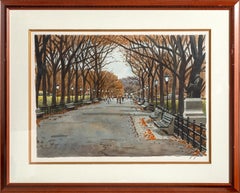
Central Park in Fall, Framed Photorealist Watercolor Painting
Located in Long Island City, NY
Artist: Unknown Title: Central Park in Fall Medium: Watercolor on paper, signed lower right Image Size: 17.5 x 25 inches Frame Size: 28 x 35 inches Watercolor of The Mall in Centra...
Category

1980s American Modern Tri-State Area - Drawings and Watercolor Paintings

Materials

Watercolor

Scripture Tapestry, collage with woman and Biblical quotes
By Audrey Anastasi
Located in Brooklyn, NY
Paper paint charcoal collage fabric These collages were created first in the presence of a live model, working quickly, in charcoal and pastel, and again, later, alone in the studio...
Category

2010s Contemporary Tri-State Area - Drawings and Watercolor Paintings

Materials

Fabric, Charcoal, Archival Paper, Magazine Paper

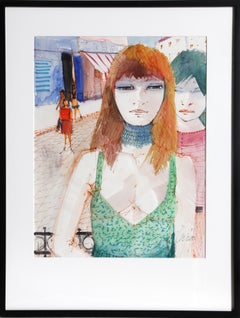
High Fashion Paris Women, Framed Watercolor Painting by Charles Levier
By Charles Levier
Located in Long Island City, NY
Artist: Charles Levier, French (1920 - 2003) Title: Red Head Year: circa 1965 Medium: Watercolor, signed l.r. Image Size: 19.5 x 15.5 inches Size: 28 x 21.5 inches
Category

1960s Fauvist Tri-State Area - Drawings and Watercolor Paintings

Materials

Watercolor

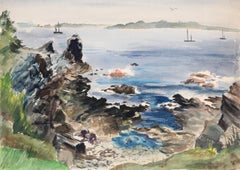
Eve Nethercott, "Cape Elizabeth", New England Landscape
By Eve Nethercott
Located in Long Island City, NY
Eve Nethercott Title: Cape Elizabeth, Portland (P6.5) Date: 1951 Medium: Watercolor on paper Paper Size: 18 x 24 inches
Category

1950s American Impressionist Tri-State Area - Drawings and Watercolor Paintings

Materials

Watercolor

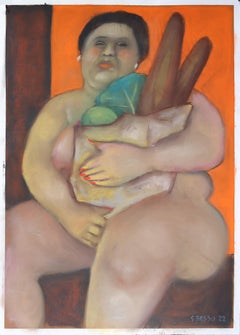
Bread and Cabbage Nude food and seated nude female figure warm earth tones
By Stephen Basso
Located in Brooklyn, NY
Soft pastel on toned archival sanded paper signed and dated bottom right corner. One of many pastel nudes by the artist who has done extensive work in the medium in addition to his o...
Category

2010s Outsider Art Tri-State Area - Drawings and Watercolor Paintings

Materials

Pastel, Archival Paper

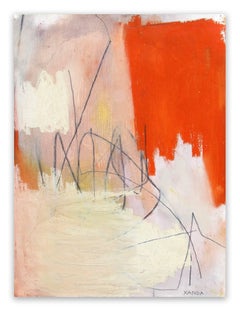
Adjacent 6 (Abstract drawing)
By Xanda McCagg
Located in London, GB
Adjacent 6 (Abstract drawing) Pencil and paint stick on paper. This piece is one of a group of works on paper made with paint sticks and pencil on paper that has been primed with g...
Category

2010s Abstract Expressionist Tri-State Area - Drawings and Watercolor Paintings

Materials

Paint, Paper, Pencil

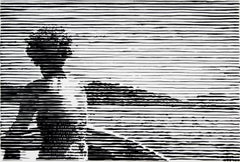
Born on a Boat, black and white work on paper, woman on lake, stripes
By Charles Buckley
Located in New York, NY
"Born on a Boat and Trying to Get to Land", Acrylic ink on paper. Paper size: 10.75" x 15.75" Frame size: 18.5" x 23.5" Charles Buckley lives and works in Brooklyn, NY. His current ...
Category

2010s Contemporary Tri-State Area - Drawings and Watercolor Paintings

Materials

Paper, Ink

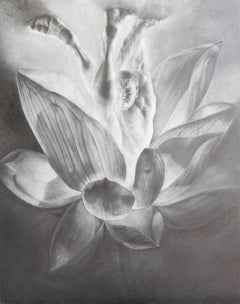
Kyle Andrew Szpyrka - Lotus, Drawing 2015
By Kyle Andrew Szpyrka
Located in Stamford, CT
Sutra, a Sanskrit word meaning “thread”, is a word or small group of words that summarize an entire complex web of ideas, truths, wisdoms, or teachings all woven together into a sing...
Category

2010s Surrealist Tri-State Area - Drawings and Watercolor Paintings

Materials

Paper, Pencil, Graphite

Still Thinking About These?

All Recently Viewed