Wisconsin - Landscape Prints
to
3
52
64
18
20
18
Overall Width
to
Overall Height
to
27
14
14
11
4
2
2
2
1
1
14
12
8
8
7
32
45
72
23
6
3
5
17
8
7
7
8
2
11
114
54
4
71
31
23
19
15
15
14
13
11
10
9
9
9
8
7
7
6
5
5
5
72
50
17
12
11
77
57
11,213
4,937
Item Ships From: Wisconsin
19th century landscape color lithograph seascape buildings cityscape houses
Located in Milwaukee, WI
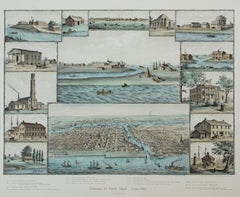
"Chicago in Early Days" is an original color lithograph by Kurz & Allison. This piece features multiple views of the city of Chicago.
16 3/4" x 23 1/4" art
28 1/8" x 33 7/8" frame
...
Category
1890s Academic Wisconsin - Landscape Prints
Materials
Lithograph

17th century etching black and white figurative landscape obelisk buildings
By Jan Frans van Bloemen (Orizzonte)
Located in Milwaukee, WI
"Figures at the Obelisk" is an original etching by Jan Frans van Bloemen. It depicts two people conversing in front of a monument. Behind them, an expansive landscape sprawls.
9 1/4" x 6 3/4" art
21 3/4" x 19 3/8" frame
Jan Frans van Bloemen (baptized 12 May 1662 - buried 13 June 1749) was a Flemish landscape painter mainly active in Rome. Here he was able to establish himself as the leading painter of views (vedute) of the Roman countryside depicted in the aesthetic of the classical landscape tradition.
Van Bloemen predominantly painted classical landscapes, taking his inspiration from the Roman Campagna. His landscapes, with their recession through a series of planes, soft, warm lightning and classical and religious subject matter, drew on the examples of artists such as Claude Lorrain and Gaspard Dughet. His paintings are exquisitely imbued with that "difficult-to-define pastoral ambience" which helped to make him such a great painter in the eyes of his contemporaries. The technique and subjects of the work of Jan Frans van Bloemen are also related to painters such as Jan Asselijn, Thomas Wyck...
Category
18th Century Old Masters Wisconsin - Landscape Prints
Materials
Etching
19th century color lithograph birds landscape nature grass sky water figure
By Currier
Ives
Located in Milwaukee, WI
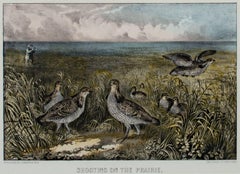
"Shooting on the Prairie" is an original hand-colored lithograph by Currier & Ives. It depicts a hunter shooting at fowl in an open field.
8 1/2" x 12 1/2" art
20 1/4" x 23 3/4" frame
Nathaniel Currier was a tall introspective man with a melancholy nature. He could captivate people with his piercing stare or charm them with his sparkling blue eyes. Nathaniel was born in Roxbury, Massachusetts on March 27th, 1813, the second of four children. His parents, Nathaniel and Hannah Currier, were distant cousins who lived a humble yet spartan life. When Nathaniel was eight years old, tragedy struck. Nathaniel’s father unexpectedly passed away leaving Nathaniel and his eleven-year-old brother Lorenzo to provide for the family. In addition to their mother, Nathaniel and Lorenzo had to care for six-year-old sister Elizabeth and two-year-old brother Charles. Nathaniel worked a series of odd jobs to support the family, and at fifteen, he started what would become a life-long career when he apprenticed in the Boston lithography shop of William and John Pendleton.
A Bavarian gentleman named Alois Senefelder invented lithography just 30 years prior to young Nat Currier’s apprenticeship. While under the employ of the brothers Pendleton, Nat was taught the art of lithography by the firm’s chief printer, a French national named Dubois, who brought the lithography trade to America.
Lithography involves grinding a piece of limestone flat and smooth then drawing in mirror image on the stone with a special grease pencil. After the image is completed, the stone is etched with a solution of aqua fortis leaving the greased areas in slight relief. Water is then used to wet the stone and greased-ink is rolled onto the raised areas. Since grease and water do not mix, the greased-ink is repelled by the moisture on the stone and clings to the original grease pencil lines. The stone is then placed in a press and used as a printing block to impart black on white images to paper.
In 1833, now twenty-years old and an accomplished lithographer, Nat Currier left Boston and moved to Philadelphia to do contract work for M.E.D. Brown, a noted engraver and printer. With the promise of good money, Currier hired on to help Brown prepare lithographic stones of scientific images for the American Journal of Sciences and Arts. When Nat completed the contract work in 1834, he traveled to New York City to work once again for his mentor John Pendleton, who was now operating his own shop located at 137 Broadway. Soon after the reunion, Pendleton expressed an interest in returning to Boston and offered to sell his print shop to Currier. Young Nat did not have the financial resources to buy the shop, but being the resourceful type he found another local printer by the name of Stodart. Together they bought Pendleton’s business.
The firm ‘Currier & Stodart’ specialized in "job" printing. They produced many different types of printed items, most notably music manuscripts for local publishers. By 1835, Stodart was frustrated that the business was not making enough money and he ended the partnership, taking his investment with him. With little more than some lithographic stones, and a talent for his trade, twenty-two year old Nat Currier set up shop in a temporary office at 1 Wall Street in New York City. He named his new enterprise ‘N. Currier, Lithographer’
Nathaniel continued as a job printer and duplicated everything from music sheets to architectural plans. He experimented with portraits, disaster scenes and memorial prints, and any thing that he could sell to the public from tables in front of his shop. During 1835 he produced a disaster print Ruins of the Planter's Hotel, New Orleans, which fell at two O’clock on the Morning of the 15th of May 1835, burying 50 persons, 40 of whom Escaped with their Lives. The public had a thirst for newsworthy events, and newspapers of the day did not include pictures. By producing this print, Nat gave the public a new way to “see” the news. The print sold reasonably well, an important fact that was not lost on Currier.
Nat met and married Eliza Farnsworth in 1840. He also produced a print that same year titled Awful Conflagration of the Steamboat Lexington in Long Island Sound on Monday Evening, January 18, 1840, by which melancholy occurrence over One Hundred Persons Perished. This print sold out very quickly, and Currier was approached by an enterprising publication who contracted him to print a single sheet addition of their paper, the New York Sun. This single page paper is presumed to be the first illustrated newspaper ever published.
The success of the Lexington print launched his career nationally and put him in a position to finally lift his family up. In 1841, Nat and Eliza had their first child, a son they named Edward West Currier. That same year Nat hired his twenty-one year old brother Charles and taught him the lithography trade, he also hired his artistically inclined brother Lorenzo to travel out west and make sketches of the new frontier as material for future prints. Charles worked for the firm on and off over the years, and invented a new type of lithographic crayon which he patented and named the Crayola. Lorenzo continued selling sketches to Nat for the next few years.
In 1843, Nat and Eliza had a daughter, Eliza West Currier, but tragedy struck in early 1847 when their young daughter died from a prolonged illness. Nat and Eliza were grief stricken, and Eliza, driven by despair, gave up on life and passed away just four months after her daughter’s death.
The subject of Nat Currier’s artwork changed following the death of his wife and daughter, and he produced many memorial prints and sentimental prints during the late 1840s. The memorial prints generally depicted grief stricken families posed by gravestones (the stones were left blank so the purchasers could fill in the names of the dearly departed). The sentimental prints usually depicted idealized portraits of women and children, titled with popular Christian names of the day.
Late in 1847, Nat Currier married Lura Ormsbee, a friend of the family. Lura was a self-sufficient woman, and she immediately set out to help Nat raise six-year-old Edward and get their house in order. In 1849, Lura delivered a son, Walter Black Currier, but fate dealt them a blow when young Walter died one year later. While Nat and Lura were grieving the loss of their new son, word came from San Francisco that Nat’s brother Lorenzo had also passed away from a brief illness. Nat sank deeper into his natural quiet melancholy. Friends stopped by to console the couple, and Lura began to set an extra place at their table for these unexpected guests. She continued this tradition throughout their lives.
In 1852, Charles introduced a friend, James Merritt Ives, to Nat and suggested he hire him as a bookkeeper. Jim Ives was a native New Yorker born in 1824 and raised on the grounds of Bellevue Hospital where his father was employed as superintendent. Jim was a self-trained artist and professional bookkeeper. He was also a plump and jovial man, presenting the exact opposite image of his new boss.
Jim Ives met Charles Currier through Caroline Clark, the object of Jim’s affection. Caroline’s sister Elizabeth was married to Charles, and Caroline was a close friend of the Currier family. Jim eventually proposed marriage to Caroline and solicited an introduction to Nat Currier, through Charles, in hopes of securing a more stable income to support his future wife.
Ives quickly set out to improve and modernize his new employer’s bookkeeping methods. He reorganized the firm’s sizable inventory, and used his artistic skills to streamline the firm’s production methods. By 1857, Nathaniel had become so dependent on Jims’ skills and initiative that he offered him a full partnership in the firm and appointed him general manager. The two men chose the name ‘Currier & Ives’ for the new partnership, and became close friends.
Currier & Ives produced their prints in a building at 33 Spruce Street where they occupied the third, fourth and fifth floors. The third floor was devoted to the hand operated printing presses that were built by Nat's cousin, Cyrus Currier, at his shop Cyrus Currier & Sons in Newark, NJ. The fourth floor found the artists, lithographers and the stone grinders at work. The fifth floor housed the coloring department, and was one of the earliest production lines in the country. The colorists were generally immigrant girls, mostly German, who came to America with some formal artistic training. Each colorist was responsible for adding a single color to a print. As a colorist finished applying their color, the print was passed down the line to the next colorist to add their color. The colorists worked from a master print displayed above their table, which showed where the proper colors were to be placed. At the end of the table was a touch up artist who checked the prints for quality, touching-in areas that may have been missed as it passed down the line. During the Civil War, demand for prints became so great that coloring stencils were developed to speed up production.
Although most Currier & Ives prints were colored in house, some were sent out to contract artists. The rate Currier & Ives paid these artists for coloring work was one dollar per one hundred small folios (a penny a print) and one dollar per one dozen large folios. Currier & Ives also offered uncolored prints to dealers, with instructions (included on the price list) on how to 'prepare the prints for coloring.' In addition, schools could order uncolored prints from the firm’s catalogue to use in their painting classes.
Nathaniel Currier and James Merritt Ives attracted a wide circle of friends during their years in business. Some of their more famous acquaintances included Horace Greeley, Phineas T. Barnum, and the outspoken abolitionists Rev. Henry Ward, and John Greenleaf Whittier (the latter being a cousin of Mr. Currier).
Nat Currier and Jim Ives described their business as "Publishers of Cheap and Popular Pictures" and produced many categories of prints. These included Disaster Scenes, Sentimental Images, Sports, Humor, Hunting Scenes, Politics, Religion, City and Rural Scenes, Trains, Ships, Fire Fighters, Famous Race Horses, Historical Portraits, and just about any other topic that satisfied the general public's taste. In all, the firm produced in excess of 7500 different titles, totaling over one million prints produced from 1835 to 1907.
Nat Currier retired in 1880, and signed over his share of the firm to his son Edward. Nat died eight years later at his summer home 'Lion’s Gate' in Amesbury, Massachusetts. Jim Ives remained active in the firm until his death in 1895, when his share of the firm passed to his eldest son, Chauncey.
In 1902, faced will failing health from the ravages of Tuberculosis, Edward Currier sold his share of the firm to Chauncey Ives...
Category
1870s Other Art Style Wisconsin - Landscape Prints
Materials
Lithograph
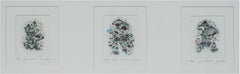
"Gnomes Homes I, II,
III, " Trio of Etchings by Jenny Tapping
By Jenny Tapping
Located in Milwaukee, WI
"Gnomes I, II, & III" are three original etchings by Jenny Tapping. Each etching is signed, titled, and numbered by the artist, and all three are in one frame. Each etching depicts a...
Category
1980s Post-Modern Wisconsin - Landscape Prints
Materials
Etching
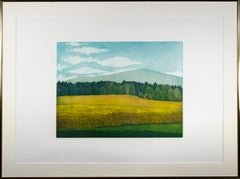
Untitled (field, hills trees)
original landscape aquatint by Nicolette Jelen
By Nicolette Jelen
Located in Milwaukee, WI
The present artwork is an original color aquatint by the Sag Harbor-based artist Nicolette Jelen, and is a particularly rare Hors Commerce proof. It presents a view of what is probab...
Category
1980s Contemporary Wisconsin - Landscape Prints
Materials
Aquatint, Paper
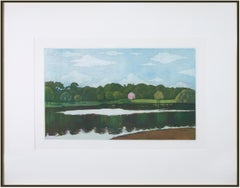
Untitled (Pink House with Lake)
original aquatint by Nicolette Jelen
By Nicolette Jelen
Located in Milwaukee, WI
The present artwork is an original color aquatint by the Sag Harbor-based artist Nicolette Jelen, and is a particularly rare Hors Commerce. It presents a view of what is probably a N...
Category
1980s Contemporary Wisconsin - Landscape Prints
Materials
Aquatint
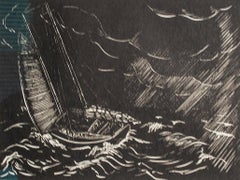
"Squall, " Sailboat Maritime Scene Wood Engraving by Lowell Merritt Lee
By Lowell Merritt Lee
Located in Milwaukee, WI
"Squall is an original wood engraving by Lowell Merritt Lee. It features a rendition of a squall, a sudden violent gust of wind that often brings in rain, snow, or sleet.
Image: 6.1...
Category
1930s American Modern Wisconsin - Landscape Prints
Materials
Woodcut
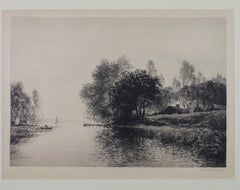
19th century black and white etching landscape scene boat riverbank trees signed
By Thomas R. Manley
Located in Milwaukee, WI
"Farm at Inlet" is an etching by Thomas R. Manley signed lower right. It depicts a waterfront scene in black and gray.
26 1/2" x 33 1/2" art
26 3/8" x 33 3/8" framed
Thomas Manley...
Category
1880s American Impressionist Wisconsin - Landscape Prints
Materials
Etching
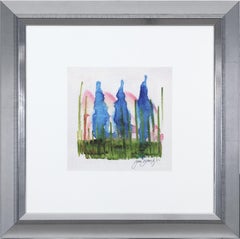
Three Trees
Giclee Print on Watercolor paper After Acrylic Painting
By Joan Dvorsky
Located in Milwaukee, WI
8" x 8" art
18.25" x 18.25" frame
In this artwork, Milwaukee-based artist Joan Dvorsky presents the viewer with an image of three blue trees that almost appear to glow in their envi...
Category
2010s Wisconsin - Landscape Prints
Materials
Giclée
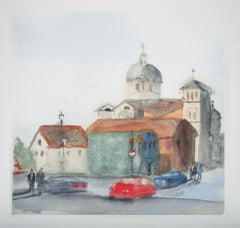
The Basilica of St. Josapha
Giclée Print on Watercolor Paper
By Julia Taylor
Located in Milwaukee, WI
Milwaukee's iconic spots are captured in watercolor and available as hand-embellished giclée. They are printed on archival quality watercolor paper and specially hand embellished so each giclée is a unique mixed media piece of artwork. The artist Julia Taylor added special original touches to each print in 'The Milwaukee Series 2020'
Art: 22" x 21"
Growing up in a small farming community in Indiana, I learned to draw early in life. I earned spending money by sketching portraits at county fairs and illustrations in weekly papers. Art teachers in high school and college taught me ways to master drawing fluidly from life.
In college, my small stained glass...
Category
2010s Wisconsin - Landscape Prints
Materials
Giclée
Contemporary landscape watercolor building street scene with figures signed
By Julia Taylor
Located in Milwaukee, WI
Milwaukee's iconic spots are captured in watercolor and available as hand-embellished giclée. They are printed on archival quality watercolor paper and specially hand embellished so each giclée is a unique mixed media piece of artwork. The artist Julia Taylor added special original touches to each print in 'The Milwaukee Series 2020'
32" x 22" art
Growing up in a small farming community in Indiana, I learned to draw early in life. I earned spending money by sketching portraits at county fairs and illustrations in weekly papers. Art teachers in high school and college taught me ways to master drawing fluidly from life.
In college, my small stained glass...
Category
2010s Wisconsin - Landscape Prints
Materials
Giclée
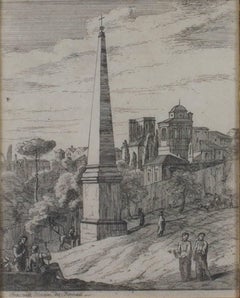
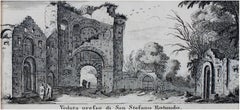
17th century engraving black and white landscape ancient building scene
By Israel Silvestre
Located in Milwaukee, WI
"Veduta Presso di San Stefano Rotondo" is an original engraving by Israel Silvestre, titled along the bottom of the image. This small etching shows an unusual view of the church San ...
Category
1650s Baroque Wisconsin - Landscape Prints
Materials
Engraving
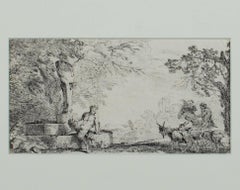
17th century etching black and white landscape forest trees satyr goats
By Giovanni Benedetto Castiglione
Located in Milwaukee, WI
"Mythological Scene--Satyr & Goat Herder" is an etching by Italian artist Giovanni Benedetto Castiglione. It depicts a satyr lounging on the left and an approaching goat herder on th...
Category
Mid-17th Century Old Masters Wisconsin - Landscape Prints
Materials
Etching
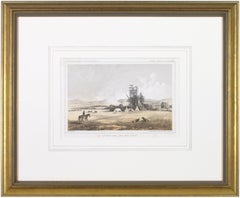
Victor
s Camp - Hell Gate Ronde
original John Mix Stanley lithograph
By John Mix Stanley
Located in Milwaukee, WI
In the mid-nineteenth century, the United States government set out to survey and document its newly acquired lands and territories west of the Mississippi. The goals of these surveys were manifold: to produce topographical maps, to document flora and fauna, and to document natural resources to build the emerging US economy. These surveys, and the images from them, also functioned to build the new sense of American identity with the landscape, condensing vistas into the 'picturesque' tradition of European image making. Thus, the entire span of US territory could be seen as a single, cohesive whole.
This lithograph comes from one of six surveys commissioned by the Army's Topographic Bureau in 1853, which sought to find the best route to construct a transcontinental railroad. The result was a thirteen-volume report including maps, lithographs, and technical data entitled 'Explorations and Surveys to ascertain the most practicable and economical route for a Railroad from the Mississippi river to the Pacific Ocean.' In particular, the print comes from the northern survey, commanded by Isaac Stevens, which explored the regions between the 47th and 49th parallels.
Stanley shows here the stop the Stanley Party made at the junction of the Bitterroot and Hell Gate, in present day Montana. While there, the Party met with the Flathead Chief by the name Victor, as is shown in the image. The figures and their encampment are dwarfed by the vast landscape around them, indicating the sublimity of these new American territories.
5.75 x 8.75 inches, image
6.5 x 9.25 inches, stone
17 x 20 inches, frame
Artist 'Stanley Del.' lower left
Entitled 'Victor's Camp - Hell Gate Ronde' lower center margin
Publisher 'Sarony, Major & Knapp. Lith.s 449 Broadway N.Y.' lower right
Inscribed 'U.S.P.R.R. EXP. & SURVEYS — 47th & 49th PARALLELS' upper left
Inscribed 'GENERAL REPORT — PLATE XXXI' upper right
Framed to conservation standards using 100 percent rag matting with French accents; glazed with UV5 Plexiglas to inhibit fading; housed in a gold reverse ogee moulding.
Print in overall good condition; some localized foxing and discoloration; minor surface abrasions to frame.
John Mix Stanley...
Category
1850s Romantic Wisconsin - Landscape Prints
Materials
Lithograph
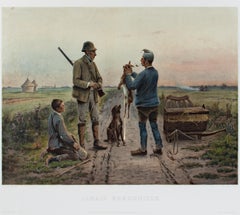
Late 19th century color lithograph figures dog rabbit landscape cart haystacks
By Jules Denneulin
Located in Milwaukee, WI
"Jamais Bredouille (Never Empty-Handed)" is a color lithograph after Jules Denneulin. It depicts a hunter showing his day's work to a farmer on a path at dusk.
20" x 26" art
40 1/4...
Category
1880s Realist Wisconsin - Landscape Prints
Materials
Lithograph
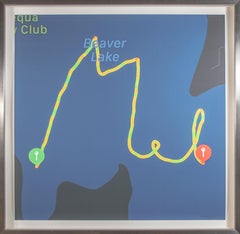
Mel Swimming in Beaver Lake (Blue)
original digital artwork by Melodee Liegl
Located in Milwaukee, WI
'Mel Swimming in Beaver Lake (Blue)' is an original digital artwork by Wisconsin-based artist and swimmer Melodee Liegl – the first digital artist represented by our gallery! As a pr...
Category
2010s Contemporary Wisconsin - Landscape Prints
Materials
Digital Pigment
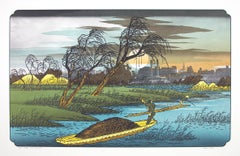
"Seba after Hiroshige" from "Japanese Suite" original lithograph signed pop art
By Michael Knigin
Located in Milwaukee, WI
"Seba after Hiroshige" is an original color lithograph from the Japanese Suite by Michael Knigin. The artist signed the piece lower right and titled it...
Category
1970s Pop Art Wisconsin - Landscape Prints
Materials
Lithograph
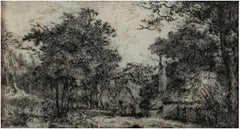
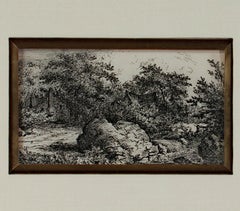
18th century landscape etching pastoral house nature scene detailed ink trees
By John Thomas Smith
Located in Milwaukee, WI
"Figure by the Cottage in Forest" is an original etching by John Thomas Smith. The miniature landscape shows a pair of cottages in the woods, nestled back into the trees. A river flo...
Category
1790s Old Masters Wisconsin - Landscape Prints
Materials
Paper, Ink, Etching
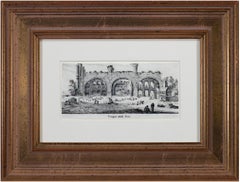
17th century engraving black and white landscape ancient building scene
By Israel Silvestre
Located in Milwaukee, WI
"Tempio Della Pace" is an original engraving by Israel Silvestre. The title is printed below the miniature image. It shows a frontal view of the remains of the Temple of Peace in Rom...
Category
1650s Old Masters Wisconsin - Landscape Prints
Materials
Paper, Ink, Engraving
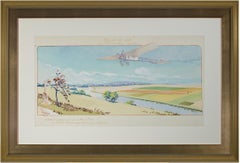
"Circuit De L
Est" Original Aeronautical Lithograph Poster by Marguerite Montaut
By Marguerite Montaut
Located in Milwaukee, WI
"Circuit De L'Est" is an original lithograph poster by Marguerite Montaut (GAMY). This artwork features an early biplane flying over farm fields. It is also passing over a river that...
Category
1910s Modern Wisconsin - Landscape Prints
Materials
Lithograph, Ink
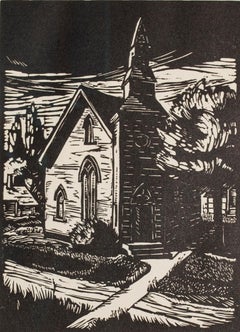
"Country Church, " Town Landscape Linoleum Cut by Elsa E. Ulbricht
Located in Milwaukee, WI
"Country Church" is an original linoleum print by Elsa E. Ulbricht. A front facing view of a country church is proudly replicated within this print.
Unsigned and unnumbered, as issued.
Image:7" x 5"
Framed: 15.25" x 13.25"
Painter, Teacher When she directed The Milwaukee Handicraft Project, Elsa Ulbricht...
Category
1930s American Modern Wisconsin - Landscape Prints
Materials
Linocut
"Venise en Fleurs" from "Je Reve, " Surrealist Lithograph signed by Andre Masson
By André Masson
Located in Milwaukee, WI
"Venise en Fleurs" is an original color lithograph by Andre Masson. This piece is from the "Je Reve" (I Dream) portfolio of 1975. The edition number, written lower left, is H.C. XXV/...
Category
1970s Surrealist Wisconsin - Landscape Prints
Materials
Lithograph

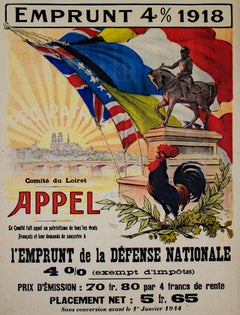
"Emprunt 4% 1918 - Appel, " Original Lithograph Poster by A. Malassinet
Located in Milwaukee, WI
"Emprunt 4% 1918 - Appel" is an original lithograph poster by A. Malassinet. This poster advertised a fund for the national defense during World War I. The following are two statemen...
Category
1910s Modern Wisconsin - Landscape Prints
Materials
Lithograph
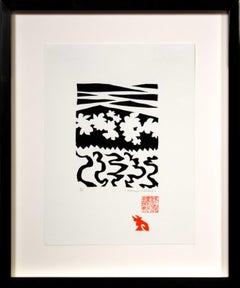
Field
original abstract linocut in black by Wisconsin artist Schomer Lichtner
By Schomer Lichtner
Located in Milwaukee, WI
'Field' is an original linocut by Wisconsin-based artist Schomer Lichtner. The composition presents fields of flowers, trees and grasses below a cloudy sky, but rendered with Lichtner's quintessential abstract sensibilities. This print is one from a series that each depict abstracted subjects in black silhouette, taking pleasure in the materiality of the linocut technique. The free forms of the plants resemble the lyrical mid-century works of the French artist Henri Matisse, which combined with these material concerns demonstrate Lichter's modern sensibilities. The prints from this series are unusual because of how below the image, Lichtner also includes his Chinese seal and a linocut remarque of a cow, each of which act as an additional signature of the artist on the artwork.
Linocut in black and red on Permalife white wove paper
4.5 x 6 inches, image
11.5 x 8.75 inches, sheet
16.5 x 13.63 inches, frame
Signed in pencil, below image, lower right.
Edition 1/100 in pencil, below image, lower left.
Chinese signature stamp in red, below image, lower right.
Remaque of a cow in red, below image, lower right.
Permalife watermark to paper.
Framed to conservation standards in a shadow-box style mounting, using 100 percent rag matting, museum glass, and housed in a silver-finish wood moulding.
Overall excellent condition with no creases or discoloration.
Milwaukee artist Schomer Lichtner was well known for his whimsical cows and ballerinas and abstract imagery. He and his late wife Ruth Grotenrath, both well-known Wisconsin artists, began their prolific careers as muralists for WPA projects, primarily post offices.
Lichtner also painted murals for industry and private clients. Schomer was a printmaker and produced block prints, lithographs, and serigraph prints. His casein (paint made from dairy products) and acrylic paintings are of the rural Wisconsin landscape and farm animals. He became interested in cows when he and Ruth spent summers near Holy Hill in Washington County. According to David Gordon, director of the Milwaukee Art Museum, Schomer Lichtner had a tremendous joie de vivre and expressed it in his art.
Schomer Lichtner was nationally known for his whimsical paintings and sculptures of black- and white-patterned Holstein cows...
Category
Late 20th Century American Modern Wisconsin - Landscape Prints
Materials
Black and White, Paper, Linocut
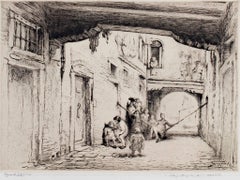
20th century etching figurative landscape city street black and white signed
By Edgar Chahine
Located in Milwaukee, WI
"Venise" is an original etching and chine colle by Edgar Chahine. This is an artist's proof, the third state of the etching, and the artist signed the piece in pencil lower right. Th...
Category
1920s Modern Wisconsin - Landscape Prints
Materials
Etching
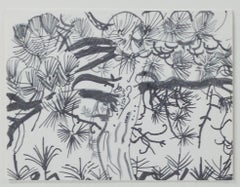
"Pine Tree, " Offset Black
White Lithograph by Ruth Grotenrath
By Ruth Grotenrath
Located in Milwaukee, WI
"Pine Tree" is an offset lithograph by Ruth Grotenrath, created for the Riveredge Nature Center, Inc. for their Artists for Conservation series. It depicts an elaborate drawing of a pine tree with branches growing in multiple directions and overlapping one another.
5" x 6 5/8" art
13 5/8" x 15 1/4" frame
"The paintings of Ruth...
Category
1960s Expressionist Wisconsin - Landscape Prints
Materials
Lithograph
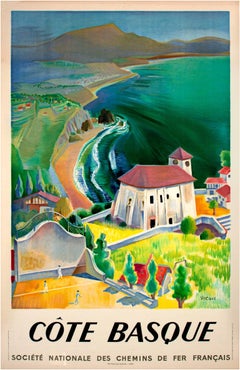
20th century color lithograph poster landscape pastoral building hills signed
By Vecoux
Located in Milwaukee, WI
"Cote Basque" is an original lithograph of the Basque region of France created by Vecoux for the Societe Nationale des Chemis de fer Francais, the French N...
Category
1940s Post-War Wisconsin - Landscape Prints
Materials
Lithograph
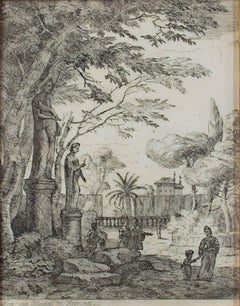
17th century etching black and white figurative landscape trees statues scene
By Jan Frans van Bloemen (Orizzonte)
Located in Milwaukee, WI
"Mother & Child Near Statues" is an original etching by Jan Frans van Bloemen. It depicts two figures, a mother and child pair, next two two classical statues. There are other figures in this park-like environment.
9 1/4" x 6 3/4" art
21 5/8" x 19 3/8" frame
Jan Frans van Bloemen (baptized 12 May 1662 - buried 13 June 1749) was a Flemish landscape painter mainly active in Rome. Here he was able to establish himself as the leading painter of views (vedute) of the Roman countryside depicted in the aesthetic of the classical landscape tradition.
Van Bloemen predominantly painted classical landscapes, taking his inspiration from the Roman Campagna. His landscapes, with their recession through a series of planes, soft, warm lightning and classical and religious subject matter, drew on the examples of artists such as Claude Lorrain and Gaspard Dughet. His paintings are exquisitely imbued with that "difficult-to-define pastoral ambience" which helped to make him such a great painter in the eyes of his contemporaries. The technique and subjects of the work of Jan Frans van Bloemen are also related to painters such as Jan Asselijn...
Category
18th Century Old Masters Wisconsin - Landscape Prints
Materials
Etching
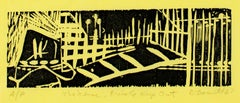
"The Fence, Private Keep Out, " Original Linocut on Yellow Paper
By David Barnett
Located in Milwaukee, WI
"The Fence, Private Keep Out" is an original linocut print on yellow paper by David Barnett. The artist signed the piece lower right, wrote the title lower center, and wrote the edit...
Category
1960s Contemporary Wisconsin - Landscape Prints
Materials
Linocut
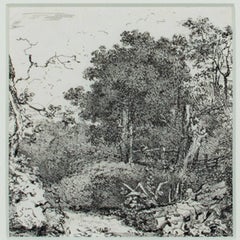
"Forest Glen, " Etching Landscape initialed in Plate by John Thomas Smith
By John Thomas Smith
Located in Milwaukee, WI
"Forest Glen" is an original etching by John Thomas Smith. The piece was initialed in plate. It depicts a small inlet to a lush forest.
3 5/8" x 3 1/2" art
12 7/8" x 12 3/4" frame
...
Category
1790s Old Masters Wisconsin - Landscape Prints
Materials
Etching
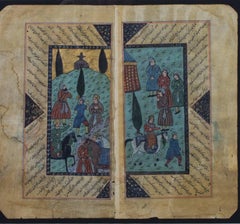
"Royalty Greeting Townspeople, " a Tempera Diptych from the Late 19th c.
Located in Milwaukee, WI
"Royalty Greeting Townspeople" is a Persian tempera diptych from the Late 19th century. It includes multiple figures in red and blue interacting in a f...
Category
Late 19th Century Other Art Style Wisconsin - Landscape Prints
Materials
Tempera
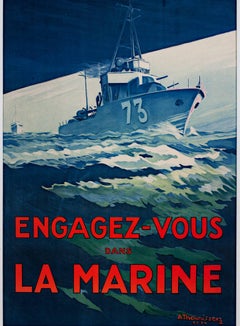
20th century color lithograph boat ocean waves seascape dramatic text signed
By A. Theunissen
Located in Milwaukee, WI
"Engagez-Vous Dans La Marine (Battleship)" is an original color lithograph poster signed and dated in print, A. Theunissen. It depicts a battleship on the ocean with a call for engag...
Category
1930s Modern Wisconsin - Landscape Prints
Materials
Lithograph
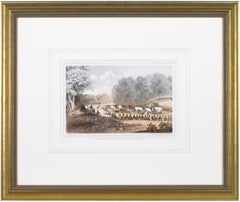
Distribution of Goods to the Assiniboines
original John Mix Stanley lithograph
By John Mix Stanley
Located in Milwaukee, WI
In the mid-nineteenth century, the United States government set out to survey and document its newly acquired lands and territories west of the Mississippi. The goals of these surveys were manifold: to produce topographical maps, to document flora and fauna, and to document natural resources to build the emerging US economy. These surveys, and the images from them, also functioned to build the new sense of American identity with the landscape, condensing vistas into the 'picturesque' tradition of European image making. Thus, the entire span of US territory could be seen as a single, cohesive whole.
This lithograph comes from one of six surveys commissioned by the Army's Topographic Bureau in 1853, which sought to find the best route to construct a transcontinental railroad. The result was a thirteen-volume report including maps, lithographs, and technical data entitled 'Explorations and Surveys to ascertain the most practicable and economical route for a Railroad from the Mississippi river to the Pacific Ocean.'
When it came to depicting the Assiniboine people, as seen in the present print, Stanley chose to juxtapose their encampment, marked by tipis in the distance, with the encampment of the Isaac Stevens survey party. In the foreground, commemorating this moment, Isaac Stevens can be seen presenting trade goods, which are known to include thirty two dressed skins and two robes. The survey leader Isaac Stevens noted being grateful for the generosity of the Assiniboine, commenting: "I felt very grateful indeed to those Indians, for their kindness to my men, their proffer of kind feeling and hospitality to myself and the survey." This description and this image, however, are arguably depicted through rose-colored glasses: to the Assiniboine people, this meeting may well have included stressful diplomatic relationships and have indicated a threat to the sovereignty over the territories agreed to be theirs by the 1851 Treaty of Fort Laramie.
5.75 x 8.75 inches, image
6.5 x 9.25 inches, stone
17 x 19.75 inches, frame
Artist 'Stanley Del.' lower left
Entitled 'Distribution of Goods to the Assiniboines' lower center margin
Publisher 'Sarony, Major & Knapp. Lith.s 449 Broadway N.Y.' lower right
Inscribed 'U.S.P.R.R. EXP. & SURVEYS — 47th & 49th PARALLELS' upper left
Inscribed 'GENERAL REPORT — PLATE XIV' upper right
Framed to conservation standards using 100 percent rag matting with French accents; glazed with UV5 Plexiglas to inhibit fading; housed in a gold reverse ogee moulding.
Print in overall good condition; some localized foxing and discoloration; frame in excellent condition.
John Mix Stanley...
Category
1850s Romantic Wisconsin - Landscape Prints
Materials
Lithograph
Near Mrs. Teshmakers, Edmonton
original etching by John Thomas Smith
By John Thomas Smith
Located in Milwaukee, WI
The present is one of the many prints John Thomas Smith produced of English cottages and vernacular architecture. This example, a view of a cottage in Edmonton, is closely related to...
Category
1790s Old Masters Wisconsin - Landscape Prints
Materials
Paper, Etching

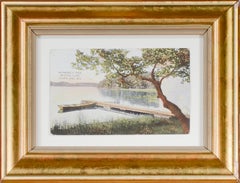
Postcard with view of Rudberg
s Pier, Beaver Lake, Hartland, Wisconsin
Located in Milwaukee, WI
With the invention of the halftone print process, photographic postcards like this became inexpensive to produce and became widely distributed in the first decades of the 20th centur...
Category
Early 1900s Tonalist Wisconsin - Landscape Prints
Materials
Lithograph
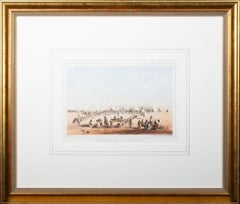
Distribution of Goods to the Gros Ventres
lithograph by John Mix Stanley
By John Mix Stanley
Located in Milwaukee, WI
In the mid-nineteenth century, the United States government set out to survey and document its newly acquired lands and territories west of the Mississippi. The goals of these surveys were manifold: to produce topographical maps, to document flora and fauna, and to document natural resources to build the emerging US economy. These surveys, and the images from them, also functioned to build the new sense of American identity with the landscape, condensing vistas into the 'picturesque' tradition of European image making. Thus, the entire span of US territory could be seen as a single, cohesive whole.
This lithograph comes from one of six surveys commissioned by the Army's Topographic Bureau in 1853, which sought to find the best route to construct a transcontinental railroad. The result was a thirteen-volume report including maps, lithographs, and technical data entitled 'Explorations and Surveys to ascertain the most practicable and economical route for a Railroad from the Mississippi river to the Pacific Ocean.' In particular, the print comes from the northern survey, commanded by Isaac Stevens, which explored the regions between the 47th and 49th parallels.
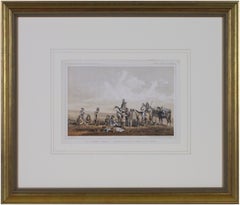
In this image, Stanley documented the encounter with the Gros Ventre people at Milk River. The explorers were invited to the Gros Ventres camp and the two groups exchanged gifts in friendship. The Stevens Party provided "... blankets, shirts, calico, knives, beads, paint, powder, shot, tobacco, hard bread, etc." The image likewise alludes to how, in 1855, Isaac Stevens, concluded a treaty (Stat., L., XI, 657) to provide peace between the United States and the Blackfoot, Flathead and Nez Perce tribes. The Gros Ventres signed the treaty as part of the Blackfoot Confederacy, whose territory near the Three Fork area became a common hunting ground for the Flathead, Nez Perce, Kootenai, and Crow Indians.
5.75 x 8.75 inches, image
6.5 x 9.25 inches, stone
17 x 20 inches, frame
Artist 'Stanley Del.' lower left
Entitled 'Distribution of Goods to the Gros Ventres' lower center margin
Publisher 'Sarony, Major & Knapp. Lith.s 449 Broadway N.Y.' lower right
Inscribed 'U.S.P.R.R. EXP. & SURVEYS — 47th & 49th PARALLELS' upper left
Inscribed 'GENERAL REPORT — PLATE XXI' upper right
Framed to conservation standards using 100 percent rag matting with French accents; glazed with UV5 Plexiglas to inhibit fading; housed in a gold reverse ogee moulding.
Print in overall good condition; some localized foxing and discoloration; minor surface abrasions to frame.
John Mix...
Category
1850s Romantic Wisconsin - Landscape Prints
Materials
Lithograph
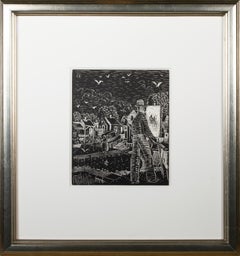
Jones Island
original woodcut engraving by Gerrit Sinclair
By Gerrit Sinclair
Located in Milwaukee, WI
The print 'Jones Island' is something of a self portrait. In the image, an artist stands before and easel, depicting the docks and buildings on the coast. The title indicates that this is Jones Island in Milwaukee, the peninsula along Lake Michigan that today is home to largely industrial buildings. The buildings and figures in the print suggest that this might be a view of the last of the Kashubian or German immigrant settlements on the peninsula before they were evicted in the 1940s to make way for the development of the harbor. The artist in the image thus acts as a documentarian of these peoples. The careful line-work of the woodblock engraving adds a sense of expressionism to the scene, leaving the figures and buildings looking distraught and dirty, though the image nonetheless falls into the Social Realist category that dominated American artists during the Great Depression.
This print was published in 1936 as part of the Wisconsin Artists' Calendar for the year 1937, which included 52 original, hand-made prints – one for each week of the year.
6 x 5 inches, image
10 x 7.13 inches, sheet
13.43 x 12.43 inches, frame
Signed "GS" in the print block,upper left
Entitled "Jones Island" lower left (covered by matting)
Inscribed "Wood Engraving" lower center (covered by matting)
Artist name "Gerrit V. Sinclair" lower right (covered by matting)
Framed to conservation standards using 100 percent rag matting and museum glass, all housed in a silver gilded moulding.
Gerrit Sinclair studied at the Art Institute of Chicago from 1910 - 1915, under Vanderpoel, Norton, and Walcott. In World War I, he served in the Army Ambulance Corps and later recorded his experiences in a series of oil paintings. He taught in Minneapolis before arriving in Milwaukee in 1920 to become a member of the original faculty of the Layton School of Art. He was also a member of the Wisconsin Painters & Sculptors.
Sinclair's paintings and drawings were executed in a lyrical, representational style, usually expressing a mood rather than a narrative. His paintings reveal a great sensitivity for color and atmosphere. His subject matter focused on cityscapes, industrial valleys, and working-class neighborhoods, captured from eye-level. A decade before the popularity of Regionalism, Sinclair's strong interest in the community was reflected not only in his paintings, but also in his encouragement to students to return to their communities as artists and teachers. Joseph Friebert...
Category
1930s American Modern Wisconsin - Landscape Prints
Materials
Engraving, Woodcut
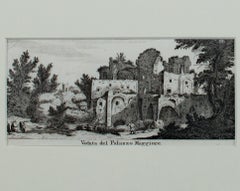
17th century engraving black and white landscape ancient building scene
By Israel Silvestre
Located in Milwaukee, WI
"Veduta del Palazzo Maggiore" is an original engraving by Israel Silvestre, titled along the lower edge of the image. The miniature image depicts an idyllic landscape framed with sil...
Category
1650s Baroque Wisconsin - Landscape Prints
Materials
Engraving
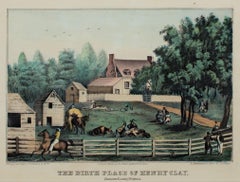
"Birthplace of Henry Clay, Hanover County, VA, " Lithograph by Kelloggs
Thayer
Located in Milwaukee, WI
"Birthplace of Henry Clay, Hanover County, Virginia" is an original hand-colored lithograph by Kelloggs & Thayer. The piece features a homestead and farm anima...
Category
1870s Victorian Wisconsin - Landscape Prints
Materials
Lithograph
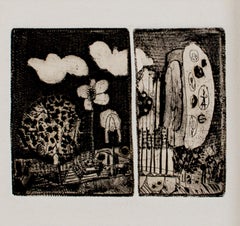
"Double Landscape, " Black
White Two-plate Landscape Etching by Joseph Rozman
By Joseph Rozman
Located in Milwaukee, WI
"Double Landscape" is an original two-plate landscape etching by Joseph Rozman. This artwork features two surreal landscape scenes in black and white.
2 1/2" x 3 1/4" art
11 5/8" x...
Category
1960s Surrealist Wisconsin - Landscape Prints
Materials
Etching
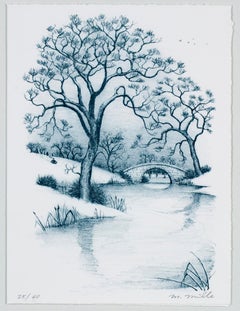
"Season
s Greetings, " Winter Landscape Lithograph in Blue signed by Mark Mille
By Mark Mille 1
Located in Milwaukee, WI
"Season's Greetings" is an original lithograph by Mark Mille. The artist signed the piece lower right and wrote the edition number (25/40) in the lower left. It features a winter river scene...
Category
1980s Post-Modern Wisconsin - Landscape Prints
Materials
Lithograph
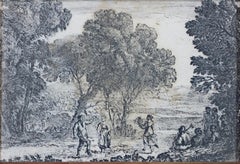
17th century etching black and white landscape scene forest trees figures sky
By Claude Lorrain
Located in Milwaukee, WI
"La Danse Sous Les Arbes (The Country Dance)" is an etching by Claude Gellee (Le Lorrain). This etching is in the collections of the Metropolitan Museum and the Louvre. Publisher: Ma...
Category
Mid-17th Century Old Masters Wisconsin - Landscape Prints
Materials
Etching
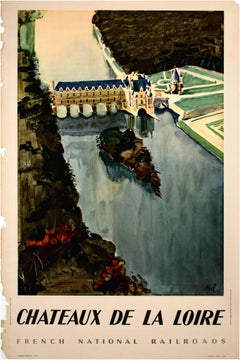
Early 20th century color lithograph poster river building trees text
By Robert Abel
Located in Milwaukee, WI
"Chateaux De La Loire" is a signed original lithograph by Robert Abel. It depicts a view of one of the most iconic houses on the Loire River in France.
Left ...
Category
21st Century and Contemporary Wisconsin - Landscape Prints
Materials
Lithograph
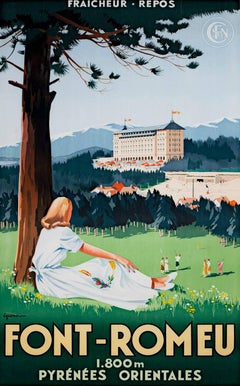
"Font-Romeu, " Original Color Lithograph Poster by Vincent Guerra
By Vincent Guerra
Located in Milwaukee, WI
"Font-Romeu (Tennis/Golfing Retreat)" is an original color lithograph poster by the designer Vincent Guerra. He signed the design in the lower left. This poster depicts a woman relaxing under a tree...
Category
1920s Wisconsin - Landscape Prints
Materials
Lithograph
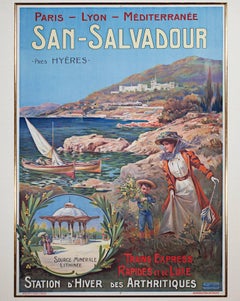
"San Salvador: Station d
Hiver des Arthritiques" Original Color Lithograph
By Ernest-Louis Lessieux
Located in Milwaukee, WI
"San Salvador (Mediterranean)" is an original color lithograph poster by Ernest Louis Lessieux. It depicts a woman and her son on the picturesque coast of...
Category
Late 19th Century Wisconsin - Landscape Prints
Materials
Lithograph, Color
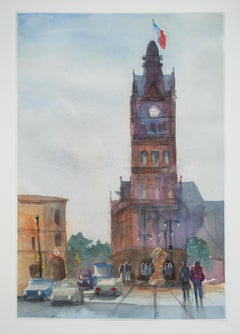
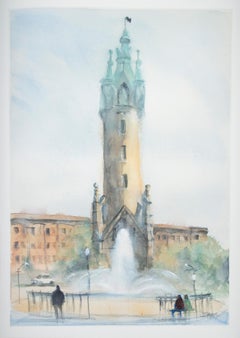
Contemporary landscape watercolor building scene with figures fountain signed
By Julia Taylor
Located in Milwaukee, WI
Milwaukee's iconic spots are captured in watercolor and available as hand-embellished giclée. They are printed on archival quality watercolor paper and specially hand embellished so each giclée is a unique mixed media piece of artwork. The artist Julia Taylor added special original touches to each print in 'The Milwaukee Series 2020'
32" x 22" art
Growing up in a small farming community in Indiana, I learned to draw early in life. I earned spending money by sketching portraits at county fairs and illustrations in weekly papers. Art teachers in high school and college taught me ways to master drawing fluidly from life.
In college, my small stained glass...
Category
2010s Wisconsin - Landscape Prints
Materials
Watercolor, Giclée
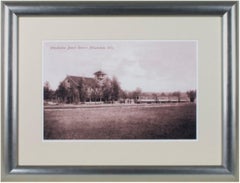
Waukesha Beach Resort, Pewaukee Lake, 2002
Located in Milwaukee, WI
John T. Faber
Waukesha Beach Resort, Pewaukee Lake, 2002
Giclee print, after original postcard 8/13/1909
Waukesha Beach Resort, Pewaukee Lake, 2002 is a giclee print after the origi...
Category
21st Century and Contemporary Wisconsin - Landscape Prints
Materials
Giclée
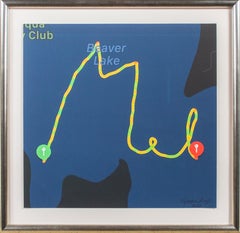
Mel Swimming in Beaver Lake (Blue)
original digital artwork by Melodee Liegl
Located in Milwaukee, WI
'Mel Swimming in Beaver Lake (Blue)' is an original digital artwork by Wisconsin-based artist and swimmer Melodee Liegl – the first digital artist represented by our gallery! As a pr...
Category
2010s Contemporary Wisconsin - Landscape Prints
Materials
Digital Pigment
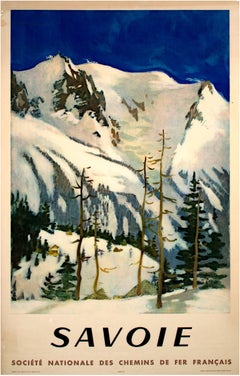
"Savoie (Societe National des Chemins de Fer Francais), " by L.J. Fontanarosa
By Lucien Joseph Fontanarosa
Located in Milwaukee, WI
"Savoie (Societe National des Chemins de fer Francais)" is a signed offset lithograph of a pastoral landscape created for the Societe Nationale...
Category
1940s Other Art Style Wisconsin - Landscape Prints
Materials
Lithograph
Lieutenant Crovers Despatch – Return of Governor Stevens to Fort Benton
By John Mix Stanley
Located in Milwaukee, WI
In the mid-nineteenth century, the United States government set out to survey and document its newly acquired lands and territories west of the Mississippi. The goals of these surveys were manifold: to produce topographical maps, to document flora and fauna, and to document natural resources to build the emerging US economy. These surveys, and the images from them, also functioned to build the new sense of American identity with the landscape, condensing vistas into the 'picturesque' tradition of European image making. Thus, the entire span of US territory could be seen as a single, cohesive whole.
This lithograph comes from one of six surveys commissioned by the Army's Topographic Bureau in 1853, which sought to find the best route to construct a transcontinental railroad. The result was a thirteen-volume report including maps, lithographs, and technical data entitled 'Explorations and Surveys to ascertain the most practicable and economical route for a Railroad from the Mississippi river to the Pacific Ocean.' In particular, the print comes from the northern survey, commanded by Isaac Stevens, which explored the regions between the 47th and 49th parallels.
5.75 x 8.75 inches, image
6.5 x 9.25 inches, stone
17 x 20 inches, frame
Artist 'Stanley Del.' lower left
Entitled 'Lieutenant Crovers Despatch – Return of Governor Stevens to Fort Benton' lower center margin
Publisher 'Sarony, Major & Knapp. Lith.s 449 Broadway N.Y.' lower right
Inscribed 'U.S.P.R.R. EXP. & SURVEYS — 47th & 49th PARALLELS' upper left
Inscribed 'GENERAL REPORT — PLATE XXXVII' upper right
Framed to conservation standards using 100 percent rag matting with French accents; glazed with UV5 Plexiglas to inhibit fading; housed in a gold reverse ogee moulding.
Print in overall good condition; some localized foxing and discoloration; minor surface abrasions to frame.
John Mix Stanley...
Category
1850s Romantic Wisconsin - Landscape Prints
Materials
Lithograph
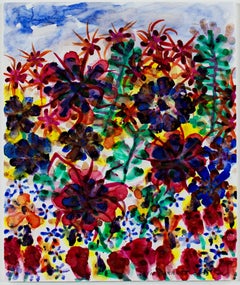
"Beaver Lake Hybrids, " Original Watercolor signed by David Barnett
By David Barnett
Located in Milwaukee, WI
"Beaver Lake Hybrids" is an original watercolor by David Barnett. The artist signed the piece lower right. It depicts a bed of brightly-colored flowers.
10" x 8" art
17" x 15" fram...
Category
Early 2000s Contemporary Wisconsin - Landscape Prints
Materials
Watercolor
"Country Inn by the Pond, " Etching by John Thomas Smith
By John Thomas Smith
Located in Milwaukee, WI
"Country Inn by the Pond" is an original etching by John Thomas Smith. It depicts a cozy building surrounded by trees and vegetation and next to a pond.
3" x 5 1/4" art
16" x 18 1/...
Category
1790s Old Masters Wisconsin - Landscape Prints
Materials
Etching