Recognized Dealers Clocks
to
19
623
108
3
63
474
86
111
39
16
8
10
2
2
5
2
5
2
2
4
86
74
62
50
32
32
30
17
12
9
7
6
5
3
1
1
581
288
283
183
149
558
155
676
434
74
56
52
Height
to
Width
to
734
638
690
35
23
23
17
12
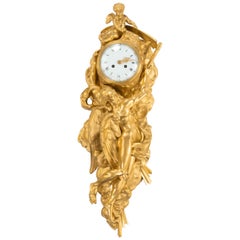
19th Century Ormolu Figural Cartel Clock
Located in London, GB
An ormolu cased Cartel clock by Vincenti & Cie
Constructed in gilt bronze, depicting a well modelled figure of Father Time, carrying his scythe, with a winged cherub surmount, hou...
Category
Antique 19th Century French Wall Clocks
Materials
Bronze, Enamel, Ormolu

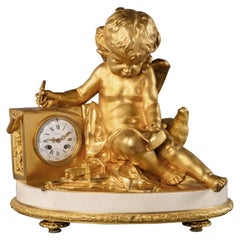
Louis XVI Style Mantel Clock, by Grohé Frères
Located in Brighton, West Sussex
A large and exceptional Louis XVI style gilt-bronze and white marble figural mantel clock, by Grohé Frères, Paris.
The dial signed ‘Grohé, A Paris'.
...
Category
Antique 19th Century French Louis XVI Mantel Clocks
Materials
Bronze
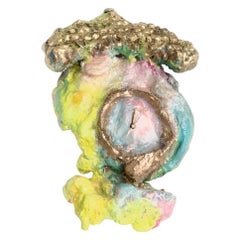
Chan Chiao Chun Contemporary Wall Clock From the Series "Stay with me" 2021
By Chan Chiao Chun
Located in Barcelona, ES
Chan Chiao Chun
Wall clock model "Day 24 - Do you remember sunshine on that day"
From the series "Stay with me"
Manufactured by Chan Chiao Chun
Produced in exclusive for Side Gal...
Category
21st Century and Contemporary Dutch Wall Clocks
Materials
Metal
William IV Rosewood and Bronze Bracket Clock by Frodsham 185
Baker
Located in Lymington, Hampshire
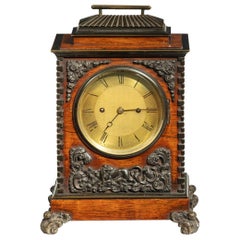
William IV rosewood and bronze bracket clock by Frodsham 185 & Baker, the brass eight-day movement striking on a bell, the backplate numbered ‘292’, the circular brass dial with roman numerals and an engine turned centre, signed ‘Frodsham & Baker Gracechurch St. London‘, in an architectural case with applied panels, the front decorated with a lion and foliage, the corners with quoins, the sides with scrolling leaves and palmettes, with a fan pagoda top with a retractable oriental gateway handle, on leaf scroll feet, with pendulum, winding key and case key. English, circa 1830.
William Frodsham was an established London clockmaker. One of his sons, John Frodsham (1785-1849), went into partnership with Baker to form ‘Frodsham and Baker’ in 1809’. They were chronometer makers to the Admiralty and also made wall...
Category
Antique 1830s English Mantel Clocks
Materials
Bronze
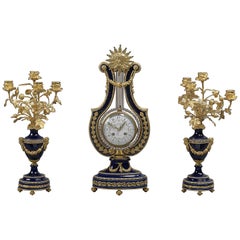
Louis XVI Style Porcelain and Gilt-Bronze Lyre Clock Garniture, circa 1900
Located in Brighton, West Sussex
A fine Louis XVI style cobalt blue porcelain and gilt-bronze lyre clock garniture, with jewel set pendulum.
French, circa 1900.
The candelabra bearing a paper label to the und...
Category
Antique Late 19th Century French Louis XVI Mantel Clocks
Materials
Bronze
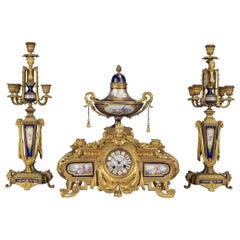
Napoleon III Clock Garniture Designed by Sévin, Cast by Barbedienne
By F. Barbedienne Foundry, Louis-Constant Sevin
Located in Brighton, West Sussex
A fine Napoleon III gilt-bronze and porcelain mounted clock garniture, designed by Louis-Constant Sévin, cast by Ferdinand Barbedienne, The Movement by Japy Frères.
Frédéric Japy ...
Category
Antique 19th Century French Napoleon III Mantel Clocks
Materials
Ormolu
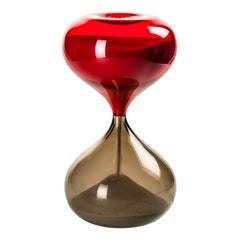
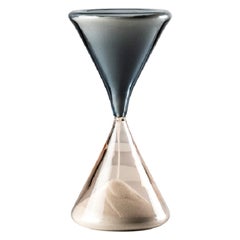
21st Century Small Clessidra Hourglass in Grey/Red by Venini
By Venini
Located in murano, IT
Little grains of sand, impalpable and unnoticeable as a whole yet so real, like time ticking away. Clessidra – designed by Fulvio Bianconi and Paolo Venini in 1957 – evolves in 2015,...
Category
21st Century and Contemporary Italian More Clocks
Materials
Glass
21st Century Clessidra Hourglass in Grape/Light Pink by Paolo Venini
By Paolo Venini, Venini
Located in murano, IT
Clessidra 420.10 Ø14 H30 UV/RS
Additional Information:
Material: Glass
Color: Grape/Light Pink
Dimensions: Ø 14 x H 30 cm
Available in other color options: Amber/light pink.
Category
21st Century and Contemporary Italian More Clocks
Materials
Glass
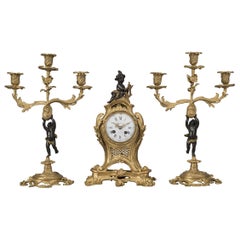
Louis XV Style Bronze Figural Clock Garniture by Maison Baguès French circa 1870
By Maison Baguès
Located in Brighton, West Sussex
A fine Louis XV style gilt and Patinated bronze figural clock garniture by Maison Baguès.
This rare example of a clock garniture by Maison Baguès has a twin train eight-day movement striking on a bell.
The garniture consists of a clock and a pair of candelabra en suite.
The clock has a Rococo cast case surmounted by a patinated bronze putto playing a lyre, above a circular white enamel dial with Roman numerals, Arabic seconds and pierced hands. The dial inscribed 'Eug Bagues, Paris'. The case terminates in four scrolling legs put down on an acanthus cast plinth base.
The candelabra en suite have gilt bronze pierced acanthus cast bases supporting patinated bronze putti each holding aloft three scrolling acanthus arms terminating in circular and foliate cast drip trays and nozzles.
Maison Baguès
The Baguès Company, located at 31, rue des Francs-Bourgeois, was founded in 1840 by Mr. Noel Baguès who started his business to cast liturgical bronzes.
By 1880 the company had expanded into the production of bronze light fixtures in response to the development of electrical lighting. Carried on by Noël’s son Eugène and grandsons Victor and Robert, Maison Baguès continued to progress, adding intricately detailed iron lighting collections in the 1920s as well as stair banisters...
Category
Antique Mid-19th Century French Louis XV Mantel Clocks
Materials
Bronze
Chan Chiao Chun Contemporary Wall Clock Model "Day 33 -You show me the bright"
By Chan Chiao Chun
Located in Barcelona, ES
Chan Chiao Chun
Wall clock model "Day 33 -You show me the bright"
From the series "Stay with me"
Manufactured by Chan Chiao Chun
Produced in exclusive for Side Gallery
Eidhoven,...
Category
21st Century and Contemporary Dutch Wall Clocks
Materials
Metal

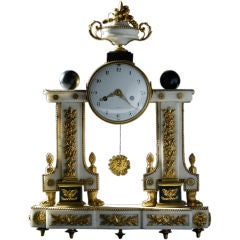
Signed French Louis XVI Mantle Clock
Located in New York, NY
A French white marble and gilt bronze mantel clock. Signed A. Paris on face.
Category
Antique 19th Century French Clocks
Materials
Marble, Ormolu
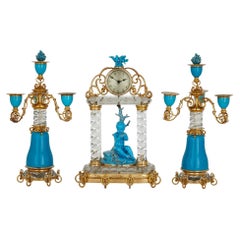
Antique Continental Gilt Bronze, Cut Glass, and Porcelain Clock Set
Located in London, GB
Antique Continental gilt bronze, cut glass, and porcelain clock set
Continental, late 19th century
Clock: Height 45cm, width 30cm, depth 22cm
Candelabra: Height 46cm, width 23cm, ...
Category
Antique Late 19th Century European Mantel Clocks
Materials
Ormolu
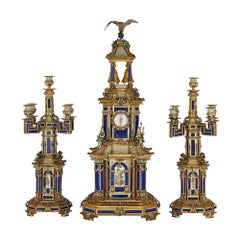
Impressive Antique Austrian Champlevé Enamel, Silver-Gilt and Lapis Lazuli Clock
Located in London, GB
Impressive antique Austrian champlevé enamel, silver-gilt and lapis lazuli clock set
Austrian, Late 19th century
Clock: Height 91cm, width 37cm, depth 37cm
Candelabra: Height 64cm, width 24cm, depth 24cm
Clock case: Height 97cm, width 44cm, depth 41cm
Candelabra case: 67cm, width 27cm, depth 27cm
Crafted in Austria in the late 19th century, this magnificent three-piece clock set was most likely gifted to the Imperial Russian family by the Austro-Hungarian Royal family. Its design is inspired by various cultures and styles, whilst its high quality celebrates some of the best craftsmen of the late 19th century.
Of a tiered pagoda shape, the clock is surmounted by an eagle, its wings spread wide landing atop a vibrant lapis lazuli ball. The eagle is most likely a reference to Turul, a mythological animal which is a symbol of Hungary. This bird of prey is also a popular feature within Turkish traditions.
Within a canopy, supported on four sturdy lapis lazuli pillars two prominent silver-gilt bells are hanging. These are carved with various motifs such as acanthus leaf design and connect to the clock mechanism below. The bells ring informing its users of the time.
All four sides of the piece are inset with a clock, an unusual feature on an object of this type and a testament to its highest quality. The inclusion of clocks on all sides signifies that the antique is aimed to be a centrepiece, admired from all sides. The dial is decorated using the champlevé enamelling technique, whereby ‘parcels’ are carved into the silver gilt and into which enamel is poured. The 12 numbers are coloured in black with a gold outline and are surrounded by a white circular background making them stand out and easy to read. The hour clock dial is cast in the form of a sun, while the minute hand is represented as the moon. The two motifs symbolise one’s bright and gloomy sides of existence.
The four corners around the clocks are mounted with three-dimensional female figures dressed in traditional garments from around the world. For example, one figure is dressed in typical Turkish clothing...
Category
Antique Late 19th Century Austrian Table Clocks and Desk Clocks
Materials
Lapis Lazuli, Silver, Enamel, Bronze
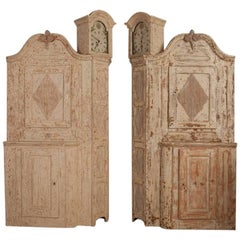
Unusual Pair of Gustavian Corner Clock Cabinets, Origin Mora, Sweden, Circa 1780
Located in New York, NY
Unusual pair of Gustavian corner clock cabinets, origin: Mora, Sweden, circa 1780
Each cabinet with matching working, tall case clocks decorated with four fluted diamond patterns an...
Category
Antique 18th Century Swedish Gustavian Cabinets
Materials
Wood, Paint