18th Century Paintings

to
330
217
165
193
205
265
Overall Width
to
Overall Height
to
2,105
6,423
42,940
122,249
744
716
1,305
1,678
1,665
2,328
3,098
3,587
3,400
3,376
381
14
4
1
568
440
5
800
453
274
265
174
129
106
78
77
68
67
34
33
33
32
26
19
17
16
15
1,001
903
450
447
85
41
5
4
4
3
857
76
911
113
Period: 18th Century
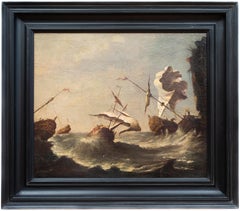
Shipping in Stormy Waters, Attributed to Italian Artist Francesco Guardi
By Francesco Guardi
Located in Stockholm, SE
The splendour of the tragic sea Francesco Guardi and maritime painting in Venetian art No Venetian painter was a stranger to the sea. After all, Venice was not only one of the most prominent ports of the Mediterranean, but indeed a city literally submerged in the ocean from time to time. Curiously however, the famous Venetian school of painting showed little interest in maritime motifs, favouring scenes from the iconic architecture of the city rather than seascapes. That is why this painting is a particularly interesting window into not only the painter Francesco Guardi himself – but to the significance of the element of water in art history, in absence as well as in the centre of attention. Whether it be calm, sunny days with stunning views of the palaces alongside the canals of Venice or – more rarely – stormy shipwrecking tragedies at sea, water as a unifying element is integral to the works of painter Francesco Guardi (1712–1793). During his lifetime, Venetian art saw many of its greatest triumphs with names like Tiepolo or Canaletto gaining international recognition and firmly establishing Venice as one of the most vibrant artistic communities of Europe. While the city itself already in the 18th century was something of an early tourist spot where aristocrats and high society visited on their grand tour or travels, the artists too contributed to the fame and their work spread the image of Venice as the city of romance and leisure to an international audience, many of whom could never visit in person. Still today, the iconic image of Venice with its whimsical array of palaces, churches and other historic buildings is much influenced by these artists, many of whom have stood the test of time like very well and remain some of the most beloved in all of art history. It was not primarily subtility, intellectual meanings or moral ideals that the Venetian art tried to capture; instead it was the sheer vibrancy of life and the fast-paced city with crumbling palaces and festive people that made this atmosphere so special. Of course, Venice could count painters in most genres among its residents, from portraiture to religious motifs, history painting and much else. Still, it is the Vedutas and views of the city that seems to have etched itself into our memory more than anything else, not least in the tradition of Canaletto who was perhaps the undisputed master of all Venetian painters. Born into his profession, Francesco lived and breathed painting all his life. His father, the painter Domenico Guardi (1678–1716) died when Francesco was just a small child, yet both he and his brothers Niccolò and Gian Antonio continued in their fathers’ footsteps. The Guardi family belonged to the nobility and originated from the mountainous area of Trentino, not far from the Alps. The brothers worked together on more challenging commissions and supported each other in the manner typical of family workshops or networks of artists. Their sister Maria Cecilia married no other than the artist Giovanni Battista Tiepolo himself, linking the family to the most renowned Venetian name of the time. During almost a decade, Guardi worked in the studio of Michele Giovanni Marieschi, sometimes simply known as Michiel, a painted similar in both style and motif. Canaletto is, however, the artist Guardi is most often compared to since they shared a mutual fascination for depicting the architecture and cityscape of Venice. During the course of his career, Guardi tried his hand in many different genres. He was as swift in painting landscapes, Vedutas of Venice, sacred motifs, interiors and architectural compositions as he was in a number of other motifs. His style is typical of the Venetian school but also distinct and personal once we look a little closer. There is an absolute certainty in the composition, the choice of which sometimes feels like that of a carefully calculated photograph – yet it is also very painterly, in the best sense of the word: fluid, bold, sensitive and full of character. The brushwork is rapid, intense, seemingly careless and extraordinarily minute at the same time; fresh and planned in a very enjoyable mixture. His interiors often capture the breath-taking spacious glamour of the palaces and all their exquisite decor. He usually constructed the motif through remarkably simple, almost spontaneous yet intuitively precise strokes and shapes. The result was a festive, high-spirited atmospheric quality, far away from the sterile and exact likeness that other painters fell victim to when trying to copy Canaletto. The painting here has nothing of the city of Venice in it. On the contrary, we seem to be transported far away into the solitary ocean, with no architecture, nothing to hold on to – only the roaring sea and the dangerous cliffs upon which the ships are just moments away from being crushed upon. It is a maritime composition evoking both Flemish and Italian precursors, in the proud tradition of maritime painting that for centuries formed a crucial part of our visual culture. This genre of painting is today curiously overlooked, compared to how esteemed and meaningful it was when our relationship to the sea was far more natural than it is today. When both people and goods travelled by water, and many nations and cities – Venice among them – depended entirely on sea fare, the existential connection to the ocean was much more natural and integrated into the imagination. The schools and traditions of maritime art are as manifold as there are countries connected to the sea, and all reflect the need to process the dangers and wonders of the ocean. It could symbolize opportunity, the exciting prospects of a new countries and adventures, prospering trade, beautiful scenery as well as war and tragedy, loss of life, danger and doom. To say that water is ambivalent in nature is an understatement, and these many layers were something that artists explored in the most wondrous ways. Perhaps it takes a bit more time for the modern eye to identify the different nuances and qualities of historic maritime paintings, they may on first impression seem hard to differentiate from each other. But when allowing these motifs to unfold and tell stories of the sea in both fiction and reality – or somewhere in between – we are awarded with an understanding of how the oceans truly built our world. In Guardi’s interpretation, we see an almost theatrically arranged shipwrecking scene. No less than five ships are depicted right in the moment of utter disaster. Caught in a violent storm, the waves have driven them to a shore of sharp cliffs and if not swallowed by the waves, crushing against the cliffs seems to be the only outcome. The large wooden ships are impressively decorated with elaborate sculpture, and in fact relics already during Guardi’s lifetime. They are in fact typical of Dutch and Flemish 17th century ships, giving us a clue to where he got the inspiration from. Guardi must have seen examples of Flemish maritime art, that made him curious about these particular motifs. One is reminded of Flemish painters like Willem van de Velde and Ludolf Backhuysen, and this very painting has indeed been mistakenly attributed to Matthieu van Plattenberg...
Category

Old Masters 18th Century Paintings

Materials

Canvas, Oil

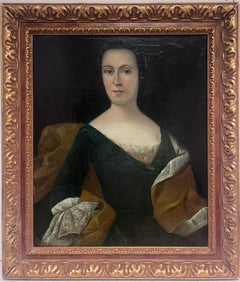
Large 18th Century European Oil Painting Portrait of Noble Lady Lace Collars
Located in Cirencester, Gloucestershire
Portrait of a Noble Lady European School, 18th century oil on canvas, framed framed: 37.5 inches canvas: 30 x 24.5 inches provenance: private collection, France condition: very good ...
Category

Old Masters 18th Century Paintings

Materials

Oil, Canvas

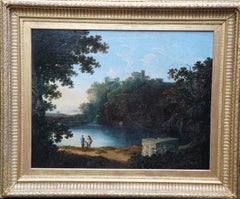
Capriccio Tivoli Landscape - British 18th century Old Master art oil painting
Located in Hagley, England
This lovely British 18th century Old Master landscape oil painting is attributed to circle of Richard Wilson. Painted circa 1770 it is a Capriccio Tivoli landscape with figures by a ...
Category

Old Masters 18th Century Paintings

Materials

Oil

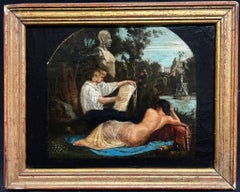
18th Century French Oil Artist Painting Nude Model Classical Garden Scene
Located in Cirencester, Gloucestershire
The Artist and his Model French School, 18th century oil on canvas, framed Framed: 14 x 17 inches Board: 11 x 14 inches Provenance: private collection, France Condition: very good co...
Category

Rococo 18th Century Paintings

Materials

Oil

Copy of "Portrait of Beatrice dʼEste" by Leonardo da Vinci created 15th Century
Located in New York, NY
A masterful copy by an unknown artist, after the portrait of "Beatrice d'Este" by Leonardo Da Vinci also known as ‘Portrait of a Lady’ or ‘La Dama con la reticella di perle (The Lady With a Pearl Hairnet)’. The original work originally created in the 15th Century is currently on display in the Pinacoteca Ambrosiana Museum of Milan. Beatrice d'Este was the Duchess of Bari/Milan and was believed to be one of the most attractive princesses of the Renaissance. Her impeccable style won her many admirers throughout Italy and France, and she became a trendsetter of the highest order. This copy of the original painting, is an oil on canvas done in the 18th Century, and in this exquisite portrait, the artist has masterfully depicted the fine details with draped hair, pearls, royal dress, ornate headgear and sumptuous jewelry in front of a dark background. Once again, capturing the imagination with another enigmatic smile. It comes housed in an elegant period giltwood frame with ebonized trims and ready to be displayed with hanging wire on verso. Art measures 28 x 18 inches Frame measures 34.5 x 24.5 inches There is much debate and controversy over who actually painted the "Beatrice d'Este" was it Leonardo da Vinci (1452–1519), or Giovanni Ambrogio de Predis (1455–1508). So we may never know who executed the original portrait which hangs in the museum, but that need not deter from an appreciation of its singularity. Following the portraiture convention established by painters of the Quattrocentro, the artist has chosen to portray his sitter in profile. In doing so, he magnificently captures the essence of his sitter, a girl on the threshold of womanhood. Bedecked in the adornments—silk, velvet, pearls and embroidery (brocade) crafted of spun gold threads—afforded her by birthright and marriage, Beatrice looks forward in noble serenity. And at the same time her profile with its upturned nose and slight smile betrays an innocence that must have been the basis of the oft-repeated epithet: la più zentil donna in Italia” (“the sweetest lady in Italy”). It is believed the lady is Beatrice d'Este (1475-1497), duchess of Bari and later of Milan, the wife of Ludovico Sforza (known as "il Moro"). One of the most beautiful princesses of the Italian Renaissance, she was known for her good taste in fashion. Beatrice was a member of the Este-Sforza family, which joined by marriage two of the oldest reigning and already powerful houses in Italy. The house of Este, which held court in Ferrara, traced its lineage to the 11th century Dukes of Saxony and Bavaria. Beatriceʼs father, Ercole I ruled the Ferrara commune for 34 years, catapulting the city-state (and the Estes with it) to an unmatched level of economic prosperity and cultural prominence. The family was renowned for its love of letters and patronage of the arts. The first time Leonardo da Vinci’s name resounded in the Ambrosiana, it was through the pen of its founder, Cardinal Federico Borromeo, who attributed this little panel to the great Master, describing it as “A portrait of a Duchess of Milan, by the hand of Leonardo”. Following the Cardinal’s statement, the portrait was for long assumed to depict Beatrice d’Este, the wife of Ludovico il Moro. However, scholars have recently been more cautious and vague in their statements, with regard to both the artist (anonymous Lombard or Emilian...
Category

Northern Renaissance 18th Century Paintings

Materials

Canvas, Oil

Leda Swan Mythological Paint oil on canvas French Painter 18th Century
Located in Riva del Garda, IT
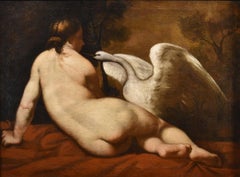
French painter of the late 18th-early 19th century Leda and the Swan (Literary source: Metamorphoses by Ovid, Book VI) Oil on canvas 95 x 126 cm Framed 109 x 142 cm This c...
Category

Old Masters 18th Century Paintings

Materials

Oil

Ancient Ruins - Oil Painting by Vinzenz Fischer - Late 18th Century
Located in Roma, IT
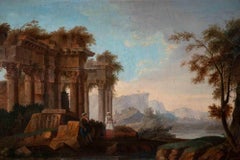
Ancient monuments is an original painting realized by Vinzenz Fischer (1729-1810) in the late 18th century. Mixed colored oil painting on canvas. This beautiful artwork represents ...
Category

18th Century Paintings

Materials

Oil

Painted Landscape with Shepherdess and Sheep late 1700s
Located in Milan, IT
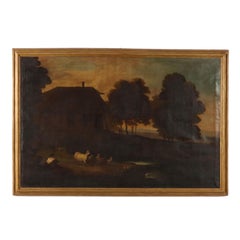
Oil on Canvas. Central European school of the late 1700s. The large painting depicts a rural landscape, with a peasant dwelling on the left, the shepherdess in the left foreground wa...
Category

Other Art Style 18th Century Paintings

Materials

Oil

Portrait of Lady Mary Burke, later Wife of Edward Southwell
Located in Taunton, GB
Portrait of Lady Mary Burke, later Wife of Edward Southwell, 2lst Baron, three-quarter length seated, wearing Red Coat and Fur Robes, a Landscape beyond Signed Oil on canvas 55 x ...
Category

18th Century Paintings

Materials

Oil

18th Century Oil on Canvas Flemish Framed Religious Painting Holy Family, 1750
Located in Vicoforte, IT
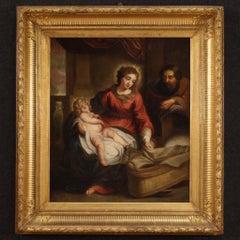
Antique Flemish painting from the 18th century. Framework oil on canvas depicting religious subject Holy family of good pictorial quality. Nice sized and pleasantly decorated framewo...
Category

18th Century Paintings

Materials

Canvas, Oil

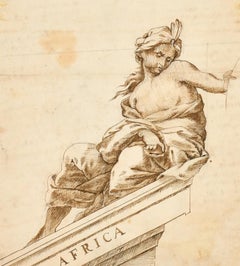
Fine 1700 s Italian Old Master Ink Wash Drawing Roman Allegorical Africa
Located in Cirencester, Gloucestershire
'Africa' Italian School, 18th century ink and wash drawing on paper, framed within a light oak wood frame (behind glass) image size: 10.5 x 7 inches overall framed: 17 x 13 inches co...
Category

Old Masters 18th Century Paintings

Materials

Ink, Watercolor, Archival Paper

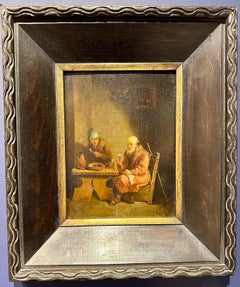
Old Master Style Inn Interior with three men drinking around a table
Located in Woodbury, CT
This 18th-century painting, attributed to Christian Wilhelm Ernst Dietrich (1712–1774), depicts a rustic inn interior, a subject frequently explored by Dutch and German genre painter...
Category

Old Masters 18th Century Paintings

Materials

Wood, Oil

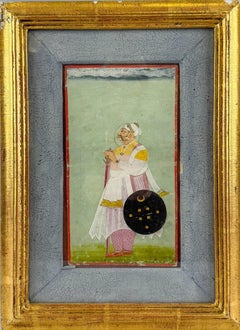
Antique Indian Mughal Portrait of a Prince, Gouache, Late 18th Century
Located in Greenwich, CT
Antique Indian Mughal portrait of a Prince, late 18th cent. , by repute possibly depicting Maharaja Vijay Singh of Marwar (1729 - 1793) Rajasthan, circa 1800’s The Maharaja is ...
Category

Other Art Style 18th Century Paintings

Materials

Gouache

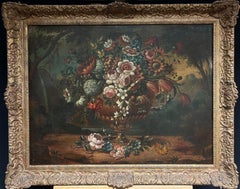
18th-Century Baroque Oil Still Life Flowers Floral Arrangement in an Ornate Urn
Located in Cirencester, Gloucestershire
Elaborate Floral Arrangement French artist, 18th Century oil on canvas, framed Framed: 27 x 34 inches Canvas: 22 x 29 inches Provenance: private collection, England Condition: very...
Category

Baroque 18th Century Paintings

Materials

Oil, Canvas

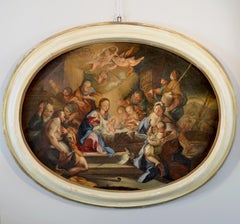
Adoration Of The Shepherds Painting Oil on canvas Italy 18th Century
By (After) Sebastiano Conca
Located in Riva del Garda, IT
(After) Sebastiano Conca (Gaeta 1680 - Naples 1764) The Adoration of the Shepherds oil on canvas, (cm): 122 x 100, framed The proposed table, datable in the first decades of the e...
Category

Baroque 18th Century Paintings

Materials

Oil

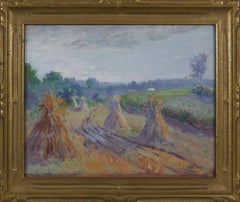
Soft Shadows, Late 19th/Early 20th Century Landscape w/ Hay, Harvest Season
Located in Beachwood, OH
William H. Kinnicutt (American, 1865-1934) Soft Shadows Oil on canvas Signed lower right 16 x 20 inches 20.5 x 24.5 inches, framed See condition in photos William H. Kinnicutt was a...
Category

American Impressionist 18th Century Paintings

Materials

Oil

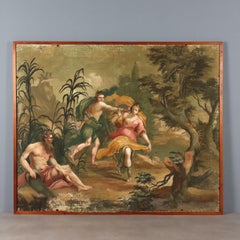
Apollo and Daphne painting 18th century
Located in Milan, IT
Oil on Canvas. Tuscan school of the 18th century. The grand scene tells the tragic story of Apollo and Daphne, recounted in Ovid's Metamorphoses. According to the myth, the god Apoll...
Category

Other Art Style 18th Century Paintings

Materials

Oil

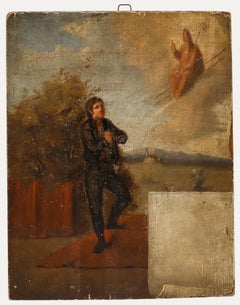
18th Century Oil - Praying to St Peter
Located in Corsham, GB
A captivating 18th-century oil painting portraying a gentleman in prayer before Saint Peter, who appears celestial in the clouds above. In the distance, a quaint church nestles withi...
Category

18th Century Paintings

Materials

Oil

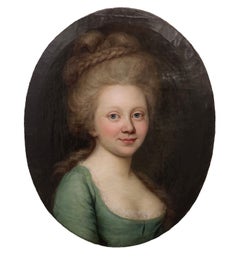
Portrait signed Darbes, 1781. Russo-Baltic period, Riga address on the reverse
Located in Firenze, IT
Portrait signed Darbes, 1781. Russo-Baltic period, Riga address on the reverse Oil on canvas, oval format, 61 × 46.5 cm Signed on the left and dated 1781, this portrait is by Joseph...
Category

Rococo 18th Century Paintings

Materials

Canvas, Oil

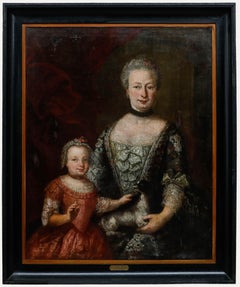
Borne - European School 18th Century Oil, Anna and Adelaide
Located in Corsham, GB
A delightfully tender 18th-century family portrait depicting mother and daughter - Anna and Adelaide - with their cherished spaniel. The artist beautifully conveys the intimate bond ...
Category

18th Century Paintings

Materials

Oil

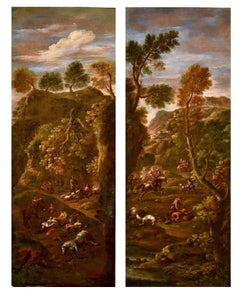
Zais Landscape Couple Paint Oil on canvas Old master 18th Century Italy Venice
By Giuseppe Zais (Canale d Agordo, Belluno 1709 - Treviso 1781)
Located in Riva del Garda, IT
Giuseppe Zais (Canale d'Agordo, Belluno 1709 - Treviso 1781) Pendant of paintings - The assault of the brigands / After the assault Oil on canvas, 108 x 42 cm. each In the frame 128...
Category

Old Masters 18th Century Paintings

Materials

Oil

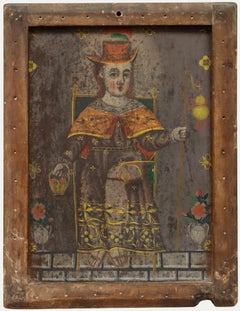
Cuzco School 18th Century Oil - Christ Child of Atocha
Located in Corsham, GB
A charming 18th-century Cuzco-style depiction of the 'Santo Niño de Atocha', or 'Holy Child of Atocha', a popular figure in Roman Catholic devotio...
Category

18th Century Paintings

Materials

Oil

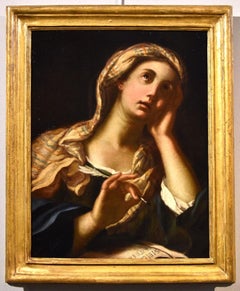
Portrait Sibyl Lady Zanotti Paint Oil on canvas Old master 18th Century Italian
Located in Riva del Garda, IT
Portrait of an Eritrean Sibyl who writes the prophecy Circle of Lorenzo Pasinelli (Bologna 1629 - 1700) - Attributable to Giampietro Cavazzoni Zanotti ...
Category

Old Masters 18th Century Paintings

Materials

Oil

Very Fine 18th Century Italian Oil Painting Nude Figures in Classical Landscape
Located in Cirencester, Gloucestershire
Classical Figures in Ancient Landscape Italian School, 18th century oil on panel, painting: 9 x 12 inches provenance: private collection, Paris condition: very good and sound condition
Category

Baroque 18th Century Paintings

Materials

Oil

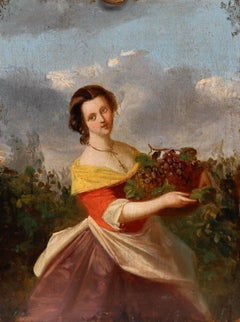
18th Century Oil - Grape Gatherer
Located in Corsham, GB
A charming oil study depicting a woman gathering grape vines in a field. Part of a pair of oils depicting women harvesting. Unsigned. On panel.
Category

18th Century Paintings

Materials

Oil

Guido Reni follower - 18/19th century figure painting - Virgin Child
By Guido Reni
Located in Varmo, IT
Guido Reni (Bologna 1575 - Bologna 1642), follower of - Madonna and Child. 91.5 x 108 cm unframed, 134.5 x 150.5 cm with frame. Ancient oil painting on canvas, in a 19th-century ca...
Category

Baroque 18th Century Paintings

Materials

Canvas, Oil

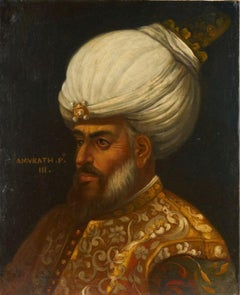
18th C Ottoman portrait of Sultan Murat, Venetian School
Located in brussel, BE
From the 16th to 19th C the production of decorative arts continued to flourish with the introduction of both rococo and baroque elements signaling an increasingly open attitude to a...
Category

18th Century Paintings

Materials

Canvas, Oil

Allegory Sculpture Trémolières Paint 18th Century Oil on canvas Old master
Located in Riva del Garda, IT
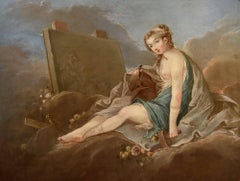
Pierre Charles Trémolières (Cholet, 1703 - Paris, 1739) Allegory of Sculpture Oil on canvas 112 x 86 cm In original lacquered frame 122 x 95 cm Work accompanied by expertise ...
Category

Old Masters 18th Century Paintings

Materials

Oil

English School 18th Century Oil - The Beast of Burden
Located in Corsham, GB
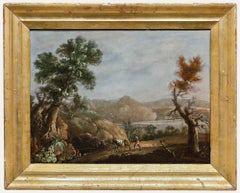
A man leads a donkey and a dog along a track in this attractive landscape scene. Well presented in a distressed gilt-effect frame. Unsigned. Framer's label to verso. On canvas on str...
Category

18th Century Paintings

Materials

Oil

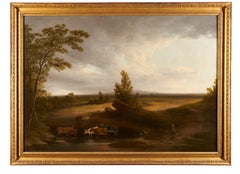
Cattle watering in an open landscape
Located in Stoke, Hampshire
Joshua Shaw (Billingborough 1776-1860 New Jersey) An open landscape with cattle watering signed and dated 'J. Shaw. 1810' lower right Oil on canvas Canvas Size 36 x 51 in Framed Siz...
Category

Old Masters 18th Century Paintings

Materials

Oil

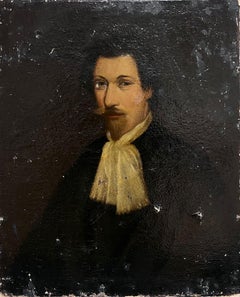
18th Century French Portrait of Mysterious Man Oil on Canvas for restoration
Located in Cirencester, Gloucestershire
Portrait of a Gentleman French School, 18th century oil on canvas, unframed canvas : 25 x 20 inches provenance: private collection, France condition: the painting is in sound conditi...
Category

Old Masters 18th Century Paintings

Materials

Oil

18th Century Oil on Canvas Italian Painting Landscape Characters and Ruins, 1750
Located in Vicoforte, IT
Antique Italian painting from 18th century. Framework oil on canvas, on the first canvas, depicting a view with characters, animals and ruins of good pictorial quality. Large size fr...
Category

18th Century Paintings

Materials

Canvas, Oil

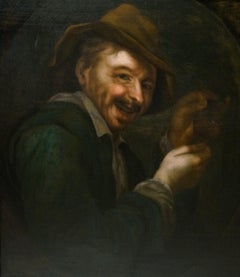
Antique oil paining, A laughing man with an upturned glass, Dutch golden age
Located in DEVENTER, NL
Anonymous, 18th century Inspired by a painting by Petrus Staverenus (1610/1612 – 1654-07-28/1664-07-28) from a series of Five Senses 'Taste: A laughing man...
Category

Old Masters 18th Century Paintings

Materials

Canvas, Oil

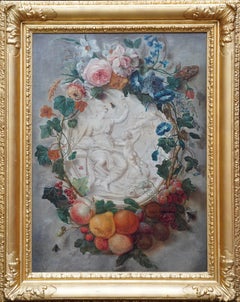
Fruit Flower Garland round Intaglio of Putti - Old Master floral oil painting
Located in Hagley, England
This superb German Old Master still life oil painting is attributed to circle of Johann Amandus Winck and also shows the influences of the Dutch Old Masters. Painted circa 1780 the p...
Category

Old Masters 18th Century Paintings

Materials

Oil

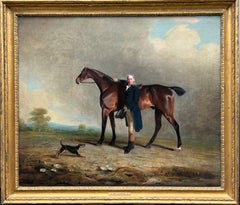
The Right Honourable Peniston Lamb, 1st Viscount Melbourne with Horse and Dog
Located in London, GB
Benjamin Marshall The Right Honourable Peniston Lamb, 1st Viscount Melbourne with Horse and Dog 1768-1835 Oil on canvas Image size: 33 x 39 1/4 inches Gilt frame Unsigned Provena...
Category

18th Century Paintings

Materials

Canvas, Oil

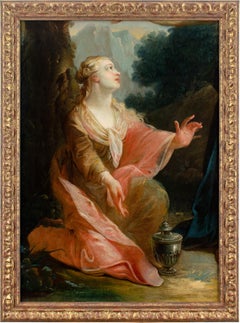
Late 18thC Venetian School Mary Magdalene Noli Me Tangere Oil Painting
Located in Cheltenham, GB
US buyers pay no import tariffs on this item. This late 18th-century Italian oil painting fragment depicts Mary Magdalene kneeling alongside an alabaster jar. Christ’s hand is parti...
Category

Italian School 18th Century Paintings

Materials

Canvas, Oil

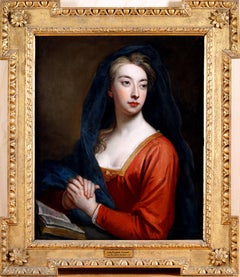
Portrait of Lady Elizabeth Cromwell as The Magdalen with a Prayer Book
Located in Taunton, GB
Portrait of Lady Elizabeth Southwell (neé Cromwell), as the Magdalene, half-length wearing a red dress with black veil, a prayer book by her side Oil on canvas, circa 1705 In a ca...
Category

18th Century Paintings

Materials

Oil

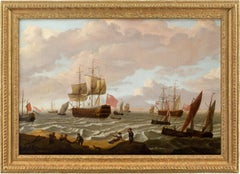
Mid-18thC English School Marine Oil Painting With Two British Men-o’-War Ships
Located in Cheltenham, GB
US buyers pay no import tariffs on this item. This splendid mid-18th-century oil painting depicts a marine scene with numerous British and Dutch vessels, including two impressive ‘Men-O’-War’. It’s comparable to the oeuvre of Anglo-French painter, Dominic Serres RA (c.1722-1793). The rich British tradition of marine painting is representative of Britain’s naval power during the 18th century. Such was the dominance of Britain’s navy that paintings such as this were in high demand by patrons, particularly by the landed gentry. These drama-filled ensembles were influenced by the earlier Dutch painters such as Ludolf Backhuysen...
Category

English School 18th Century Paintings

Materials

Oil, Canvas

Sir Charles Frederick
Located in London, GB
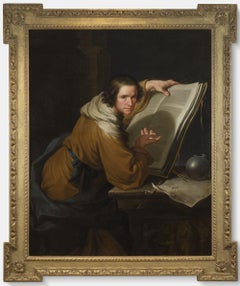
Oil on canvas 50 x 40 inches; 127 x 101.6 cm Framed dimensions: 151.5 x 127 cm Inscribed on plinth: ‘VOTIS X ET XX’ Not signed Painted c.1748 Collections: Christie’s London, 23rd December 1954, lot.272; J. Singer; Somerville Simpson Ltd, London, by 1985; The Matthiesen Gallery, London; Richard Feigen, New York; Matthew Rutenberg, New York to 2019; Lowell Libson and Jonny Yarker Ltd. Literature: Stella Rudolph, La Pittura del’ 700 a Roma, Milan, 1983, reproduced pl.133; Jacob Simon, Handel, a celebration of his life and times 1685-1759, exh. cat. London, (National Portrait Gallery), 1985, no.196; Catherine Whistler, Baroque Later Paintings in the Ashmolean Museum, London, 2016, pp.102-105, reproduced p.104 Exhibited: London, National Portrait Gallery, Handel, a celebration of his life and times 1685-1759, 1985-86, no.196, reproduced p.198 This powerful portrait of the antiquarian and courtier Sir Charles Frederick was completed in 1748 by the Roman painter Andrea Casali. Frederick, as comptroller of the royal laboratory, one of the ‘great officers’ of the Board of Ordinance at Woolwich, had just been responsible for the famed pyrotechnic display celebrating the Peace of Aix-la-Chapelle: the so-called ‘Royal Fireworks’ for which George Frederick Handel composed music. Casali’s portrait pays tribute to Frederick’s role as comptroller of the royal laboratory, showing him with a firing diagram and mortar, it also points to Frederick’s interests as an antiquarian with the inclusion of antique relief. Casali had first met Frederick in Rome in 1738, where he had painted his portrait, Frederick subsequently encouraged Casali to travel to London. This probably accounts for the unusual format; rather than a modern man of science, Casali casts Frederick as an alchemist bent on some mystic discovery, as such, it is one of the most unusual portraits of the period. Andrea Casali was a pupil of Sebastiano Conca and then of Francesco Trevisani, who recommended him to the Spanish court in 1736. He enjoyed some success in Rome as a painter of frescoes and altarpieces, notably a large cycle of Scenes from the Life of St Dominic at the cloister of S. Sisto Vecchio, for which he was made a Knight of the Golden Spur in 1729. Casali began painting Grand Tourist portraits in Rome around 1738. His first portrait of Sir Charles Frederick is dated that year Ashmolean Museum, Oxford), it casts Frederick as a focused scholar, showing him seated at an elaborately carved console table, hard at work. In common with other Grand Tour portraiture of the period, Casali includes a famous Roman landmark in the background, in this case the façade of the Pantheon. Horace Walpole noted that it was thanks to the encouragement of ‘Mr Frederick and his Friends at Rome’ that Casali travelled to London in 1741. Charles Frederick was a fascinating Augustan polymath. Born at Fort St George, Madras, where his father, Sir Thomas Frederick, was governor, he successively matriculated at New College, Oxford (1725), was called to the Middle Temple (1728), became a Fellow of the Royal Society (1731) and Director of the Society of Antiquaries (1735). His interests were wide ranging. Frederick was an amateur architect, he designed the monument to Lucy, Lady Lyttleton, in Hagley Church and the monument to Thomas Miller, bishop of Waterford, in Highclere church, Hampshire. He was a numismatist and collector of antiquities, as well as an amateur scientist. It was in the last capacity that he was appointed comptroller of the royal laboratory at Woolwich and clerk of the deliveries in 1746, this was the most junior of the ‘great officers’ who made up the membership of the royal Board of Ordnance. This appointment came through the good offices of the master-general of the Ordnance, a fellow antiquarian, John, 2nd Duke of Montagu. As comptroller, Frederick was responsible for the fireworks celebration of the treaty of Aix-la-Chapelle, for which Handel composed his celebrated music. As Horace Walpole wrote to his cousin, Henry Seymour Conway: ‘Charles Frederick has turned all his virtu into fireworks, and, by his influence with the Ordnance has prepared such a spectacle for the proclamation of Peace as is to surpass all its predecessors of bouncing memory. It is to open with a concert of fifteen hundred hands, and conclude with so many thousand crackers all set to music, that all the men killed in the war are to be wakened with a crash, as if it was the day of judgement, and fall a-dancing, like the troops in the Rehearsal. I wish you could see him making squibs of his papillotes, and bronzed over with a patina of gunpowder, and talking himself still hoarser on the superiority that his fireworks will have over the Roman naumachia.’ Performed in Green Park, the fireworks were mounted on a temporary structure designed by the architect Giovanni Niccolò Servandoni decorated by Adrea Soldi and Casali. Casali’s second portrait of Frederick was completed following the success of the firework display. In this remarkable image, we discover Frederick at work, dressed in almost monastic garb, pouring over an impossibly large tome propped on an antique altar. The altar is identifiable as a Roman relief depicting Victory writing on a shield, the original is at Villa Medici in Rome, but was engraved by Pietro Santi Bartoli...
Category

Old Masters 18th Century Paintings

Materials

Canvas, Oil

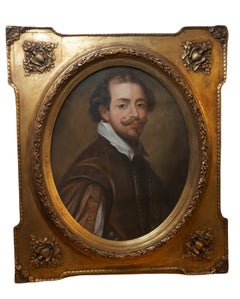
Portrait of a well-to-do gentleman
Located in DEVENTER, NL
Portrait of a well-to-do gentleman in pastel on parchment. Signed left: Marteau L. 1760. French School, possibly by Louis Marteau (1715 – 1804) In a gilded 19th century frame. Dimen...
Category

18th Century Paintings

Materials

Pastel, Parchment Paper

Presumed Portrait of Jean-Jacques-Blaise Baloin de Belvèse, Baron de Vennac
Located in BELEYMAS, FR
Marianne Loir (Paris 1705 – Paris 1783) Presumed Portrait of Jean-Jacques-Blaise Baloin de Belvèse, Baron de Vennac (?-1781) Oil on oval canvas H. 54.5 cm; W. 46 cm Unsigned Grandda...
Category

French School 18th Century Paintings

Materials

Canvas, Oil

Court Portrait Of Anne Of Cleves (1515-1557), Queen Of England, 18th Century
Located in Blackwater, GB
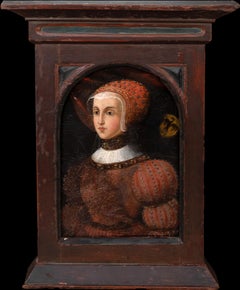
Court Portrait Of Anne Of Cleves (1515-1557), Queen Of England, 18th Century English School - Oil On Oak Panel Antique court portrait of Anne of Cleves, Queen of England, oil on pa...
Category

18th Century Paintings

Materials

Oil, Wood Panel

Mid-18th-Century German School, Portrait Of An Aristocrat In Armour, Oil
Located in Cheltenham, GB
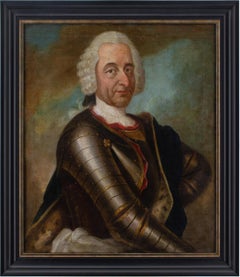
This mid-18th-century half-length German portrait depicts a middle-aged aristocrat wearing armour and a wig. Despite his heavily-clad appearance, it’s likely that this rather noncha...
Category

Old Masters 18th Century Paintings

Materials

Oil, Canvas

Giuseppe Zais (Venetian master) - 18th century landscape painting - Khnigts
By Giuseppe Zais (Canale d Agordo, Belluno 1709 - Treviso 1781)
Located in Varmo, IT
Giuseppe Zais (Forno di Canale 1709 - Treviso 1784) - Landscape with Resting Horsemen. 37.5 x 97.5 cm unframed, 45.5 x 104.5 cm with frame. Oil on canvas, in a carved and gilded wo...
Category

Rococo 18th Century Paintings

Materials

Canvas, Oil

Portrait of a Gentleman with his Dog - Possibly Abraham Tucker. Oil on Canvas
Located in St. Albans, GB
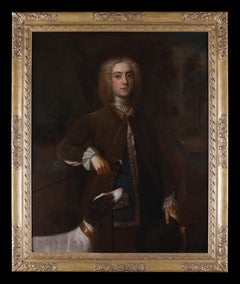
Enoch Seeman - 1894 - 1744 An excellent example of Seeman's work. It is typically unsigned as was the case of many portraits of that time. A three quarter length portrait showing a r...
Category

Old Masters 18th Century Paintings

Materials

Oil

18th Century Oil - Bust of A Man in Red Cap
Located in Corsham, GB
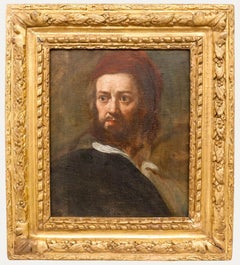
A striking portrait featuring a figure in 17th-century dress. He sports a red cap and dark clothing against a shadowy background, masterfully capturing the subject's intense gaze and...
Category

18th Century Paintings

Materials

Oil

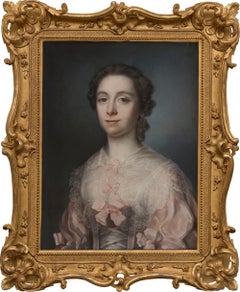
A Pair of Portraits
Located in London, GB
Pastel on paper stretched on canvas Each 23 ¼ x 19 ¾ inches; 59 x 50 cm Framed dimensions, each: 83 x 67.5 cm Both signed ‘F. Cotes Px 1751’ Collections: Captain Penton; Christie’...
Category

Old Masters 18th Century Paintings

Materials

Canvas, Paper, Pastel

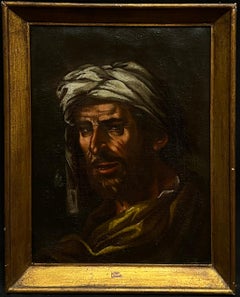
18th Century French Orientalist Portrait of Arab Man in Turban, oil painting
Located in Cirencester, Gloucestershire
Portrait of Arab Man in Turban French artist, 18th century oil on canvas, framed Framed: 21 x 16.5 inches Canvas : 18.5 x 14 inches Provenance: private collection, France Condition: ...
Category

Old Masters 18th Century Paintings

Materials

Oil, Canvas

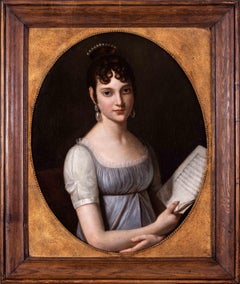
Old Master portrait of a lady musician by the master or portraiture
Located in Petworth, West Sussex
Attributed to Pierre Paul Prud’hon (French, 1758-1823) 'La belle musicienne' Oil on canvas, oval Signed ‘P. P. Prudon’ (lower left) 28.3/4 x 23.1/2 in. (73 x 59.5 cm.) Pierre Paul Prud'hon is considered a prime example of early French Romanticism. He was born as the seventh and last child of a master tailor. At the age of 16 he was a pupil of the painter and sculptor Francois Devosge. After finishing his studies he moved to Paris, where he first worked for an engraver and became friends with the Baron of Joursanvault, who became his patron. He also made a friendship with the "incorruptible", the politician and revolutionary Maximilien de Robespierre. Despite important friendships and the care of some cardinals, Prud'hon plunges into loneliness and melancholy. He has a good reputation and produces allegorical paintings, but his attachment to Robespierre forces him to leave the French capital. He now lives in the Free County of Burgundy, where he makes portraits and illustrations for Pierre Didot, the owner of the printing house. After a few years he moved back to Paris and his career received a new impetus. In the Louvre, Prud'hon is provided with a studio in which he paints "La sagesse et la vérité descendant sur la terre" (Wisdom and Truth descend to earth) for one year, as well as some ceilings of the Louvre. The government assigns him a studio in the Sorbonne, where his wife Jeanne, whom he married at the age of 19, comes looking for him. To escape her, he asks the museum director for protection. In 1808 he wrote "La justice et la vengeance divine poursuivant le crime" (Justice and divine revenge pursue the crime). In the same year he is also named Knight of the Legion of Honour and is able to break with his grumpy wife once and for all. He soon reconnects with his student and painter of neoclassicism Constance Mayer. Pierre is commissioned to paint a portrait of the Empress and wife of Napoleon, Joséphine de Beauharnais, which can still be seen today in the Louvre. He also paints the small "Roi de Rome" (King of Rome). In 1816 the Academy of Fine Arts elected him a member, where he took over the armchair in the painting section of François-André Vincent. A few years later his depressed wife commits suicide, and full of pain Prud'hon finishes her last work "Une famille malheureuse" (Engl. An Unhappy Family) and exhibits it. He himself dies soon afterwards and is buried in Paris. Many renowned artists admire Prud'hon for his "clair-obscur", the chiaroscuro painting...
Category

Old Masters 18th Century Paintings

Materials

Canvas, Oil

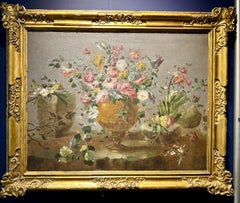
18th century Venetian Still life of flowers, classical vase on a marble ledge
Located in Woodbury, CT
The Pseudo-Guardi was an unidentified Venetian painter from the 18th or early 19th century who closely imitated the style of Francesco Guardi (1712–1793), one of the great Venetian v...
Category

18th Century Paintings

Materials

Canvas, Oil

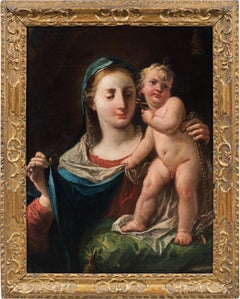
Gaspare Diziani (Venetian Rococò) - 18th century figure painting - Virgin Child
Located in Varmo, IT
Gaspare Diziani (Belluno 1689 – Venice 1767) - Madonna and Child. 74 x 58 cm unframed, 88.5 x 69.5 cm with frame. Ancient oil painting on canvas, in a carved and gilded wooden fram...
Category

Rococo 18th Century Paintings

Materials

Canvas, Oil

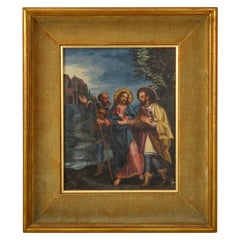
18th Century Italian Old Master Tempera on Panel Painting "Jesus Road to Emmaus"
Located in Portland, OR
An important 18th century Italian Old Master tempera on copper panel Baroque painting, "The Road to Emmaus", circa 1700. The painting represents the early resurrection biblical story...
Category

Baroque 18th Century Paintings

Materials

Copper

18th Century Oil on Canvas Italian Biblical Painting, 1720
Located in Vicoforte, IT
Magnificent Italian painting from the first half of the 18th century. This oil on canvas artwork depicts the biblical episode of Moses driving the shepherds from the well of Midian. ...
Category

18th Century Paintings

Materials

Canvas, Oil

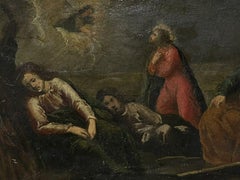
French Old Master The Garden of Gethsemane Unusual Shape Panel
Located in Cirencester, Gloucestershire
Artist/ School: French School, 18th century Title: The Garden of Gethsemane Medium: oil painting on wooden panel, unframed. painting: measurem...
Category

Old Masters 18th Century Paintings

Materials

Oil

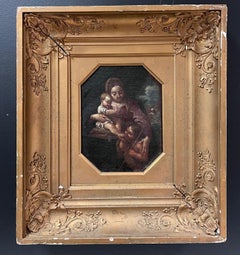
The Madonna with Christ Child St. John Fine 18th Century Italian Old Master
Located in Cirencester, Gloucestershire
The Madonna, Christ Child and St. John Italian School, 18th century oil on wood, framed in period gilt antique frame framed: 16 x 14.5 inches wood: 9 x 6.5 inches provenance: private...
Category

Old Masters 18th Century Paintings

Materials

Oil

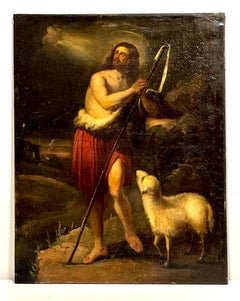
Escuela española (XVIII) - Óleo sobre tela - San Juan Bautista
Located in Sant Celoni, ES
Escuela Española siglo XVIII Se trata de un óleo sobre tela representando a San Juan Bautista Se presenta sin enmarcar la obra Medidas: 104 x 83 cm. El estado se puede ver, pres...
Category

Old Masters 18th Century Paintings

Materials

Oil

Portrait of a Lady with a Shepherd s Crook
By Joseph Wright of Derby
Located in London, GB
Joseph Wright of Derby Portrait of a Lady with a Shepherd's Crook 1734-1797 Oil on canvas, unsigned Image size: 30 x 25 inches (76 x 63.5 cm) Original carved gilt frame Provenance T...
Category

18th Century Paintings

Materials

Canvas, Oil

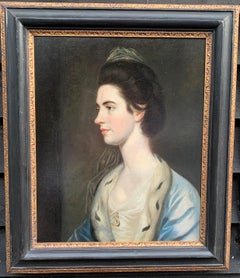
!8th century Irish or English portrait of a woman with Ermin, blue dressing lace
Located in Woodbury, CT
Wonderful 18th century Irish or English portrait, attributed to the Irish painter Nathaniel Hone. Nathaniel Hone was born in Dublin but by 1748 had set...
Category

Old Masters 18th Century Paintings

Materials

Oil

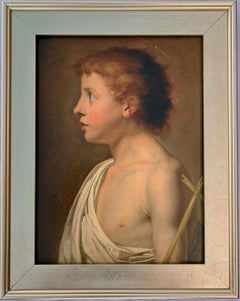
18th Century European Portrait of Saint John the Baptist as a Child.
Located in SANTA FE, NM
18th Century European Portrait of a Child Saint John the Baptist Oil on Canvas 19 x 14 1/4 inches This lovely and sensitively painting has been examined by a professional restorer w...
Category

Old Masters 18th Century Paintings

Materials

Canvas, Oil

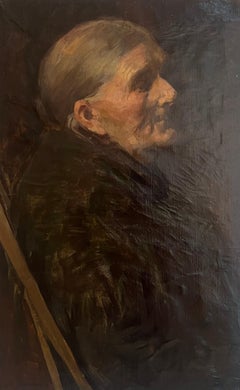
Portrait of old woman
Located in Genève, GE
Work on canvas
Category

18th Century Paintings

Materials

Oil

Read More