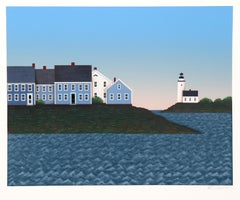
1980s Landscape Prints
to
429
290
198
557
194
77
Overall Width
to
Overall Height
to
309
229
99
94
93
89
56
28
9
6
2
28
24
23
21
18
1,012
2,154
9,963
4,023
116
114
698
512
594
1,140
1,461
1,652
1,316
629
659
746
549
16
369
223
169
165
161
154
134
96
83
81
68
67
64
61
59
50
47
46
46
43
670
290
175
127
75
107
590
945
359
Period: 1980s
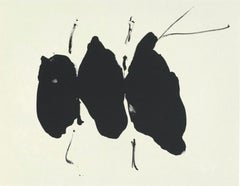
Mexican Elegy (Belknap 354-380; Engberg/Banach 415-441), Three Poems
Located in Southampton, NY
Lithograph on Japon à la main, attached with chine appliqué to vélin d’Arches paper. Paper Size: 21.5 x 17.875 inches. Inscription: Unsigned and unnumbered, as issued. Notes: From th...
Category
Abstract Expressionist 1980s Landscape Prints
Materials
Lithograph

$7,996 Sale Price
20% Off
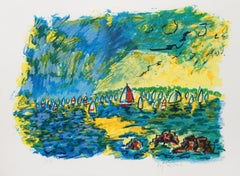
Upwind, Impressionist Lithograph by Wayne Ensrud
By Wayne Ensrud
Located in Long Island City, NY
Wayne Ensrud, American (1934 - ) - Upwind, Year: 1980, Medium: Lithograph, signed and numbered in pencil, Edition: 300, AP 45, Image Size: 19 X 26.5 inches, Size: 22 in. x 30 in...
Category
Impressionist 1980s Landscape Prints
Materials
Lithograph
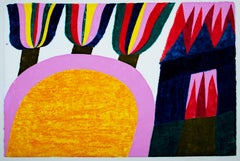
"Ravanna
s Palace Burning, " Woodcut Landscape signed by Carol Summers
Located in Milwaukee, WI
"Ravanna's Palace Burning" is a woodcut signed by Carol Summers. The image combines landscape and architecture, which is typical of the works Summers produced during the 1980s and '90s. In the image, a dark building stands burning, bright red flames licking from the windows and rooftop. It stands beside an orange field framed in pink, probably representing a plaza. Beyond the plaza are multicolored trees, their branches reaching upward like the flames on the building. The playfulness of the image is enhanced by Summers' signature printmaking technique, which allows the ink from the woodblock to seep through the paper, blurring the edges of each form.
Art: 24.5 x 37.25 in
Frame: 30 x 42.75 in
Numbered 53 of the edition of 125
Carol Summers (1925-2016) has worked as an artist throughout the second half of the 20th century and into the first years of the next, outliving most of his mid-century modernist peers. Initially trained as a painter, Summers was drawn to color woodcuts around 1950 and it became his specialty thereafter. Over the years he has developed a process and style that is both innovative and readily recognizable. His art is known for it’s large scale, saturated fields of bold color, semi-abstract treatment of landscapes from around the world and a luminescent quality achieved through a printmaking process he invented.
In a career that has extended over half a century, Summers has hand-pulled approximately 245 woodcuts in editions that have typically run from 25 to 100 in number. His talent was both inherited and learned. Born in 1925 in Kingston, a small town in upstate New York, Summers was raised in nearby Woodstock with his older sister, Mary. His parents were both artists who had met in art school in St. Louis. During the Great Depression, when Carol was growing up, his father supported the family as a medical illustrator until he could return to painting. His mother was a watercolorist and also quite knowledgeable about the different kinds of papers used for various kinds of painting. Many years later, Summers would paint or print on thinly textured paper originally collected by his mother.
From 1948 to 1951, Carol Summers trained in the classical fine and studio arts at Bard College and at the Art Students League of New York. He studied painting with Steven Hirsh and printmaking with Louis Schanker. He admired the shapes and colors favored by early modernists Paul Klee (Sw: 1879-1940) and Matt Phillips (Am: b.1927- ). After graduating, Summers quit working as a part-time carpenter and cabinetmaker (which had supported his schooling and living expenses) to focus fulltime on art. That same year, an early abstract, Bridge No. 1 was selected for a Purchase Prize in a competition sponsored by the Brooklyn Museum.
In 1952, his work (Cathedral, Construction and Icarus) was shown the first time at the Museum of Modern Art in New York City in an exhibition of American woodcuts. In 1954, Summers received a grant from the Italian government to study for a year in Italy. Woodcuts completed soon after his arrival there were almost all editions of only 8 to 25 prints, small in size, architectural in content and black and white in color. The most well-known are Siennese Landscape and Little Landscape, which depicted the area near where he resided. Summers extended this trip three more years, a decision which would have significant impact on choices of subject matter and color in the coming decade.
After returning from Europe, Summers’ images continued to feature historical landmarks and events from Italy as well as from France, Spain and Greece. However, as evidenced in Aetna’s Dream, Worldwind and Arch of Triumph, a new look prevailed. These woodcuts were larger in size and in color. Some incorporated metal leaf in the creation of a collage and Summers even experimented with silkscreening. Editions were now between 20 and 50 prints in number. Most importantly, Summers employed his rubbing technique for the first time in the creation of Fantastic Garden in late 1957.
Dark Vision of Xerxes, a benchmark for Summers, was the first woodcut where Summers experimented using mineral spirits as part of his printmaking process. A Fulbright Grant as well as Fellowships from the Louis Comfort Tiffany Foundation and the Guggenheim Foundation followed soon thereafter, as did faculty positions at colleges and universities primarily in New York and Pennsylvania. During this period he married a dancer named Elaine Smithers with whom he had one son, Kyle. Around this same time, along with fellow artist Leonard Baskin, Summers pioneered what is now referred to as the “monumental” woodcut. This term was coined in the early 1960s to denote woodcuts that were dramatically bigger than those previously created in earlier years, ones that were limited in size mostly by the size of small hand-presses. While Baskin chose figurative subject matter, serious in nature and rendered with thick, striated lines, Summers rendered much less somber images preferring to emphasize shape and color; his subject matter approached abstraction but was always firmly rooted in the landscape.
In addition to working in this new, larger scale, Summers simultaneously refined a printmaking process which would eventually be called the “Carol Summers Method” or the “ Carol Summers Technique”. Summers produces his woodcuts by hand, usually from one or more blocks of quarter-inch pine, using oil-based printing inks and porous mulberry papers. His woodcuts reveal a sensitivity to wood especially its absorptive qualities and the subtleties of the grain. In several of his woodcuts throughout his career he has used the undulating, grainy patterns of a large wood plank to portray a flowing river or tumbling waterfall. The best examples of this are Dream, done in 1965 and the later Flash Flood Escalante, in 2003. In the majority of his woodcuts, Summers makes the blocks slightly larger than the paper so the image and color will bleed off the edge.
Before printing, he centers a dry sheet of paper over the top of the cut wood block or blocks, securing it with giant clips. Then he rolls the ink directly on the front of the sheet of paper and pressing down onto the dry wood block or reassembled group of blocks. Summers is technically very proficient; the inks are thoroughly saturated onto the surface of the paper but they do not run into each other. The precision of the color inking in Constantine’s Dream in 1969 and Rainbow Glacier in 1970 has been referred to in various studio handbooks. Summers refers to his own printing technique as “rubbing”. In traditional woodcut printing, including the Japanese method, the ink is applied directly onto the block. However, by following his own method, Summers has avoided the mirror-reversed image of a conventional print and it has given him the control over the precise amount of ink that he wants on the paper. After the ink is applied to the front of the paper, Summers sprays it with mineral spirits, which act as a thinning agent. The absorptive fibers of the paper draw the thinned ink away from the surface softening the shapes and diffusing and muting the colors. This produces a unique glow that is a hallmark of the Summers printmaking technique. Unlike the works of other color field artists or modernists of the time, this new technique made Summers’ extreme simplification and flat color areas anything but hard-edged or coldly impersonal.
By the 1960s, Summers had developed a personal way of coloring and printing and was not afraid of hard work, doing the cutting, inking and pulling himself. In 1964, at the age of 38, Summers’ work was exhibited for a second time at the Museum of Modern Art. This time his work was featured in a one-man show and then as one of MOMA’s two-year traveling exhibitions which toured throughout the United States. In subsequent years, Summers’ works would be exhibited and acquired for the permanent collections of multiple museums throughout the United States, Europe and Asia. Summers’ familiarity with landscapes throughout the world is firsthand. As a navigator-bombardier in the Marines in World War II, he toured the South Pacific and Asia.
Following college, travel in Europe and subsequent teaching positions, in 1972, after 47 years on the East Coast, Carol Summers moved permanently to Bonny Doon in the Santa Cruz Mountains in Northern California. There met his second wife, Joan Ward Toth, a textile artist who died in 1998; and it was here his second son, Ethan was born. During the years that followed this relocation, Summers’ choice of subject matter became more diverse although it retained the positive, mostly life-affirming quality that had existed from the beginning. Images now included moons, comets, both sunny and starry skies, hearts and flowers, all of which, in one way or another, remained tied to the landscape.
In the 1980s, from his home and studio in the Santa Cruz mountains, Summers continued to work as an artist supplementing his income by conducting classes and workshops at universities in California and Oregon as well as throughout the Mid and Southwest. He also traveled extensively during this period hiking and camping, often for weeks at a time, throughout the western United States and Canada. Throughout the decade it was not unusual for Summers to backpack alone or with a fellow artist into mountains or back country for six weeks or more at a time. Not surprisingly, the artwork created during this period rarely departed from images of the land, sea and sky. Summers rendered these landscapes in a more representational style than before, however he always kept them somewhat abstract by mixing geometric shapes with organic shapes, irregular in outline. Some of his most critically acknowledged work was created during this period including First Rain, 1985 and The Rolling Sea, 1989. Summers received an honorary doctorate from his alma mater, Bard College in 1979 and was selected by the United States Information Agency to spend a year conducting painting and printmaking workshops at universities throughout India. Since that original sabbatical, he has returned every year, spending four to eight weeks traveling throughout that country.
In the 1990s, interspersed with these journeys to India have been additional treks to the back roads and high country areas of Mexico, Central America, Nepal, China and Japan. Travel to these exotic and faraway places had a profound influence on Summers’ art. Subject matter became more worldly and nonwestern as with From Humla to Dolpo, 1991 or A Former Life of Budha, 1996, for example. Architectural images, such as The Pillars of Hercules, 1990 or The Raja’s Aviary, 1992 became more common. Still life images made a reappearance with Jungle Bouquet in 1997. This was also a period when Summers began using odd-sized paper to further the impact of an image.
The 1996 Night, a view of the earth and horizon as it might be seen by an astronaut, is over six feet long and only slightly more than a foot-and-a-half high. From 1999, Revuelta A Vida (Spanish for “Return to Life”) is pie-shaped and covers nearly 18 cubic feet. It was also at this juncture that Summers began to experiment with a somewhat different palette although he retained his love of saturated colors. The 2003 Far Side of Time is a superb example of the new direction taken by this colorist.
At the turn of the millennium in 1999, “Carol Summers Woodcuts...
Category
Contemporary 1980s Landscape Prints
Materials
Woodcut
Willem de Kooning, Untitled, from Poems, 1988
Located in Southampton, NY
This exquisite lithograph by Willem de Kooning (1904–1997), titled Untitled, from the folio Poems, originates from the 1988 edition published by The Limited Editions Club, New York, ...
Category
Abstract Expressionist 1980s Landscape Prints
Materials
Lithograph

$7,996 Sale Price
20% Off
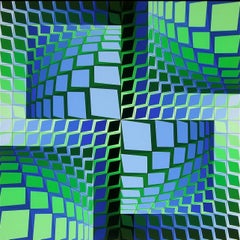
THEZ, Victor Vasarely
Located in Fairfield, CT
Artist: Victor Vasarely (1908-1997)
Title: THEZ
Year: 1982
Medium: Silkscreen on Arches paper
Edition: 248/250, plus proofs
Size: 36.5 x 30 inches
Condition: Good
Inscription: Signed...
Category
Op Art 1980s Landscape Prints
Materials
Screen
$3,200 Sale Price
20% Off
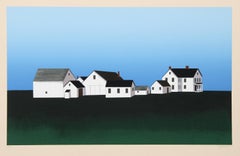
Orient Point, Folk Art Screenprint by Ted Jeremenko
Located in Long Island City, NY
Ted Jeremenko, Yugoslavian/American (1938 - ) - Orient Point. Year: circa 1985, Medium: Screenprint, signed and numbered in pencil, Edition: 175, Image Size: 21 x 34 inches, Size: 30...
Category
Folk Art 1980s Landscape Prints
Materials
Screen
Man Ray, Composition, Man Ray (after)
By Man Ray
Located in Southampton, NY
Lithograph on vélin paper. Inscription: unsigned and unnumbered, as issued. Good condition. Notes: From the folio, Man Ray, 1984. Published by Centre National des Arts Plastiques, Ni...
Category
Surrealist 1980s Landscape Prints
Materials
Lithograph
$716 Sale Price
20% Off
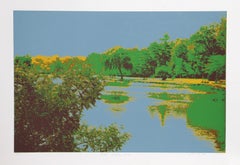
Fishing Hole, Psychedelic Screenprint by Max Epstein
By Max Epstein
Located in Long Island City, NY
Max Epstein, Canadian (1932 - 2002) - Fishing Hole, Year: 1980, Medium: Screenprint, signed and numbered in pencil, Edition: 295, Image Size: 19 x 28 inches, Size: 23 in. x 35 i...
Category
Pop Art 1980s Landscape Prints
Materials
Screen
The Departure of the Argonaut Francesco Clemente (bound book) Alberto Savinio
Located in New York, NY
The Departure of the Argonaut (1918) is the travelogue and wartime diary of Alberto Savinio, one of the seminal figures in twentieth-century Italian arts and letters. Clemente's acco...
Category
Abstract 1980s Landscape Prints
Materials
Lithograph
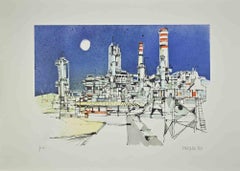
The Factory - Lithograph by Giuseppe Megna - 1980
Located in Roma, IT
The Factory is an lithograph on paper realized in 1980 by Giuseppe Megna.
Hand-signed and dated on the lower right, artist's proof.
Good conditions.
The artwork represents the a ...
Category
Contemporary 1980s Landscape Prints
Materials
Lithograph
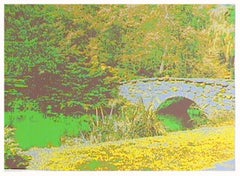
Old Stone Bridge, Psychedelic Screenprint by Max Epstein
By Max Epstein
Located in Long Island City, NY
Max Epstein, Canadian (1932 - 2002) - Old Stone Bridge, Year: 1980, Medium: Screenprint, signed and numbered in pencil, Edition: AP, Size: 30 x 44 in. (76.2 x 111.76 cm)
Category
Pop Art 1980s Landscape Prints
Materials
Screen
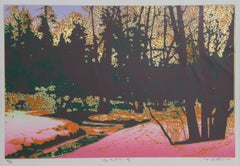
Big Foot Country, Psychedelic Screenprint by Max Epstein
By Max Epstein
Located in Long Island City, NY
Max Epstein, Canadian (1932 - 2002) - Big Foot Country, Year: 1980, Medium: Screenprint, signed and numbered in pencil, Edition: 50, Image Size: 13 x 20 inches, Size: 15 in. x 2...
Category
Pop Art 1980s Landscape Prints
Materials
Screen
Sag Harbor Antique Shop, Folk Art Lithograph by Mary Faulconer
Located in Long Island City, NY
Mary Faulconer, American (1912 - 2011) - Sag Harbor Antique Shop, Year: circa 1980, Medium: Lithograph, signed and numbered in pencil, Edition: 250, AP 35, Image Size: 12 x 15.5 ...
Category
Folk Art 1980s Landscape Prints
Materials
Lithograph
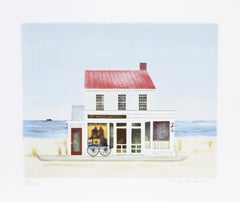
Morning View III, Modern Lithograph by Robert Kipniss
Located in Long Island City, NY
Robert Kipness was an American painter and printmaker who’s work focused on forms and a pronounced moodiness.
Morning View III
Robert Kipniss, American...
Category
American Impressionist 1980s Landscape Prints
Materials
Lithograph
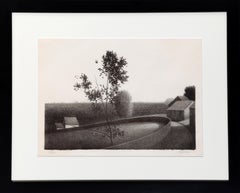
Jardins de Luxembourg, American Realist Etching with Aquatint by John McNulty
By John McNulty
Located in Long Island City, NY
John McNulty, Irish/American (1949 - ) - Jardins de Luxembourg, Year: 1984, Medium: Etching with Aquatint, signed and titled in pencil, Edition: 175, Size: 22 x 28 in. (55.88 x 7...
Category
American Realist 1980s Landscape Prints
Materials
Etching, Aquatint
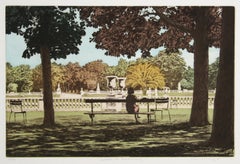
Bacchanale, Cubist Lithograph after Pablo Picasso
Located in Long Island City, NY
A lithograph from the Marina Picasso Estate Collection after the Pablo Picasso painting "Bacchanale". The original painting was completed circa 1922. In the 1970's after Picasso's d...
Category
Fauvist 1980s Landscape Prints
Materials
Lithograph
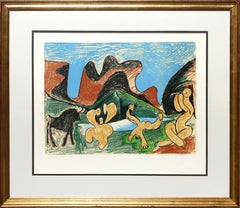
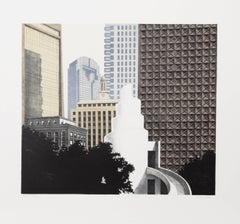
Dallas Skyline, Photorealist Aquatint Etching by Richard Haas
By Richard Haas
Located in Long Island City, NY
Artist: Richard Haas, American (1936 - )
Title: Dallas Skyline
Year: 1989
Medium: Etching with Aquatint, signed and numbered in pencil
Edition: SPI 2
Im...
Category
American Realist 1980s Landscape Prints
Materials
Etching, Aquatint
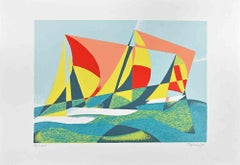
Seascape + Sails - Lithograph by Osvaldo Peruzzi - 1988
Located in Roma, IT
Seascape + Sails is an original artwork realized by Osvaldo Peruzzi in 1988 .
Mixed colored lithograph.
Hand-signed by the artist on the lower righ...
Category
Contemporary 1980s Landscape Prints
Materials
Lithograph
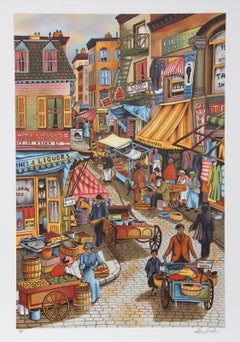
Early Days Lower East Side, Folk Art Lithograph by Ari Gradus
By Ari Gradus
Located in Long Island City, NY
Ari Gradus, Israeli (1943 - ) - Early Days Lower East Side, Year: 1980, Medium: Lithograph, Signed and Numbered in Pencil, Edition: AP, Image Size: 27 x 18 inches, Size: 30 in. ...
Category
Folk Art 1980s Landscape Prints
Materials
Lithograph
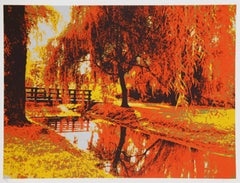
Autumn Leaves, Psychedelic Screenprint by Max Epstein
By Max Epstein
Located in Long Island City, NY
Max Epstein, Canadian (1932 - 2002) - Autumn Leaves, Year: 1980, Medium: Screenprint, Signed and Numbered in Pencil, Edition: 99, Size: 30 in. x 44 in. (76.2 cm x 111.76 cm)
Category
Pop Art 1980s Landscape Prints
Materials
Screen
Walden Pond in Winter, Folk Art Screenprint by Kay Ameche
By Kay Ameche
Located in Long Island City, NY
Kay Ameche, American (1904 - 2005) - Walden Pond in Winter, Year: 1980, Medium: Screenprint, signed and numbered in pencil, Edition: 200, AP 40, Image Size: 17 x 21 inches, Size:...
Category
Folk Art 1980s Landscape Prints
Materials
Screen
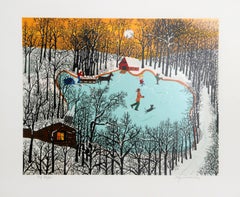
View Near Radda, Landscape Screenprint by Milton Glaser
Located in Long Island City, NY
A simplified, illustration-style landscape by American artist Milton Glaser. This print is signed and numbered in pencil by the artist.
View near Radda
Milton Glaser, American (1929...
Category
Impressionist 1980s Landscape Prints
Materials
Screen
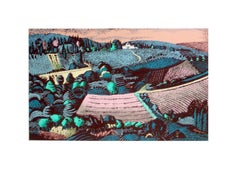
Country Balloon Fair, Folk Art Screenprint by Jack Hofflander
Located in Long Island City, NY
Jack Hofflander, American (1920 - 2003) - Country Balloon Fair, Year: 1980, Medium: Screenprint, signed and numbered in pencil, Edition: 250, AP 30, Image Size: 22 x 30 inches, S...
Category
Folk Art 1980s Landscape Prints
Materials
Screen
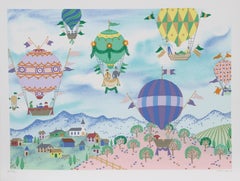
Valley Hose, Surrealist Screenprint by Charles Magistro
Located in Long Island City, NY
Artist: Charles Magistro
Title: Valley Hose
Year: 1980
Medium: Screenprint, signed and numbered in pencil
Edition: 300
Paper Size: 30 x 35 inches
Category
Surrealist 1980s Landscape Prints
Materials
Screen

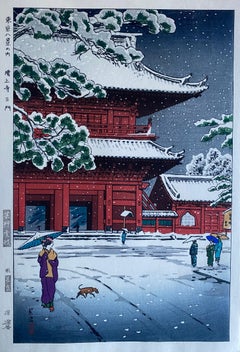
Authentic Main Gate of Zojoji Temple-Shiro Kasamatsu 笠松紫浪 1953 Publisher, Unsodo
By Shiro Kasamatsu
Located in London, GB
This is an authentic woodblock print by Shiro Kasamatsu 笠松紫浪 in 1953. It is part of his "Eight Views of Tokyo" series東京八景の内.
This is one of Shiro Kasamatsu (1898-1991)'s most iconi...
Category
Edo 1980s Landscape Prints
Materials
Ink, Handmade Paper
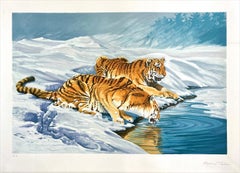
SIBERIAN TIGERS Signed Hand Drawn Lithograph Snow Landscape Big Cats Drinking
Located in Union City, NJ
SIBERIAN TIGERS by the British wildlife artist Sydney Taylor, is an original hand drawn limited edition lithograph printed using hand lithography techniques on archival Somerset paper 100% acid free. SIBERIAN TIGERS is a contemporary wildlife landscape scene depicting a pair of Siberian tigers taking a cool drink from a snow covered riverbank. Printed in shades of blue, gray, light orange, brown, and touches of black with white accents emphasizing the icy landscape. This lithograph is a handmade original print, not a commercially mass produced poster or digital reproduction, quality craftsmanship.
Year published - 1983
Edition size - 200, plus proofs
Print size - 21.5" x 29.5", unframed, excellent condition, hand signed in pencil by Sydney Taylor
The Siberian tiger (Panthera tigris...
Category
Contemporary 1980s Landscape Prints
Materials
Lithograph
Bridgetown Barbados, Oil Monotype by Romare Bearden
Located in Long Island City, NY
A unique oil print by Romare Bearden circa 1980. A bright city scene illustrated in a modern expressionist style.
Artist: Romare Bearden, American (1911 - 1988)
Title: Bridgetown, ...
Category
Expressionist 1980s Landscape Prints
Materials
Monoprint, Oil

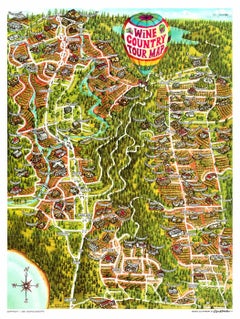
Original Wine Country Tour Map vintage California fun map, linen-backed.
Located in Spokane, WA
Original Wine Country Tour Map, archival linen backed and ready to frame. Very fine condition, Grade A-. The fold marks were restored during the backing process. No paper loss a...
Category
American Modern 1980s Landscape Prints
Materials
Offset
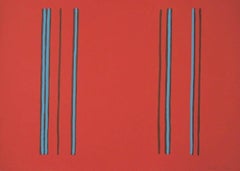
Lilac, Gene Davis
By Gene Davis
Located in Fairfield, CT
Artist: Gene Davis (1920-1985)
Title: Lilac
Year: 1980
Medium: Silkscreen on Arches paper
Edition: 247/250, plus proofs
Size: 22.5 x 28.5 inches
Condition: Good
Inscription: Signed a...
Category
Abstract Geometric 1980s Landscape Prints
Materials
Screen
$2,800 Sale Price
20% Off
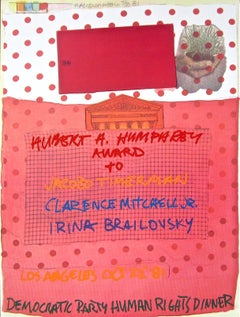
Human Rights 1981, Robert Rauschenberg
Located in Fairfield, CT
Artist: Robert Rauschenberg (1925-2008)
Title: Human Rights 1981
Year: 1981
Medium: Silkscreen and lithograph on wove paper
Edition: 41/100, plus proofs
Size: 31 x 23 inches
Conditio...
Category
Pop Art 1980s Landscape Prints
Materials
Lithograph, Screen
$5,200 Sale Price
20% Off
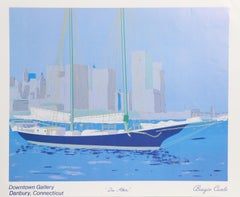
Du Alberi (two masts) Poster, Modern Poster by Biagio Civale
Located in Long Island City, NY
Biagio Civale, Italian/American (1936 - ) - Du Alberi (two masts) Poster, Medium: Poster, Signed in Pen, Size: 17.5 x 23 in. (44.45 x 58.42 cm)
Category
Modern 1980s Landscape Prints
Materials
Offset
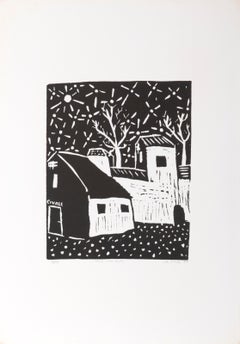
Houses in the Country, Modern Linocut by Biagio Civale
Located in Long Island City, NY
Biagio Civale, Italian/American (1936 - ) - Houses in the Country, Medium: Linocut, Signed, numbered, and titled in pencil, Edition: 13/33, Image Size: 10 x 8 inches, Size: 20 x ...
Category
Modern 1980s Landscape Prints
Materials
Linocut
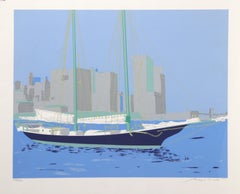
Two Masts, Modern Screenprint by Biagio Civale
Located in Long Island City, NY
Biagio Civale, Italian/American (1936 - ) - Two Masts, Year: 1984, Medium: Screenprint, Signed and Numbered in Pencil, Edition: 121/250, Size: 20 x 26 in. (50.8 x 66.04 cm)
Category
Modern 1980s Landscape Prints
Materials
Screen
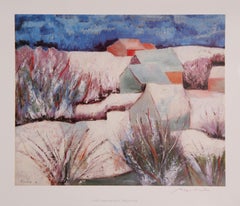
Under the Snow, Modern Screenprint by Biagio Civale
Located in Long Island City, NY
Biagio Civale, Italian/American (1936 - ) - Under the Snow, Year: 1989, Medium: Screenprint, signed in pencil, Size: 13 x 15 in. (33.02 x 38.1 cm)
Category
Modern 1980s Landscape Prints
Materials
Screen
Beach at Brighton, Folk Art Lithograph by Mary Faulconer
Located in Long Island City, NY
Mary Faulconer, American (1912 - 2011) - Beach at Brighton, Year: circa 1980, Medium: Lithograph, signed and numbered in pencil, Edition: AP 18/30, Image Size: 15.5 x 20 inches, ...
Category
Folk Art 1980s Landscape Prints
Materials
Lithograph
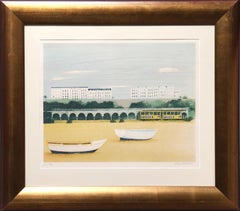
Carpenter Woods, Abstract Screenprint by Thelma Appel
By Thelma Appel
Located in Long Island City, NY
Artist: Thelma Appel, American (1940 - )
Title: Carpenter Woods
Year: 1982
Medium: Serigraph, signed and numbered in pencil
Edition: 250, AP 25
Image Size: 22 x 15 inches
Size: 29 in...
Category
Contemporary 1980s Landscape Prints
Materials
Screen
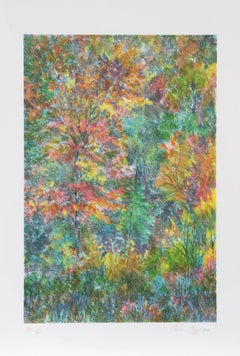
Modernist Silkscreen Screenprint
El Station, Interior
NYC Subway, WPA Artist
Located in Surfside, FL
screenprint printed in color ink on wove paper. New York City subway station interior.
Anthony Velonis (1911 – 1997) was an American painter and designer born in New York City who helped introduce the public to silkscreen printing in the early 20th century.
While employed under the federal Works Progress Administration, WPA during the Great Depression, Velonis brought the use of silkscreen printing as a fine art form, referred to as the "serigraph," into the mainstream. By his own request, he was not publicly credited for coining the term.
He experimented and mastered techniques to print on a wide variety of materials, such as glass, plastics, and metal, thereby expanding the field. In the mid to late 20th century, the silkscreen technique became popular among other artists such as Robert Rauschenberg and Andy Warhol.
Velonis was born into a relatively poor background of a Greek immigrant family and grew up in the tenements of New York City. Early on, he took creative inspiration from figures in his life such as his grandfather, an immigrant from the mountains in Greece, who was "an ecclesiastical painter, on Byzantine style." Velonis attended James Monroe High School in The Bronx, where he took on minor artistic roles such as the illustration of his high school yearbook. He eventually received a scholarship to the NYU College of Fine Arts, into which he was both surprised and ecstatic to have been admitted. Around this time he took to painting, watercolor, and sculpture, as well as various other art forms, hoping to find a niche that fit. He attended NYU until 1929, when the Great Depression started in the United States after the stock market crash.
Around the year 1932, Velonis became interested in silk screen, together with fellow artist Fritz Brosius, and decided to investigate the practice. Working in his brother's sign shop, Velonis was able to master the silkscreen process. He reminisced in an interview three decades later that doing so was "plenty of fun," and that a lot of technology can be discovered through hard work, more so if it is worked on "little by little."
Velonis was hired by Mayor LaGuardia in 1934 to promote the work of New York's city government via posters publicizing city projects. One such project required him to go on a commercial fishing trip to locations including New Bedford and Nantucket for a fortnight, where he primarily took photographs and notes, and made sketches. Afterward, for a period of roughly six months, he was occupied with creating paintings from these records. During this trip, Velonis developed true respect and affinity for the fishermen with whom he traveled, "the relatively uneducated person," in his words.
Following this, Velonis began work with the Public Works of Art Project (PWAP), an offshoot of the Civil Works Administration (CWA), where he was assigned to serve the different city departments of New York. After the formation of the federal Works Progress Administration, which hired artists and sponsored projects in the arts, he also worked in theater.
Velonis began working for the federal WPA in 1935. He kept this position until 1936 or 1938, at which point he began working in the graphic art division of the Federal Art Project, which he ultimately led. Under various elements of the WPA program, many young artists, writers and actors gained employment that helped them survive during the Depression, as well as contributing works that created an artistic legacy for the country.
When interviewed in December 1994 by the Library of Congress about his time in the WPA, Velonis reflected that he had greatly enjoyed that period, saying that he liked the "excitement" and "meeting all the other artists with different points of view." He also said in a later interview that "the contact and the dialogue with all those artists and the work that took place was just invaluable." Among the young artists he hired was Edmond Casarella, who later developed an innovative technique using layered cardboard for woodcuts.
Velonis introduced silkscreen printing to the Poster Division of the WPA. As he recalled in a 1965 interview: "I suggested that the Poster division would be a lot more productive and useful if they had an auxiliary screen printing project that worked along with them. And apparently this was very favorably received..."
As a member of the Federal Art Project, a subdivision of the WPA, Velonis later approached the Public Use of Arts Committee (PUAC) for help in "propagandizing for art in the parks, in the subways, et cetera." Since the Federal Art Project could not be "self-promoting," an outside organization was required to advertise their art more extensively. During his employment with the Federal Art Project, Velonis created nine silkscreen posters for the federal government.
Around 1937-1939 Velonis wrote a pamphlet titled "Technical Problems of the Artist: Technique of the Silkscreen Process," which was distributed to art centers run by the WPA around the country. It was considered very influential in encouraging artists to try this relatively inexpensive technique and stimulated printmaking across the country.
In 1939, Velonis founded the Creative Printmakers Group, along with three others, including Hyman Warsager. They printed both their own works and those of other artists in their facility. This was considered the most important silkscreen shop of the period.
The next year, Velonis founded the National Serigraph Society. It started out with relatively small commercial projects, such as "rather fancy" Christmas cards that were sold to many of the upscale Fifth Avenue shops...
Category
American Modern 1980s Landscape Prints
Materials
Screen
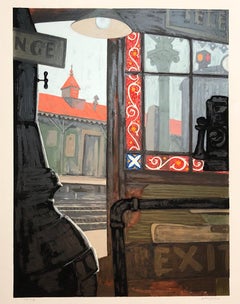
Marc Chagall, Banquet at Menelaus’s Palace, Homer, The Odyssey, 1989 (after)
By Marc Chagall
Located in Southampton, NY
This exquisite lithograph after Marc Chagall (1887–1985), titled Festessen bei Menelaus (Banquet at Menelaus’s Palace), from Homer, Die Odyssee (The Odyssey), originates from the 198...
Category
Expressionist 1980s Landscape Prints
Materials
Lithograph
$716 Sale Price
20% Off
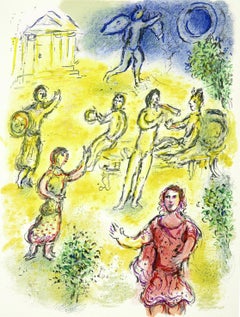
10:00 AM (Elevated Entrance-Upper Broadway), Framed Screenprint by Saul Chase
By Saul Chase
Located in Long Island City, NY
This screenprint was created by New York-born artist Saul Chase (b. 1945). The beauty of Chase's work arises out of the inherent contradiction between his subject and the rendering. ...
Category
Minimalist 1980s Landscape Prints
Materials
Screen
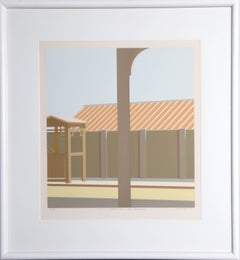
Ft. Point, San Francisco, CA, Folk Art Screenprint by Kay Ameche
By Kay Ameche
Located in Long Island City, NY
Kay Ameche, American (1904 - 2005) - Ft. Point, San Francisco, CA, Year: 1981, Medium: Screenprint, signed and numbered in pencil, Edition: 200, AP 40, Image Size: 12 x 25 in, Si...
Category
Folk Art 1980s Landscape Prints
Materials
Screen
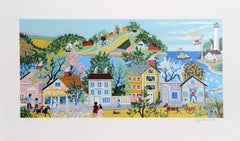
Summer Sky, limited edition lithograph, landscape, desert, turquoise, orange
By Dan Namingha
Located in Santa Fe, NM
Summer Sky, limited edition lithograph, landscape, desert, turquoise, orange
Category
Contemporary 1980s Landscape Prints
Materials
Lithograph
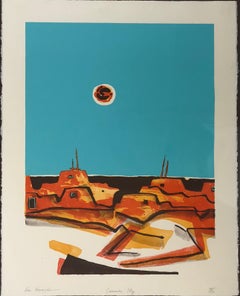
Indistinct Clear - Fluctuating ambivalence -
Located in Berlin, DE
Karl Ludwig Mordstein (1937 Füssen - 2006 Wilszhofen), Undeutlicher deutlich, 1982. Color etching, e.a. (Epreuve d'artiste) 4/9, 22.5 x 28 cm (image), 40 x 45 cm (sheet), 43 x 48 cm ...
Category
Abstract 1980s Landscape Prints
Materials
Etching
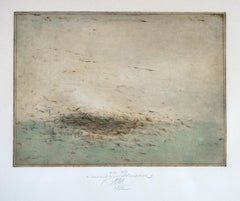
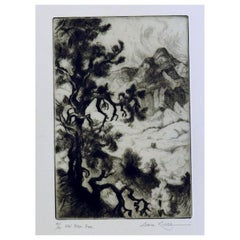
Gene Kloss Original Etching, 1981 - "Old Pinon Tree"
By Gene Kloss
Located in Phoenix, AZ
Etching & Drypoint on paper by famous Taos Artist Gene Kloss (1903-1996).
Titled: “Old Pinon Tree.” Pencil signed lower right and in excellent condition.
Image measures: 8" H x 6" W....
Category
1980s Landscape Prints
Materials
Paper
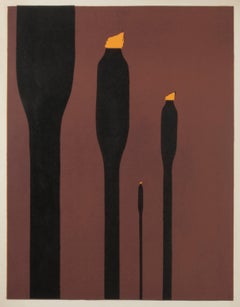
French Stacks
Located in Fairlawn, OH
French Stacks
Linocut printed in color
Unsigned
Stamped verso “Imprimerie Arnera Archives/Non Signe”
Printer: Jaime Arnera, Vallarius, France (their stamp verso)
Condition: Printed ...
Category
Abstract Expressionist 1980s Landscape Prints
Materials
Linocut
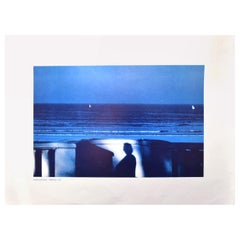
Presence - Vintage Offset Print After Franco Fontana - 1981
Located in Roma, IT
Presence is a beautiful offset realized after a photograph by Franco Fontana.
Good conditions.
Franco Fontana (Modena, 1933) is one of the Italian most famous contemporary photogra...
Category
Contemporary 1980s Landscape Prints
Materials
Offset
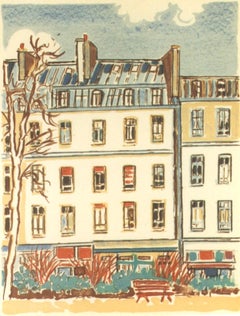
Paris, Houses and Tree - Lithograph by Orfeo Tamburi - 1980s
Located in Roma, IT
Paris, houses and tree is a beautiful artwork realized by Orfeo Tamburi during the 1980s.
Mixed colored lithograph.
Edited and printed by Graphics Arte, Livorno
Original title: Pa...
Category
Contemporary 1980s Landscape Prints
Materials
Screen
Christo and Jeanne-Claude, Surrounded Islands - Leporello, Signed Print
Located in Hamburg, DE
Christo and Jeanne-Claude
Surrounded Islands, 1980 - 83, 2009
Medium: 7-part leporello, digital pigment print (Ditone) on 260 g Hahnemühle Baryta paper
Dimensions: 32 x 175 cm (12½ x...
Category
Contemporary 1980s Landscape Prints
Materials
Digital Pigment

SAILBOATS Signed Lithograph, Abstract Seascape, Asian Boats Aqua Red Brown Green
By Peter Max
Located in Union City, NJ
SAILBOATS is an original hand drawn lithograph by the renowned American Pop artist, Peter Max, printed in 1980 in an edition of 165, using traditional hand lithography techniques on ...
Category
Pop Art 1980s Landscape Prints
Materials
Lithograph
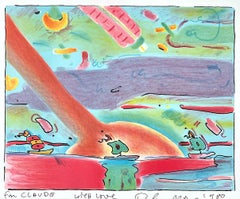
The Faucet, Surrealist Photorealist Screenprint by Doug Webb
By Doug Webb
Located in Long Island City, NY
Artist: Doug Webb, Turkish (1946 - )
Title: Faucet
Year: 1985
Medium: Screenprint, signed and numbered in pencil
Edition: AP 54/75
Size: 29.5 in. x 36 in. (74.93 cm x 91.44 cm)
Frame...
Category
Surrealist 1980s Landscape Prints
Materials
Screen
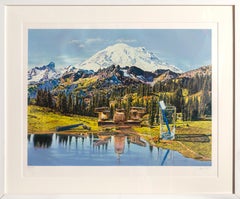
Three Lovely Kozo Inoue Pastel Prints, 1980s
By Kozo Inoue
Located in New York, NY
Kozo Inoue (Japanese, 1937-2017)
Untitled, 1980
Lithograph
Sight: 22 x 31 in. (Each)
Framed: 34 x 42 1/2 x 1 in. (Each)
Signed and dated 1980 lower right
Inscribed lower left
Kozo Inoue was a contemporary Japanese printmaker. Born in Osaka, he graduated from the Department of Art History at Keio University in 1960. During life, he worked during the winter months in the Izu Peninsula and Dordogne or Paris in the summer. He is known for his surrealistic silkscreen prints. His prints can be found in the Museum of Modern Art, Paris, Royal Library of Belgium, Modern Museum of Art Osaka and the Spencer Museum of Art, to name just a few. (Bio sourced from Ronin Gallery)
Category
Modern 1980s Landscape Prints
Materials
Lithograph
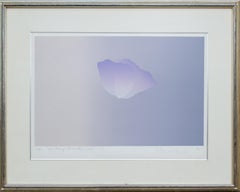
White Flowers on Pink Sky - Limited Edition Naive Serigraph
By Ivan Rabuzin
Located in Soquel, CA
White Flowers on Pink Sky - Limited Edition Naive Serigraph
Colorful serigraph by Croatian naive artist Ivan Rabuzin (b. 27 March 1921, d. 18 December 2008.) A giant white flower ri...
Category
Folk Art 1980s Landscape Prints
Materials
Paper, Ink, Screen
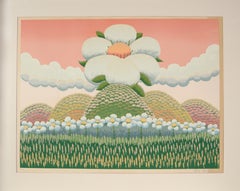
The Factory - Lithograph on Paper by Giuseppe Megna - 1980
Located in Roma, IT
The Factory is an original lithograph on paper realized in 1980 by Giuseppe Megna.
Hand-signed and dated on the lower right, numbered on the lower left in pencil, edition of xx/xxv ...
Category
Modern 1980s Landscape Prints
Materials
Lithograph
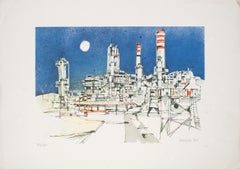
Farmhouse 3, Folk Art Screenprint by Ted Jeremenko
Located in Long Island City, NY
Ted Jeremenko, Yugoslavian/American (1938 - ) - Farmhouse 3. Year: circa 1985, Medium: Silkscreen, signed and numbered in pencil, Edition: 175, Image Size: 13 x 19 inches, Size: 19.5...
Category
Folk Art 1980s Landscape Prints
Materials
Screen
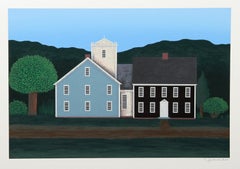
Marc Chagall, Lamentations of Odysseus, from Homer, The Odyssey, 1989 (after)
By Marc Chagall
Located in Southampton, NY
This exquisite lithograph after Marc Chagall (1887–1985), titled Wehklagen des Odysseus (Lamentations of Odysseus), from Homer, Die Odyssee (The Odyssey), originates from the 1989 Ge...
Category
Expressionist 1980s Landscape Prints
Materials
Lithograph
$716 Sale Price
20% Off
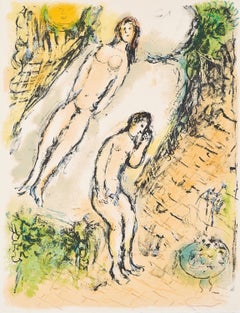
I Love New York
1981-View From my Terrace, Vintage
Located in Brooklyn, NY
David Lingwood’s "I Love New York" offers a serene, nostalgic glimpse into the iconic New York City skyline as seen from the artist’s own terrace apartment in the 1970s. Rendered wit...
Category
Contemporary 1980s Landscape Prints
Materials
Offset
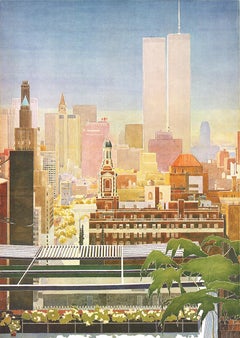
Natural Oasis - Lithograph on Silver Paper by G. Giannini - 1980
Located in Roma, IT
Natural Oasis is a very colorful artwork realized by Giuseppe Giannini in 1980.
Colored lithograph on silver paper.
The print is hand-signed and dated in pencil on the lower right....
Category
Contemporary 1980s Landscape Prints
Materials
Lithograph
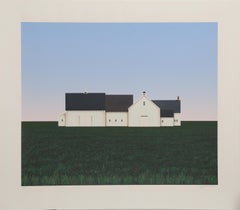
Barns, Folk Art Screenprint by Ted Jeremenko
Located in Long Island City, NY
Ted Jeremenko, Yugoslavian/American (1938 - ) - Barns. Year: circa 1985, Medium: Screenprint, signed and numbered in pencil, Edition: 175, Size: 27 x 30.5 in. (68.58 x 77.47 cm), Des...
Category
Folk Art 1980s Landscape Prints
Materials
Screen
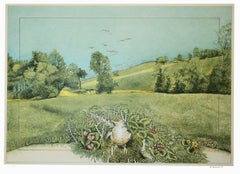
Garden - Etching by Edolo Masci - 1980s
Located in Roma, IT
Etching and aquatint realized by Edolo Masci.
Hand signed and numbered in pencil.
Edition of 90.
Excellent condition.
Category
Contemporary 1980s Landscape Prints
Materials
Etching

$119 Sale Price
50% Off
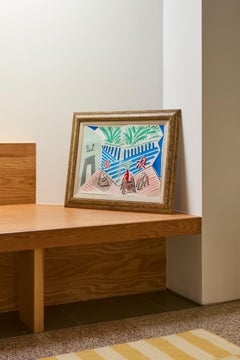
Living Room and Terrace, July 1986 -- Homemade Print by David Hockney
Located in London, GB
David Hockney
Living Room and Terrace, July 1986
Homemade print in colours executed on an office colour copy machine, On two sheets of Arches rag paper
Signed, dated and numbered 36/...
Category
1980s Landscape Prints
Materials
Other Medium
Town and Lighthouse, Folk Art Screenprint by Ted Jeremenko
Located in Long Island City, NY
Ted Jeremenko, Yugoslavian/American (1938 - ) - Town and Lighthouse. Year: circa 1989, Medium: Screenprint on Arches, signed and numbered in pencil, Edition: C ( 100 ), Image Size: 2...
Category
Folk Art 1980s Landscape Prints
Materials
Screen