20th Century Landscape Prints
to
4,833
5,095
1,774
2,001
854
333
Overall Width
to
Overall Height
to
3,515
1,086
773
669
556
426
353
343
81
57
26
15
8
5
169
156
145
101
100
1,010
2,153
10,104
3,996
116
115
718
512
594
1,137
1,469
1,669
1,369
674
657
5,394
4,508
144
4,279
2,601
1,932
1,126
1,090
1,020
881
837
765
739
701
523
480
423
356
354
333
327
321
310
5,431
2,033
907
777
611
866
2,280
7,720
2,086
Period: 20th Century
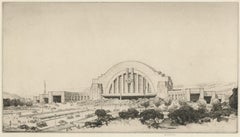
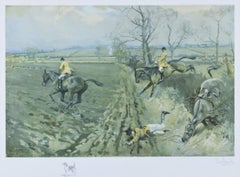
Fox hunting print by Lionel Edwards
Located in London, GB
To see our other hunting pictures, scroll down to "More from this Seller" and below it click on "See all from this Seller" and then search.
Lionel Ed...
Category
20th Century Landscape Prints
Materials
Lithograph
Pablo Picasso, Guitarist, from Oeuvres 1920-1926 (after)
Located in Southampton, NY
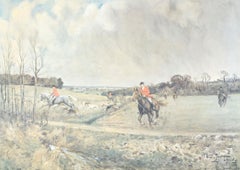
This exquisite lithograph and pochoir after Pablo Picasso (1881–1973), titled Guitariste (Guitarist), from the album, Picasso, Oeuvres 1920-1926, 1926, originates from the 1926 edition published and printed by Editions des Cahiers d'Art, Paris, under the direction of Christian Zervos, Editeur, Paris, December 10, 1926. Guitariste (Guitarist) captures Picasso’s evolving exploration of form, movement, and emotion during the mid-1920s—a pivotal period in which he redefined the relationship between classical representation and modern abstraction. With its bold contouring, stylized anatomy, and rhythmic color balance, the composition embodies the harmony between structural precision and sensual fluidity that characterized Picasso’s work in this era.
Executed as a lithograph and pochoir on velin paper, this work measures 11 x 8.75 inches. Signed in the plate and unnumbered as issued. The edition exemplifies the refined craftsmanship of Editions des Cahiers d'Art and the technical excellence of Parisian printmaking in the interwar period.
Artwork Details:
Artist: After Pablo Picasso (1881–1973)
Title: Guitariste (Guitarist), from the album, Picasso, Oeuvres 1920-1926, 1926
Medium: Lithograph and pochoir on velin paper
Dimensions: 11 x 8.75 inches (27.94 x 22.23 cm)
Inscription: Signed in the plate and unnumbered as issued
Date: 1926
Publisher: Editions des Cahiers d'Art, Paris, under the direction of Christian Zervos, Editeur, Paris
Printer: Ducros & Colas, Paris
Catalogue raisonne references: Cramer, Patrick. Pablo Picasso, The Illustrated Books: Catalogue Raisonne. Patrick Cramer, 1983, illustration 15; Bloch, Georges. Pablo Picasso: Catalogue of the Printed Graphic Work 1904–1967. Kornfeld & Klipstein, 1968, illustration 56
Condition: Well preserved, consistent with age and medium
Provenance: From the album, Picasso, Oeuvres 1920-1926, published and printed by Editions des Cahiers d'Art, Paris, under the direction of Christian Zervos, Editeur, Paris, 1926
Notes:
Excerpted from the album (translated from French), This volume was completed to be printed by the Ducros & Colas printing house, 7, rue Croulebarbe in Paris, for the Editions des Cahiers d'Art, on December 10th MCMXXVI, DCC numbered examples, VI on Japon Imperial with an etching by Picasso, numbered from I to VI, L examples on paper by papier de Hollande, Van Gelder, with an etching by Picasso, numbered from VII to LVI, DCXL examples on velin, numbered from LVII to DCC, plus II examples intended for legal deposit.
About the Publication:
The album Picasso, Oeuvres 1920-1926 was issued in 1926 by Editions des Cahiers d'Art under the direction of Christian Zervos, one of the most influential editors, critics, and publishers of 20th-century modernism. Conceived as both a visual and intellectual tribute to Pablo Picasso’s mastery during a crucial transitional period, the volume presents a series of lithographs and pochoirs that chronicle his stylistic evolution from synthetic Cubism toward a renewed engagement with the human figure. Published in conjunction with the legendary Cahiers d'Art journal, the edition reflects Zervos’s vision of uniting scholarship, craftsmanship, and artistic authenticity in the modern book arts. Each composition was executed by the master printers Ducros & Colas and colored using the pochoir technique, faithfully translating the tonal subtleties and compositional balance of Picasso’s original drawings and gouaches. Completed on December 10, 1926, the edition comprised DCC examples—VI on Japon Imperial, L on Hollande Van Gelder, and DCXL on velin paper, plus II copies reserved for legal deposit—each numbered and printed to exacting standards. The volume stands as one of the earliest major Cahiers d'Art collaborations with Picasso, preceding the monumental Catalogue Raisonne des Oeuvres de Picasso that Zervos would later dedicate his life to producing. Today, Picasso, Oeuvres 1920-1926 remains a cornerstone of interwar art publishing, representing the confluence of avant-garde innovation, technical excellence, and intellectual rigor that defined the Parisian art world of the 1920s.
About the Artist:
Pablo Picasso (1881–1973) was a Spanish painter, sculptor, printmaker, and ceramicist whose extraordinary vision revolutionized modern art and defined the visual language of the 20th century. A child prodigy from Malaga, Spain, Picasso's career spanned more than seven decades and encompassed an astonishing range of styles and innovations—from the melancholic Blue and romantic Rose periods to his pioneering invention of Cubism with Georges Braque, which shattered conventional notions of perspective and form. Influenced by the bold expressiveness of El Greco, the structure of Cezanne, and the vitality of African and Iberian sculpture, Picasso became a central figure of the Paris avant-garde, working in creative dialogue with contemporaries such as Henri Matisse, Alexander Calder, Alberto Giacometti, Salvador Dali, Joan Miro, Wassily Kandinsky, Marcel Duchamp, and Man Ray. His insatiable experimentation extended across painting, drawing, printmaking, ceramics, and sculpture, forever expanding the boundaries of artistic expression. A master of reinvention, Picasso profoundly shaped generations of artists who followed—from Andy Warhol, Roy Lichtenstein, David Hockney, and Jean-Michel Basquiat to Jeff Koons and Banksy—cementing his status as a timeless cultural icon whose works remain among the most sought after worldwide. His landmark painting Les Femmes d'Alger (Version O) achieved a record-breaking sale of 179,365,000 USD at Christie's, New York, on May 11, 2015, affirming Picasso's enduring legacy as one of the most influential and valuable artists in history.
Pablo Picasso Guitariste (Guitarist), Picasso Oeuvres 1920-1926, Picasso Zervos Cahiers d'Art, Picasso pochoir...
Category
Cubist 20th Century Landscape Prints
Materials
Lithograph, Stencil

$2,396 Sale Price
20% Off
Indistinct Clear - Fluctuating ambivalence -
Located in Berlin, DE
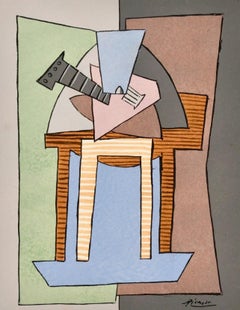
Karl Ludwig Mordstein (1937 Füssen - 2006 Wilszhofen), Undeutlicher deutlich, 1982. Color etching, e.a. (Epreuve d'artiste) 4/9, 22.5 x 28 cm (image), 40 x 45 cm (sheet), 43 x 48 cm ...
Category
Abstract 20th Century Landscape Prints
Materials
Etching
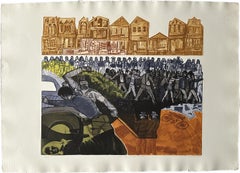
Out my garden window, 1969 Signed Limited edition etching
Located in Rochester Hills, MI
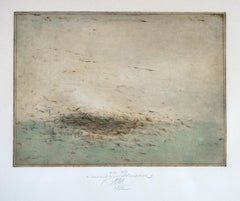
Artist: Warrington Colescott
Title Out My Garden Window
Year: 1969
Medium: Color drypoint, soft-ground etching, and aquatint, with roulette, vibrograver, à la poupée inking, found l...
Category
Post-Modern 20th Century Landscape Prints
Materials
Etching
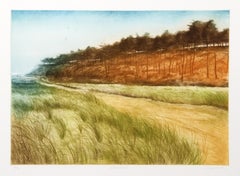
Beach Road, Landscape Etching by Harvey Kidder
Located in Long Island City, NY
Beach Road
Harvey Kidder, American (1918–2001)
Date: circa 1985
Aquatint Etching, Signed and numbered in Pencil
Edition of 150
Size: 25 x 32 in. (63.5 x 81.28 cm)
Category
American Impressionist 20th Century Landscape Prints
Materials
Etching
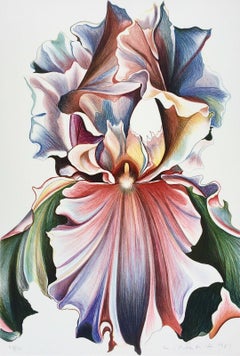
Iris, Lowell Nesbitt
Located in Fairfield, CT
Artist: Lowell Nesbitt (1933-1993)
Title: Iris
Year: 1981
Edition: 98/200, plus proofs.
Medium: Lithograph on Arches paper
Size: 36 x 24.75 inches
Condition: Good
Inscription: Signed...
Category
Pop Art 20th Century Landscape Prints
Materials
Screen
$1,276 Sale Price
20% Off
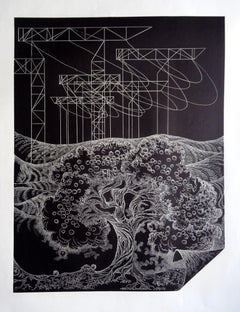
Apple tree. 1976, linocut, print size 65x50 cm; total 75x60 cm
Located in Riga, LV
Apple tree. 1976, linocut, print size 65x50 cm; total 75x60 cm
Dainis Rozkalns (1928 - 2018)
Artist, graphic artist, illustrator of folklore and fiction publications. The main dire...
Category
Abstract Geometric 20th Century Landscape Prints
Materials
Paper, Linocut
$588 Sale Price
50% Off
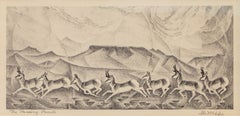
The Passing Parade, 20th Century Lithograph, Southwestern Desert with Antelope
By Ila Mae McAfee
Located in Denver, CO
This stunning original lithograph, titled The Passing Parade, is a signed piece by renowned American artist Ila Mae McAfee (1897-1995). Created in the 20th century, the artwork depic...
Category
American Modern 20th Century Landscape Prints
Materials
Lithograph
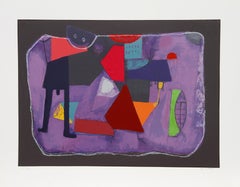
Past and Present, Abstract Geometric Lithograph by Remo Farruggio
Located in Long Island City, NY
Past and Present
Remo Farruggio, Italian/American (1904–1981)
Date: Circa 1979
Lithograph, signed and numbered in pencil
Edition of 300, AP 35
Image Size: 20.5 x 28 inches
Size: 27 i...
Category
American Modern 20th Century Landscape Prints
Materials
Lithograph
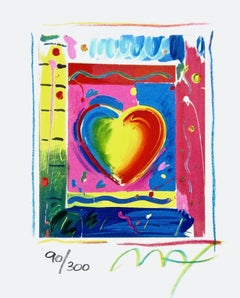
Heart Series III, Peter Max
By Peter Max
Located in Fairfield, CT
Artist: Peter Max (1937)
Title: Heart Series III
Year: 1998
Edition: 300/300, plus proofs
Medium: Lithograph on Coventry Smooth paper
Size: 5 x 4 inches
Condition: Excellent
Inscript...
Category
Pop Art 20th Century Landscape Prints
Materials
Lithograph
$763 Sale Price
20% Off
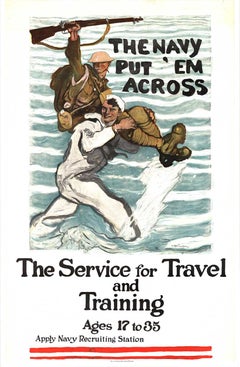
Original The Navy Put
em Across, Vintage Recruiting Poster, U.S. Navy, linen
Located in Spokane, WA
Original "The Navy Put 'Em Across": Vintage WWI Recruitment Poster by Henry Reuterdahl, 1918. Linen-backed.
An extraordinarily scarce and historically rich piece of American propag...
Category
American Modern 20th Century Landscape Prints
Materials
Lithograph
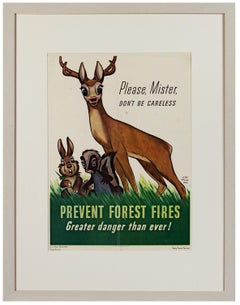
"Please, Mister, Don
t Be Careless" Vintage Poster featuring Disney Characters
Located in Milwaukee, WI
Printed in 1943, by the U.S. Government Printing Office for the U.S. Department of Agriculture Forest Service. The poster features the beloved Disney characters, Bambi (deer), Thumper (rabbit), and Flower (skunk) in wide-eyed shock leaning towards fear. With the slogan "Please, Mister, don't be careless" the poster is designed to tug at the heartstrings of the viewer and make them consider what actions they could take in their own lives to prevent forest fires.
Poster: 20" x 14 1/4"
Frame: 30" x 22 1/2"
Framed to conservation standards with a 100% cotton fiber matboard border and UV clear glass that filters 99% of UV Rays. UV Rays can be especially damaging and cause fading to the inks used in poster making. All of these features are housed in a contemporary natural wood frame.
Smokey Bear...
Category
Other Art Style 20th Century Landscape Prints
Materials
Lithograph
The Waterfall - Signed Facsimile, Ltd /450
By M.C. Escher
Located in Paris, IDF
M.C. ESCHER (1898-1972)
The Waterfall, 2008
Facsimile after the original woodcut from 1935
Signed in the plate
Numbered / 450 copies (the number you can see can be different)
On vel...
Category
Modern 20th Century Landscape Prints
Materials
Color

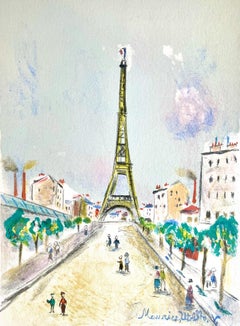
Maurice Utrillo, The Eiffel Tower, from Paris Capital, 1955
Located in Southampton, NY
This exquisite lithograph by Maurice Utrillo (1883–1955), titled La Tour Eiffel (The Eiffel Tower), from the album Paris Capitale (Paris Capital), originates from the 1955 edition pu...
Category
Modern 20th Century Landscape Prints
Materials
Lithograph, Stencil
$1,436 Sale Price
20% Off
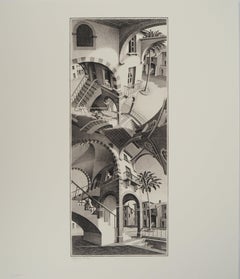
Ascendant and Descendant - Signed Facsimile, Ltd /450
By M.C. Escher
Located in Paris, IDF
M.C. ESCHER (1898-1972)
Ascendant and Descendant, 2008
Facsimile after the original woodcut from 1938
Signed in the plate
Numbered / 450 copies (the number you can see can be differ...
Category
Modern 20th Century Landscape Prints
Materials
Color
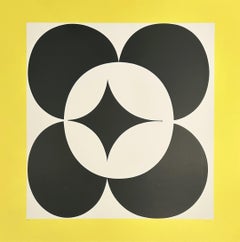
Circles in Yellow
By Yaacov Agam
Located in Washington, DC
Artist: Yaacov Agam
Title: Circles in Yellow
Medium: Screenprint in colors
Year: 1980
Edition: 154/200
Sheet Size: 30" x 28 1/2"
Image Size: 35 1/4" x 33 3/4"
Signed: Hand signed an...
Category
Abstract 20th Century Landscape Prints
Materials
Screen
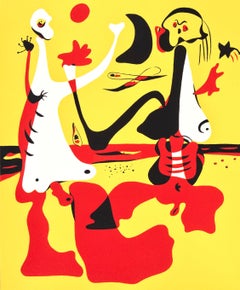
Joan Miro, Figures Before the Sea, from D
Aci i d’Alla, 1934
By Joan Miró
Located in Southampton, NY
This exquisite lithograph and pochoir by Joan Miro (1893–1983), titled Figures davant el mar (Figures Before the Sea), originates from the historic 1934 album D'Aci i d’Alla, Numero Extraordinari de Nadal dedicat a l’art del segle XX. Published by Llibreria Catalonia, Barcelona, under the direction of Antonio Lopez Llausas, Editeur, Barcelona, 1934, and under the supervision of Joan Prats, Barcelona, and Josep Lluis Sert, Barcelona; printed by Pochoir Publicity Art, Barcelona, under the direction of J. Mateu, Barcelona, 1934, the work reflects Miros early mastery of Surrealist biomorphism and his exceptional sensitivity to the pochoir technique, whose saturated, hand-applied colors were ideally suited to his luminous Mediterranean palette.
Executed as a lithograph and pochoir on velin paper, this work measures 13 x 11.1875 inches (33.02 x 28.42 cm). Unsigned and unnumbered as issued. Printed by Pochoir Publicity Art, Barcelona, under the direction of J. Mateu.
Artwork Details:
Artist: Joan Miro (1893–1983)
Title: Figures davant el mar (Figures Before the Sea), from the album D'Aci i d’Alla, Numero Extraordinari de Nadal dedicat a l’art del segle XX, 1934
Medium: Lithograph and pochoir on velin paper
Dimensions: 13 x 11.1875 inches (33.02 x 28.42 cm)
Inscription: Unsigned and unnumbered as issued
Date: 1934
Publisher: Llibreria Catalonia, Barcelona; under the direction of Antonio Lopez Llausas, Editeur, Barcelona, with the supervision of Joan Prats and Josep Lluis Sert
Printer: Pochoir Publicity Art, Barcelona; under the direction of J. Mateu
Catalogue raisonne reference: Dupin, Jacques, and Joan Miro. Miro Engraver 1928–1960. Rizzoli, 1984, illustration 13. Cramer, Patrick. Joan Miro: The Illustrated Books: Catalogue Raisonne. Patrick Cramer, 1989, illustration 11.
Condition: Well preserved, consistent with age and medium
Provenance: From the album D'Aci i d’Alla, Numero Extraordinari de Nadal dedicat a l’art del segle XX, 1934, published by Llibreria Catalonia, Barcelona
About the Publication:
The 1934 album D'Aci i d’Alla, Numero Extraordinari de Nadal dedicat a l’art del segle XX, stands as one of the most ambitious, sophisticated, and culturally significant Catalan art publications of the interwar period, conceived at a moment when Barcelona was a thriving hub of artistic modernity. Produced by Llibreria Catalonia under the direction of Antonio Lopez Llausas, with the close involvement of Joan Prats and Josep Lluis Sert—two of the most influential Catalan cultural figures of the twentieth century—the album embodied a vision of Catalonia as an active, forward-looking center of international avant-garde thought, connected intellectually and aesthetically to Paris, yet deeply rooted in Mediterranean identity. Unlike standard periodicals, D'Aci i d’Alla functioned as a hybrid fine art album, design object, and critical journal, integrating essays, photography, architecture, poetry, and original artworks in a unified modernist aesthetic. The 1934 Numero Extraordinari, devoted to twentieth-century art, was particularly ambitious in scope: it surveyed the newest movements in modernism while highlighting Catalonia’s unique contributions to the international avant-garde. Its inclusion of an original Joan Miro pochoir...
Category
Surrealist 20th Century Landscape Prints
Materials
Lithograph
$3,996 Sale Price
20% Off
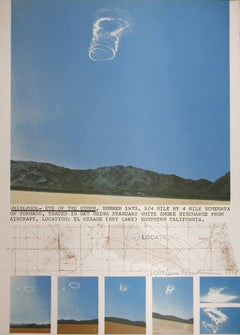
Whirlpool - Eye of the Storm, Contemporary Lithograph by Dennis Oppenheim
Located in Long Island City, NY
Artist: Dennis Oppenheim, American (1938 - 2011)
Title: Whirlpool - Eye of the Storm
Year: 1978
Medium: Lithograph on Johannot Wove Paper, signed and ...
Category
Conceptual 20th Century Landscape Prints
Materials
Lithograph
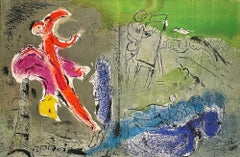
Vision de Paris II
By Marc Chagall
Located in Washington, DC
Artist: Marc Chagall
Title: Vision de Paris II
Portfolio: 1953 Verve Vol VII No. 27-28
Medium: Lithograph
Date: 1953
Edition: 6000
Frame Size: 28 1/4" x 21 1/2"
Sheet Size: 14" x 20"...
Category
20th Century Landscape Prints
Materials
Lithograph
Pale Day, Impressionist Monotype Print by Stephen Lack
By Stephen Lack
Located in Long Island City, NY
A unique monotype by noted Canadian artist and actor Stephen Lack. The image measures 16 x 22 inches on a 22.5 x 27.5 inch sheet. The artwork is signed, dated, titled and numbered ...
Category
Impressionist 20th Century Landscape Prints
Materials
Monotype
(Title Unknown) Serigraph, Plate-signed
Located in Chesterfield, MI
Measures 27 x 32 inches and is unframed. The date of creation is unknown, but is believed to be within the Late 20th Century. The piece is in Fair/Distressed Condition-indentation/su...
Category
20th Century Landscape Prints
Materials
Screen
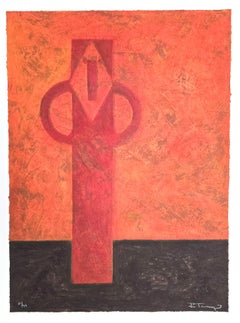
Figura Hieratica, Surrealist Etching by Rufino Tamayo
Located in Long Island City, NY
Portfolio: Rufino Tamayo 15 aguafuertes 1979
Date: 1979
Etching, signed and numbered in pencil
Edition of 61/99
Image Size: 28 x 20 inches
Size: 30 x 22 in. (76.2 x 55.88 cm)
Printer...
Category
Surrealist 20th Century Landscape Prints
Materials
Etching
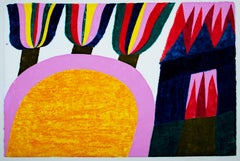
"Ravanna
s Palace Burning, " Woodcut Landscape signed by Carol Summers
Located in Milwaukee, WI
"Ravanna's Palace Burning" is a woodcut signed by Carol Summers. The image combines landscape and architecture, which is typical of the works Summers produced during the 1980s and '90s. In the image, a dark building stands burning, bright red flames licking from the windows and rooftop. It stands beside an orange field framed in pink, probably representing a plaza. Beyond the plaza are multicolored trees, their branches reaching upward like the flames on the building. The playfulness of the image is enhanced by Summers' signature printmaking technique, which allows the ink from the woodblock to seep through the paper, blurring the edges of each form.
Art: 24.5 x 37.25 in
Frame: 30 x 42.75 in
Numbered 53 of the edition of 125
Carol Summers (1925-2016) has worked as an artist throughout the second half of the 20th century and into the first years of the next, outliving most of his mid-century modernist peers. Initially trained as a painter, Summers was drawn to color woodcuts around 1950 and it became his specialty thereafter. Over the years he has developed a process and style that is both innovative and readily recognizable. His art is known for it’s large scale, saturated fields of bold color, semi-abstract treatment of landscapes from around the world and a luminescent quality achieved through a printmaking process he invented.
In a career that has extended over half a century, Summers has hand-pulled approximately 245 woodcuts in editions that have typically run from 25 to 100 in number. His talent was both inherited and learned. Born in 1925 in Kingston, a small town in upstate New York, Summers was raised in nearby Woodstock with his older sister, Mary. His parents were both artists who had met in art school in St. Louis. During the Great Depression, when Carol was growing up, his father supported the family as a medical illustrator until he could return to painting. His mother was a watercolorist and also quite knowledgeable about the different kinds of papers used for various kinds of painting. Many years later, Summers would paint or print on thinly textured paper originally collected by his mother.
From 1948 to 1951, Carol Summers trained in the classical fine and studio arts at Bard College and at the Art Students League of New York. He studied painting with Steven Hirsh and printmaking with Louis Schanker. He admired the shapes and colors favored by early modernists Paul Klee (Sw: 1879-1940) and Matt Phillips (Am: b.1927- ). After graduating, Summers quit working as a part-time carpenter and cabinetmaker (which had supported his schooling and living expenses) to focus fulltime on art. That same year, an early abstract, Bridge No. 1 was selected for a Purchase Prize in a competition sponsored by the Brooklyn Museum.
In 1952, his work (Cathedral, Construction and Icarus) was shown the first time at the Museum of Modern Art in New York City in an exhibition of American woodcuts. In 1954, Summers received a grant from the Italian government to study for a year in Italy. Woodcuts completed soon after his arrival there were almost all editions of only 8 to 25 prints, small in size, architectural in content and black and white in color. The most well-known are Siennese Landscape and Little Landscape, which depicted the area near where he resided. Summers extended this trip three more years, a decision which would have significant impact on choices of subject matter and color in the coming decade.
After returning from Europe, Summers’ images continued to feature historical landmarks and events from Italy as well as from France, Spain and Greece. However, as evidenced in Aetna’s Dream, Worldwind and Arch of Triumph, a new look prevailed. These woodcuts were larger in size and in color. Some incorporated metal leaf in the creation of a collage and Summers even experimented with silkscreening. Editions were now between 20 and 50 prints in number. Most importantly, Summers employed his rubbing technique for the first time in the creation of Fantastic Garden in late 1957.
Dark Vision of Xerxes, a benchmark for Summers, was the first woodcut where Summers experimented using mineral spirits as part of his printmaking process. A Fulbright Grant as well as Fellowships from the Louis Comfort Tiffany Foundation and the Guggenheim Foundation followed soon thereafter, as did faculty positions at colleges and universities primarily in New York and Pennsylvania. During this period he married a dancer named Elaine Smithers with whom he had one son, Kyle. Around this same time, along with fellow artist Leonard Baskin, Summers pioneered what is now referred to as the “monumental” woodcut. This term was coined in the early 1960s to denote woodcuts that were dramatically bigger than those previously created in earlier years, ones that were limited in size mostly by the size of small hand-presses. While Baskin chose figurative subject matter, serious in nature and rendered with thick, striated lines, Summers rendered much less somber images preferring to emphasize shape and color; his subject matter approached abstraction but was always firmly rooted in the landscape.
In addition to working in this new, larger scale, Summers simultaneously refined a printmaking process which would eventually be called the “Carol Summers Method” or the “ Carol Summers Technique”. Summers produces his woodcuts by hand, usually from one or more blocks of quarter-inch pine, using oil-based printing inks and porous mulberry papers. His woodcuts reveal a sensitivity to wood especially its absorptive qualities and the subtleties of the grain. In several of his woodcuts throughout his career he has used the undulating, grainy patterns of a large wood plank to portray a flowing river or tumbling waterfall. The best examples of this are Dream, done in 1965 and the later Flash Flood Escalante, in 2003. In the majority of his woodcuts, Summers makes the blocks slightly larger than the paper so the image and color will bleed off the edge.
Before printing, he centers a dry sheet of paper over the top of the cut wood block or blocks, securing it with giant clips. Then he rolls the ink directly on the front of the sheet of paper and pressing down onto the dry wood block or reassembled group of blocks. Summers is technically very proficient; the inks are thoroughly saturated onto the surface of the paper but they do not run into each other. The precision of the color inking in Constantine’s Dream in 1969 and Rainbow Glacier in 1970 has been referred to in various studio handbooks. Summers refers to his own printing technique as “rubbing”. In traditional woodcut printing, including the Japanese method, the ink is applied directly onto the block. However, by following his own method, Summers has avoided the mirror-reversed image of a conventional print and it has given him the control over the precise amount of ink that he wants on the paper. After the ink is applied to the front of the paper, Summers sprays it with mineral spirits, which act as a thinning agent. The absorptive fibers of the paper draw the thinned ink away from the surface softening the shapes and diffusing and muting the colors. This produces a unique glow that is a hallmark of the Summers printmaking technique. Unlike the works of other color field artists or modernists of the time, this new technique made Summers’ extreme simplification and flat color areas anything but hard-edged or coldly impersonal.
By the 1960s, Summers had developed a personal way of coloring and printing and was not afraid of hard work, doing the cutting, inking and pulling himself. In 1964, at the age of 38, Summers’ work was exhibited for a second time at the Museum of Modern Art. This time his work was featured in a one-man show and then as one of MOMA’s two-year traveling exhibitions which toured throughout the United States. In subsequent years, Summers’ works would be exhibited and acquired for the permanent collections of multiple museums throughout the United States, Europe and Asia. Summers’ familiarity with landscapes throughout the world is firsthand. As a navigator-bombardier in the Marines in World War II, he toured the South Pacific and Asia.
Following college, travel in Europe and subsequent teaching positions, in 1972, after 47 years on the East Coast, Carol Summers moved permanently to Bonny Doon in the Santa Cruz Mountains in Northern California. There met his second wife, Joan Ward Toth, a textile artist who died in 1998; and it was here his second son, Ethan was born. During the years that followed this relocation, Summers’ choice of subject matter became more diverse although it retained the positive, mostly life-affirming quality that had existed from the beginning. Images now included moons, comets, both sunny and starry skies, hearts and flowers, all of which, in one way or another, remained tied to the landscape.
In the 1980s, from his home and studio in the Santa Cruz mountains, Summers continued to work as an artist supplementing his income by conducting classes and workshops at universities in California and Oregon as well as throughout the Mid and Southwest. He also traveled extensively during this period hiking and camping, often for weeks at a time, throughout the western United States and Canada. Throughout the decade it was not unusual for Summers to backpack alone or with a fellow artist into mountains or back country for six weeks or more at a time. Not surprisingly, the artwork created during this period rarely departed from images of the land, sea and sky. Summers rendered these landscapes in a more representational style than before, however he always kept them somewhat abstract by mixing geometric shapes with organic shapes, irregular in outline. Some of his most critically acknowledged work was created during this period including First Rain, 1985 and The Rolling Sea, 1989. Summers received an honorary doctorate from his alma mater, Bard College in 1979 and was selected by the United States Information Agency to spend a year conducting painting and printmaking workshops at universities throughout India. Since that original sabbatical, he has returned every year, spending four to eight weeks traveling throughout that country.
In the 1990s, interspersed with these journeys to India have been additional treks to the back roads and high country areas of Mexico, Central America, Nepal, China and Japan. Travel to these exotic and faraway places had a profound influence on Summers’ art. Subject matter became more worldly and nonwestern as with From Humla to Dolpo, 1991 or A Former Life of Budha, 1996, for example. Architectural images, such as The Pillars of Hercules, 1990 or The Raja’s Aviary, 1992 became more common. Still life images made a reappearance with Jungle Bouquet in 1997. This was also a period when Summers began using odd-sized paper to further the impact of an image.
The 1996 Night, a view of the earth and horizon as it might be seen by an astronaut, is over six feet long and only slightly more than a foot-and-a-half high. From 1999, Revuelta A Vida (Spanish for “Return to Life”) is pie-shaped and covers nearly 18 cubic feet. It was also at this juncture that Summers began to experiment with a somewhat different palette although he retained his love of saturated colors. The 2003 Far Side of Time is a superb example of the new direction taken by this colorist.
At the turn of the millennium in 1999, “Carol Summers Woodcuts...
Category
Contemporary 20th Century Landscape Prints
Materials
Woodcut
Original Peugeot Moped and Motorcycles vintage French poster, linen-backed
Located in Spokane, WA
Original Peugeot BB vintage moped and motorcycle vintage poster, linen-backed, in Grade A- condition, ready to frame. All the posters were shipped folded vertically. The original fol...
Category
American Modern 20th Century Landscape Prints
Materials
Offset

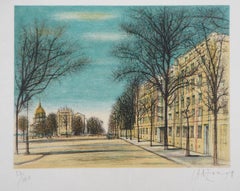
Paris: Boulevard des Invalides - Original Handsigned Lithograph, 1958
By Jean Carzou
Located in Paris, IDF
Jean CARZOU
Paris: Boulevard des Invalide, 1958
Original lithograph in color
Handsigned in pencil
Dated 1958 in pencil
Numbered / 100
On Japan paper 29 x 40 cm (c. 11.4 x 15.7 inch...
Category
Modern 20th Century Landscape Prints
Materials
Lithograph
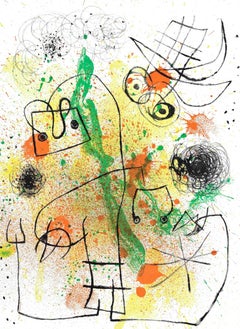
Joan Miro, Woman and Bird in Torment, from Derriere le miroir, 1967
By Joan Miró
Located in Southampton, NY
This exquisite lithograph by Joan Miro (1893–1983), titled Femme et oiseau en tourment (Woman and Bird in Torment), originates from the 1967 folio Derriere le miroir, L'oiseau solair...
Category
Surrealist 20th Century Landscape Prints
Materials
Lithograph
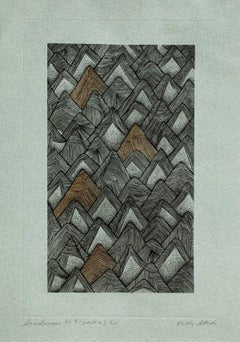
$796 Sale Price
20% Off
Sandscapes #4 Florida Artist Abstract Modernist Signed Print
By Kathy Stark
Located in Surfside, FL
Fine piece of Florida abstract Landscape art. With a French Art Deco feel to it.
Category
American Modern 20th Century Landscape Prints
Materials
Lithograph
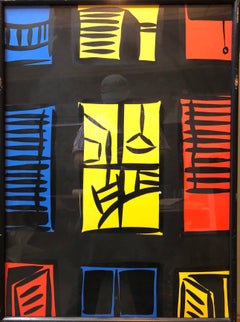
New York Night, Vintage Large Modernist Pop Art Sllkscreen
Located in Surfside, FL
5-color silkscreen on 2-ply museum board. edition of 60 hand signed and numbered.
American, 1955-2014
Born in 1955, Tom Slaughter’s career began in 1983 with his first exhibition at the Drawing Center in New York City. Since, he has had more than 20 solo shows in cities including San Francisco, Miami, London, Vancouver, Cologne and Fukuoka, Japan. Slaughter had worked extensively with master printer, Jean Russell at Durham Press, creating numerous limited edition prints using his signature bold primary colors. He worked as a printmaker in collaboration with Durham Press for 25 years, and his editions are included in the permanent collections of MoMA and the Whitney Museum of American Art.
He illustrated twelve children’s books, including “Boat Works,” “Do You Know Which Ones will Grow? ” – a 2011 Notable American Library Association book of the year – and collaborations with Marthe Jocelyn such as “ABC x 3,” “Same Same,” and “123.” These books have been translated into six languages. Slaughter also worked for the last ten seasons as the Art Director for the New Victory Theater. As a designer, he created everything from t-shirts to skateboard decks, beach towels as well as a line of wallpaper for Cavern Home. Tom Slaughter, an artist, designer, and illustrator, passed away on October 24, 2014. In his Pop-inflected prints, drawings, illustrations, paintings, and design work Tom Slaughter exudes a love of life. He makes few distinctions between his various artistic endeavors; “I paint, draw, cut paper, use a computer, and even an iPhone—it’s all the same hand,” he says. In a 2001 print...
Category
Pop Art 20th Century Landscape Prints
Materials
Screen
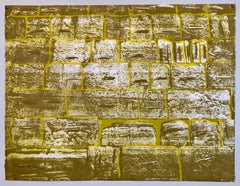
Israeli Modernist Silkscreen Print Kotel Wall Jerusalem Kadishman Lithograph
Located in Surfside, FL
On BFK Rives French art paper. This is a Photograph silkscreen print of the Kotel, Western Wall in Jerusalem overlaid with Kadishman drawing.
Menashe Kadishman was born in Tel-Aviv ...
Category
Pop Art 20th Century Landscape Prints
Materials
Lithograph
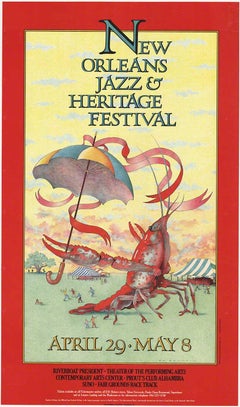
Original New Orleans Jazz
Heritage Festival vintage poster
Located in Spokane, WA
Original, Linen backed New Orleans Jazz & Heritage Festival poster from 1983. A fun image with a crawfish holding an umbrella with streamers. 1983 JAZZ & HERITAGE FESTIVAL PRO-MO ...
Category
American Modern 20th Century Landscape Prints
Materials
Offset
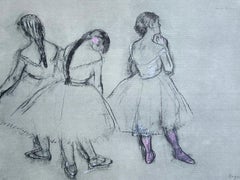
Edgar Degas, Three Dancers, 1945 (after)
By Edgar Degas
Located in Southampton, NY
This exquisite lithograph after Edgar Degas (1834–1917), titled Trois danseurs (Three Dancers), originates from the 1945 folio Degas, Ten Ballet Sketches. Published by The Studio Publications, Inc., New York, rendered and printed by Albert Carman, City Island, 1945, this work reflects Degas’s sensitive mastery of line, movement, and the intimate psychological nuances of the ballet studio.
Executed as a lithograph and pochoir on velin paper, this work measures 13 x 17 inches (33.02 x 43.18 cm). Signed in the plate and unnumbered as issued. Rendered and printed by Albert Carman, City Island.
Artwork Details:
Artist: After Edgar Degas (1834–1917)
Title: Trois danseurs (Three Dancers), from Degas, Ten Ballet Sketches, 1945
Medium: Lithograph and pochoir on velin paper
Dimensions: 13 x 17 inches (33.02 x 43.18 cm)
Inscription: Signed in the plate and unnumbered as issued
Date: 1945
Publisher: The Studio Publications, Inc., New York
Printer: Albert Carman, City Island
Condition: Well preserved, consistent with age and medium
Provenance: From the 1945 folio Degas, Ten Ballet Sketches, published by The Studio Publications, Inc., New York
Notes:
Excerpted from the album, Born in Paris in 1834, Edgar Degas lived, and surely loved the life of that city during most of his years. These continued somewhat sadly beyond those of most of his friends— into the debacle of the first World War, during which he died in 1917. Judging by the frequency with which he used them as models, he must have had an especial admiration for the ballet girls who followed a profession that at the time brought none of the glory and prosperity which attend it today. New aspects of the human body, revealed in movement, fascinated him. But his occupation with the simply anatomical side of his subjects never resulted in a cold interpretation. On the contrary there is a warmth and sympathy that pervades all of his work. The drawings here represent the painter in one important phase of his multi-sensitive view of life; and permit an insight which a more ambitious work might not do-into the operation of the creative process, the artist's transformation of reality as it passes through the mesh of his sensibilities. The Edition of this Portfolio is limited to MMMD examples. Rendered by Albert Carman.
About the Publication:
Degas, Ten Ballet Sketches (1945) is one of the earliest and most significant American postwar fine art portfolios devoted to Edgar Degas’s intimate works on paper. Published by The Studio Publications, Inc., New York, and rendered and printed by Albert Carman at City Island, the album sought to faithfully reproduce a group of Degas’s ballet-related drawings through a combination of lithography and hand-applied pochoir coloring. This hybrid technique allowed the edition to preserve the immediacy, tonal subtlety, and gestural delicacy central to Degas’s draftsmanship. Conceived as a fine art publication rather than a commercial book, the portfolio provided American audiences unprecedented access to Degas’s private, spontaneous studies—images that reveal the artist’s fascination with movement, anatomy, and the psychological atmosphere of the rehearsal studio. The album exemplifies the mid-20th-century revival of pochoir as a means of recreating the texture and coloristic nuance of original works on paper, and it remains an important document of how Degas’s legacy was translated into high-quality printed form for collectors, museums, and connoisseurs.
About the Artist:
Edgar Degas (1834–1917) was a French painter, draughtsman, printmaker, and sculptor whose groundbreaking fusion of classical draftsmanship, modern experimentation, and psychological depth helped define the trajectory of Western art, positioning him as one of the most influential figures of the nineteenth and early twentieth centuries; renowned for his depictions of ballet dancers, racehorses, theater scenes, cafe life, domestic interiors, milliners, laundresses, and women at their toilette, Degas reimagined observational realism through radical compositional innovation—employing extreme cropping, asymmetrical framing, oblique viewpoints, and dramatic lighting that anticipated photographic and cinematic language long before these technologies shaped visual culture, and although associated with Impressionism, he rejected plein-air spontaneity in favor of studio-based discipline rooted in the linear precision of Jean-Auguste-Dominique Ingres, the expressive chromaticism of Eugene Delacroix, and the modernity of Edouard Manet while also drawing inspiration from Japanese ukiyo-e prints, classical sculpture, and early photography; his independent artistic philosophy resonated with and helped shape the innovations of Pablo Picasso, Alexander Calder, Alberto Giacometti, Salvador Dali, Joan Miro, Wassily Kandinsky, Marcel Duchamp, and Man Ray, whose explorations of movement, form, dream logic, abstraction, and conceptualism all find antecedents in Degas’s investigations into seriality, temporality, and the fragmented figure, and his pioneering use of pastel, monotype, and wax sculpture fundamentally transformed each medium, influencing artists from Henri Matisse, Francis Bacon, Lucian Freud, and Giacomo Manzu to Paula Rego, contemporary realists, experimental photographers, and choreographers; his works are held in nearly every major museum collection worldwide—including the Musee dOrsay, the Louvre, the Metropolitan Museum of Art, the National Gallery of Art, the Art Institute of Chicago, the Courtauld Institute, and the National Gallery, London—affirming his central place in the history of art, and the highest auction record for Degas was achieved at Sothebys London on February 3, 2015, when Danseuses en Bleu sold for 37,033,000 GBP, cementing his status as one of the most sought-after and enduringly significant artists of the Western canon.
Degas pochoir, Degas lithograph...
Category
Impressionist 20th Century Landscape Prints
Materials
Lithograph
$796 Sale Price
20% Off
Ross Bleckner, Water Lilies (C.M.)
Located in New York, NY
Ross Bleckner
THE WATER LILIES (C.M.)
Year: 2019
Medium: Archival pigment print on Innova Etching Cotton Rag 315 gsm fine art paper
Size: 42 x 70 inches (107 x 178 cm)
Edition: 30
Price: $7,000
Also sold as a set with Floating Red
Glowing and contemplative, Ross Bleckner’s work blends abstraction with recognizable symbols to create meditations on perception, transcendence and loss.
Ross Bleckner was born in 1949 in New York and grew up in the prosperous town of Hewlett Harbor on Long Island. The first art exhibition he saw—The Responsive Eye, a show of Op art on view at the Museum of Modern Art in New York in 1965—had a strong impact on him. He decided to become an artist when he was in college, studying with Sol LeWitt and Chuck Close at New York University, where he earned a BA in 1971. Two years later, he completed an MFA at the California Institute of the Arts in Valencia, where he met David Salle.
After moving back to New York, Bleckner purchased and moved into a Tribeca loft building in 1974. Painter Julian Schnabel rented three floors of the building, and the Mudd Club, a nightclub frequented by musicians and artists, occupied space there from 1977 to 1983. Bleckner sold the building in 2004. His first solo exhibition was held in 1975 at Cunningham Ward Gallery in New York. In 1979 he began his long association with Mary Boone Gallery in New York, which championed several of the so-called art stars of the 1980s. In 1981 Bleckner met Thomas Ammann, an important Swiss art dealer who went on to collect his work.
Bleckner’s early 1980s Stripe...
Category
20th Century Landscape Prints
Materials
Archival Pigment
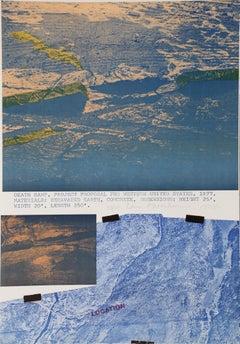
Death Ramp, Conceptual Art Lithograph by Dennis Oppenheim
Located in Long Island City, NY
Artist: Dennis Oppenheim, American (1938 - 2011)
Title: Death Ramp
Year: 1978
Medium: Lithograph, signed and numbered in pencil
Edition: 100
Size: 39 in. x 27 in. (99.06 cm x 68.58 cm)
Category
Conceptual 20th Century Landscape Prints
Materials
Lithograph
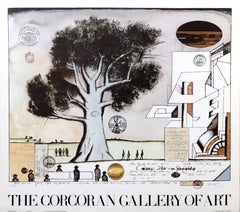
Bauhaus, The Corcoran Gallery of Art, Exhibition Poster by Saul Steinberg
Located in Long Island City, NY
A vintage exhibition poster for famed New Yorker artist, Saul Steinberg at The Corcoran Gallery of Art, Washington DC.
Category
Modern 20th Century Landscape Prints
Materials
Offset
Willem de Kooning, Untitled, from Poems, 1988
Located in Southampton, NY
This exquisite lithograph by Willem de Kooning (1904–1997), titled Untitled, from the folio Poems, originates from the 1988 edition published by The Limited Editions Club, New York, ...
Category
Abstract Expressionist 20th Century Landscape Prints
Materials
Lithograph

$7,996 Sale Price
20% Off
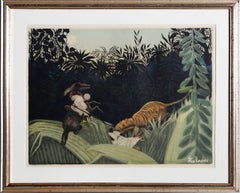
La Chasse au Tigre, Surrealist Aquatint Etching by Jacques Villon
Located in Long Island City, NY
Artist: Jacques Villon, After Henri Rousseau, French (1844 - 1910), French (1875 - 1963)
Title: La Chasse au Tigre
Year: 1924
Medium: Etching with Aquatint, signed and dated in th...
Category
Impressionist 20th Century Landscape Prints
Materials
Etching, Aquatint
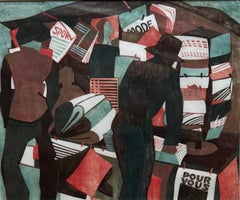
"Kiosk in Paris" British Linocut 1/50 European Modernism Swiss Vorticism Deco
By Lill Tschudi
Located in New York, NY
"Kiosk in Paris" British Linocut 1/50 European Modernism Swiss Vorticism Deco
Lill Tschudi (Swiss, 1911-2004)
Kiosk in Paris (Coppel LT 29)
Linocut...
Category
Modern 20th Century Landscape Prints
Materials
Linocut
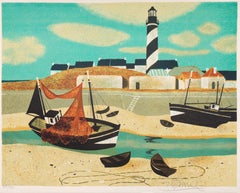
Low Tide, Brittany
, Ecole des Beaux-Arts, Musée d
Art Moderne, Paris
By Yves Ganne
Located in Santa Cruz, CA
Signed lower right, 'Y. Ganne' for Yves Ganne (French, b. 1931) with print and limitation, '144/150', lower left.
Sheet Dimensions: 21 H x 29.5 W Inches
Born in Anjou, Ganne first ...
Category
Post-Impressionist 20th Century Landscape Prints
Materials
Paper, Lithograph
The Belvoir Hunt hunting print by Lionel Edwards
Located in London, GB
To see our other hunting pictures, scroll down to "More from this Seller" and below it click on "See all from this Seller" and then search.
Lionel Ed...
Category
20th Century Landscape Prints
Materials
Lithograph
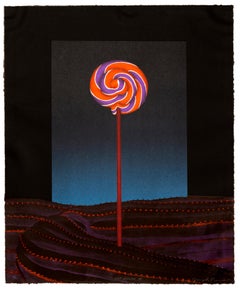
Night Flower IV, Signed Surrealist Screenprint
Located in Long Island City, NY
Artist: Unknown
Title: Night Flower IV
Medium: Screenprint, signed, titled, and numbered in pencil mounted on board
Image Size: 24.5 x 20 inches
Size: 2...
Category
Surrealist 20th Century Landscape Prints
Materials
Screen
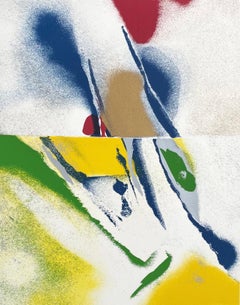
Flashback IV, Flashback Series, John Chamberlain
Located in Fairfield, CT
Artist: John Chamberlain (1927-2011)
Title: Flashback IV
Year: 1979
Medium: Lithograph on vélin d’Arches paper
Edition: 153/175, plus proofs
Size: 28 x 20 inches
Inscription: Signed ...
Category
Abstract Expressionist 20th Century Landscape Prints
Materials
Lithograph
$2,600 Sale Price
20% Off
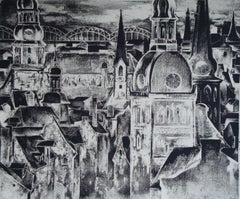
Riga. 1969, paper, silk screen printing, 62x74 cm
Located in Riga, LV
Riga. 1969, paper, silk screen printing, 62x74 cm
Josif Elgurt (1924-2007)
Born in 1924 in Kishinev in Romania. In 1947 resumed his art studies in Kishinev. Since 1952 he has lived...
Category
Realist 20th Century Landscape Prints
Materials
Paper, Screen
$432 Sale Price
20% Off
Original "The Marines Corps Builds Leaders!" vintage poster, linen backed
Located in Spokane, WA
Vintage 1967 US Marine Corps "The Marine Corps Builds Leaders!" original recruiting poster - linen-backed art print, 27" x 38.5". Grade A condition, ready to frame.
Authentic Vintag...
Category
American Modern 20th Century Landscape Prints
Materials
Offset

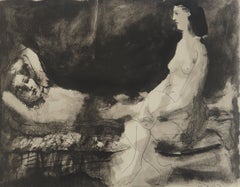
Pablo Picasso, Reclining Man and Seated Woman, The Double Flute, 1967 (after)
Located in Southampton, NY
This exquisite lithograph and pochoir after Pablo Picasso (1881–1973), titled Homme couche et femme assise (Reclining Man and Seated Woman), from the folio Picasso, La flute double, ...
Category
Cubist 20th Century Landscape Prints
Materials
Lithograph, Stencil
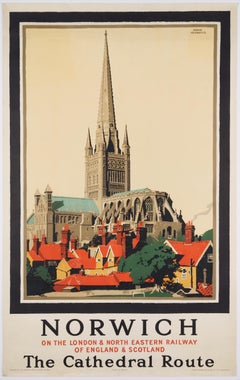
$2,636 Sale Price
20% Off
Norwich – The Cathedral Route Original Vintage British Travel Poster
Located in Zurich, CH
Original Vintage Travel Poster by Frank Newbould, commissioned by LNER (The London & North Eastern Railway of England & Scotland) to promote its connection to Norwich; beautifully pr...
Category
English School 20th Century Landscape Prints
Materials
Paper
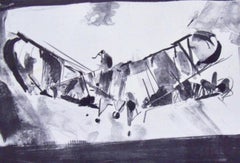
Zygmund Jankowski, Come Fly with Me
Located in New York, NY
Zygmund Jankowski is known for his modernist compositions and effective use of “the white of the paper.” 'Come Fly with Me' perfectly illustrates that skill; It is signed, titled, and dated in pencil. Jankowski was born in South Bend, Indiana. After serving in the US Navy Jankowski attended the California College of Arts and Crafts, where studied with Victor DeWilde, Otis Oldfield, and George Post. Returning to the mid-west he taught at Indiana University, South Western Michigan College, Hilton Leech School of Art, the Bremen Art Center, the Niles Art Center, the South Bend Art Association, and the Rockport Art Association. Beginning in 1964 he summered in Rocky Neck, MA, and opened a summertime gallery. In the 1970s he made a permanent move to Gloucester where he held workshops at his studio. In the 1990s he moved to Lanesville. Among those institutions with work by Jankowski is the Cape Ann Museum. In their biography of the artist they acknowledge his role of inspiring a generation of Cape Ann artists...
Category
Abstract Expressionist 20th Century Landscape Prints
Materials
Lithograph
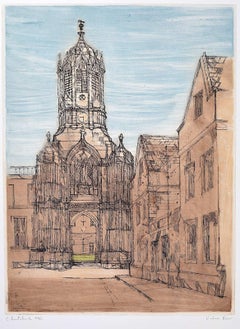
$856 Sale Price
28% Off
Christ Church, Oxford 1965 etching by Richard Beer
By Richard Beer
Located in London, GB
To see our other views of Oxford and Cambridge, or Modern British Art, scroll down to "More from this Seller" and below it click on "See all from this Seller" - or send us a message ...
Category
Modern 20th Century Landscape Prints
Materials
Etching, Aquatint
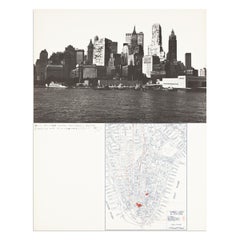
Christo, Lower Manhattan Packed Buildings (Monuments) - Signed Print
By Christo
Located in Hamburg, DE
Christo (American-Bulgarian, b. 1935)
Lower Manhattan Packed Buildings (2 Broadway and 20 Exchange Place, from Monuments), 1968
Medium: Offset and screen print on Bristol board
Dimen...
Category
Conceptual 20th Century Landscape Prints
Materials
Offset, Screen
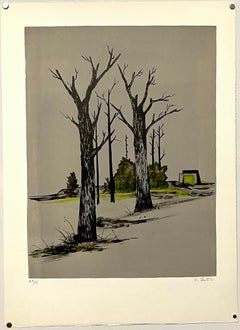
Lithograph Belgian American Surrealism WPA Modernist Karl Fortess Surrealist Art
Located in Surfside, FL
Karl Eugene Fortess (1907-1993)
Original color lithographs on BFK Rives paper,
1966, Hand signed and numbered 29/36 in pencil,
Sheet size 20.5 x 15 inches.
Karl E. Fortess (1907-1993) was a painter, printmaker and teacher, of Boston, Massachusetts and Woodstock, N.Y. Fortess was born in Antwerp, Belgium on October 13, 1907, and became an American citizen in 1923. He studied at the Art Institute of Chicago, the Art Students League in New York, and the Woodstock School of Painting with Yasuo Kuniyoshi. In 1937 the Works Progress Administration sent him and several other artists to Alaska to document the towns, villages, and remote wilderness landscapes (Pemberton, “Alaska art museum collects WPA’s Depression works from the territory,” Columbia Daily Tribune, November 9, 2003). Trains, trucks, and industrial buildings were what Karl Fortess envisioned when the Public Works of Art Project suggested that he depict “the American Scene.” His work bears the influence of Surrealism, Russsian Constructivist art and Cubism. He was part of a circle of left leaning artists loosley involved with the WPA which included Sol Wilson, Isaac Soyer, Louis Lozowick, Abraham Harriton, Ben Shahn, William Gropper, Nahum Tschacbasov, Morris Shulman, Yasuo Kuniyoshi, Louis Slobodkin, Adolf Dehn, Le Corbusier and Louis Schanker.
Karl Fortress taught at the Art Students League, Brooklyn Museum Art School, Louisiana State University, Fort Wright College, and Boston University School of Fine and Applied Arts. He was a member of the Artists Equity Association, Society of American Graphic Artists, American Association of University Professors, and the British Film Institute. He was awarded the Guggenheim Fellowship in 1946, was named an Associate of the National Academy of Design in 1960 and elected to full Academician in 1971. Fortess taught at many different schools, including Boston University School of Fine Art, where he also created an archive of interviews with more than two hundred and fifty contemporary American painters, sculptors, and graphic artists including many with with artists associated with the Woodstock, N.Y. art community.
Among the interviewees are Kenneth Armitage, Will Barnet, Romare Bearden, George Biddle, James Brooks, Adolph Dehn, Jane Freilicher, Julian Levi, Alice Neel, Larry Rivers, Moses Soyer, Dorothy Varian...
Category
Surrealist 20th Century Landscape Prints
Materials
Lithograph
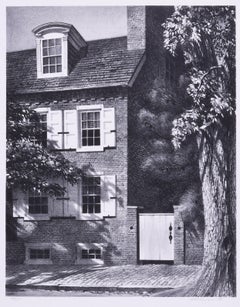
The White Gate (New Castle, Delaware)
Located in Fairlawn, OH
The White Gate (New Castle, Delaware)
Lithograph, 1961
Signed in pencil lower right (see photo)
Numbered and title in the lower left (see photos)
Condition: Excellent
Image size: 15 ...
Category
American Realist 20th Century Landscape Prints
Materials
Lithograph
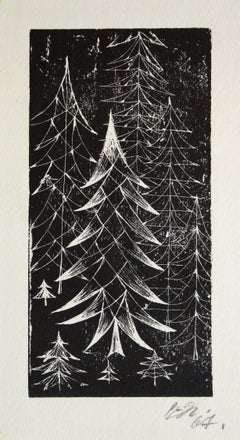
Spruce. 1967, paper, etching, 18x9 cm
Located in Riga, LV
Spruce. 1967, paper, etching, 18x9 cm
Dzidra Ezergaile (1926-2013)
Born in Riga. School years alternate with summer work in the countryside. In 1947,...
Category
Modern 20th Century Landscape Prints
Materials
Paper, Etching
$86 Sale Price
20% Off
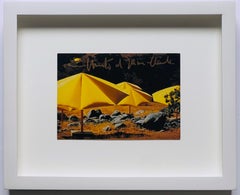
Art Card: The Umbrellas Japan-USA Hand Signed by Christo
Jeanne-Claude, Framed
Located in New York, NY
Christo and Jeanne-Claude
The Umbrellas Japan-USA Hand Signed by Christo
Jeanne-Claude
Offset lithograph card
Hand signed in orange crayon by Christo and Jeanne-Claude
Provenan...
Category
Pop Art 20th Century Landscape Prints
Materials
Postcard
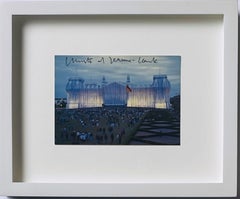
Art Card: Reichstag at Night, Hand Signed by Christo and Jeanne-Claude, Framed
Located in New York, NY
Art Card: Reichstag at Night (Berlin 1995: Der von Christo und Jeanne-Claude verhüllte Reichstag), Hand Signed by Christo and Jeanne-Claude, 1995
Offset lithograph card (Hand signed ...
Category
Pop Art 20th Century Landscape Prints
Materials
Postcard
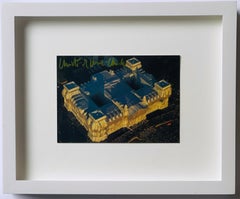
Art Card: Reichstag Aerial View, Hand Signed by Christo and Jeanne-Claude Framed
Located in New York, NY
Christo
Art Card: Reichstag Aerial View, Hand Signed by Christo and Jeanne-Claude, 1997
Offset lithograph card (HAND SIGNED) with provenance
Gorgeous aerial view of the Reichstag, ha...
Category
Contemporary 20th Century Landscape Prints
Materials
Postcard
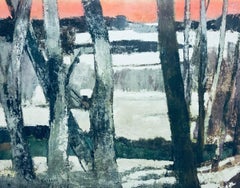
Morin Valley In The Snow-Poster, New York Graphic Society. Printed in U.S.A.
Located in Chesterfield, MI
Poster. 1971 New York Graphic Society Ltd. Printed in U.S.A. Measures 31.25 x 36.75 inches and is unframed. The image is in Very Good Condition. The white border has discoloration/su...
Category
20th Century Landscape Prints
Materials
Lithograph
Hong Kong, Psychedelic Abstract Screenprint by Risaburo Kimura
Located in Long Island City, NY
Artist: Risaburo Kimura, Japanese (1924 - )
Title: Hong Kong
Year: 1973
Medium: Screenprint on BFK Rives, Signed, titled and numbered in pencil
Edition: 250, AP 20
Size: 30 in. x 22 ...
Category
Abstract Impressionist 20th Century Landscape Prints
Materials
Screen

Lunar Landscape Abstract Signed Numbered Screenprint Blue
Located in Surfside, FL
Gittleman’s Lunar Transformation is a series of ten vividly colored serigraphs created from black and white photographs taken during the Apollo 15 mission to the moon in 1971. Gittleman uses bright color to transform the craters and crevices of the lunar surface into vibrant abstractions which recall Abstract Expressionist painting. The strong graphic prints reflect the awe-inspiring nature of their source material. photographer, film maker, video producer, graphic designer, multimedia developer, clock maker and teacher. Guggenheim fellowship (graphics), Cannes Film festival, Academy Award Nomination. Work in permanent collections: MFA Boston, MOMA NY, Smithsonian Institution and Fogg Museum, Harvard. He exhibited with Gyorgi Kepes
Solo shows:
Lunar Transformations: 10 Serigraphs by Len Gittleman - Institute of Contemporary Arts, London
Group shows:
Integrated Vision: Science, Nature, and Abstraction in the Art of Len Gittleman and György Kepes - DeCordova Sculpture Park and Museum, Lincoln, MA
Abstract Photography in the Permanent Collection - DeCordova Sculpture Park and Museum, Lincoln, MA
Photography in Boston - 1955-1985 - DeCordova Sculpture Park and Museum, Lincoln, MA
Some Photographic Use of Color: Fred Berman...
Category
Pop Art 20th Century Landscape Prints
Materials
Screen
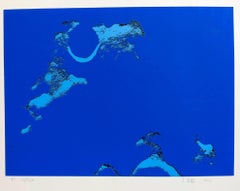
Primavera, Folk Art Screenprint by John Grillo
By John Grillo
Located in Long Island City, NY
Artist: John Grillo, American (1917 - 2014)
Title: Primavera
Year: 1980
Medium: Screenprint, Signed and Numbered in Pencil
Edition: 200, AP 30
Image Size: 22 x 29 inches
Size: ...
Category
Folk Art 20th Century Landscape Prints
Materials
Screen
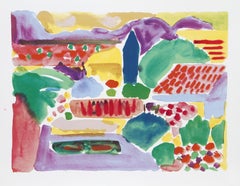
Le Moulin Abandonné
Located in New York, NY
Jean-Emile Laboureur (1877-1943), Le Moulin Abandonne, etching and engraving, 1934, signed lower left and numbered and annotated “imp” in pencil lower right....
Category
Mannerist 20th Century Landscape Prints
Materials
Engraving, Etching
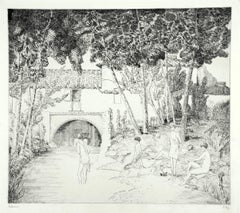
Cincinnati Union Terminal, Perspective From East
Located in Fairlawn, OH
Cincinnati Union Terminal, Perspective From East
Drypoint, 1930-1931
Signed in pencil lower right (see photo)
Initialed and dated the the plate above the pencil signature
From: Cincinnati Series (8 Plates), this No. 2
Edition: 155, completed May 4, 1931
Delivered to Fellheimer & Wagner, 1931
Louis Conrad Rosenberg
1890-1983
An American architectural etcher and engraver of the 1920's and 1930's era, Louis Conrad Rosenberg first studied at the Massachusetts Institute of Technology...
Category
American Modern 20th Century Landscape Prints
Materials
Drypoint