Nude Prints
to
252
1,055
458
622
158
103
Overall Width
to
Overall Height
to
641
607
256
183
82
60
51
20
20
13
9
6
3
1
94
62
56
56
45
20
56
1,904
437
24
79
119
126
53
140
216
507
244
111
15
1,541
805
41
1,819
1,135
870
729
457
424
410
379
262
76
72
58
54
50
47
45
44
43
35
34
943
724
346
186
146
280
734
1,205
1,075
Nude Prints For Sale
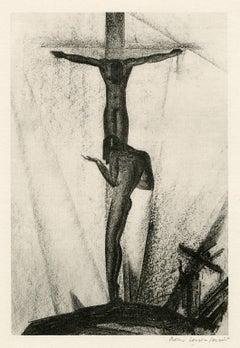
Untitled (Crucifixion)
Located in Myrtle Beach, SC
Boris Lovet-Lorski, Untitled (Crucifixion), lithograph, edition 250, 1929. Signed and numbered 7 in pencil. Number 7 of Volume 1, a series of 10 lithographs published by the artist a...
Category
1920s Art Deco Nude Prints
Materials
Lithograph

$760 Sale Price
20% Off
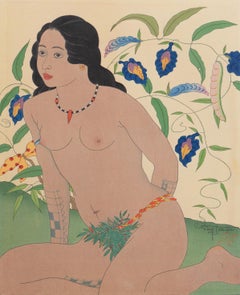
Jeune Fille de Polowat
, Tokyo, Garbo, Queen Elizabeth II, Kyoto, Woodblock
Located in Santa Cruz, CA
Signed lower right in pencil, 'Paul Jacoulet' (French-Japanese, 1902-1960) and stamped with peach seal; titled, lower right margin, 'Jeune Fille de Polowat. Est Carolines' (Young gir...
Category
1940s Post-Impressionist Nude Prints
Materials
Paper, Woodcut
$2,625 Sale Price
25% Off
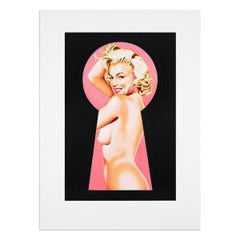
Mel Ramos, Peek-A-Boo Marilyn 1 - Original Lithograph, Signed Pop Art Print
By Mel Ramos
Located in Hamburg, DE
Mel Ramos (American, 1935-2018)
Peek-A-Boo Marilyn 1, 2002
Lithograph on wove paper
31 1/2 × 23 in 80 × 58.5 cm
Edition of 199: Hand-signed and numbered
Condition: Excellent
Category
21st Century and Contemporary Pop Art Nude Prints
Materials
Lithograph
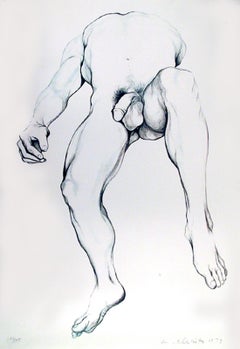
Male Nude 6, Photorealist Lithograph by Lowell Blair Nesbitt
Located in Long Island City, NY
This provocative portrayal of a male nude figure by Lowell Blair Nesbitt is very different from many of his other works featuring floral decoration and close-up depictions of flowers...
Category
1970s Photorealist Nude Prints
Materials
Lithograph
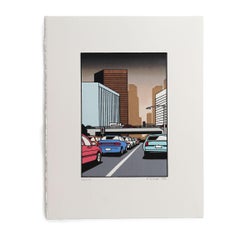
Untitled (INV# NP5778) by Ken Price
By Ken Price
Located in Morton Grove, IL
Ken Price (1935-2012)
screenprints in colors on Arches France paper
14 x 11”
signed and dated in pencil
stamped by Ken Price and Black Sparrow Graphic Arts
edition of 170, # 45/170
...
Category
1990s Contemporary Nude Prints
Materials
Screen
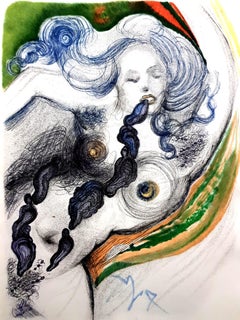
Salvador Dali - Oysters and Nude
Located in Collonge Bellerive, Geneve, CH
Salvador Dali - Oysters and Nude - Original Etching
Dimensions: 38 x 28 cm
Edition: 390
1967
On Rives Vellum
References : Field 67-4 (p. 32-33) / Michler & Lopsinger 174 to 187.
Category
1960s Surrealist Nude Prints
Materials
Etching
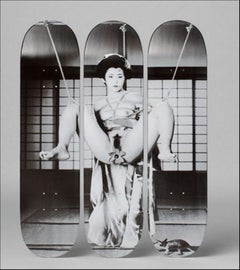
Geisha Skateboard Triptych suite of three silkscreen skateboards numbered 55/150
Located in New York, NY
Nobuyoshi Araki
Geisha Skateboard Triptych, ca. 2014
Set of (3) Skateboards of Silkscreen on 7 ply Canadian Maplewood Deck
Signed in plate, Each signed on the deck and hand numbered ...
Category
2010s Contemporary Nude Prints
Materials
Maple, Screen, Wood
Dolores
By Emil Ganso
Located in San Francisco, CA
This artwork titled "Dolores" c.1940 is an original soft ground etching and aquatint by noted German/American artist Emil Ganso, 1895-1941. It is hand signed and numbered 6/100 in pe...
Category
Mid-20th Century American Realist Nude Prints
Materials
Etching, Aquatint
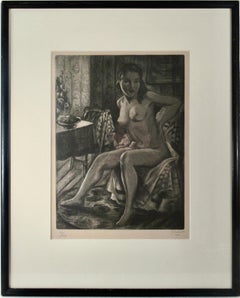
Tears From Mars, Digital Art Figurative Print on Paper, Nude Portrait, Woman
By SarahGrace
Located in Jersey City, NJ
"Tears From Mars" (2021) by SarahGrace
Digital art print on archival paper, Figurative drawing, Portrait, Woman, Nude, Red, Peach, Pink and Orange
Hand-signed by artist
Framing Avail...
Category
21st Century and Contemporary Contemporary Nude Prints
Materials
Archival Ink, Archival Paper, Digital
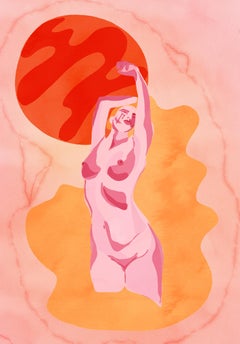
Nu a la Guitarre (Serenade), Signed Surrealist Lithograph by Salvador Dalí
Located in Long Island City, NY
Artist: Salvador Dali, Spanish (1904 - 1989)
Title: Nu a la Guitarre (Serenade) from the Nudes Suite
Year: 1970
Medium: Lithograph on Rives, Signed and numbered in Pencil
Edition: C...
Category
1970s Surrealist Nude Prints
Materials
Lithograph
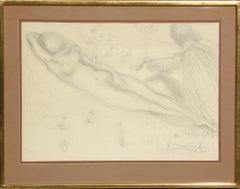
"Lendas Africanas Da Bahia" from the suite.
Located in San Francisco, CA
This artwork titled " Lendas Africanas Da Bahia" from the suite, 1978, is an original colors woodcut by renown Brazilian/Argentinian artist Hector Julio Paride Barnabo Carybe, 1911-1997. It is hand signed and numbered 83/200 in pencil by the artist. The Wood block mark (image) is 23.65 x 15.75 inches, sheet size is 26.75 x 19 inches. It is in excellent condition, has never been framed. It will be shipped in a 8 inches diameter heavy duty tube.
About the artist:
Héctor Julio Páride Bernabó (7 February 1911 – 2 October 1997) was an Argentine-Brazilian artist, researcher, writer, historian and journalist. His nickname and artistic name, Carybé, a type of piranha, comes from his time in the scouts. He died of heart failure after the meeting of a candomblé community's lay board of directors, the Cruz Santa Opô Afonjá Society, of which he was a member.
Quick Facts Born, Died ...
Carybé
Born
Héctor Julio Páride Bernabó
7 February 1911
Lanús, Argentina
Died
2 October 1997 (aged 86)
Salvador, Bahia, Brazil
Nationality
Brazilian
Known for
Painter, engraver, draughtsman, illustrator, potter, sculptor, mural painter, researcher, historian and journalist
Close
He produced thousands of works, including paintings, drawings, sculptures and sketches. He was an Obá de Xangô, an honorary position at Ilê Axé Opô Afonjá.
Orixá Panels in the Afro-Brazilian Museum in Salvador
Some of Carybé's work can be found in the Afro-Brazilian Museum in Salvador: 27 cedar panels representing different orixás or divinities of the Afro-Brazilian religion candomblé. Each panel shows a divinity with their associated implements and animal. The work was commissioned by the former Banco da Bahia S.A., now Banco BBM S.A., which originally installed them in its branch on Avenida Sete de Setembro in 1968.
Murals at Miami International Airport
American Airlines, Odebrecht and the Miami-Dade Aviation Department partnered to install two of Carybé's murals at Miami International Airport. They have been displayed in the American Airlines terminal at John F. Kennedy International Airport in New York since 1960. The 16.5 x 53-foot murals were accredited when Carybé won the first and the second prize in a contest of public art pieces for JFK airport.
As its terminal at that airport was due for demolition, American Airlines donated the murals to Miami-Dade County, and Odebrecht invested in a project to remove, restore, transport and install the murals at Miami International Airport.
The mural "Rejoicing and Festival of the Americas" portrays colorful scenes from popular festivals throughout the Americas, and "Discovery and Settlement of the West" depicts the pioneers’ journey into the American West.
Carybé's Woodcuts in Gabriel García Márquez's Books
Carybé illustrated four books by the Colombian writer Gabriel García Márquez, including One Hundred Years of Solitude, The Autumn of the Patriarch, Chronicle of a Death Foretold, and Love in the Time of Cholera "Carybé: um mestre da cultura baiana". ArqBahia Arquitetura, design, arte e lifestyle (in Brazilian Portuguese). 26 April 2023.. In particular, the woodcuts in One Hundred Years of Solitude are well-known for providing a visual image of the fictional town of Macondo, where the story takes place. The illustrations depict the colorful and winding houses, the railway bridge, and the hot and humid climate of the region, contributing to the reader's immersion in the story.
Carybé's woodcuts are, therefore, an important part of Gabriel García Márquez's literary legacy, bringing a visual dimension to his stories that further enriches the reader's experience.
Timeline
1911 — Birth in Lanús, Argentina.
1919 — Moved to Brazil.
1921 — The name Carybé is first given to him by the Clube do Flamengo scouts group, in Rio de Janeiro.
1925 — Beginning of his artistic endeavours, going to the pottery workshop of his elder brother, Arnaldo Bernabó, in Rio de Janeiro.
1927–1929 — Studies at the National School of Fine Arts, in Rio de Janeiro.
1930 — Worked for the newspaper Noticias Gráficas, in Buenos Aires, Argentina.
1935–1936 — Works with the writer Julio Cortázar and as a draughtsman for the El Diario newspaper.
1938 — Sent to Salvador by newspaper Prégon.
1939 — First collective exhibition, with the artist Clemente Moreau, at the Buenos Aires City Museum of Fine Arts, Argentina; illustrates the book Macumba, Relatos de la Tierra Verde, by Bernardo Kardon, published by Tiempo Nuestro.
1940 — Illustrates the book Macunaíma, by Mário de Andrade.
1941 — Draws the Esso Almanach, the payment for which allows him to set on a long journey through Uruguay, Brazil, Bolivia, and Argentina.
1941–1942 — Study trip around several South American countries.
1942 — Illustration for the book La Carreta by Henrique Amorim, published by El Ateneo (Buenos Aires, Argentina).
1943 — Together with Raul Brié, translates the book Macunaíma, by Mário de Andrade, into Spanish; produces the illustrations for the works Maracatu, Motivos Típicos y Carnavalescos, by Newton Freitas, published by Pigmaleon, Luna Muerta, by Manoel Castilla, published by Schapire, and Amores de Juventud, by Casanova Callabero; also publishes and illustrates Me voy al Norte, for the quarterly magazine Libertad Creadora; awarded First Prize by the Cámara Argentina del Libro (Argentine Book Council) for the illustration of the book Juvenília, by Miguel Cané (Buenos Aires, Argentina).
1944 — Illustrates the books The Complete Poetry of Walt Whitmann and A Cabana do Pai Tomás, both published by Schapire ; as well as and Los Quatro Gigantes del Alma by Mira y Lopez, Salvador BA; attends capoeira classes, visits candomblé meetings and makes drawings and paintings.
1945 — Does the illustrations for Daniel Defoe's Robinson Crusoe, for the Viau publishing house.
1946 — Helps in setting up the Tribuna da Imprensa newspaper, in Rio de Janeiro.
1947 — Works for the O Diário Carioca newspaper, in Rio de Janeiro.
1948 — Produces texts and illustrations for the book Ajtuss, Ediciones Botella al Mar (Buenos Aires, Argentina).
1949–1950 — Invited by Carlos Lacerda to work at the Tribuna da Imprensa, in Rio de Janeiro.
1950 — Invited by the Education Secretary Anísio Teixeira, moves to Bahia, and produces two panels for the Carneiro Ribeiro Education Center (Park School), in Salvador, Bahia.
1950–1997 — Settles in Salvador, Bahia.
1950–1960 — Actively participate in the plastic arts renewal movement, alongside Mário Cravo Júnior, Genaro de Carvalho, and Jenner Augusto.
1951 — Produces texts and illustrations for the works of the Coleção Recôncavo, published by Tipografia Beneditina and illustrations for the book, Bahia, Imagens da Terra e do Povo, by Odorico Tavares, published by José Olímpio in Rio de Janeiro; for the latter work he receives the gold medal at the 1st Biennial of Books and Graphic Arts.
1952 — Makes roughly 1,600 drawings for the scenes of the movie O Cangaceiro, by Lima Barreto; also works as the art director and as an extra on the film (São Paulo, SP).
1953 — Illustrations for the book A Borboleta Amarela, by Rubem Braga, published by José Olímpio (Rio de Janeiro, RJ).
1955 — Illustrates the work O Torso da Baiana, edited by the Modern Art Museum of Bahia.
1957 — Produces etchings, with original designs, for the special edition of Mário de Andrade's Macunaíma, published by the Sociedade dos 100 Bibliófilos do Brasil.
1958 — Makes an oil painting mural for the Petrobras Office in New York, USA; illustrates the book As Três Mulheres de Xangô, by Zora Seljan, published by Editora G. R. D. (Rio de Janeiro, RJ); Receives a scholarship grant in New York, USA.
1959 — Takes part in the competition for the New York International Airport panels project, in New York, USA, winning first and second prizes.
1961 — Illustrates the book Jubiabá, by Jorge Amado, published by Martins Fontes (São Paulo, SP).
1963 — Awarded the title of Honorary Citizen of Salvador, Bahia.
1965 — Illustrates A Muito Leal e Heróica Cidade de São Sebastião do Rio de Janeiro, published by Raymundo Castro Maya (Rio de Janeiro, RJ).
1966 — With Jorge Amado, co-authors Bahia, Boa Terra Bahia, published by Image (Rio de Janeiro, RJ); writes and illustrates the book Olha o Boi, published by Cultrix (São Paulo, SP).
1967 — Receives the Odorico Tavares Prize – Best Plastic Artist of 1967, in a competition ran by the state government to stimulate the development of plastic arts in Bahia; makes the Orixás Panels for the Banco da Bahia (currently at the UFBA Afro-Brazilian Museum) (Salvador, BA).
1968 — Illustrates the books Carta de Pero Vaz de Caminha ao Rei Dom Manuel, published by Sabiá (Rio de Janeiro) and Capoeira Angolana, by Waldeloir Rego, published by Itapoã (Bahia).
1969 — Produces the illustrations for the book Ninguém Escreve ao Coronel, by Gabriel Garcia Marquez, published by Sabiá (Rio de Janeiro, RJ).
1970 — Illustrates the books O Enterro do Diabo and Os Funerais de Mamãe Grande, published by Sabiá (Rio de Janeiro, RJ), Agotimé her Legend, by Judith Gleason, published by Grossman Publishers (New York, USA).
1971 — Illustrates the books One Hundred Years of Solitude, by Gabriel Garcia Marquez and A Casa Verde by Mario Vargas Llosa, both published by Sabiá (Rio de Janeiro, RJ); produces texts and illustrations for the book Candomblé da Bahia, published by Brunner (São Paulo, SP).
1973 — Illustrations for Gabriel Garcia Marquez's A Incrível e Triste História de Cândida Erendira e sua Avó Desalmada (Rio de Janeiro, RJ); paints the mural for the Legislative Assembly and the panel for the Bahia State Secretary of the Treasury.
1974 — Produces woodcuts for the book Visitações da Bahia, published by Onile.
1976 — Illustrates the book O Gato Malhado e a Andorinha Sinhá: uma história de amor, by Jorge Amado (Salvador, BA); receives the title of Knight of the Order of Merit of Bahia.
1977 — Certified with the Honor for Afro-Brazilian Cult Spiritual Merit, Xangô das Pedrinhas ao Obá de Xangô Carybé (Magé, RJ).
1978 — Makes the concrete sculpture Oxóssi, in the Catacumba Park; illustrates the book A Morte e a Morte de Quincas Berro D´Água, by Jorge Amado, published by Edições Alumbramento (Rio de Janeiro, RJ).
1979 — Produces woodcuts for the book Sete Lendas Africanas da Bahia, published by Onile.
1980 — Designs the costumes and scenery for the ballet Quincas Berro D´Água, at the Teatro Municipal in Rio de Janeiro.
1981 — Publication of the book Iconografia dos Deuses Africanos no Candomblé da Bahia (Ed. Raízes), following thirty years of research.
1982 — Receives the title of Honorary Doctor of the Federal University of Bahia.
1983 — Makes the panel for the Brazilian Embassy in Lagos, Nigeria.
1984 — Receives the Jerônimo Monteiro Commendation – Level of Knight (Espírito Santo); receives the Castro Alves Medal of Merit, granted by the UFBA Academy of Arts and Letters; makes the bronze sculpture Homenagem à mulher baiana (Homage to the Bahian woman), at the Iguatemi Shopping Center (Salvador, BA).
1985 — Designs the costumes and sets for the spectacle La Bohème, at the Castro Alves Theater; illustrates the book Lendas Africanas dos Orixás, by Pierre Verger, published by Currupio.
1992 — Illustrates the book O sumiço da santa: uma história de feitiçaria, by Jorge Amado (Rio de Janeiro, RJ).
1995 — Illustration of the book O uso das plantas na sociedade iorubá, by Pierre Verger (São Paulo, SP).
1996 — Making of the short film Capeta Carybé, by Agnaldo Siri Azevedo, adapted from the book O Capeta Carybé, by Jorge Amado, about the artist Carybé, who was born in Argentina and became the most Bahian of all Brazilians.
1997 — Illustration of the book Poesias de Castro Alves.
Exhibitions
ммIndividual Exhibitions:
1943 — Buenos Aires (Argentina) — First individual exhibition, at the Nordiska Gallery
1944 — Salta (Argentina) — at the Consejo General de Educacion
1945 — Salta (Argentina) — Amigos del Arte, Buenos Aires (Argentina) — Motivos de América, at the Amauta Gallery, Rio de Janeiro RJ — individual exhibition at the IAB/RJ
1947 — Salta (Argentina) — Agrupación Cultural Femenina
1950 — Salvador BA — First individual exhibit in Bahia, at the Bar Anjo Azul; São Paulo SP — MASP.
1952 — São Paulo SP — MAM/SP
1954 — Salvador BA — Oxumaré Gallery
1957 — New York (USA) — Bodley Gallery; Buenos Aires (Argentina) — Bonino Gallery * 1958 - New York (USA) — Bodley Gallery
1962 — Salvador BA - MAM/BA
1963 — Rio de Janeiro RJ — Bonino Gallery
1965 — Rio de Janeiro RJ — Bonino Gallery
1966 — São Paulo SP — Astrea Gallery
1967 — Rio de Janeiro RJ — Santa Rosa Gallery
1969 — London (England) — Varig Airlines
1970 — Rio de Janeiro RJ — Galeria da Praça
1971 — Rio de Janeiro RJ — MAM/RJ, São Paulo SP — A Galeria; Belo Horizonte MG, Brasília DF, Curitiba PR, Florianopolis SC, Porto Alegre RS, Rio de Janeiro RJ and São Paulo SP — The Orixás Panel (exhibition tour), at the Casa da Cultura in Belo Horizonte, MAM/DF, the Public Library of Paraná, the Legislative Assembly of Santa Catarina State, the Legislative Assembly of Rio Grande do Sul, MAM/RJ and MAM/SP
1972 — The Orixás Panel in Fortaleza CE — at the Ceará Federal University Art Museum, and in Recife PE — at the Santa Isabel Theater
1973 — São Paulo SP — A Galeria
1976 — Salvador BA — at the Church of the Nossa Senhora do Carmo Convent
1980 — São Paulo SP — A Galeria
1981 — Lisbon (Portugal) — Cassino Estoril
1982 — São Paulo SP — Renot Art Gallery, São Paulo SP — A Galeria
1983 — New York (USA) — Iconografia dos Deuses Africanos no Candomblé da Bahia, The Caribbean Cultural Center
1984 — Philadelphia (USA) — Art Institute of Philadelphia; Mexico — Museo Nacional de Las Culturas; São Paulo SP — Galeria de Arte André
1986 — Lisbon (Portugal) — Cassino Estoril; Salvador BA — As Artes de Carybé, Núcleo de Artes Desenbanco
1989 — Lisbon (Portugal) — Cassino Estoril; São Paulo SP — MASP
1995 — São Paulo SP — Documenta Galeria de Arte, São Paulo SP — Casa das Artes Galeria, Campinas SP — Galeria Croqui, Curitiba PR — Galeria de Arte Fraletti e Rubbo, Belo Horizonte MG — Nuance Galeria de Arte, Foz do Iguaçu PR — Ita Galeria de Arte, Porto Alegre RS — Bublitz Decaedro Galeria de Artes, Cuiabá MT — Só Vi Arte Galeria, Goiânia GO — Época Galeria de Arte, São Paulo SP — Artebela Galeria Arte Molduras, Fortaleza CE — Galeria Casa D'Arte, Salvador BA — Oxum Casa de Arte
Collective Exhibitions:
1939 — Buenos Aires (Argentina) — Carybé and Clemente Moreau Exhibition, at the Museo Municipal de Belas Artes
1943 — Buenos Aires (Argentina) — 29th Salon de Acuarelistas y Grabadores — first prize
1946 — Buenos Aires (Argentina) — Drawings by Argentine Artists, at the Kraft Gallery
1948 — Washington (USA) — Artists of Argentina, at the Pan American Union Gallery
1949 — Buenos Aires (Argentina) — Carybé and Gertrudis Chale, at the Viau Gallery; Salvador BA — Bahian Showroom of Fine Arts, at the Hotel Bahia
1950 — Salvador BA — 2nd Bahian Showroom of Fine Arts; São Paulo SP — MAM/SP
1951 — São Paulo SP — 1st São Paulo Art Biennial, Trianon Pavilion.
1952 — Salvador BA — 3rd Bahian Showroom of Fine Arts, at Belvedere da Sé; São Paulo SP — MAM/SP
1953 — Recife PE — Mario Cravo Júnior and Carybé, at the Santa Isabel Theater; São Paulo SP — 2nd São Paulo Art Biennial, at MAM/SP
1954 — Salvador BA — 4th Bahian Showroom of Fine Arts, at the Hotel Bahia. — Bronze medal
1955 — São Paulo SP — 3rd São Paulo Art Biennial, at MAM/SP — first prize for drawing
1956 — Salvador BA — Modern Artists of Bahia, at the Oxumaré Gallery; Venice (Italy) — 28th Venice Biennial
1957 — Rio de Janeiro RJ — 6th National Modern Art Show — exemption from the jury; São Paulo SP — Artists from Bahia, at the MAM/SP
1958 — San Francisco (USA) — Works by Brazilian Artists, at the Fine Arts Museums of San Francisco, Washington and New York (USA) — Works by Brazilian Artists, at the Pan American Union and the MoMA
1959 — Seattle (USA) — 30th International Exhibition, at the Seattle Art Museum; Salvador BA — Modern Artists of Bahia, at the Dentistry School.
1961 — São Paulo SP — 6th São Paulo Art Biennial, at MAM/SP — special room
1963 — Lagos (Nigeria) — Brazilian Contemporary Artists, at the Nigerian Museum; São Paulo SP — 7th São Paulo Art Biennial Bienal, at the Fundação Bienal
1964 — Salvador BA — Christmas Exhibition, at the Galeria Querino
1966 — Baghdad (Iraq) — collective exhibition sponsored by the Calouste Gulbenkian Foundation; Madrid (Spain) — Artists of Bahia, at the Hispanic Culture Institute; Rome (Italy) — Piero Cartona Palace; Salvador BA — 1st National Biennial of Plastic Arts (Bienal da Bahia) — special room; Salvador BA — Draughtsmen of Bahia, at the Convivium Gallery
1967 — Salvador BA — Christmas Exhibition at the Panorama Art Gallery; São Paulo SP — Artists of Bahia, at the A Gallery
1968 — São Paulo SP — Bahian Artists, at the A Gallery
1969 — London (England) — Tryon Gallery; São Paulo SP — 1st Panorama of Current Brazilian Art at the MAM/SP; São Paulo SP — Carybé, Carlos Bastos...
Category
Late 20th Century Modern Nude Prints
Materials
Woodcut
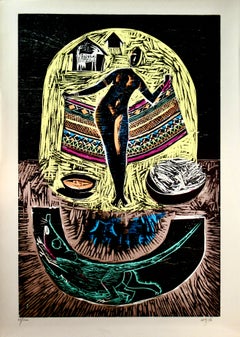
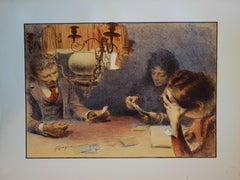
The Lamp : Evening Work - Original Lithograph - 1898
Located in Paris, IDF
Francois GUIGUET
The Lamp : Evening Work , 1898
Original lithograph (Champenois workshop)
Printed signature in the plate
On vellum, 40 x 31 cm (c. 16 x 12 in)
INFORMATION: Lithogra...
Category
1890s Art Nouveau Nude Prints
Materials
Lithograph
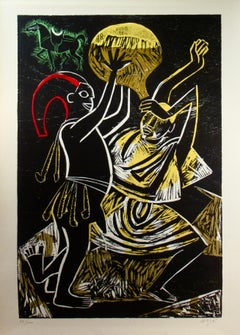
"Lendas Africanas Da Bahia" from the suite.
Located in San Francisco, CA
This artwork titled " Lendas Africanas Da Bahia" from the suite, 1978, is an original colors woodcut by renown Brazilian/Argentinian artist Hector Julio Paride Barnabo Carybe, 1911-1997. It is hand signed and numbered 83/200 in pencil by the artist. The Wood block mark (image) is 23.65 x 15.75 inches, sheet size is 26.75 x 19 inches. It is in excellent condition, has never been framed. It will be shipped in a 8 inches diameter heavy duty tube.
About the artist:
Héctor Julio Páride Bernabó (7 February 1911 – 2 October 1997) was an Argentine-Brazilian artist, researcher, writer, historian and journalist. His nickname and artistic name, Carybé, a type of piranha, comes from his time in the scouts. He died of heart failure after the meeting of a candomblé community's lay board of directors, the Cruz Santa Opô Afonjá Society, of which he was a member.
Quick Facts Born, Died ...
Carybé
Born
Héctor Julio Páride Bernabó
7 February 1911
Lanús, Argentina
Died
2 October 1997 (aged 86)
Salvador, Bahia, Brazil
Nationality
Brazilian
Known for
Painter, engraver, draughtsman, illustrator, potter, sculptor, mural painter, researcher, historian and journalist
Close
He produced thousands of works, including paintings, drawings, sculptures and sketches. He was an Obá de Xangô, an honorary position at Ilê Axé Opô Afonjá.
Orixá Panels in the Afro-Brazilian Museum in Salvador
Some of Carybé's work can be found in the Afro-Brazilian Museum in Salvador: 27 cedar panels representing different orixás or divinities of the Afro-Brazilian religion candomblé. Each panel shows a divinity with their associated implements and animal. The work was commissioned by the former Banco da Bahia S.A., now Banco BBM S.A., which originally installed them in its branch on Avenida Sete de Setembro in 1968.
Murals at Miami International Airport
American Airlines, Odebrecht and the Miami-Dade Aviation Department partnered to install two of Carybé's murals at Miami International Airport. They have been displayed in the American Airlines terminal at John F. Kennedy International Airport in New York since 1960. The 16.5 x 53-foot murals were accredited when Carybé won the first and the second prize in a contest of public art pieces for JFK airport.
As its terminal at that airport was due for demolition, American Airlines donated the murals to Miami-Dade County, and Odebrecht invested in a project to remove, restore, transport and install the murals at Miami International Airport.
The mural "Rejoicing and Festival of the Americas" portrays colorful scenes from popular festivals throughout the Americas, and "Discovery and Settlement of the West" depicts the pioneers’ journey into the American West.
Carybé's Woodcuts in Gabriel García Márquez's Books
Carybé illustrated four books by the Colombian writer Gabriel García Márquez, including One Hundred Years of Solitude, The Autumn of the Patriarch, Chronicle of a Death Foretold, and Love in the Time of Cholera "Carybé: um mestre da cultura baiana". ArqBahia Arquitetura, design, arte e lifestyle (in Brazilian Portuguese). 26 April 2023.. In particular, the woodcuts in One Hundred Years of Solitude are well-known for providing a visual image of the fictional town of Macondo, where the story takes place. The illustrations depict the colorful and winding houses, the railway bridge, and the hot and humid climate of the region, contributing to the reader's immersion in the story.
Carybé's woodcuts are, therefore, an important part of Gabriel García Márquez's literary legacy, bringing a visual dimension to his stories that further enriches the reader's experience.
Timeline
1911 — Birth in Lanús, Argentina.
1919 — Moved to Brazil.
1921 — The name Carybé is first given to him by the Clube do Flamengo scouts group, in Rio de Janeiro.
1925 — Beginning of his artistic endeavours, going to the pottery workshop of his elder brother, Arnaldo Bernabó, in Rio de Janeiro.
1927–1929 — Studies at the National School of Fine Arts, in Rio de Janeiro.
1930 — Worked for the newspaper Noticias Gráficas, in Buenos Aires, Argentina.
1935–1936 — Works with the writer Julio Cortázar and as a draughtsman for the El Diario newspaper.
1938 — Sent to Salvador by newspaper Prégon.
1939 — First collective exhibition, with the artist Clemente Moreau, at the Buenos Aires City Museum of Fine Arts, Argentina; illustrates the book Macumba, Relatos de la Tierra Verde, by Bernardo Kardon, published by Tiempo Nuestro.
1940 — Illustrates the book Macunaíma, by Mário de Andrade.
1941 — Draws the Esso Almanach, the payment for which allows him to set on a long journey through Uruguay, Brazil, Bolivia, and Argentina.
1941–1942 — Study trip around several South American countries.
1942 — Illustration for the book La Carreta by Henrique Amorim, published by El Ateneo (Buenos Aires, Argentina).
1943 — Together with Raul Brié, translates the book Macunaíma, by Mário de Andrade, into Spanish; produces the illustrations for the works Maracatu, Motivos Típicos y Carnavalescos, by Newton Freitas, published by Pigmaleon, Luna Muerta, by Manoel Castilla, published by Schapire, and Amores de Juventud, by Casanova Callabero; also publishes and illustrates Me voy al Norte, for the quarterly magazine Libertad Creadora; awarded First Prize by the Cámara Argentina del Libro (Argentine Book Council) for the illustration of the book Juvenília, by Miguel Cané (Buenos Aires, Argentina).
1944 — Illustrates the books The Complete Poetry of Walt Whitmann and A Cabana do Pai Tomás, both published by Schapire ; as well as and Los Quatro Gigantes del Alma by Mira y Lopez, Salvador BA; attends capoeira classes, visits candomblé meetings and makes drawings and paintings.
1945 — Does the illustrations for Daniel Defoe's Robinson Crusoe, for the Viau publishing house.
1946 — Helps in setting up the Tribuna da Imprensa newspaper, in Rio de Janeiro.
1947 — Works for the O Diário Carioca newspaper, in Rio de Janeiro.
1948 — Produces texts and illustrations for the book Ajtuss, Ediciones Botella al Mar (Buenos Aires, Argentina).
1949–1950 — Invited by Carlos Lacerda to work at the Tribuna da Imprensa, in Rio de Janeiro.
1950 — Invited by the Education Secretary Anísio Teixeira, moves to Bahia, and produces two panels for the Carneiro Ribeiro Education Center (Park School), in Salvador, Bahia.
1950–1997 — Settles in Salvador, Bahia.
1950–1960 — Actively participate in the plastic arts renewal movement, alongside Mário Cravo Júnior, Genaro de Carvalho, and Jenner Augusto.
1951 — Produces texts and illustrations for the works of the Coleção Recôncavo, published by Tipografia Beneditina and illustrations for the book, Bahia, Imagens da Terra e do Povo, by Odorico Tavares, published by José Olímpio in Rio de Janeiro; for the latter work he receives the gold medal at the 1st Biennial of Books and Graphic Arts.
1952 — Makes roughly 1,600 drawings for the scenes of the movie O Cangaceiro, by Lima Barreto; also works as the art director and as an extra on the film (São Paulo, SP).
1953 — Illustrations for the book A Borboleta Amarela, by Rubem Braga, published by José Olímpio (Rio de Janeiro, RJ).
1955 — Illustrates the work O Torso da Baiana, edited by the Modern Art Museum of Bahia.
1957 — Produces etchings, with original designs, for the special edition of Mário de Andrade's Macunaíma, published by the Sociedade dos 100 Bibliófilos do Brasil.
1958 — Makes an oil painting mural for the Petrobras Office in New York, USA; illustrates the book As Três Mulheres de Xangô, by Zora Seljan, published by Editora G. R. D. (Rio de Janeiro, RJ); Receives a scholarship grant in New York, USA.
1959 — Takes part in the competition for the New York International Airport panels project, in New York, USA, winning first and second prizes.
1961 — Illustrates the book Jubiabá, by Jorge Amado, published by Martins Fontes (São Paulo, SP).
1963 — Awarded the title of Honorary Citizen of Salvador, Bahia.
1965 — Illustrates A Muito Leal e Heróica Cidade de São Sebastião do Rio de Janeiro, published by Raymundo Castro Maya (Rio de Janeiro, RJ).
1966 — With Jorge Amado, co-authors Bahia, Boa Terra Bahia, published by Image (Rio de Janeiro, RJ); writes and illustrates the book Olha o Boi, published by Cultrix (São Paulo, SP).
1967 — Receives the Odorico Tavares Prize – Best Plastic Artist of 1967, in a competition ran by the state government to stimulate the development of plastic arts in Bahia; makes the Orixás Panels for the Banco da Bahia (currently at the UFBA Afro-Brazilian Museum) (Salvador, BA).
1968 — Illustrates the books Carta de Pero Vaz de Caminha ao Rei Dom Manuel, published by Sabiá (Rio de Janeiro) and Capoeira Angolana, by Waldeloir Rego, published by Itapoã (Bahia).
1969 — Produces the illustrations for the book Ninguém Escreve ao Coronel, by Gabriel Garcia Marquez, published by Sabiá (Rio de Janeiro, RJ).
1970 — Illustrates the books O Enterro do Diabo and Os Funerais de Mamãe Grande, published by Sabiá (Rio de Janeiro, RJ), Agotimé her Legend, by Judith Gleason, published by Grossman Publishers (New York, USA).
1971 — Illustrates the books One Hundred Years of Solitude, by Gabriel Garcia Marquez and A Casa Verde by Mario Vargas Llosa, both published by Sabiá (Rio de Janeiro, RJ); produces texts and illustrations for the book Candomblé da Bahia, published by Brunner (São Paulo, SP).
1973 — Illustrations for Gabriel Garcia Marquez's A Incrível e Triste História de Cândida Erendira e sua Avó Desalmada (Rio de Janeiro, RJ); paints the mural for the Legislative Assembly and the panel for the Bahia State Secretary of the Treasury.
1974 — Produces woodcuts for the book Visitações da Bahia, published by Onile.
1976 — Illustrates the book O Gato Malhado e a Andorinha Sinhá: uma história de amor, by Jorge Amado (Salvador, BA); receives the title of Knight of the Order of Merit of Bahia.
1977 — Certified with the Honor for Afro-Brazilian Cult Spiritual Merit, Xangô das Pedrinhas ao Obá de Xangô Carybé (Magé, RJ).
1978 — Makes the concrete sculpture Oxóssi, in the Catacumba Park; illustrates the book A Morte e a Morte de Quincas Berro D´Água, by Jorge Amado, published by Edições Alumbramento (Rio de Janeiro, RJ).
1979 — Produces woodcuts for the book Sete Lendas Africanas da Bahia, published by Onile.
1980 — Designs the costumes and scenery for the ballet Quincas Berro D´Água, at the Teatro Municipal in Rio de Janeiro.
1981 — Publication of the book Iconografia dos Deuses Africanos no Candomblé da Bahia (Ed. Raízes), following thirty years of research.
1982 — Receives the title of Honorary Doctor of the Federal University of Bahia.
1983 — Makes the panel for the Brazilian Embassy in Lagos, Nigeria.
1984 — Receives the Jerônimo Monteiro Commendation – Level of Knight (Espírito Santo); receives the Castro Alves Medal of Merit, granted by the UFBA Academy of Arts and Letters; makes the bronze sculpture Homenagem à mulher baiana (Homage to the Bahian woman), at the Iguatemi Shopping Center (Salvador, BA).
1985 — Designs the costumes and sets for the spectacle La Bohème, at the Castro Alves Theater; illustrates the book Lendas Africanas dos Orixás, by Pierre Verger, published by Currupio.
1992 — Illustrates the book O sumiço da santa: uma história de feitiçaria, by Jorge Amado (Rio de Janeiro, RJ).
1995 — Illustration of the book O uso das plantas na sociedade iorubá, by Pierre Verger (São Paulo, SP).
1996 — Making of the short film Capeta Carybé, by Agnaldo Siri Azevedo, adapted from the book O Capeta Carybé, by Jorge Amado, about the artist Carybé, who was born in Argentina and became the most Bahian of all Brazilians.
1997 — Illustration of the book Poesias de Castro Alves.
Exhibitions
ммIndividual Exhibitions:
1943 — Buenos Aires (Argentina) — First individual exhibition, at the Nordiska Gallery
1944 — Salta (Argentina) — at the Consejo General de Educacion
1945 — Salta (Argentina) — Amigos del Arte, Buenos Aires (Argentina) — Motivos de América, at the Amauta Gallery, Rio de Janeiro RJ — individual exhibition at the IAB/RJ
1947 — Salta (Argentina) — Agrupación Cultural Femenina
1950 — Salvador BA — First individual exhibit in Bahia, at the Bar Anjo Azul; São Paulo SP — MASP.
1952 — São Paulo SP — MAM/SP
1954 — Salvador BA — Oxumaré Gallery
1957 — New York (USA) — Bodley Gallery; Buenos Aires (Argentina) — Bonino Gallery * 1958 - New York (USA) — Bodley Gallery
1962 — Salvador BA - MAM/BA
1963 — Rio de Janeiro RJ — Bonino Gallery
1965 — Rio de Janeiro RJ — Bonino Gallery
1966 — São Paulo SP — Astrea Gallery
1967 — Rio de Janeiro RJ — Santa Rosa Gallery
1969 — London (England) — Varig Airlines
1970 — Rio de Janeiro RJ — Galeria da Praça
1971 — Rio de Janeiro RJ — MAM/RJ, São Paulo SP — A Galeria; Belo Horizonte MG, Brasília DF, Curitiba PR, Florianopolis SC, Porto Alegre RS, Rio de Janeiro RJ and São Paulo SP — The Orixás Panel (exhibition tour), at the Casa da Cultura in Belo Horizonte, MAM/DF, the Public Library of Paraná, the Legislative Assembly of Santa Catarina State, the Legislative Assembly of Rio Grande do Sul, MAM/RJ and MAM/SP
1972 — The Orixás Panel in Fortaleza CE — at the Ceará Federal University Art Museum, and in Recife PE — at the Santa Isabel Theater
1973 — São Paulo SP — A Galeria
1976 — Salvador BA — at the Church of the Nossa Senhora do Carmo Convent
1980 — São Paulo SP — A Galeria
1981 — Lisbon (Portugal) — Cassino Estoril
1982 — São Paulo SP — Renot Art Gallery, São Paulo SP — A Galeria
1983 — New York (USA) — Iconografia dos Deuses Africanos no Candomblé da Bahia, The Caribbean Cultural Center
1984 — Philadelphia (USA) — Art Institute of Philadelphia; Mexico — Museo Nacional de Las Culturas; São Paulo SP — Galeria de Arte André
1986 — Lisbon (Portugal) — Cassino Estoril; Salvador BA — As Artes de Carybé, Núcleo de Artes Desenbanco
1989 — Lisbon (Portugal) — Cassino Estoril; São Paulo SP — MASP
1995 — São Paulo SP — Documenta Galeria de Arte, São Paulo SP — Casa das Artes Galeria, Campinas SP — Galeria Croqui, Curitiba PR — Galeria de Arte Fraletti e Rubbo, Belo Horizonte MG — Nuance Galeria de Arte, Foz do Iguaçu PR — Ita Galeria de Arte, Porto Alegre RS — Bublitz Decaedro Galeria de Artes, Cuiabá MT — Só Vi Arte Galeria, Goiânia GO — Época Galeria de Arte, São Paulo SP — Artebela Galeria Arte Molduras, Fortaleza CE — Galeria Casa D'Arte, Salvador BA — Oxum Casa de Arte
Collective Exhibitions:
1939 — Buenos Aires (Argentina) — Carybé and Clemente Moreau Exhibition, at the Museo Municipal de Belas Artes
1943 — Buenos Aires (Argentina) — 29th Salon de Acuarelistas y Grabadores — first prize
1946 — Buenos Aires (Argentina) — Drawings by Argentine Artists, at the Kraft Gallery
1948 — Washington (USA) — Artists of Argentina, at the Pan American Union Gallery
1949 — Buenos Aires (Argentina) — Carybé and Gertrudis Chale, at the Viau Gallery; Salvador BA — Bahian Showroom of Fine Arts, at the Hotel Bahia
1950 — Salvador BA — 2nd Bahian Showroom of Fine Arts; São Paulo SP — MAM/SP
1951 — São Paulo SP — 1st São Paulo Art Biennial, Trianon Pavilion.
1952 — Salvador BA — 3rd Bahian Showroom of Fine Arts, at Belvedere da Sé; São Paulo SP — MAM/SP
1953 — Recife PE — Mario Cravo Júnior and Carybé, at the Santa Isabel Theater; São Paulo SP — 2nd São Paulo Art Biennial, at MAM/SP
1954 — Salvador BA — 4th Bahian Showroom of Fine Arts, at the Hotel Bahia. — Bronze medal
1955 — São Paulo SP — 3rd São Paulo Art Biennial, at MAM/SP — first prize for drawing
1956 — Salvador BA — Modern Artists of Bahia, at the Oxumaré Gallery; Venice (Italy) — 28th Venice Biennial
1957 — Rio de Janeiro RJ — 6th National Modern Art Show — exemption from the jury; São Paulo SP — Artists from Bahia, at the MAM/SP
1958 — San Francisco (USA) — Works by Brazilian Artists, at the Fine Arts Museums of San Francisco, Washington and New York (USA) — Works by Brazilian Artists, at the Pan American Union and the MoMA
1959 — Seattle (USA) — 30th International Exhibition, at the Seattle Art Museum; Salvador BA — Modern Artists of Bahia, at the Dentistry School.
1961 — São Paulo SP — 6th São Paulo Art Biennial, at MAM/SP — special room
1963 — Lagos (Nigeria) — Brazilian Contemporary Artists, at the Nigerian Museum; São Paulo SP — 7th São Paulo Art Biennial Bienal, at the Fundação Bienal
1964 — Salvador BA — Christmas Exhibition, at the Galeria Querino
1966 — Baghdad (Iraq) — collective exhibition sponsored by the Calouste Gulbenkian Foundation; Madrid (Spain) — Artists of Bahia, at the Hispanic Culture Institute; Rome (Italy) — Piero Cartona Palace; Salvador BA — 1st National Biennial of Plastic Arts (Bienal da Bahia) — special room; Salvador BA — Draughtsmen of Bahia, at the Convivium Gallery
1967 — Salvador BA — Christmas Exhibition at the Panorama Art Gallery; São Paulo SP — Artists of Bahia, at the A Gallery
1968 — São Paulo SP — Bahian Artists, at the A Gallery
1969 — London (England) — Tryon Gallery; São Paulo SP — 1st Panorama of Current Brazilian Art at the MAM/SP; São Paulo SP — Carybé, Carlos Bastos...
Category
Late 20th Century Modern Nude Prints
Materials
Woodcut
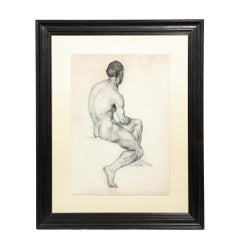
Untitled (Male Nude)
Located in New York, NY
Realized in the manner of Thomas Eakins, this sophisticated figurative print presents a nude male model with his back to the viewer. Showcasing both the technical faculty of the arti...
Category
20th Century Realist Nude Prints
Materials
Digital
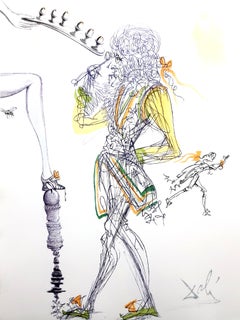
Salvador Dali - Six Eggs
Located in Collonge Bellerive, Geneve, CH
Salvador Dali - Six Eggs - Original Etching
Dimensions: 38 x 28 cm
Edition: 390
1967
On Rives Vellum
References : Field 67-4 (p. 32-33) / Michler & Lopsinger 174 to 187.
Category
1960s Surrealist Nude Prints
Materials
Etching
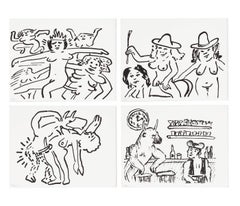
Keith Haring Fault Lines 1986 (4 works)
By Keith Haring
Located in NEW YORK, NY
Keith Haring Fault Lines 1986 (set of 4 printed works):
A grouping of 4 lithographs from the book Fault Lines by Brison Gysin with illustrations by Keith Haring. These works are eac...
Category
1980s Pop Art Nude Prints
Materials
Lithograph
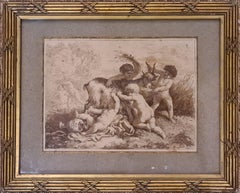
The Harvest, Cherubs Disporting with a Goat, Fine Framed 18th Century Engraving
By Jean Jacques Lagrenée the Younger
Located in Cotignac, FR
Fine 18th century engraving by French artist Jean-Jacques Lagrenée. Presented with hand cut mount and gilt filet in fine wood and gilt 'ribbon and reed' frame.
Very charming renditi...
Category
Mid-18th Century Nude Prints
Materials
Paper, Printer s Ink
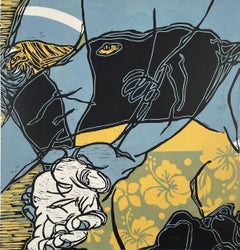
The Gathering (top left), male nude by Fernando Reyes
Located in Palm Springs, CA
The Gathering (TL)
Color woodcut, signed and titled in pencil
Edition: WP/III (Workshop Proof)
This vibrant abstract woodcut by Fernando Reyes showcases his signature blend of bold ...
Category
21st Century and Contemporary Contemporary Nude Prints
Materials
Woodcut
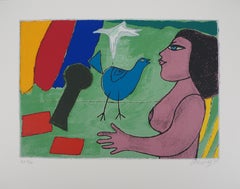
Dreaming Nude and Blue Bird - Original handsigned lithograph
By Corneille
Located in Paris, IDF
Corneille
Dreaming Nude and Blue Bird, 1998
Original lithograph
Handsigned in pencil
Numbered EA / 20
On vellum 52 x 66 cm (c. 21 x 26 inch)
Excellent condition
Category
1990s Surrealist Nude Prints
Materials
Lithograph
The Embrace - Original Lithograph by Felice Casorati - 1946
Located in Roma, IT
Hand Signed. Edition of 100 prints plus 5 prints in Roman Numerals.
From the portfolio: "Dieci Litografie (Numerus, Mensura, Pondus)".
Very rare print in perfect conditions.
This a...
Category
1940s Nude Prints
Materials
Lithograph
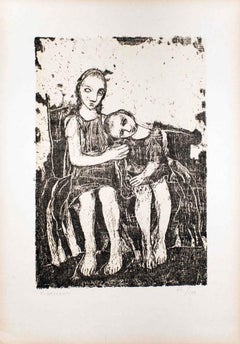
Jean Cocteau - White Book - Original Handcolored Lithograph
By Jean Cocteau
Located in Collonge Bellerive, Geneve, CH
Jean Cocteau
White Book - Autobiography about Cocteau's discovery of his homosexuality. The book was first published anonymously and created a scandal.
Original Handcolored Lithograp...
Category
1930s Modern Nude Prints
Materials
Lithograph
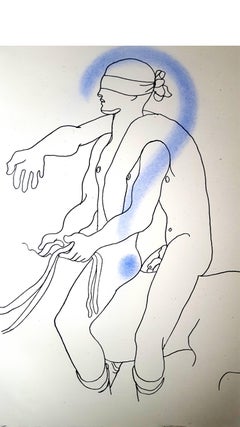
In My MInd II
By Tracey Emin
Located in New York, NY
Polymer Gravure on paper. Signed by the artist, dated, and numbered 87/100 in pencil lower margin. Titled in pencil, lower left.
Published by White Cube Editions, London.
Category
2010s Contemporary Nude Prints
Materials
Polymer, Black and White
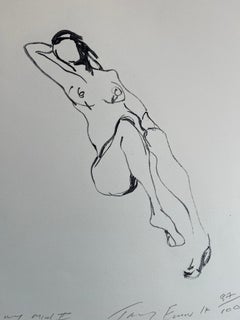
Etching from Le Satyricon
By André Derain
Located in Surfside, FL
This offering is for one etching.
---
Derain was born in 1880 in Chatou, Yvelines, Île-de-France, just outside Paris. In 1895 Derain began to study on his own, contrary to claims tha...
Category
20th Century Nude Prints
Materials
Etching
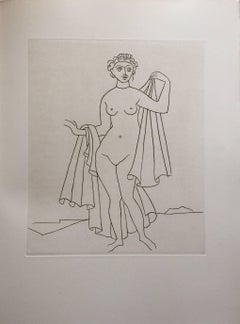
Naked Girl in Spray, Head Thrown Back
— 1930s Modernist Female Nude
By Eric Gill
Located in Myrtle Beach, SC
Eric Gill, 'Naked Girl in Spray, Head Thrown Back to Left, Four Leaves' and 'Naked Girl in Spray, Head Upright, Hands Over Head', wood engraving, 1930, edit...
Category
1930s Art Deco Nude Prints
Materials
Woodcut
$960 Sale Price
20% Off
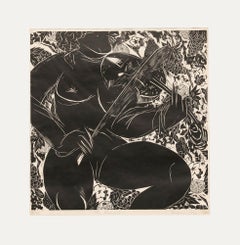
Tsugumi Ota (b.1951) - 1985 Linoprint, The Violinist
Located in Corsham, GB
A large, striking lino print by Tsugumi Ota (b.1951) depicting a nude woman playing the violin. Signed, dated, and titled in graphite below the image. Numbered 3/30. On paper.
Category
20th Century Nude Prints
Materials
Linocut
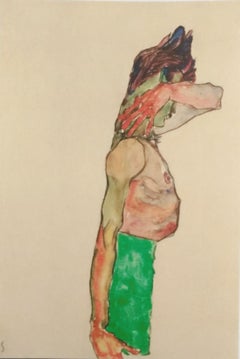
Mädchen mit grünem Rock - Original Lithograph After E. Schiele
Located in Roma, IT
This lithograph from the portfolio "Egon Schiele" is a reproduction of "Mädchen mit grünem Rock", an original artwork realized by Egon Schiele in 1910.
The portfolio, that includes...
Category
1910s Modern Nude Prints
Materials
Lithograph
Normandy, Cabourg - Lithograph (Les Maîtres de l
Affiche), Imprimerie Chaix 1897
Located in Paris, IDF
Henri PRIVAT-LIVEMONT (1861-1936)
Normandy, Cabourg, 1897
Stone lithograph
Printed signature in the plate
On vellum
Size 29 x 39 cm (c. 11.4 x 15.3 in)
Bears the blind stamp of the...
Category
1890s Art Nouveau Nude Prints
Materials
Lithograph

Leonor Fini - Pleasure - Original Lithograph
By Leonor Fini
Located in Collonge Bellerive, Geneve, CH
Leonor Fini - Pleasure - Original Lithograph
The Flowers of Evil
1964
Conditions: excellent
Edition: 500
Dimensions: 46 x 34 cm
Editions: Le Cercle du Livre Précieux, Paris
Unsigne...
Category
1960s Modern Nude Prints
Materials
Lithograph
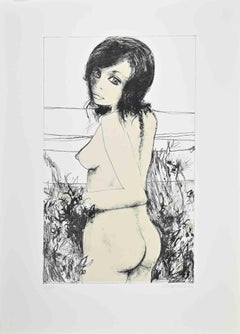
Nude from the Back - Screen Print by Nicola Simbari - 1976
Located in Roma, IT
Screen print realized by Nicola Simbari in 1976.
Edition of 90.
Hand signed in pencil.
Very good condition.
Category
1970s Contemporary Nude Prints
Materials
Screen
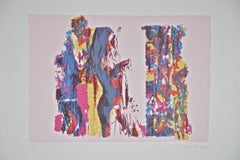
Nan Goldin - Lydia Lunch at the Russian Baths, East 10th Street, 1985, poster
By Nan Goldin
Located in New York, NY
Nan Goldin
Lydia Lunch at the Russian Baths, 268 East 10th Street, 1985 poster, 2018
Offset lithograph poster (unsigned, unnumbered and unframed)
17 × 22 inches
Published by The Kitchen in 2018, on the occasion of their Gala honoring Nan Goldin and Lydia Lunch
Provenance
Acquired from The Kitchen on the occasion of their 2018 Gala
Also accompanied by Certificate of Guarantee from Alpha 137 Gallery
Excerpt from The Kitchen description of this event:
“During the late ‘80s and early ‘90s, icons Goldin and Lunch were vanguards of post-punk New York. Both women have presented their work at The Kitchen throughout the years, consistently returning to premiere new works that went on to exemplify their careers. Goldin’s portraiture of her close-knit circle of friends in New York became emblematic of her generation’s grappling with the social issues of the time, from the epidemic of drug addiction to the AIDS crisis. Lunch is revered as a radical progenitor of No Wave music, fronting the influential Teenage Jesus and the Jerks and collaborating with acts like JG Thirlwell, Birthday Party, and Sonic Youth. Lunch has a broad artistic practice, also working in film, visual art, writing, and spoken-word. Goldin and Lunch have also collaborated on numerous occasions. For instance, the cover of Lunch’s 1995 album Drowning In Limbo featured a portrait of her taken by Goldin. Lunch also posed for Goldin’s project for The Village Voice’s short-lived fashion insert Vue in 1985. Shot as part of an editorial called “Masculine/Feminine,” the image of a reclining Lunch at Russian baths in the East Village was ultimately not included in the final layout, and we were pleased to be present the image for the first time as a limited-edition print in support of The Kitchen.
At The Kitchen in November 1980, Goldin presented slides as part of Dubbed in Glamour, a three-day event of “spectacle and extravagance” organized by Edit deAk that featured primarily women artists. Introduced by Cookie Mueller, who served as the master of ceremonies, these slides were an early version of Goldin’s landmark work The Ballad of Sexual Dependency, which continued to take shape during the next few years. The Bush Tetras, who performed at this year’s gala, also participated in Dubbed in Glamour.
In 1994, Goldin returned to The Kitchen to premiere three slideshows for the first time in the United States as part of the winter lecture series curated by Ira Silverberg. The first slideshow developed from her 1992 award-winning book The Other Side, which lauded the drag queens she lived with and among in New York. During the ‘70s, when Goldin first moved to the city, the people she lived with became not just her subjects, but also her chosen family. The second slideshow was a series of intimate self-portraits. The evening concluded with a collection of Goldin’s images that traced her relationships to her close friends Alf Bold, Gilles Dusein, and Cookie Mueller and celebrated the joy of their lives and the pain of their deaths from AIDS.
In 1985, Lunch first appeared at The Kitchen as part of the two-night screening series of experimental short films, Super 8 Motel. She and Richard Kern...
Category
2010s Contemporary Nude Prints
Materials
Lithograph, Offset

Untitled (Nude Dancer) — 1920s Modernism
Located in Myrtle Beach, SC
Boris Lovet-Lorski, 'Untitled (Nude Dancer)', lithograph, edition 250, 1929. Signed and numbered 12 in pencil. Number 12 of Volume 2, a series of 10 lithogr...
Category
1920s Art Deco Nude Prints
Materials
Lithograph
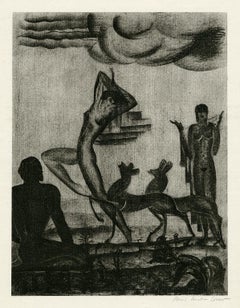
Sybil - Original Etching by Leo Guida - 1970
By Leo Guida
Located in Roma, IT
Image dimensions: 12.5 x 15.5 cm.
Drypoint, etching.
Not signed.
Good condition.
Category
1970s Contemporary Nude Prints
Materials
Etching
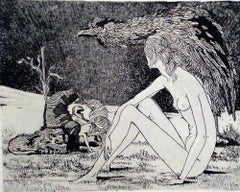
Kneeling Male Nude in Profile - Original Lithograph after E. Schiele
Located in Roma, IT
Kneeling Male Nude in Profile is a beautiful and original colored lithograph from the portfolio "Erotica" by Egon Schiele.
It is a reproduction of the homonym artwork realized in gou...
Category
Early 2000s Modern Nude Prints
Materials
Lithograph
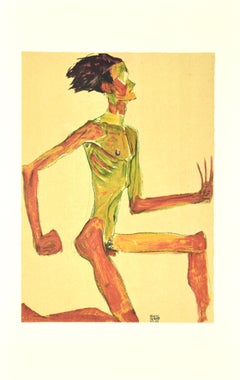
Cosmic Embrace
, San Francisco Bay Area Modernist, Atelier 63 Woman Artist
Located in Santa Cruz, CA
Stamped verso with certification of authenticity for Jane Voitle Mellin (American, born 1952). and created circa 1975.
An atmospheric, sugar-lift aquatint showing a young woman, nud...
Category
1970s Nude Prints
Materials
Paper, Aquatint
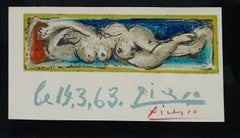
Femme nue couchée
Located in New York, NY
Color lithograph, 1963. Signed by the artist in red crayon, lower right.
Published by Éditions Cercle d'Art, Paris. From Les Dames de Mougins.
Edition of 1000, unnumbered
Frame...
Category
1960s Modern Nude Prints
Materials
Lithograph
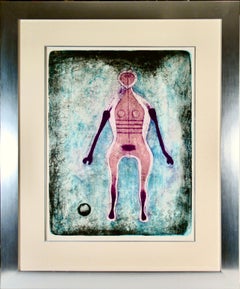
La Negra (The Black Woman)
Located in San Francisco, CA
This artwork titled "La Negra (The Black Woman)" from the suite "The Mujeres File" 1969 is an original colors lithograph on B.F.K. Rives paper by renown Mexican artist Rufino Tamayo, 1899-1991. It is hand signed and numbered 150/150 in pencil by the artist. The image size is 26.85 x 21.25 inches, sheet size is 29.5 x 22.15 inches, framed size is 42 x 35 inches. Published by Touchtone Publisher, New York, printed by Ateliers Desjobert, Paris. Referenced and pictured in the artist's catalogue raisonne by Pereda, plate #109 page 107. Custom framed in a wooden silver frame, with silver spacer and fabric matting. It is in excellent condition.
About the artist:
A native of Oaxaca in Southern Mexico, Rufino Tamayo's father was a shoemaker, and his mother a seamstress. Some accounts state that he was descended from Zapotec Indians, but he was actually 'mestizo' - of mixed indigenous/European ancestry. (Santa Barbara Museum of Art). He began painting at age 11. Orphaned at the age of 12, Tamayo moved to Mexico City, where he was raised by his maternal aunt who owned a wholesale fruit business.
In 1917, he entered the San Carlos Academy of Fine Arts, but left soon after to pursue independent study. Four years later, Tamayo was appointed the head designer of the department of ethnographic drawings at the National Museum of Archaeology in Mexico City. There he was surrounded by pre-Colombian objects, an aesthetic inspiration that would play a pivotal role in his life. In his own work, Tamayo integrated the forms and tones of pre-Columbian ceramics into his early still lives and portraits of Mexican men and women.
In the early 1920s he also taught art classes in Mexico City's public schools. Despite his involvement in Mexican history, he did not subscribe to the idea of art as nationalistic propaganda. Modern Mexican art at that time was dominated by 'The Three Great Ones' : Diego Rivera, Jose Clemente Orozco, and David Alfaro Siqueros, but Tamayo began to be noted as someone 'new' and different' for his blending of the aesthetics of post Revolutionary Mexico with the vanguard artists of Europe and the United States.
After the Mexican Revolution, he focused on creating his own identity in his work, expressing what he thought was the traditional Mexico, and refusing to follow the political trends of his contemporary artists. This caused some to see him as a 'traitor' to the political cause, and he felt it difficult to freely express himself in his art. As a result, he decided to leave Mexico in 1926 and move to New York, along with his friend, the composer Carlos Chavez. The first exhibition of Tamayo's work in the United States was held at the Weyhe Gallery, New York, in that same year. The show was successful, and Tamayo was praised for his 'authentic' status as a Mexican of 'indigenous heritage', and for his internationally appealing Modernist aesthetic. (Santa Barbara Museum of Art).
Throughout the late thirties and early forties New York's Valentine Gallery gave him shows. For nine years, beginning in 1938, he taught at the Dalton School in New York.
In 1929, some health problems led him to return to Mexico for treatment. While there he took a series of teaching jobs. During this period he became romantically involved with the artist Maria Izquierdo...
Category
Mid-20th Century Modern Nude Prints
Materials
Lithograph
Avant Garde Surrealist Abstract Female Nude Signed Limited Edition Lithograph
Located in Cotignac, FR
Avant-garde female nude lithograph on paper by Danish artist Wilhelm Freddie. Number 80 from an edition of 170. Signed, dated and titled in pencil bottom left, numbered in pencil bot...
Category
Late 20th Century Surrealist Nude Prints
Materials
Paper, Lithograph
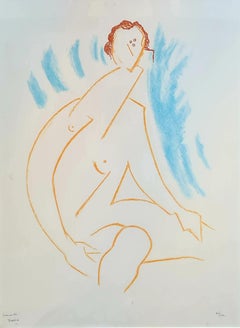
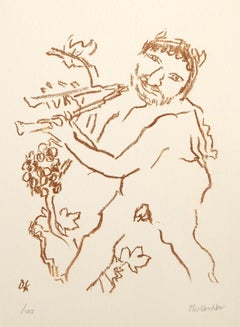
Musizierender Faun, Modern Nude Lithograph by Oskar Kokoschka
Located in Long Island City, NY
Oskar Kokoschka, Austrian (1886 - 1980) - Musizierender Faun, Year: 1976, Medium: Lithograph on laid paper, signed and numbered in pencil, Edition: 100, Image Size: 10.25 x 8 inche...
Category
1970s Modern Nude Prints
Materials
Lithograph
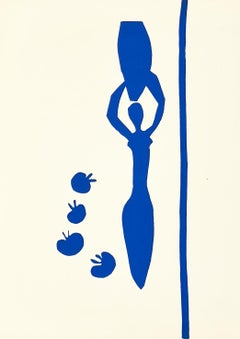
Le Jarre II, from The Last Works of Henri Matisse
Located in Washington, DC
Artist: Henri Matisse (after)
Title: Le Jarre II
Portfolio: The Last Works of Henri Matisse
Medium: Lithograph
Year: 1958
Edition: 2000
Framed Size: 20 1/2" x 15 1/4"
Sheet Size: 14"...
Category
1950s Nude Prints
Materials
Lithograph
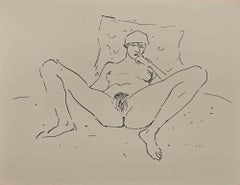
Erotic Scene - Lithograph by Albert Marquet - 1920s
Located in Roma, IT
Erotic Scene is a beautiful lithograph on ivory-colored paper, realized in the 1920s by Albert Marquet (Bordeaux, 1875 - Paris,1947).
Monogrammed on the plate on the lower margin. ...
Category
1920s Modern Nude Prints
Materials
Lithograph
$711 Sale Price
20% Off
Nude III
Located in San Francisco, CA
This artwork "Nude III" 1981, is an original etching in sepia on Wove paper by noted American artist Charles Eckart, b.1935. It is hand signed, numbered 10/17 and dated in pencil by ...
Category
21st Century and Contemporary Abstract Expressionist Nude Prints
Materials
Etching

Nude - Etching by Carlo Marcantonio - 1970s
Located in Roma, IT
Nude is an etching on paper realized by Carlo Marcantonio.
Hand-signed in the lower right in pencil.
Good conditions.
Edition of 50.
Category
1970s Contemporary Nude Prints
Materials
Etching
Erotic Scene - Héliogravure by Micheal Von Zichy - 1911
Located in Roma, IT
Erotic scene is an original Héliogravure artwork on ivory-colored paper, realized by Micheal Von Zichy in 1911. Printed in only 300 copies, Leipzig; Privatdruck, from the Catalogue "Liebe" (Dear), Text in German on the plate, The drawing created unusually bold erotic subjects through deft strokes.
Good conditions.
Mihály Zichy...
Category
1910s Modern Nude Prints
Materials
Paper, Engraving
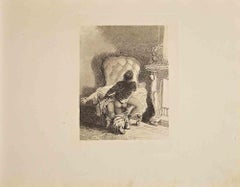
Sexual - Original Etching and Drypoint by Mino Maccari - 1960s
By Mino Maccari
Located in Roma, IT
Image dimensions: 18x11 cm.
Hand signed. Artist's Proof.
Very good conditions.
Category
1960s Nude Prints
Materials
Etching, Aquatint
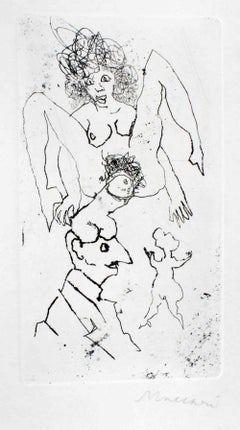
Plate XII, Le Cocu Magnifique
Located in Fairlawn, OH
Plate XII, Le Cocu Magnifique
Etching & aquatyint, 1968
From the unsigned edition of 200 impressions printed on Rives BFK paper
There is also a signed edition of 30 impressions
The s...
Category
1960s French School Nude Prints
Materials
Aquatint
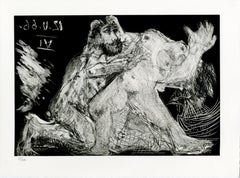
Awakening, female nude against black background by Fernando Reyes
Located in Palm Springs, CA
Signed and numbered linocut, from a series of 4 male and female nudes.
Reyes attended The School of the Art Institute of Chicago, where he received a Bachelor of Fine Arts degree in...
Category
Early 2000s Contemporary Nude Prints
Materials
Linocut
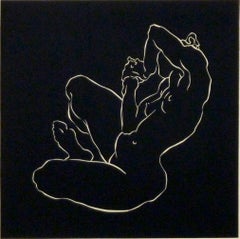
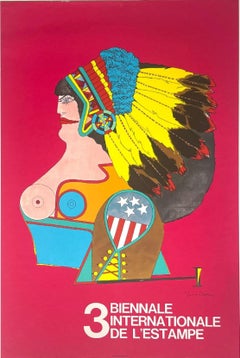
3 Biennale Internationale de L
estampe, France 1968 Miss American Indiana poster
Located in New York, NY
Richard Lindner
3 Biennale Internationale de L'estampe (International Biennale of Graphic Arts), Miss American Indian, 1968
Silkscreen on wove paper
Unnumbered
35 1/2 × 23 1/2 inches...
Category
1960s Pop Art Nude Prints
Materials
Screen
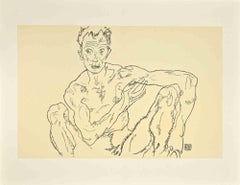
Crouching Male Nude (Self Portrait) - Lithograph - 2007
By Egon Schiele
Located in Roma, IT
Crouching Male Nude (Self-Portrait) is a beautiful lithograph from the portfolio " Erotica " by Egon Schiele.
It is a reproduction of the homonym black crayon drawing, a self-portrai...
Category
Early 2000s Modern Nude Prints
Materials
Lithograph
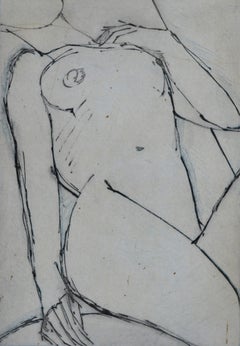
Contemporary Nude Etching by John Emanuel
By John Emanuel
Located in Brecon, Powys
Signed Limited Edition Etching 32 of 75
the artist more known for his Gouache and Oil paintings has here put his hand to an etching.
Image 16" x 11"
Category
21st Century and Contemporary Contemporary Nude Prints
Materials
Paper
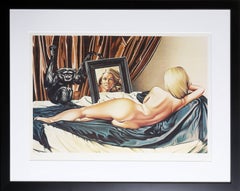
Velasquez Vision, Pop Art Nude Lithograph by Mel Ramos
By Mel Ramos
Located in Long Island City, NY
Artist: Mel Ramos
Title: Velazquez Vision
Year: 1974
Medium: Lithograph, signed and numbered in pencil
Edition: 245/250
Image Size: 16 x 23 inches
Paper Size: 19.25 x 27 inches
Fr...
Category
1970s Pop Art Nude Prints
Materials
Lithograph
Reclining Female Nude, Modern Etching by Henri Matisse
Located in Long Island City, NY
Henri Matisse, French (1869 - 1954) - Reclining Female Nude, Portfolio: Poesies de Stephane Mallarme, Year: 1930, Medium: Etching, Size: 13 x 9.5 in. (33.02 x 24.13 cm), Printer: R...
Category
1930s Modern Nude Prints
Materials
Etching
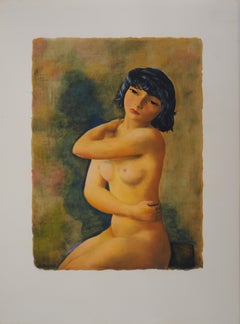
Dreaming Nude - Lithograph
Located in Paris, IDF
Moise KISLING
Dreaming Nude
Lithograph enhanced with watercolor stencil
Printed signature in the plate
On vellum 38 x 28 cm (c. 15 x 11 inch)
Very good condition
Category
1950s Modern Nude Prints
Materials
Lithograph, Stencil
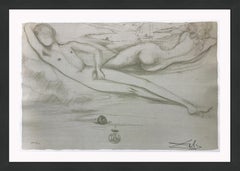
A La Plage (At the Beach), framed hand signed lithograph
Located in Aventura, FL
Lithograph in black on pale green panel on white Rives paper. Hand signed lower right by Salvador Dali. Hand numbered LXXVII/CXX lower left. Artwork size: 20 x 28 inches. Frame ...
Category
1970s Surrealist Nude Prints
Materials
Paper, Lithograph
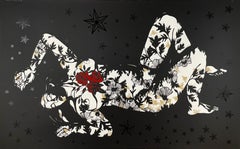
$3,712 Sale Price
25% Off
Inner Landscape, by Sonia Romero
By Sonia Romero
Located in Palm Springs, CA
Signed, titled and numbered by the artist. This is the last remaining print in the edition.
Sonia Romero is a full time artist living and working in East Los Angeles. She received h...
Category
2010s Contemporary Nude Prints
Materials
Screen
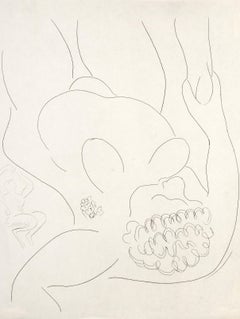
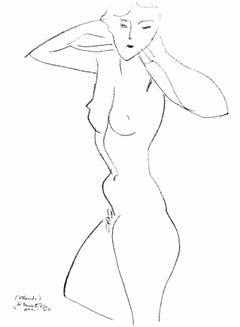
Henri Matisse, Claude, Nude Woman, from Derriere le Miroir, 1952 (after)
Located in Southampton, NY
This exquisite lithograph after Henri Matisse (1869–1954), titled Claude, Femme nue (Claude, Nude Woman), originates from the 1952 folio Derriere le Miroir, No. 46–47, published by M...
Category
1950s Modern Nude Prints
Materials
Lithograph
$716 Sale Price
20% Off
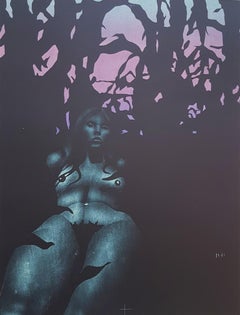
From Portfolio "Twilight" with Karin Szekessy
Located in Kansas City, MO
Paul Wunderlich
From Portfolio "Twilight" with Karin Szekessy
Year: 1971
Medium: Color Lithograph
Edition: 125
Size: 33 x 25 in.
Publisher: A.A.A., New ...
Category
1970s Contemporary Nude Prints
Materials
Lithograph
$350 Sale Price
50% Off
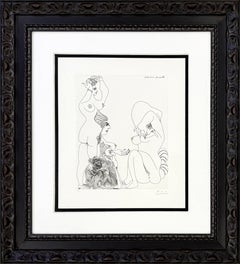
Vieil Homme Avec Magicien Evoquant Trois Odalisques (Bl. 1486, Ba. 1501)
Located in Aventura, FL
Etching on BFK Rives paper, Plate 6 from series 347. Hand signed lower right by Pablo Picasso. Hand numbered 18/50 lower left (there were also 17 artist's proofs). Sheet size: 24 ...
Category
1960s Cubist Nude Prints
Materials
Paper, Etching
$28,000 Sale Price
20% Off
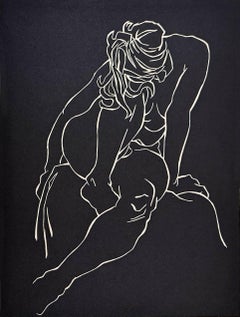
Serene, female nude linocut by Fernando Reyes
Located in Palm Springs, CA
Signed and numbered linocut, from the Sensual Line series of 4 male and female nudes.
Reyes attended The School of the Art Institute of Chicago, where he received a Bachelor of Fine...
Category
Early 2000s Contemporary Nude Prints
Materials
Linocut
Nude - Original Drawing in Pen by Sergio Barletta - 1958
Located in Roma, IT
Nude is an original drawing in pen realized by Sergio Barletta in 1958.
Applied on passepartout: 70 x 49.5 cm.
Hand-signed on the lower right, dated along the left margin.
In very...
Category
1950s Contemporary Nude Prints
Materials
Pen
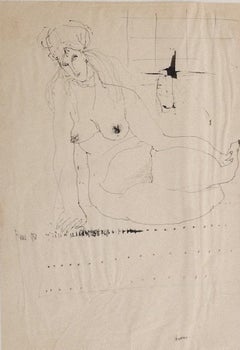
Two nudes - Figurative etching print, Monochromatic, Minimalistic, Female nude
By Leszek Rózga
Located in Warsaw, PL
LESZEK RÓZGA (1924-2015)
He studied painting at Maria Skarbek-Kruszewska private atelier in 1945-46. In 1948, he began studies at the art school in Łódź (later: Academy of Fine Arts) in the studios of professors Władysław Strzemiński, Adam Rychtarski, Stefan Wegner and Ludwik Tyrowicz. He graduated with special award from the Academy of Fine Arts in Krakow in 1954. In 1958 he became a member of the Piąte Koło association ("Fifth Wheel...
Category
Early 2000s Contemporary Nude Prints
Materials
Paper, Watercolor, Drypoint