19th Century Figurative Sculptures
to
48
216
112
148
69
45
Overall Width
to
Overall Height
to
193
590
2,186
7,359
77
41
113
120
59
117
127
173
230
268
67
7
4
2
2
1
462
328
325
285
264
159
116
67
56
44
34
20
20
17
14
13
12
12
11
11
410
400
131
117
40
30
14
12
7
6
354
235
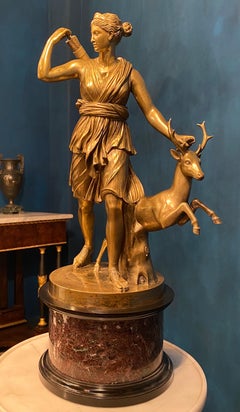
Period: 19th Century
VALTON Charles. The Griffin Marco. Patinated bronze. Marble base. Signed.
Located in Paris, FR
The Griffin Marco. Patinated bronze. Marble base. Signed and titled.
Charles Valton was a French sculptor known for his works created in the animalier style, a 19th-century movement ...
Category
Realist 19th Century Figurative Sculptures
Materials
Bronze
Marble Figure of a Recumbent Lion, 19th Century
Located in Beachwood, OH
Figure of Recumbent Lion, 19th Century
Carved gray veined marble
4.5 x 8 x 4.5 inches
Category
19th Century Figurative Sculptures
Materials
Marble

$1,040 Sale Price
20% Off
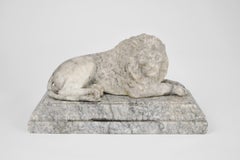
Large Neoclassical White Marble Sculpture Venus Italica mid-19th century
Located in Pistoia, IT
Venus Italica, imposing sculpture in white Carrara marble, mid-nineteenth-century Roman atelier.
Antonio Canova made several sculptures depicting Venus. The first was made as compen...
Category
Italian School 19th Century Figurative Sculptures
Materials
Marble
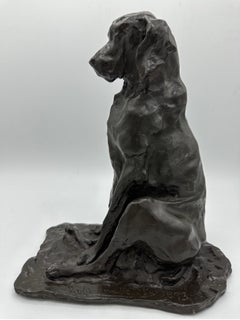
A late 19th century bronze animalier figure of a seated hound
By Prince Paul Troubetzkoy
Located in Bath, Somerset
A late 19th century bronze of a hound, seated on a naturalistic base, after Prince Paul Troubetzkoy. Incised to base 'Paolo Troubetzkoy 1893', with a dark brown patina.
Born in 1866...
Category
Naturalistic 19th Century Figurative Sculptures
Materials
Bronze
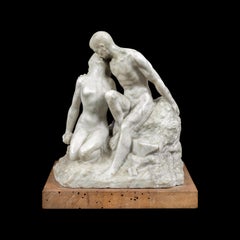
Early 19th century Romantic marble sculpture - Kiss figures
Located in Varmo, IT
White marble sculpture - The Kiss. 19th century.
15 x 20 x h 20 cm including base, 12 x 17 x h 18 cm excluding base.
Entirely in white marble, some small breaks and repairs.
- ...
Category
Romantic 19th Century Figurative Sculptures
Materials
Marble
$1,776 Sale Price
40% Off
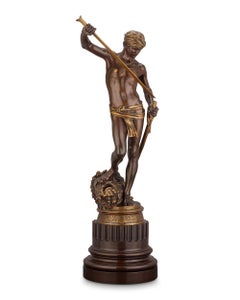
David Vainqueur de Goliath by Marius Jean Antonin Mercié
Located in New Orleans, LA
Marius Jean Antonin Mercié
French (1845-1916)
David vainqueur de Goliath
(David, Victor of Goliath)
Signed “A. Mercié” (on base)
Bronze
This incredible bronze sculpture, entitled ...
Category
Academic 19th Century Figurative Sculptures
Materials
Bronze
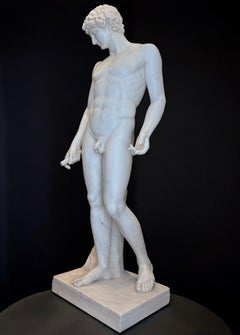
ANTINOUS Magnificent Italian Neoclassical Carrara Marble Sculpture
Located in Rome, IT
Outstanding 19th century Italian finely carved Carrara "Statuario" marble sculpture of Antinoo , after the Antique The Capitoline 'Antinous'.
Antinous, a young Bithinius favorite...
Category
Academic 19th Century Figurative Sculptures
Materials
Marble
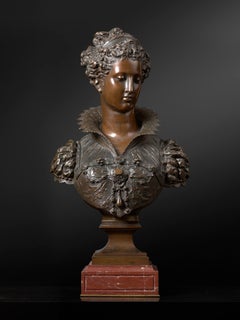
Marie de
Medici
Located in Douglas, Isle of Man
Mathurin Moreau 1822-1912, was a French sculptor in the classic academic style. His father was also a sculptor and his siblings. Mathurin first received a medal at the Salon in 1848,...
Category
19th Century Figurative Sculptures
Materials
Bronze
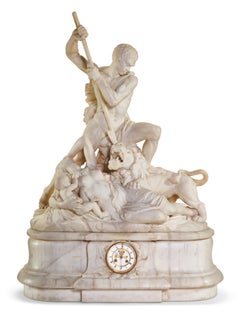
An Exceptional White Marble Figural Sculpture Clock, "A Nubian Slaying The Lion"
Located in Queens, NY
An Exceptional and Monumental White Marble Figural Sculpture Clock, "A Nubian Slaying The Lion" by Jean-Joseph Jacquet (Belgian, 1822–1898), circa 1860
This extremely impressive whi...
Category
19th Century Figurative Sculptures
Materials
Marble
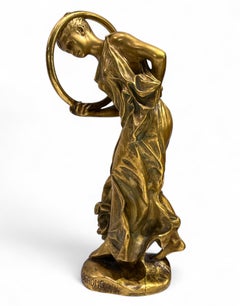
Jean-Léon Gérôme La Danseuse au Cerceau - Gilt Bronze Statue of a Hoop Dancer
Located in New York, NY
Jean-Léon Gérôme
French
1824 - 1904
La Joueuse De Cerceau - The Hoop Dancer
A mini gilt bronze female figural statue of a young hoop dancer inspired by a trove of ancient terraco...
Category
Academic 19th Century Figurative Sculptures
Materials
Bronze
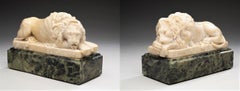
Pair of Italian "Alabaster Stone Lions" after Antonio Canova; Mid 19th Century
Located in SANTA FE, NM
"Pair Recumbent Stone Lions"
after Antonio Canova (1757-1822)
Italian (possibly Florence)
Mid 19th Century
Alabaster, marble
6 x 9 x 4 inches
This is an exquisite pair of Italian alabaster lions on marble bases based on the monumental lions carved by Antonio Canova (1757-1822), the greatest Italian neoclassical sculptor. Canova sculpted the marble lions for the monumental tomb of Pope Clement XIII in St. Peter’s, Rome in 1792
Canova Lions refers to the pair of copies of lion sculptures by Antonio Canova. When Canova created the sculptures in 1792, he installed them on the tomb of Pope Clement XIII. The marble sculptures are some of the most prominent features in St. Peter's Basilica in Rome. Given the intricacies of creating the original Canova lions, some artists created molds and replicated them. A good example is the pair of lion sculptures...
Category
Italian School 19th Century Figurative Sculptures
Materials
Alabaster, Marble
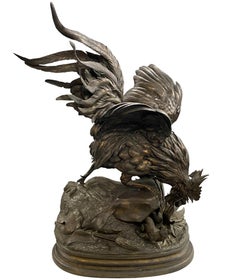
Rooster
Ermine
Located in Milford, NH
A monumental 19th century patinated animalier cast bronze of a rooster & ermine (weasel), with varying titles including "Coq Guettant," "Coq Attaquant une Belette," and "Cockerel and...
Category
19th Century Figurative Sculptures
Materials
Bronze
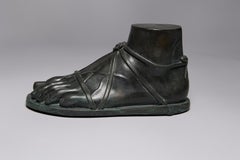
Grand Tour Sandaled Foot of an Antiquity, 19th Century Italian
Located in Beachwood, OH
Grand Tour Italian, 19th Century
Sandaled Foot of an Antiquity
Bronze
5.5 x 12 x 5 inches
Category
19th Century Figurative Sculptures
Materials
Bronze
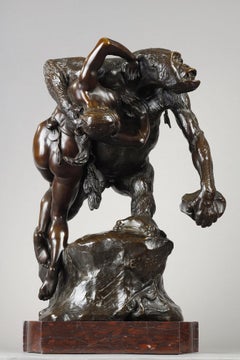
Gorilla kidnapping a woman
Located in PARIS, FR
Emmanuel FREMIET (1824-1910)
Gorilla kidnapping a woman
A rare bronze group with a greenish dark brown patina
signed "E. Fremiet" on the base
cast by " F. Barbedienne Fondeur " (fo...
Category
French School 19th Century Figurative Sculptures
Materials
Bronze
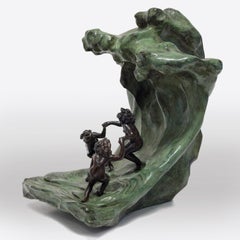
La Vague (The Wave)
Located in Palm Desert, CA
"La Vague (The Wave)" is a figurative abstract bronze sculpture created by Camillle Claudel. The artwork is 24 1/4 x 19 x 24 inches, weighing less than 50 lbs. It is signed "C. Claud...
Category
Impressionist 19th Century Figurative Sculptures
Materials
Bronze
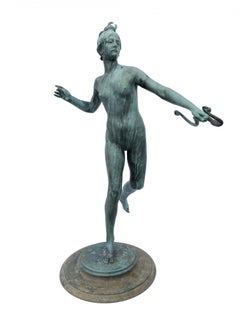
Diana the Huntress, 1890 Classical Bronze Sculpture of Nude Woman
Located in Beachwood, OH
Frederick William MacMonnies (American, 1863-1937)
Diana, 1890
Bronze with green verdigris patina
Signed and dated
Copyright 1894 with Jaboeuf & Rouard, Paris foundry mark
31 x 21 x 17 inches
A sculptor of classical figures, American-born Frederick MacMonnies...
Category
19th Century Figurative Sculptures
Materials
Bronze
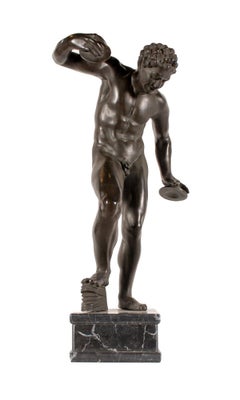
Satyr with Cymbals and Kroupezion, Grand Tour after the Antique, 19th century
Located in Beachwood, OH
19TH CENTURY CONTINENTAL SCHOOL
Satyr with Cymbals and Kroupezion, Grand Tour after the Antique
Bronze with marble base
26 in. h. x 15 in. w. x 10 in. d.
This dancing faun is now mo...
Category
19th Century Figurative Sculptures
Materials
Marble, Bronze
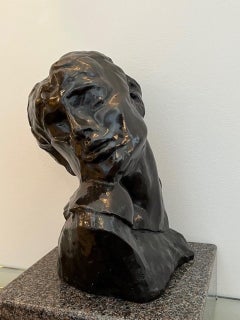
Head of Lust (Tete de la Luxure)
Located in New York, NY
Originally conceived in 1880-82 for the tympanum of the Gates of Hell, where she is cradled in the arms of L'homme qui tombe, as well as crouching in slightly varied form to the lef...
Category
Impressionist 19th Century Figurative Sculptures
Materials
Bronze
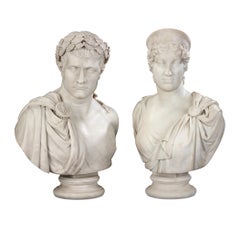
Pair of Carrara Marble Busts of the Emperor Napoleon and Empress Marie Louise
Located in New Orleans, LA
"I am a true Roman Emperor; I am of the best race of the Caesars—those who are founders." –Napoleon Bonaparte, 1812
Among the most iconic and celebrated figures in history, Napoleon...
Category
19th Century Figurative Sculptures
Materials
Marble
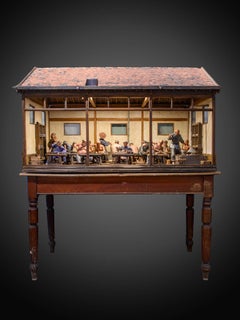
Scaled model of Chinese Ceramic workshop with 17 polychromed figures.End 19th C
Located in brussel, BE
The Diorama was in a private collection for more than 20 years and is said to have been exposed at the China Exposition 1902 in Copenhagen.This group of Chinese polychromed-decorate...
Category
19th Century Figurative Sculptures
Materials
Terracotta
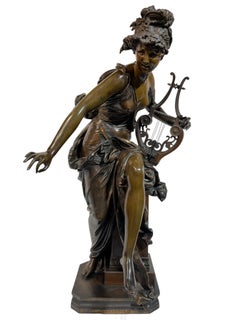
Albert Ernest Carrier-Belleuse A Figural Bronze Sculpture Melodie
Located in New York, NY
Albert-Ernest Carrier-Belleuse (1824 - 1887)
Female Figural Bronze Sculpture Melodie (Melody)
A young lady with a lyre in bronze with a dark green patina
19th Century
31" H x ...
Category
19th Century Figurative Sculptures
Materials
Bronze
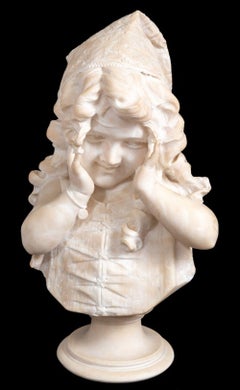
Neapolitan Girl
Located in Astoria, NY
Emilio Fiaschi (Italian, 1858-1941) Neapolitan Girl Alabaster Bust, late 19th century, depicting a young girl hiding her face behind her hands, on a socle, signed "E Fiaschi" to back...
Category
Italian School 19th Century Figurative Sculptures
Materials
Alabaster
Tiger surprising an antelope
Located in PARIS, FR
Antoine-Louis BARYE (1796-1875)
Tiger surprising an antelope
Bronze with nuanced dark greenish brown patina
Signed on the base " Barye "
Cast by Barye's own workshop (conducted in t...
Category
French School 19th Century Figurative Sculptures
Materials
Bronze
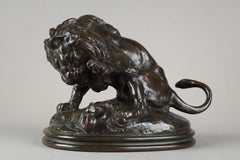
Lion and snake
Located in PARIS, FR
Lion and snake n°3
by Antoine-Louis Barye (1796-1875)
Bronze sculpture with a nuanced dark greenish brown patina
signed "Barye" on the base
old edition cast – probably from the Bary...
Category
French School 19th Century Figurative Sculptures
Materials
Bronze
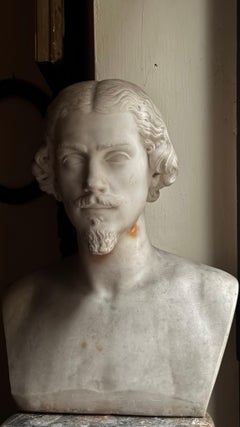
Italian Mid 19th century White Carrara Marble bust. Portrait of young male.
Located in Firenze, IT
Italian Portrait White Marble Bust in a Heroic Attitude.
Carrara statuary Marble.
Tuscan school.
Circa 1850.
Bust depicting a young man with bare shoulders.
This model draws inspira...
Category
Academic 19th Century Figurative Sculptures
Materials
Marble
$3,600 Sale Price
20% Off
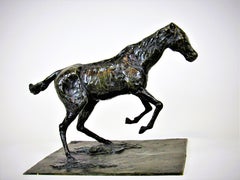
Edgard Degas: Horse Clearing an Obstacle (work 48 /certified by Comité Degas)
By Edgar Degas
Located in Gent, VOV
Horse Clearing an Obstacle (work number 48)
Bronze with dark brown green patina bearing the stamp of the signature "Degas",
Numbered IV/IX and dated 1998
Posthumous lost wax casting as of 1998.
Stamp of Valsuani.
Signed Degas
The work is a sought-after rarity in terms of Degas’ sculptures. This bronze is distinguished by the fact that it is a Valsuani bronze, meaning it faithfully records Degas’ wax version’s as it appeared at the time of its creation. Most Degas' bronzes that are found on the market were cast by Hébrard – these serialized bronzes are surmoulages, or “aftercasts,” that were cast from the modèle bronzes currently in the Norton Simon Museum (Pasadena). Because these Hebrard bronzes...
Category
Impressionist 19th Century Figurative Sculptures
Materials
Bronze
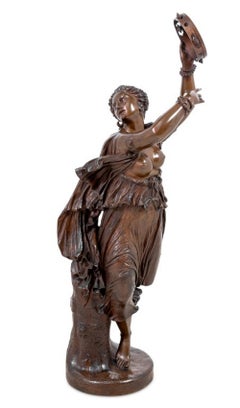
Jean Clesinger "Zingara" Patinated Bronze
Located in Astoria, NY
Jean Baptiste Clesinger (French, 1814-1883) "Zingara" Patinated Bronze Sculpture, 1857, cast by F. Barbedienne, the Neapolitan dancer upholding a tambourine, signed "J Clesinger, Rom...
Category
Pre-Raphaelite 19th Century Figurative Sculptures
Materials
Bronze
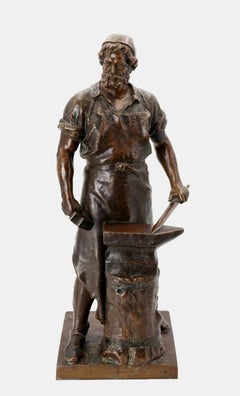
The Blacksmith of Solingen / - The Double-edged Sword -
Located in Berlin, DE
Wilhelm Albermann (1835 Werden an der Ruhr - 1913 Cologne), The Blacksmith of Solingen, after 1895. Bronze-color patinated zinc cast on plinth, 47 cm (height) x 20 cm (width) x 16 cm (depth), weight 5.5 kg. Signed “Albermann.” on the plinth and identified as a cast by “AKT.[TIEN] GES.[ELLSCHAFT] GLADENBECK BERLIN”. Dedication on the front: “Mr. Ing. F. Kuhlmann to the wedding. Management and officials of the Hannoversche Waggonfabrik. Aircraft construction department".
- The zinc showing through in spots, the patina somewhat stained, the right upper arm under the sleeve retouched in black.
- The Double-edged Sword -
The figure is a reduction of Wilhelm Albermann's 1895 fountain figure of the armourer of Solingen, who has always been identified with the historical blacksmith Peter Hahn. In 1839, Karl Simrock wrote the poem “The Blacksmith of Solingen" and thus coined the legendary figure. The first and penultimate verses read:
A blacksmith spoke to Solingen
With every bayonet,
That came to his diligence:
"Oh, that Fritz had it!"
The war took its course,
Many battles were fought,
Which often made him fearful and anxious
In his soul.
The blacksmith had given up his trade to fight for Frederick the Great. Not least because of his strength and will to fight, the battles were won. With his fountain sculpture, Albermann has given the legendary blacksmith a figurative form and at the same time created a landmark for the city of Solingen, which was once famous for the art of sword forging and today still stands for the production of high-quality knives. During the bombing raid in November 1944, the fountain was destroyed along with the entire old town of Solingen. Only the head remained.
The broad-shouldered blacksmith stands securely behind his anvil, his leather apron tied around him, and has just finished a sword blade with his own "weapon" - the blacksmith's hammer. His entire body shows the strength with which he wields the hammer, but also the strain of this activity, as evidenced by the wide open shirt, the somewhat 'untidy' apron, and especially the furrowed face.
However, the blacksmith does not look at the finished work, but resolutely and at the same time thoughtfully into the distance, in line with the quoted verse from Simrock's poem that the battles "often made him fearful and anxious in his soul". There is certainly something melancholy in his gaze, fed by the knowledge of the necessity of forging swords and taking up arms and their deadly use - experiences Albermann had to make during his own war missions. The flowing full beard gives his gaze into the distance an almost prophetic character.
In keeping with the craft of the perfectly formed art of blacksmithing, the detailed casting reproduces the respective materials depicted in perfect form: the leather apron convincingly conveys the impression of leather and lies - also in the back view - like a second formed layer over the body, while the shirt and trousers illustrate their own textile qualities.
Due to its masterful execution and profound content, the “Blacksmith of Solingen”, which has survived in its cast reproductions, remains Albermann's most famous work to this day.
About the artist
The son of a carpenter, Wilhelm Albermann began an apprenticeship as a joiner, but then followed his artistic calling and trained as a sculptor in Elberfeld. In 1855, at the age of twenty, he was drafted into the army in Berlin, where he served until 1857. Albermann attended the Berlin Art Academy on the side and began regular studies after his service. While still a student, he completed commissioned works for his teachers August Fischer and Hugo Hagen. His first independent commissions followed, enabling him to establish a flourishing sculpture studio in Cologne in 1865. His artistic activities were repeatedly interrupted by military service, and he took part in the German-Danish War in 1864, the war against Austria in 1866, and the Franco-Prussian War in 1870/71. After his last war service, Albermann, already a respected artist, founded a commercial drawing school at the request of the city government, where he taught the modeling class and served as director until 1896. In 1890 he also worked for the "Society for the Promotion of Sculpture in the Rhineland and Westphalia".
Albermann was one of the most prolific sculptors in Cologne in the second half of the 19th century. He created numerous monuments, fountains, tomb sculptures, architectural ornaments, and domestic statues. At its peak, his workshop employed up to thirty sculptors and stonemasons at a time.
GERMAN VERSION
Wilhelm Albermann (1835 Werden an der Ruhr - 1913 Köln), Der Schmied von Solingen, nach 1895. Bronzefarben patinierter Zinkguss auf gegossener Plinthe, 47 cm (Höhe) x 20 cm (Breite) x 16 cm (Tiefe), Gewicht 5,5 kg. Auf der Plinthe mit „Albermann.“ signiert und als Guss der „AKT.[TIEN] GES.[ELLSCHAFT] GLADENBECK BERLIN“ ausgewiesen. Schauseitige Widmung: „Herrn Ing. F. Kuhlmann zur Vermählung. Direktion und Beamte der Hannoverschen Waggonfabrik. Abt. Flugzeugbau“.
- Punktuelles Durchscheinen des Zinks, Patina etwas fleckig, der rechte Oberarm unter dem Ärmel schwarz retuschiert.
- Die Zweischneidigkeit des Schwertes -
Die Figur ist eine Reduktion von Wilhelm Albermanns 1895 geschaffener Brunnenfigur des Waffenschmieds von Solingen, der seit jeher mit dem historischen Schmied Peter Hahn identifiziert wurde. 1839 hatte Karl Simrock das Gedicht „Der Schmied von Solingen“ verfasst und damit die legendäre Figur geprägt. Die erste und die vorletzte Strophe lauten:
Zu Solingen sprach ein Schmied
Bei jedem Bajonette,
Das seinem Fleiß geriet:
»Ach, daß der Fritz es hätte!«
Der Krieg ging seinen Gang,
Man schlug noch viele Schlachten,
Die oft ihm angst und bang'
In seiner Seele machten.
Der Schmied hatte sein Handwerk ruhen lassen, um selbst für Friedrich den Großen zu kämpfen. Nicht zuletzt durch seine Kraft und seinen Kampfeswillen verliefen die Schlachten siegreich. Dem legendären Schmied verlieht Albermann mit seiner Brunnenskulptur eine bildliche Gestalt und schuf damit zugleich ein Wahrzeichen der Stadt Solingen, die einst für die Kunst des Schwerterschmiedens berühmt war und bis heute für die Herstellung qualitätvoller Messer einsteht. Beim Bombenangriff im November 1944 wurde mit der gesamten Solinger Altstadt auch der Brunnen zerstört. Einzig der Kopf blieb erhalten.
Mit sicherem Stand und umgebundener Lederschürze steht der breitschultrige Schmied hinter seinem Amboss und hat gerade mit seiner eigenen ‚Waffe‘ – dem Schmiedehammer – eine Schwertklinge fertiggestellt. Seinem gesamten Körper ist die Kraft abzulesen, mit der er den Hammer führt, aber auch die Anstrengung dieser Tätigkeit, wovon das weit geöffnete Hemd, die etwas ‚unordentlich‘ arrangierte Schürze und vor allem das zerfurchte Gesicht zeugen.
Der Schmied schaut aber nicht auf das vollendete Werk, sondern entschlossen und zugleich sinnierend in die Ferne, entsprechend der zitierten Zeile von Simrocks Gedicht, dass die Schlachten „oft ihm angst und bang‘ in seiner Seele machten“. Der Blick hat durchaus etwas Melancholisches, dass sich aus dem Wissen um die Notwendigkeit, Schwerter zu schmieden und zu den Waffen zu greifen und deren tödlichem Einsatz speist – Erfahrungen, die Albermann bei seinen eigenen Kriegseinsätze machen musste. Der wallende Vollbart verleiht dem in die Ferne schauenden Blick einen beinahe prophetischen Charakter.
Dem Handwerk der formvollendenden Schmiedekunst entsprechend, gibt der detaillierte Guss die jeweils dargestellten Materialien in vollendeter Ausformung wieder: Die Lederschürze vermittelt überzeugend den Eindruck des Leders und liegt – auch in der Rückenansicht – wie eine zweite ausgeformte Schicht über dem Körper, während das Hemd und die Hose...
Category
Realist 19th Century Figurative Sculptures
Materials
Metal
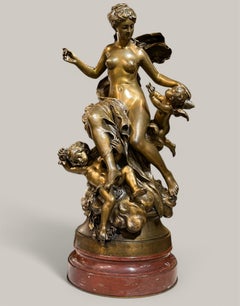
Mathurin Moreau Triumph of Flora Bronze
Located in New York, NY
Mathurin Moreau (French, 1822-1912)
The Triumph of Flora
Female figural statue of Flora and two putti resting on a rouge marble base.
Bronze and Rouge Marble
signed 'Math. Morea...
Category
19th Century Figurative Sculptures
Materials
Bronze
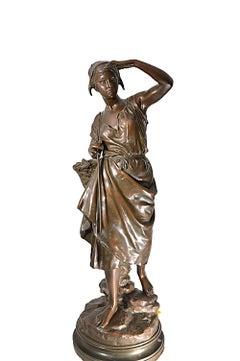
Eugène Laurent (1832-1898), The Beachcomber
Located in Berlin, DE
Eugène Laurent (1832-1898),
The Beachcomber
Inscribed "E. Laurent" on the base plate in the cast.
H 63 cm
Eugène Laurent studied at the École des Beaux-Arts in Paris and was awa...
Category
Jugendstil 19th Century Figurative Sculptures
Materials
Bronze
Amazone
Located in Berlin, DE
ALBERT-ERNEST CARRIER-BELLEUSE
French
1824 - 1887
signed: A. CARRIER
Bronze Marmor
Albert-Ernest Carrier-Belleuse (1824–1887) was a prominent French sculptor of the 19th centur...
Category
Art Nouveau 19th Century Figurative Sculptures
Materials
Bronze
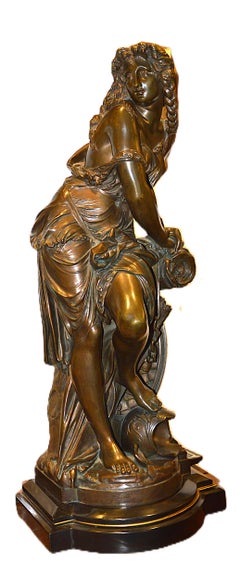
French antique bronze sculpture by Eutrope Bouret
Located in Berlin, DE
This is an outstanding bronze statue of Eutrope Bouret, signed on the base, by the very well-known French artist Eutrope Bouret (1833-1906).
French antique bronze sculpture by Eutro...
Category
Art Nouveau 19th Century Figurative Sculptures
Materials
Bronze
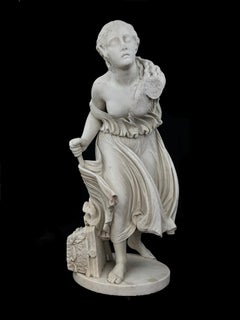
NYDIA, THE BLIND FLOWER GIRL OF POMPEII Marble Sculpture 1856-1870
Located in Soquel, CA
Randolph John Rogers (American, 1825 - 1892) Randolph Rogers' Nydia, the Blind Flower Girl of Pompeii debuted in 1856 to critical and public acclaim, solidifying Rogers’ position as a pre-eminent American sculptor and it remains one of the artist’s most celebrated works today. The subject of Nydia is drawn from Edward Bulwer-Lytton's The Last Days of Pompeii 1834. After touring the ruins of the ancient city in 1833, and inspired by the stories of blinding volcanic ash, he composed the tale of Nydia, a slave who led her master, Glaucus, to safety. Rogers depicts Nydia at the moment that she and Glaucus have become separated in their perilous journey through the rubble and Nydia seeks familiarity in the surrounding chaos, her distress evident in her pained expression. The grace of the sculpture is at odds with the turmoil portrayed; a toppled Corinthian capital lies at her feet and obstructs her next step, indicated by the tilt of her back foot and grip on her walking stick. Examples of this model can be found in major American collections, including The Metropolitan Museum of Art, the Art Institute of Chicago, the Detroit Institute of Arts, the Los Angeles County Museum of Art, and the Museum of Fine Arts, Boston.
Literature, Millard F Rogers, Jr. Randolph Rogers, American Sculptor in Rome. University of Massachusetts Press, 1971, American Figurative Sculpture in the Museum of Fine Arts Boston. Museum of Fine Arts, Boston, 1986. Joyce K Schiller. "Nydia, A Forgotten Icon of the Nineteenth Century." Bulletin of the Detroit Institute of Arts,
Born in Waterloo, New York, Randolph John Rogers became an expatriate* sculptor of idealized figures, portraits, and commemorative works in Neo-Classical* and Realist* styles. He worked in clay, plaster, marble and bronze, and lived both in Italy and the United States. He made 167 examples of Nydia in two sizes (varies depending on base height) 36" and 54'.
Rogers was raised in Ann Arbor, Michigan, and as a young man did woodcuts* for the local newspaper, The Michigan Argus, and also worked as a baker's assistant and a dry goods clerk. In 1847, he moved to New York City, where he hoped to find work as an engraver*, but failing to do so, worked in a dry goods store owned by John Steward...
Category
Italian School 19th Century Figurative Sculptures
Materials
Marble
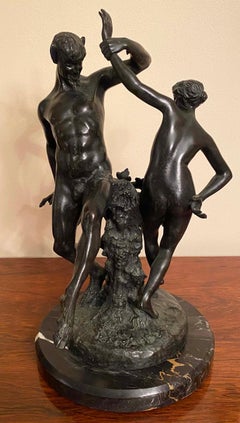
Bacchanal
Located in Los Angeles, CA
Charles Edouard Richefeu (1868-1945)
A stunning dated 1926.
A faun and nude woman dancing.
Signed RICHEFEU in the bronze. Foundry mark stamp "R. COTTIN & FILS Paris Bronze".
Definitely inspired by Diagilev Russian Ballet and Nijinsky dancer on Claude Debussy...
Category
Art Deco 19th Century Figurative Sculptures
Materials
Bronze
$2,368 Sale Price
20% Off
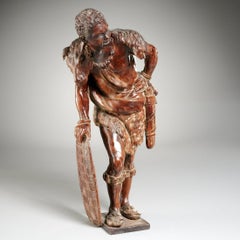
Orientalist African Hunter Leaning on His Shield 19th cent. Black Forest, German
Located in SANTA FE, NM
Orientalist African Hunter Leaning on His Shield
Black Forest, School Switzerland 19th century
Carved Wood
21 inches
This is an exceptionally beautifu...
Category
Academic 19th Century Figurative Sculptures
Materials
Wood
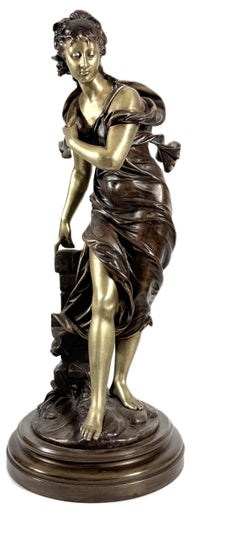
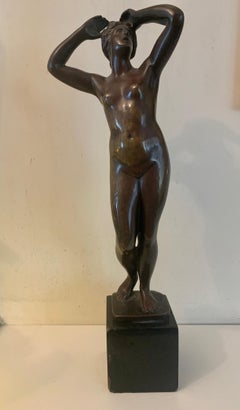
19th century French Bronze of a naked woman standing up.
Located in Woodbury, CT
Well modeled 19th century French bronze of a standing naked woman.
Signed Cartinet, this piece is a wonderful example of the skill of a Sculptor.
The piece retains all its origina...
Category
Victorian 19th Century Figurative Sculptures
Materials
Bronze
$1,200 Sale Price
29% Off
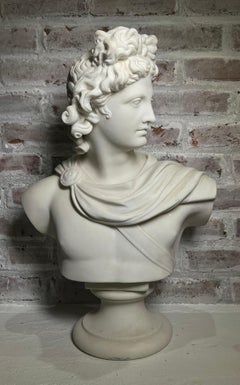
Large 19th Century Antique Marble Bust of Apollo of Belvedere
Located in New York, NY
Pietro Bazzanti (1842-1881) specialized in allegorical and genre subjects as well as copies of Antique and Renaissance sculpture. Regarded as one of the most talented sculptors of h...
Category
Academic 19th Century Figurative Sculptures
Materials
Marble
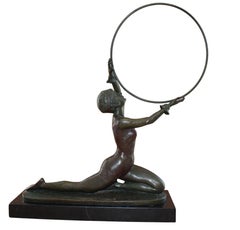
Dancer, bronze, 40x46x12 cm
Located in Riga, LV
Ferdinand Preiss(1882-1943)
Category
Realist 19th Century Figurative Sculptures
Materials
Marble, Bronze
$2,658 Sale Price
20% Off
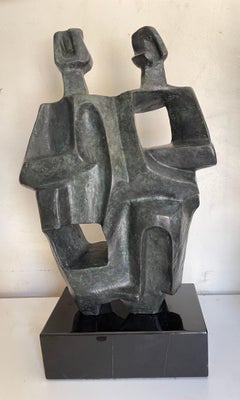
Cubist Couple
Located in Los Angeles, CA
CHARNA RICKEY
"THE COUPLE"
BRONZE, SIGNED
AMERICAN, DATED 1976,
14.5 INCHES OVERALL
Recent casting
Category
Cubist 19th Century Figurative Sculptures
Materials
Bronze
The Victorious David / - The melancholy of the radiant hero -
Located in Berlin, DE
Henri Honoré Plé (1853 Paris - 1922 Paris), The Victorious David, around1890. Red-brown and brown patinated bronze with terrain plinth mounted on a round base. 42 cm (total height) x...
Category
Realist 19th Century Figurative Sculptures
Materials
Bronze

Emile Guillemin "The Falconer" Patinated Bronze
Located in Astoria, NY
Emile Coriolan Hippolyte Guillemin (French, 1841-1907) "The Falconer" Patinated Bronze Sculpture, late 19th century, the figure of a young man holding a falcon whilst standing on a d...
Category
Other Art Style 19th Century Figurative Sculptures
Materials
Bronze

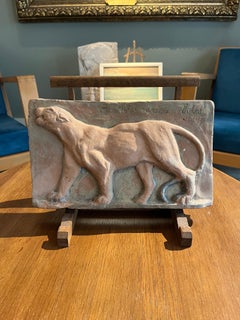
Panther - Sculpture in low Relief
By Louis Vidal
Located in PARIS, FR
Louis Vidal, or Vidal l'aveugle (Vidal the blind)
(1831 - 1892)
Panther
Sculptuer, low relief, terracotta
17,5 x 28,7 x 3 cm
Inscription and signature on the top : "Panthère, Vidal ...
Category
19th Century Figurative Sculptures
Materials
Terracotta
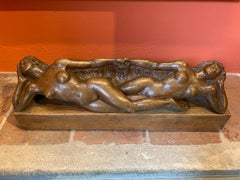
Scultura figurativa allegoria nudo femminile toscano del XX secolo in legno
Located in Florence, IT
Piccola scultura in legno (40 x 7 x 13 cm) con soggetto due figure femminili nude distese che si tengono per mano, su uno sfondo non riconoscibile ma che probabilmente vuole richiama...
Category
Other Art Style 19th Century Figurative Sculptures
Materials
Bronze
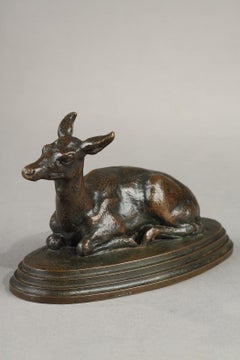
Reclining Doe
Located in PARIS, FR
Reclining Doe
by Antoine-Louis Barye (1796-1875)
Bronze sculpture with a nuanced dark brown patina
signed "Barye" on the base
old edition cast – probably from the Barye's workshop (...
Category
French School 19th Century Figurative Sculptures
Materials
Bronze
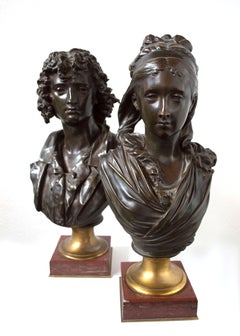
Pair of 19th Century Busts by Albert Ernest Carrier-Belleuse
Located in Santa Fe, NM
Signed: A. Carrier-Belluese
Two large bronze matching busts of an unknown male and female
22 x 10 x 11" male
23 x 10 x 9" female
Both show signs of wear with their age but are in fa...
Category
Baroque 19th Century Figurative Sculptures
Materials
Marble, Bronze
$6,000 Sale Price
50% Off
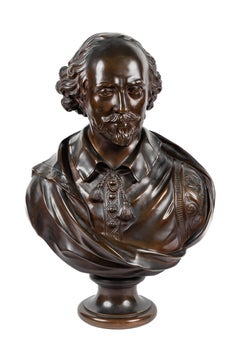
A Monumental French Patinated Bronze Bust of William Shakespeare, after Houdon
Located in Queens, NY
A Monumental French Patinated Bronze Bust of William Shakespeare, after Houdon, by F. Barbedienne Foundry, circa 1870.
Masterfully and realistically sculpted in solid bronze, this b...
Category
19th Century Figurative Sculptures
Materials
Bronze
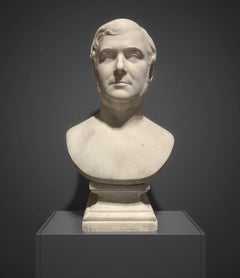
Busto in Marmo Firmato Ritratto Virile Scultura Francese
Located in Pistoia, IT
Francisque-Joseph Duret (Paris, 1804-1865), busto virile in marmo bianco. Francisque Joseph Duret (19 ottobre 1804 – 26 maggio 1865) è stato uno scultore francese, figlio e allievo ...
Category
Romantic 19th Century Figurative Sculptures
Materials
Marble
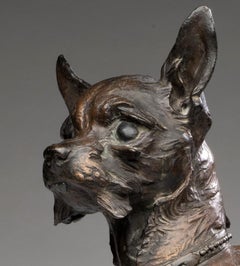
Rare, Antique, Life-Size Dog Bronze of a Chihuahua "Lydie" Charles Valton. 1890s
Located in SANTA FE, NM
Antique Bronze Dog Sculpture
Chihuahua "La Petite Belle Lydie"
Charles Valton (French, 1851-1918)
Circa 15 1/2 x 10 1/4 x 7
Lydie is a Chihuahua making her a very rare image from ...
Category
Realist 19th Century Figurative Sculptures
Materials
Bronze
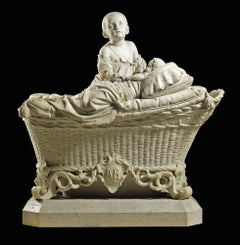
Life-Size Italian 19th Century Marble Sculpture Children on Crib, A. Tantardini
Located in LA, CA
Antonio Tantardini (Italian, 1829-1879) An extraordinary Italian 19th century life size carved Carrara white marble sculpture of "A Young Child and a baby in a wicker crib" - A Risorgimento Allegory. Signed and dated: A.nio Tantanrdini F.ce / 1863. The older child's medallion inscribed with an interlocked XV and Garibaldi, the crib monogrammed: AR. Circa: Florence, 1863. This sculpture includes a recent custom-made veined black marble pedestal stand. (The 2 items description mean the sculpture and pedestal, which are sold as sold a set.)
In a country famed for its skilled carvers and working in an age when virtuoso carving technique was highly prized, Antonio Tantardini was one of the very best exponents of master carvers in nineteenth century Italy. Vicario describes Tantardini's skill as 'un abilità tecnica stupefacente'.
The present amazing quality marble group epitomizes Tantardini's exceptional talents as a carver. Lesser sculptors might have shied away from attempting to carve a life-size wicker crib in marble, but Tantardini has clearly relished the Challenge. The result is a stunning achievement of verismo Italian sculpture.
This marble group, however, is more than a paradigm of Italian marble carving, it is also a prime example of the use of Risorgimento allegory in Italian sculpture of the 1860s. Famous sculptural Risorgimento allegories include Raffaelle Monti...
Category
Academic 19th Century Figurative Sculptures
Materials
Marble
$348,500 Sale Price
46% Off
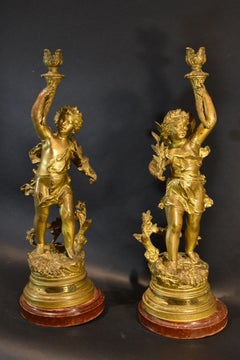
Pair Bronze Candlesticks Rancoulet Signature 19th Century France Sculpture
Located in Riva del Garda, IT
Ernest Rancoulet (Bordeaux 1842 - Bordeaux 1905)
Signature on reverse side ‘Rancoulet’
Pair of bronze candlesticks depicting winged cupids ‘Allegory of Autumn and Spring’
Gilt bron...
Category
Impressionist 19th Century Figurative Sculptures
Materials
Bronze
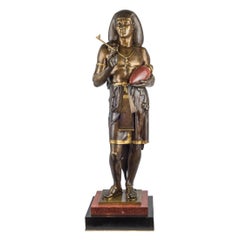
Egyptian Revival Gilt and Patinated Bronze Figure byÉmile Louis Picault
Located in New York, NY
Émile-Louis Picault (1833–1915)
Egyptian Scribe 'Hierogrammate'
Date: circa 1880 French
Signature: signed Picault on base
Size: height 33 in. x 10.25 in
Category
Other Art Style 19th Century Figurative Sculptures
Materials
Marble, Bronze
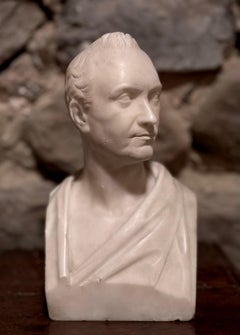
Busto in Marmo Neoclassico in Erma epoca Impero Dignitario Romano
Located in Pistoia, IT
Busto neoclassico in marmo raffigurante un dignitario romano in erma. Epoca Impero, primo quarto del XIX secolo.
Si tratta di un piccolo busto da scrivania raffigurante un giovan...
Category
Academic 19th Century Figurative Sculptures
Materials
Marble
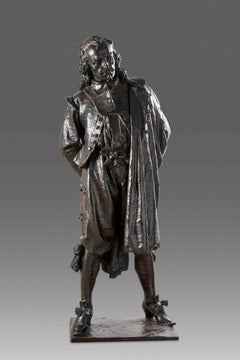
Il Bernini - Sculpture by Ambrogio Borghi - 1884
Located in Roma, IT
The bronze proposed here was initially presented in November 1878 at the Competition for the Encouragement of Brera. It is therefore one of the first celebratory works of the sculptor Ambrogio Borghi...
Category
Modern 19th Century Figurative Sculptures
Materials
Bronze
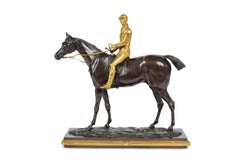
A Rare Gilt and Patinated Bronze Jockey on A Horse, circa 1875
Located in Queens, NY
Isidore-Jules Bonheur (French, 1827–1901)
A Rare Gilt and Patinated Bronze Jockey on A Horse, circa 1875.
Introducing a truly exceptional and highly so...
Category
19th Century Figurative Sculptures
Materials
Bronze
$13,500 Sale Price
50% Off
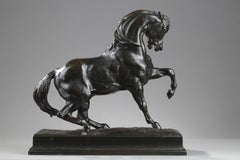
Turkish Horse
Located in PARIS, FR
"Turkish Horse"
by Antoine-Louis Barye (1796-1875)
Bronze with nuanced dark brown patina
cast by BARBEDIENNE
France
circa 1880
height 28 cm
length 31,5 cm
This is the biggest size...
Category
French School 19th Century Figurative Sculptures
Materials
Bronze
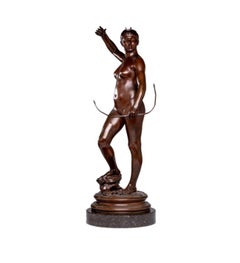
Diana the Huntress, a bronze sculpture by Alexandre Falguière (1831–1900)
Located in Gent, VOV
This majestic bronze sculpture, titled Diana the Huntress, is the work of renowned French sculptor Alexandre Falguière, created in 1882. The Roman goddess of the hunt is depicted in ...
Category
Academic 19th Century Figurative Sculptures
Materials
Bronze
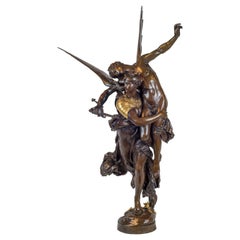
Bronze Figural Sculpture of Gloria Victis by Antonin Mercié
Located in New York, NY
Gloria Victis, a winged figure of victory carrying a fallen warrior casted in bronze with brown patina. Inscribed with 'F. Barbedienne. Fonduer' mark and...
Category
19th Century Figurative Sculptures
Materials
Bronze
A Monumental Patinated Bronze Bust of Jesus Christ by Clesinger and Barbedienne
Located in Queens, NY
A Monumental and Truly Exceptional French Patinated Bronze Bust of Jesus Christ, Circa 1858, Signed J. Clesinger, Rome 1858
F. Barbedienne Fondeur
This monumental and extraord...
Category
19th Century Figurative Sculptures
Materials
Bronze

David Slaying Goliath Large Figural Bronze Statue by Antonin Mercie
Located in New York, NY
The base marked "A. Mercie" and "506 F. Barbenienne, Fondeur, Paris" ad "A. Collas" "Reduction Mecanique."
The dazzling David, a prolific subject amongst sculpture artists beginning...
Category
Academic 19th Century Figurative Sculptures
Materials
Bronze
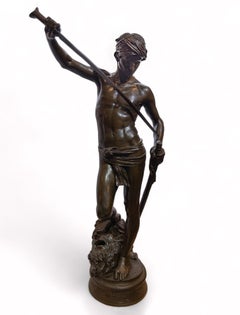
Grand Tour Bronze Sculpture of Diana Goddess of the Hunt Signed B. Boschetti.
Located in Rome, IT
Grand Tour Fine Group of Sculpture in Bronze after a Louvre Diana of Versailles or Artemis, Goddess of the Hunt.
Diana is represented at the hunt, hastening forward, as if in pursui...
Category
Academic 19th Century Figurative Sculptures
Materials
Bronze