David Barnett Gallery Prints and Multiples
to
8
170
236
117
132
78
Overall Width
to
Overall Height
to
96
68
53
47
46
30
21
19
7
5
3
2
1
37
30
28
23
20
53
136
492
52
17
11
24
45
27
24
72
134
75
36
15
409
305
19
377
218
118
110
95
75
66
60
55
54
48
40
36
32
32
29
28
24
24
23
405
129
53
43
43
277
196
733
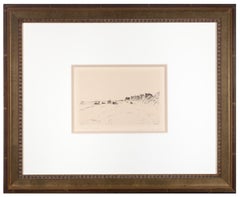
"La Plage de la Panne, " Seascape Etching signed by James Ensor
By James Ensor
Located in Milwaukee, WI
"La Plage de la Panne" is an original etching by James Ensor. The artist signed the piece in plate in the lower right and signed, titled, and dated it below t...
Category
Early 1900s Landscape Prints
Materials
Etching
"Red/Blue/Black Diamond" Silkscreen Print signed by Ilya Bolotowsky
By Ilya Bolotowsky
Located in Milwaukee, WI
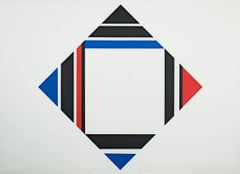
Ilya Bolotowsky's Red/Blue/Black Diamond from around 1970, immediately shows the deep influence of Piet Mondrian's New-Plasticism. Bolotowsky first saw Mondrian's paintings in the 19...
Category
1970s Abstract Geometric Abstract Prints
Materials
Screen
"Zarathustra, " Abstract Volcano Woodcut signed by Carol Summers
By Carol Summers
Located in Milwaukee, WI
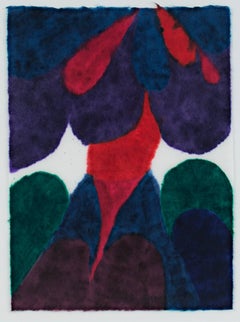
"Zarathustra" is an original color woodcut by Carol Summers. The artist signed the piece in the image. This woodcut depicts an erupting volcano in simplified color fields. The editio...
Category
Early 2000s Landscape Prints
Materials
Woodcut
"Acquacaliente, " Colorful Landscape Silkscreen signed by Carol Summers
By Carol Summers
Located in Milwaukee, WI
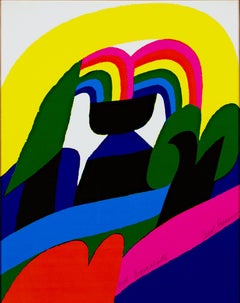
"Acquacaliente" is an original color screenprint by Carol Summers. The artist signed the piece in the lower right. This screenprint depicts a fountain spouting rainbows in the backgr...
Category
1970s Abstract Landscape Prints
Materials
Screen, Ink
"See Ya Next Week, " Giclee Print after 1999 Mixed Media signed by Reginald Gee
By Reginald K. Gee
Located in Milwaukee, WI
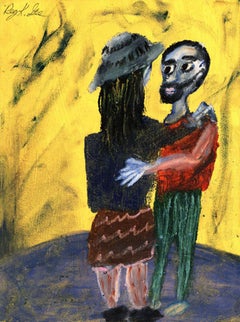
"See Ya Next Week" is a giclee print on paper after a 1999 acrylic and pastel on grocery bag signed by Reginald K. Gee. A male and a female embrace in the foreground. The man's face ...
Category
2010s Contemporary Figurative Prints
Materials
Paper, Giclée
"Door County, Wisconsin, " Landscape Silkscreen Travel Poster
By Schomer Lichtner
Located in Milwaukee, WI
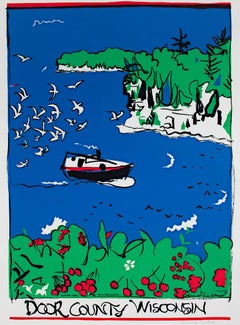
"Door County Wisconsin" is an original silkscreen by Schomer Lichtner. The artist signed the piece lower right in pencil and in the screen. This piece feat...
Category
1980s Contemporary Landscape Prints
Materials
Screen, Ink
"Le Bouquet tout fait (The Ready-made Bouquet), " Lithograph after Rene Magritte
By René Magritte
Located in Milwaukee, WI
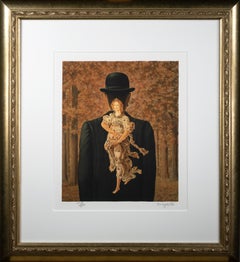
"Le Bouquet tout fait (The Ready-made Bouquet)" is a color lithograph after a 1954 original painting by Rene Magritte. A bourgeois "little man" faces away from the viewer looking towards a fall forest. Flora, the goddess of flowers and season of spring, from Sandro Botticelli's "Primavera" is painted on the back of the man. This juxtaposes fall and spring.
Art: 12 x 9.75 in
Frame: 22.38 x 20.38 in
René-François-Ghislain Magritte was born November 21, 1898, in Lessines, Belgium and died on August 15, 1967 in Brussels. He is one of the most important surrealist artists. Through his art, Magritte creates humor and mystery with juxtapositions and shocking irregularities. Some of his hallmark motifs include the bourgeois “little man,” bowler hats, apples, hidden faces, and contradictory texts.
René Magritte’s father was a tailor and his mother was a miller. Tragedy struck Magritte’s life when his mother committed suicide when he was only fourteen. Magritte and his two brothers were thereafter raised by their grandmother.
Magritte studied at the Brussels Academy of Fine Arts from 1916 to 1918. After graduating he worked as a wallpaper designer and in advertisement. It was during this period that he married Georgette Berger, whom he had known since they were teenagers.
In 1926, René Magritte signed a contract with the Brussels Art Gallery, which allowed him to quit his other jobs and focus completely on creating art. A year later he had his first solo show at the Galerie la Centaurie in Brussels. At this show Magritte exhibited what is today thought of as his first surrealist piece, The Lost Jockey, painted in 1926. In this work a jockey and his steed run across a theater stage, curtains parted on either side. Throughout the scene, there are trees with trunks shaped somewhat like chess pawns with musical scores running vertically up their sides and branches sticking out from all angles. Critics did not enjoy this style of art; it was new, different, and took critical thought to understand, but The Lost Jockey was only the first of many surrealist artworks Magritte would paint.
Because of the bad press in Brussels, René and Georgette moved to Paris in 1927, with the hope that this center of avant-garde art would bring him success and recognition. In Paris, he was able to become friends with many other surrealists, including André Breton and Paul Éluard. They were able to learn from and inspire one another, pushing the Surrealist movement further forward.
It was also in Paris that Magritte decided to add text to some of his pieces, which was one of the elements that made his artwork stand out. In 1929, he painted one of his most famous oil works: The Treachery of Images. This is the eye-catching piece centered on a pipe. Below the pipe is written “Ceci n’est pas un pipe,” which translates to “This is not a pipe.” This simple sentence upset many critics of the time, for of course it was a pipe. Magritte replied that it was not a pipe, but a representation of a pipe. One could not use this oil on canvas as a pipe, to fill it with tobacco and smoke it. Thus, it was not a pipe.
In 1930, Magritte and Georgette moved back to Brussels. Though they would travel to his exhibitions elsewhere, their home going forward would always be in Brussels.
Magritte had his first American exhibition at the Julien Levy Gallery in New York City in 1936 and his first show in England two years later in 1938 at The London...
Category
2010s Surrealist Figurative Prints
Materials
Lithograph
"La Grande Guerre (The Great War), " Color Lithograph after Rene Magritte
By René Magritte
Located in Milwaukee, WI
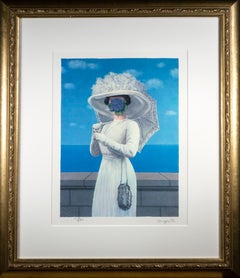
"La Grande Guerre (The Great War)" is a color lithograph after the 1964 painting by Rene Magritte. A Victorian lady stands in white facing the viewer. A bouq...
Category
2010s Surrealist Figurative Prints
Materials
Lithograph
"La Bataille de l
Argonne (The Battle of Argonne), " Litho after Rene Magritte
By René Magritte
Located in Milwaukee, WI
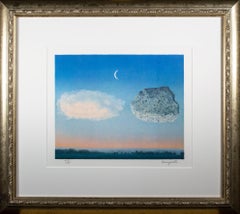
"La Bataille de l'Argonne (The Battle of Argonne)" is a color lithograph after the original 1959 painting by Rene Magritte. The landscape is shrouded by ...
Category
2010s Surrealist Landscape Prints
Materials
Lithograph
Smith Brothers Restaurant
By Ruth Grotenrath
Located in Milwaukee, WI
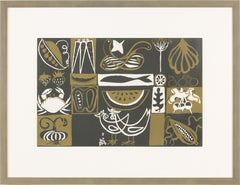
An original color silkscreen print by Ruth Grotenrath. A lovely assortment of different foods both vegetable and animal alike. The photos do not do this piece justice. The dark color...
Category
1950s American Modern Animal Prints
Materials
Ink, Printer s Ink, Screen
"Annette"
By Alberto Giacometti
Located in Milwaukee, WI
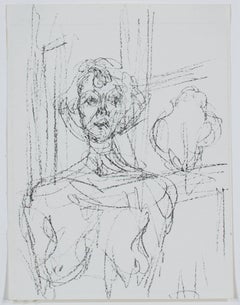
"Annette" is a black and white lithograph after Alberto Giacometti, published in Derriere le Miroir. It depicts the bust of a nude woman in scratchy lines. Annette was Alberto's wife and frequently modeled for his sculptures and drawings.
10" x 7 1/4" art
21 1/4" x 18 5/8" frame
Alberto Giacometti (1901-1966) was born in Borgonovo, a Swiss municipality, to the post-impressionist painter Giovanni Giacometti.
In 1922 he moved to Paris to study under the sculptor Antoine Bourdelle, an associate of Auguste Rodin. It was there that Giacometti experimented with cubism and surrealism and came to be regarded as one of the leading surrealist sculptors. Among his associates were Joan Miró, Max Ernst, Pablo Picasso, Bror Hjorth and Balthus.
Between 1936 and 1940, Giacometti concentrated his sculpting on the human head, focusing on the sitter's gaze. He preferred models he was close to, his sister and the artist Isabel Rawsthorne (then known as Isabel Delmer). This was followed by a unique artistic phase in which his statues of Isabel became stretched out; her limbs elongated. Obsessed with creating his sculptures exactly as he envisaged through his unique view of reality, he often carved until they were as thin as nails and reduced to the size of a pack of cigarettes, much to his consternation. A friend of his once said that if Giacometti decided to sculpt you, "he would make your head look like the blade of a knife." After his marriage to Annette Arm in 1946 his tiny sculptures became larger, but the larger they grew, the thinner they became. Giacometti said that the final result represented the sensation he felt when he looked at a woman.
In 1962, Giacometti was awarded the grand prize for sculpture at the Venice Biennale, and the award brought with it worldwide fame. Even when he had achieved popularity and his work was in demand, he still reworked models, often destroying them or setting them aside to be returned to years later. The prints produced by Giacometti are often overlooked but the catalogue raisonné, Giacometti - The Complete Graphics and 15 Drawings by Herbert Lust (Tudor 1970), comments on their impact and gives details of the number of copies of each print. Some of his most important images were in editions of only 30 and many were described as rare in 1970.
In his later years Giacometti's works were shown in a number of large exhibitions throughout Europe. Riding a wave of international popularity, and despite his declining health, he travelled to the United States in 1965 for an exhibition of his works at the Museum of Modern Art in New York. As his last work he prepared the text for the book Paris sans fin...
Category
1970s Minimalist Figurative Prints
Materials
Lithograph

$3,800
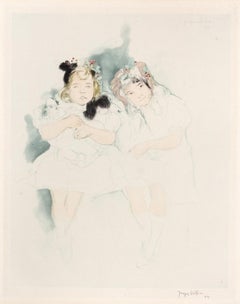
"Mes Petites Amies, Les Deux Sœurs" signed by Jacques Villon
By Jacques Villon
Located in Milwaukee, WI
This is a drypoint and aquatint artwork by Jacques Villon. The artist signed in pencil on the lower right. As well as signed in plate at the top right of the image. This is a wonderful artwork of different intaglio processes being brought together in a beautiful almost seamless harmony. The thin pencil like markings and hair detailing are made using the Drypoint printmaking method. Whilst the color details around the girls are made using the Aquatint etching method. Jacques Villon shows his skills as a printmaker with the way these pieces line up perfectly and with how clean the rest of the plate is around the girls. An unnumbered impression, apart from the numbered edition of 50.
Catalogue Raisonne E101, pg. 66-67 (Ginestet & Pouillon. It depicts two young girls.
15" x 11 1/2" art
25 1/8" x 20" frame
French painter, printmaker and illustrator. The oldest of three brothers who became major 20th-century artists, including Raymond Duchamp-Villon and Marcel Duchamp, he learnt engraving at the age of 16 from his maternal grandfather, Emile-Frédéric Nicolle (1830-94), a ship-broker who was also a much appreciated amateur artist. In January 1894, having completed his studies at the Lycée Corneille in Rouen, he was sent to study at the Faculty of Law of the University of Paris, but within a year he was devoting most of his time to art, already contributing lithographs to Parisian illustrated newspapers such as Assiette au beurre. At this time he chose his pseudonym: Jack (subsequently Jacques) in homage to Alphonse Daudet’s novel Jack (1876) and Villon in appreciation of the 15th-century French poet François Villon...
Category
Early 1900s Modern Figurative Prints
Materials
Drypoint, Aquatint, Etching, Intaglio
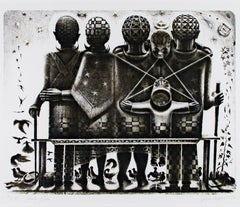
"Family of Six, " Original Lithograph signed by John Thomas Biggers
By John Thomas Biggers
Located in Milwaukee, WI
"Family of Six" is an original black and white lithograph by John Biggers. The artist signed and dated the piece in the lower right and titled and editioned it (AP III) in the lower ...
Category
1980s Contemporary Figurative Prints
Materials
Lithograph
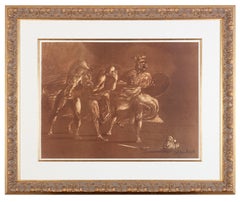
Homage a Leonardo d
Vinci (Three Figures Advancing from De La Bataille Vol. I)
By Claude Weisbuch
Located in Milwaukee, WI
Art: 17" x 23 1/4"
Frame: 27 5/8" x 33 7/8"
Original color lithograph (VIII/L)
Signed lower right.
This original Weisbuch lithograph comes from th...
Category
1970s Contemporary Figurative Prints
Materials
Lithograph
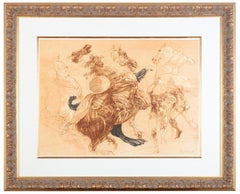
Homage a Leonardo d
Vinci (Battle Scene I from De La Bataille Vol. I)
By Claude Weisbuch
Located in Milwaukee, WI
Art: 17" x 23 1/4"
Frame: 27 5/8" x 33 7/8"
Original color lithograph (VIII/L)
Signed lower right.
This original Weisbuch lithograph comes from th...
Category
1970s Animal Prints
Materials
Lithograph
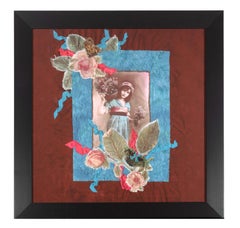
Victorian Girl With Flowers
Giclee print on board after mixed media textile
By Stacy Wiatrak
Located in Milwaukee, WI
Art: 16"x15-3/4"
Frame: 18-3/4"x 18-3/4"
Giclee print on board after mixed media textile
Stacy Wiatrak is a textile artist from Milwaukee, Wisconsin a...
Category
Early 2000s Prints and Multiples
Materials
Giclée
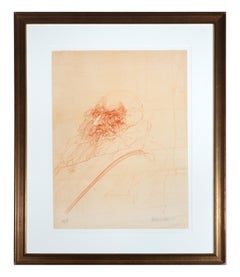
Homage A Leonard de Vinci (Portrait of Leonardo) Original lithograph
By Claude Weisbuch
Located in Milwaukee, WI
Original lithograph signed VII/L
Art: 23 1/8"x17"
Frame: 32 3/4"x26 5/8
Signed and number lower margin.
Claude Weisbuch was born in Thionville, France in 1927 and was a pupil at L' ...
Category
1970s Prints and Multiples
Materials
Lithograph
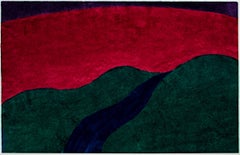
"Farewell, " Sunset Landscape Woodcut by Carol Summers
By Carol Summers
Located in Milwaukee, WI
"Farewell" is an original color woodcut by Carol Summers. The artist signed the piece. This woodcut depicts a river flowing through green hills beneath a blood-red sky. The edition number is 20/50.
24 1/4" x 37" art
32" x 45" frame
Carol Summers has worked as an artist throughout the second half of the 20th century and into the first years of the next, outliving most of his mid-century modernist peers. Initially trained as a painter, Summers was drawn to color woodcuts around 1950 and it became his specialty thereafter.
Over the years he has developed a process and style that is both innovative and readily recognizable. His art is known for it’s large scale, saturated fields of bold color, semi-abstract treatment of landscapes from around the world and a luminescent quality achieved through a printmaking process he invented.
In a career that has extended over half a century, Summers has hand-pulled approximately 245 woodcuts in editions that have typically run from 25 to 100 in number. His talent was both inherited and learned.
Born in 1925 in Kingston, a small town in upstate New York, Summers was raised in nearby Woodstock with his older sister, Mary. His parents were both artists who had met in art school in St. Louis. During the Great Depression, when Carol was growing up, his father supported the family as a medical illustrator until he could return to painting. His mother was a watercolorist and also quite knowledgeable about the different kinds of papers used for various kinds of painting. Many years later, Summers would paint or print on thinly textured paper originally collected by his mother.
From 1948 to 1951, Carol Summers trained in the classical fine and studio arts at Bard College and at the Art Students League of New York. He studied painting with Steven Hirsh and printmaking with Louis Schanker. He admired the shapes and colors favored by early modernists Paul Klee (Sw: 1879-1940) and Matt Phillips (Am: b.1927- ). After graduating, Summers quit working as a part-time carpenter and cabinetmaker (which had supported his schooling and living expenses) to focus fulltime on art. That same year, an early abstract, Bridge No. 1 was selected for a Purchase Prize in a competition sponsored by the Brooklyn Museum. In 1952, his work (Cathedral, Construction and Icarus) was shown the first time at the Museum of Modern Art in New York City in an exhibition of American woodcuts.
In 1954, Summers received a grant from the Italian government to study for a year in Italy. Woodcuts completed soon after his arrival there were almost all editions of only 8 to 25 prints, small in size, architectural in content and black and white in color. The most well-known are Siennese Landscape and Little Landscape, which depicted the area near where he resided. Summers extended this trip three more years, a decision which would have significant impact on choices of subject matter and color in the coming decade. After returning from Europe, Summers’ images continued to feature historical landmarks and events from Italy as well as from France, Spain and Greece. However, as evidenced in Aetna’s Dream, Worldwind and Arch of...
Category
1990s Landscape Prints
Materials
Woodcut
Affiche - Le Condottiere, signed inscribed to D.B.
By Claude Weisbuch
Located in Milwaukee, WI
Art: 29-3/8"x 21-1/8"
Frame: 31'x 22-1/2"
Original signed lithograph poster
Claude Weisbuch was born in Thionville, France in 1927 and was a pupil at L' École des Beaux-Arts de Nanc...
Category
1970s Animal Prints
Materials
Archival Pigment
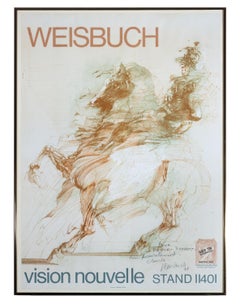
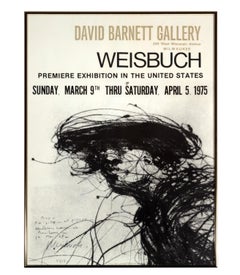
U.S. Premiere Exhibition Poster at the David Barnett Gallery (43/58)
By Claude Weisbuch
Located in Milwaukee, WI
Art: 26-3/4"x19-3/4"
Frame: 27"x20"
Poster, signed & inscribed to Philip Barnett lower left
(43/58)
Claude Weisbuch was born in Thionville, France in 1927 and was a pupil at L' Écol...
Category
1970s Figurative Prints
Materials
Archival Pigment
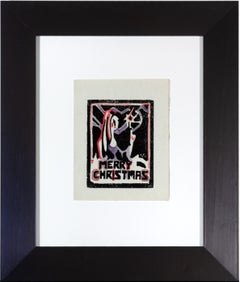
Merry Christmas
original color woodcut on paper, signed in block
By Sylvia Spicuzza
Located in Milwaukee, WI
Art: 5 1/2 x 4 3/8"
Frame: 10 1/8 x 8 1/8"
Original color woodcut on paper, signed in block.
Born in 1908, Sylvia Spicuzza was the daughter of noted painter Francesco Spicuzza. Sylvia devoted herself to teaching art to the students of Lake Bluff...
Category
1950s Figurative Drawings and Watercolors
Materials
Woodcut
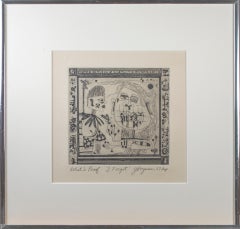
I Forgot
original etching (A/P)
By Joseph Rozman
Located in Milwaukee, WI
Sheet: 9 7/8 x 11 3/8 inches
Plate: 5.75 x 5.88 inches
Frame: 14 x 14 inches
Etching (A/P)
Rozman received his BFA (with honors in 1967) and MFA (1969) from UW-Milwaukee, and would...
Category
1960s Figurative Prints
Materials
Etching
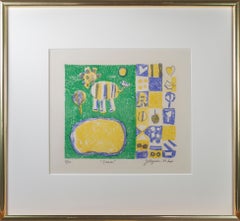
Oasis
signed color lithograph (2/10)
By Joseph Rozman
Located in Milwaukee, WI
Art: 11-1/4 x 11-7/8
Color lithograph, signed (2/10)
Rozman received his BFA (with honors in 1967) and MFA (1969) from UW-Milwaukee, and would later become a Professor at Mount Mary...
Category
1960s Abstract Prints
Materials
Lithograph
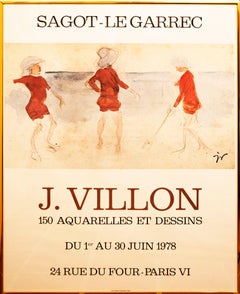
Sagot-Le Garrec
Poster
By Jacques Villon
Located in Milwaukee, WI
The frame is included.
Art size: 25" x 19"
This is an original and very rare vintage art poster from a Jacques VILLON's exhibition. It took place ...
Category
1970s Figurative Prints
Materials
Lithograph
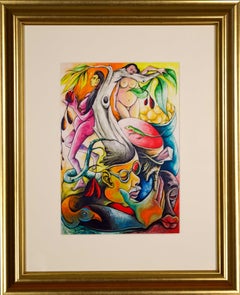
Clanman
Located in Milwaukee, WI
Gicleé print on white wove paper after original ca.1960 oil on canvas.
Art: 13" x 9"
Frame: 23" x 18.75"
Signed in the image, lower left.
Category
1960s Abstract Prints
Materials
Giclée
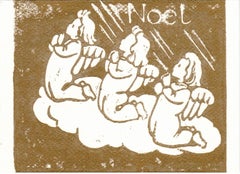
Noel
Linocut with estate signature
By Sylvia Spicuzza
Located in Milwaukee, WI
4.88 x 6 inches, folded sheet - David originally printed this as a greeting card in 2008 from Sylvia's block. In 2022 he had it cut down to the image size and stamped on face with es...
Category
Early 2000s Figurative Prints
Materials
Linocut
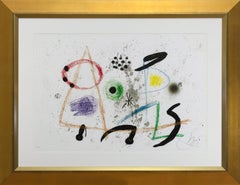
Maravillas con variaciones acrósticas en el jardín de Miró, 1975, (VI/XV)
By Joan Miró
Located in Milwaukee, WI
Joan Miró produced this original color lithograph especially for Rafael Alberti's text 'Maravillas con Variaciones Acrósticas en el Jardín de Miró' (Wonders with Acrostic Variations ...
Category
Late 20th Century Prints and Multiples
Materials
Lithograph
The Basilica of St. Josapha
Giclée Print on Watercolor Paper
By Julia Taylor
Located in Milwaukee, WI
Milwaukee's iconic spots are captured in watercolor and available as hand-embellished giclée. They are printed on archival quality watercolor paper and specially hand embellished so each giclée is a unique mixed media piece of artwork. The artist Julia Taylor added special original touches to each print in 'The Milwaukee Series 2020'
Art: 22" x 21"
Growing up in a small farming community in Indiana, I learned to draw early in life. I earned spending money by sketching portraits at county fairs and illustrations in weekly papers. Art teachers in high school and college taught me ways to master drawing fluidly from life.
In college, my small stained glass...
Category
2010s Prints and Multiples
Materials
Giclée
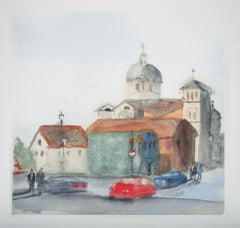
Three Trees
Giclee Print on Watercolor paper After Acrylic Painting
By Joan Dvorsky
Located in Milwaukee, WI
8" x 8" art
18.25" x 18.25" frame
In this artwork, Milwaukee-based artist Joan Dvorsky presents the viewer with an image of three blue trees that almost appear to glow in their envi...
Category
2010s Prints and Multiples
Materials
Giclée
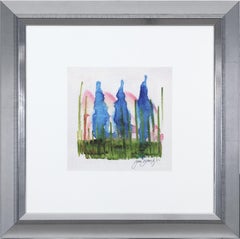
"Arroyo, " Woodcut and Monotype Landscape signed by Carol Summers
By Carol Summers
Located in Milwaukee, WI
"Arroyo" is a woodcut and monotype signed by Carol Summers. The print is a break from the usual bright coloring of Summers' images, though is rendered in his typical style and fields of unmodeled color. A pair of trees stand front and center before an arroyo, a Spanish term for an intermittently dry creek, running out to the ocean. A white sunrise glows in the distance beyond the sea. The playfulness of the image is enhanced by Summers' signature printmaking technique, which allows the ink from the woodblock to seep through the paper, blurring the edges of each form.
14.25 x 14 inches, artwork
Numbered from the edition of 120
This print was commissioned by the Madison Print Club, Madison, WI
Carol Summers (1925-2016) worked as an artist throughout the second half of the 20th century and into the first years of the next, outliving most of his mid-century modernist peers. Initially trained as a painter, Summers was drawn to color woodcuts around 1950 and it became his specialty thereafter. Over the years he has developed a process and style that is both innovative and readily recognizable. His art is known for its large scale, saturated fields of bold color, semi-abstract treatment of landscapes from around the world, and a luminescent quality achieved through a printmaking process he invented.
In a career that has extended over half a century, Summers has hand-pulled approximately 245 woodcuts in editions that have typically run from 25 to 100 in number. His talent was both inherited and learned. Born in 1925 in Kingston, a small town in upstate New York, Summers was raised in nearby Woodstock with his older sister, Mary. His parents were both artists who had met in art school in St. Louis. During the Great Depression, when Carol was growing up, his father supported the family as a medical illustrator until he could return to painting. His mother was a watercolorist and also quite knowledgeable about the different kinds of papers used for various kinds of painting. Many years later, Summers would paint or print on thinly textured paper originally collected by his mother.
From 1948 to 1951, Carol Summers trained in the classical fine and studio arts at Bard College and at the Art Students League of New York. He studied painting with Steven Hirsh and printmaking with Louis Schanker. He admired the shapes and colors favored by early modernists Paul Klee (Sw: 1879-1940) and Matt Phillips (Am: b.1927- ). After graduating, Summers quit working as a part-time carpenter and cabinetmaker (which had supported his schooling and living expenses) to focus fulltime on art. That same year, an early abstract, Bridge No. 1 was selected for a Purchase Prize in a competition sponsored by the Brooklyn Museum.
In 1952, his work (Cathedral, Construction, and Icarus) was shown for the first time at the Museum of Modern Art in New York City in an exhibition of American woodcuts. In 1954, Summers received a grant from the Italian government to study for a year in Italy. Woodcuts completed soon after his arrival there were almost all editions of only 8 to 25 prints, small in size, architectural in content, and black and white in color. The most well-known are Siennese Landscape and Little Landscape, which depicted the area near where he resided. Summers extended this trip three more years, a decision that would have a significant impact on choices of subject matter and color in the coming decade.
After returning from Europe, Summers’ images continued to feature historical landmarks and events from Italy as well as from France, Spain, and Greece. However, as evidenced in Aetna’s Dream, Worldwind, and Arch of Triumph...
Category
1980s Contemporary Abstract Prints
Materials
Monotype, Woodcut
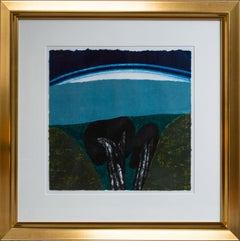
Pura Vida, 1985, (A/P)
By Carol Summers
Located in Milwaukee, WI
Woodcut in colors on Japanese paper. Signed and titled by artist.
24.25" x 24.25" art
34.88" x 34.63" frame
Carol Summers (1925-2016) has worked as an artist throughout the second ...
Category
1980s Abstract Prints
Materials
Woodcut
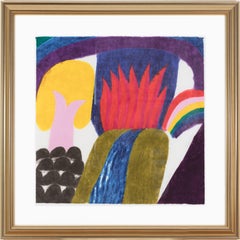
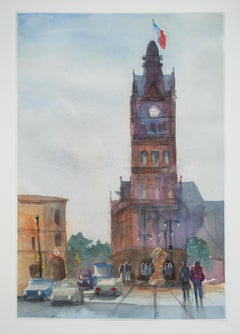
Contemporary landscape watercolor building street scene with figures signed
By Julia Taylor
Located in Milwaukee, WI
Milwaukee's iconic spots are captured in watercolor and available as hand-embellished giclée. They are printed on archival quality watercolor paper and specially hand embellished so each giclée is a unique mixed media piece of artwork. The artist Julia Taylor added special original touches to each print in 'The Milwaukee Series 2020'
32" x 22" art
Growing up in a small farming community in Indiana, I learned to draw early in life. I earned spending money by sketching portraits at county fairs and illustrations in weekly papers. Art teachers in high school and college taught me ways to master drawing fluidly from life.
In college, my small stained glass...
Category
2010s Prints and Multiples
Materials
Giclée
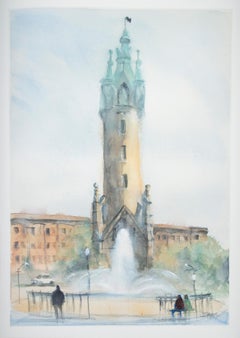
Contemporary landscape watercolor building scene with figures fountain signed
By Julia Taylor
Located in Milwaukee, WI
Milwaukee's iconic spots are captured in watercolor and available as hand-embellished giclée. They are printed on archival quality watercolor paper and specially hand embellished so each giclée is a unique mixed media piece of artwork. The artist Julia Taylor added special original touches to each print in 'The Milwaukee Series 2020'
32" x 22" art
Growing up in a small farming community in Indiana, I learned to draw early in life. I earned spending money by sketching portraits at county fairs and illustrations in weekly papers. Art teachers in high school and college taught me ways to master drawing fluidly from life.
In college, my small stained glass...
Category
2010s Landscape Prints
Materials
Watercolor, Giclée
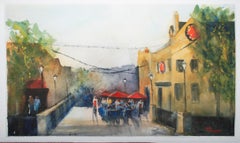
Cafe Hollander in Tosa, 2020
By Julia Taylor
Located in Milwaukee, WI
Milwaukee's iconic spots are captured in watercolor and available as hand-embellished giclée. They are printed on archival quality watercolor paper and specially hand embellished so ...
Category
2010s Paintings
Materials
Watercolor, Giclée
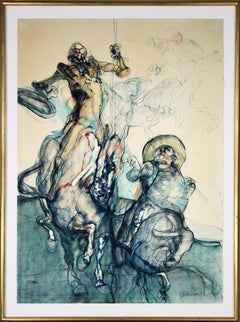
Don Quichotte
Sancho Panza, c.1972, (A/P)
By Claude Weisbuch
Located in Milwaukee, WI
29 3/4 x 21 1/2 paper
34 x 25 1/4 framed
Signed lower right.
Claude Weisbuch was born in Thionville, France in 1927 and was a pupil at L' École des Beaux-Arts de Nancy, France. As ...
Category
Late 20th Century Prints and Multiples
Materials
Lithograph
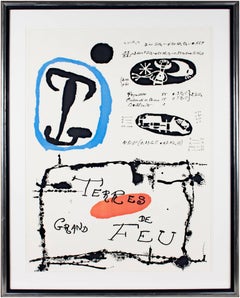
"Derrière le Miroir, Terres de Grand Feu" Original Color Lithograph by Joan Miro
By Joan Miró
Located in Milwaukee, WI
"Derrière le Miroir (Terres de Grand Feu)" from the exposition "Terres de Grand Feu Miró-Artigas" at Galerie Maeght June-July 1956. This is an original color lithograph on Arches paper, with three works on one sheet from the catalogue for the exhibition of ceramic work produced by Joan Miró and Llorens Artigas...
Category
1950s Abstract Abstract Prints
Materials
Lithograph
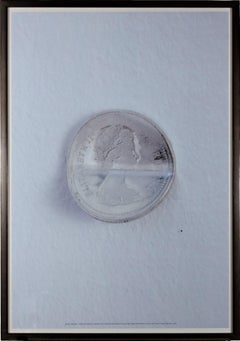
Untitled
Poster Series Curated by Christophe Boutin and Mélanie Scarciglia
Located in Milwaukee, WI
26 1/4" x 18" art
28.25" x 20" frame
Poster for Untitled, 2017 Poster Series Curated by Christophe Boutin and Mélanie Scarciglia for Untitled, Miami Beach, 2017.
Category
2010s Still-life Prints
Materials
Digital
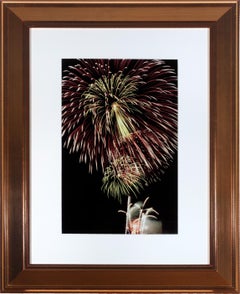
Fireworks
Located in Milwaukee, WI
Photo Giclee print, signed lower right by Michael MacDonald.
17 3/4 x 11 3/4 art
29.375 x 23.50" frame
Category
Early 2000s Abstract Prints
Materials
Giclée
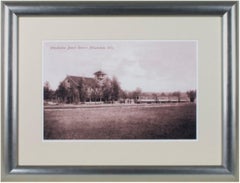
Waukesha Beach Resort, Pewaukee Lake, 2002
Located in Milwaukee, WI
John T. Faber
Waukesha Beach Resort, Pewaukee Lake, 2002
Giclee print, after original postcard 8/13/1909
Waukesha Beach Resort, Pewaukee Lake, 2002 is a giclee print after the origi...
Category
21st Century and Contemporary Landscape Prints
Materials
Giclée
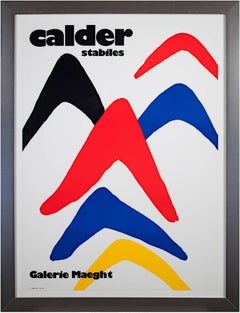
Stabiles
original lithograph poster after Alexander Calder, Galerie Maeght
By Alexander Calder
Located in Milwaukee, WI
'Stabiles' is a lithograph poster after Alexander Calder and published by Galerie Maeght in 1971. Calder had produced the stones for this lithograph a year earlier in 1970 for a prin...
Category
1970s Abstract Expressionist Abstract Prints
Materials
Lithograph
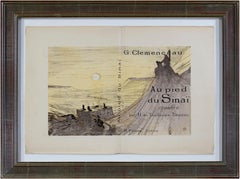
Toulouse Lautrec Original Lithograph Famous Political 1800s Collection Signed
By Henri de Toulouse-Lautrec
Located in Milwaukee, WI
"Lautrec Book: From Au Pied du Sinai written by Georges Clemenceau" lithographs created by the legendary Henri de Toulouse-Lautrec. This book, Au Pied...
Category
1890s Post-Impressionist Figurative Prints
Materials
Lithograph, Mulberry Paper
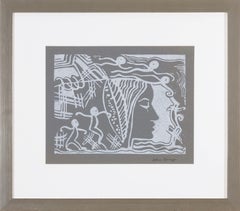
Figural Abstraction
original black and white block print by Sylvia Spicuzza
By Sylvia Spicuzza
Located in Milwaukee, WI
'Figural Abstraction' is an original block print by American artist and teacher Sylvia Spicuzza. The image, printed in white ink against a grey paper, presents bold and graphic figur...
Category
Mid-20th Century Modern Abstract Prints
Materials
Paper, Ink
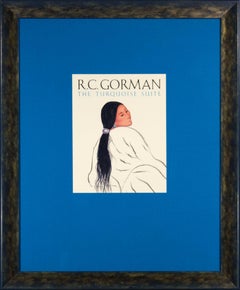
The Turquoise Suite
complete portfolio of lithographs by Rudolph Carl Gorman
By R.C. Gorman
Located in Milwaukee, WI
'The Turquoise Suite' is a portfolio of three original color lithograph by the renown printmaker R.C. Gorman. From Arizona, the artist's later works fo...
Category
1990s Contemporary Figurative Prints
Materials
Lithograph
Fatima
original lithograph in colors signed by Rudolph Carl Gorman
By R.C. Gorman
Located in Milwaukee, WI
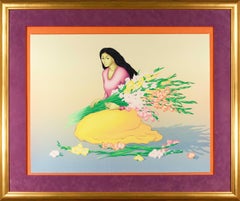
'Fatima' is an original color lithograph by the renown printmaker R.C. Gorman. from Arizona, the artist's later works focus almost entirely on the female figure and take Native American and Southwestern imagery as a source of inspiration. Here, a single woman sits in a colorful yet undefined space. The form of her yellow dress as she kneels is repeated in the delicately drawn bunches gladiolus flowers...
Category
1990s Contemporary Figurative Prints
Materials
Lithograph
Gladia
original lithograph in colors signed by Rudolph Carl Gorman
By R.C. Gorman
Located in Milwaukee, WI
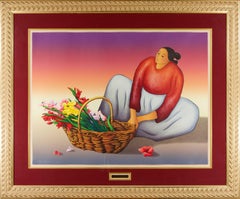
'Gladia' is an original color lithograph by the renown printmaker R.C. Gorman. from Arizona, the artist's later works focus almost entirely on the female figure and take Native American and Southwestern imagery as a source of inspiration. Here, a single woman sits in a colorful yet undefined space. The oval shape of her broad seated form is repeated in the delicately drawn shape of the flower basket at her feet. The basket contains a bundle of multicolor gladiolus flowers...
Category
1990s Contemporary Figurative Prints
Materials
Lithograph
Mel Swimming in Beaver Lake (Blue)
original digital artwork by Melodee Liegl
Located in Milwaukee, WI
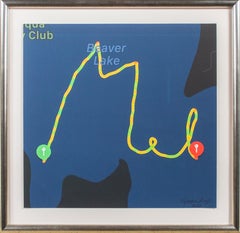
'Mel Swimming in Beaver Lake (Blue)' is an original digital artwork by Wisconsin-based artist and swimmer Melodee Liegl – the first digital artist represented by our gallery! As a pr...
Category
2010s Contemporary Abstract Prints
Materials
Digital Pigment
Mel Swimming in Beaver Lake (Blue)
original digital artwork by Melodee Liegl
Located in Milwaukee, WI
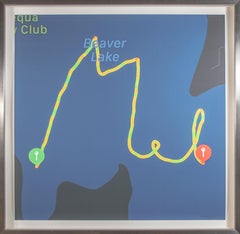
'Mel Swimming in Beaver Lake (Blue)' is an original digital artwork by Wisconsin-based artist and swimmer Melodee Liegl – the first digital artist represented by our gallery! As a pr...
Category
2010s Contemporary Abstract Prints
Materials
Digital Pigment
Flowers
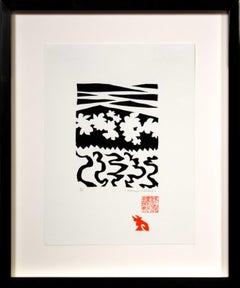
original abstract linocut by Wisconsin artist Schomer Lichtner
By Schomer Lichtner
Located in Milwaukee, WI
'Flowers' is an original linocut by Wisconsin-based artist Schomer Lichtner. The composition presents a scattered floral still life amongst abstracted shadows and forms, rendered with Lichtner's quintessential abstract sensibilities. This print is one from a series that each depict abstracted subjects in black silhouette, taking pleasure in the materiality of the linocut technique. The free forms of the flower resemble the lyrical mid-century works of the French artist Henri Matisse, which combined with these material concerns demonstrate Lichter's modern sensibilities. The prints from this series are unusual because of how below the image, Lichtner also includes his Chinese seal and a linocut remarque of a cow, each of which act as an additional signature of the artist on the artwork.
Linocut in black and red on Permalife white wove paper
4 x 5.25 inches, image
11.5 x 8.75 inches, sheet
16.5 x 13.63 inches, frame
Signed in pencil, below image, lower right.
Edition 1/100 in pencil, below image, lower left.
Chinese signature stamp in red, below image, lower right.
Remaque of a cow in red, below image, lower right.
Permalife watermark to paper.
Framed to conservation standards in a shadow-box style mounting, using 100 percent rag matting, museum glass, and housed in a silver-finish wood moulding.
Overall excellent condition with no creases or discoloration.
Milwaukee artist Schomer Lichtner was well known for his whimsical cows and ballerinas and abstract imagery. He and his late wife Ruth Grotenrath, both well-known Wisconsin artists, began their prolific careers as muralists for WPA projects, primarily post offices.
Lichtner also painted murals for industry and private clients. Schomer was a printmaker and produced block prints, lithographs, and serigraph prints. His casein (paint made from dairy products) and acrylic paintings are of the rural Wisconsin landscape and farm animals. He became interested in cows when he and Ruth spent summers near Holy Hill in Washington County. According to David Gordon, director of the Milwaukee Art Museum, Schomer Lichtner had a tremendous joie de vivre and expressed it in his art.
Schomer Lichtner was nationally known for his whimsical paintings and sculptures of black- and white-patterned Holstein cows...
Category
Late 20th Century American Modern Abstract Prints
Materials
Paper, Black and White, Linocut

Field
original abstract linocut in black by Wisconsin artist Schomer Lichtner
By Schomer Lichtner
Located in Milwaukee, WI
'Field' is an original linocut by Wisconsin-based artist Schomer Lichtner. The composition presents fields of flowers, trees and grasses below a cloudy sky, but rendered with Lichtner's quintessential abstract sensibilities. This print is one from a series that each depict abstracted subjects in black silhouette, taking pleasure in the materiality of the linocut technique. The free forms of the plants resemble the lyrical mid-century works of the French artist Henri Matisse, which combined with these material concerns demonstrate Lichter's modern sensibilities. The prints from this series are unusual because of how below the image, Lichtner also includes his Chinese seal and a linocut remarque of a cow, each of which act as an additional signature of the artist on the artwork.
Linocut in black and red on Permalife white wove paper
4.5 x 6 inches, image
11.5 x 8.75 inches, sheet
16.5 x 13.63 inches, frame
Signed in pencil, below image, lower right.
Edition 1/100 in pencil, below image, lower left.
Chinese signature stamp in red, below image, lower right.
Remaque of a cow in red, below image, lower right.
Permalife watermark to paper.
Framed to conservation standards in a shadow-box style mounting, using 100 percent rag matting, museum glass, and housed in a silver-finish wood moulding.
Overall excellent condition with no creases or discoloration.
Milwaukee artist Schomer Lichtner was well known for his whimsical cows and ballerinas and abstract imagery. He and his late wife Ruth Grotenrath, both well-known Wisconsin artists, began their prolific careers as muralists for WPA projects, primarily post offices.
Lichtner also painted murals for industry and private clients. Schomer was a printmaker and produced block prints, lithographs, and serigraph prints. His casein (paint made from dairy products) and acrylic paintings are of the rural Wisconsin landscape and farm animals. He became interested in cows when he and Ruth spent summers near Holy Hill in Washington County. According to David Gordon, director of the Milwaukee Art Museum, Schomer Lichtner had a tremendous joie de vivre and expressed it in his art.
Schomer Lichtner was nationally known for his whimsical paintings and sculptures of black- and white-patterned Holstein cows...
Category
Late 20th Century American Modern Landscape Prints
Materials
Black and White, Paper, Linocut
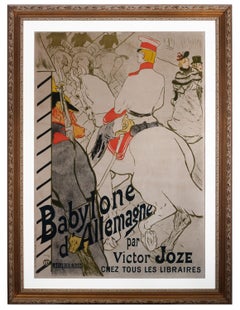
Babylone d
Allemagne
original lithograph poster by Henri de Toulouse-Lautrec
By Henri de Toulouse-Lautrec
Located in Milwaukee, WI
'Babylone d'Allemagne' or 'German Babylon' is an original lithograph poster by the lauded artist of the Art Nouveau style Henri de Toulouse-Lautrec. This is the second poster that La...
Category
1890s Art Nouveau Portrait Prints
Materials
Paper, Lithograph
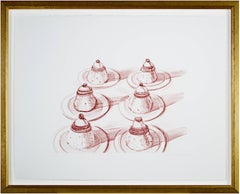
"Italian Desserts, " Etching signed by Wayne Thiebaud
By Wayne Thiebaud
Located in Milwaukee, WI
An etching in red by American pop artist Wayne Thiebaud depicting six Italian desserts. This is #16 from the edition of 50. It is signed and dated in pencil lower right, and numbered...
Category
1970s Contemporary Still-life Prints
Materials
Etching
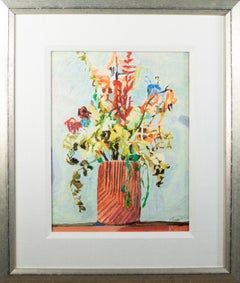
Dried Flowers in a Stoneware Vase giclee print spring color gift decor mom
By Kevin Knopp
Located in Milwaukee, WI
This giclee print on canvas is hand embellished with acrylic gel brushstrokes after the 2001 original oil painting. Depicting brightly colored flowers in a vase, this beautiful artwo...
Category
2010s Contemporary Still-life Paintings
Materials
Canvas, Acrylic, Giclée
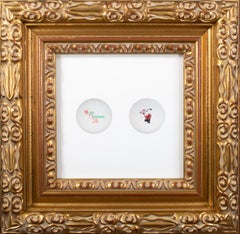
Pair of Christmas Golf Balls
gicleé print on watercolor paper
Located in Milwaukee, WI
In this playful gicleé print, the viewer is presented with two golf balls adorned with Christmas-related imagery. The golf ball on the right features Santa ...
Category
2010s Contemporary Still-life Prints
Materials
Giclée
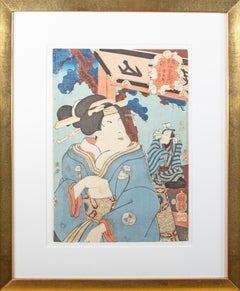
19th century color woodcut Japanese ukiyo-e print female geisha figure signed
By Utagawa Kuniyoshi
Located in Milwaukee, WI
This print is from a highly regarded series by the Edo woodblock artist Utagawa Kuniyoshi: in the period, there were at times prohibitions in depicting a...
Category
1850s Edo Figurative Prints
Materials
Paper, Pigment, Woodcut
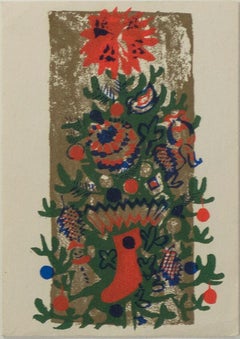
O
Tannenbaum
original color silkscreen signed on verso, Christmas tree, winter
By Ruth Grotenrath
Located in Milwaukee, WI
'O'Tannenbaum' (Artist's #30129) is an original color silkscreen print by Ruth Grotenrath, signed by the artist on verso. Influenced by the works of Expressionists like Henri Matisse and the woodblock prints of early modern Japanese artists like Katsushika Hokusai, Ruth Grotenrath's 'O'Tannenbaum' combines the expressive use of color of the former with the precision of the latter to create a Christmas card that is as vibrant as it is subtle. Depicting a pine tree decked with ornaments and stockings, Grotenrath has rendered the tree-topping star as a ball of flames to analogize the warmth and spirit of the holiday season.
Original color silkscreen
6.625 x 4 inches, silkscreen
14.375 x 11.375 inches, frame
Signed in screen on verso inside-letter
Framed to conservation standards using archival materials including 100 percent rag matting and mounting materials, Museum Glass to inhibit UV damage and reduce glare, and housed in a gold finish wood frame.
"The paintings of Ruth...
Category
1940s Expressionist Interior Prints
Materials
Screen
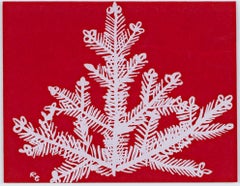
"Fir Tree, " Original Color Silkscreen signed by Ruth Grotenrath
By Ruth Grotenrath
Located in Milwaukee, WI
"Fir Tree" (Artist's #1516) is an original color silkscreen by Ruth Grotenrath. The artist signed the piece with her initials lower left. This artwork depicts a white fir tree branch in white on red.
4 1/4" x 5 3/8" art
12" x 13" frame
"The paintings of Ruth...
Category
1950s Expressionist Prints and Multiples
Materials
Screen
Winter Silhouettes,
offset lithograph by Schomer Lichtner
By Schomer Lichtner
Located in Milwaukee, WI
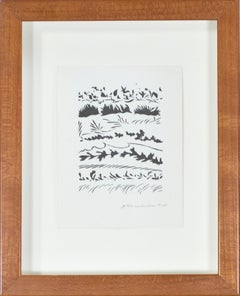
'Winter Silhouettes,' a small and delicate print, is an original offset lithograph by the Milwaukee artist Schomer Lichtner. The composition displays registers of foliage, emerging from the white of the paper as though emerging from the snow-covered ground. The artwork is thus plays with the materials of printmaking; the paper is both the support and the primary indication of the season. The subtle texture of the tooth of the paper also adds life to the image, giving the snow a wind-swept, creature trodden surface. The free forms of the grasses and leaves resemble the lyrical mid-century works of the French artist Henri Matisse, which combined with these material concerns demonstrate Lichter's modern sensibilities.
3.75 x 2.75 inches, image
5.5 x 4.5 inches, paper
10 x 8 inches frame
Signed and dated in the stone, lower right
Framed to conservation standards in a shadow-box style mounting, using 100 percent rag matting, museum glass, and housed in a cherry wood moulding
Overall excellent condition; some toning to edges of paper; some minor abrasions to frame
Milwaukee artist Schomer Lichtner was well known for his whimsical cows and ballerinas and abstract imagery. He and his late wife Ruth Grotenrath, both well-known Wisconsin artists, began their prolific careers as muralists for WPA projects, primarily post offices.
Lichtner also painted murals for industry and private clients. Schomer was a printmaker and produced block prints, lithographs, and serigraph prints. His casein (paint made from dairy products) and acrylic paintings are of the rural Wisconsin landscape and farm animals. He became interested in cows when he and Ruth spent summers near Holy Hill in Washington County. According to David Gordon, director of the Milwaukee Art Museum, Schomer Lichtner had a tremendous joie de vivre and expressed it in his art.
Schomer Lichtner was nationally known for his whimsical paintings and sculptures of black- and white-patterned Holstein cows and elegant ballerina dancers. Lichtner also painted all sorts of combinations of beautiful women, flowers and country landscapes. James Auer, former Milwaukee Journal Sentinel art critic, said that his art eventually "exploded into expressionistic design elements with bold, flat areas of color and high energy that anticipated Pop Art." Auer went on to describe Lichtner’s work as full of "wit, vigor and virtuosity."
As early as 1930, Lichtner’s work was shown at the prestigious Carnegie International Exhibition in New York and at museums throughout the Midwest. As a student, he was a protégé of another icon of 20th century American art, Gustave Moeller.
Lichtner and his wife, Ruth Grotenrath (1912-1988), are celebrated as Milwaukee’s first couple of painting and are regarded as major Wisconsin artists. Lichtner’s impressive production, perseverance, longevity, and positive approach to his life and art made him and his work distinctive and much loved by his many admirers. His work is currently represented in collections at the Milwaukee Art Museum, the John Michael Kohler Art Center, the West Bend Museum, and in the collections of many individuals. Books on the lives and art work of both Lichtner and Grotenrath are in progress and it is anticipated that they will be published next year.
Schomer Lichtner passed away on May 9, 2006 at the age of 101. He continued to amaze and create with his whimsical paintings of ballerinas...
Category
1960s American Modern Landscape Prints
Materials
Black and White, Lithograph
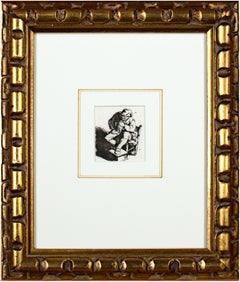
The Smoker (Le Fumeur)
original etching by Cornelis-Pietersz Bega
By Cornelis Bega
Located in Milwaukee, WI
'The Smoker (Le Fumeur)' is an original etching by the celebrated Dutch painter and printmaker Cornelis-Pietersz Bega. It presents a genre scene of the type Bega was best known for: Bega's principal subjects were genre representations of taverns, domestic interiors and villages. He depicted nursing mothers, prostitutes, drunks, gamblers and fools such as quack doctors and alchemists. In this case, he shows a man seated on a chair with his foot on a flat stool and holding a smoking pipe. For Bega, this representation was more of a caricature than it was an image of a specific person, and such genre scenes would have held allegorical and symbolic meaning for the seventeenth-century viewer. During the seventeenth century, the Dutch of all levels of society consumed tobacco and alcohol, and these were an important part of the Dutch economy and a major source of wealth. At the same time, however, moralists and ministers sought to curb intoxication: they openly described drinking and smoking as sinful, immoral, and a general threat to one’s reputation. This paradox is reflected in prints such as this, which inherently carry the national pride of the Dutch economy alongside a moral warning in a print that could be just as easily consumed and collected.
2.5 x 2.25 inches, print
12.38 x 10.38 inches, frame
Framed to conservation standards using archival materials including 100 percent rag matting and mounting materials. Housed in a gold finish Spanish-style wood moulding.
Overall good and stable condition; margins cut to plate; some wrinkling in the corners from previous mounting; housed in a new custom frame.
Cornelis Bega was born into prosperous circumstances. His mother, Maria Cornelis, inherited half the estate (gold, silver, paintings, drawings and prints) and all of the red chalk drawings of her father, Cornelis Cornelisz van Haarlem, a renowned Mannerist artist. Bega's father was Pieter Jansz Begijn (d 1648), a gold and silversmith.
Like other family members, Bega was probably Catholic. Houbraken's claim that Bega studied with Adriaen van Ostade is likely to be correct; this was probably before 24 April 1653, when Bega joined Vincent Laurentsz. van der Vinne in Frankfurt for a journey through Germany, Switzerland and France. Bega had returned to Haarlem by 1 September 1654, at which time he joined the Guild of St Luke; he was already a competent draughtsman, as indicated by his first extant dated work, Interior with a Nursing Mother (1652; Frankfurt am Main, Städel. Kstinst.), and by a remarkable double portrait (Amsterdam, Rijksmuseum) drawn by him and Leendert van der Cooghen in 1654.
Bega painted, drew, etched and made counterproofs in a wide variety of materials on different types of small-scale supports. He may have been the first Dutch artist to make monotypes, but this remains controversial. Approximately 160 paintings, 80 drawings and six monotypes by Bega have been catalogued, as well as around 34 etchings.
Bega's principal subjects were genre representations of taverns, domestic interiors and villages. He depicted nursing mothers, prostitutes, drunks, smokers, gamblers and fools such as quack doctors and alchemists. Less common subjects include the ridiculed or pestered woman, as in Two Figures and Mother with a Spirits Bottle (c. 1662; Gouda, Stedel, Museum Catharina Gasthuis) and The Inn (etching), as well as witty satires on traditional scenes of middle-class music-makers, such as the Music Lesson (1663; Paris, Petit Palace).
Bega's early paintings, such as the Weaver's Family (c. 1652; St Petersburg, Hermitage), are freely executed, dark and coarse, recalling the many-figured peasant subjects of van Ostade. Between c. 1660 and 1664 he began to paint genre scenes with fewer figures, which are finely articulated, colourful and psychologically expressive, for example Two Men Singing (1662; Dublin, N.G.). His exquisite, late fijnschilderen ('fine painting') manner, evident in The Alchemist (1663; Malibu, Getty Museum), compares well with that of Gerrit Dou.
As a draughtsman Bega is noted for his single-figure studies, executed mainly in black and white chalk on blue paper or red chalk on white paper. None of the studies, which were drawn naer het leven (from life), seem to relate to a painting or etching. Bega traded drawings or shared models with other artists of the Haarlem school, including van der Cooghen, Gerrit Berckheyde, Dirck Helmbreker and Cornelis Visscher. These artists drew chalk figure studies in a very similar style, characterised by regular and precise parallel shading and well-defined forms; their drawings, especially those of Bega and Berckheyde, have been frequently confused. Unlike the realistic figure studies, Bega's etchings depict interiors with figures or single figures in the manner of van Ostade; the compositions, often with masterful chiaroscuro effects, reflect most closely the paintings of the 1650s.
Bega is likely to have remained in Haarlem, where he paid dues to the Guild in 1661. He probably died from the plague; fees for his expensive funeral at St. Bavo's were paid on 30 August 1664. Among the artists he influenced were Thomas Wijck, Jan Steen, Richard Brakenburg (1650-1702) and Cornelis Dusart. Painters such as R. Oostrzaen ( fl ?1656) and Jacob Toorenvliet...
Category
17th Century Old Masters Figurative Prints
Materials
Paper, Etching
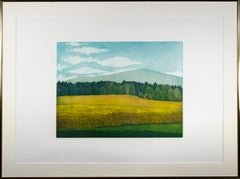
Untitled (field, hills trees)
original landscape aquatint by Nicolette Jelen
By Nicolette Jelen
Located in Milwaukee, WI
The present artwork is an original color aquatint by the Sag Harbor-based artist Nicolette Jelen, and is a particularly rare Hors Commerce proof. It presents a view of what is probab...
Category
1980s Contemporary Landscape Prints
Materials
Aquatint, Paper
Four original etchings of women from
Aula Veneris
series by Wenceslaus Hollar
By Wenceslaus Hollar
Located in Milwaukee, WI
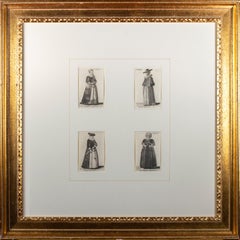
Presented here as a group are four original etchings of women in European national dress from the master printmaker Wenceslaus Hollar's series "Aula V...
Category
17th Century Old Masters Figurative Prints
Materials
Etching, Paper