Lincoln Glenn

to
99
606
281
167
153
93
91
67
65
63
53
52
50
50
43
26
25
24
24
22
15
14
14
10
7
7
4
29
16
14
14
14
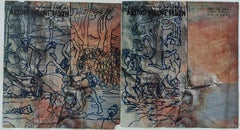
"Untitled" Bob Thompson, Figurative Work on Paper, Black Abstract Artist
By Bob Thompson
Located in New York, NY
Bob Thompson Untitled, 1964 Felt tip pen on printed paper 11 x 20 1/2 inches Provenance: The artist Kathy Komaroff Goodman (gift from the artist) Hollis Taggart, New York Exhibited...
Category

1960s Modern Figurative Drawings and Watercolors

Materials

Paper, Watercolor

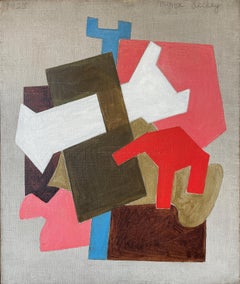
"Abstract Interior of Room" Myron Lechay, Colorful Early Geometric Abstract
By Myron Lechay
Located in New York, NY
Myron Lechay Abstract Interior of Room, 1923 Signed upper right corner and dated upper left corner Oil on canvas 24 x 20 inches Provenance: Estate of the artist Spanierman Gallery, ...
Category

1920s Abstract Abstract Paintings

Materials

Canvas, Oil

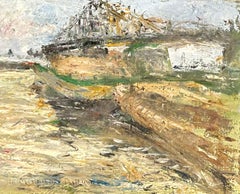
"Near Provincetown" Charles Webster Hawthorne, Cape Cod Impressionist Landscape
By Charles Webster Hawthorne
Located in New York, NY
Charles Hawthorne Near Provincetown Signed and inscribed "TO MY FRIEND RILLINGIK" lower left Oil on canvas 16 x 20 1/4 inches Provenance: Private Collection Sotheby's New York, September 12, 1994, Lot 145 Spanierman Gallery, New York Private Collection, Scarsdale, New York Charles W. Hawthorne (1872-1930) was one of America's most dynamic, penetrating and forthright portrait painters, as well as a creative, inspiring teacher. A painter's painter, Hawthorne ran a summer school in Provincetown - the Cape Cod School of Art - for over thirty years and made it a leading artists' colony of plein-air impressionist-inspired talents. Hawthorne grew up in Richmond, Maine, the son of Joseph Jackson Hawthorne and Cornelia Jane Smith...
Category

1910s Impressionist Landscape Paintings

Materials

Canvas, Oil

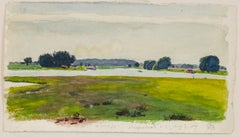
"Sheepshead, Brooklyn, Long Island" Oscar Bluemner, Modernist Watercolor
By Oscar Bluemner
Located in New York, NY
Oscar Bluemner Sheepshead, Long Island, 1907 Signed with the artist's conjoined initials "OB" and dated "4-30 - 5 - 30" / "Aug 3, 07" Watercolor on paper 6 x 10 inches Provenance: J...
Category

Early 1900s American Modern Landscape Drawings and Watercolors

Materials

Paper, Watercolor

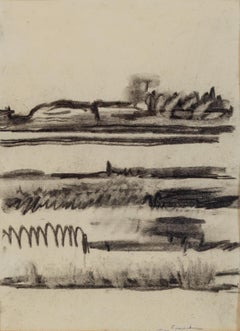
"Untitled I" Jane Freilicher, Hamptons Landscape Drawing, Mid-century Abstract
By Jane Freilicher
Located in New York, NY
Jane Freilicher Untitled I, 1958-59 Signed lower right Charcoal on paper 11 1/2 x 8 3/4 inches Provenance: Tibor de Nagy Gallery, New York Private Collection, New York Jane Freilic...
Category

1950s Modern Landscape Drawings and Watercolors

Materials

Paper, Charcoal

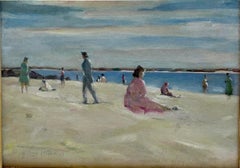
"Ocean Parkway Beach, October 2" Nathan Hoffman, Brooklyn, Impressionist
Located in New York, NY
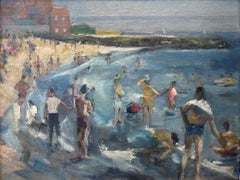
Nathan Hoffman Ocean Parkway Beach, October 2, 1941 Signed, titled, dated on the reverse Oil on artists board 9 3/4 x 14 inches Born in Russia, the son...
Category

1940s American Impressionist Landscape Paintings

Materials

Oil, Board

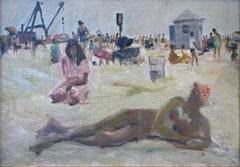
"Brighton Beach, August 5" Nathan Hoffman, Brooklyn, Impressionist, Sunny Day
Located in New York, NY
Nathan Hoffman Brighton Beach, August 5, 1941 Signed, titled, dated and estate stamped on the reverse Oil on board 9 3/4 x 14 inches Born in Russia, th...
Category

1940s American Impressionist Landscape Paintings

Materials

Oil, Board

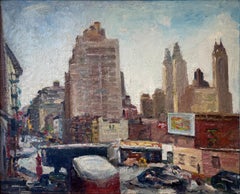
"Manhattan from the Rooftops" Nathan Hoffman, Impressionist Cityscape Landscape
Located in New York, NY
Nathan Hoffman Manhattan from the Rooftops, July 1, 1947 Signed, dated and estate stamped on the reverse Oil on board 15 3/4 x 20 inches Born in Russia...
Category

1940s American Impressionist Landscape Paintings

Materials

Oil, Board

"Brighton Beach" Nathan Hoffman, New York, Sunny Day Landscape Impressionism
Located in New York, NY
Nathan Hoffman Brighton Beach, July 31, 1946 Signed, dated, and estate stamped on the reverse Oil on artist's board 10 x 13 1/2 inches Provenance: Esta...
Category

1940s American Impressionist Landscape Paintings

Materials

Oil, Board

"The Beach" Nathan Hoffman, Brooklyn, New York, Sunny Day Landscape
Located in New York, NY
Nathan Hoffman The Beach Estate stamped on the reverse Oil on artist's board 10 1/4 x 14 inches Provenance: Estate of the artist Born in Russia, the s...
Category

1940s American Impressionist Landscape Paintings

Materials

Oil, Board

"Untitled, " Thiago Rocha Pitta, Brazilian Contemporary Grey Watercolor
Located in New York, NY
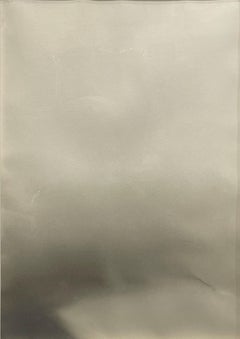
Thiago Rocha Pitta Untitled, 2006 Watercolor on paper 30 x 23 inches Brazil-based artist Thiago Rocha Pitta’s (b. 1980) temporal and sensitive body of work depicts interventions wit...
Category

Early 2000s Contemporary Abstract Drawings and Watercolors

Materials

Paper, Watercolor

"Untitled, " Thiago Rocha Pitta, Contemporary Grey Watercolor
Located in New York, NY
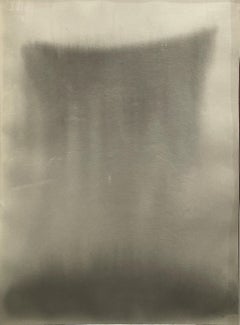
Thiago Rocha Pitta Untitled, 2006 Watercolor on paper 30 x 23 inches Brazil-based artist Thiago Rocha Pitta’s (b. 1980) temporal and sensitive body of work depicts interventions wit...
Category

Early 2000s Contemporary Abstract Drawings and Watercolors

Materials

Paper, Watercolor

"Young Girl (Jenue Fille)" Louis Valtat, French Drawing
By Louis Valtat
Located in New York, NY
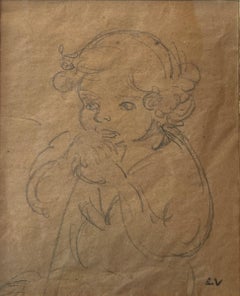
Louis Valtat Young Girl Stamped with initials lower right Pencil on brown paper Sight 7 x 6 inches Provenance: Mrs. Ernest M. Werner, New York Private Collection, Rhode Island Loui...
Category

Early 20th Century Fauvist Figurative Drawings and Watercolors

Materials

Paper, Pencil

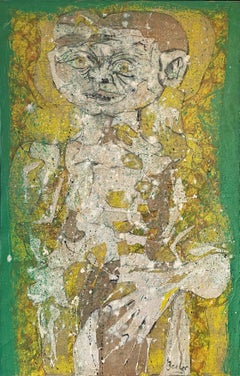
"Boy from Mansos, " Karl Zerbe, Green Figurative "Degenerate" Art Collage
By Karl Zerbe
Located in New York, NY
Karl Zerbe (1903 - 1972) Boy from Mansos, 1963 Collage and acrylic on canvas 35 x 23 inches Signed lower right Provenance: Lee Nordness Galleries, New York Karl Zerbe was born on September 16, 1903 in Berlin, Germany. The family lived in Paris, France from 1904–1914, where his father was an executive in an electrical supply concern. In 1914 they moved to Frankfurt, Germany where they lived until 1920. Karl Zerbe studied chemistry in 1920 at the Technische Hochschule in Friedberg, Germany. From 1921 until 1923 he lived in Munich, where he studied painting at the Debschitz School, mainly under Josef Eberz. From 1924 until 1926 Karl Zerbe worked and traveled in Italy on a fellowship from the City of Munich. In 1932 his oil painting titled, ‘’Herbstgarten’’ (autumnal garden), of 1929, was acquired by the National-Galerie, Berlin; in 1937, the painting was destroyed by the Nazis as "Degenerate art...
Category

1960s Post-War Abstract Paintings

Materials

Canvas, Acrylic

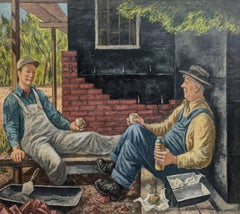
"Lunch Break” Fletcher Martin, Men Working, Bricklayers, WPA, American Scene
By Fletcher Martin
Located in New York, NY
Fletcher Martin Lunch Break, circa 1940 Signed lower right Oil on canvas 31 1/2 x 37 3/8 inches When Fletcher Martin died in 1979, the New York Times entitled his obituary “Artist o...
Category

1940s American Realist Landscape Paintings

Materials

Canvas, Oil

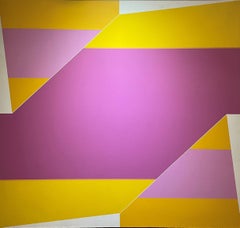
"Jean Jean" Larry Zox, Color Field, Geometric Abstraction, Hard-Edge, Yellow
By Larry Zox
Located in New York, NY
Larry Zox Jean Jean, 1964 Signed, dated, and titled on the stretcher Liquitex on canvas 58 x 62 inches Provenance: Solomon & Co., New York Private Collection, NJ Estate of the above, 2023 Committed to abstraction throughout his career, Larry Zox played a central role in the Color Field discourse of the 1960s and 1970s. His work of the time, consisting of brilliantly colored geometric shapes in dynamic juxtapositions, demonstrated that hard-edge painting was neither cold nor formalistic. He reused certain motifs, but he did so less to explore their aspects than to “get at the specific character and quality of each painting in and for itself,” as James Monte stated in his essay for Zox’s solo exhibition at the Whitney Museum of American Art in 1973. By the 1970s, Zox was using a freer, more emotive method, while maintaining the autonomy of color, which increasingly became more important to him than structure in his late years. Zox began to receive attention in the 1960s, when he was included in several groundbreaking exhibitions of Color Field and Minimalist art, including Shape and Structure (1965), organized by Henry Geldzahler for the Gallery of Modern Art, New York, and Systemic Painting (1966), organized by Lawrence Alloway for the Guggenheim Museum. In 1973, the Whitney’s solo exhibition of Zox’s work gave recognition to his significance in the art scene of the preceding decade. In the following year, Zox was represented in the inaugural exhibition of the Hirshhorn Museum, which owns fourteen of his works. Zox was born in Des Moines, Iowa. He attended the University of Oklahoma and Drake University. While studying at the Des Moines Art Center, he was mentored by George Grosz, who despite his own figurative approach encouraged Zox’s forays into abstraction. In 1958, Zox moved to New York, joining the downtown art scene. His studio on 20th Street became a gathering place for artists, jazz musicians, bikers, and boxers. He occasionally sparred with the visiting fighters. He later established a studio in East Hampton, where he painted and fished including using a helicopter to spot fish. In the 1950s and early 1960s, Zox’s works were collages consisting of painted pieces of paper stapled onto sheets of plywood. He then produced paintings that were illusions of collages, including both torn- and trued-edged forms, to which he added a wide range of intense hues that created ambiguous surfaces. Next, he omitted the collage aspect of his work and applied flat color areas to create more complete statements of pure color and shape. From 1962 to 1965, he produced his Rotation Series, at first creating plywood and Plexiglas reliefs, which turned squares into dynamic polygons. He used these shapes in his paintings as well, employing white as a foil between colors to produce negative spaces that suggest that the colored shapes had only been cut out and laid down instead of painted. The New York Times noted in 1964: “The artist is hip, cool, adventurous, not content to stay with the mere exercise of sensibility that one sees in smaller works.” In 1965, he began the Scissors Jack...
Category

1960s Abstract Geometric Abstract Paintings

Materials

Canvas, Acrylic

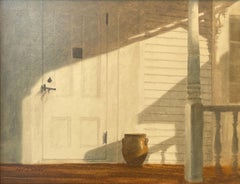
"Doorway" Ken Davies, Realist House Porch Architecture
Located in New York, NY
Ken Davies Doorway, circa 1970 Signed lower left Oil on board 11 x 15 inches Provenance: The Heritage Gallery Inc., Columbus, Ohio, 1975 Private Collection, Columbus Acquired from the estate of the above Born in New Bedford, Massachusetts, Kenneth Davies...
Category

1970s Realist Landscape Paintings

Materials

Oil, Board

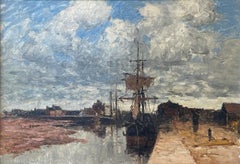
Bateau au Quai (Docked Sailing Vessel at Low Tide), Frank Myers Boggs, Landscape
By Frank Myers Boggs
Located in New York, NY
Frank Myers Boggs Bateau au Quai (Docked Sailing Vessel at Low Tide) Signed lower left Oil on canvas 15 x 21 1/2 inches Provenance: David Findlay Galleries, New York Charles R. Brown Fine Art, Locust Valley, New York The Impressionist Frank Myers Boggs spent his formative and mature years abroad and in 1923 became a naturalized French citizen. He was born in Springfield, Ohio, but moved as a young boy to New York, where his father was a newspaper executive. The artist began his career at the age of seventeen as a wood engraver for Harper’s, preparing illustrations for Harper’s Weekly and for an American edition of the works of Charles Dickens. It has also been stated that he studied with the portraitist John Barnard Whittaker (1836–1926). After working at Niblo’s Garden in New York with a scene painter named Vauglin, Boggs went to Paris to study scene painting. On his arrival there in 1876, he was unable to find anyone to instruct him in this field and instead entered the École des Beaux-Arts. Realizing that Boggs was not well suited to painting figurative subjects, his teacher Jean-Léon Gérôme (1824–1904) advised him to try some outdoor landscapes. Between 1877 and 1881, he concentrated on marine...
Category

Late 19th Century Impressionist Landscape Paintings

Materials

Canvas, Oil

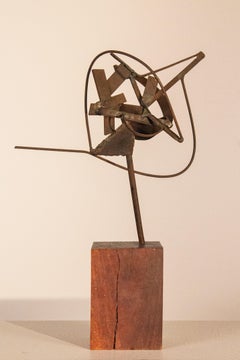
"Untitled" Sidney Gordin, Abstract Metal Steel Sculpture
By Sidney Gordin
Located in New York, NY
Sidney Gordin Untitled, 1958 Incised with initials Welded Steel 15 x 10 1/2 x 6 inches Provenance: Eric Firestone Gallery, New York On October 24, 1918, Sidney Gordin was born in Chelyabinsk, Russia. He spent his early years in Shanghai, China. At the age of four, he moved with his family to New York. Gordin’s nephew, Eliot Nemzer recalls that when Gordin was a child he attended “a dinner party with his parents. Someone showed him a book of pictures that when thumbed through quickly made the image appear to move. This person then gave him a wad of blank papers and something to write with. Sid created a similar type of moving image with his materials. All the adults at the party became quite excited [and] praised his efforts. Sid told me he thought this was a pivotal experience in guiding him towards his vocation.” During his formative years at Brooklyn Technical High School, he briefly contemplated the idea of becoming an architect; yet, by the time he enrolled at Cooper Union, he was determined to become a professional artist. There, he studied under Morris Kantor (1896-1974) and Leo Katz...
Category

1950s Abstract Abstract Sculptures

Materials

Steel

"Pyroclastic Fever, " Nigel Cooke, Contemporary Painting, Lightning Skyscape
By Nigel Cooke
Located in New York, NY
Nigel Cooke (Born 1973) Pyroclastic Fever, 2002 Oil on canvas 60 1/2 x 84 1/2 inches Signed, titled and dated "NIGEL COOKE 'PYROCLASTIC FEVER' 2002 Nigel C...
Category

Early 2000s Contemporary Abstract Paintings

Materials

Canvas, Oil

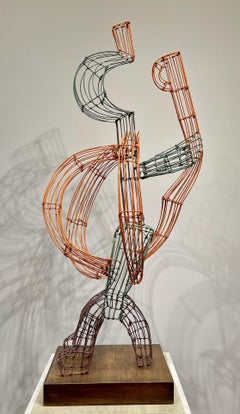
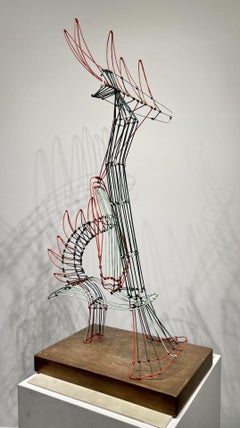
"Hitch Hiked" Hayward Oubre, Painted Wire Sculpture, Southern Black Artist
Located in New York, NY
Hayward Oubre Hitch Hiked, 1960 Signed on Base: OUBRE 60 Painted wire sculpture 45 H. x 21 W. x 19 D. inches Provenance: Estate of the Artist Deeply at...
Category

1960s Figurative Sculptures

Materials

Wire

"The Trap" Hayward Oubre, Painted Wire Sculpture, Black Artist
Located in New York, NY
Hayward Oubre The Trap, c. 1960 Painted wire sculpture 40 H. x 16 1/2 W. x 21 D. inches Provenance: Estate of the Artist Deeply attached to his Souther...
Category

1960s Figurative Sculptures

Materials

Wire

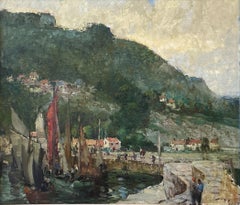
"A Devon Harbor" William Lee Hankey, Coastal Town Seascape with Boats, England
By William Lee Hankey
Located in New York, NY
William Lee Hankey A Devon Harbor Signed lower right; titled on the stretcher Oil on canvas 24 x 29 inches William Lee Hankey (1869–1952) RWS, RI, ROI, RE, NS[clarification needed] ...
Category

Early 20th Century Impressionist Landscape Paintings

Materials

Canvas, Oil

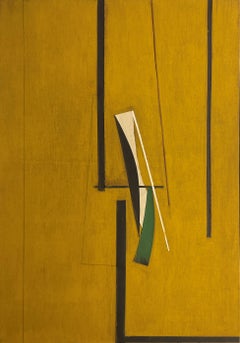
"Ouverture, with Cypress Forms" Stephen Edlich, Abstract Geometric Painting
By Stephen Edlich
Located in New York, NY
Stephen Edlich Ouverture, with Cypress Forms, 1982 Signed, dated and titled on the stretcher Acrylic paint, mixed media, and burlap on canvas 60 x 40 inches An artist who worked in the post-cubist and constructivist traditions, Stephen P. Edlich gained a considerable amount of acclaim in the 1970s and 1980s for his collages, sculpture, and paintings. His promising career was cut short due to his untimely death at age 45 in 1989. Edlich was born in New York City. He received his undergraduate degree with a major in fine arts studies from New York University in 1967. During his college years, he traveled to London, where he met the art dealer Victor Waddington and created his first white on white collage. In that same year, he attended a major exhibition of the work of Ben Nicholson, which would be influential source in his art. Edlich returned to England in 1967, where he met Barbara Hepworth and Patrick Heron in London and traveled to St. Ives, Cornwall, long a favorite artists' haunt. Edlich began creating acrylic reliefs...
Category

1980s Abstract Geometric Abstract Paintings

Materials

Canvas, Burlap, Mixed Media, Acrylic

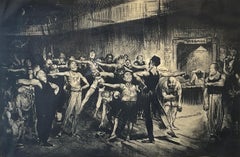
"Business-Men s Class, Y.M.C.A." George Bellows, Ashcan School Print
By George Wesley Bellows
Located in New York, NY
George Bellows Business-Men's Class, Y.M.C.A, 1916 Signed, numbered "No. 41" and titled lower margin Lithograph on wove paper 11 1/2 x 17 1/8 inches Edition of 64 Provenance: Hirschl & Adler Galleries, New York Private Collection, Ohio Literature: Mason, 20. After his arrival from Columbus, Ohio in 1904, Bellows lived at the West Side YMCA. It was there that he met Eugene Speicher, another aspiring young artist who was to become his lifelong friend. Always interested in the anatomy of the human body, Bellows often satirized the various types who, while leading a sedentary life, feel compelled to devote a portion of their daily routine to physical self-improvement. Throughout his brief but illustrious career, George Wesley Bellows created striking scenes that documented ordinary American life in all its beauty and banality. Considered an American Realist, the artist eschewed embellishment, finding inspiration in the gritty boroughs of New York City, the rocky coastline of Maine, and, later, in his friends and family. Bellows garnered early recognition for his arresting portrayals of illegal prizefighting, dramatic works executed in dark tonal palettes that underscore the brutality of the violent sport. Bellows’ elderly Methodist parents hoped their son might pursue the ministry, a calling the extroverted athlete never received. The Columbus native competed on the baseball team at Ohio State University and also served as an illustrator for the college yearbook. In the fall of 1904—just months shy of his expected graduation—Bellows defied his father’s wishes and boarded a train to New York City in hopes of becoming a magazine illustrator like his idols Howard Chandler Christy and Charles Dana Gibson. Before leaving, he reportedly turned down an offer to play professional baseball with the Cincinnati Reds...
Category

1910s Ashcan School Figurative Prints

Materials

Paper, Lithograph

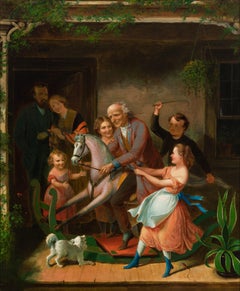
"Playing with Grandfather" Tomkins Harrison Matteson, Family Genre Scene
Located in New York, NY
Tomkins Harrison Matteson Playing with Grandfather, 1869 Signed and dated lower left Oil on canvas 29 5/16 x 24 3/16 inches Provenance: Sotheby's New York, May 24, 2001, Lot 150 Estate of a New Hampshire Collector Tompkins H. Matteson was one of the most noted painters in upstate New York during the 1850s and was well-known for genre and historical subjects. Born in Peterboro, New York, he studied and exhibited at the National Academy of Design - established himself as a portrait painter in Sherburne, New York before moving in 1841 to New York City. In 1850, he returned to Shelburne, where he spent the remainder of his life. A follower of William Sidney Mount...
Category

1860s Realist Figurative Paintings

Materials

Canvas, Oil

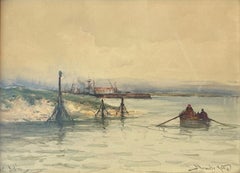
"Gray Morning" James MacMaster, Scottish Seascape, Marine Ship Landscape
By James MacMaster
Located in New York, NY
James MacMaster Gray Morning Signed and titled lower left Watercolor on paper 10 1/4 x 14 inches Provenance: Private Collection, New Jersey
Category

Late 19th Century Landscape Paintings

Materials

Paper, Watercolor

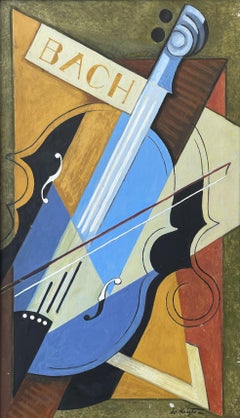
"Nature morte" Bela de Kristo, Mid-century Cubist Still Life Abstract Cello
By Bela De Kristo
Located in New York, NY
Bela de Kristo Nature morte, circa 1956 Signed lower right Oil on board 19 5/8 x 11 3/4 inches Provenance: Alexander Kahan Fine Arts, New York Private ...
Category

1950s Cubist Still-life Paintings

Materials

Oil, Board

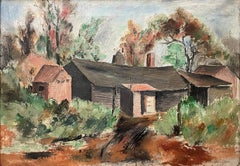
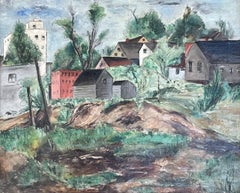
"Shanties in the Bronx, New York" Bumpei Usui, Japanase-American City Landscape
Located in New York, NY
Bumpei Usui Shanties in the Bronx, 1933 Signed lower right Oil on canvas 14 x 20 inches Provenance: The artist's estate Salander O'Reilly Galleries, New Y...
Category

1930s American Realist Landscape Paintings

Materials

Canvas, Oil

"Backyard, Staten Island, New York" Bumpei Usui, Japanase-American Landscape
Located in New York, NY
Bumpei Usui Backyard, Staten Island, 1933 Signed lower right Oil on canvas 20 x 24 inches Provenance: The artist's estate Salander O'Reilly Galleries, New...
Category

1930s American Realist Landscape Paintings

Materials

Canvas, Oil

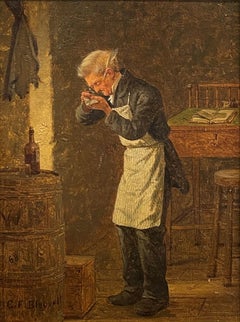
"The Doubtful Bill" Charles Blauvelt, 19th Century Genre Painting Money Interior
Located in New York, NY
Charles Blauvelt The Doubtful Bill, 1868 Signed and dated lower left Oil on canvas 12 1/4 x 9 1/2 inches Provenance: Private Collection, Connecticut...
Category

1860s Figurative Paintings

Materials

Canvas, Oil

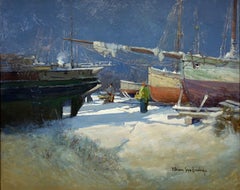
"Great Kills, Staten Island" Dry Docks in Winter, Snowy Impressionist Landscape
Located in New York, NY
William Jean Beauley Great Kills, circa 1917 Signed lower right Oil on panel 40 x 50 inches Housed in its original Newcomb-Macklin gilt frame Pro...
Category

1910s American Impressionist Landscape Paintings

Materials

Oil, Wood Panel

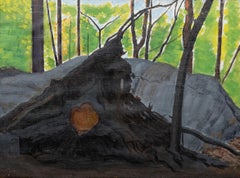
"Tree, Trunk, and Roots, New York" Joseph Stella, American Modernism
By Joseph Stella
Located in New York, NY
Joseph Stella (1877 - 1946) Tree, Trunk, and Roots, Bronx, New York, circa 1924 Oil on canvas 12 x 16 inches inscribed in another hand Joseph Stella/Estate and bears Joseph Stella Estate stamp (on the reverse) Provenance: The Estate of the Artist Rabin & Kreuger, New Jersey Parke Bernet Galleries, New York, March 14, 1968, Lot 147 ACA Galleries, New York Thence by descent Stella was born June 13, 1877 at Muro Lucano, Italy, a mountain village not far from Naples. He became painter laureate of Muro Lucano when he was in his teens with a representation of the local saint in the village church. Stella immigrated to America in 1896 and studied medicine and pharmacology, but upon the advice of artist friend Carlo de Fornaro, who recognized his undeveloped talent, he enrolled at the Art Students League in 1897. Stella objected to the rule forbidding the painting of flowers, an indication of his lifelong devotion to flower painting. He also studied under William Merritt Chase in the New York School of Art and at Shinnecock Hills, Long Island in 1901-1902, displaying the bravura brushwork and dark Impressionist influence of Chase. Stella liked to paint the raw street life of immigrant society, rendering this element more emotionally than the city realists, the Aschcan School headed by Robert Henri. Stella went through a progression of styles--from realism to abstraction--mixing media and painting simultaneously in different manners, reviving styles and subjects years later. The "Survey" sent Stella to illustrate the mining disaster of 1907 in Monongah, West Virginia, and in 1908 commissioned him to execute drawings of the Pittsburgh industrial scene. Steel and electricity became a major experience in shaping his responses to the modern world, and Stella succeeded in portraying the pathos of the steelworkers and the Pittsburgh landscape. Stella went abroad in 1909 at the age of thirty-two, lonely for his native land. He returned to Italy, traveling to Venice, Florence and Rome. He took up the glazing technique of the old Venetian masters to get warmth, transparency, and depth of color. One of Stella's paintings was shown in the International Exhibition in Rome in 1910 and was acquired by the city of Rome. The influence of the French Modernists awakened his dormant individuality. His friendship with Antonio Mancini, a Futurist, also played a role in his new style. At the urging of Walter Pach...
Category

1920s American Modern Landscape Paintings

Materials

Canvas, Oil

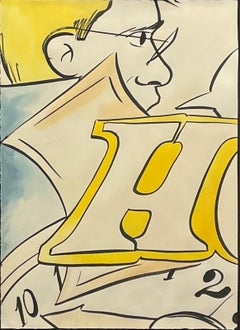
"Untitled, " Crash, Pop Art, Street Art Graffiti, Figure with Clock
By John Crash Matos
Located in New York, NY
Crash Untitled, 1989 Signed and dated lower left Watercolor and ink on paper 30 x 20 1/2 inches A contemporary of Keith Haring and a modern-day master of this present day art form o...
Category

1980s Street Art Figurative Paintings

Materials

Paper, Ink, Watercolor

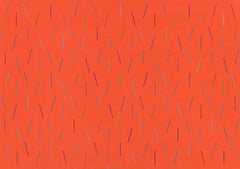
"Eleven Thirteen, (Dancing Line Series)" Elliott Thompson, Color Field Work
Located in New York, NY
Elliott Thompson Eleven Thirteen, (Dancing Line Series), 1972 Signed, Elliott Thompson, dated, 2/72, and inscribed, Eleven Thirteen, on verso and agai...
Category

1970s Color-Field Abstract Paintings

Materials

Canvas, Tape, Acrylic

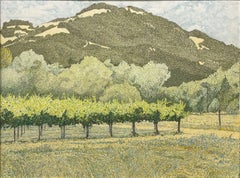
"Sonoma Mountain, " Fred R. Parker, California Landscape, Olive Tree Farm
Located in New York, NY
Fred Parker Sonoma Mountain, 1996 Signed, dated, and titled on the reverse Acrylic, pastel, and pencil on board 21 1/2 x 29 1/2 inches
Category

1990s Contemporary Landscape Paintings

Materials

Oil Pastel, Acrylic, Board, Pencil

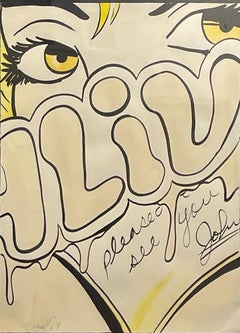
"Pleased to See You, " Crash, Pop Art, Street Art Graffiti
By John Crash Matos
Located in New York, NY
Crash Pleased to See You, 1989 Signed and dated lower left Watercolor and ink on paper 30 x 20 1/2 inches A contemporary of Keith Haring and a modern-day master of this present day ...
Category

1980s Street Art Figurative Paintings

Materials

Paper, Ink, Watercolor

"Untitled, " Seymour Fogel, Geometric Abstraction, Texas Hard-Edge
By Seymour Fogel
Located in New York, NY
Seymour Fogel Untitled Oil on illustration board construction 10 x 7 1/2 inches Provenance: Estate of the artist Charles and Faith McCracken Larry and Trish Heichel Private Collection Seymour Fogel was born in New York City on August 24, 1911. He studied at the Art Students League and at the National Academy of Design under George Bridgeman and Leon Kroll. When his formal studies were concluded in the early 1930s he served as an assistant to Diego Rivera who was then at work on his controversial Rockefeller Center mural. It was from Rivera that he learned the art of mural painting. Fogel was awarded several mural commissions during the 1930s by both the Works Progress Administration (WPA) and the Treasury Section of Fine Arts, among them his earliest murals at the Abraham Lincoln High School in Brooklyn, New York in 1936, a mural in the WPA Building at the 1939-1940 New York World's Fair, a highly controversial mural at the U.S. Post Office in Safford, Arizona (due to his focus on Apache culture) in 1941 and two murals in what was then the Social Security Building in Washington, D.C., also in 1941. Fogel's artistic circle at this time included Phillip Guston, Ben Shahn, Franz Kline, Rockwell Kent and Willem de Kooning. In 1946 Fogel accepted a teaching position at the University of Texas at Austin and became one of the founding artists of the Texas Modernist Movement. At this time he began to devote himself solely to abstract, non-representational art and executed what many consider to be the very first abstract mural in the State of Texas at the American National Bank in Austin in 1953. He pioneered the use of Ethyl Silicate as a mural medium. Other murals and public works of art done during this time (the late 1940s and 1950s) include the Baptist Student Center at the University of Texas (1949), the Petroleum Club in Houston (1951) and the First Christian Church, also in Houston (1956), whose innovative use of stained glass panels incorporated into the mural won Fogel a Silver Medal from the Architectural League of New York in 1958. Fogel relocated to the Connecticut-New York area in 1959. He continued the Abstract Expressionism he had begun exploring in Texas, and began experimenting with various texturing media for his paintings, the most enduring of which was sand. In 1966 he was awarded a mural at the U.S. Federal Building in Fort Worth, Texas. The work, entitled "The Challenge of Space", was a milestone in his artistic career and ushered in what has been termed the Transcendental/Atavistic period of his art, a style he pursued up to his death in 1984. Painted and raw wood sculpture...
Category

Mid-20th Century Abstract Geometric Abstract Paintings

Materials

Oil, Board

Rapelyea House, New York, William Rickarby Miller, Hudson River School Landscape
By William Rickarby Miller
Located in New York, NY
William Rickarby Miller Rapelyea House, New York, 1884 Signed and dated lower left Oil on canvas 20 x 30 inches Provenance: Kennedy Galleries, New York Born in Staindrop, County Durham, England, he was a portrait and landscape painter, especially appreciated for watercolor painting, which he sold through the American Art Union...
Category

1880s Hudson River School Landscape Paintings

Materials

Canvas, Oil

"Municipal Building, Manhattan, New York, " Ruth Anderson, Impressionist Scene
Located in New York, NY
Ruth Anderson Municipal Building, Manhattan, circa 1918 Oil on canvas 25 x 19 inches Ruth A. Anderson was born in Carlisle, Pennsylvania in 1891 and die...
Category

1910s Impressionist Figurative Paintings

Materials

Canvas, Oil

"Portrait of a Woman with Red Hat, Paris, " Isabella Howland
Located in New York, NY
Isabella Howland Portrait of a Woman, Paris, 1925 Oil on canvas laid on board 19 1/2 x 16 1/2 inches Provenance: Hammer Galleries, New York Private C...
Category

1920s Modern Figurative Paintings

Materials

Canvas, Oil, Board

"Prospect Park, Brooklyn" Nathan Hoffman, New York City Impressionist Landscape
Located in New York, NY
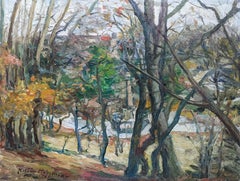
Born in Russia, the son of Friede (1878 – 1956) and Benjamin Hoffman (1878 – a. 1942). Benjamin was a dealer in mineral and seltzer water and the family resided on Snediker Avenue in Brooklyn, New York, just down the streetfrom the home where George Gershwin (1898 – 1937) was born. This area of Brooklyn, known as Brownsville, “witnessed the development of one of the largest communities of Eastern European Jewish immigrants during the last decade of the 19th century and the first two decades of the 20 th century.” Today, little remains of this once thriving Jewish section of Brooklyn, which today houses many commercial and repair businesses. Hoffman studied at the Art Students League of New York, the National Academy of Design and in the art program at Cooper Union. His work at the National Academy received praise, and in 1921 he was awarded the 2nd prize and an honorable mention from the John Armstrong Chaloner Paris Prize Foundation at the National Academy, which allowed the recipient to study in Paris, France for as long as five years. The following year he was awarded the 1 st prize in the competition (with The Reform Advocate running the headline “Young Jew Wins Art Prize”) as well as the Suydam Bronze Medal for his achievements in the Academy’s Men’s Night Class. In 1923 he was residing in Long Branch, New Jersey, when he was awarded 4th place in the Chaloner competition. Early on, Hoffman exhibited his work throughout the city, including in 1925 with the recently organized Society of Independent Artists. He also received several solo exhibitions during the first part of his career, including one at Ferargil Galleries in 1929. In the spring of 1930 a solo exhibition of his portraits, including paintings and drawings, was held at at Babcock Galleries, where a reviewer noted: “Portraiture is obviously Mr. Hoffman’s specialty… his best work is characterized by a sensitive appreciation of character set down in a vigorous decisive statement. Later that same year, in August, he participated in Babcock’s summer exhibition where reviewer Jerome Klein, writing for The Baltimore Sun, felt Hoffman’s and other artists work was already becoming old fashioned, remarking “…if an effort toward accomplishment is to be made, it must be in the language of today. It is for that reason that such contemporaries as Eugene Higgins and Nathan Hoffman, in this show, seem artists of a bygone era…” The onset of the Great Depression appears to have slowed his success, as was the case for many up-and-coming artists. By 1939 Hoffman had become a gallerist in addition to being a painter, operating the collective exhibition space “Sutton Gallery,” which was originally located at 358 East 57th Street. There Hoffman exhibited his own works as well as those created by other prominent New York artists including David Burliuk (1882 – 1967), Charles C. Curran (1861 – 1942), Louis Eilshemius (1864 – 1941), Ann Goldthwaite (1869 – 1944), Maurice Kish (1895 – 1987), Lawrence Lebduska (1894 – 1966), Bradford Perin and Ellis Wilson...
Category

1940s Post-Impressionist Landscape Paintings

Materials

Oil, Board

"Along the Kanahawa River, West Virginia, " Ernest Fiene, WPA Coal Steamboat
By Ernest Fiene
Located in New York, NY
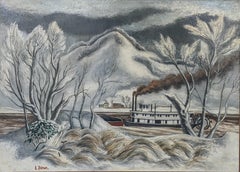
Ernest Fiene Along the Kanahawa River, West Virginia, 1936 Signed lower right Oil on canvas 26 x 36 inches Fiene made a series of paintings, drawings and lithographs which are based on his travels through Pennsylvania and West Virginia during the winter of 1935-36. The industrial areas of Pennsylvania and West Virginia are represented in numerous oils, among which are some of his most well-known. Fiene wrote of the trip, "The increasing snow and atmospheric conditions [in the Kanawha River valley} enhanced this mountainous coal mining country with a majestic beauty." Winter on the River is Fiene's only American Artists Group print and there were only two lithographs produced from the West Virginia trip. The American Artists Group (AAG), under the direction of Carl Zigrosser, who was then working at New York's famed Weyhe Gallery, published ninety-three prints by over fifty artists in 1936 and 1937. Zigrosser's goal was to popularize contemporary American art through original prints offered at the low price of $2.75. The project was also a means to provide income for impoverished artists during the Depression. The prints were featured in many of the leading print exhibitions and publications of the period. The lithograph produced from this image is now in the collection of the Amon Carter Museum, Baltimore Museum of Art, Cleveland Museum of Art, Philadelphia Museum of Art, Pensacola Museum of Art, San Francisco Fine Arts Museum, Syracuse Museum, Yale University Art Museum. Ernest Fiene was born in Elberfeld, Germany in 1894. As a teenager, Fiene immigrated to the United States in 1912. He studied art at the National Academy of Design in New York City from 1914 to 1918, taking day classes with Thomas Maynard and evening classes with Leon Kroll. Fiene continued his studies at the Beaux-Arts Institute of Design in New York from 1916 to 1918, adding classes in printmaking at the Art Students League in 1923. Fiene began his career as an artist in 1919 with his first exhibition of watercolors at the MacDowell Club arranged by his mentor Robert Henri. In 1923 the Whitney Studio Club mounted a large exhibition of his works. The following year he had an exhibition at the New Gallery in New York, which completely sold out all fifty-two works, including paintings, watercolors, drawings, and etchings. With the proceeds of sales from the New Gallery exhibition, Ernest Fiene and his younger brother Paul, a sculptor, built studios in Woodstock, New York in 1925. In the early Twenties Ernest Fiene painted mostly landscapes of Woodstock and both the Ramapo and Hudson River Valleys. The first monograph from the Younger Artists Series was published on Fiene in 1922. Published in Woodstock, the series went on to include Alexander Brook, Peggy Bacon, and Yasuo Kuniyoshi. The book reproduced 1 illustration in color and another 27 reproductions in black and white. Around 1925 Fiene became fascinated with the intensity, excitement, and opportunities for color harmonies New York City offered as a subject. His paintings shifted to urban and industrial themes with architecture, industry, and transportation becoming his subjects. By 1926 Fiene had attracted the dealer Frank K.M. Rehn, who gave him a one-man exhibition that year, which travelled to the Boston Arts Club. C.W. Kraushaar Galleries gave Fiene a one-man exhibition of urban, landscape, portrait, and still life paintings in 1927. Julianna Force, the director of the Whitney Studio Club and first director of the Whitney Museum of American Art, included two of Fiene’s paintings in a fall exhibition in 1928. The Whitney Studio Club showed Fiene’s paintings in a two-man exhibition with Glenn O. Coleman that year and acquired three of Fiene’s paintings. Also in 1928 Fiene became affiliated with Edith Halpert’s Downtown Gallery where he had an exhibition of 20 lithographs in the spring. Fiene sold his house in Woodstock in 1928 to spend more of his time in New York City. With so many successful exhibitions, Fiene returned to Paris in 1928-29 where he rented Jules Pascin's studio and studied at the Académie de la Grande Chaumière. In France, Fiene painted both landscape and urban subjects developed from ideas influenced by Cubist geometry and the use of flat areas of broad color. Upon returning to New York in 1930, Fiene used this new approach to continue to paint New York skyscraper and waterfront subjects, as well as to begin a series of paintings on changing old New York based on the excavations for Radio City Music Hall and the construction of the Empire State Building. Frank K.M. Rehn Galleries exhibited this series, titled “Changing Old New York,” in 1931. Fiene also has solo exhibitions at Rehn Galleries in 1930 and 1932. Fiene’s oil paintings are exhibited at the Chicago Arts Club in 1930 as well. Fiene was included in the Museum of Modern Art’s exhibition Painting and Sculpture by Living Americans in December of 1931. Visiting New York, Henri Matisse saw the exhibition and called Fiene’s Razing Buildings, West 49th Street the finest painting he had seen in New York. Fiene had two mural studies from his Mechanical Progress series exhibited at the Museum of Modern Art’s exhibition Murals by American Painters and Photographers in 1932. Fiene sent View from my Window which depicts Fiene working on a lithograph stone while looking out his window to the newly completed Empire State Building to the Carnegie International in 1931. In 1932 Fiene participated in the first Biennial of American Painting at the Whitney Museum and his prints were included in exhibitions at the Downtown Gallery and the Wehye Gallery. In the same year, Fiene was awarded a Guggenheim fellowship to further study mural painting in Florence, Italy. On his return from Italy in 1933 Fiene re-engaged himself in New York City life and won several public and private mural projects. Fiene resumed his active exhibition schedule, participating in two group exhibitions at the Whitney Museum and a one-man exhibition of recent paintings at the Downtown Gallery in January 1934. In 1933 he purchased a farm in Southbury, Connecticut, which added Connecticut scenes to his landscape subjects. This was also the year Fiene began to spend summers on Monhegan Island, Maine, where he painted seascapes, harbor scenes, and still lifes. Fiene’s landscape paintings attracted numerous commissions as part of the American Scene movement. Through the fall and winter of 1935-36, Fiene took an extended sketching trip through the urban, industrial, and farming areas of Pennsylvania and West Virginia. Most of the twenty-four Pennsylvania urban and rural paintings from this trip were featured in an exhibition held at the First National Bank in Pittsburgh in October of 1937 by the Pittsburgh Commission for Industrial Expansion. Fiene said of these works that he formed rhythm, opportunity for space and color, and integrity in the Pennsylvania mill and furnace paintings. Fiene received the silver medal for one of the Pittsburgh paintings...
Category

1930s American Realist Landscape Paintings

Materials

Canvas, Oil

"Composition with Figure, " Irene Rice Pereira
By Irene Rice Pereira
Located in New York, NY
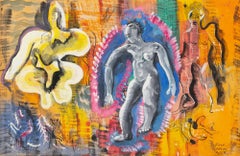
Irene Rice Pereira Composition with Figure, 1951 Inscribed, signed and dated Salford/Pereira 2/51 (lr); inscribed I Rice Pereira/2669 Great Clowes St/Sa...
Category

1950s Abstract Abstract Paintings

Materials

Paper, India Ink, Casein

"The Belt Parkway, " Lawrence Rothbort, Brooklyn, Cars, Textured Impasto
By Lawrence Rothbort
Located in New York, NY
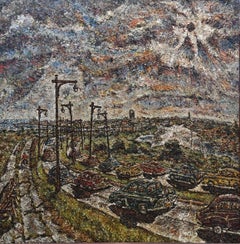
Lawrence Rothbort Belt Parkway, circa 1950 Oil on canvas 48 x 48 inches Lawrence Rothbort was born March 1920 in Brooklyn, New York. He was a model from infancy for his father, Amer...
Category

1950s Modern Landscape Paintings

Materials

Canvas, Oil

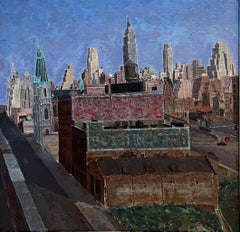
"Manhattan Looking East, " Herman Rose, WPA New York City View from Midtown
By Herman Rose
Located in New York, NY
Herman Rose (1909 - 2007) Manhattan Looking East (View from Midtown), 1952-54 Oil on canvas 26 x 28 inches Signed lower right Fairfield Porter wrote an essay in ArtNews on this exact painting in 1955. Please inquire for a copy of the article. Literature: Fairfield Porter, "Herman Rose Paints a Picture," ArtNews, April 1955 Volume 54, Number 2, illustrated. Herman Rose was best known for his depictions of cityscapes of New York City. Herman Rappaport was born in Brooklyn, New York. in 1909. Herman Rose was the professional pseudonym of Herman Rappaport. Originally trained as a draftsman and studied at the National Academy of Design from 1927 to 1929, he was later employed by the Works Progress Administration's Murals Division under Arshile Gorky from 1934 until 1939. In 1939, after experimenting with a variety of contemporary expressionistic styles, Rose decided to paint from life. Working mostly in East New York and East Canarsie in Brooklyn, and in Manhattan, Rose began to paint roof tops and street scenes. Rappaport began using the name Herman Rose when he held his first solo art exhibition in 1946 at the Charles Egan Gallery in New York City. Although he initially began as an Expressionistic painter, he became known for small, light-filled Impressionist paintings of still life, cityscapes and skies by the early 1950s. His paintings and images were often composed of very small dabs of paint and tiny, blurry "squares," which combined to create the image on canvas, his favorite medium. Often described as a "lyrical painter" Rose's work "interpreted traditional subjects: landscape, still life and the figure like the Post-Impressionists from whom he developed his own style, Rose built up forms from distinct touches of color that don't entirely blend in the viewer's eye. This gives his surfaces an active quality that flattens forms, one of the great lessons of modernism." Herman Rose's work received official recognition when Ms. Dorothy Miller of Museum of Modern Art (MoMA) included his work in an exhibition called, "15 Americans," alongside work by Clyfford Still, Mark Rothko and Jackson Pollock. New York Times art critic Hilton Kramer wrote of Rose's work in 1981, "{he} must surely be counted among the most beautiful works anyone has produced in this challenging medium for many years." The Art in America art critic Lawrence Campbell...
Category

1950s American Modern Landscape Paintings

Materials

Canvas, Oil

"New York City Skyline View from the East River, " Lionel Reiss, Jewish Artist
By Lionel Reiss
Located in New York, NY
Lionel S. Reiss (1894 - 1988) New York City Skyline View from the East River Watercolor on paper 13 x 19 inches Signed lower left In describing his own style, Lionel Reiss wrote, “By nature, inclination, and training, I have long since recognized the fact that...I belong to the category of those who can only gladly affirm the reality of the world I live in.” Reiss’s subject matter was wide-ranging, including gritty New York scenes, landscapes of bucolic Bucks County, Pennsylvania, and seascapes around Gloucester, Massachusetts. However, it was as a painter of Jewish life—both in Israel and in Europe before World War II—that Reiss excelled. I.B. Singer, the Nobel Prize winner for Literature, noted that Reiss was “essentially an artist of the nineteenth century, and because of this he had the power and the courage to tell visually the story of a people.” Although Reiss was born in Jaroslaw, Poland, his family immigrated to the United States in 1898 when he was four years old. Reiss's family settled on New York City’s Lower East Side and he lived in the city for most of his life. Reiss attended the Art Students League and then worked as a commercial artist for newspapers and publishers. As art director for Metro-Goldwyn-Mayer, he supposedly created the studio’s famous lion logo. After World War I, Reiss became fascinated with Jewish life in the ‘Old World.’ In 1921 he left his advertising work and spent the next ten years traveling in Europe, the Middle East, and North Africa. Like noted Jewish photographers Alter Kacyzne and Roman Vishniac, Reiss depicted Jewish life in Poland prior to World War II. He later wrote, “My trip encompassed three main objectives: to make ethnic studies of Jewish types wherever I traveled; to paint and draw Jewish life, as I saw it and felt it, in all aspects; and to round out my work in Israel.” In Europe, Reiss recorded quotidian scenes in a variety of media and different settings such as Paris, Amsterdam, the Venice ghetto, the Jewish cemetery in Prague, and an array of shops, synagogues, streets, and marketplaces in the Jewish quarters of Warsaw, Lodz, Krakow, Lublin, Vilna, Ternopil, and Kovno. He paid great attention to details of dress, hair, and facial features, and his work became noted for its descriptive quality. A selection of Reiss’s portraits appeared in 1938 in his book My Models Were Jews. In this book, published on the eve of the Holocaust, Reiss argued that there was “no such thing as a ‘Jewish race’.” Instead, he claimed that the Jewish people were a cultural group with a great deal of diversity within and between Jewish communities around the world. Franz Boas...
Category

1940s American Modern Landscape Drawings and Watercolors

Materials

Paper, Watercolor

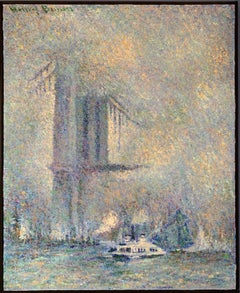
"Brooklyn Bridge, New York City, " Foggy Day with Boats, Cityscape, East River
By Henry Benson
Located in New York, NY
Henry Benson (1930 - 1998) Brooklyn Bridge, East River, 1971 Acrylic on canvas 34 x 28 inches Signed upper left corner: Henry Benson Provenance: Golden Door Gallery, New Hope, Penns...
Category

1970s Contemporary Landscape Paintings

Materials

Canvas, Acrylic

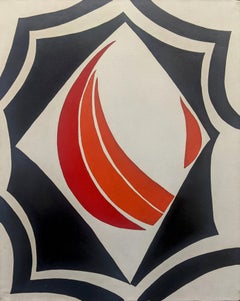
"Inside the Black Diamond, " Lila Katzen, Pop Art, Color Field Female Abstract
Located in New York, NY
Lila Katzen Inside the Black Diamond, 1964 Signed, titled, and dated on the reverse Acrylic on canvas 30 x 24 inches Lila Katzen said of her pieces in all media: “I feel marvelous w...
Category

1960s Pop Art Abstract Paintings

Materials

Canvas, Acrylic

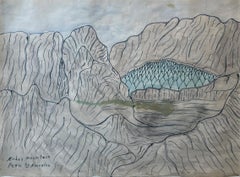
"Andes Mountains Peru South America, " Joseph Yoakum, Black Folk Art Landscape
By Joseph Yoakum
Located in New York, NY
Joseph Yoakum Andes Mountains Peru So America, circa 1960s Colored pencil and ballpoint pen on paper 7 1/4 x 10 1/2 inches Provenance: Karen Lennox Gallery, Chicago Private Collection, South Dakota Yoakum began drawing in the early 1960s. Most of his work consists of radiantly colored landscapes with mountains, water, trees, and winding roads in abstract and complex configurations. his period of greatest activity — 1965 to 1970 — when he usually made one drawing a day. Yoakum maintained he had seen all the places represented in his drawings, a statement that may not be true in some instances. He traveled a great deal, beginning in his early teens when he ran away from home and became a circus handyman. Yoakum’s drawings can be considered memory images growing out of either actual or imagined experiences. All of his drawings have titles that grew longer and more specific over the years. He dated his works with a rubber stamp — an oddly impersonal, labor-saving device. Although Joseph Yoakum gave vastly different accounts of his background, he was, throughout his life, classified as an African American. Sometimes Yoakum claimed that he was a full-blooded ​“Nava-joe” Indian, one of twelve or thirteen children born to a farmer on an Indian reservation in Window Rock, Arizona. At other times he insisted that he was of African-American descent. He described his mother as a strong woman who was a doctor and knowledgeable in the use of herbal medicines. Yoakum’s family moved to Kansas City, Missouri, during his early childhood. His father was employed briefly in the railroad yards prior to settling permanently on a farm in nearby Walnut Grove...
Category

1960s Folk Art Landscape Paintings

Materials

Paper, Watercolor, Ballpoint Pen, Color Pencil
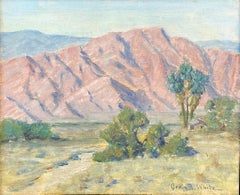
"California Mountains, " Orrin White, Impressionism, Southwest Desert Landscape
By Orrin A. White
Located in New York, NY
Orrin White California Mountain Landscape Signed lower right Oil on board 8 x 10 inches A nationally known landscape painter, who spent the prime of his career in California, Orrin White was born in Hanover, Illinois. He was artistically inclined at an early age but did not pursue an art career until he was in his thirties. After receiving a Bachelor of Arts degree from Notre Dame University...
Category

Early 20th Century Impressionist Landscape Paintings

Materials

Oil, Board

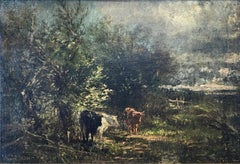
"Flushing Landscape with Cows, " Charles Henry Miller, Barbizon, Rural Farm
By Charles Henry Miller
Located in New York, NY
Charles Henry Miller Flushing Landscape with Cows, circa 1880 Signed lower left Oil on canvas 13 x 19 inches Charles Henry Miller was a noted artist and painter of landscapes from Long Island, New York. The American poet Bayard Taylor called him, "The artistic discoverer of the little continent of Long Island." Miller was educated at Mount Washington Collegiate Institute, and graduated in medicine at the New York Homeopathic Institute in 1864. Before his graduation, he had occasionally painted pictures, and in 1860 he exhibited The Challenge Accepted at the National Academy of Design, in New York City. He lived in Queens at the summer estate, Queenslawn, originally purchased by his parents. He went abroad in 1864 and again in 1867, and was a pupil in the Bavarian Royal Academy at Munich under the instruction of Adolf Lier...
Category

1880s Barbizon School Landscape Paintings

Materials

Canvas, Oil

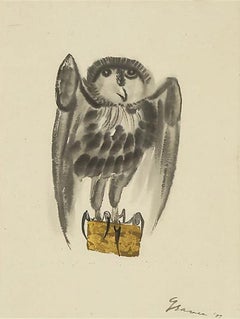
"Offering, " Morris Graves, American Modernism, Owl, Bird, Gift, Present
By Morris Graves
Located in New York, NY
Morris Graves Offering, 1957 Signed and dated lower right Sumi ink wash and gold leaf on paper 18 x 13 3/8 inches Born in Fox Valley, Oregon in 1910, Morris Graves was a leading proponent of the Northwest School...
Category

1950s Modern Animal Drawings and Watercolors

Materials

Gold Leaf

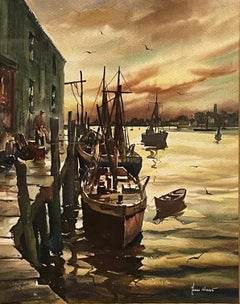
"Gloucester Harbor at Sunset, " John Hare, Cape Ann, New England Watercolor View
Located in New York, NY
John Hare Gloucester Harbor at Sunset, Massachusetts Signed lower right Watercolor on paper 16 x 12 inches John Cuthbert Hare, 1908-1978, was a watercolorist who painted boats, seascapes and harbor scenes. He was primarily associated New England, especially Cape Cod, Massachusetts where he spent his summers from 1938 to 1965. However, he was in Florida where he was a member of the St. Augustine Art Association, and other locations on the East Coast. It is likely Hare was born in New York City. He first studied commercial art in Brooklyn at the Pratt Institute and also studied at the Art Students League in Manhattan. He worked for Hearst newspapers corporation, and in 1933 married. In the next few years, he and his wife traveled extensively, camping and painting and exhibiting his work in galleries. In 1935, they visited St. Augustine and an exhibition of his watercolors was held there in the old bank...
Category

Mid-20th Century Impressionist Landscape Drawings and Watercolors

Materials

Paper, Watercolor

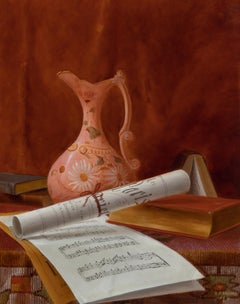
"Still Life with Pink Ewer and Sheet Music" Nicholas Alden Brooks, Trompe L oeil
By Nicholas Alden Brooks
Located in New York, NY
Nicholas Alden Brooks Still Life with Pink Ewer and Sheet Music, 1891 Signed and dated lower right Oil on canvas 20 1/8 x 16 inches Considerable mystery surrounds the name Nicholas Alden Brooks. Other than having been active in New York City between 1880 and 1904, very little is known about the artist. There are no records of any art societies showing him as a member or his having participated in any exhibits. The name Brooks, in fact, could possibly be a pseudonym for Robert Fullington, whose name appears on theatrical memorabilia in Brookss trompe loeil still-life paintings. William Harnett...
Category

1890s Realist Still-life Paintings

Materials

Canvas, Oil

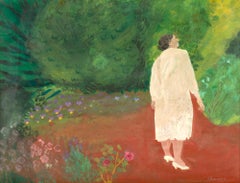
"Woman Listening" Honore Sharrer, Magical Realism Landscape with Flora Figure
By Honore Sharrer
Located in New York, NY
Honore Sharrer (1920 - 2009) Woman Listening Signed lower right Caseine on paper 15 x 20 inches Provenance: Forum Gallery, New York Private Collection ...
Category

Late 20th Century American Realist Landscape Paintings

Materials

Paper, Casein

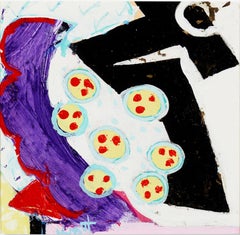
"Untitled" Knox Martin, Abstract Expressionism, Purple, Yellow, Black
By Knox Martin
Located in New York, NY
Knox Martin (1923 - 2022) Untitled Signed to lower edge Acrylic and gold foil on canvas 9 x 9 inches Knox Martin (1923-2022) was an esteemed New York School painter. Knox Martin was born in 1923 in Barranquilla, Colombia. He was the son of the aviator, painter, and poet William Knox Martin, the first man to fly over the Andes Mountains. After serving in World War II, Knox Martin attended the Art Students League of New York on the G.I. Bill from 1946-1950, where he studied with Harry Sternberg, Vaclav Vytlacil, Will Barnet, and Morris Kantor. In 1954, Knox Martin's friend Franz Kline placed a painting of his in the Stable Gallery Annual. Charles Egan of the renowned Charles Egan Gallery saw Knox Martin's painting at the Stable Gallery and asked Martin to show his work in a one-man show for the tenth anniversary of the Egan Gallery. Since then, Knox Martin was a celebrated painter, sculptor and muralist. Knox Martin had an extensive exhibition record and his work is in museum, corporate and private collections worldwide. His two best-known murals in NYC are Venus and Woman with Bicycle...
Category

Late 20th Century Abstract Abstract Paintings

Materials

Gold, Foil

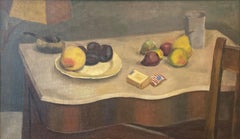
"Still Life of Fruit " Albert Swinden, American Abstract Association, AAA
By Albert Swinden
Located in New York, NY
Albert Swinden (1901 - 1961) Still Life of Fruit, 1937 Oil on canvas 18 x 30 inches Provenance: Graham Gallery, New York Albert Swinden (1901–1961) was an English-born American abstract painter. He was one of the founders of the American Abstract Artists, and he created significant murals as part of the Federal Art Project. Albert Swinden was born in Birmingham, England in 1901. When he was seven, he moved with his family to Canada, and in 1919 he immigrated to the United States. He lived in Chicago, where he studied for about a year and a half at the Art Institute. He then relocated to New York City, where his art education continued briefly at the National Academy of Design. He soon changed schools again, to the Art Students League, which he attended from 1930 to 1934. He studied with Hans Hofmann and gained an appreciation for Synthetic Cubism and Neoplasticism. According to painter and printmaker George McNeil, Swinden "could have influenced Hofmann ... He was working with very, very simple planes, not in this sort of Cubistic manner. Swinden was working synthetically at this time." While still a student, Swinden began teaching at the Art Students League, in 1932. Swinden married Rebecca Palter (1912–1998), from New York. Their daughter, Alice Swinden Carter, also became an artist. Carter, who attended the School of the Museum of Fine Arts, Boston, received an award from the Institute of Contemporary Art, Boston for her large sculptures. Swinden was hired for the Federal Art Project (FAP) of the Works Progress Administration (WPA), and he is best known for the murals which he painted as part of that project. In 1935, New York City Mayor Fiorello La Guardia attended the opening of the inaugural exhibit at the Federal Art Project Gallery, accompanied by Audrey McMahon, New York regional director for the Works Progress Administration/Federal Art Project. Among the works on display was Abstraction, a sketch by Swinden; it was the design for a mural planned for the College of the City of New York. A newspaper account described it as consisting of "brightly colored T-squares, triangles and rulers in horizontal, vertical and diagonal positions". La Guardia asked what it was, and upon being told it was a mural design, he said he didn't know what it depicted. Someone joked that it could be a map of Manhattan. The displeased mayor stated that "if that's art, I belong to Tammany Hall." (Tammany Hall, which the Republican mayor referenced, was the New York Democratic Party political society.) Fearing that the mayor's negative attitude could jeopardize the future of abstract art within the Federal Art Project, McMahon dispatched an assistant to summon an artist who could speak to the mayor in defense of abstraction. The assistant returned with Arshile Gorky. Swinden played an important role in the founding of the American Abstract Artists. In 1935, he met with three friends, Rosalind Bengelsdorf, her future husband Byron Browne, and Ibram Lassaw, with the goal of exhibiting together. The group grew and started meeting in Swinden's studio, which adjoined those of Balcomb and Gertrude Greene...
Category

1930s Modern Still-life Paintings

Materials

Canvas, Oil

"June Day at the Sound, " Walter Farndon, American Impressionism, Sailboats
By Walter Farndon
Located in New York, NY
Walter Farndon June Day at the Sound Signed lower right Oil on canvas 20 x 24 inches Living and working in an era of passionate and often controversial changes in the art world, Wal...
Category

1930s American Impressionist Landscape Paintings

Materials

Canvas, Oil

"Lexington, " Larry Zox, Abstract Expressionism, Minimalism, Brown Modernism
By Larry Zox
Located in New York, NY
Larry Zox Lexington, 1973 Acrylic on canvas 61 x 49 inches Provenance: Andre Emmerich Gallery, New York Janie C. Lee Gallery, Houston, Texas Private Collection, Greenwood Village, Colorado Exhibited: New York, Andre Emmerich Gallery, Larry Zox: New Paintings, March 10 - 28, 1973. Houston, Texas, Janie C. Lee Gallery, Larry Zox, February - April, 1974. A painter who played an essential role in the Color Field discourse of the 1960s and 1970s, Larry Zox is best known for his intensely and brilliantly colored geometric abstractions, which question and violate symmetry. Zox stated in 1965: “Being contrary is the only way I can get at anything.” To Zox, this position was not necessarily arbitrary, but instead meant “responding to something in an examination of it [such as] using a mechanical format with X number of possibilities." What he sought was to “get at the specific character and quality of each painting in and for itself,” as James Monte stated in his introductory essay in the catalogue for Zox’s 1973–74 solo exhibition at the Whitney Museum of American Art. Zox also at times used a freer, more intuitive method, while maintaining coloristic autonomy, which became increasingly important to him in his later career. Zox began to receive attention in the 1960s, when he was included in several groundbreaking exhibitions of Color Field and Minimalist art, including Shape and Structure (1965), organized by Henry Geldzahler and Frank Stella for Tibor de Nagy, New York, and Systemic Painting (1966), organized by Lawrence Alloway for the Guggenheim Museum. In 1973–74, the Whitney’s solo exhibition of Zox’s work gave recognition to his significance in the art scene of the preceding decade. In the following year, he was represented in the inaugural exhibition of the Hirshhorn Museum, which acquired fourteen of his works. Zox was born in Des Moines, Iowa. He attended the University of Oklahoma and Drake University, and then studied under George Grosz at the Des Moines Art Center. In 1958, Zox moved to New York, joining the downtown art scene. His studio on 20th Street became a gathering place for artists, jazz musicians, bikers, and boxers. He occasionally sparred with visiting fighters. He later established a studio in East Hampton, a former black smithy used previously by Jackson Pollock. Zox’s earliest works were collages consisting of pieces of painted paper stapled onto sheets of plywood. He then produced paintings that were illusions of collages, including both torn- and trued-edged forms, to which he added a wide range of strong hues that created ambiguous surfaces. Next, he omitted the collage aspect of his work and applied flat color areas to create more complete statements of pure color and shape. He then replaced these torn and expressive edges with clean and impersonal lines that would define his work for the next decade. From 1962 to 1965, he produced his Rotation series, at first creating plywood and Plexiglas reliefs, which turned squares into dynamic polygons. He used these shapes in his paintings as well, employing white as a foil between colors to produce negative spaces that suggest that the colored shapes had only been cut out and laid down instead of painted. The New York Times noted in 1964: “The artist is hip, cool, adventurous, not content to stay with the mere exercise of sensibility that one sees in smaller works.” In 1965, he began the Scissors Jack series, in which he arranged opposing triangular shapes with inverted Vs of bare canvas at their centers that threaten to split their compositions apart. In several works from this series, Zox was inspired by ancient Chinese water vessels...
Category

1970s Abstract Expressionist Abstract Paintings

Materials

Canvas, Acrylic

Still Thinking About These?

All Recently Viewed