Lions Gallery More Art
to
60
15
17
16
24
Overall Width
to
Overall Height
to
8
111
13
1
1
11
15
7
16
10
35
18
14
5
3
1
44
30
12
38
35
26
20
15
6
5
4
4
3
132
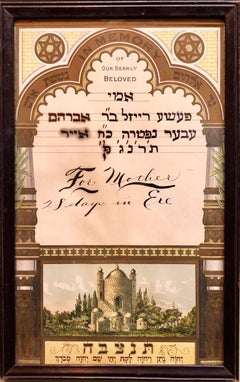
Rare Judaica 1893 Jewish Yizkor Memorial Plaque Hebrew English Chromolithograph
Located in Surfside, FL
A rare Judaic memorial piece for mother.
Category
Late 19th Century Aesthetic Movement More Prints
Materials
Lithograph

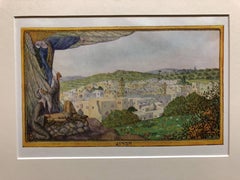
Rare Judaica Chevron Bezalel Zeev Raban Chromolithograph (made in Palestine)
By Zeev Raban
Located in Surfside, FL
Jerusalem's Bezalel School
The Bezalel Academy of Arts and Design, was founded in 1906 by Boris Schatz. In 1903, Schatz met Theodore Herzl and became an ardent Zionist. At the Zionis...
Category
Early 20th Century Art Nouveau More Art
Materials
Lithograph
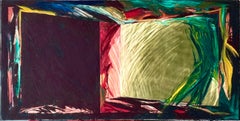
Large California Modernist Abstract Laddie John Dill Abstract Oil Painting Art
By Laddie John Dill
Located in Surfside, FL
Laddie John Dill (American, b. 1943)
Untitled
Oil painting on canvas mounted on panel
Hand signed Laddie Dill (verso)
36 x 72 inches. (with frame 37 X 73)
Laddie John Dill was born ...
Category
1980s Post-Modern Abstract Paintings
Materials
Canvas, Oil, Board
Large Budd Hopkins Modernist Hard Edged Abstract Expressionist Oil Painting 1965
Located in Surfside, FL
Budd Hopkins, American (1931-2011)
Strike Red
Oil on canvas, 1965, signed 'Hopkins' and dated lower right.
Dimensions: 85 x81 in., 86 x 52 in. with frame.
Provenance: bears partial label remnant verso from Poindexter Gallery. (a major gallery founded in 1955 in New York City by Elinor Poindexter. The gallery specialized in sculpture, abstract, and figurative art and featured the works of such artists as Richard Diebenkorn, Jules Olitski, Nell Blaine, Al Held, Willem de Kooning, Franz Kline, Earl Kerkam, Milton Resnick and Robert De Niro, among others.
Budd Hopkins was one of the leading proponents of the "hard-edge" abstract minimalist school of painting in the 1950s and 1960s, Budd Hopkins (born 1931) created works that show the strong influence of Jackson Pollock and other leading painters of the Abstract Expressionism movement. Hopkins' paintings are now in numerous major collections, including the San Francisco Museum of Art, the Guggenheim Museum in New York, and the Hirshhorn Collection in Washington, DC.
Recently, he has also been recognized for his research into the matter of UFOs and one of his books, "The Intruders", printed by Random House, was on the New York Times best-seller list and was the basis for a television show on CBS.
Born in 1931, he is a graduate of Linsly Military Institute (now Linsly School) in 1949 and Oberlin College in 1953. He first displayed artistic abilities when, as a child recovering from a long-term illness, he began to create sculptures of ships made out of modeling clay. But it wasn't until he arrive at Oberlin that he made a serious study of art. Later, Hopkins included abstracted figures in his sculptural pieces. While moving away from Abstract Expressionism, Hopkins retained in his work the use of intense colors and hard-edged forms. His works of the 1980s, including Temples and Guardians, featured these "sentinels" who were, according to Hopkins, "participating in a frozen ritual, fixed – absolutely – within a privileged space..." Though Hopkins denied any connection, some critics viewed these ritualistic pieces as an extension of Hopkins' fascination with alien beings. Hopkins viewed his sculpted guardians not as human per se, but as magical, fierce, noble robots of the unconscious.
He settled in New York after obtaining his degree and has had a residence there ever since. He and his wife, April Kingsley, and their daughter, Grace, divide their time between their home at Cape Cod, Mass., and that in New York City. In his work, he travels widely. He has exhibited in England, Finland, Italy and Switzerland.
In 1963, Hopkins was selected by the Columbia Broadcasting System as one of the 15 painters featured in the network's first television special on American art. In 1958, Art News picked him as one of 12 Americans for exhibition in Spoleto, Italy, in the "Festival of Two Worlds."
His brilliance has won him a number of fellowships and awards. In 1972, the West Virginia Arts and Humanities Council awarded him its Commission Prize. In 1976, he received the John Simon Guggenheim Fellowship for Painting and in '79 he received a fellowship from the National Endowment of the Arts. He also won a special project grant from the New York State Council on the Arts in 1982. He was friends with Robert Ryman and many of the other 10th street avant garde artists. He was an original member of March Gallery which showed Alice Baber, Elaine de Kooning, Mark di Suvero, Lester Johnson, Matsumi Kanemitsu.
His art has been featured in the Metropolitan Museum of Art, Museum of Modern Art, Bronx Museum of Art, Brooklyn Museum, Whitney Museum, Corcoran Gallery, Guggenheim Museum, Queens Museum in New York, and the Public Library of New York. He was included in Young America 1960: Thirty American Painters Under Thirty-Six buy Lloyd Goodrich at the Whitney Museum of American Art in NYC. Artists included: Sonia Gechtoff, Edward Giobbi, Ron Gorchov, James Harvey, Budd Hopkins, Wolf Kahn, Alex Katz, Robert Natkin, Rudy Pozzatti, Dean Richardson...
Category
1960s Abstract Expressionist Abstract Paintings
Materials
Paint
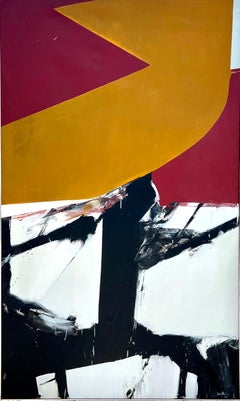
Vintage Abstract Expressionist Ibram Lassaw Modernist Bronze Sculpture Pendant
By Ibram Lassaw
Located in Surfside, FL
IBRAM LASSAW
(Russian-American, 1913-2003),
Sculptural pendant
Gold plated bronze
Signed verso
Measurements: 2-7/8''h, 2-1/4''w.
Ibram Lassaw was born in Alexandria, Egypt, of Russian Jewish émigré parents. After briefly living in Marseille, France, Naples, Italy Tunis, Malta, and Constantinople, Turkey his family settled in Brooklyn, New York, in 1921.His family settled in Brooklyn, New York. He became a US citizen in 1928. Ibram Lassaw, one of America's first abstract sculptors, was best known for his open-space welded sculptures of bronze, silver, copper and steel. Drawing from Surrealism, Constructivism, and Cubism, Lassaw pioneered an innovative welding technique that allowed him to create dynamic, intricate, and expressive works in three dimensions. As a result, he was a key force in shaping New York School sculpture.He first studied sculpture in 1926 at the Clay Club and later at the Beaux-Arts Institute of Design in New York. He made abstract paintings and drawings influenced by Kandinsky, Sophie Taeuber Arp, and other artists. He also attended the City College of New York. Lassaw’s encounter with avant-garde art in the International Exhibition of Modern Art (1926), organized by the Société Anonyme at the Brooklyn Museum, made a powerful impression on him. In the early 1930s he explored new materials and notions of open-space sculpture. The ideas of László Moholy-Nagy and Buckminster Fuller were important to him, and he knew the work of Julio González, Pablo Picasso, and the Russian Constructivists. After experimenting with plaster, rubber and wire, Lassaw began working with steel, which became a frequent medium for the artist, along with other metals. His work reflects the influence of Surrealist artists such as Alberto Giacometti and Joan Miro as well as American Modernist Alexander Calder.A pioneer of abstract sculpture in the United States, in 1936 Lassaw was a founding member of the organization American Abstract Artists. Between 1933 and 1942 he worked for various federal arts projects: the Public Works of Art Project, Civil Works Authority, and WPA, the Works Progress Administration Federal Art Project. In 1938 he produced his first welded work. He served with the U.S. Army, where he learned direct welding techniques. During the 1940s he experimented with cage constructions and with acrylic plastics, adding color to his sculptures by applying dye directly to their surfaces. In 1949 Lassaw was a founder of the Club, an informal discussion group of avant-garde artists that had developed from gatherings at his studio, on Eighth Street.
During the mid-1930s, Lassaw worked briefly for the Public Works of Art Project cleaning sculptural monuments around New York City. He subsequently joined the WPA as a teacher and sculptor until he was drafted into the army in 1942. Lassaw's contribution to the advancement of sculptural abstraction went beyond mere formal innovation; his promotion of modernist styles during the 1930s did much to insure the growth of abstract art in the United States. He was one of the founding members of the American Abstract Artists group, and served as president of the American Abstract Artists organization from 1946 to 1949. In 1951, Samuel Kootz invited Lassaw to join his gallery in New York. He also had a summer gallery in Provincetown, MA. Lassaw had been summering in Provincetown since 1944, and in 1951 rented an apartment next door to the Kootz Gallery. Among the artists in the Kootz Gallery were Jean Arp, William Baziotes, Georges Braque, Jean Dubuffet, Herbert Ferber, Arshile Gorky, Adolph Gottlieb, David Hare, Hans Hofmann, Fernand Leger, Georges Mathieu, Joan Miró, Robert Motherwell, Pablo Picasso, Pierre Soulages, and Maurice de Vlaminck. Lassaw is a sculptor who was a part of the New York School of Abstract expressionism during the 1940s and 1950s. Jackson Pollock, Lee Krasner, James Brooks, Willem de Kooning, and several other artists like Lassaw spent summers on the Southern Shore of Long Island. Lassaw spent summers on Long Island from 1955 until he moved there permanently in 1963.
SELECT EXHIBITIONS
1961 International Exhibition of Modern Jewelry 1890–1961, organized by the Worshipful Company of Goldsmiths in association with the Victoria and Albert Museum, London
1967 Exhibition of Jewelry by Painters and Sculptors, organized for circulation by MoMA
1973 Jewelry...
Category
Mid-20th Century Abstract Expressionist Abstract Sculptures
Materials
Gold, Bronze
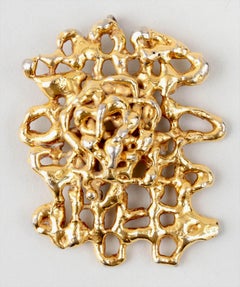
Vintage French Modernist Jean Lurcat Glazed Ceramic Art Plate Sant-Vicens France
By Jean Lurçat
Located in Surfside, FL
Vintage Jean Lurcat glazed fired enamel wall plaque ceramic plate limited edition hand inscribed faience Ceramique Saint Vicens charger. It depicts a h...
Category
Mid-20th Century Modern More Art
Materials
Ceramic, Glaze
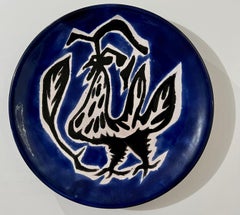
Peace Mid-Century Modern Pop Art Enamel Painting Chaim Gross Modernist Ltd Ed
By Chaim Gross
Located in Surfside, FL
Mod, Hippie era Peace art.
Chaim Gross, born in Wolowa, Austria in 1904, was educated at the Beaux Arts Institute of Design and at the Art Student's League in New York. Chaim Gross's work was greatly influenced by his experiences during a period of international conflict, World War II. He had moved to Kolomyia from Wolowa to get a better education, but the Germans came to occupy, killing, raping, and looting. Gross and his family were chased from one village to
the next. He wrote, "We were sleeping on roofs and in the fields, with the sound of cannon fire always in the distance,". Eventually, he ended up in Budapest with his two brothers, where Anti Semitism was not as severe, and that is where he began to sculpt and draw. He even had a few odd jobs there as a gold and silversmith. When he was seventeen, Gross immigrated to America where his older brother was. There he was a student and then a teacher at the Educational Alliance on the Lower East Side. Teaching became a big part of his philosophy, as he believed that an artist must pass on the knowledge which he had received from others in his artwork.
He was part of an artist emigre community which included Raphael Soyer, Moses Soyer, Arnold Newman, Max Weber and David Burliuk. His daughter is the artist Mimi Grooms and his son in law was Red Grooms.
Chaim Gross works reflect his Jewish and Austrian roots and his Hasidic Jewish upbringing. The figures in his art reflect the Hasidic spirit of being happy and making other people happy. In his pieces, Jews sing and dance in celebration of the Jewish Sabbath and festivals. They are shown rejoicing in the great gifts of love and life. Chaim Gross was honored with a number of prestigious awards including: the Award of Merit Medal from the National Institute of Arts and Letters in 1963, and the Gold Medal award from the National Academy of Design in 1985. He often used his creative abilities to explore and experiment with media. In his artwork he retains an optimistic philosophy, even when facing somber issues such as war, depression, and the Holocaust.
He is in the collections of the Museum of Modern Art; the Metropolitan Museum of Art; the Whitney Museum of American Art; the Philadelphia Museum of Art; the Art Institute of Chicago; the Tel Aviv Museum of Art, Israel. And the EIN HAROD Museum's Holdings: Israeli art is represented by the works of Reuven Rubin, Zaritzky, Nahum Gutman, Mordechai Ardon, Aharon Kahana, Arie Lubin, Yehiel Shemi, Yosl Bergner and others.
The graphic arts collection contains drawings and graphic works by Pissaro, Amedeo Modigliani, Jules Pascin, Marc Chagall (almost all of his graphic work), and numerous other artists. The sculpture collection includes works by Jewish sculptors from all over the world including leading Israeli sculptors; Ben Zvi, Lishansky, David Palombo, Yehiel Shemi, Aharon Bezalel and Igael Tumarkin. Many Jewish sculptors from all parts of the world, beginning with Mark Antokolsky, are represented in the collection. In the sculpture courtyard there are works by Chana Orloff, Jacob Epstein (the works he bequeathed to the Museum), Enrico Glicenstein, Loutchansky, Joseph Constant and Leon Indenbaum from Western Europe; Glid from Yugoslavia; William Zorach, Chaim Gross and Minna Harkavy from the United States; and most of the outstanding sculptors of Israel : Zeev Ben-Zvi, Lishansky, Ziffer, Rudi Lehmann, Dov Feigin, Sternschuss, David Palombo ( who executed the iron gate...
Category
Mid-20th Century Modern More Art
Materials
Metal
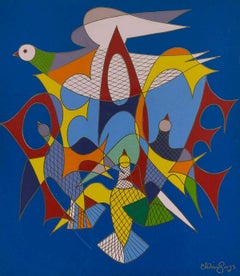
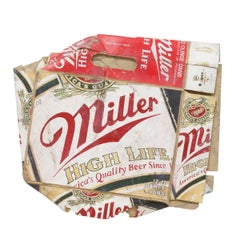
Miller High Life, Trompe L
Oeil Hyperrealism Decay Art
By Tom Pfannerstill
Located in Surfside, FL
Tom Pfannerstill was born in Milwaukee, Wisconsin, in 1951. He earned is bachelor’s degree in 1975 from Western Kentucky University. Pfannerstill has been a full-time studio artist s...
Category
Late 20th Century Conceptual More Art
Materials
Wood, Acrylic
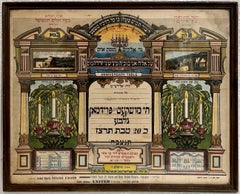
Rare Palestine Antique Hebrew Judaica Yahrzeit Synagogue Sign Memorial Plaque
Located in Surfside, FL
Circa 1890-1920. This Neoclassical, Judaic, Egyptian revival, Orientalist Mizrach sign, was produced in British Mandate Palestine by the chromolithograph process at the beginning of the 20th century. It pictures vignettes of holy places. with a hand written memorial. It was for the Tzedakah charity fund for the century-old institutions in Jerusalem: The great "Torah Center Etz Chaim"; a Free Kitchen for poor children and orphans; the famous Bikur Cholim Hospital with its dispensaries and clinics and the only Home for Incurable Invalids in Eretz Israel. They also worked with Arthur Szyk and Alfred Salzmann.. The A.L. Monsohn Lithographic Press (Monzon Press, Monson Press, דפוס אבן א"ל מאנזאהן, דפוס מונזון) was established in Jerusalem in 1892 by Abraham-Leib (or Avrom-Leyb) Monsohn II (Jerusalem, c.1871-1930) and his brother Moshe-Mordechai (Meyshe-Mordkhe). Sponsored by members of the Hamburger family, the brothers had been sent to Frankfurt, Germany in 1890 to study lithography. Upon returning to Jerusalem in 1892 with a hand press, they established the A.L. Monsohn Lithographic Press in the Old City of Jerusalem. According to the Information Center for Israeli Art A.L. Monsohn "created complex decorations for documents and oriental calendars that combined the tradition of Jewish art with modern printing techniques such as photographic lithography, raised printing and gilding."
The founders of the Monsohn press produced Jewish-themed color postcards, greeting cards, Jewish National Fund stamps, and maps documenting the evolution of the Jewish settlement in Eretz Israel in the nineteenth-twentieth centuries; religious material such as decorative plaques for synagogues, portraits of Old Yishuv rabbis such as Shmuel Salant, Mizrah posters indicating the direction of prayer for synagogues, memorial posters, and posters for Sukkot booths; color frontispieces for books such as Pentateuch volumes and the early song collections of Abraham Zvi Idelsohn (e.g., Shire Zion, Jerusalem 1908); artistic wedding invitations; and labels, packaging and advertisements for the pioneering entrepreneurs of Eretz Israel. The texts appearing in the Monsohn products were in several languages: Hebrew, Arabic, Yiddish, English, German (e.g., a c1920 trilingual Hebrew-English-Arabic "Malaria Danger" broadside warning the public of mosquitoes spreading malaria). Many of the brilliantly colored postcards and maps can be seen online as can the artistic invitations to his children's weddings which Monsohn published in the Jerusalem Hebrew press.
For years, the Monsohn (later, Monson/Monzon) Press was considered the best and most innovative in the country—pioneering in such techniques as gold-embossing and offset printing, among others. Early items for tourists included collections of Flowers of the Holy Land (c. 1910–1918)—pressed local flowers accompanied by scenes from the Eretz Israel countryside and relevant verses from the Bible, edited by Jsac Chagise (or Itzhak Haggis), an immigrant from Vitebsk, and bound in carved olive wood boards. Shortly after World War I Monsohn (now spelled מונזון) used zincography to produce the prints included in the Hebrew Gannenu educational booklets for young children illustrated by Ze'ev Raban of the Bezalel Academy of Art and Design and printed in Jerusalem by Hayim Refael Hakohen (vol. 1, 1919; vols. 2–3, 1920). In 1934 Monsohn moved into the new, western part of Jerusalem, in a shop with four presses and 30 workers, including Abraham-Leib's sons, David, Yosef, Moshe and Shimon, and his daughter Raytse's husband, Abraham Barmacz. The concern did business with all sectors of the city's population, including Arabs, for whom they printed in Arabic. Among their clients were members of the Ginio, Havilio, and Elite families, and Shemen, Dubek, and other renowned national brands, manufacturing products such as wine, candies, oil, and cigarettes. They also printed movie and travel posters, and government posters, postcards and documents, hotel luggage labels...
Category
Early 20th Century Aesthetic Movement More Art
Materials
Lithograph
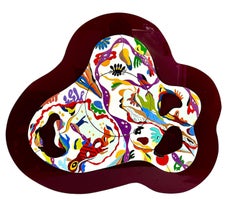
Italian Surrealist Colorful Metal Enamel Plaque Painting Wall Hanging Art Luigi
Located in Surfside, FL
Biomorphic Surrealism.
Signed Luigi, Enamel on metal (probably copper). Mounted to a plexi or acrylic purple mounting. I am assuming it is Italian as it is signed Luigi but it might ...
Category
20th Century Surrealist More Art
Materials
Enamel
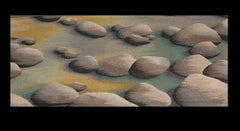
Very Large Hand Woven Wool Tapestry "Boulders II" River Stones
By Julia Mitchell
Located in Surfside, FL
Julia Mitchell Wool on Linen Tapestry, Boulders II Signed and dated JM 82
Julia Mitchell’s Biography
Julia grew up in a family of artists, adopting tap...
Category
20th Century American Modern More Art
Materials
Wool, Linen
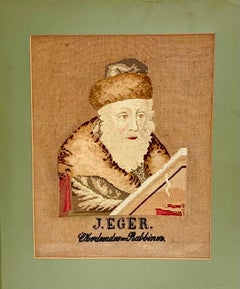
Hungarian Rabbi Akiba Eger 19thC Judaica Folk Art Tapestry Needlepoint Sampler
Located in Surfside, FL
Dimensions board backing is 2 X 18.5 board opening is 16.5 X 13 inches
19th Century framed tapestry of a Rabbi, embroidered sampler, with beaded script below. (it reads J. Eger Oberlandes Rabbiner or Oberlander Rabbiner) There is some sort of texture and dimension to his fur hat (Shtreimel) and coat collar. This is being sold without the frame..
Rabbi Akiba Eger (5521-5598; 1761-1838)
Rabbi Akiba Eger was one of the greatest scholars of his time, who had a great influence on Jewish life. He was born in Eisenstadt, Hungary, in the year 5521 (1761), nearly two hundred years ago. The city of his birth was a seat of learning for centuries, and his family was a family of scholars and Rabbis.Rabbi Akiba Eger, who was Rabbi in the famous community of Pressburg (also Hungary, but since 1913 it belonged to Czechoslovakia and was called Bratislava). He was invited to become Rabbi of the famous city of Posen, and in fact became the chief rabbi of the entire Posen province, though he did not carry that title. His famous son-in-law, Rabbi Moshe Sofer (known as the 'Chasam Sofer'), Rabbi of Pressburg, who had married Rabbi Akiba Eger's daughter. King Frederick III of Prussia honored him with a special medal. Rabbi Akiba Eger was recognized as a great authority on Jewish law, and many well known rabbis and Jewish leaders turned to him for advice and decisions on points of law.
"This sort of art, craft work, emerges from a long tradition of Jewish folk art...
Category
Early 1900s Folk Art More Art
Materials
Wool, Mixed Media, Thread