Lions Gallery Figurative Paintings

to
114
109
163
96
78
Overall Width
to
Overall Height
to
1
523
36
2
15
14
14
39
30
46
29
177
45
41
40
29
27
24
22
5
3
316
213
18
55
38
20
16
15
10
8
5
5
4
4
3
3
3
3
3
3
3
3
3
517
384
245
234
112
9
8
7
7
7
28
560
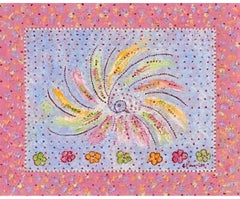
Whimsical French Folk Art, Naive, Oil Painting Madeline Marie Christine Clavier
By Madeline Christine Clavier
Located in Surfside, FL
MADELINE CHRISTINE CLAVIER (1913-2015) Signature: Signed lower right & titled verso Medium: Oil on canvas Provenance: The collection of the artist's family Marie Christine Clavier ...
Category

20th Century Folk Art Animal Paintings

Materials

Canvas, Oil

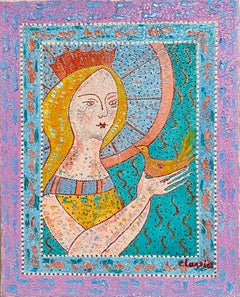
Whimsical French Folk Art, Naive, Oil Painting Madeline Marie Christine Clavier
By Madeline Christine Clavier
Located in Surfside, FL
MADELINE CHRISTINE CLAVIER (1913-2015) Signature: Signed lower right & titled verso Medium: Oil on canvas Provenance: The collection of the artist's family Marie Christine Clavier ...
Category

20th Century Folk Art Animal Paintings

Materials

Canvas, Oil

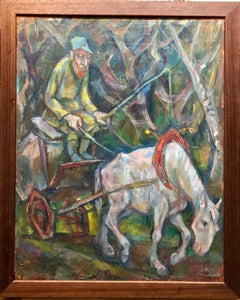
Large Modernist Oil Painting 1940s, Judaica Hasidic Shtetl Wagon Driver WPA Era
By Emanuel Glicenstein Romano
Located in Surfside, FL
Genre: Modern Subject: Landscape with figure of horse, driver and wagon Medium: Oil Surface: wood Board Hand signed lower middle E.Romano EMANUEL ROMANO Rome, Italy, b. 1897, d. 1984 Emanuel Glicen Romano was born in Rome, September 23, 1897. His father Henryk Glicenstein was a sculptor and was living in Rome with his wife Helena (born Hirszenberg) when Emanuel was born. His father obtained Italian citizenship and adopted the name Enrico. Emanuel was brought up in Italy, Switzerland, Germany, England and Poland. In 1926 Emanuel Glicenstein Romano and his father sailed for New York. They briefly visited Chicago. Romano's sister, Beatrice, and mother only joined them in New York years later. Romano changed his name on his arrival to America and some have erroneously speculated that this was to avoid antisemitic discrimination. In truth, as the son of a highly-regarded artist, Romano changed his name to ensure that any success or recognition he would later attain, would be the result of nothing other than his own merit as an artist, and not on account of his father's fame. In 1936 Romano was worked for the WPA Federal Art Project creating murals. ( there were many jewish artists active with in the WPA period. notably Chaim Gross, Ben Shahn, Isaac and Moses Soyer, Abraham Rattner and many others. During and immediately after World War II, Romano created a series of allegorical works depicting graphic holocaust images that were held closely by the family until after his passing. One of these works is now on permanent display in the Florida Holocaust Museum in St. Petersburg Florida. Emanuel's father died in 1942 in a car accident before they could realize their shared dream of visiting Israel. In 1944 Romano, having completed his degree at the Pennsylvania Academy of Fine Arts and the Art Institute of Chicago, began teaching at the City College of New York. Romano moved to Safed, Israel in 1953 and established an art museum in his father's memory, the Glicenstein Museum. COLLECTIONS Indianapolis Museum of Art Metropolitan Museum of Art Boston Fine Arts Museum Fogg Museum Musée Nacional de France Recently his work has been added to the Florida Holocaust Museum collection. His notable works include his holocaust themed allegorical paintings as well as portraits of Marianne Moore, his father and William Carlos Williams...
Category

1930s American Modern Figurative Paintings

Materials

Oil, Board

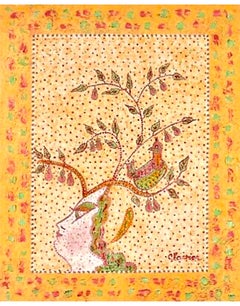
Whimsical French Folk Art, Naive, Oil Painting Madeline Marie Christine Clavier
By Madeline Christine Clavier
Located in Surfside, FL
MADELINE CHRISTINE CLAVIER (1913-2015) Signature: Signed lower right & titled verso Medium: Oil on canvas Provenance: The collection of the artist's family Marie Christine Clavier ...
Category

20th Century Folk Art Animal Paintings

Materials

Canvas, Oil

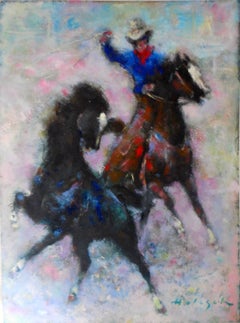
Western Scene (Cowboy on Horseback)
By Denes de Holesch
Located in Surfside, FL
This is an oil on artist board (unframed) by the important Hungarian-born and internationally celebrated Denes de Holesch (1910-1983). Denes de Holesch was an international equestrian artist. His works have been exhibited all over the world, including in New York, Beverly Hills, Boston, Chicago, Paris, Mexico City, Montreal, Tokyo, Sydney, and Madrid. His horse paintings fall into one of seven themes, including polo, cowboys, circus, rodeo, hunt, bull-fight, race-course and running free. His mastery of the subject has been compared to that of Picasso, Delacroix and Franc Marc. 1910 Denes Dezo George de Holesch was born on 9 February, 1910 at Banska-Bystrica, Northern Hungary. He was the third child and youngest son of Hugo de Holesch, an architect and Margit, nee Wagner. Many generations of the de Holesch family had worked as professional architects. He studied at the Hungarian Academy of Fine Arts in Budapest on a scholarship. Early in his career he traveled to China, Japan, Philippines, Java, Bali and Australia, where his reputation grew rapidly. Here he produced portraits in oils, and lithographs of the Chinese, as well as landscape works in oils,depicting the local countryside, and canal, street and city scenes. His exposure to the arts of the Chinese, with their simplicity of line, greatly influenced his later works. In 1939 he established a studio at Lavender Bay near Sydney. In 1940 he exhibited at the Macquarie Galleries in Sydney. In 1944 he married Joyce Greer, the Melbourne concert pianist. In 1945 the couple moved to New York where his interest in horses grew. He held exhibitions at Gallery Wildenstein, Herve, and FAR Gallery. In 1946 Holesch moved to Montreal where he exhibited at the National Gallery of Montreal. In 1947 he moved to Boston where he continued painting portraits and horses. He exhibited there at the Ehrmann and Vose galleries. Later in the year he moved to San Francisco where he was invited to participate in the "Renoir to Picasso" Exhibition held at the Maxwell Gallery.1946 He moved to Montreal, Canada and exhibited at the National Gallery of Montreal. (Frederic Remington and Charles Russell) 1947 Early in the year he moved to Boston and continued painting portraits and horses. In June, he painted the portrait of Harvard Law School Dean, Erwin N. Griswold, and in October his works were exhibited at Margaret Brown's Galerie Intime, Newbury Street, Boston. 1948 He produced a clay sculpture head of Egon Petri, one of a number of clay sculptures that he produced. He also produced a number of wood carvings. His paintings were chosen for inclusion in a Group Exhibition in the National Gallery of San Francisco, and in the important and prestigious 'Renoir to Picasso' Exhibition held at Maxwell's Galleries, 372 Sutter Street, San Francisco. 1953 His works were included in a Group Impressionists Exhibition held at the Ohana Gallery, London 1954 He travelled to New York, where he was commissioned to paint Herbert Gasser, Nobel Prize Winner in Biochemistry. 1955 He returned to England, and then travelled to Paris to exhibit works in the Galerie Marcel Lenoir. 1956 He again returned to New York to work on portrait commissions and for exhibitions of his works, mainly of horses. These exhibitions were held in New York, Boston, San Francisco and late in the year at the Galleries of Frank J. Oehlschlaeger at 107 East Oak Street, Chicago. During this year, visits with his family to Ringling Circus and to a rodeo in Tucson, Arizona must have impressed him greatly, for images of these events soon appeared on his canvases. His work was greatly admired by Hollywood film- stars, such as Ann Rutherford and Burt Lancaster, and David Niven purchased one of the horse paintings to give as his wedding present to Grace Kelly on her marriage to Sovereign Prince Rainier III of Monaco. 1959 The prints of 'Courtship' and 'Chargers' were produced. It has been estimated that close to a million copies of his prints were sold over the next ten years, with 'Courtship' being advertised by Stern's Book Dpt. on 5th Avenue, New York along with prints by Picasso...
Category

20th Century American Realist Figurative Paintings

Materials

Oil, Board

Large Modernist Oil Painting Card Poker Player Aaron Fink Pop Art Americana
By Aaron Fink
Located in Surfside, FL
Aaron Fink (American, b. 1955) Hand signed and dated 1986, verso. The large canvas size measures approx: 72" x 66". This painting is part of the artist's "Images of Gambling" serie...
Category

1980s Pop Art Figurative Paintings

Materials

Canvas, Oil

Large Trompe L oeil Oil Painting Rene Chavelle Belgian Hyper Realist Apples
Located in Surfside, FL
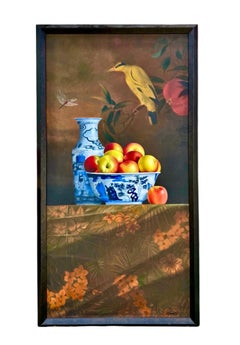
Monumental Hyper Realist Still Life Painting Of Apples Hand Signed Oil on canvas 72 X 36.5 canvas. 76.5 X 41 inches framed Photo Realist Still Life Painting Of Apples, Dragonfly, Bird, with Chinese or Asian Porcelain Ceramic pieces on a floral tablecloth. Rene Chavelle was born in Brussels, Belgium in 1953. His first love was music, in particular the cello, which he studied as a child in Paris...
Category

20th Century Pop Art Figurative Paintings

Materials

Canvas, Oil

French Neo Expressionist Surreal Oil Painting Robert Vernet Bonfort Deaf Artist
By Robert Vernet-Bonfort
Located in Surfside, FL
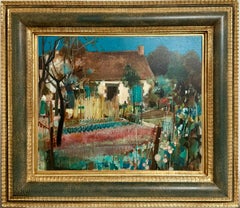
Robert Vernet-Bonfort (French, 1934-2017) LA VIEILLE MAISON Oil painting on canvas Hand signed lower right, signed and inscribed on verso In a heavy carved frame Dimensions: 19 ¼ x 23 ¾”, frame 29 x 33 Provenance: Cambridge Art Gallery, Brentwood, California. Born in Marseille, France in 1934, he began his life as a healthy, happy child. Rendered deaf by an early childhood illness, Vernet-Bonfort embraced visual arts in study and practice as a refuge from the silence of the outer world, permitting elaborate expression through a vivid and colourful visual language. He studied at L'école des Beaux-Arts in Marseille from 1948 to 1957. A frequently exhibited and lauded French artist active since the 1950's, Vernet-Bonfort's work demonstrates the intersection of old and new masters' technique, with a strong personal sensibility with an element of surrealism. Upon completion of his studies he was awarded the Prix Claverie, the first of many future accolades. The year of his graduation also marked his first gallery exhibition at the Galerie Reboul in Marseille. In the next decade Vernet-Bonfort exhibited in many French cities, earning many honours, including the Prix de l'U.N.A.M., for Young Mediterranean Artists He has exhibited over the years with Albert-Ernest De Carrier-Belleuse, Maximilien Luce, Jean Pesce, Lucien Guerber, Honore Jacquet, Georgette Nivert...
Category

20th Century Neo-Expressionist Landscape Paintings

Materials

Canvas, Oil

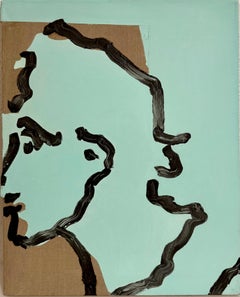
Judy Rifka Abstract Expressionist Pop Art Portrait Oil Painting Brooke Alexander
By Judy Rifka
Located in Surfside, FL
Judy Rifka (American, b. 1945) Roman Nose 1982 Oil on canvas Dimensions: 30 x 24 inches (76.2 x 61.0 cm) Hand signed on stretcher: Judy Rifka Provenance: Brooke Alexander Galle...
Category

1980s Pop Art Figurative Paintings

Materials

Oil, Canvas

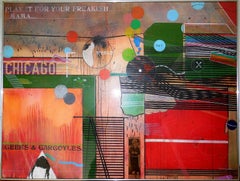
Large Richard Merkin Painting Geeks Gargoyles New Yorker Magazine Cover Artist
By Richard Merkin
Located in Surfside, FL
#9 Geeks and Gargoyles (for Nelson Algren) Mixed Media and Collage Provenance: Obelisk Gallery, Boston, 1967 (label verso) the word Chicago is featured prominently in this piece. So...
Category

1960s Abstract Paintings

Materials

Mixed Media

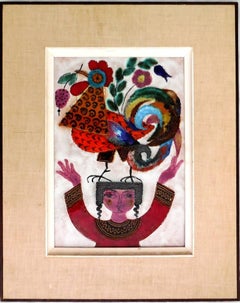
Girl Rooster Enamel Glazed Ceramic Plaque Israeli Artist Awret Naive Folk Art
By Irene Awret
Located in Surfside, FL
This is a rare ceramic plaque painted with enamel glaze by famed Israeli German artist Irene Awret is signed Awret Safed on the verso. the actual glazed ceramic is 10X15 inches. Irèn...
Category

1950s Expressionist Figurative Paintings

Materials

Enamel

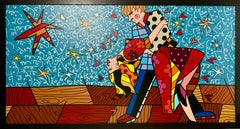
Large Romero Britto Mixed Media Diamond Dust Giclee Pop Art Cubism Hollywood
By Romero Britto
Located in Surfside, FL
Romero Britto "Hollywood Romance" mixed media digital giclee painting print on canvas, featuring a dancing couple in a the artist's characteristic whimsical theme. Measurements: V...
Category

2010s Pop Art Figurative Paintings

Materials

Mixed Media

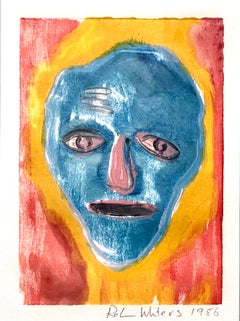
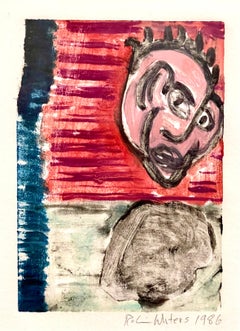
Conceptual Pop Art Color Oil Monotype Painting Abstract Figure Robin Winters
By Robin Winters
Located in Surfside, FL
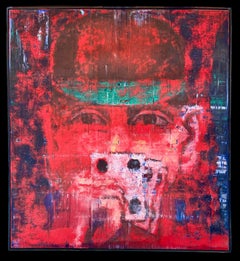
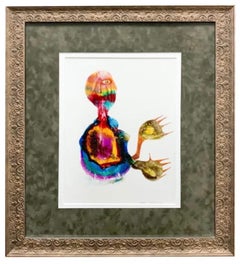
Robin Winters (American, born 1950), Untitled (Red Face) from "Cherry Block Series" 1986, monotype, pencil signed and dated lower right, plate: 6"h x 8.5"w, overall (with frame): 22.25"h x 18.25"w. Provenance: Property from a Private Collection, San Francisco. Winters was invited to make monotypes at Experimental Workshop in San Francisco, (they printed Richard Bosman, Sam Francis, Claire Falkenstein, Deborah Oropallo and Kenneth Noland and many more greats). Winters chose to paint on wood blocks rather than the more usual metal plates in order to capture the organic quality of the natural material. He exploited a salient characteristic of the monoprint in Ghost Story by adding new painted elements onto the increasingly faint ghost images that result from successive impressions from a single block. In so doing he achieved the effect of transparent layers of color and shadow imagery. Winters's brightly-colored monotypes portray an array of figures and landscapes (and an occasional still-life) that, although can be seen in the context of a general trend away from abstraction that has marked the 1980s, defy strict stylistic categorization. They are neither realistic nor abstract, psychological self-examinations nor narrative fictions, but they contain elements of all of these approaches. Like Jonathan Borofsky, Winters derives much of his subject matter from dreams, believing that through his private fears and obsessions he can touch similar emotions in others. Although at first glance Winters's images look as if they could have been made by a child, closer attention reveals sly art historical references to Jackson Pollock and Pattern Painting (the drip and splatter backgrounds), Mark Rothko (the three-part horizontal compositions) and Minimalism (the gridded Cherry Block Series: Bread Beat). Robin Winters (born 1950 in Benicia, California) is an American conceptual, multi-disciplinary, artist and teacher based in New York. Winters is known for creating solo exhibitions containing an interactive durational performance component to his installations, sometimes lasting up to two months. Winters first emerged in the burgeoning Soho NYC art scene of the 1970s. An early practitioner of the Relational Aesthetics (social interaction as an art medium) Winters also created in works through sculpture, installation, performance, painting, drawing and prints. His art maintains a whimsical spirit, and he often returns to ongoing themes involving faces, boats, cars, bottles, hats and jesters or fools. Winters has incorporated such devices as blind dates, double dates, dinners, fortune telling, and free consultation in his performances. Throughout his career he has engaged in a wide variety of media, such as performance art, film, video, writing prose and poetry, photography, installation art, printmaking, drawing, painting, ceramic sculpture, bronze sculpture, and glassblowing. Winters was born in Benicia, California in 1950 to lawyer parents. As a child his hobby was collecting glass bottles found on the beach and under old buildings, which would later influence him as an artist. In 1968, Winters had his first durational performance, entitled Norman Thomas Travelling Museum. The artist drove a Volkswagen bus decorated in collage, many of the images relating to current events and politics. Inside was what the artist described as a “reliquary” containing many objects, including a bottle collection. Winters took the van to shopping centers and even as far as Mexico. That same year, Winters opted not to register for the military draft. Although he was deemed fit to serve, Winters refused. In 1975 the resulting legal proceedings finally came to a close after it was proven that the artist had been harassed by the local draft board. In his teens and early twenties, Winters became acquainted with several local artists who helped shape his aesthetic, most notably Manuel Neri and Robert Arneson. By the early 1970s, Winters was studying at the San Francisco Art Institute (SFAI) and had relocated to San Francisco. At this time Winters became friends with the Bay Area conceptual artists Terry Fox and Howard Fried, and participated in several of Fried's performance works. In 1972 Winters was accepted into the Whitney Independent Study Program in New York City. After coming to New York City, Winters helped support himself by working for various artists, among them the performance artist Joan...
Category

1980s Pop Art Figurative Paintings

Materials

Monoprint, Monotype

Conceptual Pop Art Color Oil Monotype Painting Abstract Figure Robin Winters
By Robin Winters
Located in Surfside, FL
Robin Winters (American, born 1950), Untitled (Red Face) from "Cherry Block Series" 1986, monotype, pencil signed and dated lower right, plate: 6"h x 8.5"w, overall (with frame): 22.25"h x 18.25"w. Provenance: Property from a Private Collection, San Francisco. Winters was invited to make monotypes at Experimental Workshop in San Francisco, (they printed Richard Bosman, Sam Francis, Claire Falkenstein, Deborah Oropallo and Kenneth Noland and many more greats). Winters chose to paint on wood blocks rather than the more usual metal plates in order to capture the organic quality of the natural material. He exploited a salient characteristic of the monoprint in Ghost Story by adding new painted elements onto the increasingly faint ghost images that result from successive impressions from a single block. In so doing he achieved the effect of transparent layers of color and shadow imagery. Winters's brightly-colored monotypes portray an array of figures and landscapes (and an occasional still-life) that, although can be seen in the context of a general trend away from abstraction that has marked the 1980s, defy strict stylistic categorization. They are neither realistic nor abstract, psychological self-examinations nor narrative fictions, but they contain elements of all of these approaches. Like Jonathan Borofsky, Winters derives much of his subject matter from dreams, believing that through his private fears and obsessions he can touch similar emotions in others. Although at first glance Winters's images look as if they could have been made by a child, closer attention reveals sly art historical references to Jackson Pollock and Pattern Painting (the drip and splatter backgrounds), Mark Rothko (the three-part horizontal compositions) and Minimalism (the gridded Cherry Block Series: Bread Beat). Robin Winters (born 1950 in Benicia, California) is an American conceptual, multi-disciplinary, artist and teacher based in New York. Winters is known for creating solo exhibitions containing an interactive durational performance component to his installations, sometimes lasting up to two months. Winters first emerged in the burgeoning Soho NYC art scene of the 1970s. An early practitioner of the Relational Aesthetics (social interaction as an art medium) Winters also created in works through sculpture, installation, performance, painting, drawing and prints. His art maintains a whimsical spirit, and he often returns to ongoing themes involving faces, boats, cars, bottles, hats and jesters or fools. Winters has incorporated such devices as blind dates, double dates, dinners, fortune telling, and free consultation in his performances. Throughout his career he has engaged in a wide variety of media, such as performance art, film, video, writing prose and poetry, photography, installation art, printmaking, drawing, painting, ceramic sculpture, bronze sculpture, and glassblowing. Winters was born in Benicia, California in 1950 to lawyer parents. As a child his hobby was collecting glass bottles found on the beach and under old buildings, which would later influence him as an artist. In 1968, Winters had his first durational performance, entitled Norman Thomas Travelling Museum. The artist drove a Volkswagen bus decorated in collage, many of the images relating to current events and politics. Inside was what the artist described as a “reliquary” containing many objects, including a bottle collection. Winters took the van to shopping centers and even as far as Mexico. That same year, Winters opted not to register for the military draft. Although he was deemed fit to serve, Winters refused. In 1975 the resulting legal proceedings finally came to a close after it was proven that the artist had been harassed by the local draft board. In his teens and early twenties, Winters became acquainted with several local artists who helped shape his aesthetic, most notably Manuel Neri and Robert Arneson. By the early 1970s, Winters was studying at the San Francisco Art Institute (SFAI) and had relocated to San Francisco. At this time Winters became friends with the Bay Area conceptual artists Terry Fox and Howard Fried, and participated in several of Fried's performance works. In 1972 Winters was accepted into the Whitney Independent Study Program in New York City. After coming to New York City, Winters helped support himself by working for various artists, among them the performance artist Joan...
Category

1980s Pop Art Figurative Paintings

Materials

Monoprint, Monotype

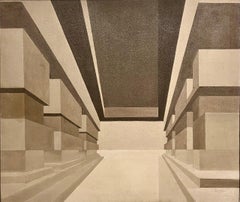
Venezuelan Surrealism Architectural Oil Painting Emerio Lunar Latin American Art
Located in Surfside, FL
Provenance: Galeria Durban Cesar Segnini, Caracas Venezuela. Emerio Dario Lunar was born on January 27, 1940 in Cabimas, Zulia state. Self-taught in painting, makes primary educati...
Category

1980s Surrealist Figurative Paintings

Materials

Canvas, Oil

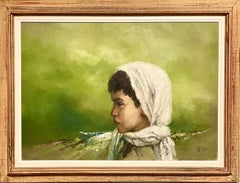
Large Israeli Expressionist Orientalist Oil Painting Draped Child Kibbutz Art
By William Weintraub
Located in Surfside, FL
William (Sunny) Weintraub, Israeli (Born 1926) Oil on masonite William Weintraub (He was also known as Shlomo Weintraub and nicknamed Sonny Weintraub) Genre: Impressionist Subject: ...
Category

Mid-20th Century Expressionist Figurative Paintings

Materials

Canvas, Oil, Board

Large Venezuelan Expressionist Oil Painting Diego Barboza Latin American Master
Located in Surfside, FL
Diego Barboza - 1945-2003 Hand signed and dated 1988 Oil on Canvas Diego Barboza was born the Carabobo street of Maracaibo, Venezuela on February 4, 1945. He was a Venezuelan Neo Figurative Painter who is among the most famous and influential figures in Venezuelan art history. Diego Barboza opened a new chapter in Latin America, beyond the surreal or the magical realism of the Modern Latin American Masters. He created a new language of dislocation and transgression. Personages became distorted to the point that was very exaggerated forms His figures twisted and contorted without losing their presence or their pull. Extremities muscles, and bones burst into an explosive compound of divergent and convergent lines. Through eruptive brushstrokes and fractured outlines. Barboza created a world of illusions. Barboza was born into a upper-middle-class family. He stopped going to school at 12 years old, and he registered himself at the School of Visual Art in the City of Maracaibo Venezuela. Barboza studied at the School of Visual Arts in Caracas, Venezuela. Barboza began his training as an artist at age 12 in his native Maracaibo when he left formal education to enroll in the then School of Plastic Arts of Zulia, then Julio Arraga School of Plastic Arts, where he was a student in the modeling, collage and Drawing of Angelina Curiel. His first collages, in the sixties, show the influence of American Pop Art. In 1967 he exhibited at the Ateneo de Caracas his series 'Los Ratones', a proposal then 'criticized by critics as unprecedented in Venezuela'. In his tribute to the film "Nosferatu" Friedrich Murnau included 32 drawings as well as two-dimensional objects. In 1968 he moved to London where he studied at the London College of Printing. From that time is his '30 Girls with Nets', an action in which 30 students of the London College of Printing, dressed in black and covered by white nets, toured London public places, behaving naturally. His 'street expressions', which he later called 'poetic actions', symbolized a breakdown of social restraints through unusual behaviors that sought to provoke public reactions. Upon his return to Venezuela in 1973, Barboza continues with this line of work, being recognized as one of the initiators of Venezuelan conceptual art. In the 1980's Diego Barboza turned to painting, the New Venezuelan Figuration. Here belongings and the feminine figure fill the work of that time, in which he embodied his intimacy and daily life through scenes of furnishings and flowers that included objects from his workshop and home. His nudes were made from live model, then to follow the path of distortion resulting in their unmistakable females: a figure that represented their personal way of appreciating beauty. Barboza presented his first individual exhibition at the Centro de Bellas Artes of Maracaibo Venezuela. In 1963, he traveled to London when the Conceptual Art movement started, he had the support of the London New Art Lab Gallery. On March 7, 1970 Barboza displayed his first work on Conceptual Art, which he called Art of Action. In London with the performance of 30 Girls with nets (30 Muchachas con redes). His second work was Nets and Hats in markets and restaurants (Con sombreros y redes en mercados y restaurantes). In London UK. His third The Centerpiece (El Ciempies) and the fourth Expression on a laundry-mat (Expresiones en una lavandería) In 1974. Baboza returned to Venezuela. Where he presented two very important Conceptual Art works: The Armadillo Box (La Caja del Cachicamo) and from the School of Athens to the New School of Caracas (De la Escuela de Atenas a la Nueva Escuela de Caracas). Closing his cycle of Conceptual Art creation. IN Venezuela a sort of impromptu academy started up at Claudio Perna’s house. Eugenio Espinoza, Roberto Obregón, Antonieta Sosa, Alfred Wenemoser, Yeni and Nan, Sigfredo Chacón, Diego Barboza, Luis Villamizar, Margherita D’Amico, Pedro Terán, Alfredo del Mónaco, as well as international figures who happened to be visiting Venezuela such as Antoni Muntadas, Charlotte Moorman, and Roman Polanski would gather there. Venezuela, especially Caracas, was a rich field of action for modernism in South America. Venezuelan Geometric Abstraction, Op art and Kinetic Art dominated through crucial figures like Jesús Rafael Soto, Gego, Alejandro Otero, and Carlos Cruz Diez, the country’s kinetic art made a fundamental contribution internationally. The Greater London Arts Association and the Arts Council of Great Britain did several exhibitions of (North, Central, South, London, Wales, Scotland and Ulster) to show the actual Visual Arts in all of the United Kingdom and Diego Barboza was invited for this event with a solo exhibition, expressions around a cylinder (Expresiones alrededor de un cilindro). Diego has made numerous solo and group exhibitions, obtaining rewards since 1963. He is represented in the most important museums of Venezuela, as well as in England, Brazil, Colombia and Cuba. In 1986 he was awarded the Municipal Visual Arts Award of the Municipal Council of the Federal District and in 1997 he received the National Prize for Plastic Arts granted by the National Council of Culture, CONAC. Select Group Exhibitions 1964 Ateneo de Caracas, Caracas, Venezuela 1965 Salón Arturo Michelena, Valencia, Venezuela 1968 Salón Oficial Museo de Bellas Artes, Caracas, Venezuela 1971 Art Spectrum London, London, Great Britain 1972 Serpentine Gallery, London, Great Britain 1973 Midland Group Gallery, London, Great Britain 1974 Galería BANAP, Caracas, Venezuela 1975 Casa de Las Américas, La Habana, Cuba Museo de Bellas Artes, Caracas Galería de Arte Nuevo, Buenos Aires, Argentina 1976 Museo de Arte Moderno, Bogotá, Colombia Museo de Arte Contemporáneo, Sao Paulo, Brazil Museo de la Tertulia, Cali, Colombia Bienal de Venecia, Venecia, Italy 1979 Centro de Artes y Comunicación, Buenos Aires, Argentina 1980 Galería NBC, Memphis, Tennessee, USA 1981 Galería de Arte Nacional, Caracas, Venezuela Museo de Arte Contemporáneo, Medellín, Colombia Museo de Bellas Artes, Caracas, Venezuela 1986 Museo de Arte La Rinconada, Caracas, Venezuela 1989 Galería Venzor, Chicago, Illinois, USA 1990 Museo Bellas Artes, Santiago de Chile, Chile 1992 Ambrosino Gallery, Coral Gables, Florida, USA 1993 Museo de Arte de Petare, Caracas, Venezuela Centro de Arte Lia Bermúdez...
Category

1980s Neo-Expressionist Figurative Paintings

Materials

Canvas, Oil

Simka Simkhovitch WPA W/C Painting Gouache American Modernist Beach Scene Nude
By Simka Simkhovitch
Located in Surfside, FL
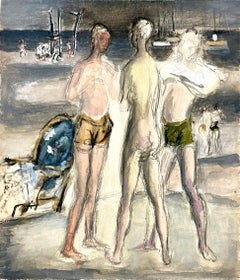
Simka Simkhovitch (Russian/American 1893 - 1949) This came with a small grouping from the artist's family, some were hand signed some were not. These were studies for larger paintin...
Category

1930s American Modern Nude Paintings

Materials

Watercolor, Gouache, Board

Simka Simkhovitch WPA Artist Painting Gouache American Modernist Beach Scene
By Simka Simkhovitch
Located in Surfside, FL
Simka Simkhovitch (Russian/American 1893 - 1949) This came with a small grouping from the artist's family, some were hand signed some were not. These were studies for larger paintin...
Category

1930s American Modern Nude Paintings

Materials

Gouache, Board

Constructivist of Futurist gouache painting
By Ivan Kurach
Located in Surfside, FL
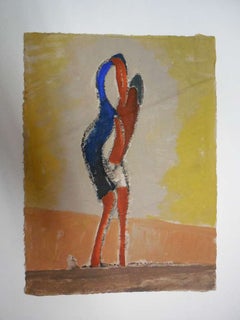
Ivan Kurach (1909 – 1968) Ukranian-Italian lived and studied in Italy. Russian Constructivist or Futurist style work on paper. there is some creasing to the paper but it should lay f...
Category

1930s Constructivist Figurative Paintings

Materials

Paper

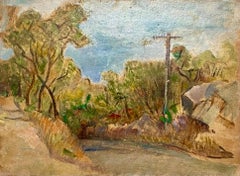
Simka Simkhovitch WPA Artist Oil Painting Gouache American Modernist Powerline
By Simka Simkhovitch
Located in Surfside, FL
Simka Simkhovitch (Russian/American 1893 - 1949) This came with a small grouping from the artist's family, some were hand signed some were not. These were studies for larger paintin...
Category

1930s American Modern Landscape Paintings

Materials

Oil, Gouache, Board

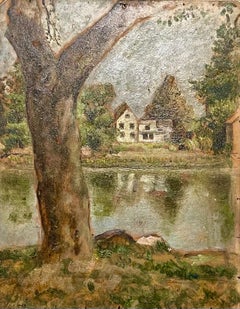
Simka Simkhovitch WPA Artist Oil Painting American Modernist Landscape Pond Tree
By Simka Simkhovitch
Located in Surfside, FL
Simka Simkhovitch (Russian/American 1893 - 1949) This came with a small grouping from the artist's family, some were hand signed some were not. These were studies for larger paintin...
Category

1930s American Modern Landscape Paintings

Materials

Oil, Board

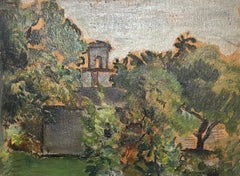
Simka Simkhovitch WPA Artist Oil Painting American Modernist Landscape w Tower
By Simka Simkhovitch
Located in Surfside, FL
Simka Simkhovitch (Russian/American 1893 - 1949) This came with a small grouping from the artist's family, some were hand signed some were not. These were studies for larger paintin...
Category

1930s American Modern Landscape Paintings

Materials

Oil, Board

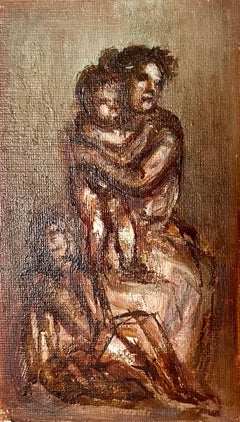
Simka Simkhovitch WPA Artist Oil Painting Family Mother, Kids American Modernist
By Simka Simkhovitch
Located in Surfside, FL
Simka Simkhovitch (Russian/American 1893 - 1949) This came with a small grouping from the artist's family, some were hand signed some were not. These were studies for larger paintin...
Category

1930s American Modern Figurative Paintings

Materials

Oil, Board

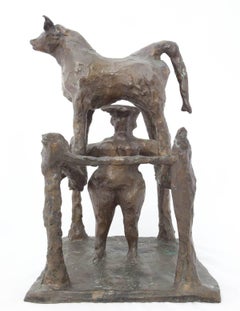
Rare Large Modernist Bronze Sculpture Woman with Bull Bernard Reder
By Bernard Reder
Located in Surfside, FL
Cow on a trapeze Signed and dated 1957 marked 2- II (could be from an edition of 2, please see photos) The sculpture is included in the book titled Sculptures and Woodcuts of Reder by John Rewald. Bernard Reder...
Category

Early 20th Century Post-Impressionist Figurative Paintings

Materials

Bronze

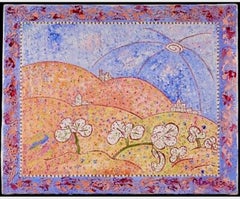
Whimsical French Folk Art, Naive, Oil Painting Madeline Marie Christine Clavier
By Madeline Christine Clavier
Located in Surfside, FL
MADELINE CHRISTINE CLAVIER (1913-2015) Signature: Signed lower right & titled verso Medium: Oil on canvas Provenance: The collection of the artist's family Marie Christine Clavier was born in Saigon, Vietnam in 1913 to French parents and lived there for her formative years. She returned to France as a teenager and began to study painting. Her work quickly developed into whimsical paintings of poetry and songs – harmonized in a unique and distinct painting technique. Her work has an impasto feel and a folk art, outsider artist sensibility to it. Similar in style to Maik and other fantasy realists who use animals, flowers and foliage in their artworks. Marie Clavier painted ro herself rather than for profit as she was quite independently wealthy. She exhibited extensively in the United States in the 1970s especially across Connecticut and New York, showing at various galleries and cultural centres. She had numerous solo exhibitions in the 1970’s- notably at the Maison Francaise in New York and New York University. She showed at Galerie Bernheim Jeune in Paris. She won many awards for her work including Gold Medals and Palme D’Or medals. In 1988 the prestigious art publisher Leopard D’Or produced catalogue book on her life and work – by this point she had virtually given up painting. She died in 2015 aged 102. Bernheim-Jeune gallery is one of the oldest art galleries in Paris. Opened on Rue Laffitte in 1863 by Alexandre Bernheim (1839-1915), friend of Delacroix, Corot and Courbet, it changed location a few times before settling on Avenue Matignon. The gallery promoted realists, Barbizon school paintings and, in 1874, the first impressionist and later post-impressionist painters. It closed in 2019. In 1901, Alexandre Bernheim, with his sons, Josse (1870-1941), and Gaston (1870-1953), organized the first important exhibition of Vincent van Gogh paintings in Paris with the help of art critic Julien Leclercq. In 1906, Bernheim-Jeune frères started presenting works by Pierre Bonnard, Edouard Vuillard, Paul Cezanne, Henri-Edmond Cross, Kees van Dongen, Henri Matisse, Le Douanier Rousseau, Raoul Dufy, Maurice de Vlaminck, Amedeo Modigliani, Maurice Utrillo and Georges Dufrenoy. From 1906 to 1925, art critic Félix Fénéon was the director of the gallery and was instrumental in bringing in the art of Georges Seurat and Umberto Boccioni. In 1922, an exhibition brought together works by Alice Halicka, Auguste Herbin, Pierre Hodé, Moise Kisling, Marie Laurencin, Henri Lebasque, Fernand Leger and Henri Matisse. The gallery now exhibits painters and sculptors in the tradition of the École de Paris and artists such as Jean Carzou, Shelomo Selinger or Pollès. Her style is a recognizable, cheerful, whimsical and a happy creation. Naïve art is any form of visual art that is created by a person who lacks the formal education and training that a professional artist undergoes (in anatomy, art history, technique, perspective, ways of seeing). Unlike folk art, naïve art does not necessarily evince a distinct cultural context or tradition. Naïve art is recognized, and often imitated, for its childlike simplicity and frankness. Paintings of this kind typically have a flat rendering style with a rudimentary expression of perspective. One particularly influential painter of "naïve art" was Henri Rousseau (1844–1910), a French Post-Impressionist who was discovered by Pablo Picasso. Naïve art is often seen as outsider art that is by someone without formal (or little) training or degree. While this was true before the twentieth century, there are now academies for naïve art. Naïve art is now a fully recognized art genre, represented in art galleries worldwide. Museums devoted to naïve art now exist in Kecskemét, Hungary; Riga, Latvia; Jaen, Spain; Rio de Janeiro, Brasil; Vicq France and Paris. Another term related to (but not completely synonymous with) naïve art is folk art. There also exist the terms "naïvism" and "primitivism" which are usually applied to professional painters working in the style of naïve art (like Paul Gauguin, Mikhail Larionov, Paul Klee). At all events, naive art can be regarded as having occupied an "official" position in the annals of twentieth-century art since - at the very latest - the publication of the Der Blaue Reiter, an almanac in 1912. Wassily Kandinsky and Franz Marc, who brought out the almanac, presented 6 reproductions of paintings by le Douanier' Rousseau (Henri Rousseau), comparing them with other pictorial examples. However, most experts agree that the year that naive art was "discovered" was 1885, when the painter Paul Signac became aware of the talents of Henri Rousseau and set about organizing exhibitions of his work in a number of prestigious galleries. The Earth Group (Grupa Zemlja) were Croatian artists, architects and intellectuals active in Zagreb from 1929 to 1935. The group included the painters Krsto Hegedušić, Edo Kovačević, Omer Mujadžić, Kamilo Ružička, Ivan Tabaković, and Oton Postružnik, the sculptors Antun Augustinčić, Frano Kršinić, and the architect Drago Ibler. A term applied to Yugoslav (Croatian) naive painters working in or around the village of Hlebine, near the Hungarian border, from about 1930. Some of the best known naive artists are Dragan Gaži, Ivan Generalić, Josip Generalić, Krsto Hegedušić, Mijo Kovačić, Ivan Lacković-Croata, Franjo Mraz, Ivan Večenaj and Mirko Virius. Camille Bombois (1883–1970) Ferdinand Cheval, known as 'le facteur Cheval' (1836–1924) Henry Darger (1892–1973) L. S. Lowry (1887–1976) Grandma Moses, Anna Mary Robertson...
Category

20th Century Folk Art Animal Paintings

Materials

Canvas, Oil

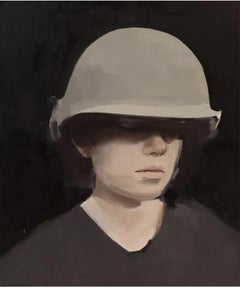
Maggie in Helmet Portrait Oil Painting Richard Butler Psychedelic Furs Front Man
Located in Surfside, FL
'Maggie with Helmet' 2012 Oil on canvas Verso: Hand signed and dated on canvas. Dimensions: 24" h x 20" w. Frame: 25.5" h 21.5" w Provenance: Property of a Southampton, NY collection Richard Butler (Post-war and Contemporary artist) studied painting at the Epsom School of Art and Design (now University for the Creative Arts). In school he was exposed to radical developments taking hold in the artworld including Andy Warhol, Jasper Johns, David Hockney and Francis Bacon and the emerging British pop art of Richard Hamilton and Peter Blake. He later turning to silkscreen printmaking. But like many famous rockers, from Keith Richards and Roger Waters to Tupac Shakur and Lady Gaga, Butler began making music in art school, and art was a passion that never went away. Shortly after graduating from the art school, in 1977, Richard Butler became a founder and singer/songwriter for the British post-punk / new wave rock and roll band "The Psychedelic Furs". Quickly gaining commercial success, his musical career kept him away from painting throughout the 80s and the 90s. In early 2000s, Richard Butler returned to painting and started exhibiting his art in the U.S. and Europe. He prefers to call himself a painter who sings, rather than a singer who paints. He was influenced by Anselm Kiefer and Francesco Clemente and became friends with Julian Schnabel. With his daughter, Maggie Mozart Butler, as his muse, he produces expressionistic portraits of pensive female subjects, who serve as ciphers for himself. As he describes, “In a way I think all of my paintings are self-portraits in that, though the face I am painting may not be my own, the feeling I get back from the painting is certainly an important element of my own psyche.” His work is a sort of dark moody expressionism with nods towards Lucien Freud. He lives and works in Connecticut. He has had solo exhibitions in New York City, Miami and Florence, Italy. One of his works, Girl with a Map, has been used as a CD's cover art. Selected Solo Exhibitions 2020 Richard Butler: Amnesiac Hostess, Waltman Ortega Fine Art, Miami, Florida, USA 2017 101/EXHIBIT, La Peer Drive, West Hollywood, Los Angeles, California, USA 2015 naturalhistory ,Freight+Volume (Allen St.) ,Lower East Side, New York, USA Selected Group Exhibitions 2025 Summer Sale, Galerie Olivier Waltman, Paris Saint-Germain, 6e, Paris, France The Rhythm. Vibratory Shock of Being, Galerie Olivier Waltman, Paris Marais...
Category

2010s Expressionist Figurative Paintings

Materials

Canvas, Oil

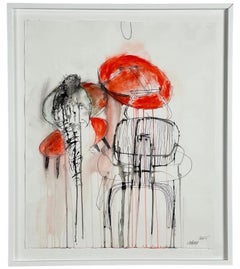
Abstract Expressionist Contemporary Modernist South African Painting Lorna Marsh
Located in Surfside, FL
Lorna Marsh (1949-2022) Acrylic on Paper (mixed media) Hand signed and dated Chairs, Table, and Figure 2015 Original masterpiece by Lorna Marsh. Created with acrylic and ink wash on...
Category

2010s Contemporary Figurative Paintings

Materials

Paper, Acrylic

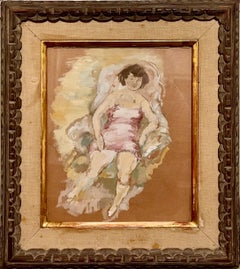
Gouache Painting Jules Pascin Hand Signed Woman in Boudoir German Expressionism
By Jules Pascin
Located in Surfside, FL
Genre: German Expressionist Subject: Woman Medium: gouache paint Surface: Paper board This is hand signed lower right. Framed it measures 17.25 X 15.5, sheet 12 X 10 This came from ...
Category

Early 20th Century Expressionist Figurative Paintings

Materials

Paper, Gouache, Cardboard

Pop Art Painting Dennis Hollingsworth LA Spanish Artist Post Modernist Abstract
By Dennis Hollingsworth
Located in Surfside, FL
Dennis Hollingsworth (Spanish/American, b. 1956), "Lil' Franklin," 1997, Oil on canvas, Hand signed on stretcher bar verso, Gallery label verso (Bennett Roberts Fine Art, Los Ange...
Category

1990s Pop Art Abstract Paintings

Materials

Canvas, Oil

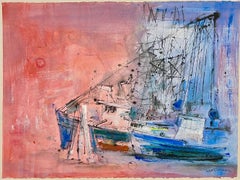
Gouache Watercolor Painting, Nantucket Harbor Boats American Deaf Modernist Art
By Robert Freiman
Located in Surfside, FL
Abstract harbor scene with boats, in bold, vivid colors on heavy mould made paper. Hand signed and dated, 1980 22 X 30 not frame Robert Freiman, deaf from birth, was born in March 1917 in New York City. He attended an oral program near his home and later transferred to the Lexington School for the Deaf when he was six. Early in his childhood, his love for drawing, painting and studying became apparent, and as an adult, he continued his studies in New York at the National Academy of Design, Pratt Institute, the Art Students League and the Parsons School of Design. In Paris, France he studied at the Ecole des Beaux Arts. Bob Freiman was especially focused on painting portraits and figures in motion in various mediums, especially the mixed-media combination of watercolor, acrylic and pen. Among his subjects were acrobats, ballet dancers, cyclists and other athletes. He as well focused on abstracts for a time, discovering new media in his works with quick brushwork and expressive movements. In the latter part of his career, his style became abstract and surreal with images of metaphysical landscapes with architectural elements such as arches, towers, pyramids and castles floating in the air. The famed art critic Pierre Rouve wrote: “It is therefore refreshing to see them revitalized by the colourist wealth and virile handwriting of Robert Freiman, probably the best American water-colorist since John Marin. He worked in Provincetown and Nantucket and regularly exhibited there. He showed at Doll & Richards gallery of Boston alongside John Chetcuti, Lloyd Goodrich, Tod Lindenmuth, William Meyerowitz, Dwight Shepler...
Category

1980s Expressionist Figurative Paintings

Materials

Watercolor, Gouache, Archival Paper

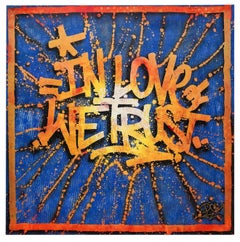
Large French Street Art Mixed Media Graffiti Painting DoK In Love We Trust
Located in Surfside, FL
DOK (Fench, B. 1976) "In Love We Trust" Mixed Media on Canvas 2021 Hand igned by artist DOK in lower right corner. Hand signed and tagged on back by artist. 38.6" x 38.6" Born in...
Category

2010s Street Art Figurative Paintings

Materials

Canvas, Paint, Spray Paint

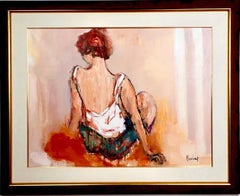
Large Post Impressionist Fauvist Art French Oil Painting Dancer Urbain Huchet
By Urbain Huchet
Located in Surfside, FL
Urbain Huchet (French, 1930-2014) Title: Jeune Fille de Dos aux Cheveux Rouges (Young Girl From The Back With Red Hair) Date: c. 1998 Dimensions: 61.5"L x 2"W x 49.5"H canvas is 36.5 x 48.5 by Urbain Huchet is a striking impressionist oil on canvas depicting a seated young woman, perhaps a ballet dancer, viewed from behind, her red hair and relaxed posture rendered in fluid, expressive brushstrokes that evoke both intimacy and abstraction. The artist's palette of warm ochres, blush tones, and earthy greens, paired with his gestural application, creates a contemplative atmosphere, characteristic of Huchet's post-impressionist style. This work is an homage to Edgar Degas, Pierre-Auguste Renoir and Henri de Toulouse-Lautrec. Masters of an earlier generation who painted this theme. The painting is elegantly housed in a richly detailed custom frame featuring a gilded inner trim and a unique design of gilded nude figures, intertwined and enmeshed into one another, an artistic embellishment that deepens the sensual undertone of the composition. Urbain Huchet, known for his romantic portrayals of figures, landscapes, and coastal scenes, was a widely exhibited French painter who trained in both economics and art, traveling extensively and drawing inspiration from locales such as Brittany, Venice, Istanbul, and South America. His works were frequently shown at the Salon de la Société Nationale des Beaux-Arts in Paris and are held in numerous private and public collections across Europe, the United States, and Japan. Signature and title on verso. Urbain Emmanuel Huchet was born in Rennes, France on April 28, 1930. Known for his modernist marine, cityscape, figure and genre painting. After studying law and owning a textile factory for four years, he decided in 1960 to devote himself entirely to painting. Mr. Huchet spent his first three years as an artist in Pont-Aven, following in the footsteps of the Post Impressionist, Paul Gauguin, and Symbolist, Emile Bernard, both of whom influenced him a great deal. In 1963, he moved to Paris, catching the travel bug. He journeyed throughout Europe and the Middle East, spending time in Indian markets, visiting Peru, Mexico, Egypt, and every beautiful country he could, finding inspiration in each place. He painted the scenery of each locale, culminating in a book to document his experiences. His works are typified by a fluid and free, gestural approach to both form and color, and they are immediately recognizable. He is adept at both painting oil on canvas and watercolor, and is an accomplished lithograph artist. His subjects are diverse, but are primarily a reflection of the landscape of the Brittany region as he has a profound love for the coast. His wonderful depictions of circus performers, vineyard workers having lunch, farmers, cabaret musicians and everyday people were strongly influenced by his adventures and sojourns in foreign lands. Urbain Huchet has been an exhibiting artist since 1960. He has had exhibitions in New York, London, New Orleans, Egypt, and Paris. He has exhibited at Park West Galleries along with Yaacov Agam, Alvar, Fauvist artist Emile Bellet, Romero Britto, Slava Brodinsky, Pierre Eugene Cambier, Claude Cambour...
Category

20th Century Interior Paintings

Materials

Canvas, Oil

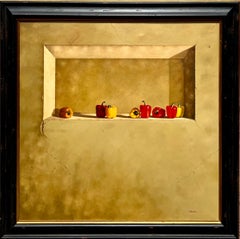
Large Trompe L oeil Oil Painting Rene Chavelle Belgian Photo Realist Peppers
Located in Surfside, FL
Monumental Hyper Realist Still Life Painting Of Peppers, Hand Signed Oil on canvas 48 x 48 in, 58 x 58 in (framed) Perfect for a ki...
Category

20th Century Pop Art Figurative Paintings

Materials

Canvas, Oil

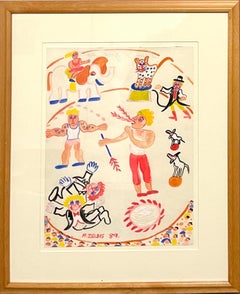
Malcah Zeldis Folk Art Gouache Painting Outsider Artist Circus Fire Eater, Tiger
Located in Surfside, FL
MALCAH ZELDIS ''Circus, Fire Eaters'', 1989, gouache on paper Hand signed and dated bottom center, titled in pencil on paper verso Paper 12''h, 9''w. Provenance: Estate of Laura Fisher...
Category

1980s Folk Art Figurative Paintings

Materials

Paper, Gouache

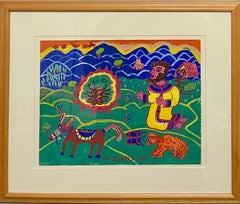
Malcah Zeldis Folk Art Gouache Moses Bible Painting Self Taught Outsider Artist
Located in Surfside, FL
MALCAH ZELDIS (American-Israeli, b. 1931) Moses and the burning bush, 1982, gouache on paper, Hand signed and dated lower middle. Paper 9''h, 11-3/4''w. Framed 14.5 X 17.5 Provenance: Estate of Laura...
Category

1980s Folk Art Figurative Paintings

Materials

Paper, Gouache

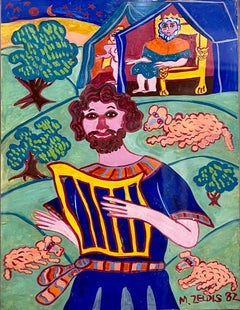
Malcah Zeldis Folk Art Gouache Painting King David Self Taught Outsider Artist
Located in Surfside, FL
MALCAH ZELDIS (American-Israeli, b. 1931), ''David and Saul'', 1982, Gouache on paper Hand signed and dated lower right, titled in pencil on paper verso. Provenance: Estate of Laura Fisher...
Category

1980s Folk Art Figurative Paintings

Materials

Paper, Gouache

Whimsical French Folk Art, Naive, Oil Painting Madeline Marie Christine Clavier
By Madeline Christine Clavier
Located in Surfside, FL
MADELINE CHRISTINE CLAVIER (1913-2015) Signature: Signed lower right & titled verso Medium: Oil on canvas Provenance: The collection of the artist's family Marie Christine Clavier was born in Saigon, Vietnam in 1913 to French parents and lived there for her formative years. She returned to France as a teenager and began to study painting. Her work quickly developed into whimsical paintings of poetry and songs – harmonized in a unique and distinct painting technique. Her work has an impasto feel and a folk art, outsider artist sensibility to it. Similar in style to Maik and other fantasy realists who use animals, flowers and foliage in their artworks. Marie Clavier painted ro herself rather than for profit as she was quite independently wealthy. She exhibited extensively in the United States in the 1970s especially across Connecticut and New York, showing at various galleries and cultural centres. She had numerous solo exhibitions in the 1970’s- notably at the Maison Francaise in New York and New York University. She showed at Galerie Bernheim Jeune in Paris. She won many awards for her work including Gold Medals and Palme D’Or medals. In 1988 the prestigious art publisher Leopard D’Or produced catalogue book on her life and work – by this point she had virtually given up painting. She died in 2015 aged 102. Bernheim-Jeune gallery is one of the oldest art galleries in Paris. Opened on Rue Laffitte in 1863 by Alexandre Bernheim (1839-1915), friend of Delacroix, Corot and Courbet, it changed location a few times before settling on Avenue Matignon. The gallery promoted realists, Barbizon school paintings and, in 1874, the first impressionist and later post-impressionist painters. It closed in 2019. In 1901, Alexandre Bernheim, with his sons, Josse (1870-1941), and Gaston (1870-1953), organized the first important exhibition of Vincent van Gogh paintings in Paris with the help of art critic Julien Leclercq. In 1906, Bernheim-Jeune frères started presenting works by Pierre Bonnard, Edouard Vuillard, Paul Cezanne, Henri-Edmond Cross, Kees van Dongen, Henri Matisse, Le Douanier Rousseau, Raoul Dufy, Maurice de Vlaminck, Amedeo Modigliani, Maurice Utrillo and Georges Dufrenoy. From 1906 to 1925, art critic Félix Fénéon was the director of the gallery and was instrumental in bringing in the art of Georges Seurat and Umberto Boccioni. In 1922, an exhibition brought together works by Alice Halicka, Auguste Herbin, Pierre Hodé, Moise Kisling, Marie Laurencin, Henri Lebasque, Fernand Leger and Henri Matisse. The gallery now exhibits painters and sculptors in the tradition of the École de Paris and artists such as Jean Carzou, Shelomo Selinger or Pollès. Her style is a recognizable, cheerful, whimsical and a happy creation. Naïve art is any form of visual art that is created by a person who lacks the formal education and training that a professional artist undergoes (in anatomy, art history, technique, perspective, ways of seeing). Unlike folk art, naïve art does not necessarily evince a distinct cultural context or tradition. Naïve art is recognized, and often imitated, for its childlike simplicity and frankness. Paintings of this kind typically have a flat rendering style with a rudimentary expression of perspective. One particularly influential painter of "naïve art" was Henri Rousseau (1844–1910), a French Post-Impressionist who was discovered by Pablo Picasso. Naïve art is often seen as outsider art that is by someone without formal (or little) training or degree. While this was true before the twentieth century, there are now academies for naïve art. Naïve art is now a fully recognized art genre, represented in art galleries worldwide. Museums devoted to naïve art now exist in Kecskemét, Hungary; Riga, Latvia; Jaen, Spain; Rio de Janeiro, Brasil; Vicq France and Paris. Another term related to (but not completely synonymous with) naïve art is folk art. There also exist the terms "naïvism" and "primitivism" which are usually applied to professional painters working in the style of naïve art (like Paul Gauguin, Mikhail Larionov, Paul Klee). At all events, naive art can be regarded as having occupied an "official" position in the annals of twentieth-century art since - at the very latest - the publication of the Der Blaue Reiter, an almanac in 1912. Wassily Kandinsky and Franz Marc, who brought out the almanac, presented 6 reproductions of paintings by le Douanier' Rousseau (Henri Rousseau), comparing them with other pictorial examples. However, most experts agree that the year that naive art was "discovered" was 1885, when the painter Paul Signac became aware of the talents of Henri Rousseau and set about organizing exhibitions of his work in a number of prestigious galleries. The Earth Group (Grupa Zemlja) were Croatian artists, architects and intellectuals active in Zagreb from 1929 to 1935. The group included the painters Krsto Hegedušić, Edo Kovačević, Omer Mujadžić, Kamilo Ružička, Ivan Tabaković, and Oton Postružnik, the sculptors Antun Augustinčić, Frano Kršinić, and the architect Drago Ibler. A term applied to Yugoslav (Croatian) naive painters working in or around the village of Hlebine, near the Hungarian border, from about 1930. Some of the best known naive artists are Dragan Gaži, Ivan Generalić, Josip Generalić, Krsto Hegedušić, Mijo Kovačić, Ivan Lacković-Croata, Franjo Mraz, Ivan Večenaj and Mirko Virius. Camille Bombois (1883–1970) Ferdinand Cheval, known as 'le facteur Cheval' (1836–1924) Henry Darger (1892–1973) L. S. Lowry (1887–1976) Grandma Moses, Anna Mary Robertson...
Category

20th Century Folk Art Animal Paintings

Materials

Canvas, Oil

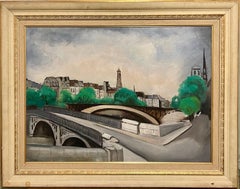
1927 Oil Painting Eiffel Tower Paris American Modernist Wpa Artist Morris Kantor
By Morris Kantor
Located in Surfside, FL
Morris Kantor New York (1896 - 1974) Paris from the Ile St. Louis, 1927 (view of Eiffel Tower) Oil painting on canvas Hand Signed lower left. Provenance: Hirshhorn Museum and Scul...
Category

1920s American Modern Landscape Paintings

Materials

Canvas, Oil

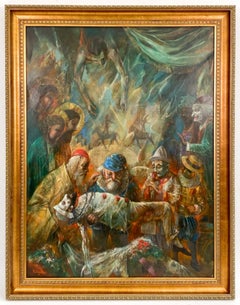
Large Oil Painting Circus Scene Clowns Rediscovered NY Artist Jonah Kinigstein
By Jonah Kinigstein
Located in Surfside, FL
Jonah Kinigstein "Death of a Clown" Large Oil on Board Painting of macabre circus scene with clowns Hand signed lower left and signed and titled verso Frame: 55 X 43 Image: 48 X 36 ...
Category

20th Century Expressionist Portrait Paintings

Materials

Oil, Board

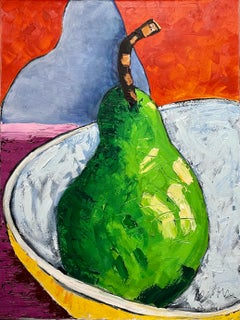
Large Pop Art Oil Painting "Pear" Modernist Colorful Composition Suzanne Mears
Located in Surfside, FL
Bold, colorful, still life oil painting of a pear. In lush, vibrant color. SUZANNE WALLACE MEARS During college she focused on painting and clay. Then it became photography and clay...
Category

20th Century Pop Art Abstract Paintings

Materials

Canvas, Oil

French Modernist Post Impressionist Provence Mod Women Jean Sardi Oil Painting
Located in Surfside, FL
Attributed to Jean Sardi, French (b. 1947) Painting, Oil on Board "Seated Woman". Apparently not signed. Dimensions: Sight- 30.5" x 24.5", Frame- 31.25" x 25.25". Jean Sardi is a French Postwar & Contemporary painter who was born in 1947. His meeting in 1980 with the Toulon painter Jacques Bartoli...
Category

20th Century Post-Modern Figurative Paintings

Materials

Oil

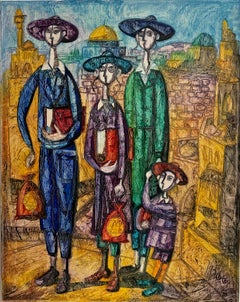
Jerusalem Hasidic Family Oil Painting Israeli Judaica Yossi Stern Bezalel School
By Jossi Stern
Located in Surfside, FL
Jossi Stern Hungarian Israeli 1923- 1992) Untitled (Figures, Chassidic Family, Father and Sons), Oil on canvas, Hand signed lower right, Provenance: gallery label (Safrai Art Gall...
Category

20th Century Modern Figurative Paintings

Materials

Canvas, Oil

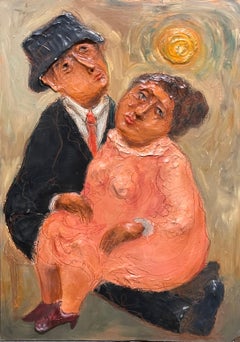
Judaica Painting w Sculpture Terra Cotta Jewish Couple Israeli Artist Kanovich
Located in Surfside, FL
Original Painting: Terracotta Relief With Acrylic Painting on Wood Panel Hand signed These works are paintings with a 3D carved sculpture dimension to them, fusing sculpture with pai...
Category

21st Century and Contemporary Folk Art Figurative Paintings

Materials

Terracotta, Acrylic, Wood Panel

Large Original Mixed Media Painting on Rice Paper Chinese Artist Jiang Tiefeng
Located in Surfside, FL
Jiang Tiefeng (China/Minnesota, 1938-) Mixed media gouache painting on rice paper with a gold tone Titled: "Mother and Child II." Artist is identified on Dyansen Gallery label on v...
Category

20th Century Modern Abstract Paintings

Materials

Paint, Ink, Gouache, Rice Paper

Large Naive European Folk Art Oil Painting Lazar Obican French Scarecrow Clown
Located in Surfside, FL
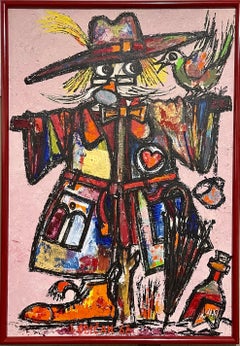
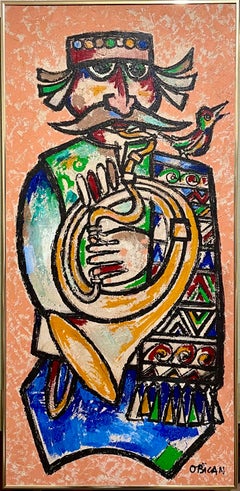
Lazar Obican 1944-2004 Genre: Other Subject: People Medium: Oil Surface: Canvas Dimensions: 35" x 16.5 Dimensions w/Frame: 35.5" x 17.25 An impasto composition that depicts a colorful scarecrow clown with a bird perched on his shoulder with a bottle of French Vin (wine) Artist signature L OBICAN to bottom and dated 1968. Title to verso. Work Size: 36 x 25 in. Framed 37.5 x 26 x 1 in The artist Lazar Obican iconic style is child-like yet masterfully adult; a style that tells a story with sociological overtones. His funny little people are always colorful, full of spirit, living with music and birds to bring them happiness. Lazar Obican artist, painter, sculpture and mosaic ceramic artisan was born in Cannes, France, to his Yugoslavian family. He finished his training, imbued with the spirit of his native country, the people, their legends, and their philosophy. It has been said that his work has a "timeless quality" and a naive, folk art, outsider art brut quality, child-like primitive style. Obican is identified with his style the world over, a style that is simple yet sophisticated; child-like yet masterfully adult; a style that tells a story with psychological, philosophical or sociological overtones. His funny little people are always colorful, full of spirit, living with music and birds to bring them happiness. Best known for his depictions of folklore and traditional costumes rendered in a playful, childlike style and for his happy Jewish wedding scenes. He often used bright colors and black outlines in his renderings of figures and animals, giving his work an illustration-like quality. Thematically, the artist’s work is similar to Marc Chagall and Jean Dubuffet for its dreamlike images and so-called naïve style of painting. Over the course of his career, the artist maintained a studio in Boca Raton, Florida and Dubrovnik, Croatia—part of former Yugoslavia— where he developed an interest in Eastern Europe’s Jewish culture. Many of his mature works depict Jewish traditions and ceremonies, including traditional Jewish weddings, the dancing of the Hora, and traditional music. There is a display of his works in his former Dubrovnik studio. His style is a unique conglomerate of tradition, history, legends, heroes, old customs and folklore. It is a self-standing style, recognizable, cheerful, whimsical and a happy creation. Naïve art is any form of visual art that is created by a person who lacks the formal education and training that a professional artist undergoes (in anatomy, art history, technique, perspective, ways of seeing). Unlike folk art, naïve art does not necessarily evince a distinct cultural context or tradition. Naïve art is recognized, and often imitated, for its childlike simplicity and frankness. Paintings of this kind typically have a flat rendering style with a rudimentary expression of perspective. One particularly influential painter of "naïve art" was Henri Rousseau (1844–1910), a French Post-Impressionist who was discovered by Pablo Picasso. Naïve art is often seen as outsider art that is by someone without formal (or little) training or degree. While this was true before the twentieth century, there are now academies for naïve art. Naïve art is now a fully recognized art genre, represented in art galleries worldwide. Museums devoted to naïve art now exist in Kecskemét, Hungary; Riga, Latvia; Jaen, Spain; Rio de Janeiro, Brasil; Vicq France and Paris. "Primitive art" is another term often applied to art by those without formal training, but is historically more often applied to work from certain cultures that have been judged socially or technologically "primitive" by Western academia, such as Native American, sub saharan African or Pacific Island art (see Tribal art). This is distinguished from the self-conscious, "primitive" inspired movement primitivism. Another term related to (but not completely synonymous with) naïve art is folk art. There also exist the terms "naïvism" and "primitivism" which are usually applied to professional painters working in the style of naïve art (like Paul Gauguin, Mikhail Larionov, Paul Klee). At all events, naive art can be regarded as having occupied an "official" position in the annals of twentieth-century art since - at the very latest - the publication of the Der Blaue Reiter, an almanac in 1912. Wassily Kandinsky and Franz Marc, who brought out the almanac, presented 6 reproductions of paintings by le Douanier' Rousseau (Henri Rousseau), comparing them with other pictorial examples. However, most experts agree that the year that naive art was "discovered" was 1885, when the painter Paul Signac became aware of the talents of Henri Rousseau and set about organizing exhibitions of his work in a number of prestigious galleries. The Earth Group (Grupa Zemlja) were Croatian artists, architects and intellectuals active in Zagreb from 1929 to 1935. The group included the painters Krsto Hegedušić, Edo Kovačević, Omer Mujadžić, Kamilo Ružička, Ivan Tabaković, and Oton Postružnik, the sculptors Antun Augustinčić, Frano Kršinić, and the architect Drago Ibler. A term applied to Yugoslav (Croatian) naive painters working in or around the village of Hlebine, near the Hungarian border, from about 1930. Some of the best known naive artists are Dragan Gaži, Ivan Generalić, Josip Generalić, Krsto Hegedušić, Mijo Kovačić, Ivan Lacković-Croata, Franjo Mraz, Ivan Večenaj and Mirko Virius. Camille Bombois (1883–1970) Ferdinand Cheval, known as 'le facteur Cheval' (1836–1924) Henry Darger (1892–1973) L. S. Lowry (1887–1976) Grandma Moses, Anna Mary Robertson...
Category

1960s Folk Art Figurative Paintings

Materials

Canvas, Oil

Large Naive European Folk Art Oil Painting Jovan Obican Klezmer Jazz Musician
By Jovan Obican
Located in Surfside, FL
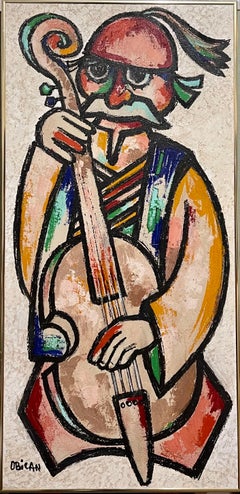
Genre: Other Subject: People Medium: Oil Surface: Canvas Dimensions: 35" x 16.5 Dimensions w/Frame: 35.5" x 17.25 This depicts a Jazz or Klezmer musician. This one is a bass player. The last photo shows it in a group of three that I have available. This listing is for the one painting. The artist Jovan Obican iconic style is child-like yet masterfully adult; a style that tells a story with sociological overtones. His funny little people are always colorful, full of spirit, living with music and birds to bring them happiness. JOVAN OBICAN Cannes, France, b. 1918, d. 1986 Jovan Obican (1918-1986) artist, painter, sculpture and mosaic ceramic artisan was born in Cannes, France, to his Yugoslavian parents. From childhood on, Jovan practically devoted himself to art, scratching designs into the dirt when paper was unavailable. He trained with many recognized teachers and with many styles. He finished his training, imbued with the spirit of his native country, the people, their legends, and their philosophy. It has been said that his work has a "timeless quality" and a naive, folk art, outsider art brut quality, child-like primitive style. Obican is identified with his style the world over, a style that is simple yet sophisticated; child-like yet masterfully adult; a style that tells a story with psychological, philosophical or sociological overtones. His funny little people are always colorful, full of spirit, living with music and birds to bring them happiness. Best known for his depictions of folklore and traditional costumes rendered in a playful, childlike style and for his happy Jewish wedding scenes. He often used bright colors and black outlines in his renderings of figures and animals, giving his work an illustration-like quality. Thematically, the artist’s work is similar to Marc Chagall and Jean Dubuffet for its dreamlike images and so-called naïve style of painting. Over the course of his career, the artist maintained a studio in Boca Raton, Florida and Dubrovnik, Croatia—part of former Yugoslavia— where he developed an interest in Eastern Europe’s Jewish culture. Many of his mature works depict Jewish traditions and ceremonies, including traditional Jewish weddings, the dancing of the Hora, and traditional music. There is a display of his works in his former Dubrovnik studio. His style is a unique conglomerate of tradition, history, legends, heroes, old customs and folklore. It is a self-standing style, recognizable, cheerful, whimsical and a happy creation. Naïve art is any form of visual art that is created by a person who lacks the formal education and training that a professional artist undergoes (in anatomy, art history, technique, perspective, ways of seeing). Unlike folk art, naïve art does not necessarily evince a distinct cultural context or tradition. Naïve art is recognized, and often imitated, for its childlike simplicity and frankness. Paintings of this kind typically have a flat rendering style with a rudimentary expression of perspective. One particularly influential painter of "naïve art" was Henri Rousseau (1844–1910), a French Post-Impressionist who was discovered by Pablo Picasso. Naïve art is often seen as outsider art that is by someone without formal (or little) training or degree. While this was true before the twentieth century, there are now academies for naïve art. Naïve art is now a fully recognized art genre, represented in art galleries worldwide. Museums devoted to naïve art now exist in Kecskemét, Hungary; Riga, Latvia; Jaen, Spain; Rio de Janeiro, Brasil; Vicq France and Paris. "Primitive art" is another term often applied to art by those without formal training, but is historically more often applied to work from certain cultures that have been judged socially or technologically "primitive" by Western academia, such as Native American, sub saharan African or Pacific Island art (see Tribal art). This is distinguished from the self-conscious, "primitive" inspired movement primitivism. Another term related to (but not completely synonymous with) naïve art is folk art. There also exist the terms "naïvism" and "primitivism" which are usually applied to professional painters working in the style of naïve art (like Paul Gauguin, Mikhail Larionov, Paul Klee). At all events, naive art can be regarded as having occupied an "official" position in the annals of twentieth-century art since - at the very latest - the publication of the Der Blaue Reiter, an almanac in 1912. Wassily Kandinsky and Franz Marc, who brought out the almanac, presented 6 reproductions of paintings by le Douanier' Rousseau (Henri Rousseau), comparing them with other pictorial examples. However, most experts agree that the year that naive art was "discovered" was 1885, when the painter Paul Signac became aware of the talents of Henri Rousseau and set about organizing exhibitions of his work in a number of prestigious galleries. The Earth Group (Grupa Zemlja) were Croatian artists, architects and intellectuals active in Zagreb from 1929 to 1935. The group included the painters Krsto Hegedušić, Edo Kovačević, Omer Mujadžić, Kamilo Ružička, Ivan Tabaković, and Oton Postružnik, the sculptors Antun Augustinčić, Frano Kršinić, and the architect Drago Ibler. A term applied to Yugoslav (Croatian) naive painters working in or around the village of Hlebine, near the Hungarian border, from about 1930. Some of the best known naive artists are Dragan Gaži, Ivan Generalić, Josip Generalić, Krsto Hegedušić, Mijo Kovačić, Ivan Lacković-Croata, Franjo Mraz, Ivan Večenaj and Mirko Virius. Camille Bombois (1883–1970) Ferdinand Cheval, known as 'le facteur Cheval' (1836–1924) Henry Darger (1892–1973) L. S. Lowry (1887–1976) Grandma Moses, Anna Mary Robertson...
Category

20th Century Folk Art Figurative Paintings

Materials

Canvas, Oil

Large Naive European Folk Art Oil Painting Jovan Obican Klezmer Jazz Musician
By Jovan Obican
Located in Surfside, FL
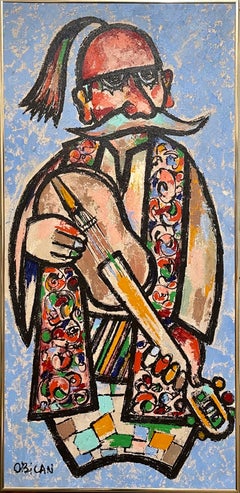
Genre: Other Subject: People Medium: Oil Surface: Canvas Dimensions: 35" x 16.5 Dimensions w/Frame: 35.5" x 17.25 This depicts a Jazz or Klezmer musician. This one is a banjo or guitar player. The last photo shows it in a group of three that I have available. This listing is for the one painting. The artist Jovan Obican iconic style is child-like yet masterfully adult; a style that tells a story with sociological overtones. His funny little people are always colorful, full of spirit, living with music and birds to bring them happiness. JOVAN OBICAN Cannes, France, b. 1918, d. 1986 Jovan Obican (1918-1986) artist, painter, sculpture and mosaic ceramic artisan was born in Cannes, France, to his Yugoslavian parents. From childhood on, Jovan practically devoted himself to art, scratching designs into the dirt when paper was unavailable. He trained with many recognized teachers and with many styles. He finished his training, imbued with the spirit of his native country, the people, their legends, and their philosophy. It has been said that his work has a "timeless quality" and a naive, folk art, outsider art brut quality, child-like primitive style. Obican is identified with his style the world over, a style that is simple yet sophisticated; child-like yet masterfully adult; a style that tells a story with psychological, philosophical or sociological overtones. His funny little people are always colorful, full of spirit, living with music and birds to bring them happiness. Best known for his depictions of folklore and traditional costumes rendered in a playful, childlike style and for his happy Jewish wedding scenes. He often used bright colors and black outlines in his renderings of figures and animals, giving his work an illustration-like quality. Thematically, the artist’s work is similar to Marc Chagall and Jean Dubuffet for its dreamlike images and so-called naïve style of painting. Over the course of his career, the artist maintained a studio in Boca Raton, Florida and Dubrovnik, Croatia—part of former Yugoslavia— where he developed an interest in Eastern Europe’s Jewish culture. Many of his mature works depict Jewish traditions and ceremonies, including traditional Jewish weddings, the dancing of the Hora, and traditional music. There is a display of his works in his former Dubrovnik studio. His style is a unique conglomerate of tradition, history, legends, heroes, old customs and folklore. It is a self-standing style, recognizable, cheerful, whimsical and a happy creation. Naïve art is any form of visual art that is created by a person who lacks the formal education and training that a professional artist undergoes (in anatomy, art history, technique, perspective, ways of seeing). Unlike folk art, naïve art does not necessarily evince a distinct cultural context or tradition. Naïve art is recognized, and often imitated, for its childlike simplicity and frankness. Paintings of this kind typically have a flat rendering style with a rudimentary expression of perspective. One particularly influential painter of "naïve art" was Henri Rousseau (1844–1910), a French Post-Impressionist who was discovered by Pablo Picasso. Naïve art is often seen as outsider art that is by someone without formal (or little) training or degree. While this was true before the twentieth century, there are now academies for naïve art. Naïve art is now a fully recognized art genre, represented in art galleries worldwide. Museums devoted to naïve art now exist in Kecskemét, Hungary; Riga, Latvia; Jaen, Spain; Rio de Janeiro, Brasil; Vicq France and Paris. "Primitive art" is another term often applied to art by those without formal training, but is historically more often applied to work from certain cultures that have been judged socially or technologically "primitive" by Western academia, such as Native American, sub saharan African or Pacific Island art (see Tribal art). This is distinguished from the self-conscious, "primitive" inspired movement primitivism. Another term related to (but not completely synonymous with) naïve art is folk art. There also exist the terms "naïvism" and "primitivism" which are usually applied to professional painters working in the style of naïve art (like Paul Gauguin, Mikhail Larionov, Paul Klee). At all events, naive art can be regarded as having occupied an "official" position in the annals of twentieth-century art since - at the very latest - the publication of the Der Blaue Reiter, an almanac in 1912. Wassily Kandinsky and Franz Marc, who brought out the almanac, presented 6 reproductions of paintings by le Douanier' Rousseau (Henri Rousseau), comparing them with other pictorial examples. However, most experts agree that the year that naive art was "discovered" was 1885, when the painter Paul Signac became aware of the talents of Henri Rousseau and set about organizing exhibitions of his work in a number of prestigious galleries. The Earth Group (Grupa Zemlja) were Croatian artists, architects and intellectuals active in Zagreb from 1929 to 1935. The group included the painters Krsto Hegedušić, Edo Kovačević, Omer Mujadžić, Kamilo Ružička, Ivan Tabaković, and Oton Postružnik, the sculptors Antun Augustinčić, Frano Kršinić, and the architect Drago Ibler. A term applied to Yugoslav (Croatian) naive painters working in or around the village of Hlebine, near the Hungarian border, from about 1930. Some of the best known naive artists are Dragan Gaži, Ivan Generalić, Josip Generalić, Krsto Hegedušić, Mijo Kovačić, Ivan Lacković-Croata, Franjo Mraz, Ivan Večenaj and Mirko Virius. Camille Bombois (1883–1970) Ferdinand Cheval, known as 'le facteur Cheval' (1836–1924) Henry Darger (1892–1973) L. S. Lowry (1887–1976) Grandma Moses, Anna Mary Robertson...
Category

20th Century Folk Art Figurative Paintings

Materials

Canvas, Oil

Large Naive European Folk Art Oil Painting Jovan Obican Klezmer Jazz Musician
By Jovan Obican
Located in Surfside, FL
Genre: Other Subject: People Medium: Oil Surface: Canvas Dimensions: 35" x 16.5 Dimensions w/Frame: 35.5" x 17.25 This depicts a Jazz or Klezmer musician. This one is a saxophone or trumpet horn player. The last photo shows it in a group of three that I have available. This listing is for the one painting. The artist Jovan Obican iconic style is child-like yet masterfully adult; a style that tells a story with sociological overtones. His funny little people are always colorful, full of spirit, living with music and birds to bring them happiness. JOVAN OBICAN Cannes, France, b. 1918, d. 1986 Jovan Obican (1918-1986) artist, painter, sculpture and mosaic ceramic artisan was born in Cannes, France, to his Yugoslavian parents. From childhood on, Jovan practically devoted himself to art, scratching designs into the dirt when paper was unavailable. He trained with many recognized teachers and with many styles. He finished his training, imbued with the spirit of his native country, the people, their legends, and their philosophy. It has been said that his work has a "timeless quality" and a naive, folk art, outsider art brut quality, child-like primitive style. Obican is identified with his style the world over, a style that is simple yet sophisticated; child-like yet masterfully adult; a style that tells a story with psychological, philosophical or sociological overtones. His funny little people are always colorful, full of spirit, living with music and birds to bring them happiness. Best known for his depictions of folklore and traditional costumes rendered in a playful, childlike style and for his happy Jewish wedding scenes. He often used bright colors and black outlines in his renderings of figures and animals, giving his work an illustration-like quality. Thematically, the artist’s work is similar to Marc Chagall and Jean Dubuffet for its dreamlike images and so-called naïve style of painting. Over the course of his career, the artist maintained a studio in Boca Raton, Florida and Dubrovnik, Croatia—part of former Yugoslavia— where he developed an interest in Eastern Europe’s Jewish culture. Many of his mature works depict Jewish traditions and ceremonies, including traditional Jewish weddings, the dancing of the Hora, and traditional music. There is a display of his works in his former Dubrovnik studio. His style is a unique conglomerate of tradition, history, legends, heroes, old customs and folklore. It is a self-standing style, recognizable, cheerful, whimsical and a happy creation. Naïve art is any form of visual art that is created by a person who lacks the formal education and training that a professional artist undergoes (in anatomy, art history, technique, perspective, ways of seeing). Unlike folk art, naïve art does not necessarily evince a distinct cultural context or tradition. Naïve art is recognized, and often imitated, for its childlike simplicity and frankness. Paintings of this kind typically have a flat rendering style with a rudimentary expression of perspective. One particularly influential painter of "naïve art" was Henri Rousseau (1844–1910), a French Post-Impressionist who was discovered by Pablo Picasso. Naïve art is often seen as outsider art that is by someone without formal (or little) training or degree. While this was true before the twentieth century, there are now academies for naïve art. Naïve art is now a fully recognized art genre, represented in art galleries worldwide. Museums devoted to naïve art now exist in Kecskemét, Hungary; Riga, Latvia; Jaen, Spain; Rio de Janeiro, Brasil; Vicq France and Paris. "Primitive art" is another term often applied to art by those without formal training, but is historically more often applied to work from certain cultures that have been judged socially or technologically "primitive" by Western academia, such as Native American, sub saharan African or Pacific Island art (see Tribal art). This is distinguished from the self-conscious, "primitive" inspired movement primitivism. Another term related to (but not completely synonymous with) naïve art is folk art. There also exist the terms "naïvism" and "primitivism" which are usually applied to professional painters working in the style of naïve art (like Paul Gauguin, Mikhail Larionov, Paul Klee). At all events, naive art can be regarded as having occupied an "official" position in the annals of twentieth-century art since - at the very latest - the publication of the Der Blaue Reiter, an almanac in 1912. Wassily Kandinsky and Franz Marc, who brought out the almanac, presented 6 reproductions of paintings by le Douanier' Rousseau (Henri Rousseau), comparing them with other pictorial examples. However, most experts agree that the year that naive art was "discovered" was 1885, when the painter Paul Signac became aware of the talents of Henri Rousseau and set about organizing exhibitions of his work in a number of prestigious galleries. The Earth Group (Grupa Zemlja) were Croatian artists, architects and intellectuals active in Zagreb from 1929 to 1935. The group included the painters Krsto Hegedušić, Edo Kovačević, Omer Mujadžić, Kamilo Ružička, Ivan Tabaković, and Oton Postružnik, the sculptors Antun Augustinčić, Frano Kršinić, and the architect Drago Ibler. A term applied to Yugoslav (Croatian) naive painters working in or around the village of Hlebine, near the Hungarian border, from about 1930. Some of the best known naive artists are Dragan Gaži, Ivan Generalić, Josip Generalić, Krsto Hegedušić, Mijo Kovačić, Ivan Lacković-Croata, Franjo Mraz, Ivan Večenaj and Mirko Virius. Camille Bombois (1883–1970) Ferdinand Cheval, known as 'le facteur Cheval' (1836–1924) Henry Darger (1892–1973) L. S. Lowry (1887–1976) Grandma Moses, Anna Mary Robertson...
Category

20th Century Folk Art Figurative Paintings

Materials

Canvas, Oil

Jules Perahim Surrealism Oil Painting on Paper Romanian French Surrealist Figure
Located in Surfside, FL
Jules Perahim (Born: 1914; Bucharest, Romania - Died: 2008; Paris, France) Oil painting on paper depicting a figure with abstract multicolor design. (this might be gouache on paper) ...
Category

1960s Surrealist Figurative Paintings

Materials

Paper, Oil

Large Pointillism Oil Painting Flower Seller and Cart Henry Benson Americana Art
By Henry Benson
Located in Surfside, FL
Flower Seller Textured Oil on Canvas Hand signed lower right Image: H 30 x W 40 inches Beautiful muted pastel tone colors This depicts a boy and girl playing in the sand with a buck...
Category

20th Century Post-Impressionist Figurative Paintings

Materials

Canvas, Oil

Pre War European Hasidic Rabbi Kiddush Levana (Moon) German Judaica Oil Painting
Located in Surfside, FL
Kiddush Levanah oil painting Hand signed A. Gruenstein. It is not dated or titled. Pre War European Chasidic Rabbis Kiddush Levana (Blessing on seeing the new moon) German Judaica ...
Category

20th Century Expressionist Figurative Paintings

Materials

Canvas, Oil

Oil Painting Italian Cityscape Rome Architecture Tonino Antonio Caputo
Located in Surfside, FL
Antonio Caputo (Italian, 1933-2021) Architectural oil paintings on canvas boards titled Ciney. The composition captures a distinct stark Italian cityscape, blending classical and ind...
Category

20th Century Post-Modern Landscape Paintings

Materials

Canvas, Oil

Oil Painting Italian Cityscape Rome Architecture Tonino Antonio Caputo
Located in Surfside, FL
Antonio Caputo (Italian, 1933-2021) Architectural oil paintings on canvas boards titled Fornace. The composition captures a distinct stark Italian cityscape, blending classical and i...
Category

20th Century Post-Modern Landscape Paintings

Materials

Canvas, Oil

Oil Painting Italian Cityscape Rome Architecture Tonino Antonio Caputo
Located in Surfside, FL
Antonio Caputo (Italian, 1933-2021) Architectural oil paintings on canvas boards titled Testaccio. The composition captures a distinct stark Italian cityscape, blending classical a...
Category

20th Century Post-Modern Landscape Paintings

Materials

Canvas, Oil

Large Israeli Colorful Metal Wall Sculpture Painting Circus Scene Calman Shemi
By Calman Shemi
Located in Surfside, FL
Calman Shemi (1939-) Laser cut metal wall sculpture 3D Titled "Circus" Signed on the front lower left edge, and signed, numbered, and titled verso. Marked, Jerusalem Limited edition,...
Category

1990s Contemporary Figurative Sculptures

Materials

Metal

Cuban Artist Pastel Drawing African American Emilio Cruz Bonnie Clyde Painting
Located in Surfside, FL
Emilio Cruz (1938-2004) Bonnie and Clyde Pastel on paper Hand signed lower right Dimensions Framed H 15-7/8" W 18-1/2", Sight H 13-1/2" W 16-1/8" Emilio Antonio Cruz (1938 – 2004) was a Cuban American artist who lived most of his life in New York City. His work is held in several major museums in the United States. Emilio Antonio Cruz was an American Artist of Cuban descent. He was born in the Bronx on March 15, 1938. He studied at the Art Students League of New York with Edwin Dickinson, George Grosz and Frank J. Reilly and at The New School in New York City, and finally at the Seong Moy School of Painting and Graphic Arts in Provincetown, Massachusetts. As a young artist in the 1960s, Cruz was connected with other artists who were applying abstract expressionism concepts to figurative art such as Lester Johnson, Red Grooms, Mimi Gross, Bob Thompson and Jan Muller. He combined human and animal figures with imagery from archaeology and natural history to create disturbing, dreamlike paintings. Cruz received a John Hay Whitney Fellowship and awards from the Joan Mitchell Foundation and from the National Endowment for the Arts. In the late 1968, Emilio and wife Patricia Cruz moved to St. Louis to work with Julius Hemphill and the Black Artists Group. He served as director for the visual arts program, which also included painters Oliver Jackson and Manuel Hughes. In addition to artistic contributions, the couple participated in city-wide civil rights protests and rent strikes. Cruz moved to Chicago and taught at the School of the Art Institute of Chicago during the 1970s, where he exhibited widely and was represented by the Walter Kelly Gallery. He wrote two plays, Homeostasis: Once More the Scorpion and The Absence Held Fast to Its Presence. These were first performed at the Open Eye Theater in New York in 1981, and later were included in the World Theater Festival in Nancy and Paris, France, and in Italy. In 1982 he returned to New York where he began to exhibit again. In the late 1980s he resumed teaching at the Pratt Institute and at New York University. Harry Rand, Curator of 20th Century Painting and Sculpture at the Smithsonian American Art Museum, described Emilio Cruz as one of the important pioneers of American Modernism of the 1960s for his fusion of Abstract Expressionist art with figuration. Geno Rodriguez, Curator and Executive Director of The Alternative Museum, wrote in 1985, "Emilio Cruz, is a brilliant and impassioned artist whose current paintings are monumental, imbued with intelligence, fury and an apt sense of irony. They reflect the turbulent world within which we live." Geoffrey Jacques wrote in 1990, "Emilio Cruz paints humanity’s essence. Mythology and archeology are the foremost concerns of the painter Emilio Cruz. Dinosaurs, skeletal humans and fossil-like images are used in his work as metaphoric signposts in a consideration of the basic questions of existence." Art historian and curator Paul Staiti wrote in 1997, "Emilio Cruz's Homo sapiens series is a strange and haunting genealogy of the modern soul... What is at stake here more than biopolitical culture, is the remystification of the body and mapping of consciousness ... For all the trauma, explicit and implicit, Cruz's style is masterful, classical, even beautiful." Exhibitions Cruz held his first solo exhibition at the Zabriskie Gallery in New York in 1963. Afterwards his work was included in many group and solo exhibitions, including the Anita Shapolsky Gallery in 1986 and 1991, museum exhibitions at the Studio Museum in Harlem in 1987, the Pennsylvania Academy of the Fine Arts in 1997. In 1994, Cruz's work was shown as part of the American contingent at the IV Bienal Internacional de Pintura en Cuenca, Ecuador. Other American artists exhibiting at this show were Donald Locke, Philemona Williamson, Whitfield Lovell...
Category

20th Century Neo-Expressionist Figurative Drawings and Watercolors

Materials

Paper, Oil Pastel

Large John Hultberg SF Bay Area Artist Abstract Expressionist Oil Painting
By John Hultberg
Located in Surfside, FL
John Hultberg Oil on canvas Panorama of pictures. 1998 Hand signed lower right, J. Hultberg ‘98. Artist, date, and title written on verso. Canvas 25.5”H x 35”W, Frame 26”H x 35.5”...
Category

1990s Abstract Expressionist Abstract Paintings

Materials

Canvas, Oil

Rare Jewish Yemenite Woman Oil Painting Israeli Girl Judaica Itamar Siani
By Itamar Siani
Located in Surfside, FL
Itamar Siani, Yemenite Israeli (Born 1941) Oil on Canvas "Portrait of a Seated Woman" Hand signed lower left Dimensions: 26.25" x 17.75". Frame measures 38.25" x 30" Itamar Sian...
Category

1970s Neo-Expressionist Figurative Paintings

Materials

Canvas, Oil

Large Modern Dutch Expressionist Oil Painting Vibrant Cafe Scene Jan Rylaarsdam
Located in Surfside, FL
Jan Rijlaarsdam, Dutch 1911 - 2007 Hand signed lower right Sight size: 23.5"h x 31.5"w Overall: 33"h x 40.25"w Jan Reylaarsdam was a Dutch Postwar & Contemporary painter who was born in Holland in 1911. He is known for Architectural Townscape, factory, industrial site and figure painting. A student of Albertus Gerhard Hulshoff Pol (1883-1957), a well-known painter and art teacher. The painter and draftsman was born in Nieuwkoop, but moved with his parents to Hilversum in 1924, where they opened a dairy. Jan delivered orders by bicycle and, during his travels, stumbled upon Dekker, a frame shop, where he met local painters and their work. There, he learned the framer's trade and, in his spare time, drew buildings and industrial complexes in Amsterdam. A painter of towns, figures, factories and industrial sites at the border of the cities and Parisian cafe scenes. Rijlaarsdam received a Royal allowance. He painted in a figurative expressionist style. Influenced by George Hendrik Breitner, a leading figure of Amsterdam Impressionism, as well as Willem Witsen, Eduard Karsen and Willem de Zwart. He was among the group of painters who depicted daily life in Amsterdam. In 1928, he cycled to Bruges and Antwerp, Belgium to further develop his drawing skills. He returned there regularly. He gradually gained recognition, and in 1932, he received a Royal Grant, which allowed him to pay for lessons. He joined various painting associations in Hilversum, Amsterdam (Sint Lucas), and the Gooi region. His work has a distinctive style. It wasn't until the 1950s that he finally visited Paris, France. An informal member of the "École de Paris" School of Paris. This became his favorite destination; the vibrant Parisian city life drew him in. Later, Rijlaarsdam also spent a lot of time in Spain, especially Barcelona where he was exposed to the works of Pablo Picasso and Salvador Dali. Jan Rijlaarsdam left behind an impressive and highly versatile oeuvre, encompassing styles, materials, and techniques. Ranging from realistic to impressionist and expressionism, with even forays into abstraction and abstract expressionism. Rijlaarsdam consistently managed to surprise. Jan Rijlaarsdam's favorite subjects were gathering homeless people and prostitutes in cafés. In the tradition of Isaac Israëls and Henri de Toulouse-Lautrec, he was a true interpreter of city life. He was a member of St. Lucas, an art society in Amsterdam, The Gooise Art Society and the Society of Figurative Art in Hilversum (Vereniging van Beeldende Kunst). Works by Rijlaarsdam are in possession of the Singer Museum in Laren. The artist died February 16, 2007 in Baarn, Netherlands. He showed and has been exhibited with Jan Knikker, Jean Lucebert, Henk Bos, Aris Knikker, Gustavo Novoa, Juan Bayon Salado, Marie Henrie MacKenzie, David Schulman, Michel Henry, Dirk Herman Willem Filarski, Karel Appel, Willem Van Den Berg, Jan Wittenberg, Freek Van Den Berg, Cornelis Noltee, Arnout Colnot, Matthieu Wiegman, Harm Henrick Kamerlingh Onnes, Jan Sierhuis...
Category

Mid-20th Century Expressionist Interior Paintings

Materials

Canvas, Oil